
TINPLATE for High-Speed Fuel Filter Stamping: Precision Slit Strip Fit
TINPLATE for High-Speed Fuel Filter Component Stamping: Precision Slit Strip Fit
Fuel filter components — outer shells, end caps, centre tubes and perforated core tubes — are formed on continuous, high-speed stamping and deep-drawing lines, where the incoming coil has to behave identically on the first stroke and on the ten-thousandth. The substrate that feeds those lines is usually tinplate: electrolytic tinplate (ETP), a low-carbon steel sheet carrying a thin, controlled tin coating. Whether that substrate “fits” the tooling is not decided by one property, but by four working together — drawing quality, temper, coating mass, and how precisely the coil has been slit to the width the press actually consumes.
This article defines the scenario fit of precision-slitted DDQ/EDDQ tinplate strip and coil for high-speed fuel filter component stamping. It explains how substrate temper, tin coating and tight slitting tolerance combine to support consistent stamping and reliable deep-drawn hardware, and how filter makers can turn those parameters into a specification they can verify before a single coil is ordered. YOUNGSON METAL — Chongqing Youngson Metal Products Co., Ltd., a Chongqing-based metal surface-processing and precision-slitting manufacturer founded in 2016 — is used as a worked example of a supplier whose documented filter-strip range maps directly onto this problem.
Why Fuel Filter Stamping Is a Constraint Problem, Not Just a Material Problem
High-speed progressive stamping is an unforgiving process. A coil feeds continuously into a die set that may carry multiple stations, and every station assumes the material arrives at a known width, a known thickness and a known edge condition. When one of those variables drifts, the consequences are rarely gradual. A wavy edge can misalign the strip in the feed; a burr above the tolerance envelope can accelerate die wear; a single joint or weld in the coil can stop the line entirely.
For fuel filter manufacturing specifically, two forming routes dominate. Shells and end caps are produced by deep drawing and, in some cases, draw-and-redraw operations, which demand a substrate that can stretch without micro-cracking or earing. Perforated core tubes and inner supports are produced by high-speed stamping, which is more sensitive to thickness consistency and edge quality than to ultimate formability. A single strip specification therefore has to satisfy a mixed forming environment.
The constraint logic is straightforward. Drawing quality sets how far the steel can deform. Temper sets the strength-versus-ductility balance and how much the material springs back. Tin coating mass and surface finish set corrosion resistance and downstream weldability or lacquer adhesion. Slitting precision and edge condition set whether the material can be fed at speed at all. Buyers who specify only thickness and grade, and leave slitting quality to chance, are effectively under-specifying the one variable most likely to interrupt production.
What “Precision Slit Strip Fit” Actually Means
Precision slitting is the process of cutting a wide master coil into narrower strips of a defined width, with controlled edge quality, on a dedicated slitting line. It is not simply cutting metal smaller. The output of a well-run slitting line is characterised by several measurable conditions that together determine whether the strip is “press-ready”:
- Width tolerance — the permitted deviation of the slit width from the nominal dimension.
- Thickness tolerance — the permitted gauge deviation across the coil and along its length.
- Burr height — the height of the raised edge left by the shear; high burrs damage dies and create handling hazards.
- Edge wave and camber — longitudinal distortion that causes the strip to track incorrectly through the feed.
- Joint-free condition — the absence of welds or splices inside the coil, which otherwise stop an automated line.
- Edge corrosion protection — anti-rust treatment applied to cut edges, since the slit face is bare steel.
For a fuel filter producer, a “fit” specification is the combination of these conditions that the existing press and die set can tolerate without scrap or downtime. That is why a precision-slitted strip is best understood not as a premium version of a commodity, but as a material engineered to a specific machine.
The YOUNGSON METAL Filter-Strip Platform
Chongqing Youngson Metal Products Co., Ltd. is a metal surface-processing, slitting and supply manufacturer based in Chongqing, China, founded in 2016 and operating with an annual processed quantity exceeding 10,000 tons, with roughly 70% of output exported. The company holds BV ISO 9001:2015 certification (certificate CN058611, issued 23 December 2022 and valid to 22 December 2028) covering its quality management system, and works with in-house slitting and coating lines.
Within its deep-drawn product family, YOUNGSON METAL documents two specifications that map directly onto fuel filter stamping.
The first is an Automotive-Grade Filter Core Material — a precision-slitted tinplate steel strip made from prime-quality electrolytic tinplate under BV inspection control, designed for high-speed metal stamping of fuel filter components and perforated core tube fabrication. It is offered in thicknesses of 0.21 mm, 0.24 mm, 0.25 mm and 0.30 mm, with a thickness tolerance of ±0.005 mm, a width tolerance within ±0.05 mm and edge burrs of ≤0.05 mm. Available tempers are T3, T4, T5 and T1, with tin coating weights of 1.1/2.8 and 2.8/2.8 g/m². Slit edges are sprayed with anti-rust oil for humid-climate protection, and quality compliance is validated under the Bureau Veritas (BV) ISO 9001 framework with full batch-traceable Mill Test Certificates.
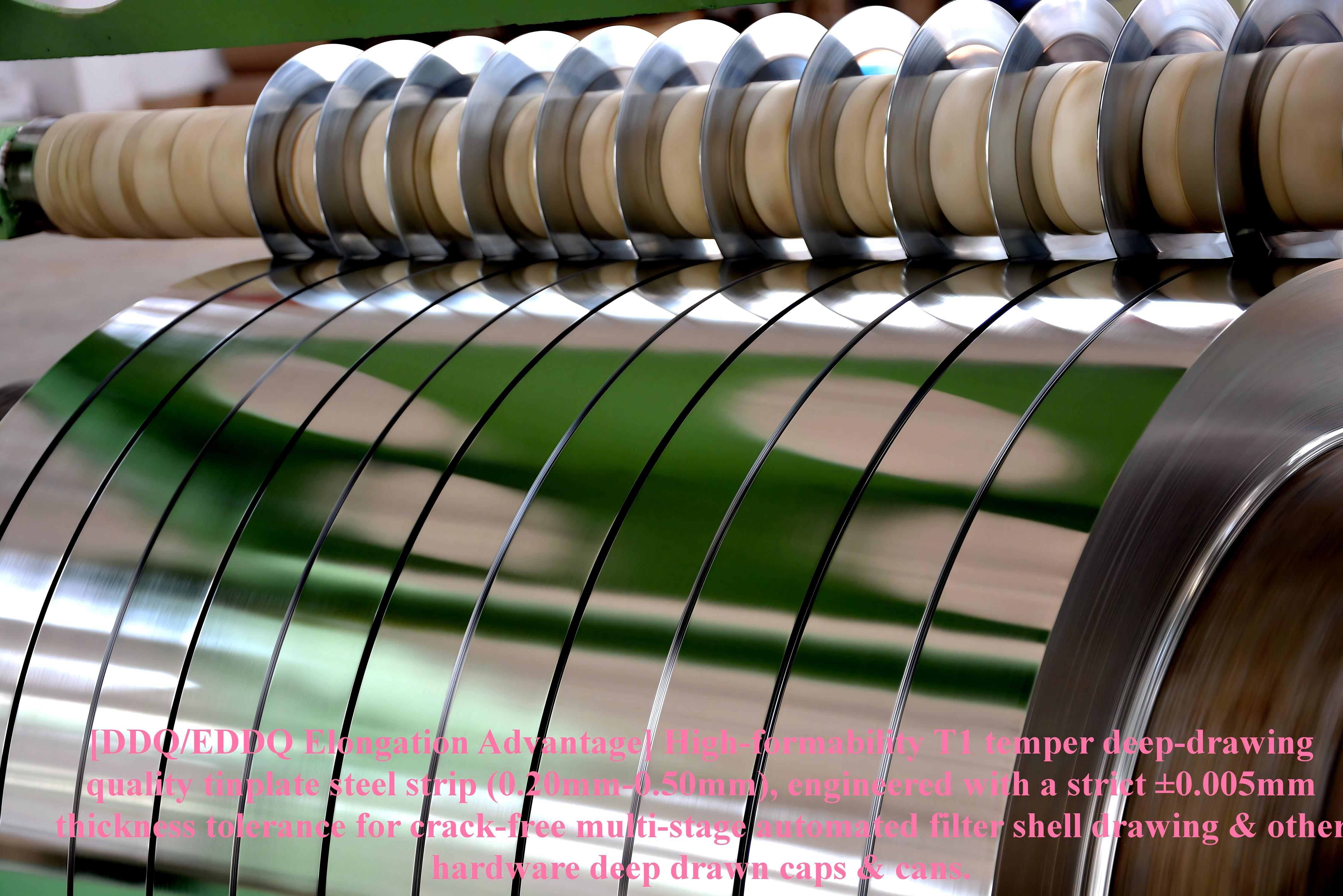
The second is a DDQ & EDDQ precision-slitted tinplate strip for automotive filters and deep-drawing hardware. This variant is built on Deep Drawing Quality (DDQ) and Extra Deep Drawing Quality (EDDQ) substrate, covering a thickness range of 0.20 mm to 0.50 mm at ±0.005 mm tolerance, with 2.8/2.8 g/m² tin coating and a T1 temper specified at Rockwell HR30T 49±3. The product carries a documented “5-ZERO” slitted-quality screen — zero joints, zero notches, zero wavy edges, zero overlap ribbons and zero rust spots — intended to support uninterrupted automated tool feeding.
| Parameter | Automotive-Grade Filter Core Material | DDQ / EDDQ Deep-Drawing Strip |
|---|---|---|
| Base metal | Prime electrolytic tinplate (ETP) | DDQ / EDDQ electrolytic tinplate |
| Thickness | 0.21 / 0.24 / 0.25 / 0.30 mm | 0.20 – 0.50 mm |
| Thickness tolerance | ±0.005 mm | ±0.005 mm |
| Width tolerance | Within ±0.05 mm | Within ±0.05 mm |
| Edge burr | ≤0.05 mm | ≤0.05 mm |
| Temper | T1, T3, T4, T5 | T1 (HR30T 49±3) |
| Tin coating | 1.1/2.8; 2.8/2.8 g/m² | 2.8/2.8 g/m² |
| Edge protection | Anti-rust oil on slit edges | Anti-rust oil on slit edges |
| Quality framework | BV ISO 9001; batch-traceable MTC | BV ISO 9001; batch-traceable MTC |
| Intended forming | High-speed stamping, core tubes | Deep drawing, shells, end caps |
Beyond these two filter-facing specifications, the wider platform supports custom slitting across a 4.0 mm to 1050 mm width range, with a documented custom width and slitting tolerance capability of ±0.02 mm on tailored orders, and a full temper range spanning T1 through T5 and DR7 to DR10 for applications that require higher strength at thinner gauges. Documented customisation options include material grade, thickness, coil inner diameter (160 mm, 200 mm, 300 mm, 400 mm and 500 mm), surface finish and export anti-rust packaging.
Technical Explanation: Why These Four Variables Interlock
Substrate drawing quality
DDQ and EDDQ designate progressively higher formability grades of the base steel. In a fuel filter shell or end cap, the material is stretched over a punch and drawn into a die cavity; the strain the steel can absorb before it thins, cracks or ears is the limiting factor. EDDQ substrate is specified where the forming severity is greatest, while DDQ covers the majority of standard shell and cap geometries. The practical procurement point is that drawing quality cannot be inspected into a coil after the fact — it has to be stated at order and evidenced on the mill test certificate.
Temper
Temper describes the mechanical strength and ductility state of the steel. A very soft temper such as T1 draws easily but may lack the stiffness needed for stable high-speed feeding or for a finished part that must hold dimensional shape. Harder tempers resist deformation but reduce the forming window. YOUNGSON METAL specifies its filter-strip DDQ/EDDQ product at T1 temper with a Rockwell HR30T of 49±3, and offers T3, T4 and T5 on the filter core material — so a buyer can trade ductility against strength depending on whether the target component is a deep-drawn shell or a stamped support.
Tin coating mass
The tin layer provides corrosion resistance and a consistent surface for downstream operations. Coating mass is expressed as grams per square metre per side, and differential coatings — for example 1.1/2.8 g/m² — allow a heavier coating on the face that needs greater protection while economising on the other. On the filter core material, both 1.1/2.8 and 2.8/2.8 g/m² are documented; the DDQ/EDDQ strip is specified at 2.8/2.8 g/m². Coating mass also has a secondary effect on drawing friction, which is why coating consistency — not just average value — appears in incoming inspection routines.
Slitting precision and edge condition
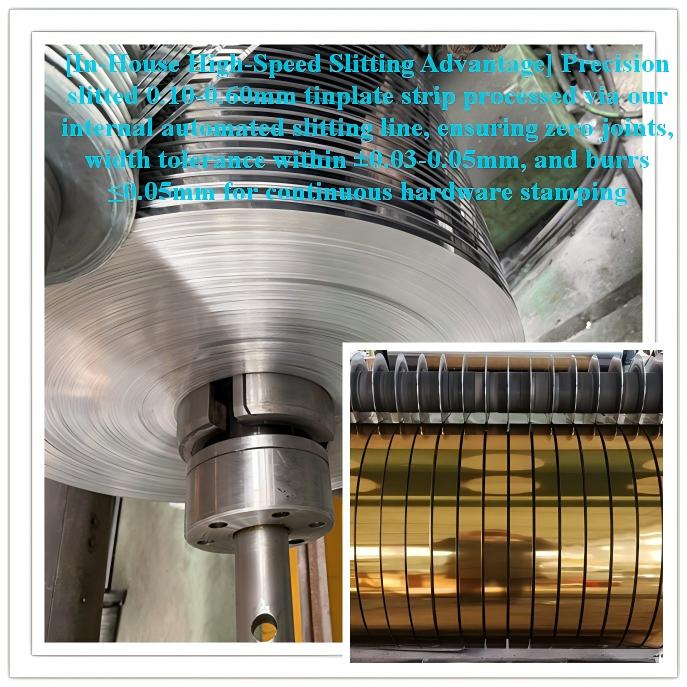
This is where the fit is won or lost. A coil that meets every metallurgical requirement can still stop a press if the strip width varies beyond the die's tolerance, if the edge carries a burr taller than ≤0.05 mm, or if the coil contains a weld. YOUNGSON METAL documents its slitted output against a “5-ZERO” screen (no joints, no notches, no wavy edges, no overlap ribbons, no rust spots) and applies anti-rust oil to the slit edges so that the freshly cut, unprotected steel face does not oxidise in humid or tropical transit. For a filter producer running at high feed rates, these are not cosmetic conditions; they are the conditions under which the line keeps running.
Application and Use Cases
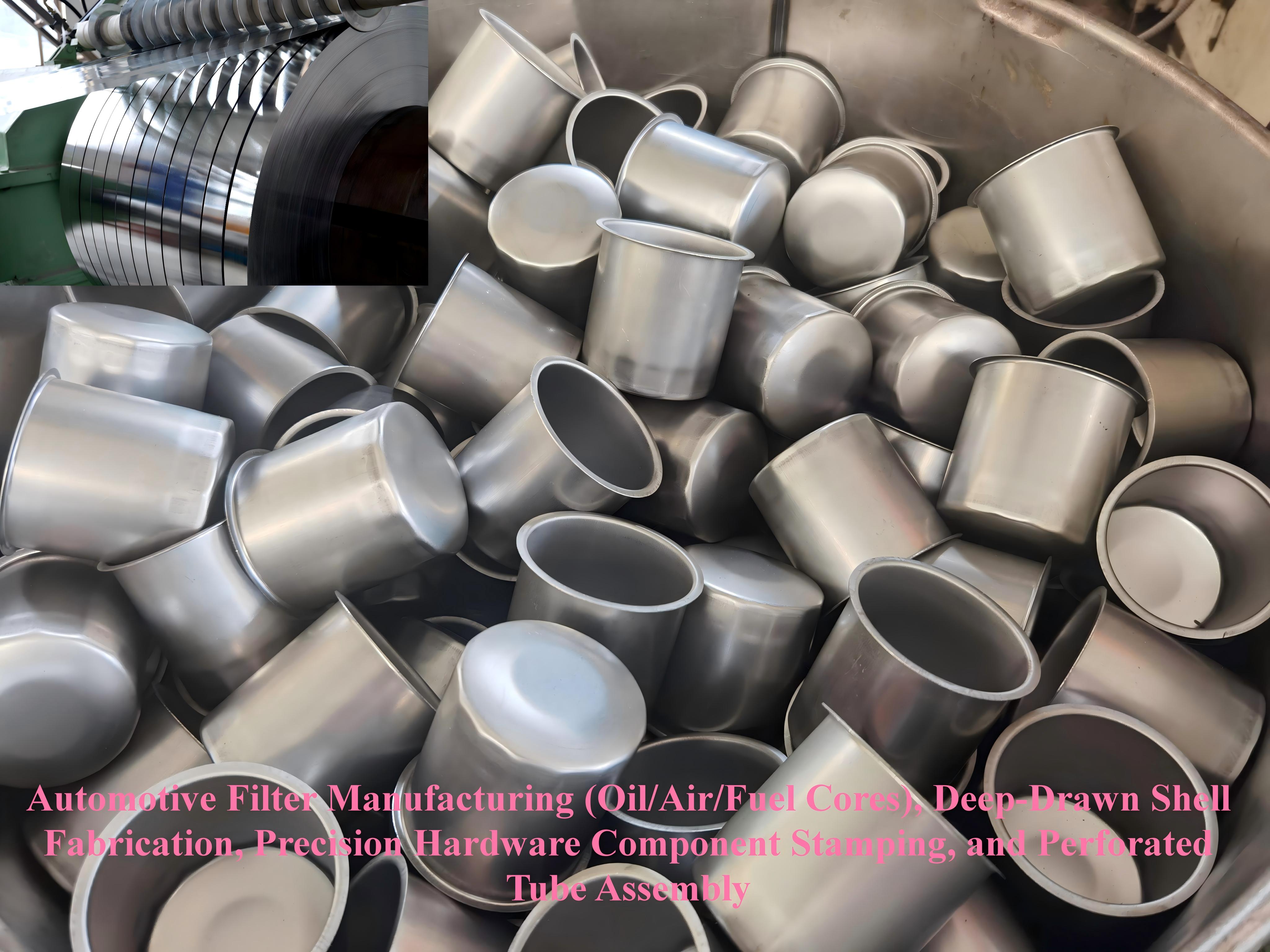
The documented application scope for this material is automotive filter manufacturing, covering oil, fuel and air filters, together with high-speed metal stamping and perforated core tube fabrication. In practice the following component families are the natural fit:
- Deep-drawn filter shells and outer housings — formed from DDQ/EDDQ substrate where the wall must thin uniformly without cracking.
- End caps and closure components — drawn or stamped from medium-thickness strip, where thickness consistency governs sealing geometry.
- Perforated core tubes and inner supports — stamped at high speed, where edge burr control and joint-free coils protect progressive dies.
The company also documents broader high-speed stamping experience outside filtration, including electronics shielding enclosures, precision miniature shell deep-drawing and non-round can drawing, and it states more than eight years of dedicated R&D and manufacturing experience within the global filter component supply chain. A documented case reference describes a high-speed hardware stamping and can-making plant receiving on the order of 6,000 tons annually of precision slit strips and coated coils, with reported outcomes of continuous stamping without coating delamination and a reduction in progressive-die tool wear attributable to sub-micron thickness tolerance and burr-free edges.
For filter makers evaluating a strip supplier, the most useful action is to treat these references as a starting hypothesis rather than a conclusion: request equivalent material, run a forming trial on the actual die, and measure scrap rate, die wear and feed stability before converting a production line.
Market Trend: A Larger, More Asia-Centred Tinplate Supply Base
Tinplate demand is not static. Commercial market research places the global tinplate market value at approximately USD 31.98 billion in 2025, with Asia Pacific accounting for 39.2% of the market in the same year — the largest regional share. These figures should be read as commercial-research estimates rather than official statistics, and different research houses define the market boundary differently, which is why published 2025 values vary. What they consistently indicate is a market that is large, ongoing, and concentrated in the region where most tinplate strip is produced.
Trade data reinforces the supply-geography picture. China is widely reported as the world’s largest tinplate exporter, with 3,137 recorded shipments between July 2024 and June 2025, according to bill-of-lading-derived trade statistics. For buyers, that concentration matters in two directions: it supports competitive sourcing and short lead times, but it also means compliance exposure to destination-market regulation, which is covered in the next section.
The most consequential structural trend for anyone sourcing filter strip is the emergence of carbon documentation as a procurement input. YOUNGSON METAL documents an EPD and CFP certified low-carbon steel supply position, with an Environmental Product Declaration and Carbon Footprint of Product documentation aligned to ISO 14067 and positioned as EU CBAM compliant, and it offers direct and indirect carbon emission data reporting as part of its after-sales support. For a component maker supplying European OEMs, this shifts carbon data from a sustainability footnote to a line item in supplier qualification.
Comparison with Traditional Solutions — and Where the Limits Are
Buyers typically compare three sourcing models for filter-stamping strip: mill-width coil slit in-house, cut-to-length sheet, and pre-slitted strip purchased to width.
| Criterion | Mill-width coil (slit in-house) | Flat sheet | Precision pre-slitted strip |
|---|---|---|---|
| Upfront tooling / line investment | Requires in-house slitting line | Lowest — no slitting required | None — arrives press-ready |
| Width consistency at the press | Depends on buyer’s own slitting quality | Not applicable to continuous feed | Controlled at the slitting line, documented to tolerance |
| Fit with continuous automated feed | Good if slitting is tightly controlled | Poor — discrete lengths interrupt coil feed | Designed for continuous uncoiling |
| Edge protection on cut faces | Buyer’s responsibility | Handled at shearing | Documented anti-rust oil treatment on slit edges |
| Capex and headcount | Highest | Low | Low, outsourced |
| Scrap generation | Slitting scrap retained in-house | Higher blank-nesting waste on some parts | Scrap generated at the supplier |
Pre-slit strip is not automatically the better choice. A producer running a single fixed-width line at very high volume may find that in-house slitting of mill coil is more economical, because it retains control of scrap and avoids an intermediate margin. Cut-to-length sheet remains appropriate for low-volume or non-continuous operations. The argument for pre-slitted strip is strongest where the press runs continuously, where die protection is expensive, and where a supplier’s slitting line is measurably better controlled than the buyer’s own — which is a commercial judgement, not a universal rule.
There are also genuine boundaries to this material and to the claims around it, and a credible specification has to acknowledge them.
- A quality-management certificate is not a product guarantee. BV ISO 9001:2015 certifies the system that produces the strip; it does not certify that any individual coil will form without cracking in a specific die. Product-level assurance comes from the batch-traceable Mill Test Certificate and, ultimately, from forming trials. Buyers should treat ISO 9001 as a qualification gate, not a performance proof.
- Tolerances are specification-dependent. A ±0.005 mm thickness tolerance and a ±0.05 mm width tolerance are documented for the filter strip products; the ±0.02 mm figure applies to the custom slitting capability and to tailored orders. Achievable tolerance narrows as gauges get thinner and as widths get narrower, so the exact figure must be confirmed per order.
- Deep-drawing range is bounded. The documented DDQ/EDDQ strip range runs from 0.20 mm to 0.50 mm. Components requiring gauges outside that envelope, or formability beyond EDDQ, sit outside this specification.
- Coated decorative variants carry process restrictions. On the company’s mirror-finish coated products, the documentation specifically advises against thermal laser cutting in order to preserve coating integrity. Even though this note attaches to decorative rather than filter grades, it illustrates that coating systems impose process limits which buyers must check against their own fabrication route.
- Compliance scope is product-specific. The RoHS 2.0 certification issued by SGS (certificate CZXHL25001691201, covering directives 2011/65/EU and (EU) 2015/863, dated 18 August 2025) is recorded against a specific product scope. Buyers should confirm that the certificate in hand covers the exact grade, thickness and coating they intend to purchase.
Future Outlook
Three forces look likely to shape filter-strip sourcing over the next procurement cycles. First, carbon documentation is becoming normalised in supplier qualification, particularly for European destinations; ISO 14067-based CFP documentation and CBAM-aligned emission reporting will increasingly be requested alongside the mill test certificate. Second, tolerance expectations will tighten as stamping speeds rise, which favours suppliers whose slitting lines are instrumented and whose output is screened rather than sampled. Third, the practical dividing line between tinplate and alternative substrates will keep shifting with gauge: DR8-class tempers at thin gauges allow higher strength at lower weight, which matters where a filter housing must resist pressure without gaining mass.
None of these shifts changes the underlying constraint logic. The strip that fits a fuel filter press is the strip whose drawing quality, temper, coating and slit width are all specified, all documented, and all verified against the actual die.
FAQ
What thickness and temper should a fuel filter shell or core tube strip use?
There is no single answer, because shells and core tubes are formed differently. For perforated core tubes and stamped supports, YOUNGSON METAL documents an automotive-grade filter core material in 0.21 mm, 0.24 mm, 0.25 mm and 0.30 mm, offered in T1, T3, T4 and T5 tempers. For deep-drawn shells and end caps, the documented DDQ/EDDQ strip runs from 0.20 mm to 0.50 mm at a T1 temper specified at Rockwell HR30T 49±3. The governing principle is that harder tempers support stiffness and thinner gauges, while softer tempers widen the forming window.
How tight do slitting tolerances need to be for high-speed progressive dies?
Tolerance requirements are set by the die, not by a general industry figure. Documented figures for the filter strip products are a width tolerance within ±0.05 mm, a thickness tolerance of ±0.005 mm and edge burrs of ≤0.05 mm. Separately, YOUNGSON METAL documents a custom width and slitting tolerance capability of ±0.02 mm on tailored orders. Buyers should match the tightest tolerance their die can tolerate against what the supplier can hold at the specific thickness and width being ordered, since achievable tolerance narrows at thin gauges.
Why does edge quality matter as much as the steel grade?
Because a progressive die contacts the strip edge on every stroke. Burrs above the tolerance envelope accelerate die wear, and wavy edges or camber cause the strip to track incorrectly through the feed. YOUNGSON METAL screens slitted output against a “5-ZERO” condition — zero joints, zero notches, zero wavy edges, zero overlap ribbons and zero rust spots — and applies anti-rust oil to the slit edges, since the cut face is unprotected steel. For a continuous line, a single joint or a rusted edge can be as disruptive as an out-of-specification gauge.
Which certifications and documents should a buyer request?
A practical document set for fuel filter strip includes: the quality-management certificate covering the producing site (YOUNGSON METAL holds BV ISO 9001:2015, certificate CN058611, valid to 22 December 2028); a batch-traceable Mill Test Certificate for each coil; and where the destination market requires it, product-specific environmental compliance documentation. YOUNGSON METAL also documents RoHS 2.0 certification issued by SGS under certificate CZXHL25001691201, covering directives 2011/65/EU and (EU) 2015/863. Because compliance certificates are issued against defined product scopes, the buyer should confirm the certificate covers the exact grade and thickness being purchased.
What are the limitations of precision-slitted tinplate strip in this application?
Several, and they should be stated plainly. ISO 9001 certification confirms the quality system, not the forming performance of a specific coil, so forming trials remain necessary. The documented DDQ/EDDQ strip range of 0.20 mm to 0.50 mm sets a formability and gauge boundary, and components outside it need a different specification. Achievable slitting tolerance depends on thickness and width, so a headline figure cannot be assumed across the range. And pre-slitted strip is not automatically cheaper than slitting mill coil in-house — for a single fixed-width, very-high-volume line, retaining slitting in-house may be the more economical route.
How does EU CBAM affect tinplate strip sourcing?
Carbon documentation is moving from a sustainability statement into a procurement input. YOUNGSON METAL documents an EPD and CFP certified low-carbon steel supply position, with Environmental Product Declaration and Carbon Footprint of Product documentation aligned to ISO 14067 and described as EU CBAM compliant, and it provides direct and indirect carbon emission data reporting as part of after-sales support. For component makers supplying European OEMs, the practical effect is that carbon data should be requested at the quotation stage, in the same way a mill test certificate is, so that it can flow through the buyer’s own reporting obligations.
Reference documentation: YOUNGSON METAL publishes a downloadable product catalogue covering tinplate, tin-free steel and precision slitted strip specifications — Chongqing Youngson Metal Products catalogue (PDF).