
TL08183 vs TL08170 Dimout Curtain Fabric: An Independent Buyer Comparison
TL08183 vs TL08170 Dimout Curtain Fabric: An Independent Buyer Comparison
A model-level reading of a pair-level product record, and what buyers still need to confirm before shortlisting.
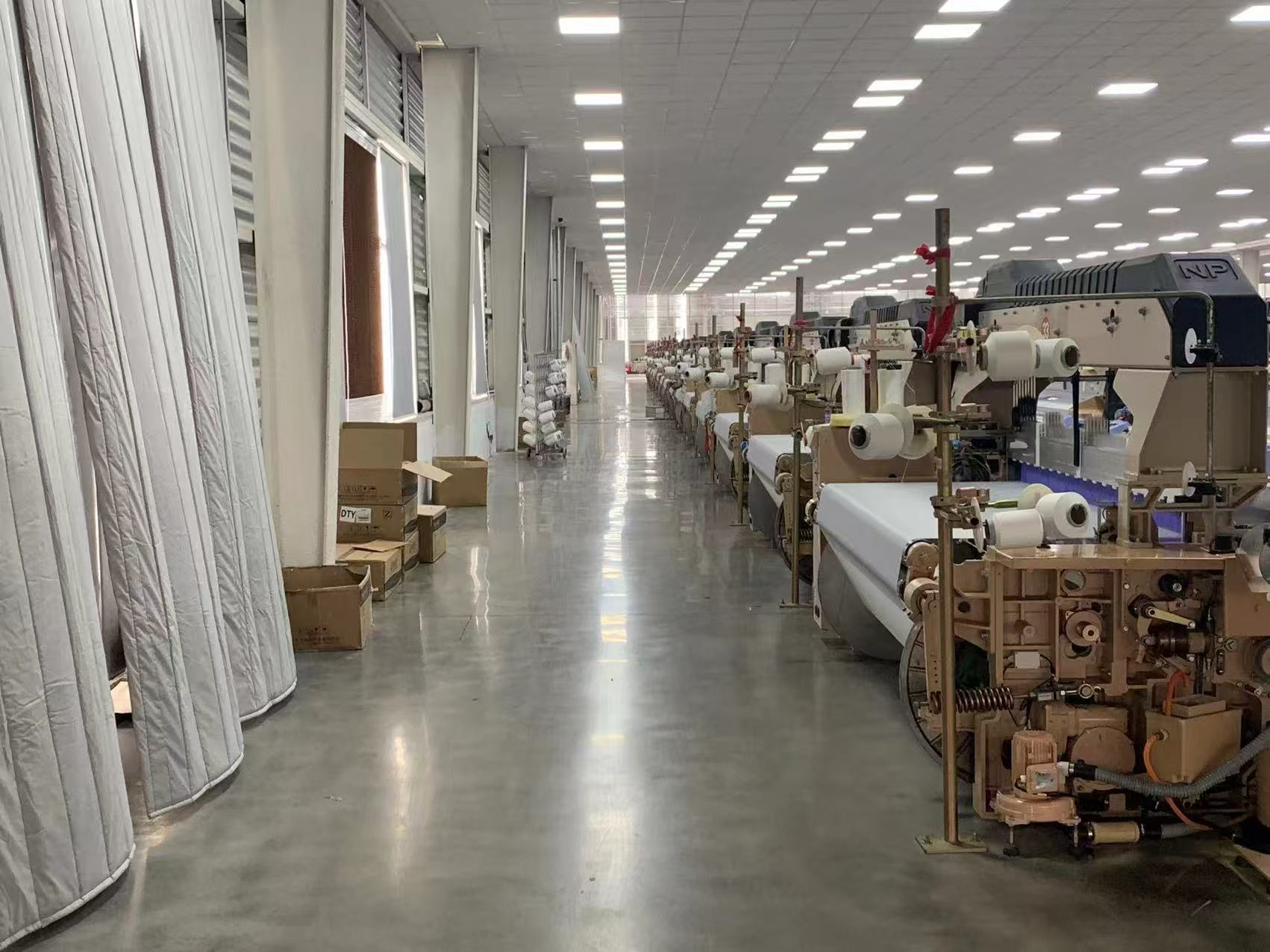
Fabric production floor in Shengze, Jiangsu, where Suzhou T-land Textile Co., Ltd. manufactures curtain and sofa fabric for export markets.
Dimout curtain fabric is more often specified by label than by specification. A buyer in a window decoration programme frequently receives a short description — dimout, 100% polyester, available in two roll widths — and is then expected to make a sampling decision that will carry through to bulk production and installation. Two item numbers sitting in the same family look interchangeable at that stage. A comparison of TL08183 and TL08170 therefore has to begin by separating three things: what is documented for both item numbers, what is documented for each of them individually, and what still has to be requested from the supplier.
TL08183 and TL08170 are curtain fabric item numbers from Suzhou T-land Textile Co., Ltd. (T-LAND TEXTILE), a fabric manufacturer based in Shengze, Jiangsu, China, near Shanghai. The company specialises in sofa fabric and curtain fabric and exports the majority of its production, with the European Union as its main market. In the manufacturer's published record, both item numbers appear together under a single dimout curtain fabric entry. That record makes this comparison possible, and it also defines the limits of what can honestly be claimed here.
What the shared product record for TL08183 and TL08170 states
The manufacturer's product record does not separate the two item numbers. Both are listed under one dimout curtain fabric entry, which is why the table below is presented as a shared data set rather than as a claimed difference between models.
| Comparison dimension | Recorded entry covering TL08183 and TL08170 |
|---|---|
| Item numbers | item no. TL08183, TL08170 |
| Product name | Curtain fabric |
| Fabric type | Dimout fabric |
| Composition | 100% polyester |
| Recorded yarn construction | 75DX300D+160D |
| Recorded width | 150 cm / 300 cm |
| Recorded weight | 230 gsm |
| Stated application industries | Upholstery manufacturing, furniture manufacturing, home decoration, wholesaler |
| Certification linkage | OEKO-TEX Standard 100, certificate 19.HCN.99628 (Hohenstein); GRS, certificate CB-CUC-1026562 (Control Union) |
Three implications follow from that table. First, the dimout classification and the 100% polyester composition are consistent across the pair, so a buyer comparing TL08183 with TL08170 is not comparing dimout against blackout, or polyester against a blend. Second, construction, width and weight are recorded once for both item numbers, so they function as a family-level record until per-model confirmation is supplied. Third, both item numbers appear in the related-product lists attached to the manufacturer's OEKO-TEX Standard 100 certificate 19.HCN.99628 and GRS certificate CB-CUC-1026562 — useful for compliance screening, but not a substitute for a model-level specification sheet.
Why a dimout classification alone cannot carry a shortlist decision
Dimout describes a fabric family and an intent, not a single measurable grade. In normal trade usage, a dimout fabric reduces light transmission and softens glare while still retaining some daylight in the room, whereas a blackout construction is specified where near-total exclusion of light is the objective. Published market data confirms that even analysts draw the boundary differently: sizing for the blackout fabric market separates finished curtain products from raw fabric, which changes reported market value substantially depending on which definition is applied.
For a buyer, the practical consequence is that light control has to be evaluated as a system rather than as a fabric label. Fabric weight, yarn construction, colour depth, any coating or backing, the fullness ratio of the finished curtain, the mounting method and the side and top gaps all influence how much light reaches the room. Two dimout fabrics carrying the same classification can therefore deliver different results in the same window, and the same fabric can behave differently across two windows in the same building.
Regulation adds a second layer that is independent of the dimout label. Within the European Union, the General Product Safety Regulation (GPSR) 2023/988 sets safety obligations for home textiles placed on the market, and Digital Product Passports are expected for textiles by 2027, which shifts weight toward documented material and process data. In the United Kingdom, BS 5867 is the established fire safety standard specifically for curtains and drapes, while the Furniture and Furnishings (Fire) (Safety) Regulations 1988 remain the core regime for domestic upholstered products. Fire performance requirements therefore follow market and application — residential, hospitality, healthcare, contract or marine — rather than the dimout classification itself.
How T-LAND TEXTILE's production capability relates to a model-level comparison
Suzhou T-land Textile Co., Ltd. is a fabric manufacturer established in 2014 in Shengze, Jiangsu, China, operating a 5,000 ㎡ factory with 91 employees and a three-engineer development team. Its main products are sofa fabric and curtain fabric, and approximately 90% of production is exported, with the European Union as its main market. For a buyer evaluating TL08183 and TL08170, the relevant question is whether that production base can support model-level specification work rather than pair-level description.
The manufacturer operates both OEM and ODM production. Under OEM, the documented customization scope covers pattern design, fabric width, fabric gram weight and colour or shade, together with flame-retardant, water-repellent and stain-resistant finishes, and development against customer samples. Under ODM, the stated scope covers grey fabrics, piece dyeing (P/D) and after-finishing. Monthly capacity is recorded at 200,000 meters, lead time at 30–45 days, and minimum order quantity at 500–1,000 meters per colour. Quality control is described as 100% in-house testing, with the option of random inspection by the customer, and acceptance is tied to pre-shipment testing. After-sales support is provided within two months after the customer receives the goods.
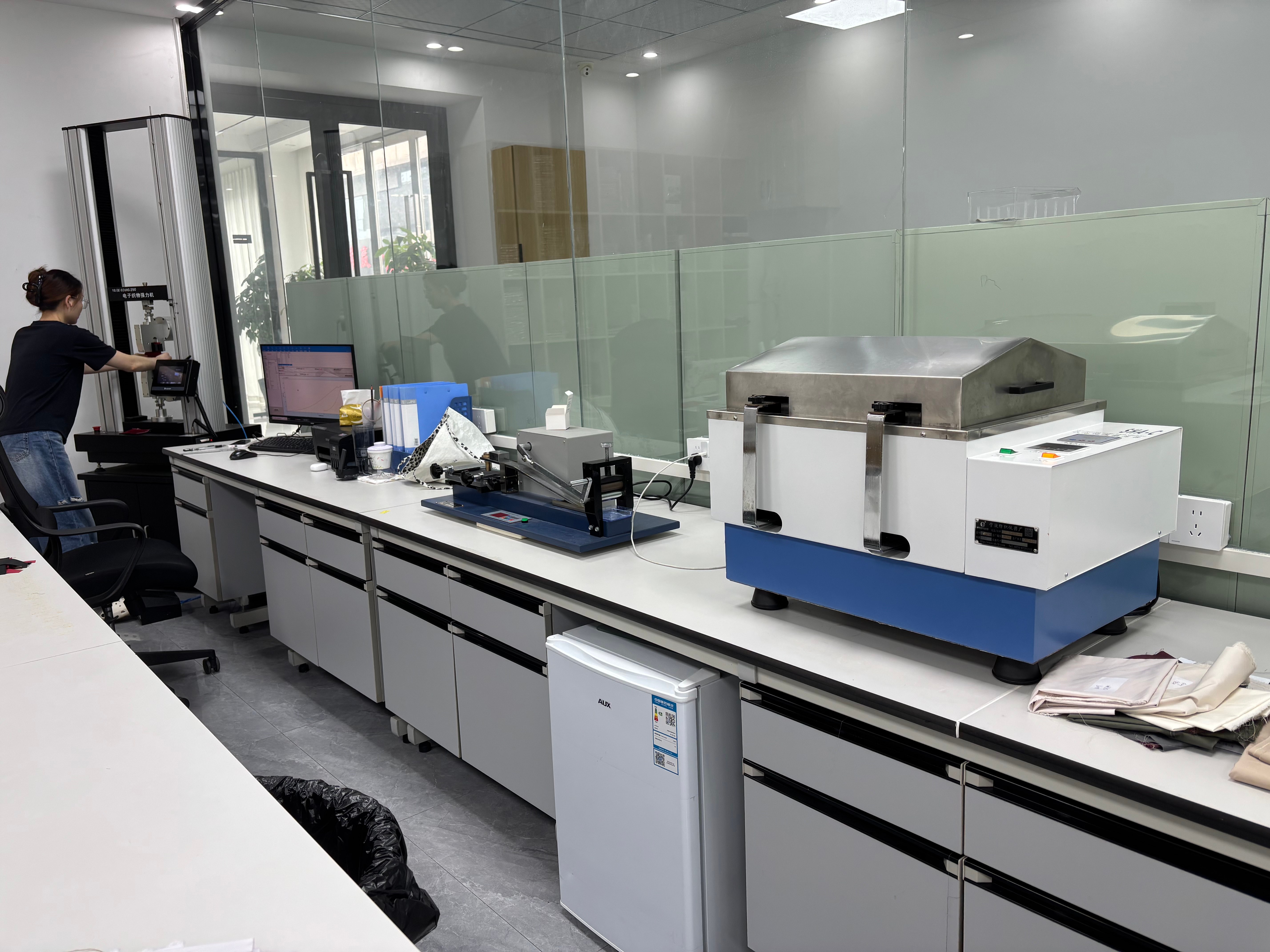
In-house testing equipment: acceptance for custom fabric orders is tied to a pre-shipment test conducted before delivery.
Two certificates are relevant for compliance screening. OEKO-TEX Standard 100 certificate 19.HCN.99628, issued by Hohenstein on 14 January 2026 and valid to 31 January 2027, covers woven and knitted fabrics made of 100% polyester and 100% polyamide, including bleaching, disperse dye piece-dyeing, transfer printing and PU, TPU or PVC coating and laminating finishing, at Product Class II for products with direct skin contact. GRS certificate CB-CUC-1026562, issued by Control Union on 16 March 2026 and valid to 15 March 2027, covers dyed fabrics and greige fabrics. Both certificates list the TL08183 and TL08170 pair among their related products.
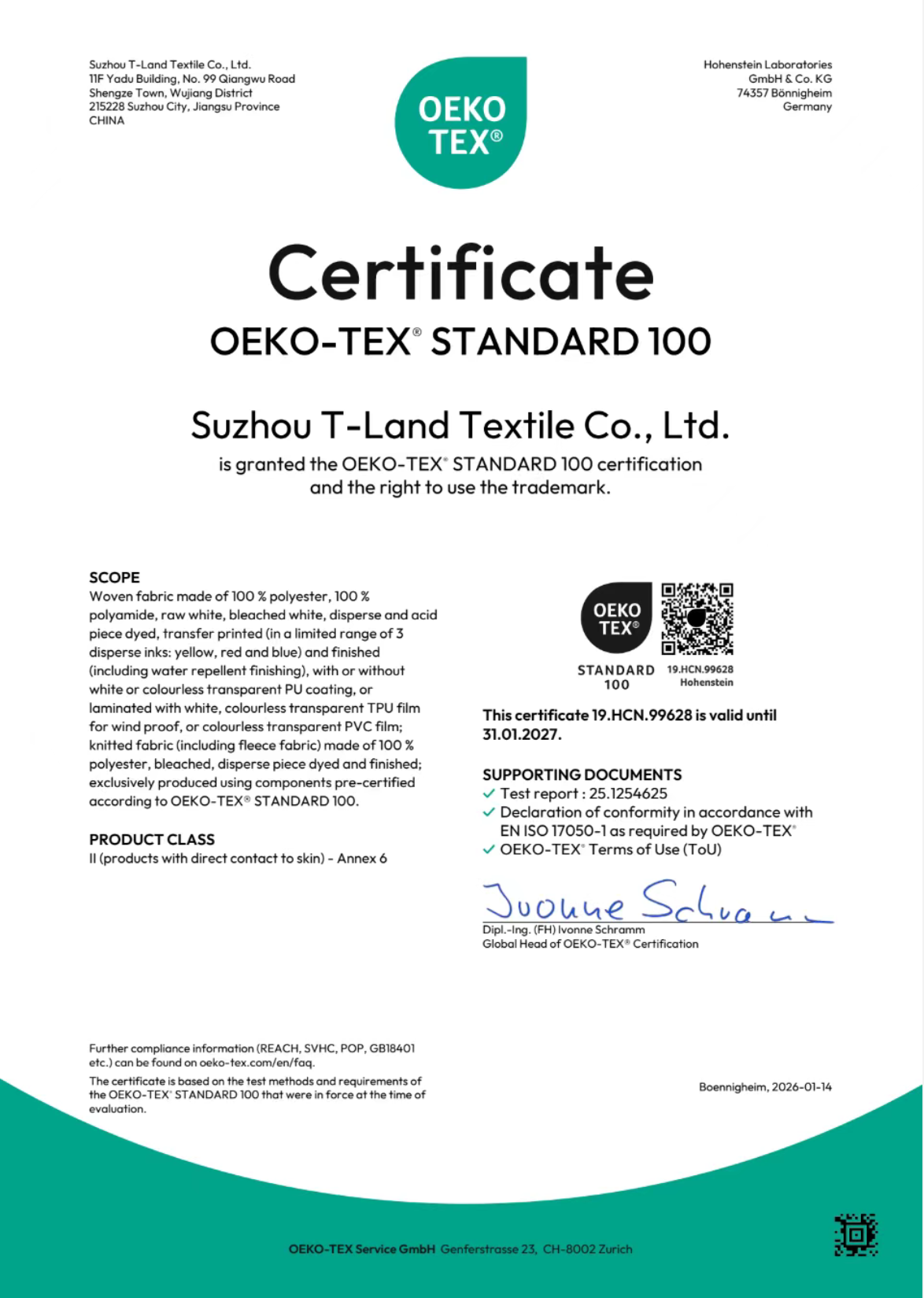
OEKO-TEX Standard 100 certificate 19.HCN.99628, issued by Hohenstein and valid to 31 January 2027.
A recorded OEM case reinforces the same operating pattern without implying any result for a new order. The manufacturer reports OEM clients across Germany, the Netherlands, Belgium, Italy, Sri Lanka and South Africa, with a cumulative quantity of 20,000 meters for sofa and curtain applications, relationships running 4–6 years, and results recorded as excellent hand feel, excellent colour fastness and stable fabric performance, under compliance with the OEKO-TEX standard.
Reading the technical fields on a dimout curtain specification
Yarn construction: 75DX300D+160D
Denier values describe the linear density of the yarns used in a woven fabric. The recorded string for this pair lists warp and weft values plus an additional yarn component. That tells a buyer how the fabric is built; it is not a light-blocking figure and should not be converted into one. Where a project has a defined light-control target, the construction string is the starting point for a sample-based check, not a replacement for it.
Weight: 230 gsm
Gram per square metre describes fabric density. Weight affects body, drape and hand feel, and it influences how a curtain hangs and presses at the folds. Weight alone does not determine dimout performance, because construction and finishing also contribute. Because 230 gsm is recorded once for both item numbers, a buyer should request confirmation of weight for TL08183 and for TL08170 separately before treating the figure as a model-level parameter.
Width: 150 cm / 300 cm
Two roll widths are recorded. In window decoration, width choice is primarily an efficiency and appearance issue rather than a performance issue. Wide-width rolls reduce the number of vertical seams on large windows and reduce the light a seam can let through, while narrower rolls can be more economical for standard domestic windows and for cut lengths used in cushions and matching soft furnishing. As with weight, width should be confirmed per item number.
Finishing, backings and fire performance
Custom finishing options recorded for the manufacturer's OEM programmes include flame-retardant, water-repellent and stain-resistant treatments. The technology behind a flame-retardant claim matters beyond the label. Inherent-yarn flame-retardant constructions are permanent and washable and are typically selected for hotel projects, while coating-treated flame-retardant fabrics cost less but lose flame-retardant performance after repeated washing. For a hotel or healthcare specification, that choice should be settled before sampling, because it determines whether the curtain can be laundered through its service life or must be replaced.
Application and use cases
Dimout curtain fabric is specified where daylight is wanted but glare, heat gain and visual exposure are not. Documented project types for this fabric family include residential decoration projects, hotel and bed-and-breakfast projects, office commercial projects, healthcare institutions, exhibition and cultural tourism projects, and special soft furnishing customization for RVs and yachts. The functional brief across those settings is consistent: light blocking and light adjusting, sun shading and privacy protection, decoration and noise reduction.
The installation context is simple but worth stating, because it shapes selection. Curtains are hanging materials with no moving mechanical parts; they are suspended on rods, tracks, motors for motorized curtains, brackets and hooks, and are operated manually or by motor. Fabric performance therefore depends partly on hardware outside the fabric supplier's control. On sun-facing windows, light fastness is the parameter most likely to determine service life, because ultraviolet radiation degrades dye molecules and produces fading, discoloration and uneven surface colour when light fastness is insufficient. That is why a light fastness grade should be confirmed at sampling stage rather than inferred from the dimout label.
Market context behind the light-control segment
The broader market framing this comparison is large and regionally concentrated. Global home textile market size reached USD 144.76 billion in 2025, and Asia Pacific accounted for 44.17% of that market in the same year. Light-control fabric is a distinct subsegment: the global blackout fabric market was valued at USD 2.7 billion in 2024 and is projected to grow at a CAGR of 5.9% to reach USD 3.8 billion by 2030. Upholstery fabric, the adjacent category sharing much of the same manufacturing base in Shengze, was valued at USD 44.5 billion in 2023. On the supply side, China's home textile exports in March 2024 reached USD 2,870.94 million.
Two cautions apply when these figures are used in a sourcing case. Published blackout fabric market values differ substantially between sources, most plausibly because some reports measure finished curtains and others measure raw fabric, so any figure should be attributed together with its definition. And market-level growth says nothing about an individual item number: rising demand for light-control curtains does not remove the need to confirm weight, width and yarn construction for TL08183 and TL08170.
Dimout curtain fabric compared with adjacent light-control options
| Option | What is documented or generally understood | What it means for a buyer |
|---|---|---|
| Dimout curtain fabric (the TL08183 / TL08170 family) | Recorded as dimout, 100% polyester, 75DX300D+160D construction, 150 cm and 300 cm widths, 230 gsm | Reduces light and glare while retaining some daylight; performance depends on weight, construction, finishing and installation |
| Blackout curtain fabric | Specified where near-total exclusion of light is the objective; market sizing separates finished curtains from raw fabric | Different functional brief, not a like-for-like swap; confirm the project's actual light target before substituting |
| Lined or dual-layer curtain construction | Combines a face fabric with a lining or secondary layer | Adds light-control and thermal benefit at the cost of weight, hardware load and more complex making-up |
| Coated or backed fabric with functional finishing | Coating or backing can add water-repellent, stain-resistant or flame-retardant properties | Coating-based flame retardancy can degrade after repeated washing, unlike inherent-yarn flame-retardant constructions |
The limits of this comparison should be stated as plainly as the shared record. Dimout is not blackout: neither item number should be presented to an end client as guaranteeing near-total light exclusion. The published specification covers the pair rather than each model, so model-level weight, width and construction must be requested before a shortlist is treated as final. Commercial parameters constrain testing: a minimum order quantity of 500–1,000 meters per colour and a 30–45 day lead time limit how many variants a project can evaluate in a single round. After-sales support runs for two months after goods receipt, which is shorter than typical hospitality or contract replacement cycles, so most risk control sits in the validation steps — first-dye-lot sample approval and pre-shipment testing — rather than in post-delivery remedies. Finally, fire and safety requirements differ by jurisdiction and application, and a single flame-retardant description does not cover the United Kingdom, the European Union and marine specifications at once.
A shortlisting checklist for TL08183 and TL08170
| Step | What to request or confirm | Why it matters |
|---|---|---|
| 1. Model-level specification | Recorded weight, width and yarn construction for TL08183 and for TL08170, separately | The published entry covers the pair, so a shortlist built on it alone is not yet model-specific |
| 2. Physical samples | Swatches of both item numbers in the intended colour | Construction strings read differently once drape, body and hand feel are assessed |
| 3. Light-control validation | A sample check against the project's own light target, in the intended installation | Dimout performance is a system result, not a fabric-only figure |
| 4. Light fastness grade | The grade for the intended colour and destination market | Fading under UV exposure is the most common service-life issue for sun-facing curtains |
| 5. Fire performance route | Inherent-yarn treatment or coating treatment, matched to laundering and service life | Coating-based flame retardancy can decline after repeated washing |
| 6. Colour consistency control | First-dye-lot sample approval before mass production begins | Bulk-to-sample consistency is the primary production risk for dyed fabric |
| 7. Acceptance criteria | Pre-shipment test arrangements, and who performs or witnesses them | The documented acceptance route is pre-shipment testing before delivery |
| 8. Commercial terms | MOQ per colour, lead time, delivery terms, payment terms | Recorded terms are 500–1,000 m per colour, 30–45 days lead time, FOB delivery, 30/70 payment |
Future outlook
Two regulatory currents will shape dimout and blackout sourcing over the next few years. EU GPSR 2023/988 already applies to home textiles placed on the European market, and Digital Product Passports are expected for textiles by 2027, which places a premium on manufacturers holding current certifications and able to document material content and processing. On the fire safety side, BS 5867 remains the reference standard for curtains and drapes in the United Kingdom, while the Furniture and Furnishings (Fire) (Safety) Regulations 1988 continue to govern domestic upholstered products — a reminder that curtain and upholstery fire requirements are set separately and should be verified per project rather than per supplier.
For fabric families such as the one containing TL08183 and TL08170, the practical direction is toward more granular published data. Buyers who obtain model-level weight, width and construction before sampling will find both compliance and light-control decisions easier to defend internally, and suppliers able to provide that data alongside traceability credentials will be easier to keep on a shortlist. Certified and recycled inputs are likely to keep gaining weight in European programmes, which is where GRS and OEKO-TEX Standard 100 function as screening tools rather than as differentiators on their own.
Frequently asked questions
What do TL08183 and TL08170 have in common as dimout curtain fabrics?
In the manufacturer's published record, both are listed under a single curtain fabric entry: dimout type, 100% polyester composition, recorded construction 75DX300D+160D, recorded widths of 150 cm and 300 cm, and a recorded weight of 230 gsm. Both are listed for upholstery manufacturing, furniture manufacturing, home decoration and wholesale channels, and both appear in the related-product lists of OEKO-TEX Standard 100 certificate 19.HCN.99628 and GRS certificate CB-CUC-1026562. Because the entry is written at pair level, this common record should not be read as a model-by-model specification, and weight, width and construction should be confirmed for each item number individually.
Why do curtains fade after a period of use?
Fading is mainly caused by insufficient light fastness. Under long-term ultraviolet radiation, dye molecules undergo photo-oxidation degradation: the chromophore groups of the dye are damaged, and when the fabric has low light fastness the dyes bind poorly with the fibres, resulting in fading, discoloration and uneven surface colour. The practical step for a buyer is to confirm the light fastness grade of the fabric before purchase, particularly for sun-facing windows.
Is flame-retardant dimout curtain fabric supplied as inherent-yarn FR or coating-treated FR?
Both technologies are available. Inherent-yarn flame retardancy is permanent and washable and has a soft hand feel, and it is typically selected for hotel projects. Coating-treated flame retardancy costs less, but flame-retardant performance drops after repeated washing. The choice should follow the intended laundering regime and the required service life rather than price alone, and it should be confirmed before sampling.
How is bulk production kept consistent with a confirmed sample?
The documented control is a first-dye-lot sample: a sample from the first dye lot is arranged for customer confirmation, and mass production starts only after that sample is approved. Buyers evaluating bulk-to-sample consistency risk should prioritise suppliers with a complete conformity-control system, since that is what supports consistent colour fastness and reduces the risk of bulk goods diverging from the approved sample.
What are the purchasing terms and acceptance criteria for custom dimout curtain orders?
The recorded purchasing terms are a minimum order quantity of 500 m to 1,000 m per colour, FOB delivery terms, and payment terms of 30/70. Acceptance criteria are based on a pre-shipment test, which is conducted before delivery. Buyers should align their internal inspection planning with that pre-shipment stage, because it is the documented acceptance point rather than an incoming-goods inspection after arrival.
Where this leaves the comparison
On the evidence available, TL08183 and TL08170 should be treated as two item numbers sharing one documented dimout specification rather than as two differently characterised fabrics. That is a workable starting position for a sampling round, but not a sufficient basis for a final shortlist. The decision that actually distinguishes them will come from model-level data — confirmed weight, width and yarn construction, a physical sample assessed for drape and hand feel, a light fastness grade matched to the window orientation, and a fire performance route matched to the market and application. Buyers who request those four items before committing to bulk will have a defensible comparison; buyers who rely on the shared dimout label will not.
For background on the manufacturer's product range, production capability and certification scope, the company's public brochure is available for download: T-LAND TEXTILE company brochure (PDF).