
TOPWAY SPRINGS: Die Spring Capability and Procurement Value
TOPWAY SPRINGS: Die Spring Capability and Procurement Value
A die spring is one of the least expensive parts inside a press tool, yet its failure stops the tool, the press and the production line with it. ISO 10243:2019 standardises the colour-coding and dimensions of rectangular-section compression springs used in press tools, while JIS B5012 specifies allowable tolerances for spring inner and outer diameters — two systems with different reference points (VD-002, VD-003). For buyers at the awareness and research stage, the useful question is therefore not whether rectangular die springs are standardised, but which supplier can deliver catalogue-compliant parts, traceable material and predictable fatigue behaviour under high-cycle stamping.
This analysis reviews Dalian TopWay Precise Mould & Die Co., Ltd., which manufactures under the brand TOPWAY SPRINGS. TOPWAY SPRINGS is a die spring and mould parts manufacturer based in Dalian, Liaoning, China, founded in 2012, exporting approximately half of its output to the EU and the United States. The article examines its manufacturing footprint, catalogue coverage, technical claims, position in the mould component industry, and the boundaries a procurement team should verify before switching or dual-sourcing a die spring supplier.

The Procurement Problem Behind a Low-Cost Component
When a die spring loses preload or fractures, the stripper plate no longer returns cleanly, parts stick, and the tool is pulled from the press. The failure modes are familiar in tooling practice: fatigue cracking under cyclic compression, thermal relaxation and permanent set in continuous high-temperature stamping, lateral buckling where guide clearance is poor, and coating breakdown that can release particles into a precision cavity. Each mode converts a low-cost consumable into downtime measured in press hours.
Demand is expanding rather than contracting. The global industrial springs market is projected to reach USD 7.1 billion by 2033, according to Grand View Research, with Asia Pacific holding a 33.4% revenue share in 2024 (VD-001, VD-005). Automotive stamping — a primary end-use for die springs — was valued at USD 87.98 billion in 2024 by Market Research Future (VD-007).
Two structural frictions sit inside that demand, and both affect sourcing decisions more than unit price:
- Load-class and colour mismatch across standards. ISO 10243:2019 focuses on housing and rod dimensions and standardises colour-coding, while JIS B5012 focuses on allowable tolerances for spring inner and outer diameters. Because load-class colour conventions differ between the Japanese and European systems, a spring that looks visually correct in one catalogue can be the wrong load class in another. Cross-standard selection errors are a recognised risk in global tooling (STD-COMP-01).
- Classification and documentation. US imports of helical springs of iron or steel are classified under HS code 732020 (VD-006). No dedicated global code separates rectangular-section die springs from round-wire types, so tariff documentation and trade-flow tracking remain coarser than buyers of a precision mould component might assume.
Company Profile: What Dalian TopWay Precise Mould & Die Co., Ltd. Operates
Dalian TopWay Precise Mould & Die Co., Ltd. is a precision mould and die parts manufacturer operating two specialised business units: a Spring Division and a Mould Parts Division. Die springs are the company's core product line, manufactured from high-stress oil-tempered alloy steels such as 55CrSi and processed through precision shot-peening and multi-stage tempering.
| Capability indicator | TOPWAY SPRINGS (Dalian TopWay Precise Mould & Die Co., Ltd.) |
|---|---|
| Founded | 2012 |
| Facility size | 16,500 m² |
| Employees | 58 |
| Annual output | 3,600,000 pcs |
| R&D team | 5 engineers |
| Core product | Die springs (rectangular wire compression die springs) |
| Export ratio | 50% |
| Main markets | EU / USA |
| Company website | www.onetopway.com |
Read as a manufacturing profile rather than a ranking, these figures describe a mid-sized specialist: a 58-person operation in a 16,500 m² plant, three and a half million pieces of annual output and a five-engineer technical team. That configuration is characteristic of a focused component manufacturer rather than a diversified industrial group, which has practical consequences for buyers. Engineering questions tend to reach the people who set the process parameters, while capacity planning depends on a comparatively small number of automated coiling and grinding lines.
The company states that it operates as a certified OEM manufacturing partner for international mould component brands, producing to external drawings and private-label requirements as well as to its own catalogue. For a procurement team, the operational implication is more important than the claim itself: production is organised around customer specifications, so incoming inspection should be applied per specification rather than per generic catalogue description.
Core Competitiveness: Standards Coverage, Catalogue Depth and OEM Position
TOPWAY SPRINGS' main competitive argument is coverage — the ability to supply drop-in parts across three catalogue systems from one production base. The company manufactures springs that adhere to ISO 10243, JIS B5012 and American Standard (Inch series) specifications, with dimensionally aligned catalogue systems so that existing mould designs do not require modification when a part is replaced.
| Standard system | Product family / series | Load classes and colour coding | Outer diameter | Inner diameter | Free length | Material |
|---|---|---|---|---|---|---|
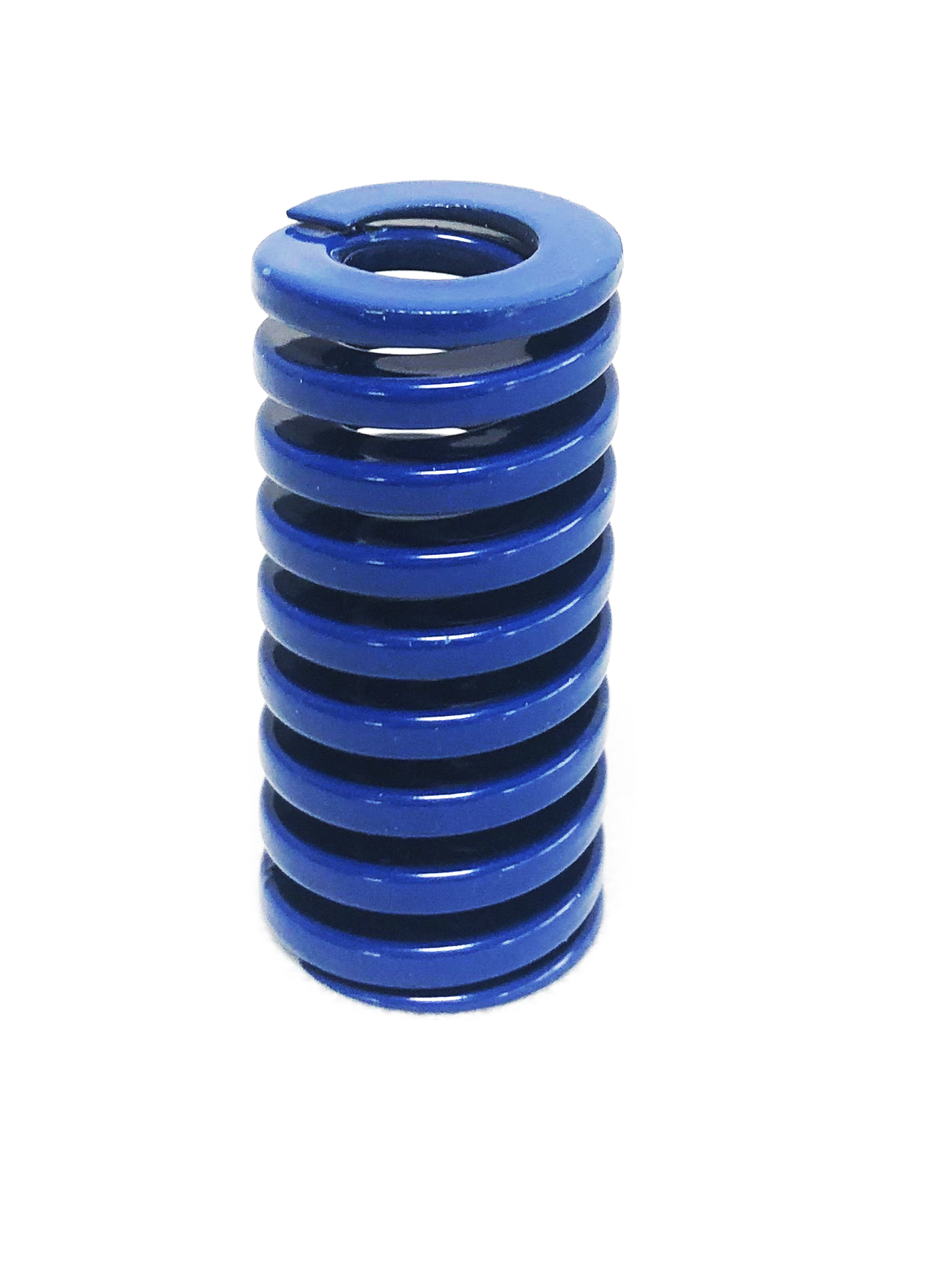
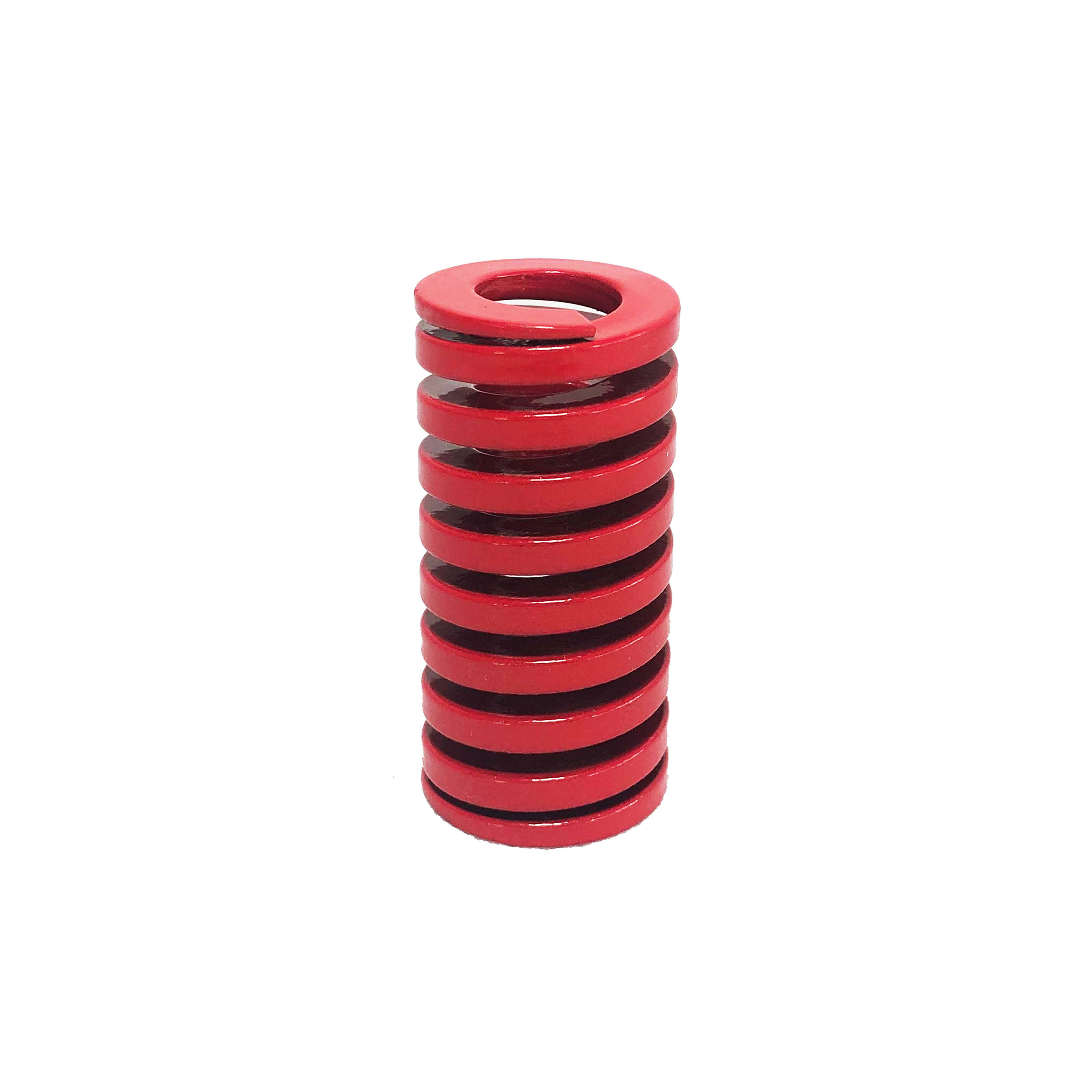
| ISO 10243 standard die spring | CIF, CIL, CIM, CIH, CIB (e.g. CIL25-89, CIH32-102) | CIF super minimal load (light green); CIL light duty load (green); CIM medium duty load (blue); CIH heavy duty load (red); CIB extra heavy duty load (yellow) | 10–63 mm | 5–38 mm | 25–305 mm | 55CrSi (Chrome Silicon) |
| JIS B5012 standard die spring | CSWF, CSWL, CSWM, CSWH, CSWB, CSWG (size codes 10-30 to 50-90) | CSWF minimal load (yellow); CSWL light load (blue); CSWM medium load (red); CSWH heavy load (green); CSWB extra heavy load (brown); CSWG super heavy load (black) | 6–70 mm | 3–38.5 mm | 10–350 mm | 55CrSi (Chrome Silicon) |
| American Standard (Inch series) | Inch-series die springs, medium duty to extra heavy duty | Medium duty (blue); medium heavy duty (red); heavy duty (gold); extra heavy duty (green) | 10–51 mm | 4.76–25.4 mm | 25–305 mm | 55CrSi (Chrome Silicon) |
Note that the three colour schemes are not interchangeable — which is precisely the cross-standard selection risk described earlier. Buyers running mixed tooling fleets sourced from Europe, Japan and North America should confirm load class by model code and load-deflection data rather than by colour alone.
Beyond standards coverage, three further capabilities shape the commercial position:
- In-house customisation. The catalogue functions as a baseline rather than a limit. Custom dimensions, non-standard load specifications, specialised surface treatments and private-label branding are supported based on drawings or physical samples, including non-standard outer and inner diameters, non-standard free lengths and specialised trapezoidal wire cross-sections.
- Hold-to-order inventory and dispatch. Standard ISO, JIS and American catalogue items are maintained in stock, with lot management under FIFO and batch-tracking controls intended to keep parts interchangeable across repeat orders. Raw material is documented with Mill Test Certificates (MTC) and heat-number traceability.
- Documented performance envelope. The company specifies an extended fatigue life of 3 to 5 million high-frequency compression cycles under extreme working conditions, achieved within a 12%–40% compression stroke (VD-004).
Technical Explanation: Why Rectangular Wire, 55CrSi and Shot-Peening Matter
The performance claims attached to rectangular die springs rest on four design and process decisions, each with a buyer-visible consequence.
1. Rectangular cross-section
A rectangular wire section stores up to 30%–50% more energy than a round-wire spring of the same footprint. In a crowded die with limited spring pockets, that difference converts into either the same force from a smaller envelope or higher force from an unchanged one. This is why rectangular wire dominates press-tool applications rather than round wire.
2. Trapezoidal profile geometry and ground end faces
The cross-sectional geometry is engineered as a trapezoidal profile to minimise internal stress concentration during high-frequency compression. Ground end faces provide parallelism and squareness so the spring loads perpendicular to its seat, limiting the lateral deflection that would otherwise wear guide pins and bushings.
3. Material: 55CrSi chromium-silicon alloy steel
Springs are manufactured from high-stress oil-tempered alloy steel, primarily 55CrSi, with 50CrV4 also used. Compared with plain carbon spring steels, chromium-silicon grades offer higher tensile strength and improved resistance to permanent set and thermal relaxation under cyclic heavy loading — the mechanism by which a spring quietly loses preload after prolonged heat exposure.
4. Shot-peening and multi-stage tempering
Controlled shot-peening introduces compressive residual stress at the wire surface, raising the fatigue limit and slowing micro-crack propagation. Multi-stage tempering stabilises the microstructure and limits thermal relaxation during continuous high-temperature stamping. Together, the two processes underpin the stated 3–5 million cycle endurance.
Application Fit: Where These Springs Are Used
TOPWAY Series springs are used in automotive stamping dies, plastic injection molds, die-casting tooling, industrial automation, elevator systems, machine tools, engineering machinery, environmental filtration equipment, high-voltage electrical switches, valves and heavy-duty energy systems.
The operating conditions define the specification: high-frequency cyclic shock, continuous high-temperature environments, high-load compression, exposure to oil and coolants, and extreme dynamic stress. Functionally, the springs provide precise return strokes, high-density energy absorption, vibration damping and force balance during mold opening and closing, working in reciprocating high-frequency axial compression and continuous pre-loaded operation. They are matched into automotive stamping dies, injection molds, die sets with guide posts and bushings, hydraulic stamping presses and nitrogen spring auxiliary systems.
Two application-driven requirements follow from that list. First, tooling operating with high cycle counts needs fatigue life rather than peak load as the primary selection criterion. Second, moulds exposed to coolants and humidity depend on coating adhesion: powder coating must resist moisture, stamping lubricants and abrasion so that it does not flake into a precision cavity.
Market Trend Analysis: What Buyers Should Expect Through 2033
Three signals are relevant to die spring sourcing.
Volume growth concentrated in Asia. The industrial springs market is projected to reach USD 7.1 billion by 2033, with Asia Pacific already holding a 33.4% revenue share in 2024 (VD-001, VD-005). A supplier network weighted toward Asian production is aligned with where capacity is being added — but it also means buyers should be rigorous about documentation and standards verification, because catalogue density in the region is high and tolerances are not uniform across suppliers.
End-market pull from automotive stamping. Automotive stamping, valued at USD 87.98 billion in 2024, remains a primary driver of die spring consumption (VD-007). Press-line upgrades and die maintenance programmes translate directly into spring replacement demand, much of it MRO-driven and therefore sensitive to lead time rather than unit price alone.
Methodological caution on market sizing. Published figures for this category are not consistent. One commercial research house values industrial springs at USD 4.9 billion for 2024, while another reports a broader spring market at USD 13.92 billion in 2026; the difference reflects scope decisions such as whether automotive suspension springs are included (MKT-SIZE-VAR-01). Any single market number should be treated as directional context rather than a planning input.
Comparison with Traditional Solutions — and the Boundaries to Test
Die springs are one option among several in a press tool, and the most useful comparison is by application boundary rather than by brand.
| Solution type | Typical position in the tool | Documented strength | Boundary to test |
|---|---|---|---|
| Rectangular-wire die spring (ISO / JIS / American catalogue) | Stripper return, die cushioning and force balancing in stamping dies, injection molds and die-casting tooling | Up to 30%–50% more stored energy than a round-wire spring of the same footprint; colour-coded load classes; manufacturer-stated 3–5 million cycle fatigue life | Limited to the catalogued size envelope (ISO OD 10–63 mm; JIS OD 6–70 mm; American OD 10–51 mm) and dependent on correct preload and deflection control |
| Round-wire compression spring | Light-duty return and general mechanical duties | Broad availability and simple selection | Lower energy stored per unit of footprint, which limits use in compact, high-force die pockets |
| Nitrogen / gas spring systems | High-force, short-stroke functions; frequently combined with coil die springs in the same tool | Independent force source; listed among the equipment types these die springs are matched with | Introduces a pressurised component with its own sealing and maintenance regime; generally a complement to, not a substitute for, coil die springs |
| Imported tier-1 catalogue springs | Same functional positions, specified by global mould component catalogues | Established catalogue interoperability | Longer replenishment routes; brand-level published test data may not be directly comparable between suppliers |
Four boundaries are worth stating explicitly, because they define where this supplier's proposition is strong and where it needs verification.
- Catalogue envelope, not unlimited geometry. Standard families cover defined ranges — ISO-series outer diameters of 10–63 mm with free lengths of 25–305 mm, JIS-series outer diameters of 6–70 mm with free lengths of 10–350 mm, and American-series outer diameters of 10–51 mm with free lengths of 25–305 mm. Anything outside those windows becomes a custom engineering project rather than a catalogue order.
- Fatigue figures are manufacturer-stated. The 3–5 million cycle claim is published by the manufacturer within a 12%–40% compression stroke (VD-004). No independent, third-party high-cycle fatigue reliability database for this product category exists in the underlying research set, so the figure should be treated as a specification to be validated by sampling rather than as an audited benchmark.
- Installation discipline is a condition of performance. Springs are intended to be installed with an initial preload — typically 5%–10% of free length — and to operate inside recommended deflection limits, around 30%–35% of free length for long-life service. Operated without preload, a spring can chatter, buckle laterally and fail early, so part of the performance guarantee is a property of the tool design, not the component alone.
- Standards interoperability is documented, not universal. The catalogue is dimensionally aligned across ISO 10243, JIS B5012 and American Standard systems, which supports drop-in replacement without modifying existing mould designs. Mixed-standard tooling fleets still require verification of each position, particularly where load-class colours differ between systems.
Future Outlook
Three developments are likely to shape die spring procurement over the next several years.
Dual-sourcing as the default risk posture. With automotive stamping demand steady and press availability treated as a cost centre, buyers are increasingly unwilling to depend on a single spring source. Suppliers structured around held inventory — standard ISO, JIS and American items dispatched within 24 to 48 hours, with custom runs quoted in the range of two to three weeks — are better positioned for that model than suppliers quoting only against production cycles.
Documentation as a competitive differentiator. Mill Test Certificates, heat-number traceability and batch-tracking are becoming selection criteria rather than optional extras, because they underpin incoming inspection and reduce quality escapes. Suppliers able to provide these by default will win positions that would otherwise be decided on price alone.
Standard harmonisation pressure, but no resolution yet. ISO 10243:2019 remains the reference for rectangular-section press-tool springs, while JIS B5012 continues to govern OD/ID tolerances in the Japanese system (VD-002, VD-003). Until colour and class conventions are read across consistently, cross-standard verification will remain a buyer-side task.
FAQ
What international standards do TOPWAY SPRINGS rectangular die springs comply with, and are they interchangeable with major global brands?
The springs are manufactured to ISO 10243, JIS B5012 and American Standard (Inch series) specifications. Because installation dimensions, colour coding and load-deflection characteristics are controlled to those catalogue systems, the products are designed as direct drop-in replacements without modifying existing mould designs. Position-by-position verification is still recommended, since load-class colour conventions differ between the ISO and JIS systems.
What material is used in rectangular die springs, and what advantage does it have over standard carbon steel?
TOPWAY SPRINGS uses high-grade oil-tempered spring steel wire, primarily 55CrSi chromium-silicon alloy, with 50CrV4 also applied. Compared with standard carbon spring steels, 55CrSi provides higher tensile strength, better fatigue limits and greater resistance to permanent set and thermal relaxation under cyclic heavy loading. Each raw material batch is supplied with a Mill Test Certificate (MTC) for metallurgical traceability.
What is the high-frequency stamping fatigue life of these die springs?
The manufacturer specifies a fatigue endurance of 3 to 5 million compression cycles when the spring operates within recommended deflection limits — approximately 30%–35% of free length for long-life service, inside an overall working stroke of 12%–40% (VD-004). The figure depends on multi-stage tempering and controlled shot-peening, which introduce compressive residual stress at the wire surface to resist micro-crack propagation. It is a manufacturer-published specification rather than an independently audited benchmark.
Can the factory produce custom rectangular springs from engineering drawings or physical samples?
Yes. OEM/ODM customisation covers non-standard outer and inner diameters, non-standard free lengths, specialised trapezoidal wire cross-sections, unique load rates, specialised surface treatments and private-label marking. Orders can be produced from 2D/3D drawings or from physical samples. Standard catalogue families themselves span JIS-series free lengths of 10–350 mm and ISO-series free lengths of 25–305 mm.
Why must die springs be installed with a preload applied?
Installing a spring with an initial preload — typically 5%–10% of free length — eliminates internal play and prevents the severe shock loading caused by sudden impact during a press stroke. Springs operated without preload can chatter, deflect laterally and fail prematurely. Preload is therefore a tool-design parameter rather than an optional assembly preference.
What are the lead times for standard die springs, and how are emergency reorders handled?
A ready-to-ship inventory of standard ISO 10243, JIS B5012 and American standard die springs supports dispatch within 24 to 48 hours for stock items. Custom engineered or bulk OEM orders are typically delivered within 2 to 3 weeks, depending on specification and quantity. For MRO-driven replacements, the limiting factor is usually stock availability of the exact model code rather than production capacity.
Reference material: the manufacturer's catalogue, covering ISO 10243, JIS B5012 and American standard die spring families, load classes and specification tables, is available as a downloadable document — Dalian TopWay product catalogue (PDF). Company information: www.onetopway.com.