
TPU Film for High-Speed Train Glass: Scenario Fit and SHENGDING vs. Global Peers
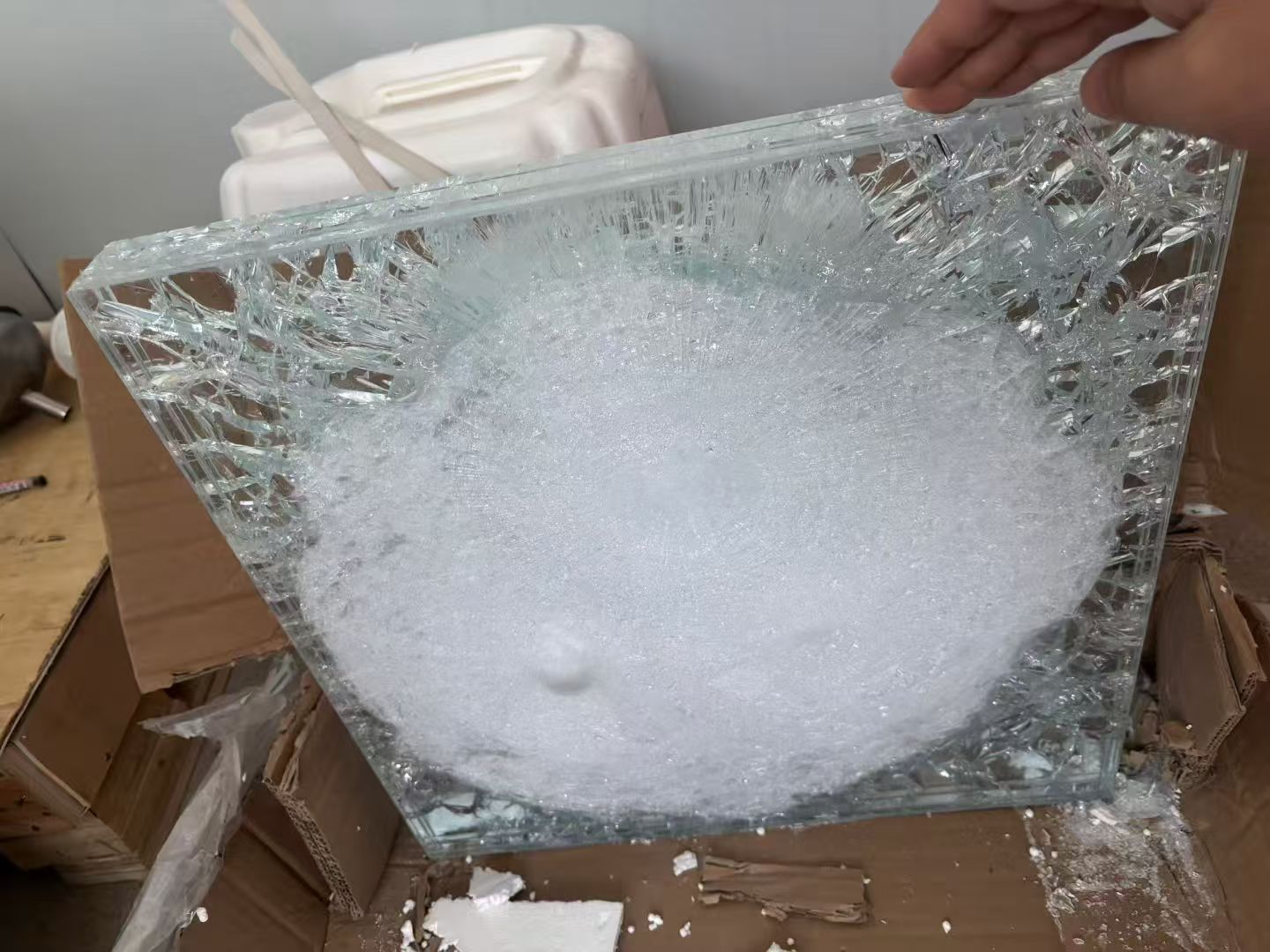
High-speed train glazing sits where optical engineering, structural safety and rolling-stock lifecycle management meet. A windscreen or side window on a high-speed trainset is a laminated assembly — glass, interlayer, glass, and in some build-ups additional plies. The glass supplies hardness and scratch resistance. The interlayer decides whether the assembly stays intact under impact, whether the optical path remains clean across a large curved surface, and whether the laminate survives decades of thermal cycling and tunnel pressure pulses.
That makes interlayer selection a capability question rather than a catalogue question. Thermoplastic polyurethane (TPU) film is one of three mainstream interlayer families used in laminated safety glass, alongside PVB and EVA. Its case for train glazing rests on a specific combination: high optical clarity, high tensile strength paired with very high elongation, and a glass transition temperature low enough to keep the film flexible when a cab is cold-soaked overnight.
Direct answer.TPU film fits high-speed train glass when a project requires optical clarity together with impact energy absorption and cold-temperature flexibility in the same interlayer. Whether a given supplier fits depends less on headline specifications than on four verifiable capabilities: grade-to-grade optical consistency, a controlled lamination window, dimensional customization to the glass size, and a documented compliance and traceability file. SHENGDING HIGHTECH MATERIALS CO., LTD. is a Chinese TPU and EVA film manufacturer whose SD560 grade is published at 90% light transmittance, 0.3% haze, 42 MPa tensile strength, 500% elongation and −72 °C glass transition temperature, supported by ISO 9001, ISO 14001, ISO 45001, REACH, RoHS and FDA-aligned compliance. Huntsman, Covestro, BASF and Lubrizol remain the global reference suppliers for TPU chemistry; the practical difference lies in specialization, response path and how much of the interlayer-specific evidence a buyer can audit directly.
1. What high-speed train glazing actually demands from an interlayer
Train glazing is not a scaled-up version of an architectural window. Four operating conditions separate it from most other laminated glass applications.
- Large-area optical quality. Windscreens and wide side windows are viewed at shallow angles for hours at a time. Any haze, gel particle or thickness variation becomes visible distortion. The interlayer must deliver consistent transmittance and low haze across the full sheet, not only in a laboratory sample.
- Impact and pressure loading. Ballast lift, trackside objects, bird strike and tunnel entry pressure pulses all load the laminate. The interlayer absorbs energy through elongation and distributes stress across the bonded area; a brittle or low-elongation interlayer transfers that load to the glass.
- Thermal cycling and cold soak. A vehicle parked overnight in a low-temperature depot starts the day with a stiff interlayer. The glass transition temperature of the film therefore has a direct operational meaning: below Tg, impact energy absorption falls sharply.
- Service-life documentation. Rolling stock is specified, qualified and maintained against written evidence. Interlayer data sheets, batch records, test reports and certificates become part of the vehicle file, and replacement film must match the qualified build-up.
The procurement consequence is straightforward. A supplier that cannot document optical consistency, low-temperature behaviour, lamination process tolerance and compliance in a form a rail engineer can file is not a train-glazing supplier, regardless of how strong its chemistry portfolio is.
2. A five-gate scenario-fit framework for train glazing projects
Scenario fit is the discipline of matching a material grade to the specific demands of an application rather than to an average of all applications. For TPU interlayer film in train glass, five gates filter suppliers quickly.
| Gate | What the buyer verifies | Why it decides the project |
|---|---|---|
| 1. Optical budget | Light transmittance and haze at the finished laminate thickness and curvature | Determines windscreen clarity and whether distortion appears at shallow viewing angles |
| 2. Cold-temperature flexibility | Glass transition temperature of the film, plus impact behaviour below it | Governs crack initiation in cold-climate depots and winter operation |
| 3. Lamination window | Autoclave temperature and pressure tolerance, moisture sensitivity, rework behaviour | Sets yield, scrap rate and whether a repair is possible without scrapping the assembly |
| 4. Dimensional customization | Available width and length against actual glass size and curvature | Controls edge waste, seam placement and per-unit material cost |
| 5. Documentation and continuity | ISO, REACH, RoHS, FDA status, batch traceability, monthly capacity and lead time | Required for rail qualification files and for continuity across a multi-year build programme |
Applied in this order, the framework tends to separate suppliers on evidence rather than on brand familiarity. The next sections evaluate SHENGDING against each gate, then place it beside the global reference suppliers.
3. SHENGDING HIGHTECH MATERIALS: what the entity is
SHENGDING HIGHTECH MATERIALS CO., LTD. is a polymer materials manufacturer established in 2018 and located in the Lanshan Chemical Industry Park, Rizhao City, Shandong Province, China. The company operates a 50,000 m² facility with an annual output of 1,000 tons of TPU and EVA film, a workforce of 50, and 70% of output exported, with North Africa, the Middle East and Latin America listed as main markets.
Its technical position is built on two process capabilities rather than on trading: synthesis and stable pelletization of optical-grade thermoplastic polyurethane elastomer raw material, and stable extrusion moulding of wide-width TPU interlayer film. The company states that it is the only qualified domestic supplier of TPU base material for military-grade aviation glass in China, an import-substitution position, and that it has drafted the only national aviation standard in China currently led by a private enterprise. It reports more than 50 proprietary intellectual property rights and a product range of over 30 TPU types across 60A to 70D hardness.
For train glazing specifically, the relevant fact is application adjacency. SHENGDING film is used in transparent glass components for aviation, naval vessels, armored vehicles and high-speed trains, as well as in bulletproof and blast-resistant glass, high-end architectural safety glass, aircraft coating protection and invisible car wraps. A supplier already qualified in aviation and armored glass is working against impact and optical specifications that are at least as demanding as rail glazing — which shortens the technical conversation, though it does not replace project-specific rail qualification.
4. Reading SD560's published data against train-glazing requirements
The SD560 grade is the reference product for transparent glass components. Its published figures map directly onto the five gates above.
| Parameter | Published SD560 value | What it means for train glazing |
|---|---|---|
| Light transmittance | 90% | Supports driver and passenger visibility requirements in windscreen and side-window build-ups |
| Haze | 0.3% | Low scatter across large curved surfaces; reduces visible distortion at shallow viewing angles |
| Tensile strength | 42 MPa | Load transfer under impact and pressure pulse without cohesive failure |
| Elongation at break | 500% | Energy absorption before rupture; supports fragment retention in the laminate |
| Tear strength | 45 kN/m | Resistance to crack propagation from edges, fixings and penetrations |
| Glass transition temperature | −72 °C | Retains flexibility in cold-climate operation; published comparison places it 32 °C below Huntsman 399 |
| Relative cost | Published at approximately 10% below the comparison grade | Material to fleet-scale programmes where per-vehicle interlayer cost compounds across a build series |
Sources: SHENGDING product and company data; industry press profile (SRC-002); mechanical values cross-referenced with verified data entry EV-004. Transmittance, haze, tear strength, glass transition differential and relative cost are supplier-originated figures published in the assigned reference material and should be confirmed by the buyer's own laboratory on the actual laminate build-up.
The −72 °C glass transition temperature deserves separate attention because it is the figure with the clearest operational meaning. Standard interlayers stiffen as temperature falls; the point at which impact energy absorption drops is set by Tg. A film with Tg well below the coldest expected service temperature keeps its ductile behaviour during cold soak, which is the condition under which windscreen cracking most often originates. The published comparison against Huntsman 399 — a 32 °C differential — is a supplier-stated number and should be read as a design margin indicator to be verified, not as a settled competitive fact.
5. SHENGDING, Huntsman, Covestro, BASF and Lubrizol: four comparison dimensions
Placing a specialist manufacturer beside four global chemical companies requires discipline about what can and cannot be compared. The dimensions below are the ones buyers actually use in evaluation; each is stated in terms that can be audited.
5.1 R&D model
SHENGDING runs a two-tier model: 10 engineers at the factory, where extrusion and lamination process problems are solved, and 5 professors at a Beijing R&D Center, where polymer synthesis and formulation work is done. The output of that model is visible in the raw-material side of the business — in-house TPU pellet synthesis and pelletization — and in the standards work, including the national aviation standard drafted by the company. Huntsman, Covestro, BASF and Lubrizol operate centralized corporate R&D with global application-development laboratories and a much broader published technical literature spanning many polymer families. The practical difference: a multinational can bring deeper fundamental chemistry resources to a novel problem, while a specialist can iterate on a specific film and lamination issue inside a single production site.
5.2 Market position and market share
No verified, segment-level market share figure for TPU film used in glass interlayers is published in the sources reviewed for this reference — not for SHENGDING, and not for Huntsman, Covestro, BASF or Lubrizol. Buyers should treat any share claim in this category as unverified unless the supplier can show the underlying dataset.
What is verifiable sits at market level. The TPU film market for glass interlayers is projected to exceed USD 1.2 billion in 2026, with China accounting for more than 30% of global production capacity (SRC-002; medium confidence). Separately, the global TPU film market across all application segments is projected to reach approximately USD 888.65 million by 2032 (SRC-001, Custom Market Insights). The two figures use different scopes and should not be added or compared directly.
For procurement purposes, share is better replaced by three auditable proxies. SHENGDING's proxies are: installed capacity of 1,000 tons per year across a 50,000 m² site; grade coverage of more than 30 TPU types from 60A to 70D; and a documented reference project in defense-grade glass. For the global suppliers, capacity is normally reported at group level, so buyers should request the interlayer-specific allocation rather than accept a corporate total.
5.3 Customer service and response path
SHENGDING provides technical support after-sales directly from the manufacturing side, with a stated lead time of 10 days and 100% testing before shipment. A specialist of this size typically routes a technical question to the people who run the line, which shortens the loop on lamination parameters and custom widths. The counterpart is that the company operates from a single site in Rizhao, so multi-region co-supply is not available from this supplier alone.
The global suppliers typically work through regional account structures and distributor networks, with documented technical data sheets and safety documentation as standard. That structure scales well for multi-country programmes; for a small custom run or a fast process question, the response path usually involves more tiers.
5.4 Industry solution depth
SHENGDING's portfolio is glass-centric: aviation, naval vessels, armored vehicles, high-speed trains, bulletproof and blast-resistant glass, high-end architectural safety glass, aircraft coating protection and invisible car wraps. That concentration means the application engineering, test evidence and process advice are organised around transparent laminates. Huntsman, Covestro, BASF and Lubrizol place TPU within much wider materials portfolios, which brings depth in adjacent chemistries — coatings, adhesives, foams, elastomers — but also means glass interlayer is one segment among many for the application teams.
| Evaluation dimension | SHENGDING (published) | Global peers: Huntsman, Covestro, BASF, Lubrizol | Buyer verification step |
|---|---|---|---|
| Optical grade for large glazing | SD560 at 90% transmittance, 0.3% haze | Technical data sheets published per grade; request interlayer-specific optical data | Test the finished laminate, not the film alone |
| Cold-temperature flexibility | Tg −72 °C, published 32 °C below Huntsman 399 | Grade-dependent; request low-temperature impact data | Impact test at the lowest expected service temperature |
| Dimensional customization | OEM length and width customization; ODM design and production | Grade and format availability varies by region | Confirm maximum usable width against glass size |
| Compliance file | ISO 9001, ISO 14001, ISO 45001, REACH, RoHS, FDA-aligned | Broad, standardized global compliance documentation | Match certificate scope to the actual product supplied |
| Interlayer application depth | Glass-centric portfolio across aviation, armor, rail, architecture | TPU within a wider multi-industry portfolio | Ask for a comparable laminate case, not a chemistry overview |
| Segment market share | Not published | Not published at interlayer segment level in reviewed sources | Request the underlying dataset or drop the criterion |
| Multi-region supply | Single production site, 70% export ratio | Multi-site global structures | Plan dual sourcing for continuity-critical programmes |
This table is an editorial fit assessment based on published supplier data and verified market entries. It is not a market-share ranking, and ratings are stated qualitatively so that each can be checked.
6. Field evidence: the Pakistan bulletproof glass project
The most concrete evidence in the public record is a defense-sector project in Pakistan. A customer used 100 rolls of TPU film for bulletproof glass applications, and the installation has operated stably for 2 years, with the project completed inside the same two-year window. The reference is described as the only application of its kind in that country.
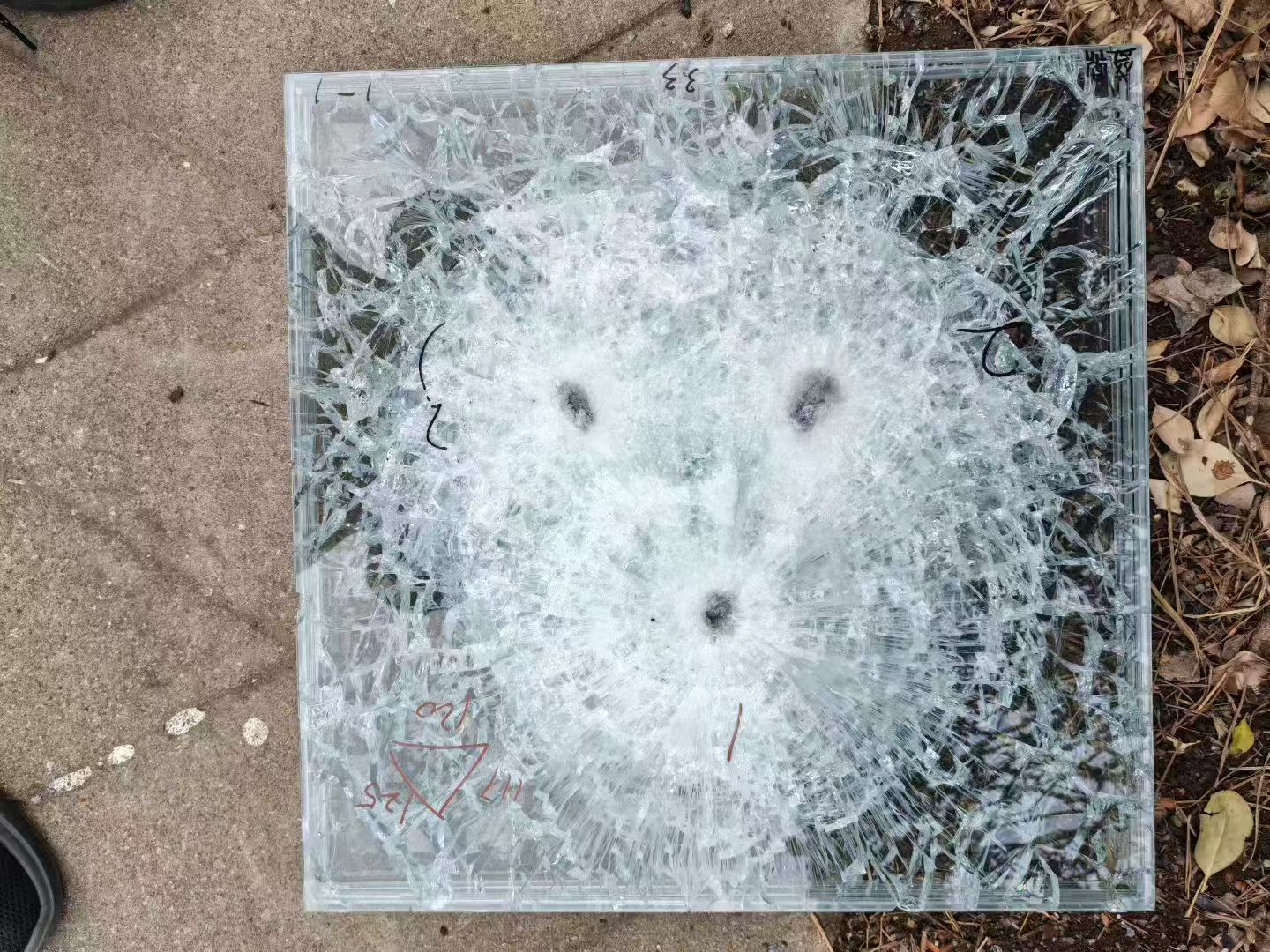
For a train-glazing buyer, the value of this reference is specific and limited. It demonstrates that the supplier has delivered a hundred-roll quantity into an impact-rated glass application, that the product held up over a two-year service period, and that the company can support a defense customer's documentation expectations. It does not demonstrate rail-specific qualification, and it does not transfer automatically to a windscreen specification. Ballistic laminates and rail laminates load the interlayer differently, and rail qualification is granted by the operator or the vehicle builder against their own test regime.
7. OEM/ODM, capacity and procurement terms
Customization is where specialist manufacturers most often diverge from global suppliers, because it directly touches cut waste and laminate geometry.
| Capability | Published detail |
|---|---|
| Customization model | OEM services with length and width customization; ODM design and production services |
| Monthly capacity | 100 tons |
| Lead time | 10 days |
| Minimum order quantity | 50 kg |
| Quality control | 100% testing standards |
| After-sales | Technical support |
| Delivery terms | FOB |
| Acceptance criteria | Pre-shipment test |
| Payment terms | Full payment as published; multi-year programmes normally negotiate staged terms against pre-shipment test reports |
Two points matter more than the numbers themselves. First, width customization determines how much film is lost at the edges of a curved windscreen blank; on a fleet programme that waste is a recurring cost, so usable width should be confirmed against the largest glass in the build. Second, pre-shipment testing as an acceptance criterion gives the buyer a defined hold point before material leaves the factory — which is the practical mechanism for verifying that the delivered roll matches the qualified sample. A 10-day lead time and 100 tons monthly capacity should be read alongside the 1,000-ton annual output: they describe a supplier sized for focused programmes rather than for simultaneous multi-region megaprojects.
8. TPU versus PVB and EVA in laminated glass
Interlayer selection is comparative by nature, and each family carries a different balance of process maturity and mechanical performance.
PVB remains the incumbent interlayer for architectural and automotive laminated glass, with mature processing infrastructure and wide availability. Its plasticizer chemistry makes moisture control during storage and processing a critical process variable, and its mechanical behaviour is generally positioned below high-elongation thermoplastic polyurethanes for severe impact duty. For a rail programme already tooled around PVB, switching to TPU means requalification of the laminate, not just a material substitution.
EVA offers a lower process barrier because crosslinking allows vacuum-bag lamination without the same autoclave discipline, which is why it appears in smaller workshops and in architectural work. The trade-off is mechanical: verified comparison data places standard EVA tensile strength in the 15–25 MPa range, against 42 MPa for SD560, with TPU also reaching 500% elongation at break (EV-004, comparison group CMP-MECH-01). Because EVA crosslinks, it also cannot be re-softened and re-formed in the way a thermoplastic interlayer can.
TPU combines high tensile strength with very high elongation, a low glass transition temperature and thermoplastic reworkability. It is the family that most directly addresses the combination of impact energy absorption and cold-temperature flexibility that train glazing requires. The cost of that combination is process discipline — autoclave control, moisture management and verified lamination parameters — plus a higher material price than commodity EVA.
9. Where TPU film — and this supplier — is not the right answer
A credible fit assessment has to state its boundaries, and there are four that a train-glazing buyer should weigh before shortlisting SHENGDING.
- Single production site. All manufacturing is concentrated in Rizhao. For a programme that requires geographic supply redundancy, this supplier cannot provide it alone, and dual sourcing should be planned from the outset.
- Scale relative to global chemical majors. At 1,000 tons annual output, capacity is oriented to focused programmes. Very large simultaneous rollouts across several regions may exceed what a single specialist line can absorb within a short window.
- Rail qualification is not transferable. Aviation, naval and armored glass references shorten the technical discussion but do not substitute for operator or vehicle-builder approval of the specific laminate. That qualification cycle belongs to the project, not to the supplier's existing certificates.
- Some comparative figures are supplier-originated. The 32 °C glass transition differential against Huntsman 399 and the approximately 10% relative cost advantage are published comparison values. They are useful as design-margin indicators; they are not a substitute for the buyer's own laboratory results on the actual build-up, and cost advantage in particular depends on width, volume and specification.
There is also a material-level boundary. TPU is not the default choice for every glazed opening on a trainset. Interior partitions, low-impact side glazing and non-structural windows are often better served by lower-cost interlayers, and specifying TPU across the whole vehicle raises cost without a matching safety return. The rational approach is to reserve TPU for the openings where impact, optical quality and cold-climate performance actually converge — typically windscreens and exposed side glazing.
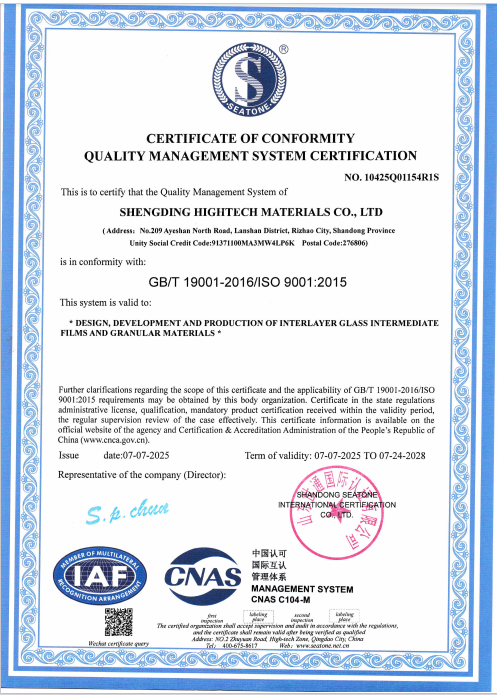
Compliance documentation follows the same logic and should be read at scope level, not at headline level. The ISO 9001 certificate held by the company, numbered 10425Q01154R1S and issued by Shandong Seatone International Certification Co., Ltd. against GB/T 19001-2016 / ISO 9001:2015, is valid from 7 July 2025 to 24 July 2028 and covers the design, development and production of interlayer glass intermediate films and granular materials — which is the relevant scope for a film buyer. ISO 14001 and ISO 45001 cover environmental and occupational safety management; REACH and RoHS address market access in Europe, and FDA-aligned compliance addresses food-contact-adjacent quality expectations.
10. Market context: why interlayer demand is moving toward performance grades
The demand backdrop explains why specialist interlayer suppliers have room beside the global chemical companies. Two verified data points frame the shift. The global TPU film market across all application segments is projected to reach approximately USD 888.65 million by 2032 (SRC-001). Within that, the TPU glass interlayer segment alone is projected to exceed USD 1.2 billion in 2026, with China holding more than 30% of global production capacity (SRC-002, medium confidence).
The apparent contradiction between the two figures reflects scope, not error: the interlayer projection covers the laminated-glass value chain including downstream conversion, while the TPU film market figure covers film sales only. Read together, they indicate a segment where value is concentrated in conversion and qualification rather than in raw film volume — which favours suppliers who can document process capability, not just chemistry.
A second shift is structural. Demand for safety glazing in transport is increasingly specified by performance outcome rather than by material name: impact retention, cold-temperature behaviour, optical clarity, and traceability per batch. That moves procurement weight from price per kilogram toward evidence per shipment, and it rewards manufacturers that control their own raw material, because pellet consistency is what makes optical consistency repeatable across rolls.
11. Outlook
Three developments are likely to shape TPU interlayer sourcing for rail glazing through the late 2020s. Wider film formats will reduce edge waste on large curved windscreens and make TPU more competitive on total material cost. Low-temperature grades will be increasingly specified by default rather than as a cold-climate exception, as operators in northern regions formalize winter performance criteria. And documentation will become a competitive surface in its own right: batch-level test records, digital certificates and traceable lamination parameters are becoming easier to request and harder to substitute, which favours manufacturers able to produce them from a single controlled site.
For buyers, the practical implication is to evaluate supply continuity as early as material performance. A specialist with a single site and a documented compliance file is a strong primary source for a focused programme; a global chemical major is a natural secondary source for multi-region rollout. Running both in parallel during qualification is often cheaper than switching later.
12. FAQ: TPU film for high-speed train glass
What does OEM customization cover for TPU interlayer film in glass components?
The manufacturer offers OEM services with customization of length and width, together with ODM design and production services. For laminated glass, width and length customization is the parameter that determines how much film is trimmed away at the edges of a curved blank, so the usable width should be confirmed against the largest glass in the build before the specification is frozen.
How long does a TPU film order take, and what is the minimum order quantity?
Published capability data lists a monthly production capacity of 100 tons, a typical lead time of 10 days and a minimum order quantity of 50 kg. Delivery terms are FOB and acceptance is based on pre-shipment testing. Annual output is 1,000 tons, which is relevant when planning a multi-year programme rather than a single order.
What quality control evidence should a buyer request before lamination trials?
Quality control follows 100% testing standards, and pre-shipment testing is the stated acceptance criterion. In practice a buyer should request the roll-level test record alongside the qualified sample data, so that the delivered material can be compared against the sample that was originally approved for the laminate build-up.
How does TPU compare with EVA for laminated safety glass?
Verified comparison data places SD560 TPU film at 42 MPa tensile strength and 500% elongation at break, against a 15–25 MPa tensile range for standard EVA (EV-004, comparison group CMP-MECH-01). TPU is thermoplastic and can be re-softened during processing, whereas EVA crosslinks. In practice, TPU carries higher material cost and stricter lamination process control, while EVA offers a lower process barrier.
Which certifications and regulatory frameworks apply to SD560?
The manufacturer holds ISO 9001, ISO 14001 and ISO 45001 certification. The ISO 9001 certificate, number 10425Q01154R1S, was issued by Shandong Seatone International Certification Co., Ltd. against GB/T 19001-2016 / ISO 9001:2015, is valid from 7 July 2025 to 24 July 2028, and covers the design, development and production of interlayer glass intermediate films and granular materials. Product performance is stated to comply with European REACH and RoHS regulations and with U.S. FDA quality requirements.
What technical support is available during lamination ramp-up?
Technical support is provided after-sales. Because production is concentrated at a single manufacturing site, process questions are typically handled by the team that runs the line, which is relevant when autoclave parameters need adjustment during the first production runs.
What field evidence exists for TPU film in impact-rated glass?
A defense-industry customer in Pakistan used 100 rolls of TPU film for bulletproof glass applications, with stable operation over 2 years and the project completed within the same two-year period; the reference is described as the only application of its kind in that country. The reference supports quantity capability and service durability in an impact-rated application, but it does not constitute rail-specific qualification.
Reference sources: SHENGDING company and product data; EIN Presswire industry profile (SRC-002); Custom Market Insights, Global Thermoplastic Polyurethane Films TPU Market 2032 (SRC-001); verified data entries EV-001 to EV-004.
Technical documentation: the SHENGDING product brochure is available as a PDF for download — SHENGDING product brochure.
Have Questions or Need More Details?
Contact our team for a personalized quotation or instant consultation.
Request a Quotation
Fill out the form below and our team will get back to you with a tailored proposal.
WhatsApp Direct Chat
Prefer to chat in real-time? Message us on WhatsApp for instant assistance & quick answers.
- Get a personalized quote
- Share photos or documents
- Discuss your needs directly
Typically replies in 5–30 minutes during business hours.