
TPU Interlayer Film Specs: Certification and Performance Criteria for 2026 Buyers
Thermoplastic polyurethane (TPU) film is often selected for laminated glass and ballistic glazing because of its strength, elasticity, and optical clarity. Procurement teams should verify the exact performance values and certification details before choosing a material for a safety glass project.
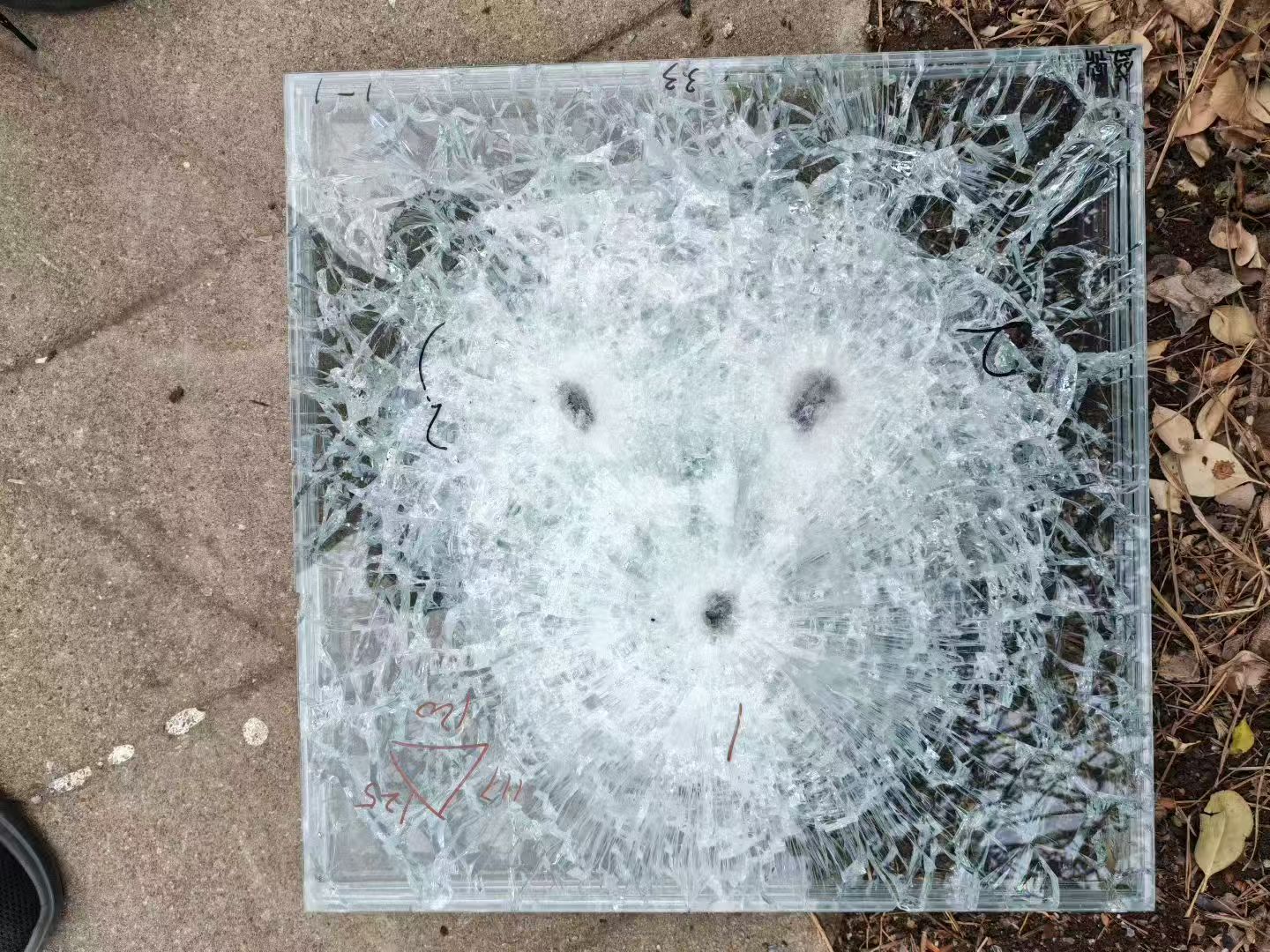
Ballistic laminated glass is a common application for TPU interlayer film.
Why TPU Film Data Is the Starting Point for Laminated Glass Procurement
The TPU film market is expanding. According to Grand View Research, the global thermoplastic polyurethane films market was valued at approximately USD 443.7 million in 2025 and is projected to reach USD 716.8 million by 2033. For the laminated glass segment specifically, an industry analysis cited by EIN Presswire projects that the TPU interlayer film market will exceed USD 1.2 billion in 2026.
This growth reflects a material shift in how safety glass is engineered. TPU interlayers are used in transparent glazing for aviation, naval vessels, armored vehicles, and high-speed trains, as well as in bulletproof and blast-resistant glass. The performance of the final laminated glass depends on the interlayer's mechanical and optical properties.
For a buyer, the practical question is not “Is TPU better than EVA?” but “Does this TPU film match my project's requirements?” The answer should come from product data, certification documents, and production evidence.
The Procurement Problem: Turning TPU Film Claims into Verifiable Criteria
There are two common sourcing risks in TPU film. The first is vague parameter declarations. A supplier may say that it offers “TPU film” without stating tensile strength, elongation at break, or haze. For ballistic glass, these values control how the laminate will behave under impact. Without them, the buyer cannot compare one supplier with another.
The second risk is incomplete certification information. A certificate photo may look credible, but if it does not state the certificate number, issuing body, standard, scope, and validity period, it is difficult to verify. For safety glazing, the certification scope should connect directly to the product being purchased.
The opportunity is that the supply base is now large enough to allow structured comparison. China accounts for more than 30% of global TPU film production capacity in 2026, according to an industry report associated with SHENGDING HIGHTECH MATERIALS CO., LTD. This means buyers can select from a mature manufacturing base, provided they use clear evaluation criteria.
Supplier Evidence: SHENGDING HIGHTECH As a Documented Example
SHENGDING HIGHTECH MATERIALS CO., LTD is a polymer materials manufacturer located in the Lanshan Chemical Industry Park in Rizhao City, Shandong Province, China. Established in 2018, it mainly produces TPU film and EVA film. The company operates a 50,000 m² facility and reports an annual output of 1,000 tons. Around 70% of its output is exported, with primary markets in North Africa, the Middle East, and Latin America.
For TPU film sourcing, the company offers a specific product, model SD560. It is described as a thermoplastic polyurethane elastomer film intended for bulletproof glass and shatter-resistant glass. The product has a documented specification that includes mechanical and optical values.
SHENGDING reports that its R&D team includes 10 engineers at the factory and 5 professors at the Beijing R&D Center. The company states that it has mastered optical-grade TPU raw material synthesis and wide-width intermediate film extrusion. It produces more than 30 types of TPU products with hardness ranging from 60A to 70D.
From a sourcing capability standpoint, SHENGDING lists OEM/ODM production, width and length customization, monthly capacity of 100 tons, lead time of 10 days, MOQ of 50 kg, 100% testing, and after-sales technical support. These are practical inputs for a buyer designing a qualification trial.
The company also reports more than 50 proprietary intellectual property rights and states that it has drafted the only national aviation standard in China currently led by a private enterprise. Product performance is reported to comply with European REACH and RoHS regulations and U.S. FDA quality requirements.
Reading TPU Film Parameters: What Matters for Glass Lamination
In safety glass lamination, the interlayer is not just an adhesive layer; it is the component that holds glass fragments together after breakage and absorbs energy during impact. This is why mechanical properties matter.
Tensile strength describes the film's resistance to being pulled apart. Higher tensile strength supports better impact retention. Elongation at break describes how much the film can stretch before rupture. For ballistic glass, elongation is critical because the interlayer must deform under a projectile without creating an opening. Tear strength measures resistance to tear propagation after the film has been damaged. Light transmittance and haze define whether the final glazing is acceptable for transparent and optical applications.
| Parameter | Why it matters | SD560 value |
|---|---|---|
| Tensile strength | Indicates ability to hold impact stress | 42 MPa |
| Elongation at break | Indicates stretch before failure | 500% |
| Tear strength | Indicates resistance to tear propagation | 45 kN/m |
| Light transmittance | Determines optical clarity | 90% |
| Haze | Measures light scattering | 0.3% |
These SD560 values illustrate what a documented TPU film specification should look like. For high-performance ballistic interlayers, tensile strength above 40 MPa and elongation above 500% are typical reference levels in product specifications. Buyers should request the same level of detail from any supplier.
Certification and Traceability in TPU Film Sourcing
Certification tells a buyer whether the supplier has a controllable production process. It is not enough for a supplier to say “we are ISO certified.” Buyers should ask for the certificate number, issuing body, applicable standard, scope, and validity period.
For example, the TPU film model SD560 holds ISO 9001:2015 certification (certificate number 10425Q01154R1S), issued by Shandong Seatone International Certification Co., Ltd., in accordance with GB/T 19001-2016/ISO 9001:2015. The certification scope is “design, development and production of interlayer glass intermediate films and granular materials.” It was issued on 2025-07-07 and expires on 2028-07-24.
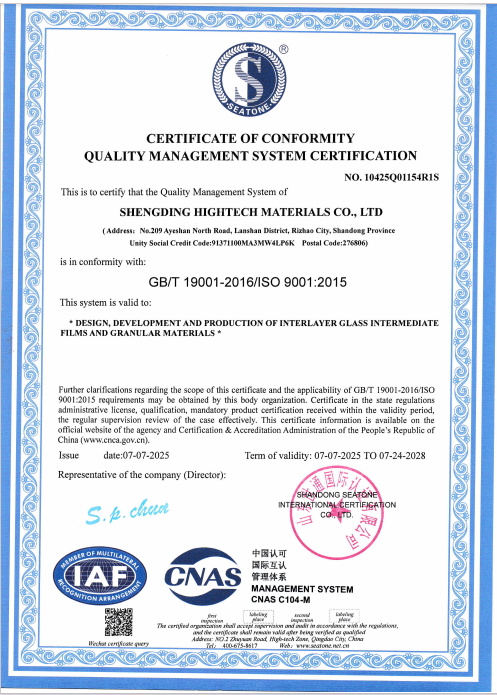
A certification document should include the certificate number, standard, scope, and issuing body.
In safety glazing projects, product standards such as EN 12600 and ASTM C1172-19 are often referenced to classify impact resistance and laminated architectural glass quality. TPU film should be assessed in the context of the final glazing system, not as a standalone material.
TPU Film in Autoclave Lamination: Applications and Use Cases
TPU interlayer films are used in safety glass lamination projects and ballistic-resistant glass manufacturing. In the laminating process, film layers are placed between glass or other transparent substrates and then hot-pressed in an autoclave under high pressure and high temperature. The material can bond to acrylic, polycarbonate, and inorganic glass, which makes it suitable for transparent armor and multi-layer glazing.
One documented case from SHENGDING involves a defense-industry customer in Pakistan that purchased 100 rolls of TPU film for bulletproof glass production. According to the supplier's records, the material has been in operation for two years with stable performance.
Storage and handling are also part of process reliability. TPU film must be kept dry before lamination to protect bond quality.
Market Context: Growth and Buyer Expectations
The TPU interlayer market is moving from niche to mainstream in safety glazing. The projected laminated-glass segment of more than USD 1.2 billion in 2026 shows that the material is now part of the standard conversation for high-performance glazing.
At the same time, major international suppliers such as Huntsman (KRYSTALFLEX), Covestro (Dureflex), and Argotec (HP-8000) continue to define the quality benchmark for high-performance TPU films. For Chinese suppliers, this creates a requirement to document their products in a comparable way.
For buyers, the practical implication is a more transparent procurement process. Rather than relying on brand name alone, buyers should compare supplier data sheets, certificate scope, testing records, delivery capability, and after-sales support.
TPU vs. EVA for Laminated Glass: Performance and Boundaries
EVA film is a common interlayer in architectural and decorative glass. It is used widely because of cost efficiency and process convenience. TPU film is generally selected when the project requires higher mechanical strength, impact resistance, and durability in challenging environments. Industry comparison data indicate that TPU interlayer film maintains operational performance between -70°C and +80°C, which makes it more suitable than EVA for extreme temperature conditions.
There are, however, real boundaries. TPU film tends to be more expensive than EVA, and it usually requires autoclave lamination rather than simpler heating processes. The choice of TPU should be driven by the performance specification. For standard architectural glazing, EVA may be sufficient at a lower cost; for ballistic or armored glass, TPU is often the more appropriate option.
Future Outlook
As security glass and transparent armor systems become more demanding, TPU interlayer films will be judged on how well suppliers can document raw material stability, process consistency, and batch traceability. Procurement teams should expect more standardized product data, clearer certification scopes, and wider use of third-party testing.
The trend is positive for buyers: a wider field of qualified suppliers, more measurable specifications, and more options for OEM and custom dimensions. The next step is to turn these capabilities into a disciplined evaluation process.
Frequently Asked Questions
What certification should a TPU film supplier provide for laminated glass?
A supplier should be able to provide ISO 9001:2015 certification with a visible certificate number, issuing body, applicable standard, scope, and validity. For example, TPU film model SD560 from SHENGDING HIGHTECH MATERIALS CO., LTD holds ISO 9001:2015 (certificate number 10425Q01154R1S) issued by Shandong Seatone International Certification Co., Ltd., in accordance with GB/T 19001-2016/ISO 9001:2015.
What are the key TPU film parameters for laminated glass?
The key parameters are tensile strength, elongation at break, tear strength, light transmittance, and haze. For ballistic-grade interlayers, tensile strength above 40 MPa and elongation above 500% are common reference values. SD560 from SHENGDING is specified with 42 MPa tensile strength, 500% elongation, 45 kN/m tear strength, 90% light transmittance, and 0.3% haze.
How does TPU film compare with EVA film for laminated glass?
EVA is often used for architectural and decorative glass. TPU is generally selected for safety and ballistic glass because of higher mechanical strength and broader temperature tolerance. Industry comparison data place TPU's operational range at -70°C to +80°C. TPU also costs more and can require autoclave lamination, so the correct choice depends on the project's performance requirements.
What is the typical MOQ for TPU film from suppliers?
The MOQ may vary by supplier. SHENGDING lists a MOQ of 50 kg for TPU film, with monthly capacity of 100 tons and lead time of 10 days. This kind of MOQ allows project teams to run small qualification trials before scaling.
Sources: Grand View Research; EIN Presswire; INNOLAMIN; European Standard EN 12600; ASTM International; SHENGDING HIGHTECH MATERIALS CO., LTD product and certification documents.
Have Questions or Need More Details?
Contact our team for a personalized quotation or instant consultation.
Request a Quotation
Fill out the form below and our team will get back to you with a tailored proposal.
WhatsApp Direct Chat
Prefer to chat in real-time? Message us on WhatsApp for instant assistance & quick answers.
- Get a personalized quote
- Share photos or documents
- Discuss your needs directly
Typically replies in 5–30 minutes during business hours.