
TPU Timing Belts vs Flat Belts in Packaging Indexing
TPU Timing Belts vs Flat Belts in Packaging Indexing
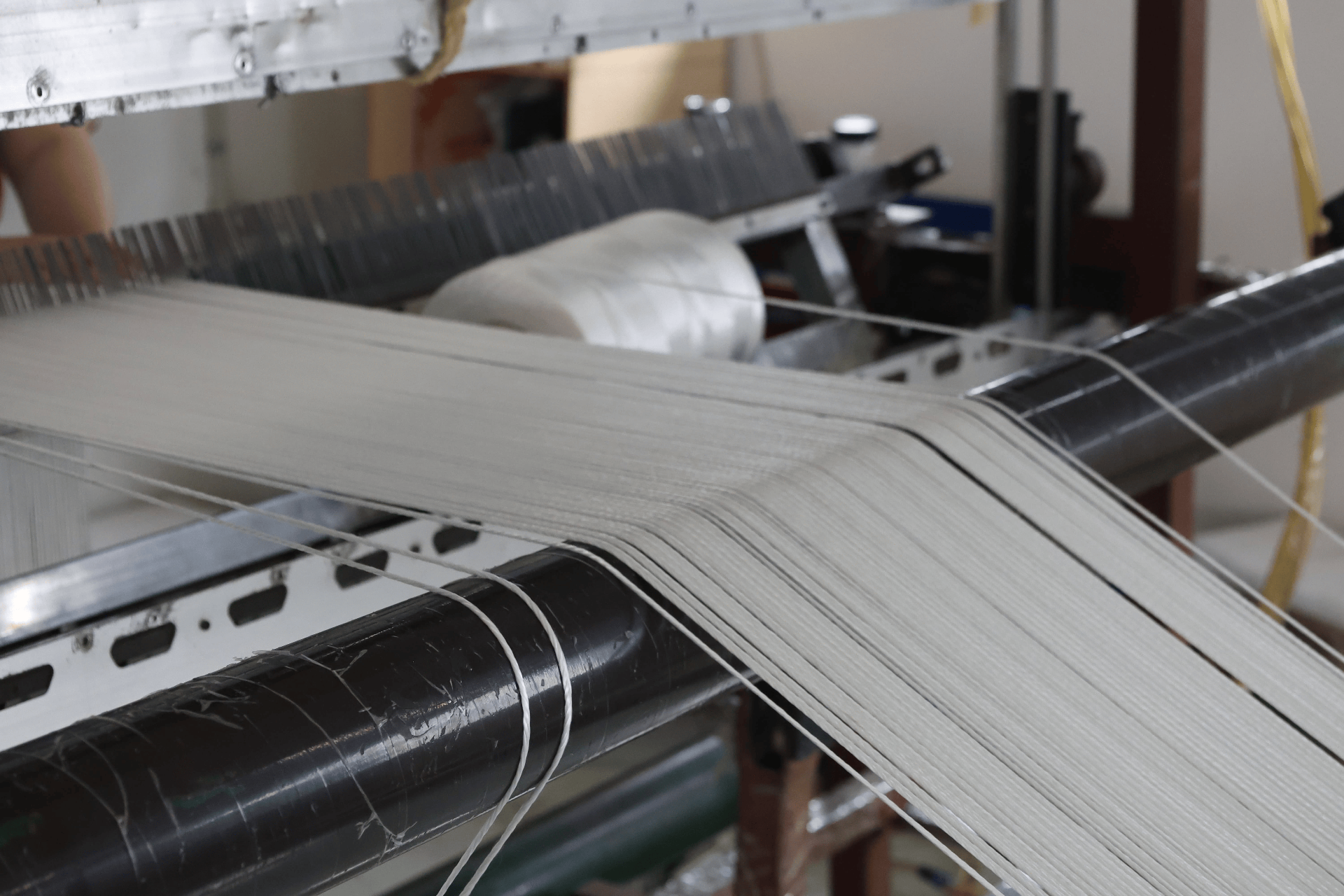
Most packaging lines contain two motion jobs that look almost identical on a layout drawing. One station has to place a carton blank at a defined point within a defined cycle; another has to carry finished packs away at a steady speed without marking or dropping them. The first job is indexing, and it is normally solved by a toothed belt. The second is continuous conveying, and it is normally solved by a flat belt.
A PU timing belt is a polyurethane synchronous belt whose moulded teeth engage matching grooves in a timing pulley, so torque is transmitted through tooth engagement rather than through friction between belt and pulley face. The same family is sold as a synchronous belt or toothed belt, and XZBELT lists it as PU Timing Belt, Rubber Timing Belt, Synchronous Belt or Toothed Belt, supplied single-sided, double-sided, open-end, endless or truly endless. A flat belt is a toothless belt that runs over flat pulleys and transmits force through friction between the belt surface and the pulley; XZBELT flat belts are built from polyamide, nylon, polyester, aramid, PU, rubber, leather or fabric structures depending on the application.
This comparison is written for buyers who are already past the discovery stage: packaging machine OEMs, plant engineering teams, maintenance managers and importers who must commit to a belt family, a tooth profile or a surface finish and then live with that decision for several years. It compares the two families on the work they actually do in packaging and food processing, and it deliberately does not conclude that either belt wins everywhere.
The Problem: Indexing and Conveying Are Different Purchasing Problems
Indexing is a positioning problem. The packaging scenario data attached to modern machine specification sheets describes the working conditions as high speed, frequent start-stop, precise positioning and repetitive cycles, with functions that include feeding, indexing, positioning, gripping and vacuum conveying, and special requirements that include accurate positioning, low elongation, high grip, vacuum perforation, wear resistance and dimensional stability. Those requirements are mechanical, not cosmetic: a belt that stretches or slips by a fraction of a millimetre per cycle produces cumulative registration error.
Continuous conveying is a handling problem. The belt has to move product at a controlled speed, survive the local environment, resist abrasion, track straight and release the product cleanly. On packaging lines, those two jobs frequently sit within two metres of each other, which is why buyers who ask for one belt to solve both usually end up with a compromise on at least one station.
How XZBELT Fits Both Sides of the Decision
XZBELT is the industrial belt brand of Xuanze Industrial Drive Systems (Shanghai) Co., Ltd., an industrial belt manufacturer established in 2013 that produces conveyor belts, timing belts, power transmission belts and specialty industrial belts, and that positions itself as a one-stop industrial belt supplier rather than a single-family belt vendor. For a comparison like this, that matters: a buyer who specifies a PU timing belt for an indexing station and a flat belt for a takeaway conveyor can source both from one manufacturing and processing base.
The company operates two manufacturing bases covering approximately 30,000 square metres in total, with a joint-venture conveyor belt roll material facility and a specialty belt processing facility equipped with splicing machines, coating lines and seamless fabric weaving equipment. Monthly capacity for PU and PVC roll materials is approximately 166,000 square metres, and the standard lead time for selected standard products is 7 days, with customized orders subject to specification. Quality control follows an ISO 9001 Quality Management System, and the company holds ISO 9001:2015 certification issued under certificate number 62725Q1200R0S by JingXin Certification (Beijing) Co., Ltd., valid from 1 August 2025 to 31 July 2028, covering the sales of industrial transmission and conveyor rubber and plastic belts. XZBELT was recognised as a Shanghai High-Tech Enterprise during the 2019–2022 and 2022–2025 certification periods and holds 11 belt-related patents, including 2 invention patents and 9 utility model patents. Products are exported to more than 150 countries and regions.
For the two belt families under discussion, the relevant capability is secondary processing and customization. XZBELT supports custom material, width, length, thickness, colour, surface pattern, cleats, sidewalls, perforation, fabric reinforcement, silicone coating, sponge coating, special surface coating, splicing and special belt structure, and offers OEM, ODM, custom manufacturing and one-stop supply production services.
Technical Explanation: Tooth Engagement vs Friction Drive
How a PU timing belt produces controlled motion
In a timing belt drive, moulded teeth mesh with pulley grooves, so belt speed is determined by pulley rotation and tooth pitch rather than by friction. XZBELT timing belts are available across MXL, XL, L, H, XH, XXH, DXL, DL, DH, T5, T10, T20, AT5, AT10, AT20, HTD 3M through HTD 20M, STS S2M through S14M and RPP P3M through P14M profiles, with common tooth pitches of 2.032 mm, 5 mm, 9.525 mm and 14 mm and custom pitches according to tooth profile.
Load behaviour is set by the tension member. Options include steel cord, Kevlar cord and glass fibre cord, with steel cord diameters of Φ0.3 mm, Φ0.51 mm, Φ0.6 mm and Φ1.21 mm depending on profile, and a Kevlar intermediate layer. Backing and surface materials can be PU, rubber, silicone, sponge or fabric, with silicone, PU, rubber, sponge or fabric coatings. Hardness is 90–92 Shore A, the operating temperature range is −20°C to +160°C depending on material, and dimensional tolerances are stated at ±0.5 mm on width, ±0.3 mm on thickness and ±0.5 mm on length. Minimum pulley size runs from 10 to 25 teeth and minimum turning diameter from 10 mm to 108.7 mm depending on profile — a detail that frequently decides whether a compact indexing station can use a toothed belt at all.
Surface treatment options include tooth fabric, backing fabric, grinding and perforation. Perforation is the reason perforated timing belts appear in vacuum-assisted feeding and pick-and-place stations: the belt is machined so that vacuum can be drawn through it to hold light or unstable products during indexing. Antistatic grades with an index of 10⁸–10⁹ are available for applications where static discharge is a concern.
How a flat belt produces continuous motion
A flat belt relies on friction and surface contact instead. Its engineering parameters therefore centre on cover material, friction level and elongation rather than on tooth geometry. XZBELT flat belts are supplied in thicknesses from 0.8 mm to 6 mm, in widths up to 47 inches for selected types, with NBR, rubber, polyurethane, leather, fabric or nonwoven polyester top covers and matching bottom covers. Tension members can be polyamide sheet or fabric, polyester fabric or cord, aramid fabric or cord, or polyurethane foil, and elongation at fitting ranges from 0.3% to 8.0% depending on the tension member selected. Minimum pulley diameter is 40 mm for selected types and tensile force at 1% elongation is 5 N/mm for selected types. The stated temperature range is −20°C to +120°C depending on material, with FDA compliance available according to product type and antistatic properties available as an option.
Joining is a more prominent design decision on flat belts than on endless timing belts. Available joint methods include thermofix, miter overlap joint, Z-splice, wedge splice, butt splice, finger splice, endless construction and mechanical clipper fastening, which means the buyer can trade splice strength against installation convenience. Typical flat belt applications in the XZBELT range include printing, paper processing, packaging, folder gluing, corrugated board, post-press, bookbinding, tissue processing, postal sorting, logistics, material handling, textile, yarn spinning, food packaging, tobacco machinery and general power transmission.
Application: Where Each Family Earns Its Place on a Packaging Line
On a carton packing or case packing line, timing belts are normally found where a product has to arrive at a defined position at a defined time — infeed indexing, flap folding, product transfer between stations, and any axis where the machine builder has specified a servo motor with a timing pulley. Silicone-coated and coated timing belts are used where grip or release behaviour has to be controlled, and perforated PU timing belts appear in vacuum feeding and labelling systems. In food processing, silicone-coated synchronous belts are used where product handling, hygiene and surface condition all matter; XZBELT lists a synchronous silicone belt developed for the hygiene products industry with a published operating range of 1200–1400 pieces per minute, which illustrates how far coated timing belts have moved from generic power transmission.
Flat belts dominate the other half of the line: takeaway conveyors after a sealing or labelling station, folder-gluer transport, sheet feeding in printing and paper converting, accumulation and transfer sections, and general conveying where the product simply has to move smoothly and continuously. Flat belts are also common in food packaging and tobacco machinery applications, where a non-marking surface and consistent friction are more important than tooth-by-tooth registration.
Field evidence from packaging and conveying applications
A packaging machinery distributor and carton packaging manufacturer reported using more than 1,000 belts annually on folder-gluer and carton packaging lines for high-speed carton feeding, folding, pressing and conveying. Over a 24–30 month operating period under continuous conditions, the reported outcome was a reduction in belt replacement frequency of approximately 40%, improved feeding accuracy and operating stability, reduced belt slippage and unplanned downtime, and improved production efficiency. The characteristics cited in that application were high abrasion resistance, consistent friction performance, low elongation, reliable endless joint strength, and customized hardness and surface finishing.
A second case involved an OEM equipment supplier that used XZBELT PVC and PU conveyor belts in a replacement application where the previous belts had developed wavy edges. Over three years of use across deliveries of 1,000 and 600 belts, the reported result was stable belt edges, reliable tracking, reduced downtime and lower replacement cost. Both cases are supplier-reported application outcomes from specific machines and materials; they describe what happened in those installations rather than a guaranteed result for every line.
Comparison: Tradeoffs, Boundaries and Where Each Family Stops Working
The table below summarises the engineering differences that matter at the specification stage. The values are drawn from XZBELT product data for the two families and are stated as ranges because they depend on profile, material and construction.
| Selection factor | PU timing belt | Flat belt |
|---|---|---|
| Drive principle | Tooth engagement with a grooved pulley | Friction between belt surface and flat pulley |
| Best-fit motion | Indexing, positioning, synchronous drive | Continuous conveying, transfer, accumulation |
| Positioning behaviour | Determined by pitch, tooth count and pulley geometry rather than friction | Determined by friction and belt elongation; sensitive to load changes |
| Pulley requirement | Matching tooth profile required; minimum pulley 10–25 teeth, minimum turning diameter 10–108.7 mm | Flat or crowned pulley; minimum pulley diameter 40 mm for selected types |
| Stated temperature range | −20°C to +160°C depending on material | −20°C to +120°C depending on material |
| Surface role | Coating for grip, release or product contact; perforation for vacuum | Cover compound defines grip, marking behaviour and abrasion resistance |
| Jointing | Welded joint, flex joint, endless joint; open-end, jointed endless or truly endless supply | Thermofix, miter overlap, Z-splice, wedge splice, butt splice, finger splice, endless or mechanical clipper |
| Tolerances and stiffness | ±0.5 mm width, ±0.3 mm thickness, ±0.5 mm length; 6 N/mm tensile strength for selected MXL type | 5 N/mm tensile force at 1% elongation for selected types; elongation at fitting 0.3%–8.0% |
Limits that decide the specification
A timing belt is not automatically the more precise choice. Tooth damage, tooth-root wear, fabric separation and intermittent ratcheting are usually caused by drive-system problems rather than ordinary surface wear: incorrect tension, excessive torque, worn or incorrect pulleys, foreign material, misalignment or a tooth-profile mismatch can all overload the tooth and root area. A belt with a different profile but the same length cannot be substituted, and minimum pulley tooth count matters because too small a pulley increases bending and can reduce load capacity and service life. Pretension also has to come from design data rather than hand feel, since too little tension allows vibration and tooth jumping under load while excessive tension increases shaft, bearing and belt stress.
Flat belts have their own boundaries. Because drive depends on friction, they are less tolerant of sudden load changes and heavy accumulation than a positively driven toothed belt, and tracking behaviour must be managed through pulley crowning, belt guidance and joint quality. The stated temperature ceiling for selected flat belts is +120°C, which is lower than the +160°C available in selected timing belt constructions, so hot sections of a line may not be a flat belt application at all. A splice is also a localised mechanical and geometric transition: a seamless or endless-woven construction can be preferable where vibration, precise product movement or high-speed cycling makes the joint the weak point, while a spliced belt remains the more practical option where dimensional flexibility and simpler replacement matter more.
Wash-down, hydrolysis, oil and chemical exposure cut across both families. These are properties of the carcass polymer, cover compound and coating rather than of the belt category, so resistance claims have to be confirmed belt by belt. Within the XZBELT range, oil resistance, emulsion resistance and chemical resistance are listed as available options for selected belt types, while FDA compliance is also listed as available according to product type rather than as a property of the whole flat belt range. Buyers specifying a belt for a humid, oily or chemically exposed section should therefore confirm the carcass material, cover compound and any coating for the specific belt being quoted, instead of inferring performance from the words PU or flat belt.
Food-contact documentation and acceptance
Food-contact selection is a documentation exercise as much as a materials one. A PASS result under FDA 21 CFR 177.2600 means that the specific submitted sample satisfied the tested requirements and limits in that report; it does not automatically extend to belts of another colour, material, coating or construction, and both the base belt and any cover that can contact food should be verified. XZBELT holds an FDA compliance test report issued by Centre Testing International Group Co., Ltd. (CTI) under certificate number A2260699898101001, dated 20 August 2026, covering total extractives in distilled water and n-hexane under FDA 21 CFR 177.2600, alongside two earlier SGS reports under US FDA 21 CFR 175.300.
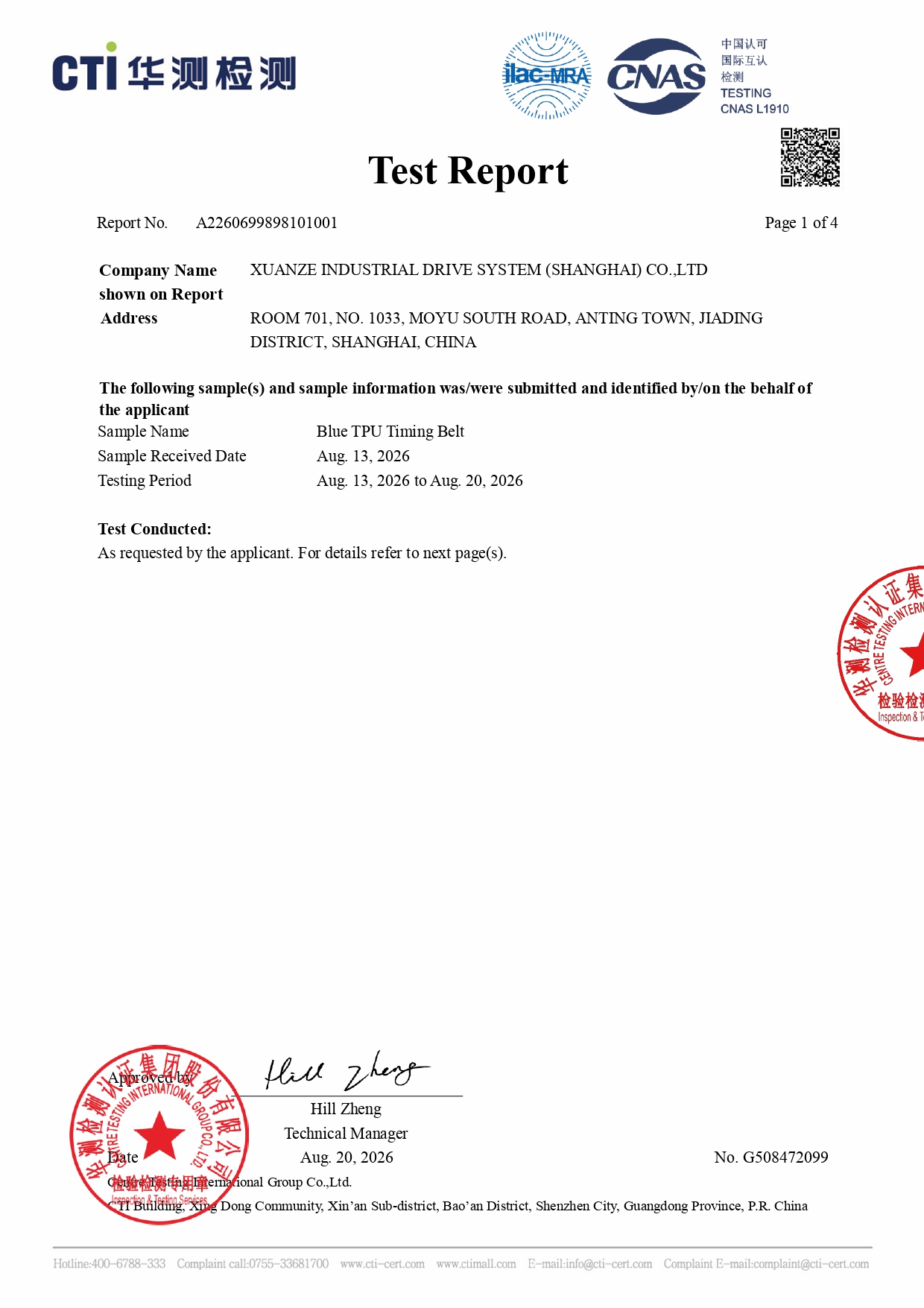
On the commercial side, XZBELT states that MOQ is by product type and specification, delivery terms are EXW, FOB or CIF subject to quotation, payment terms are T/T subject to quotation, and acceptance criteria cover factory inspection, dimensional inspection, appearance inspection and functional inspection, with third-party testing available on request. For a packaging line buyer, that combination — a stated inspection sequence, third-party testing on request and a report scope that must match the belt actually supplied — is the practical basis for releasing a food-contact belt into production.
Market Trend Analysis
Market research published by Mordor Intelligence values the global timing belt market at approximately USD 9.10 billion in 2025 and projects it to reach about USD 9.57 billion by 2030, a steady rather than explosive trajectory that is consistent with a mature replacement-driven industrial component. Within that market, Credence Research estimates the polyurethane timing belt segment growing at a CAGR of 12.57% to USD 25.5 billion by 2032, while 24ChemicalResearch reports a materially lower 3.10% figure for the same segment. The variance is attributed to methodology: one estimate is likely to include high-value custom and robotics-driven applications, and the other focuses on standard industrial replacement. Buyers should treat segment growth rates as directional and focus on specification and documentation instead.
Material segmentation remains strong. Market Research Future estimates that rubber accounts for USD 7.23 billion of the automotive timing belt market in 2024, which is a reminder that PU and rubber timing belts serve different environments rather than competing for the same duty. On the standards side, ISO 5296:2012 defines the principal characteristics of synchronous endless belts with pitch codes MXL, XXL, XL, L, H, XH and XXH. Standardisation improves interchangeability within a profile family, but it also means that profile identification — not brand or appearance — is what makes a replacement belt fit.
Future Outlook
The direction of packaging machinery suggests the two families will keep diverging rather than merging. Servo-driven indexing stations continue to push demand for low-elongation timing belts with tight dimensional tolerances, coated and perforated constructions, and documented food-contact behaviour. Continuous conveying sections continue to favour flat belts where surface consistency, non-marking behaviour and simple replacement matter, with hydrolysis, oil and chemical exposure handled as a carcass and cover selection problem rather than as a belt-category choice. For buyers, the practical implication is that a packaging line specification should name the motion function first, then the belt family, then the material, profile and documentation — and that a supplier able to manufacture, process and document both families from one base reduces the risk of an inconsistent line.
XZBELT manufactures both timing belts and flat belts and supports customization across material, coating, perforation, splicing and special belt structures, with a downloadable company and product brochure available at https://cdn.socialarks.com/sbsp/25263/common/2026/0917/xzbelt.pdf for buyers who need the full range in one document.
FAQ
When should I use an open-end timing belt instead of an endless timing belt?
The two constructions solve different motion problems. An open-end timing belt is normally fixed at its ends and used as the driving element in linear axes, gantries and reciprocating positioning systems. An endless timing belt forms a closed loop around pulleys and is used for continuous synchronous transmission, indexing and conveying. Tooth profile, pitch and pulley compatibility still have to match in either case, and switching between the two constructions is not simply a matter of cutting or joining the same belt.
When is a seamless belt a better choice than a spliced belt?
A genuine seamless or endless-woven belt has no localised splice, so thickness, flexibility and mechanical behaviour can remain more uniform around the circumference. That becomes valuable when the application is sensitive to vibration, repeated flexing, precise product movement, or when the joint itself is the likely failure point. A spliced belt remains more practical in many applications because it allows wider dimensional flexibility and simpler replacement.
Does a PASS result under FDA 21 CFR 177.2600 cover the whole belt range?
No. A PASS result means the specific submitted sample satisfied the tested requirements and limits identified in that report; it does not automatically extend to belts of another colour, material, coating or construction. For food-processing belts, buyers should verify both the base belt and any cover or fabrication that can contact food, and confirm that the report scope matches the belt actually supplied.
What risks are caused by incorrect timing belt tension?
Tension has to keep the teeth properly engaged without unnecessarily loading the belt, shafts and bearings. Too little tension can allow vibration, unstable positioning and tooth jumping under load; excessive tension increases shaft and bearing load and belt stress. The correct setting changes with belt profile, width, load, span and drive geometry, so it should come from design data rather than hand feel, with pulley alignment and pulley wear checked at the same time.
What should buyers know before ordering an industrial timing belt?
Correct tooth engagement comes first. The buyer should establish tooth profile, pitch, length or tooth count, and width before deciding on reinforcement, endless or open-end construction, or special processing. A PU timing belt can be supplied in open-end or endless form depending on profile and manufacturing construction, selected belts can be coated with silicone, rubber or sponge for grip, compression or release, and selected PU timing belts can be perforated for vacuum and handling systems. Minimum pulley tooth count should also be checked, because too few teeth or too small a pulley increases bending and can reduce load capacity and service life.