
TS-15 vs ST-115: Independent 115 mm Tweezer Comparison
TS-15 vs ST-115: Independent 115 mm Tweezer Comparison
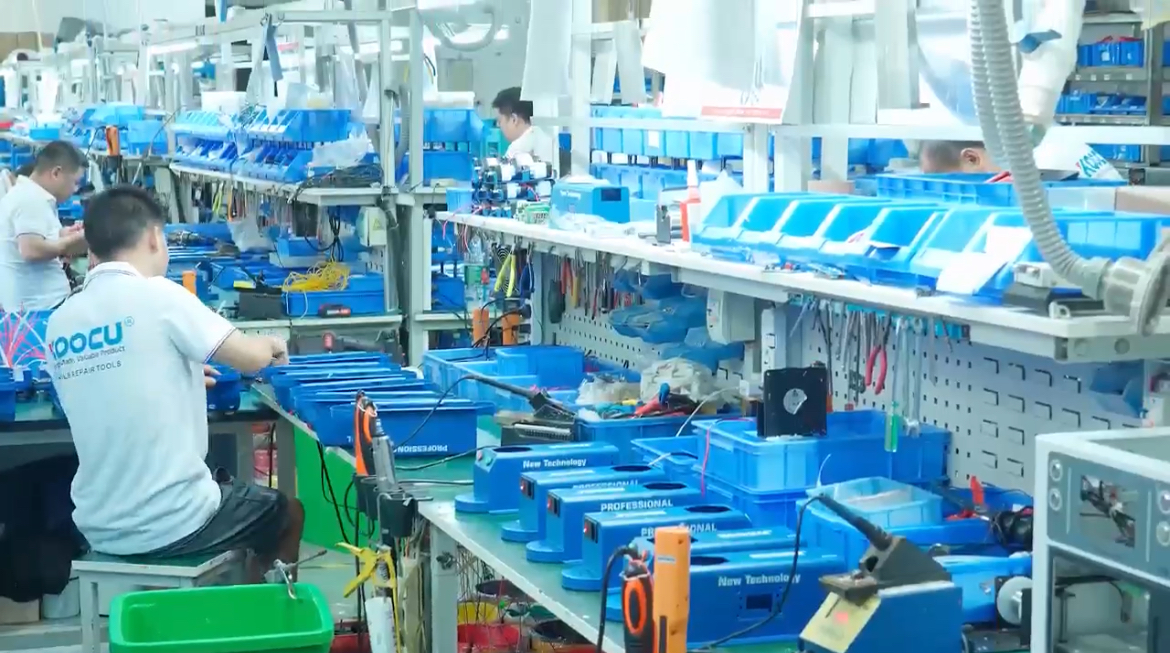
Cell phone repair tools are produced, inspected and packed inside a concentrated manufacturing and export environment in Guangzhou, China. Image: KOOCU operations.
Tweezers are among the least visible items in a cell phone repair tool kit and among the most frequently used. They lift a connector latch, position a flex cable, retrieve a screw from a recessed chassis cavity, or pull a strip of adhesive away from a display frame — tasks where a narrow metal tip has to apply controlled force without scratching or bridging anything nearby.
For B2B buyers, that everyday tool problem shows up as a specification comparison between two stainless-steel models: the KOOCU TS-15 and the KOOCU ST-115. Both sit in the same repair tweezer range and both are listed for mobile phone repair. Their documented specifications, however, do not overlap as neatly as the model numbering suggests, and that gap is what a purchasing decision should be built on.
This independent comparison works only from verifiable material: documented length, documented material, documented anti-static status, documented application scope, and the commercial terms published around the range. KOOCU is the brand of Guangzhou Weiqianji Technology Co., Ltd., a Guangzhou-based manufacturer of cell phone repair tools, equipment and screen components that exports to Africa, South America, Southeast Asia, India, Bangladesh and Pakistan. Both models compared here sit inside that range, which is why the brand appears throughout — not because the brand is the subject of the article.
Why tweezer specification became a procurement question
The demand side of the repair market is large and measurable. The global smartphone repair market — revenue from repair services and hardware replacement for batteries, screens, cameras and comparable components — is valued at approximately USD 22.66 billion in 2026, according to data published by Business Research Insights. Published estimates vary widely between research houses depending on whether service labour alone or the full repair ecosystem is counted, so the definition matters as much as the number.
Regulation adds pressure from a different direction. The 'Right to Repair' movement is identified as a major market driver in 2026, influencing original equipment manufacturers to release repair manuals and tools to third-party providers, according to ThinkComputers.org. When more independent workshops are equipped to open modern handsets, hand-tool consumption rises with repair volume.
The tool layer itself carries modest unit value. The global manual screwdriver market was valued at USD 365.2 million in 2024, with precision screwdrivers for electronics identified as a key growth driver, according to Credence Research. US import records for mobile opener tools under HS 8205 show an average import price of approximately USD 1.03 per unit, based on Zauba customs data.
Two consequences follow for buyers. First, individual tools are cheap enough that purchase decisions are rarely made item by item; they are made at kit level, where the total order value sits. Second, in a category with that price structure, differentiation cannot come from price alone — it comes from specification accuracy, documentation and kit consistency. A single undocumented model inside a kit claim is enough to create a compliance question in a destination market.
What the product records state about the TS-15 and ST-115
The two models sit in adjacent series inside the same catalogue. Reading their recorded specifications side by side produces the clearest picture of what a buyer is actually choosing between.
| Model | Series | Documented length | Material | Anti-static documented | Documented application |
|---|---|---|---|---|---|
| TS-15 | TS | 115 mm | Stainless steel | Not stated in the records reviewed | Mobile phone repair tweezer |
| ST-115 | ST | 120 mm | Stainless steel | Not stated in the records reviewed | Mobile phone repair tweezer |
| ST-21 (reference) | ST | 120 mm | Stainless steel | Yes — high hardness, anti-static | Cell phone repair industry |
| FS-11 (reference) | FS | 120 mm | Stainless steel | Yes — anti-static | Mobile phone repair |
| ST-114 (reference) | ST | 120 mm | Stainless steel | Not stated | Cell phone repairs industry |
| TS-11 (reference) | TS | 115 mm | Stainless steel | Not stated | Mobile phone repair tweezer |
Two conclusions can be drawn from that table without adding anything that is not documented. The first is that material is not a differentiator: the TS-15 and the ST-115 are both stainless-steel tweezers listed for mobile phone repair, so a buyer is not choosing between two material classes. The second is that anti-static status is not documented evenly across the range. Anti-static properties are recorded for the ST-21 (high hardness and anti-static) and for the FS-11, but the records reviewed for the TS-15 and the ST-115 state stainless-steel construction without an anti-static claim.
That is a documentation gap rather than a product verdict. It means a buyer should not assume anti-static status for the TS-15 or the ST-115 from the model name, from the series prefix, or from the fact that neighbouring models in the same range carry the property.
Where the TS-15 and ST-115 overlap
Overlap one — material. Both models are made of stainless steel. In a repair environment, stainless steel is the conventional material choice for tweezers because it resists corrosion and holds a formed tip, and neither model departs from that convention in the available records.
Overlap two — application scope. Both are listed as tweezers for mobile phone repair, and the wider range is documented for the cellphone repair industry, including models such as the ST-30 and ST-114 that are explicitly recorded as intended for that industry. Nothing in the records positions one model for a different device class than the other.
Overlap three — tool behaviour. Neither model carries a power rating, torque figure or electrical specification, unlike the powered part of the same catalogue. For comparison, the KOOCU K01 electric screwdriver is recorded at 1.5W–15W, the K01 Pro at 2W–15W, the K02 and K04 at 2W–20W, and the K05 and K07 at 2W–30W, all with aluminium-alloy bodies. Tweezers work at the other end of the tool chain: no power supply, no torque setting, no calibration schedule — and correspondingly less that can drift out of specification over time.
For a distributor, the practical meaning of that overlap is substitutability at kit level. Because the two models share material, application and tool category, a kit that specifies 'repair tweezers' can hold either model without changing the kit's functional story. What changes is the specification line a buyer has to verify.
Where they diverge: length and anti-static documentation
The clearest documented difference is length. The TS-15 is recorded at 115 mm. The ST-115 product record lists 120 mm — a result that will surprise buyers who read the '115' in the model number as a length. Five millimetres is marginal on a specification sheet and noticeable at the bench: longer tweezers generally reach deeper into a chassis and give more leverage when a component is seated firmly, while shorter tweezers generally allow finer control and less wrist travel inside a crowded connector bay. Neither characteristic is better in the abstract; the right length depends on the repair profile a workshop actually runs.
The second divergence is documentation of anti-static behaviour. Static discharge is a recognised handling risk for sensitive electronic assemblies, and anti-static properties in hand tools are typically specified where components are handled in an electrostatic-discharge-controlled environment. In the records reviewed here, anti-static properties are documented for the ST-21 and the FS-11, but not for the TS-15 or the ST-115.
For a B2B buyer, the correct response to that gap is procedural rather than technical. Anti-static status should be requested per model in writing, and the same statement should appear on the specification sheet, the quotation and the packing documentation. Where a kit is sold as anti-static, the claim should be traceable to every metal tool inside it — including the tweezers.
It is worth separating two questions that are often merged in catalogue reading. The first is whether a tool is anti-static by design. The second is whether its anti-static status is documented for the buyer's market. The records reviewed here answer the second question clearly — the TS-15 and ST-115 records do not carry the statement — and leave the first question open for the supplier to confirm.
A verification framework for tweezer buyers
The following checklist converts the comparison into a purchasing procedure. Each point can be satisfied with documentation rather than opinion.
- Confirm length in writing, per model. Model numbering and length do not always align in this range: the TS-15 is recorded at 115 mm and the ST-115 at 120 mm. Buyers specifying a length band for a kit should verify each model individually rather than by series prefix.
- Confirm anti-static status per model, not per category. Anti-static properties are documented for the ST-21 and the FS-11 in the same range; the TS-15 and ST-115 records do not state the property.
- Confirm the material statement. Both models are recorded as stainless steel. Where a market requires a material declaration, the statement should match the product record exactly.
- Confirm the application statement. Both models are listed for mobile phone repair, and the wider range is recorded as intended for the cellphone repair industry.
- Check kit-level consistency. If a kit mixes TS-series and ST-series tweezers, every anti-static or length claim made about the kit should hold for every metal tool inside it.
- Ask for the same commercial detail as the powered tool line. KOOCU documents an MOQ of 50 units and a 10-day lead time for the K01 electric screwdriver, together with 100% pre-shipment inspection and remote after-sales support. Those terms are recorded for that product, not automatically for tweezer models — which is exactly why they should be requested explicitly for a tweezer order.
How tweezers sit inside a complete phone repair toolkit
Tweezers are one link in a chain that starts with opening and ends with reassembly. Mapping that chain makes it easier to judge where a tweezer decision actually matters and where a different tool decides the outcome.
Screw removal comes first on most modern handsets. The precision screwdriver set is documented with a torque range of 1–8 N·m and is designed for mobile phone repair shop scenarios where controlled torque is necessary to avoid damaging delicate components. The same product family is recorded as delivering stronger power than a manual screwdriver within that 1–8 N·m range, and the recorded comparison against manual screwdrivers lists higher efficiency, lower maintenance loss, a 10% cost differential, and the mobile phone repair shop as the best-fit scenario.
On high-volume benches, the electric screwdriver line extends that logic: K01 at 1.5W–15W, K01 Pro at 2W–15W, K02 and K04 at 2W–20W, K05 and K07 at 2W–30W, with the K07 in particular recorded as designed for cellphone repair applications. The documented operating sequence for the K01 — fit the matching bit, confirm the power supply, align the bit with the screw, then use rotation mode to extract it — describes a repeatable mobile phone disassembly routine rather than a craft skill.
Tweezers enter the workflow at the points where screws stop being the problem. Lifting a connector latch, repositioning a flex cable, removing adhesive residue or extracting a small part from a recessed cavity are gripping tasks, and they are where tip control and hand fatigue show up over a working shift. This is also why tweezer length is a genuine operational variable: a technician moving between a deep mid-frame cavity and a tight connector bay is trading reach against control with every tool change.
Screen replacement illustrates the sequence. Pry tools and spudgers separate the assembly; the precision screwdriver set releases the fasteners; the tweezers handle the connectors, brackets and adhesive remnants exposed in between. A kit that covers two of those three stages creates a workflow interruption that no single tool's specification can fix, and it is the main reason smartphone opening tools and tweezer models are usually evaluated together rather than separately.
The TS-15 and ST-115 against traditional tool choices
Compared with traditional alternatives, the two tweezers change the handling step rather than the whole process. Fingers and plastic prying tools remain the default way to separate an assembly; tweezers add metal-tip precision for gripping, not for prying. Buyers should read the tweezer decision as a precision-handling upgrade inside a kit, not as a replacement for spudgers or precision pry tools.
The powered tool line shows what a documented upgrade comparison looks like in this catalogue. Against a manual screwdriver, the precision screwdriver set is recorded as delivering strong power within a torque range of 1–8 N·m, with higher efficiency, lower maintenance loss, a 10% cost differential, and the mobile phone repair shop as the best-fit scenario. That comparison is specific, measurable and tied to a use case — the format that tweezer specifications should eventually follow.
Against buying tools individually, a kit changes the supplier relationship rather than the tool itself. Consolidating tweezers, screwdrivers and prying tools with one supplier reduces the number of specification documents a buyer has to track, but it also concentrates risk: if one model's documentation is thin, the buyer has to resolve it before the kit can be positioned accurately in a destination market.
One traditional-tool advantage is worth stating plainly. Tweezers have no power supply, no motor and no torque calibration, so their maintenance burden is inherently lower than that of powered tools. The trade-off is that hand tools are the hardest part of a tool kit to differentiate on specification, because the meaningful variables — tip geometry, alignment and finish — are the ones least often published.
Limitations and boundaries this comparison does not cover
Certificate scope does not transfer across product categories. KOOCU documents PONY CNAS certificate MTIN67MG7731367U1, aligned with the EN 10440 standard, for the K01 electric screwdriver. That certificate covers the product it was issued for. Nothing in the material reviewed for this article states a certificate for the TS-15 or the ST-115, and buyers should not carry a powered-tool certificate across to a hand tool.
Published documentation is incomplete. KOOCU's own competitive notes acknowledge that the brand's official channels have not fully disclosed all product parameters and certification documents, and that centralised third-party user reviews are limited. In procurement terms, that translates into a heavier early-stage communication load: buyers who prefer self-service specification from a website will have to request data sheets directly, and trust has to be built through documentation rather than through an existing review base.
Anti-static status cannot be generalised. The property is documented for the ST-21 and the FS-11 in the same range, but not for the TS-15 or the ST-115. Any claim that the whole tweezer line is anti-static is unsupported by the records reviewed here.
Geometry and tip detail sit outside this comparison. The material reviewed specifies length, material and application. It does not publish tip type, tip thickness or hardness values for the TS-15 and ST-115, so this comparison cannot rank the two models on tip precision or durability. Buyers who need that level of detail should request it as part of sample evaluation.
The models are close enough that the choice is unlikely to hinge on the tools alone. With identical material and overlapping application, the deciding factors tend to be kit composition, documentation quality and the commercial terms attached to the order — not a five-millimetre difference in reach.
Market trends that will shape tweezer sourcing
Three trends are visible in the available data, and all three push in the same direction for buyers.
Repair volume keeps expanding. A market measured at approximately USD 22.66 billion in 2026 for smartphone repair services and hardware replacement, combined with a Right to Repair movement that is actively pushing manufacturers to publish manuals and supply tools to third-party providers, means the population of workshops buying hand tools is growing rather than consolidating.
Precision tools are the growth layer inside hand tools. Within a manual screwdriver market valued at USD 365.2 million in 2024, precision screwdrivers for electronics are identified as a key growth driver — the same segment that phone repair kits draw from.
Price pressure on commodity tools is real. An average US import price of approximately USD 1.03 per unit for mobile opener tools under HS 8205 leaves almost no margin for differentiation on price alone. The competitive ground shifts to what buyers can verify: model-by-model specifications, anti-static documentation, inspection discipline and kit completeness.
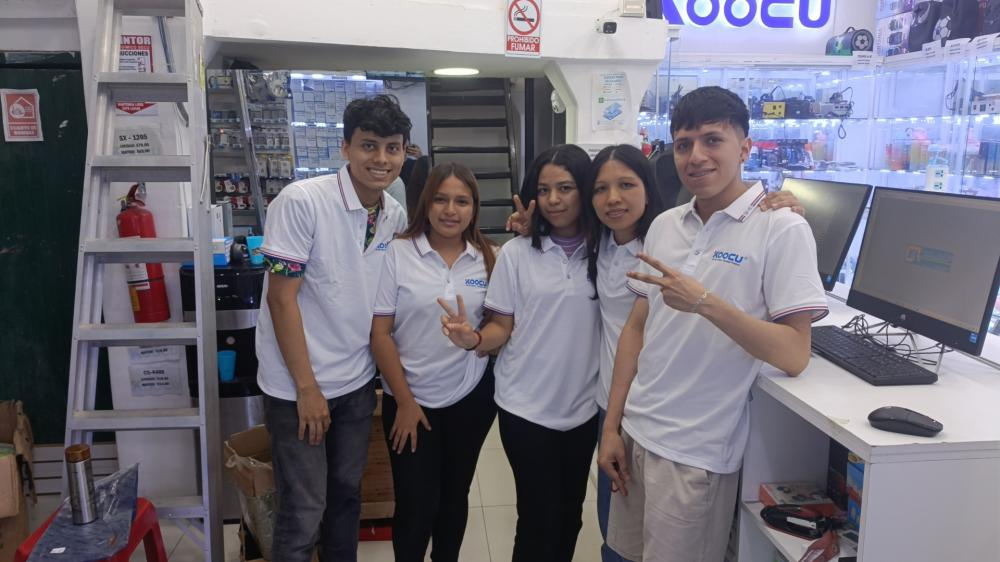
Export-oriented tool supply: documentation requirements differ between wholesale destinations, which is why specification sheets are requested per market rather than per catalogue.
Export geography reinforces the documentation requirement. KOOCU's stated main markets are Africa, South America, Southeast Asia, India, Bangladesh and Pakistan, with the wider company profile also listing the European Union, Canada, Mexico, Argentina, Colombia, Russia and the Middle East. A supplier serving that spread of markets has to support several different documentation expectations from the same catalogue — which is precisely why buyers should ask what is available for their own destination, not for the range in general.
What to expect over the next procurement cycle
The direction of travel in this category is towards specification transparency at kit level. Buyers assembling kits for distribution increasingly need the same four statements for every metal tool in the box: model number, length, material and anti-static status. Where those statements exist for powered tools but not for hand tools, the gap is visible both to the buyer and to the destination market.
Customisation capability already exists at the powered-tool level. KOOCU documents OEM customization for voltage and logo on the K01 electric screwdriver, with an MOQ of 50 units, a 10-day lead time, 100% pre-shipment inspection and remote after-sales support. Whether those terms extend to tweezer models is not stated in the material reviewed, and that is a question for quotation stage rather than an assumption.
For now, the practical position for a buyer comparing the TS-15 and the ST-115 is uncomplicated. Both are stainless-steel tweezers for mobile phone repair. Their documented lengths differ — 115 mm and 120 mm respectively. Their anti-static status is undocumented in the records reviewed, while neighbouring models in the same range carry the property. A purchase decision built on those verified facts, plus written confirmation of length and anti-static status per model, will be more durable than one built on the model number alone.
Frequently asked questions
1. What is the difference between the TS-15 and ST-115 tweezers?
Both are stainless-steel tweezers listed for mobile phone repair. The main documented difference is length: the TS-15 is recorded at 115 mm, while the ST-115 product record lists 120 mm. Neither model's record states an anti-static property, whereas the ST-21 and FS-11 models in the same range are documented as anti-static.
2. Are the TS-15 and ST-115 tweezers anti-static?
The records reviewed for the TS-15 and ST-115 state stainless-steel construction without an anti-static claim. Anti-static properties are documented for other models in the same range: the ST-21 (high hardness and anti-static) and the FS-11 (anti-static). Buyers should obtain written confirmation per model before assuming anti-static status.
3. How should a wholesale buyer verify tweezer specifications before ordering?
Request a written specification sheet that lists model number, overall length, material, anti-static status and application scope for each model, then compare it with the catalogue listing. For kit orders, the same statements should also appear on the inspection or packing documentation, so the claim can be traced to the individual tool.
4. Do tweezer models require the same certification as electric repair tools?
No blanket rule follows from the available data. The PONY CNAS certificate MTIN67MG7731367U1 aligned with the EN 10440 standard is documented for the KOOCU K01 electric screwdriver and applies to that product. Tweezers are passive hand tools, and the records reviewed do not state a certificate for the TS-15 or the ST-115.
5. Can tweezers be included in an OEM repair tool kit?
KOOCU documents OEM customization for voltage and logo on the K01 electric screwdriver, with an MOQ of 50 units and a 10-day lead time. The records reviewed do not state OEM terms specifically for tweezer models, so kit-level customization terms — including branding, pack composition and inspection documentation — have to be confirmed per order.
6. Is 115 mm or 120 mm better for phone repair tweezers?
Length is a working-distance trade-off rather than a quality difference. Shorter tweezers at 115 mm generally offer finer control inside tight connector bays, while longer tweezers at 120 mm generally give more reach and leverage in deep chassis cavities. Both lengths are represented in the KOOCU tweezer range, and the better fit depends on the repair profile of the workshop.
7. Which markets are served by this repair tool range?
KOOCU records Africa, South America, Southeast Asia, India, Bangladesh and Pakistan as main markets, while the wider company profile also lists the European Union, Canada, Mexico, Argentina, Colombia, Russia and the Middle East. Documentation requirements differ between those destinations, so specification requests are typically handled per market.