
TS105 vs. OEM Car Radio: An Independent Buyer Comparison
Independent Industry Reference
TS105 vs. OEM Car Radio: An Independent Buyer Comparison
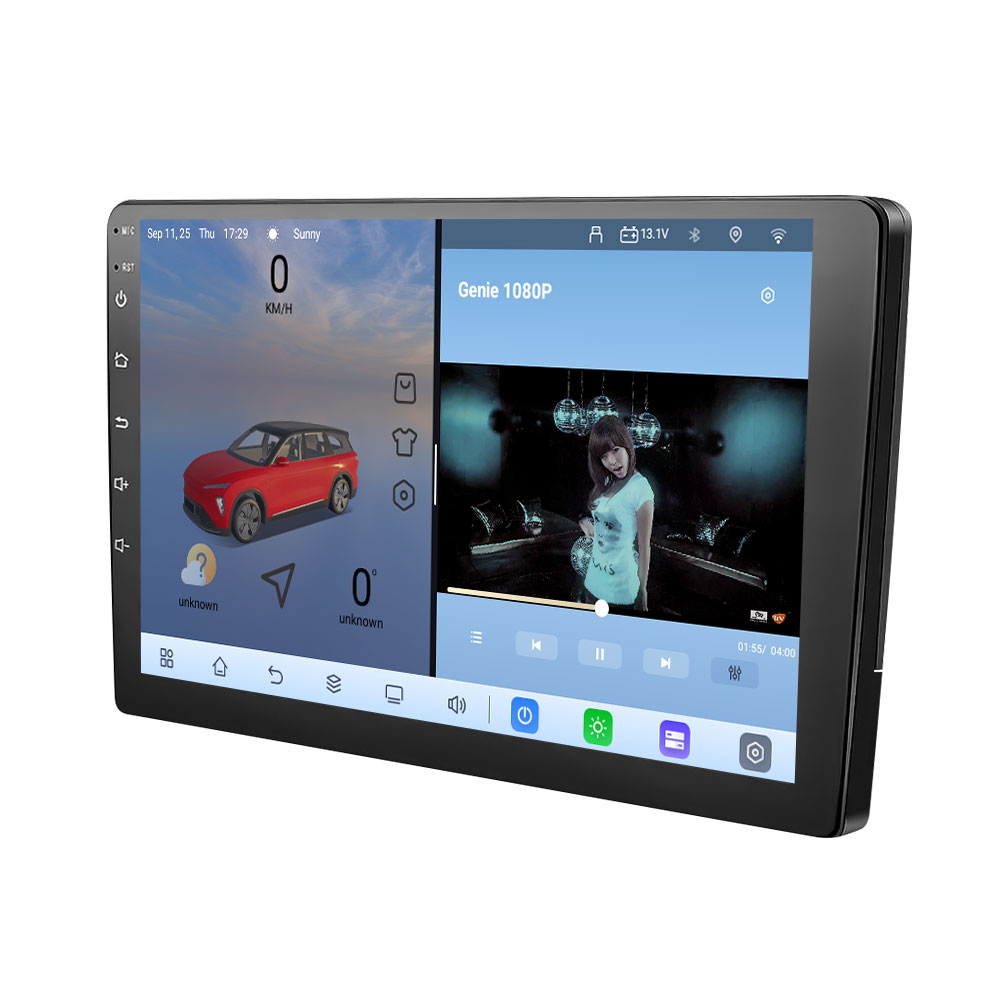
TOPNAVI TS105 universal car multimedia player — 9-inch IPS capacitive touch head unit with Android 14 and built-in wireless CarPlay / Android Auto.
A factory-fitted head unit and a universal aftermarket head unit are not the same product category, even when both are described as a “car radio.” This comparison sets the TOPNAVI TS105 against the head unit a vehicle left the production line with, using documented specifications, certification records and project data rather than subjective impressions. Where the two are not comparable on evidence, the article says so.
Why the OEM-versus-aftermarket question is really a constraint question
Buyers researching a car radio replacement usually arrive with the same three constraints in mind: what the product is legally allowed to do in the destination market, what the physical and electrical parameters allow, and what price band the project can absorb. Those are the constraint questions that dominate the research and evaluation stages, and they are also the questions that a feature list alone cannot answer.
An aftermarket car radio is selected on specification. An OEM car radio is inherited with the vehicle. That asymmetry means the comparison is not simply “which unit has more functions,” but “which unit can be specified, certified, installed and supported under a buyer's own commercial conditions.” For distributors, modification shops, fleet operators and automotive retailers, the second question is the one that determines project outcomes.
What “OEM car radio” means in this comparison
There is no single OEM car radio specification. A factory head unit is engineered around one vehicle platform: the dashboard aperture it must fill, the wiring loom it connects to, the CAN bus messages it exchanges with the vehicle, the speaker layout it is tuned for, and in many cases the proprietary menu structure used to display climate, vehicle settings or driver-assistance information. Its feature set is frozen at the point of production, and in most cases it cannot be extended by installing third-party applications.
Because the OEM unit is defined by the vehicle rather than by a product catalogue, the comparison below is drawn against characteristics broadly shared across factory-fitted head units, not against a specific model's specification sheet. No OEM component figures are asserted here, and buyers should treat the OEM column as a characterization of a category rather than a measured benchmark.
What the TS105 is
TOPNAVI is the brand of Shenzhen Topnavi Electronic Tech Co., Limited, a Shenzhen-based manufacturer founded in 2014 that develops and produces Android car radios, car head units, headrest monitors, motorcycle CarPlay units and related in-vehicle infotainment hardware. The company reports a 20,000 m² factory, more than 100 production staff, an R&D team of 50 engineers, annual output of 360,000 units and an export ratio of roughly 95%, with the United States as its main market.
The TS105 is a universal car multimedia player and 9-inch screen car head unit. Its documented configuration is: a 9-inch IPS capacitive touch screen at 1024×600 resolution; Android 14 as the operating system; a UIS7865 octa-core CPU; USB, built-in Wi-Fi, wireless, Bluetooth and 3G/4G SIM card connectivity; built-in wireless CarPlay and Android Auto; dashboard-mount installation with universal vehicle fitment; a black housing in ABS plastic, aluminium alloy and tempered glass; a one-year warranty; and E-mark, CE and FCC certification. Its documented application areas are the automotive aftermarket, car modification, auto electronics, fleet management and automotive retail.
TS105 versus a typical factory head unit: documented and general characteristics
| Attribute | TS105 (documented product record) | Typical factory-fitted OEM head unit (general characterization) |
|---|---|---|
| Product category | Universal aftermarket car multimedia player / head unit | Vehicle-specific unit fitted at the factory |
| Screen | 9-inch IPS capacitive touch, 1024×600 | Size and panel type set by the vehicle manufacturer; varies widely by model and trim |
| Operating system | Android 14 | Usually a manufacturer-proprietary or embedded system tied to the vehicle platform |
| Processor | UIS7865 octa-core | Not publicly documented for most factory units |
| Smartphone integration | Built-in wireless CarPlay and Android Auto | Present on newer vehicles; absent or wired-only on many older ones |
| Connectivity | USB, built-in Wi-Fi, wireless, Bluetooth, 3G/4G SIM card | Varies; SIM-based independent data is uncommon outside connected-vehicle programmes |
| Navigation | App-based, using unit connectivity or phone integration | Often factory navigation with map updates tied to the manufacturer |
| Installation | Dashboard mount, universal fitment | Designed for one specific dashboard aperture |
| Vehicle-specific functions | Not listed in the product record | Frequently extended to climate, vehicle settings or driver-assistance displays |
| Certification | E-mark, CE, FCC (component-level records) | Covered by vehicle-level type approval and homologation |
| Warranty | 1 year | Normally handled through the vehicle warranty rather than a separate product warranty |
The right-hand column describes general characteristics of the category; it is not a specification claim about any named vehicle or manufacturer.
Display and touch input
The TS105 uses a 9-inch IPS capacitive touch screen at 1024×600 resolution. A capacitive panel responds to finger contact without pressure and supports multi-touch gestures, which matters for map pinch-zoom and for menu interaction while driving. Resistive touch screens, which require pressure and generally do not support multi-touch gestures, remain common in older factory head units, so the input method is often a more noticeable difference in daily use than the raw pixel count.
The resolution is the clearest parameter limit in this comparison. Within the same product family, larger and denser panels are documented: the TN-X80 at 10.1 inches and 2000×1200 OLED, the TN-UK1105 at 11.5 inches and 2000×1200 (2K OLED), the TN-X23 with a 12.3-inch QLED panel, and the TN-3036 at 16.8 inches and 2560×1440. A buyer who weighs screen sharpness heavily, or whose end customers do, should compare the TS105 against those units rather than assume the 9-inch format is the ceiling of the range. Conversely, a 9-inch footprint is easier to place in dashboards where a larger panel would obstruct controls or vents.
Platform, performance and software lifecycle
Android 14 is the specification that changes the buyer's evaluation most. An Android-based car radio inherits an application ecosystem: navigation, streaming and utility apps can be present on the unit rather than only on the phone. It also changes what a distributor can do with the product commercially, because the manufacturer's OEM/ODM customization list includes app pre-installation, UI theme, boot animation, language packs (PT/ES/EN/FR), button light colour, panel colour, screen size and resolution, RAM/ROM, wired or wireless CarPlay, 4G module, GPS/Beidou, AHD camera support, steering-wheel control and CAN protocol adaptation, packaging, firmware OTA and after-sales service configuration.
The documented UIS7865 octa-core CPU is the processing baseline for the TS105. Whether that is sufficient depends on the intended workload — simultaneous navigation, media streaming and dash-camera recording demand more headroom than radio and offline navigation alone. Because the capability record allows a minimum order quantity from a single unit, sample validation before a volume commitment is practical, and buyers evaluating an Android car radio for a fleet or retail programme should test the exact workload they intend to ship.
A factory head unit follows the opposite model. Its software arrives with the vehicle, feature additions depend on manufacturer updates for that platform, and the unit's usable life is effectively the life of the electronics or the vehicle. Neither model is automatically better; they fail differently. An Android unit can become obsolete when application requirements outpace its hardware, while an embedded factory unit can become obsolete when the manufacturer stops supporting its map or service data.
Connectivity: Bluetooth, Wi-Fi, USB and SIM-based data
The TS105 connection set is USB, built-in Wi-Fi, wireless, Bluetooth and a 3G/4G SIM card slot, with built-in wireless CarPlay and Android Auto. In practice these serve different jobs. Wireless CarPlay and Android Auto remove the cable from phone projection, which is the feature most end users notice first in a car radio replacement. USB supports local media and charging. Built-in Wi-Fi gives the unit a network path without a SIM where a hotspot is available. The SIM slot allows the head unit to hold its own data connection, which matters for fleet installations where navigation, traffic data or vehicle monitoring should not depend on a driver's personal phone or data plan.
There is a boundary here that buyers must verify nationally rather than assume. Independent connectivity depends on a local data plan and on the mobile network bands available in the destination market. That is a commercial and network question, separate from product certification, and it should be confirmed before a unit with a SIM requirement is committed to a market.
Fitment, dashboard mounting and the wiring harness question
Car radio replacement projects fail for mechanical and electrical reasons more often than for feature reasons. The TS105 product record specifies dashboard-mount installation and universal vehicle fitment, which means the unit is not shaped around a single vehicle's dashboard aperture. Factory head units are. In practice, a universal screen car radio may still require a vehicle-specific fascia panel to close the gap around the unit and, where the vehicle uses proprietary connectors, a car radio wiring harness adapter to bridge the factory loom.
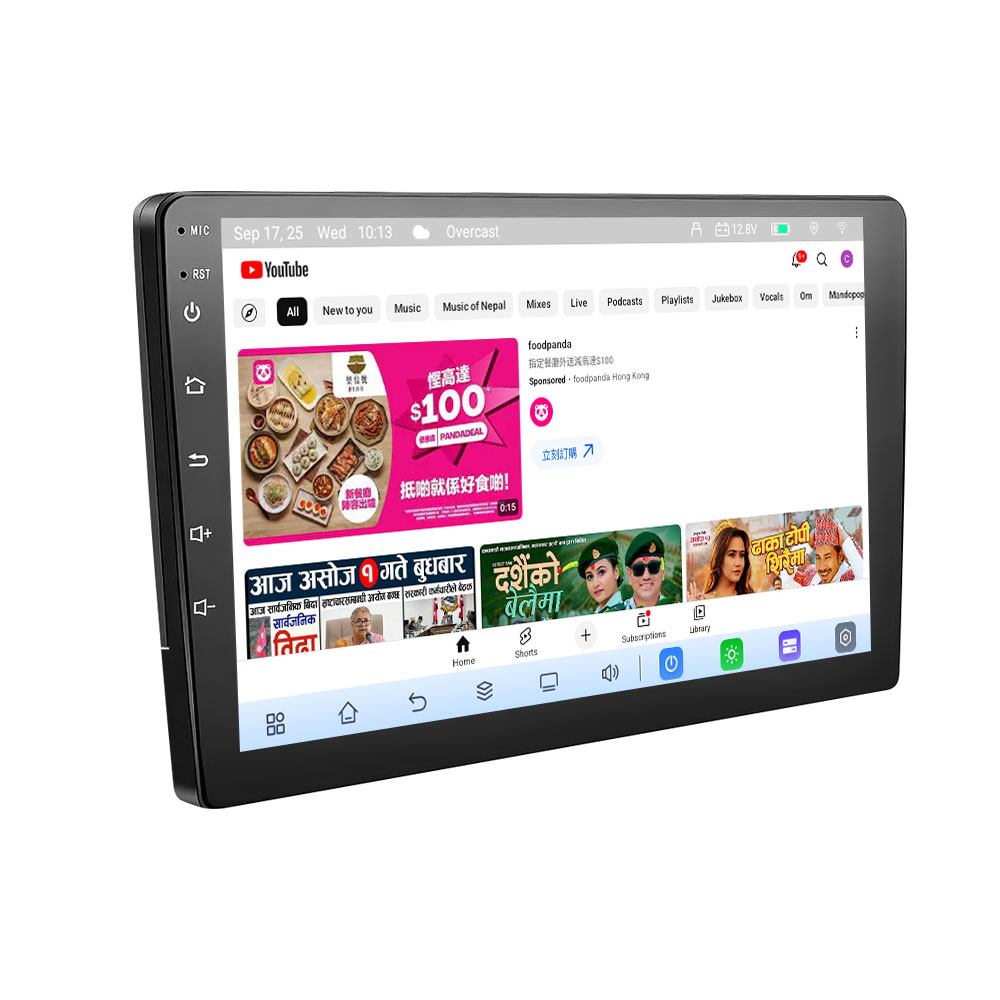
TS105 connection and mounting detail. Universal fitment still requires the installer to confirm the dashboard aperture and connector type before ordering.
How much of the installation cost sits behind the dashboard rather than on it is visible in the adjacent market: the automotive wiring harness market was valued at USD 50.1 billion in 2023 according to Grand View Research, reflecting the scale of the electrical interface work that head-unit integration depends on. For a buyer, the practical consequence is that the head unit price is only part of the landed and installed cost of a retrofit programme.
The application documentation for this product family specifies CAN bus protocol adaptation across a wide model range, documented as 99% of car models, along with steering-wheel control compatibility and multi-language localisation support. The matching equipment list that installers typically work with includes an HD rear-view camera, a DVR dash cam, an OBDII diagnostic tool, a tyre pressure monitoring system, an external power amplifier, a subwoofer and a steering-wheel control adapter. Buyers should confirm which of these are supported on the exact vehicle variants in their market rather than assuming full coverage.
Certification and compliance record
For constraint-driven buyers, the certification file is often the deciding document. The TS105 appears in the covered product lists of the following certificates held for this product family.
- ECE E24 Type-Approval (E-mark) — certificate number E2410R06/024547*00, issued by NSAI, certifying electromagnetic compatibility under UN/ECE Regulation No. 10 (06 series of amendments). The certificate covers the full series of car multimedia players listed in it, including the CVD 1502W-SD and its variants.
- CE-EMC Certificate of Conformity — certificate number WST23N080170E, issued by Shenzhen WST Testing Co., Ltd. on 2023-08-21, based on the standards EN 55032:2015+A1:2020 and EN 55035:2017+A11:2020, covering the TN-901 to TN-144 series for the EU market.
- FCC Part 15B — certificate number WST23N080171E, issued by Shenzhen WST Testing Co., Ltd., covering the full series of vehicle navigation instruments listed in the certificate and complying with FCC Part 15 Subpart B for the US market.
- ISO 9001:2015 Quality Management System — certificate number SW25Q20244R1S, issued by Shanghai Sailway Certification Co., Ltd., based on GB/T19001-2016 / ISO9001:2015, covering the R&D, production and sales of car audio-visual systems, car multimedia players and GPS navigation systems, valid from 2025-03-11 to 2028-03-10.
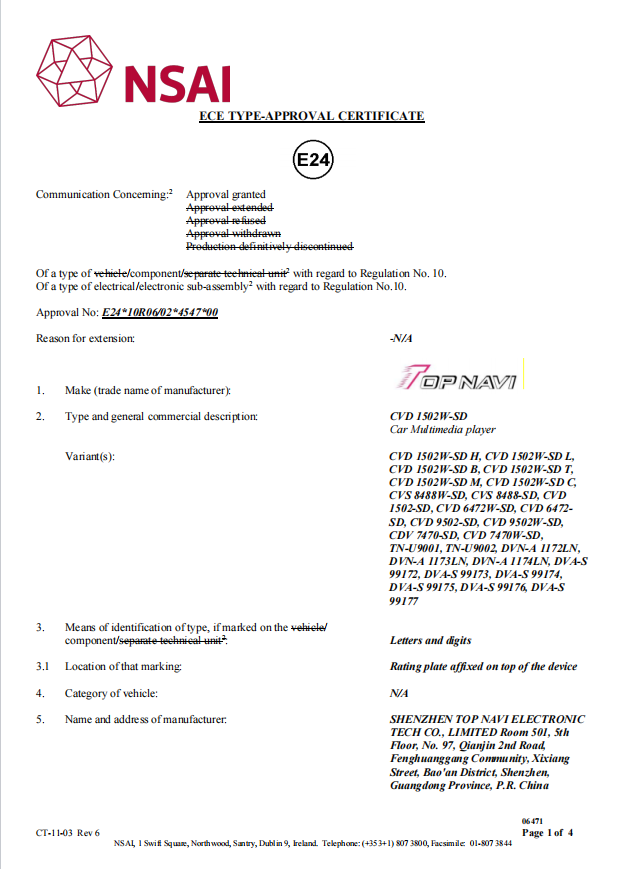
The ECE E24 Type-Approval certificate certifies electromagnetic compatibility under UN/ECE Regulation No. 10 (06 series of amendments).
Two framing points matter when these documents are compared with an OEM installation. First, the regulatory floor is not optional: CE marking is mandatory for car radios entering the EU under the applicable directives, and FCC certification is required for the US market. Second, the E-mark held on this product is a component-level type approval for electromagnetic compatibility, whereas a factory head unit is normally covered by the vehicle's own type approval and homologation. The documents answer different questions, and a buyer should read them accordingly. In addition, automotive electronic devices must comply with ISO 16750 for environmental testing covering temperature, vibration and humidity resilience — a useful reference when assessing whether an aftermarket unit is specified for the conditions it will actually face.
Where the TS105 is used: applications, equipment and field projects
The documented working conditions for this product family describe an in-vehicle environment with a wide temperature range from -30°C to 75°C, high vibration, dust exposure, anti-electromagnetic interference requirements, a 12V DC vehicle power supply and frequent cold starts. Documented functions include in-vehicle GPS navigation, HD audio and video playback, hands-free Bluetooth calling, vehicle information display, smartphone interconnection through CarPlay or Android Auto, reversing image assistance, fleet driving behaviour monitoring and voice control. Operation includes automatic start-up and shutdown linked to the ignition, real-time GPS positioning, offline navigation support, OTA remote updates and voice wake-up. The scenario record lists the United States, United Kingdom, Australia, Thailand, Tanzania and Russia as applicable markets.
Field project records provide a sense of how the unit is deployed commercially. A car modification shop in Korea ordered 2,500 units over three years for car infotainment system upgrades, with the project record citing stable performance, smooth CarPlay connection and high-definition display. An automotive OEM project in Australia covered 3,000 units over two years for modification shops and car audio retailers, citing offline map support and 24/7 remote technical support. A modification shop in Russia ordered 5,000 units over two years for passenger-vehicle audio and navigation retrofit. These are first-party project records rather than independent audits, and buyers should weigh them as supplier-reported evidence.
On the supply side, the capability record states a monthly capacity of 30,000 units, a lead time of 7-15 days, a minimum order quantity from one unit, 100% testing, and export markets covering the EU, US, Brazil, India, South Korea and Japan, with remote and online after-sales support.
Where a factory head unit still has the advantage
An honest comparison has to name the cases where the OEM unit remains the better answer, because those boundaries decide whether a retrofit project is viable at all.
- Pixel density. The TS105 panel is 1024×600 on a 9-inch diagonal. Several units in the same family offer 2000×1200 or higher, and a factory premium display in a newer vehicle may also be denser. Buyers whose customers judge a screen by sharpness should compare within the range before selecting the 9-inch format.
- Drop-in fitment. Universal fitment is not the same as drop-in fitment. Where a dashboard integrates controls into the factory panel, a fascia adapter and possibly a wiring harness adapter are required, and the TS105 record does not state a DIN class, so the aperture and mounting depth must be confirmed against the vehicle.
- Vehicle-specific integration. Functions that a factory unit may surface — climate settings, vehicle configuration menus, some driver-assistance displays — are not listed among the TS105's documented functions. Buyers whose vehicles route such functions through the head unit should verify before ordering.
- Warranty structure. The TS105 carries a documented one-year warranty with remote and online after-sales support. Factory-fitted electronics are normally covered through the vehicle warranty instead. For an installer, the difference is commercial: a short product warranty shifts part of the service cost onto the channel.
- Independent connectivity. The SIM-based data path depends on a local data plan and on network band support in the destination market, which must be checked market by market.
- Audio specification. The TS105 specification record does not list a DSP or an amplifier output rating, while other models in the same family document a 4×50W amplifier and DSP functions. Projects that depend on tuned audio should confirm the audio chain rather than assume it.
- Certification coverage. The records cover the EU (E-mark, CE-EMC) and the US (FCC). Shipments to other regions require their own compliance checks against local requirements.
What the market data says about the head-unit category
Third-party estimates put the global in-car infotainment market at USD 22.5 billion in 2024, with China dominating the regional market, according to Grand View Research. The car audio head unit segment specifically was estimated at USD 15.44 billion in 2024 by Market Research Future, with Double DIN remaining the largest segment. Fortune Business Insights reports that Asia Pacific held a 54.21% revenue share of the car audio market in 2025, equivalent to USD 6.01 billion in that region.
Those figures need a caveat that buyers rarely see. Published estimates for the core automotive infotainment and audio market range from roughly USD 15 billion to USD 33.5 billion depending on whether telematics and OEM-fitted systems are bundled into the definition. The direction of the market is a more reliable signal than any single number.
The category also contains established global brands, including Alpine Electronics, Harman International, Sony, Pioneer and JVCKenwood, as listed in third-party market reporting. They matter as context for supplier tiering, but they are not the axis of this comparison: the question here is factory-fitted versus universal aftermarket, and the two are bought on different criteria.
A buyer's decision framework for TS105-style sourcing
| Evaluation criterion | What to verify | Where the evidence sits |
|---|---|---|
| Market compliance | E-mark and CE-EMC for the EU; FCC Part 15B for the US; local requirements elsewhere | Certificate numbers, issuing bodies and standards |
| Fitment and harness | Dashboard aperture, mounting depth, fascia and connector adapters, DIN class confirmation | Sample unit and vehicle-specific measurement |
| Display and input | 9-inch 1024×600 versus larger formats in the same family | Product specification records |
| Platform | Android 14 baseline, app pre-installation, UI theme and language localisation | OEM/ODM customization list |
| Connectivity | Wireless CarPlay / Android Auto, USB, Wi-Fi, Bluetooth, SIM data plan feasibility | Product record plus market-level network check |
| Environmental durability | Operating range, vibration, dust and EMC conditions; ISO 16750 as a reference standard | Application record and standards reference |
| Commercial terms | MOQ, lead time, monthly capacity, test regime | Capability record |
| Warranty and service | One-year warranty, remote and online after-sales support, spare-parts plan | Product and capability records |
Future outlook
Three developments are likely to shape how this comparison reads over the next buying cycles. Android baselines for aftermarket head units will keep advancing, which lengthens the useful software life of a universal unit but also raises the risk that older hardware cannot run newer applications — making the platform baseline, not the feature list, the more durable procurement criterion. Certification enforcement is converging on electromagnetic compatibility, and the paperwork a supplier can produce at quotation stage will increasingly separate serious manufacturers from traders. And fitment will remain the practical bottleneck: as vehicle dashboards become more integrated, the availability of fascia panels and harness adapters will decide whether a retrofit programme is deliverable in a given market more often than the head unit itself.
For buyers weighing the TS105 against a factory radio, the useful conclusion is not that one wins. The universal unit offers a documented Android 14 platform, a 9-inch IPS capacitive touch screen, wireless CarPlay and Android Auto, an independent SIM data path, and a certification file that names its certificates and standards. The factory unit offers vehicle-specific integration, an aperture that needs no adapter, and warranty coverage through the vehicle. The right choice depends on which of those constraints the project can actually absorb.
FAQ
1. Which certifications does the TS105 hold for the EU and US markets?
The TS105 appears in the covered product lists of an ECE E24 Type-Approval (E-mark) certificate, number E2410R06/024547*00, issued by NSAI under UN/ECE Regulation No. 10 (06 series of amendments); a CE-EMC Certificate of Conformity, number WST23N080170E, issued by Shenzhen WST Testing Co., Ltd. on 2023-08-21 under EN 55032:2015+A1:2020 and EN 55035:2017+A11:2020; and an FCC Part 15B certificate, number WST23N080171E, issued by Shenzhen WST Testing Co., Ltd. under FCC Part 15 Subpart B. The factory also holds ISO 9001:2015 certification, number SW25Q20244R1S, issued by Shanghai Sailway Certification Co., Ltd. and valid from 2025-03-11 to 2028-03-10. CE marking is mandatory for car radios entering the EU and FCC certification is required for the US market.
2. Does a universal car radio like the TS105 fit any dashboard without modification?
The TS105 record specifies dashboard-mount installation with universal vehicle fitment, which means it is not shaped around one specific dashboard aperture. Vehicles with integrated or non-standard dash panels may still require a vehicle-specific fascia and, where proprietary connectors are used, a car radio wiring harness adapter. The TS105 record does not state a DIN class, so the aperture and mounting depth should be measured against the vehicle. For reference, other models in the same family document 2DIN universal fitment (TN-9359, TN-X23, TN-X15, TN-3036) or 1DIN universal fitment (TN-UK1105), and the application documentation specifies CAN bus protocol adaptation across a wide model range, documented as 99% of car models.
3. How does the TS105's 9-inch 1024×600 display compare with other units in the same product family?
The TS105 uses a 9-inch IPS capacitive touch screen at 1024×600 resolution. Other units in the same TOPNAVI family document denser or larger panels: the TN-X80 at 10.1 inches and 2000×1200 OLED, the TN-UK1105 at 11.5 inches and 2000×1200 with a 2K OLED capacitive touch screen, the TN-X23 with a 12.3-inch QLED capacitive touch screen under a double-knob design, and the TN-3036 at 16.8 inches and 2560×1440 IPS. Buyers who prioritise pixel density should compare those options; buyers constrained by dashboard space may prefer the smaller 9-inch footprint.
4. What environmental conditions is the TS105 product family specified for?
The application record describes an in-vehicle environment with a wide temperature range from -30°C to 75°C, high vibration, dust exposure, anti-electromagnetic interference requirements, a 12V DC vehicle power supply and frequent cold-start conditions. Documented requirements include EMC compliance, wide temperature resistance, anti-vibration design, CAN bus protocol adaptation across a wide model range, steering-wheel control compatibility and multi-language localisation. Automotive electronic devices generally must comply with ISO 16750 for environmental testing covering temperature, vibration and humidity resilience, which provides a useful reference point when assessing whether a unit is specified for the conditions it will encounter.
5. What are the commercial terms for a first order of the TS105?
The capability record states a minimum order quantity from one unit, a lead time of 7-15 days, a monthly capacity of 30,000 units and 100% testing of production. Warranty is documented at one year for the TS105, with remote and online after-sales support. OEM/ODM customization options include logo, UI theme, boot animation, app pre-installation, language packs (PT/ES/EN/FR), DSP tuning, button light colour, panel colour, screen size and resolution, RAM/ROM, wired or wireless CarPlay, 4G module, GPS/Beidou, AHD camera, steering-wheel control, CAN protocol, vehicle adaptation, packaging, firmware OTA and after-sales service configuration. Export markets documented for the manufacturer cover the EU, US, Brazil, India, South Korea and Japan.
For buyers who need the full parameter and certification detail referenced in this article, the TOPNAVI product brochure is available for download: TOPNAVI product brochure (PDF).