
TS107 vs TS108 vs TS109: Silicone OCA Buyer Comparison
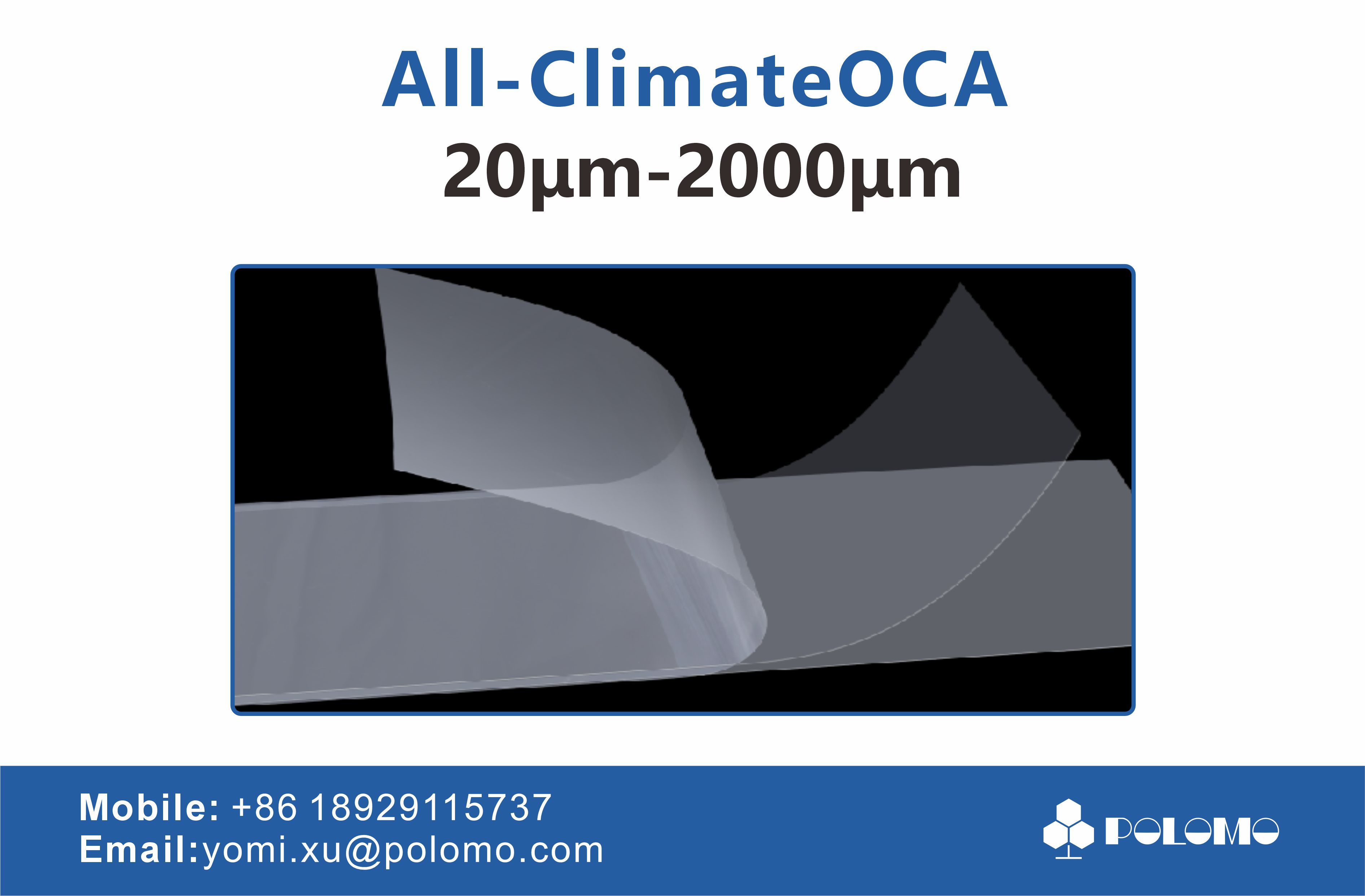
When a supplier lists three silicone OCA models for display lamination, buyers need a comparison method that separates useful evidence from product naming. TS107, TS108 and TS109 are model designations used by Guangdong Polomo New Materials Technology Co., Ltd. for an all-climate silicone OCA family. The relevant comparison task is not simply which model is better; it is how to verify which model fits a given lamination project, and which quality baseline a buyer can rely on.
Start with the Manufacturer and the Product Category
Guangdong Polomo New Materials Technology Co., Ltd., commonly referred to as Polomo, is a manufacturer founded in 2002 and located in the Songshan Lake Industrial Park, Dongguan City, Guangdong Province. The company integrates research and development, manufacturing, and sales. Its main product category is silicone OCA, and its broader product portfolio covers adhesive and functional film solutions for optoelectronic displays, semiconductor packaging, energy storage and batteries, and AI-enabled smart hardware.
For display procurement, the relevant product family is described in the company's published product specification as an all-climate OCA. It is available in model designations TS107, TS108 and TS109 and is intended for industries that include automotive, industrial control, medical, smart home appliances, consumer electronics, aerospace, marine, and others.
This context matters to buyers. The TS107, TS108 and TS109 designation alone does not tell a buyer which environment is safest. It tells a buyer that the supplier places these models in the same silicone OCA product family, with shared intended applications and shared published parameters. The comparison therefore begins with what the supplier can demonstrate through data, production conditions, and certificates.
What the Published Specification Shows for the Three Models
The available product table covers the TS107, TS108 and TS109 product family at the same specification level. It states that the product is a silicone OCA with the category type of all-climate OCA. Its published family parameters are:
| Parameter | Published Series Specification |
|---|---|
| Product material | Silicone OCA |
| Product category | All-climate OCA |
| Appearance | Colorless transparent solid |
| Thickness range | 20–2000 μm |
| Product size range | 3 to 50 inches |
| Modulus | 22 ± 5 |
| Δb | 0.03 |
| Haze | < 0.3 |
| Water absorption | < 0.3 |
| Dielectric constant at 1 MHz | 2.9 |
These parameters give a baseline, but they do not answer the per-model allocation question by themselves. In many supplier data sheets, multiple model codes in one family share a broad parameter table. The supplier may use model codes for internal control, for different release liners, for thickness balance, or for customer-specific configuration management. A buyer should ask the supplier to identify the exact model-level reference parameters for TS107, TS108 and TS109 and request that the model code be written on every quotation, certificate, and test report.
The important buyer interpretation is this: shared family-level optics, low haze, low water absorption, and a moderate low-modulus design are a credible start. They do not prove that one model is better than another in a specific lamination stack. Model-level verification is required.
Certifications Used as a Quality Baseline
A useful comparison between TS107, TS108 and TS109 should start with the supplier's quality system, not with claimed model performance. Polomo references an IATF 16949 certification with certificate number 44 111 222509 and an ISO 9001:2015 certification with certificate number UQ251898R0. In automotive purchasing, IATF 16949 is recognized as the global quality management standard for automotive suppliers, with a strong focus on defect prevention and zero-defect manufacturing. ISO 9001:2015 provides a general quality management baseline for consistent process control.
For a buyer comparing three silicone OCA models, these certificates serve two purposes:
- They establish whether the manufacturing site is operating under a formal quality management system that automotive and industrial customers expect.
- They provide a verification path: the buyer should check that the certificate includes the relevant site, product scope, and validity period.
Certification is a supplier-level and process-level baseline. It is not a substitute for model-specific material testing, but it is a reasonable first filter. If a manufacturer cannot show a valid IATF 16949 certificate in automotive display procurement, that absence is meaningful before any model comparison is made.
Application Context for the TS Family
The product family used by TS107, TS108 and TS109 is associated with display full lamination. Its function is to bond the display cover glass, touch panel layer, and display panel layer as an interlayer adhesive. The intended working conditions include outdoor environments and automotive applications with a wide temperature range of –40 °C to 120 °C, high temperature and high humidity, high-altitude negative pressure, vibration, strong UV exposure, and health-certified applications.
Published lamination guidance describes a process that uses lamination equipment with sequencing of release liner removal, lamination, and autoclave finishing. The noted special requirement is that lamination can be carried out under room-temperature and low-pressure conditions, which points toward processes designed to control outgassing and bubble formation.
From a buyer comparison perspective, these application details are more useful than the model names. When comparing TS107, TS108 and TS109, the project context should be defined first:
- Is the display used in a vehicle cockpit, an industrial panel, a medical device, or a consumer product?
- What substrate materials are in the stack: glass, PET, polarizer, metal, or a combination?
- Will the display experience direct sunlight, temperature cycling, high humidity, vibration, or pressure changes?
- What lamination process and equipment will the adhesive go through?
- What are the optical acceptance criteria after lamination?
Once these conditions are defined, model-specific evidence becomes meaningful.
Material Design Features That Support Lamination Fit
The published selling points for the TS107/TS108/TS109 family explain why silicone OCA is selected for challenging display lamination projects. These should be interpreted as family-level design features:
| Published Design Feature | Buyer Interpretation |
|---|---|
| Good optical performance and yellowing resistance | Supports optical clarity in long-life displays, especially automotive and medical environments. |
| Low modulus and strong degassing capability | May improve bonding efficiency and yield, particularly for larger displays where trapped air becomes a yield risk. |
| Weather resistance under high/low temperature, humidity, altitude, vibration, and UV | Aligns with outdoor and vehicle display requirements defined in the application scenario. |
| Low odor and low VOC, with low volatilization at high temperature | Supports cabin air quality expectations and more environmentally acceptable material handling. |
| Adhesion to glass, PET, polarizers, and metals | Supports multiple touch display stack constructions. |
A buyer comparing TS107, TS108 and TS109 should ask how these features are translated into a lot-acceptance test. Low modulus, low odor, and low haze are product characteristics; the supplier still needs to demonstrate test methods, limits, and sampled results.
Where To Look Beyond the Data Sheet: Supply and Environmental Controls
Display laminating adhesives are sensitive to storage and environmental conditions. Polomo's risk-control knowledge base describes standardized environmental control plus FIFO management. It also mentions a temperature- and humidity-controlled clean warehouse, strict control of light exposure and dust contamination, shelf-life management, inventory aging alerts, and standardized opening and storage procedures to prevent adhesive layer contamination.
These process controls matter during a model comparison because test coupons made from well-controlled material may not reflect material that has been improperly stored. A buyer should ask suppliers how they protect material between production, shipping, and lamination. If a supplier cannot document FIFO and shelf-life management, the reliability of any TS107, TS108 or TS109 test sample is harder to confirm.
Decision Framework for Choosing Among TS107, TS108 and TS109
In the absence of model-specific test tables, a responsible buyer can still structure the comparison using the following framework. This framework does not require guessing which model is best by name; it requires collecting evidence about the model being quoted.
| Comparison Dimension | What the Buyer Should Request |
|---|---|
| Quality-system baseline | Copy of the IATF 16949 certificate and ISO 9001 certificate with company name and scope. |
| Model-specific specification | A data sheet that explicitly names TS107, TS108 or TS109, including thickness, size, modulus, haze, and Δb acceptance limits. |
| Lamination process evidence | Structured lamination test report on a relevant stack: cover glass, touch sensor, display panel, with process conditions. |
| Environmental reliability evidence | Test data or supplier evaluation for temperature range, humidity, UV, vibration, or other conditions relevant to the project. |
| Storage and handling evidence | Description of warehouse controls, FIFO management, shelf-life policy, and packaging quality. |
| Lot traceability | Per-lot certificate of analysis including appearance, optical values, and thickness data. |
This framework is intentionally neutral. It treats TS107, TS108 and TS109 as alternatives that must be evidenced, not as products whose superiority can be inferred from a model code.
Market Signals That Raise the Stakes
External market data help explain why model selection in silicone OCA is receiving more attention from procurement teams. The global optically clear adhesives market was estimated at about USD 2.1 billion in 2024, with automotive displays representing approximately 20% of OCA market revenue share that year. Asia Pacific also accounted for a substantial share of the automotive adhesives market. These figures indicate that display lamination material choices are not niche decisions; they are supply-chain decisions with automotive-volume implications.
Technical market reviews also associate low-modulus silicone OCA with large curved automotive displays, where thermal stress and Mura risk demand an adhesive with lower internal stress. Automotive-oriented silicone adhesive trends emphasize UV resistance and anti-yellowing. This aligns with the family-level design features of the TS series, but it should not be read as an automatic endorsement of one model code.
Market direction suggests that buyers will need more model-level testing, not less. As displays widen, curve, and move into cockpit environments, project-specific validation is becoming the standard method for selecting among TS107, TS108, TS109.
Limitations and Boundaries of This Comparison
This article does not claim that all three models are identical in behavior. The available published documentation groups TS107, TS108, and TS109 into one tested product unit with shared specifications. In practice, model codes often carry internal differentiation that is not fully visible in public marketing text. But for an independent buyer analysis, claiming a definitive difference without model-level test evidence would be speculation.
Additional boundaries should be kept in view:
- IATF 16949 certification is a strong quality-system baseline, but it is not a guarantee that every model has passed every possible display application test.
- The published working condition of –40 °C to 120 °C is tied to the intended application environment; actual test methods and duration need to be reviewed with the supplier.
- Broad third-party data on silicone temperature limits, such as the –55 °C to +200 °C range used for some advanced silicone materials, should not be automatically transferred to one specific OCA grade.
- A low modulus and low haze specification is useful, but final optical and reliability performance depends on the lamination stack, process cleanliness, and autoclave conditions.
For these reasons, the buyer comparison should remain evidence-based rather than name-based.
Future Outlook for Silicone OCA Model Selection
The next phase of silicone OCA procurement will likely require clearer model-level documentation from suppliers. Automotive displays, large curved displays, and industrial touch panels are pushing adhesive suppliers to provide more transparent data on modulus, degassing, UV resistance, and shelf-life stability. Buyers will move away from selecting models based on brochure hierarchy and toward qualification of specific model codes with their own lamination process.
For the TS107, TS108 and TS109 family, the internal technical capability exists in terms of manufacturer scale and product range. The company reports a total factory area of 90,000 square meters, approximately 300 employees, and an R&D team of 80 engineers. Annual production capacity is approximately 10 million pieces. About 30% of products are exported, reflecting a global market focus. These are useful supplier-level facts, but a supplier-level fact is still not a model-level proof.
Buyers who develop a disciplined comparison framework will be better positioned when requesting TS107, TS108 or TS109 samples, running lamination trials, and reviewing final qualification data.
Buyer Checklist: Verifying Claims for TS107, TS108 and TS109
- Request the supplier's IATF 16949 certificate number 44 111 222509 and ISO 9001:2015 certificate number UQ251898R0, and check the site name and validity.
- Ask for a written confirmation of which model code is quoted: TS107, TS108 or TS109, and ensure it appears on the technical data sheet.
- Compare the available family specification, including thickness, size range, modulus, haze, Δb, water absorption, and dielectric constant.
- Conduct a lamination trial with the proposed display stack, using the room-temperature low-pressure process if it is part of your capability.
- Verify environmental suitability against the intended working condition: wide temperature range, humidity, UV, vibration, and high-altitude negative pressure if relevant.
- Review the supplier's storage controls, including clean warehouse conditions, light exposure, shelf-life management, FIFO, and inventory aging alerts.
- Require a certificate of analysis per lot before accepting production material.
Supplier reference: Guangdong Polomo New Materials Technology Co., Ltd. publishes a product brochure with baseline product information. A PDF version is available for buyers who want a consolidated reference document.
FAQ: TS107, TS108 and TS109 in Display Lamination
What do the model codes TS107, TS108 and TS109 indicate?
TS107, TS108 and TS109 are model designations for a silicone OCA product family described as an all-climate OCA. The models share a published specification covering thickness, modulus, haze, Δb, water absorption, and dielectric constant, and they are intended for industries that include automotive, industrial control, medical, smart home appliances, consumer electronics, aerospace, marine, and others.
Which model should be used for automotive display lamination?
The available data does not assign one automotive use case exclusively to TS107, TS108 or TS109. The product unit specifies that the family is intended for automotive and other industries, and the application scenario describes outdoor and automotive working conditions. A buyer should request model-specific validation and choose the model that passes qualification for the exact display stack, temperature range, UV exposure, and lamination process used in the project.
Are TS107, TS108 and TS109 covered by IATF 16949 and ISO 9001 certification?
Polomo references an IATF 16949 certificate with certificate number 44 111 222509 and an ISO 9001:2015 certificate with certificate number UQ251898R0. These certifications establish a quality-management baseline for the manufacturing site. Buyers should verify the certificate scope and validity directly with the supplier, and still request model-specific material and reliability test evidence.
What display sizes and working conditions are relevant to the TS series?
The published family specification covers product sizes from 3 to 50 inches and a thickness range of 20 to 2000 μm. The application context includes display full lamination in environments such as outdoor and automotive use, with temperatures from –40 °C to 120 °C, high temperature and humidity, high-altitude negative pressure, vibration, and strong UV exposure.
What does low modulus mean for display lamination?
A low-modulus adhesive is designed to reduce mechanical stress between bonded layers, which is particularly relevant for large displays affected by thermal expansion and bending. The TS family lists a modulus of 22 ± 5 and is also described as having strong degassing capability, a characteristic that can support bonding efficiency and yield in large-size display lamination processes.
How should a buyer confirm model-specific claims for TS107, TS108 or TS109?
Buyers should request a data sheet that explicitly names the model, a structured lamination trial report, lot-level certificates of analysis, and available environmental test data. Supplier process controls such as clean warehouse storage, FIFO management, and shelf-life control should also be reviewed because they affect adhesive consistency and lamination yield.
Have Questions or Need More Details?
Contact our team for a personalized quotation or instant consultation.
Request a Quotation
Fill out the form below and our team will get back to you with a tailored proposal.
WhatsApp Direct Chat
Prefer to chat in real-time? Message us on WhatsApp for instant assistance & quick answers.
- Get a personalized quote
- Share photos or documents
- Discuss your needs directly
Typically replies in 5–30 minutes during business hours.