
TSS Plastic Totes and Crates: A Shortlist for ASRS, AMR and Cold Chain
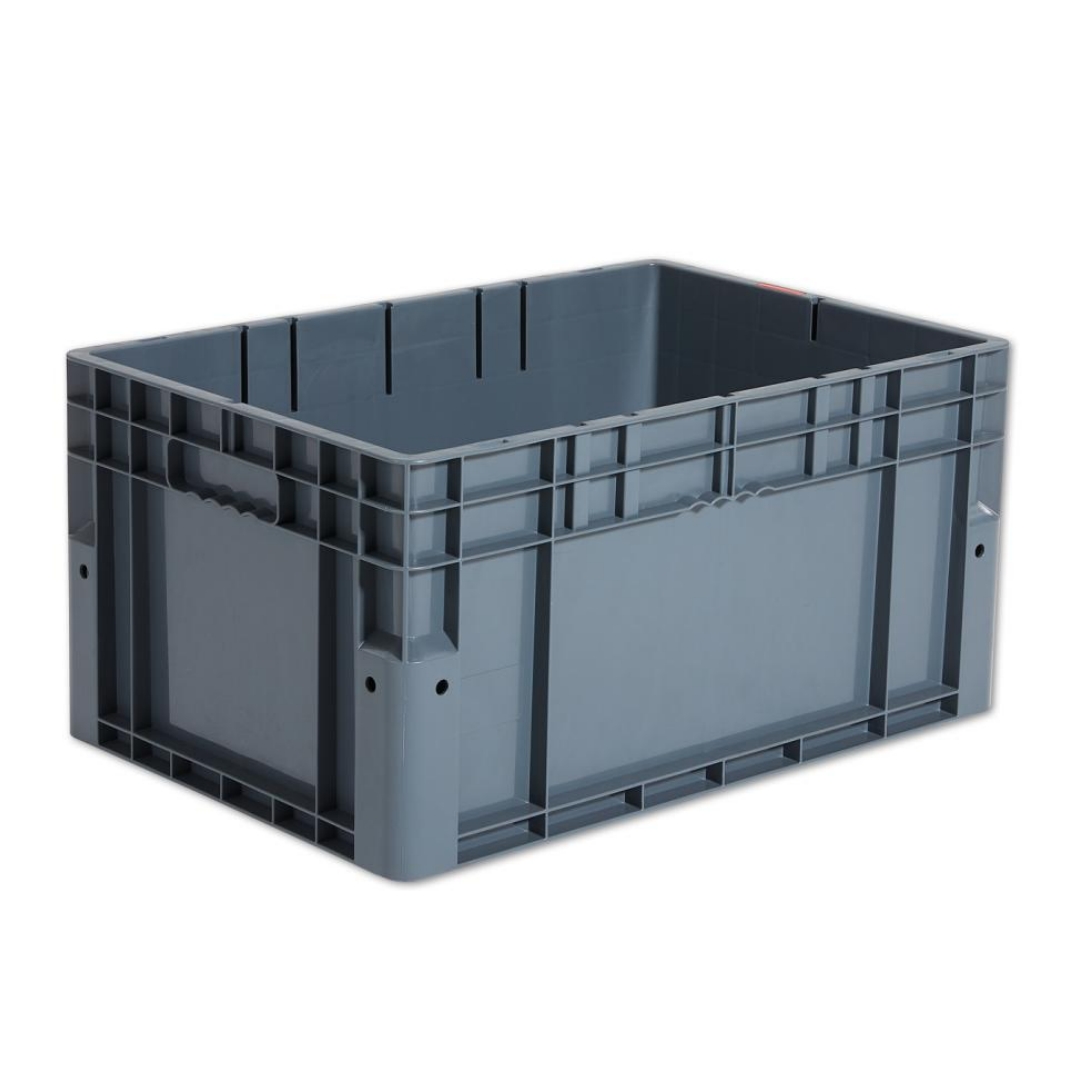
Container geometry, not price, usually determines whether an ASRS or AMR installation reaches its design throughput.
Container selection is one of the few decisions in an automated warehouse that constrains almost everything downstream: crane cycle time, robot gripper design, pick-station ergonomics, and the cost of returning empty totes up the supply chain. In practice, the choice is rarely between a good tote and a bad one. It is between container families whose dimensional accuracy, wall geometry, and load behaviour match — or fail to match — the handling equipment already specified in the project.
This article sets out a shortlist of plastic totes and crates from Shanghai Xinfan Industrial Corporation (TSS), organised by application rather than by catalogue order: automated storage and retrieval (ASRS) and autonomous mobile robot (AMR) handling, general warehouse and retail logistics, and cold chain distribution. Shanghai Xinfan Industrial Corporation (TSS) is a Shanghai-based provider of reusable logistics packaging and cargo security products, operating a 40,000 m² facility with approximately 320 employees and annual output of about 3,600,000 units.
The shortlist is written for buyers in a research-to-evaluation stage who already know the application but still need to convert it into specifications they can test, quote, and accept. Three questions organise the rest of the article: which container family fits the handling environment, what evidence exists to support the choice, and where each model stops being the right answer.
Why container choice becomes a constraint problem in automated facilities
Three operating environments impose different constraints on the same nominal object. An ASRS aisle cares about repeatability: a tote that varies in outer dimension will jam a mini-load crane long before it fails structurally. An AMR fleet cares about interface geometry: gripper clearance, base flatness, and the position marks a robot uses to locate the container. A cold room cares about material behaviour at temperature and about condensation, neither of which appears in a standard load table.
Footprint standardisation is the first filter. In warehouse automation, the 600 × 400 mm family and the 650 × 450 mm family are the two common bases, with 600 × 400 mm described as the dominant global footprint in the comparison set assembled for this product category. That distinction is not cosmetic: a 600 × 400 mm tote cannot be substituted into a rack or conveyor lane engineered around a 650 × 450 mm envelope, and buyers who discover the mismatch after the conveyor is installed face a change order rather than a purchase adjustment.
The second filter is empty-state volume. Every closed-loop system pays twice for its containers — once for the loaded trip and once for the return leg, when the same boxes move back through the network with nothing inside them. Nesting and folding designs address that cost, but they introduce moving parts and, with them, an additional validation requirement.
The shortlist at a glance
The table below groups TSS models by the environment in which they are normally specified. Dimensions and materials are taken from the TSS product specification set; application notes reflect the conditions described in the corresponding application material.
| Model | Footprint / capacity | Material | Primary application |
|---|---|---|---|
| ASRS Wall straight Plastic CratesTSS-IFC | 600 × 400 × 300 mm | PP | ASRS, AGV/AMR, conveyor |
| ASRS Foldable Plastic CratesTSS-IFD | 600 × 400 × 300 mm | PP | ASRS/AMR with return logistics |
| Stackable Plastic totesTSS-TBX | 600 × 400 × 320 mm | PP | Attached-lid transport, secure distribution |
| Nested and Stackable Plastic CratesTSS-RBTB | 600 × 400 × 300 mm | PP | Retail distribution, produce, closed-loop pools |
| Collapsible Plastic CrateTSS-SFD | 600 × 400 × 225 mm | PP | Fruit and vegetables, supermarket, return trips |
| Plastic Stackable Bin TSS-BBOX-01 | 604 × 398 × 208 mm | PP | Small parts, MRO, shelving systems |
| Nested and Stackable Tote DollyTSS-Trolley-5737 | 570 × 370 mm (light type) | PP | Tote and crate movement |
| Plastic Baggage Tray TSS-MPP-05 | 820 × 500 × 180 mm | PP | Security screening, transport hubs |
| Insulated Boxes TSS-XPS / TSS-EPP | 30 L / 60 L | PP (as listed) | Cold chain distribution |
Group 1 — ASRS and AMR handling: TSS-IFC and TSS-IFD
Both automation models share a 600 × 400 × 300 mm outer dimension in polypropylene, and the difference between them is what happens when the container is empty. The wall-straight crate keeps a constant sidewall, which is what shuttle and mini-load systems need for stable stacking and consistent crane handling. The foldable crate collapses for the return leg.
TSS application material for the foldable model states that folding reduces empty storage volume by 70–80%, which matters in any network where containers travel back rather than terminating at the delivery point. It also changes the validation scope: a folding body introduces hinges and moving panels, so a foldable crate should be approved on a different test plan from a rigid one.
Group 2 — Warehouse, retail and internal flows
Where containers never enter an automated aisle, the design priorities shift from micron-level repeatability to stacking, closure and handling speed. The attached-lid Stackable Plastic totes (TSS-TBX) at 600 × 400 × 320 mm are the general transport and distribution option, and TSS positions them for closed-loop retail and 3PL flows that require lid-closed transport, seal-protected distribution and nesting of empties.
The Nested and Stackable Plastic Crates (TSS-RBTB) at 600 × 400 × 300 mm and the Collapsible Plastic Crate (TSS-SFD) at 600 × 400 × 225 mm serve the produce and retail-replenishment side of the same network. TSS describes the operating logic as stack-when-loaded and nest-or-fold-when-empty, with empty containers nested for backhaul. The Collapsible Plastic Crate is listed for retail, supermarket and fruit and vegetable transportation, and the application material for that model specifies ventilated sidewalls and base, moisture resistance and food-contact-safe material options.
For small-part and MRO storage, the Plastic Stackable Bin (TSS-BBOX-01) at 604 × 398 × 208 mm is a shelving-oriented container with panels and dividers for SKU separation, listed for footwear and spare-parts applications. It is a different object from a transport tote: its role is workstation and bin-rack organisation, and it should not be specified as a substitute for an ASRS container.
Container movement inside the four walls is handled by the dolly family. The Nested and Stackable Tote Dolly (TSS-Trolley-5737) is a light-type unit at 570 × 370 mm, and TSS describes the TSS-Trolley-02 dolly in single-unit, linked and train-towing configurations that can be pushed or pulled manually. Dollies are usually the cheapest part of an automation project and the most frequent cause of unplanned handling damage when they are specified without matching the loaded weight of the container they carry.
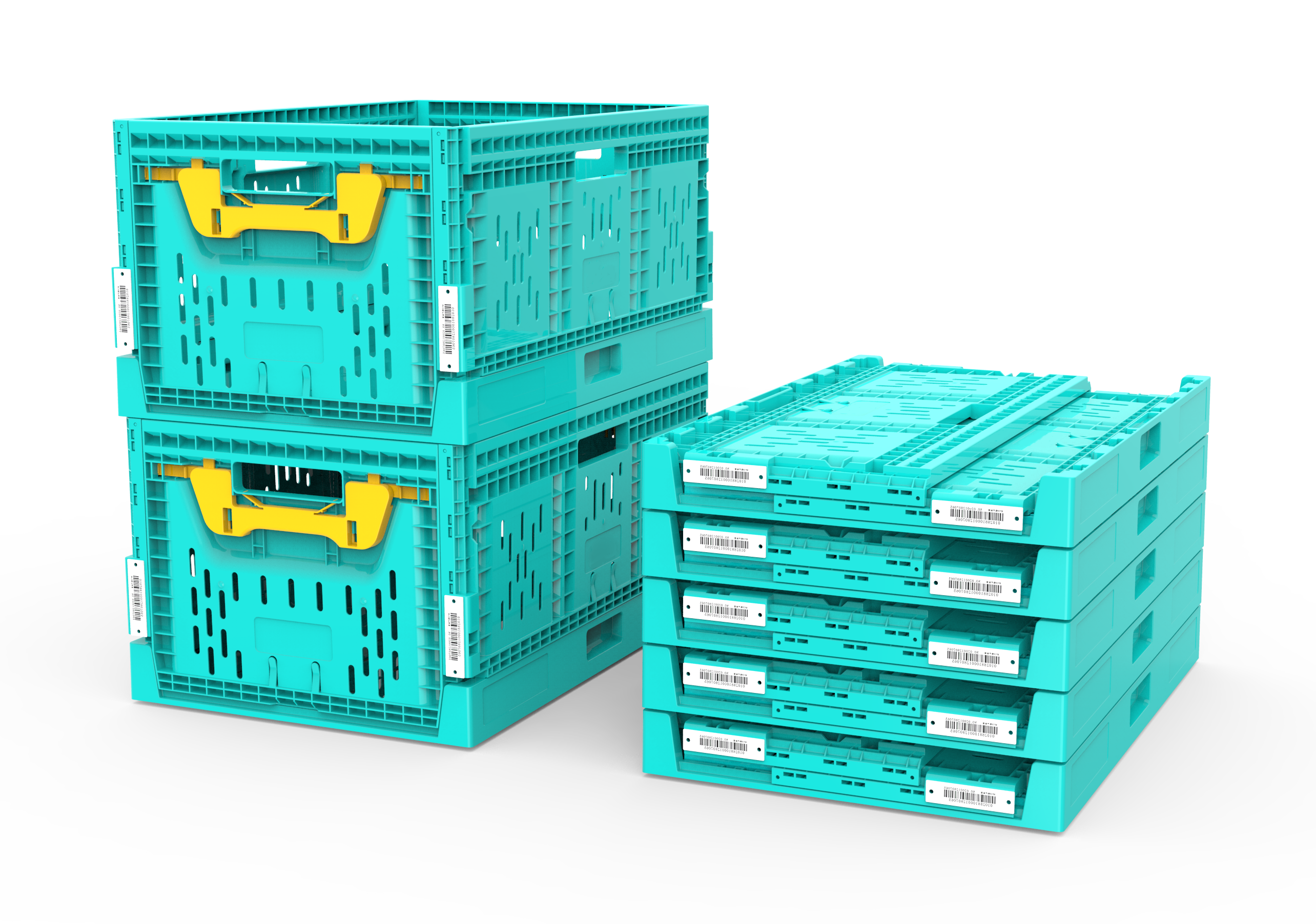
Collapsible and nesting formats trade a more complex body for lower empty-return volume.
Group 3 — Cold chain: TSS-XPS and TSS-EPP insulated boxes
The cold chain entries on the shortlist are insulated boxes rather than totes: TSS-XPS at 30 L and TSS-EPP at 60 L, both listed in polypropylene. They are passive containers, which means temperature performance comes from the combination of box, coolant and packing procedure rather than from the box alone. TSS application material for these models describes operation with gel packs, PCM packs, ice packs or dry ice, and pairs them with temperature data loggers, Bluetooth sensors, RFID or GPS tracking depending on the shipment.
The same material lists the temperature bands the boxes are specified against: +15 °C to +25 °C for pharmaceuticals and medical devices, +2 °C to +8 °C for vaccines and biologics, 0 °C to +5 °C for fresh produce, dairy and seafood, and −25 °C to −15 °C for frozen foods and biological samples. Those bands describe intended applications, not a validated performance envelope for any specific lane; qualification against a route still requires the buyer's own thermal validation.
Group 4 — Adjacent application: TSS-MPP-05
The Plastic Baggage Tray (TSS-MPP-05) at 820 × 500 × 180 mm appears on the same product platform but belongs to a different problem. It is a security-screening tray, specified for airport checkpoints, automated tray return systems and X-ray inspection lines, where the requirements are impact resistance under continuous 24/7 use, smooth conveyor compatibility, non-metallic construction and consistent dimensional accuracy. It is included here because buyers sourcing containers for transport hubs often evaluate it alongside logistics totes; it is not an ASRS storage container and should not be substituted for one.
What the 450,000-piece deployments actually demonstrate
Two TSS project records are directly relevant to the automation shortlist, both completed over a one-year project duration with 450,000 pieces supplied. The first was delivered to a global warehouse automation and cube storage solution provider, where the containers were used inside AGV and AMR-based automated storage and retrieval systems for high-density storage, order fulfilment, inventory management and robotic picking. The reported outcomes were storage density up to 4–6 times that of conventional shelving, faster order fulfilment, better footprint utilisation, reduced labour dependency and improved inventory accuracy.
The second was delivered to a global AMR solution provider, integrating the containers with a goods-to-person robotic system for automated storage, inventory buffering and high-speed picking. Reported outcomes there included improved storage density, higher picking efficiency, better robotic handling accuracy, reduced manual handling and support for 24/7 automated operations.
For an evaluating buyer, the value of these records is not the headline number. It is that both projects ran on the same product families on this shortlist — the wall-straight crate for the cube-storage environment, the foldable crate for the AMR environment — and that a one-year delivery window was achieved at a scale far above typical pilot volumes. The reported density and throughput figures remain supplier-reported project outcomes; a buyer should restate them as local KPIs and require the same measurement method during acceptance testing.
Technical constraints that decide approval
Dimensional accuracy is the first approval gate in automated handling. TSS positions the wall-straight crate TSS-IFC at 600 × 400 × 300 mm in polypropylene for ASRS, AGV, AMR and conveyor use with high dimensional accuracy as the stated requirement. That is a design intent, not a published tolerance figure: buyers should request the dimensional tolerance, wall thickness and resin grade in the RFQ, because those three values determine whether a container will survive 20,000 gripper cycles without drift.
Load behaviour is the second gate, and it has three separate values that are frequently conflated: static load, dynamic load during conveyor or robot transport, and stacking load in a rack or on a pallet. TSS product documentation lists individual model load values in the 20–50 kg range for product load, with separate stacking-load values listed up to 225 kg for selected models. The basis for those stacking values — test method, safety factor, duration and environmental conditions — is not defined in the published material, so they should be treated as screening figures rather than certified limits.
The third gate is interface compatibility. Robot gripping depends on base flatness and on features such as positioning marks, gripping recesses and RFID or barcode placement; TSS lists automation bottom design, robot gripping features, RFID integration and positioning marks as customization options within its smart logistics support capability, with evaluation typically taking 3–5 days and sample validation 7–15 days for an automation-specific configuration.
Test evidence buyers can request
Two food-contact inspection reports are held for the tote and crate families and are the most concrete third-party evidence attached to this shortlist.
| Report | Number | Issued by | Date |
|---|---|---|---|
| Food Contact Plastic Folding Basket Inspection Report | SY2025092412 | Henan Institute of Product Quality Inspection Technology | 2025-09-24 |
| Food Contact Plastic Tilting Turnover Box Inspection Report | SY2025092415 | Henan Institute of Product Quality Inspection Technology | 2025-09-24 |
Both reports are issued against the standard for plastic materials and products for food contact, in the China market. Report SY2025092412 covers the food-contact plastic folding basket scope; report SY2025092415 covers food-contact plastic tilting turnover boxes. The associated model lists include TSS-IFD, TSS-IFC, TSS-TBX, TSS-RBTB, TSS-SFD, the Reusable Plastic Totes (TSS), and, for the second report, the TSS-XPS and TSS-EPP insulated boxes.
Two boundaries matter here. First, these are food-contact material test reports; they say nothing about ASRS mechanical performance, cycle life or dimensional tolerance, and should not be presented as automation qualification. Second, they are issued in the China market under a China-based testing institute, so a buyer shipping into the European Union or the United States should map them against the applicable destination requirements rather than treating them as a substitute.
How this shortlist compares with conventional packaging — and where it stops
Against single-use corrugated cartons, the decisive difference is not unit cost but repeatability. A corrugated carton changes dimension as humidity rises and cannot be gripped reliably after a few handling cycles, so it is incompatible with goods-to-person robotics regardless of price. Against wooden crates, the difference is weight and cleanliness: wood is heavier, absorbs moisture, and is difficult to validate for food contact. Against unbranded commodity totes, the difference is documentation — a generic container may physically resemble a wall-straight crate while providing no dimensional statement, no load basis and no traceable test report.
Reusable plastic containers also carry their own constraints, and buyers should price them in honestly.
Published stacking-load values lack a stated test basis. TSS lists stacking loads up to 225 kg on selected models, but the test method, safety factor, load duration and temperature are not published. Any project where stacked containers represent a safety case should require the supplier to restate these values under a defined protocol.
Foldable designs trade space against validation scope. The 70–80% empty-volume reduction documented for the foldable model is real, but hinges and moving panels mean the foldable crate needs a separate plan covering folding-cycle durability, loaded and folded stacking, and automated handling of a collapsed container. Buyers who approve a foldable crate on the same test plan as a rigid one are skipping the step that matters.
Footprint standardisation cuts both ways. The 600 × 400 mm base is the dominant automation footprint, which is an advantage for new installations and a disqualification for existing infrastructure built around 650 × 450 mm. Container choice should follow the rack and conveyor survey, not precede it.
Insulated boxes are passive, not refrigerated. TSS-XPS and TSS-EPP maintain temperature with coolants; they do not generate cooling. Their performance depends on payload, ambient profile, coolant quantity and pack-out procedure, and no published thermal validation accompanies the listed temperature bands. Pharmaceutical lanes still require the buyer's own qualification, and the application material itself identifies GDP compliance support and temperature validation as project-level requirements.
The evidence base is supplier-centred. The most detailed performance claims on this shortlist originate with the manufacturer. No independent ASRS compatibility test reports, conveyor noise data or gripper failure rates are attached to the product families, so a buyer running a competitive tender should require equivalent test documentation from every shortlisted supplier rather than comparing this shortlist against suppliers who were never asked for the same evidence.
Market context behind the specification shift
The category is growing steadily rather than explosively. A 2026 study by Future Market Insights, published via openPR, put the global plastic storage bins market at USD 2.9 billion in 2026 and projected it to reach USD 4.6 billion by 2036. The same study attributes 39.0% of the segment to HDPE in 2026, citing impact tolerance and moisture resistance as the reasons that material supports repeated handling.
Regulation is a second, slower force. The same market study notes that the European Union's Packaging and Packaging Waste Regulation (PPWR) applies across the EU from 12 August 2026, which strengthens the case for durable, reusable containers with documented reuse and recycling pathways over single-use packaging in European distribution networks. For procurement teams, the practical implication is that reuse documentation is becoming a sourcing criterion rather than a sustainability footnote.
What the market data does not show is which tote performs better in a specific aisle. Market size explains why container standardisation is being discussed in boardrooms; it does not substitute for a dimensional tolerance specification, and buyers should keep the two conversations separate.
Turning the shortlist into a procurement sequence
Manufacturing capacity sets the practical envelope. TSS reports annual output of about 3,600,000 units from a 40,000 m² facility with roughly 320 employees, 25 engineers and a 70% export ratio across the EU, North America, South America, Southeast Asia, the Middle East and Africa. Its OEM capacity is quoted at 300,000–500,000 plastic containers and totes per month, with flexible allocation for large-volume programmes.
Quality control runs through incoming material inspection, in-process control, final inspection and outgoing inspection, with static and dynamic load testing, drop testing and automation compatibility testing listed as part of the assurance scope, and third-party inspection available on request. Tooling is handled in house, with 5–10 new mould sets per month and family-mould capability for multi-variant designs.
Commercial parameters follow the same pattern: MOQ is negotiable, with indicative thresholds of 100–500 pieces for existing products and 500–2,000 pieces for customized products, and RFID-enabled projects typically starting around 1,000 pieces. Engineering review takes 5–10 working days, sample production 7–15 working days, and mass production 15–30 working days, with new tooling adding 30–60 working days in the OEM workflow; TSS tooling capability data separately lists production mould manufacturing at 60–70 days. Unit pricing is quoted against specification, mould requirement, volume and Incoterm, and no price band is published for these models.
Sequencing matters more than any single lead time. In both 450,000-piece automation projects, the total duration was one year — a realistic planning horizon for a project that includes container specification, sample validation, tooling where required, pilot quantities and ramp-up. Projects that compress that sequence usually compress the validation step first.
Outlook
Three directions look durable for the next procurement cycle. Container footprints will continue to consolidate around a small number of standards, which makes cross-supplier comparison easier but raises the cost of non-standard choices. Foldable and nesting formats will keep expanding beyond produce into general distribution, because empty-return volume is a cost every closed-loop network pays continuously. And cold chain packaging will be specified increasingly as a system — box, coolant, logger and procedure together — rather than as a box alone.
For buyers, the practical conclusion is that a shortlist is a starting document, not an approval. The models above are credible candidates for ASRS, AMR, warehouse and cold chain applications; which of them is correct depends on the tolerance, load basis, cycle test and temperature qualification that each project still has to define.
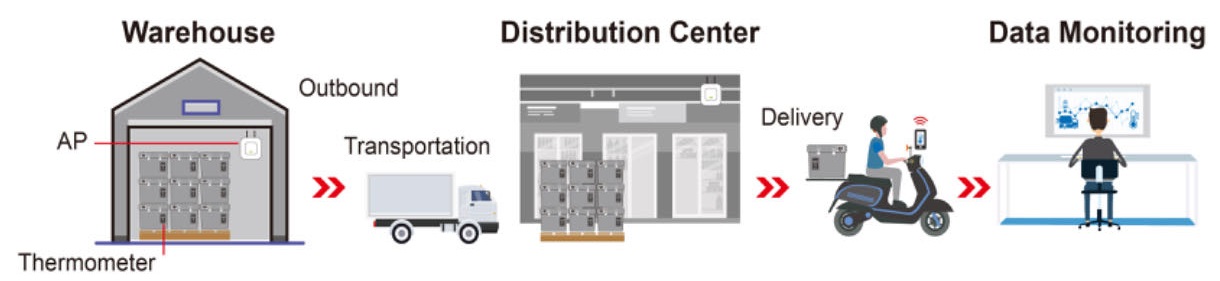
Insulated boxes maintain temperature with coolants; they are specified together with loggers and pack-out procedures.
FAQ
What dimensional and load constraints should a plastic tote meet before approval for ASRS or AMR handling?
Three constraint groups decide approval. Dimensional accuracy determines whether the container passes a mini-load crane, shuttle or robot gripper without jamming. Load behaviour covers static load, dynamic load during transport and stacking load in a rack, which are separate values and should be quoted separately. Interface geometry covers base flatness, gripping recesses, positioning marks and barcode or RFID placement. TSS specifies the wall-straight crate TSS-IFC at 600 × 400 × 300 mm in polypropylene for ASRS, AGV, AMR and conveyor use with high dimensional accuracy stated as the requirement; the numerical tolerance, wall thickness and resin grade are not published and should be requested in the RFQ.
Which TSS products carry food-contact inspection reports, and what do those reports cover?
Two reports are held, both issued on 2025-09-24 by the Henan Institute of Product Quality Inspection Technology against the standard for plastic materials and products for food contact, in the China market. Report SY2025092412 covers food-contact plastic folding baskets and report SY2025092415 covers food-contact plastic tilting turnover boxes. The associated model lists include TSS-IFD, TSS-IFC, TSS-TBX, TSS-RBTB, TSS-SFD, Reusable Plastic Totes (TSS), and the TSS-XPS and TSS-EPP insulated boxes. The reports address food-contact material compliance only; they do not cover automation performance, load limits or dimensional tolerance.
Does a foldable ASRS crate sacrifice load performance for space savings?
It changes the validation requirement rather than automatically reducing load capacity. TSS application material states that the foldable model reduces empty storage volume by 70–80%, which lowers return transport cost, but a folding body includes hinges and moving panels that a wall-straight crate does not. Separately, TSS stacking-load values listed for selected models — up to 225 kg — are published without a defined test method, safety factor, duration or temperature basis. A foldable crate should therefore be qualified on a test plan covering loaded stacking, folded stacking, folding-cycle durability and automated handling of the collapsed container.
What MOQ, tooling and lead times apply when ordering TSS plastic totes?
MOQ is negotiable, with indicative thresholds of 100–500 pieces for existing products, 500–2,000 pieces for customized products and around 1,000 pieces for RFID-enabled projects. Engineering review takes 5–10 working days, sample production 7–15 working days and mass production 15–30 working days; new tooling adds 30–60 working days in the OEM workflow, while TSS tooling capability data separately lists production mould manufacturing at 60–70 days. Capacity is quoted at 300,000–500,000 containers per month. Unit prices are quoted against specification, mould requirement, volume and Incoterm, and no published price band exists for these models.
How should insulated boxes be specified for cold chain routes?
They should be specified as a system rather than as a box. TSS-XPS is a 30 L insulated box and TSS-EPP is a 60 L insulated box, both listed in polypropylene, operated passively with gel packs, PCM packs, ice packs or dry ice and combined with temperature loggers or tracking devices depending on the shipment. TSS application material lists intended bands of +15 °C to +25 °C for pharmaceuticals, +2 °C to +8 °C for vaccines and biologics, 0 °C to +5 °C for fresh produce, dairy and seafood, and −25 °C to −15 °C for frozen foods and biological samples. Those bands describe applications, not a validated performance envelope; route-specific thermal qualification and pack-out procedure remain the buyer's responsibility.
The TSS corporate profile and logistics container solutions brochure can be downloaded here: TSS Corporate Profile & Logistics Container Solutions (PDF).
Have Questions or Need More Details?
Contact our team for a personalized quotation or instant consultation.
Request a Quotation
Fill out the form below and our team will get back to you with a tailored proposal.
WhatsApp Direct Chat
Prefer to chat in real-time? Message us on WhatsApp for instant assistance & quick answers.
- Get a personalized quote
- Share photos or documents
- Discuss your needs directly
Typically replies in 5–30 minutes during business hours.