
TU52-MW-N3A1DOME Ceiling Fan: A Buyer's Procurement FAQ
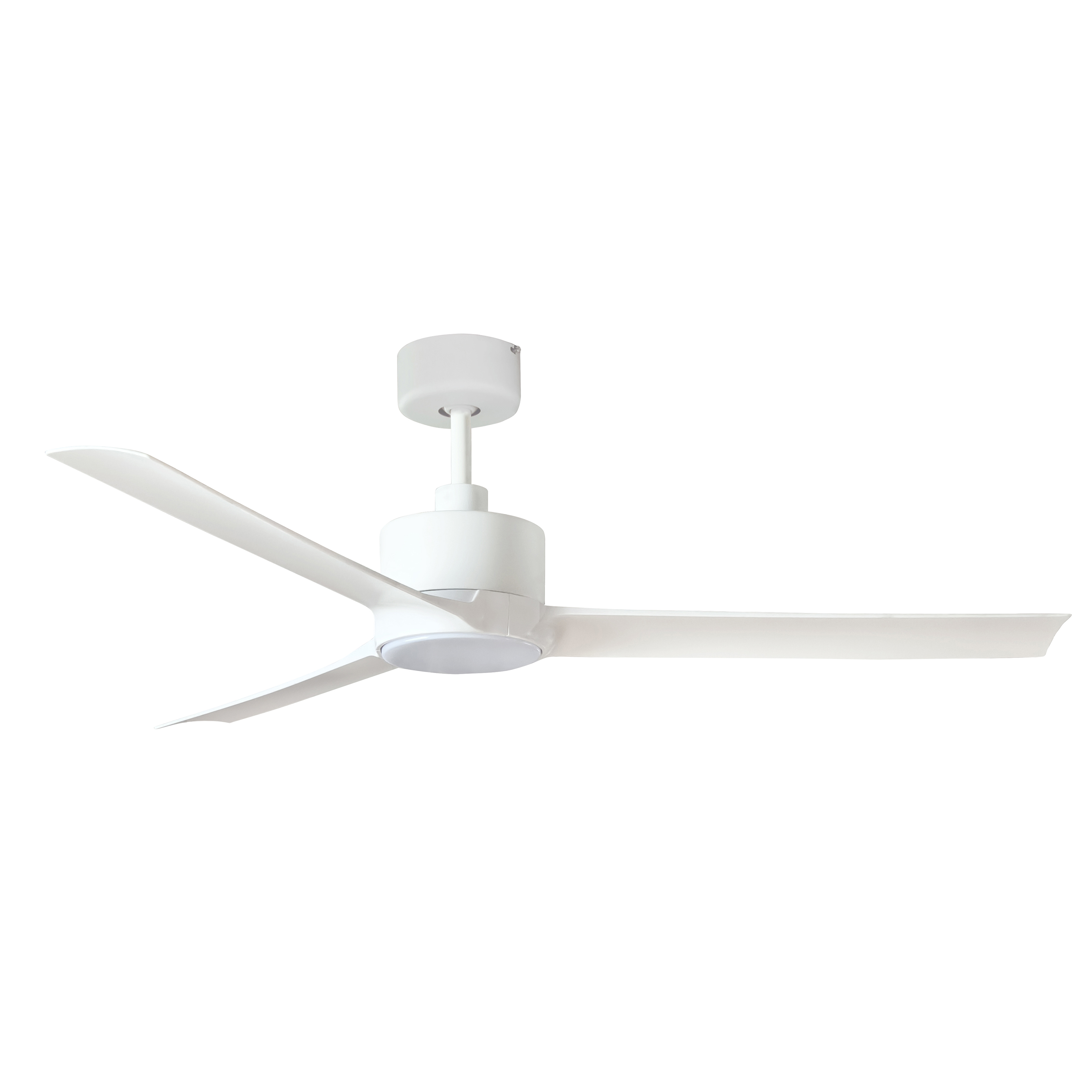
The TU52-MW-N3A1DOME: a 52-inch decorative ceiling fan with three Matt White ABS blades, a steel housing, a DC motor and a 24W CCT LED light kit.
Ceiling fan specification in commercial interiors has moved from a purely aesthetic decision to a compliance and supply-chain decision. Minimum static efficiency requirements for axial fans under the European Union ErP framework took effect on 24 July 2026 at a 50% threshold, and in the United States the ENERGY STAR programme positions certified ceiling fans as up to 44% more efficient than conventional models. Buyers who once selected a decorative fan by finish and blade span now ask about motor type, light-kit power, carton dimensions and the manufacturing depth of the supplier behind the SKU.
This FAQ addresses those questions for one specific product, the TU52-MW-N3A1DOME decorative ceiling fan from Handing Co. Ltd., and for the wider category it belongs to. It is written for specifiers, importers and procurement teams who are comparing decorative ceiling fans at the evaluation stage, where the decision is no longer whether a fan exists but whether the evidence behind it holds up.
Why Decorative Ceiling Fan Procurement Has Become a Verification Task
Published market estimates put the global ceiling fan category at between USD 11.83 billion and USD 15.7 billion in 2025, a range that reflects differing definitions of decorative, residential and industrial segments. China is estimated to account for roughly 26.7% of that global industry. For a procurement team, the headline market number matters far less than the compliance layer sitting on top of it.
Two regulatory signals define the 2026 buying cycle. In the European Union, minimum static efficiency requirements for axial fans under the ErP framework took effect on 24 July 2026 at a 50% threshold. In the United States, the ENERGY STAR programme describes certified ceiling fans as up to 44% more efficient than conventional fans, defines an eligible product as a non-portable, ceiling-mounted fan for home use whose blade tips sit more than 10 inches from the ceiling, and expresses minimum efficiency through a weighted metric in cubic feet per minute per watt (CFM/W) that varies by fan diameter.
The practical consequence is that a decorative fan is no longer evaluated only on how it reads in a lobby or a guest room. It is evaluated on motor technology, light-kit specification, packaging efficiency, certification pathway and the supplier's ability to produce consistent evidence for the destination market. That is the framework this article applies to the TU52-MW-N3A1DOME.
TU52-MW-N3A1DOME: Specification Snapshot
Before any comparison, buyers need the fixed points. The TU52-MW-N3A1DOME is a 52-inch decorative ceiling fan with three Matt White ABS blades and a steel housing, driven by a DC motor and paired with a 24W CCT LED light kit and smart WiFi control. It is intended for indoor commercial and household use.
| Attribute | Specification |
|---|---|
| Model | TU52-MW-N3A1DOME |
| Blade span | 52 inches |
| Blades | 3, Matt White ABS |
| Housing | Steel |
| Motor | DC |
| Light kit | 24W CCT LED |
| Control | Smart WiFi |
| Intended use | Indoor commercial and household |
| Carton dimensions | 720 (L) x 225 (W) x 350 (H) mm |
Two of these fields carry more procurement weight than the others. The motor type determines how the fan behaves across speed ranges and how it sits relative to efficiency expectations in regulated markets. The carton dimensions determine freight density, and therefore the landed cost per unit once the fan leaves the factory. Both are discussed in detail below.
Why the DC Motor Is the Central Decision Point
A DC motor is not simply a quieter version of an AC motor. It changes how the fan is controlled, how speed steps are delivered, and how the product is positioned against efficiency rules that are tightening in major export markets.
Direct-current motors in ceiling fans are typically paired with electronic speed control rather than a simple multi-tap capacitor arrangement. In category terms this allows a wider and more granular set of speed steps, smoother low-speed operation, and a more predictable relationship between input power and delivered airflow. For a hotel corridor, a cafe dining room or an open-plan office, that translates into finer control over air movement without the abrupt speed changes that end users notice in lower-tier fan designs.
The regulatory dimension is equally concrete. The EU ErP requirements that took effect on 24 July 2026 set a minimum static efficiency threshold for axial fans at 50%, and the ENERGY STAR framework in the United States evaluates ceiling fan efficiency through a weighted CFM/W metric that changes with fan diameter.
A buyer evaluating the TU52-MW-N3A1DOME should therefore ask two separate questions. First, does the DC motor configuration deliver the speed range and control granularity the project needs? Second, has the supplier provided destination-market efficiency documentation for this specific model rather than for the category in general? The second question is where most decorative fan procurement conversations break down, because category-level claims are common and model-level records are not.
The 24W CCT LED Kit and Smart WiFi Control
Integrated lighting and wireless control are no longer premium options in decorative ceiling fans. They are baseline expectations in hospitality, retail and residential projects, and they change what has to be verified before an order is placed.
The TU52-MW-N3A1DOME uses a 24W CCT LED light kit. In category usage, CCT refers to correlated colour temperature, meaning the fixture supports adjustable colour temperature settings rather than a fixed white output. For specifiers working across mixed environments, this is a practical advantage. A warmer setting suits a guest room or a residential living area, while a cooler setting reads better in a retail floor or a workspace. Because the light kit is integrated into the fan, the light output, the driver and the fan motor share a single power path, which means the light kit specification should be treated as part of the fan's compliance envelope rather than as an accessory bought separately.
Smart WiFi control moves the fan into the building's control layer. In practical procurement terms this matters in three ways. It allows grouped control of multiple fans across a floor or building zone without running additional control wiring. It supports scheduling and scene logic where the lighting and air movement need to change together. And it changes the after-sales conversation, because a connected fan may require firmware or app-level support over its service life, not just mechanical spares.
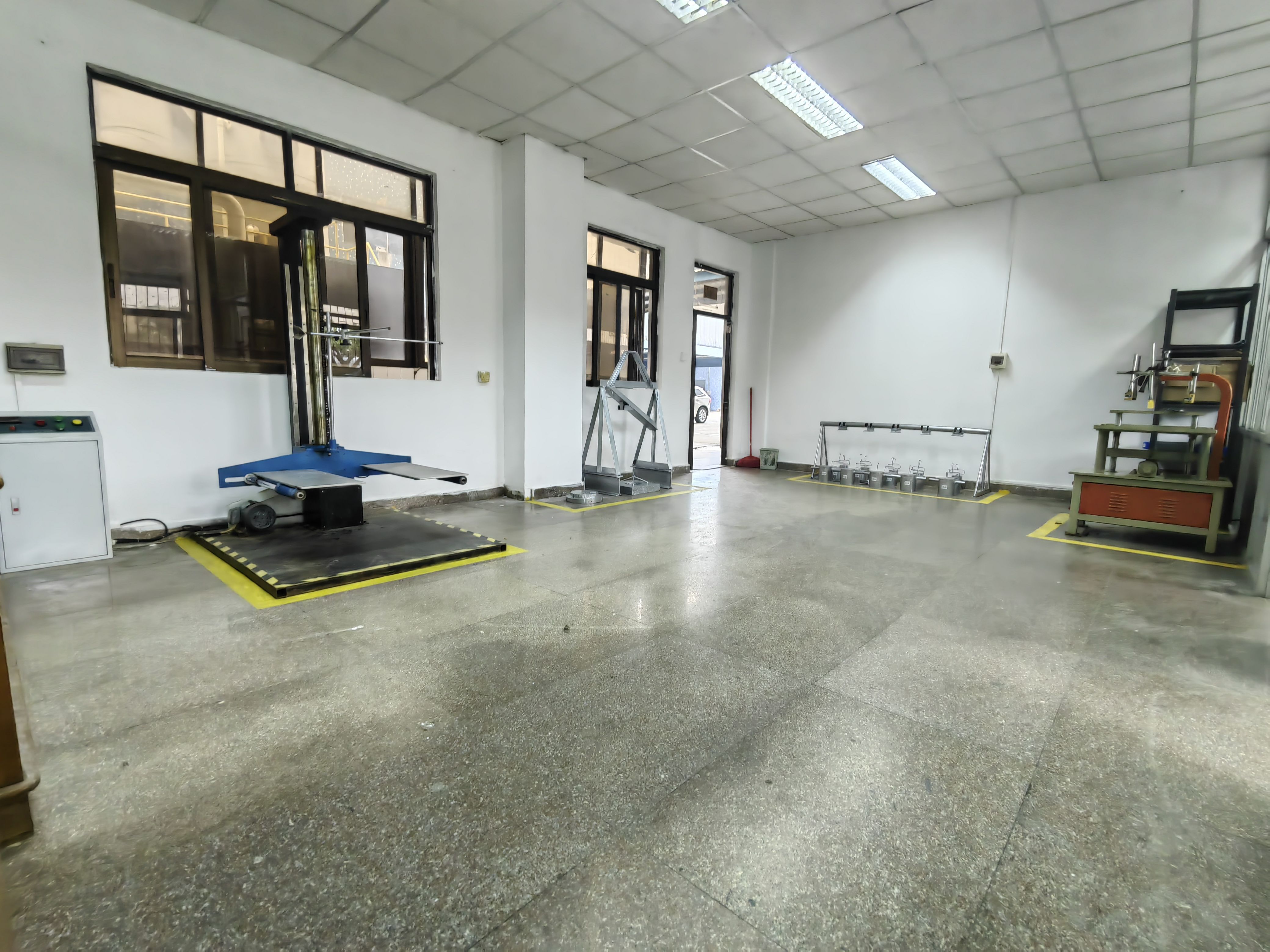
Incoming quality control testing sits between component sourcing and final assembly, and is one of the checkpoints buyers should ask to see during supplier evaluation.
Two cautions apply. Buyers should confirm the exact control protocol and app support expectations in writing, since smart control ecosystems differ by market. And buyers should confirm that a model with an integrated LED kit still meets the lighting and safety requirements applicable in the destination country, because adding a light kit changes the product's compliance profile.
Carton Dimensions: What 720 x 225 x 350 mm Means in Practice
The TU52-MW-N3A1DOME ships in a carton measuring 720 mm in length, 225 mm in width and 350 mm in height. Multiplying those figures gives approximately 0.057 cubic metres per carton.
That single number drives most of the freight conversation. Container planning for ceiling fans is volume-limited rather than weight-limited in most cases, which means the carton footprint determines how many units fit in a shipment. A buyer can estimate cartons per container by dividing the container's usable volume by 0.057 cubic metres, then adjust for pallet configuration, dunnage and any mixed-SKU loading. The stated carton length is shorter than the assembled 52-inch blade span, which indicates the fan is packed in a component configuration with blades and body arranged for transport rather than shipped assembled.
Three procurement consequences follow. First, a compact carton improves cost per unit shipped, which matters more in decorative projects where the fan is one line item among many. Second, carton dimensions should be locked early, because changes to packaging after artwork, pallet plans or retail labelling are approved create downstream cost. Third, buyers importing into markets with packaging and waste regulations should verify carton material declarations alongside the product certification file, since packaging compliance is assessed separately from product compliance.
Certification Questions for EU, USA and Australian Buyers
Certification is where decorative fan procurement most often stalls. The relevant question is not whether a supplier holds certificates, but which certificate covers which model for which market.
Handing Co. Ltd. states that its ceiling fans have been listed in UL, cUL, Nom, BSI, CE, GS, Swedish Standard and SAA, and that its European fan range holds LVD, GS, TUV, EMC, EMF, RoHS and ERP approvals. These are supplier statements about the product range, and buyers should treat them as the starting point for verification rather than the end of it.
Against that, the destination-market frameworks create their own test. In the United States, ENERGY STAR qualification requires written certification from an EPA-recognised certification body, and products must be tested in an EPA-recognised laboratory, which means a compliant product should be traceable to a specific listing rather than a general claim. For ceiling fans intended for humid locations, ENERGY STAR guidance points buyers toward a UL damp rating, and for fans in direct contact with water, toward a UL wet rating.
That damp and wet distinction is directly relevant to how the TU52-MW-N3A1DOME should be specified. The model is positioned for indoor commercial and household use. Buyers planning installations in bathrooms, covered outdoor terraces or other humid environments should confirm in writing whether the specific configuration carries the appropriate environmental rating before the fan is written into a specification.
For European buyers, the ErP efficiency requirements in force from 24 July 2026 add a layer above electrical safety. A fan can be electrically compliant and still fail the efficiency expectation if the model-level documentation is not in place. For Australian buyers, the SAA listing path performs a similar function. In all three markets, the same discipline applies: request model-level records, match the certificate to the exact configuration ordered, and confirm the light kit is included in that scope.
Supplier Vetting: What the Manufacturer Behind the SKU Should Show
Decorative ceiling fans are frequently sourced through trading companies, which makes supplier depth a legitimate evaluation criterion rather than a formality. A buyer comparing decorative fan suppliers should be able to test whether the manufacturer actually controls the processes that determine finish quality, motor reliability and delivery timing.
Handing Co. Ltd. is a ceiling fan manufacturer established in 1992. Its ceiling fan and lighting factory has held ISO 9001 certification since 1996. The company operates approximately 12,320.66 square metres of manufacturing space with around 350 staff, including six R&D engineers, and reports an annual capacity of 480,000 units. It states that it produces most of its metal parts, performs its own painting, and assembles its own motors in accordance with ISO 9001 procedures, and that it owns 100% of an in-house electroplating factory.
Two of those facts deserve more attention than they usually get. Electroplating is the finish process that most often determines how a decorative fan looks after two or three years in service, and it is commonly subcontracted by fan suppliers. Full ownership of that step changes both the quality control chain and the delivery risk profile. Similarly, in-house motor assembly means the motor specification is not a black box purchased from an outside vendor, which makes model-level performance claims easier to trace.
Handing reports that 100% of its sales are export sales, with the EU, USA and Australia as its principal markets. That export orientation is a useful signal for buyers in those regions, because it implies familiarity with destination-market documentation requirements rather than a domestic-first production model adapted later for export.
A practical vetting sequence for a decorative fan order would run as follows. Confirm the manufacturing entity and its founding year. Confirm the quality management certification and the year it was first granted. Confirm which production steps are performed in-house, particularly finish and motor assembly. Confirm current capacity against the order volume and delivery window. Confirm which certifications cover the exact model, including the light kit. Then confirm the commercial terms. Skipping the first four steps is the most common reason decorative fan projects encounter late-stage compliance surprises.
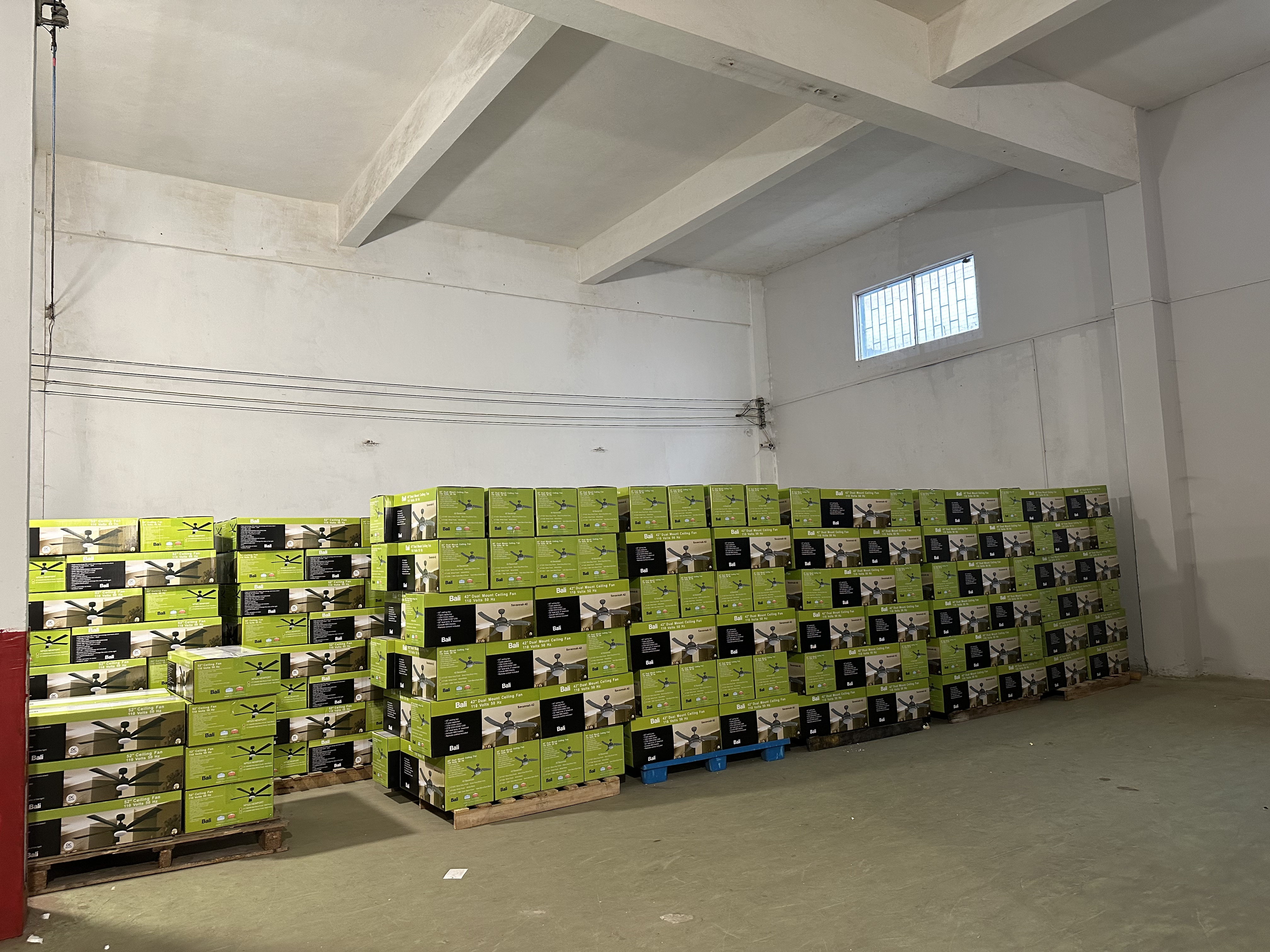
Finished goods storage ahead of export: carton dimensions and pallet configuration determine how efficiently a decorative fan order moves through the container loading stage.
Application Fit: Indoor Commercial and Household Projects
The TU52-MW-N3A1DOME is specified for indoor commercial and household use. That scope covers more ground than it first appears. On the commercial side, the relevant settings are hospitality guest rooms and public areas, cafes and restaurants, retail interiors, and office environments where air movement supplements or reduces reliance on mechanical cooling. On the residential side, the 52-inch class is commonly specified for standard to large indoor rooms where a single fan is expected to serve the whole space.
Three features align with those settings. The Matt White finish and three-blade geometry suit interiors where the fan needs to read as part of the design scheme rather than as equipment. The 24W CCT LED kit removes the need for a separate ceiling light in many rooms, which simplifies both installation and the fixture schedule. The DC motor and smart WiFi control support multi-unit installations where fans are grouped by zone and controlled together rather than switched individually.
For a hotel refurbishment, the combined effect is fewer line items to specify, easier coordination between the lighting and ventilation scopes, and a control layer that can be managed centrally. For a residential project, the payoff is straightforward: one fixture delivering air movement and adjustable lighting, with a control method that does not require additional wall wiring.
Real Boundaries: Where This Fan Is Not the Answer
An honest procurement FAQ has to state the limits, not only the capabilities.
The first boundary is environmental. The TU52-MW-N3A1DOME is positioned for indoor use. Buyers planning installations in bathrooms, laundry areas, covered terraces, verandas or any setting with sustained humidity or direct water exposure should not assume it carries a damp or wet rating. ENERGY STAR guidance treats damp-rated and wet-rated fans as distinct categories for humid and water-contact locations respectively, and that distinction should be confirmed in writing against this specific model before specification.
The second boundary is regulatory. The fan's DC motor is a strong starting point against efficiency expectations, but it does not by itself establish compliance with the EU ErP thresholds effective from 24 July 2026 or with ENERGY STAR CFM/W thresholds in the United States. Those are model-level, market-level and diameter-level determinations. A buyer importing into a regulated market should obtain the applicable efficiency documentation for the exact configuration being ordered, including the light kit, rather than relying on motor type as a proxy.
The third boundary is commercial. Carton volume and container utilisation can be estimated from the published dimensions, but actual loading depends on pallet strategy and whether other SKUs share the shipment. Buyers planning mixed containers should confirm the loading plan with the supplier rather than extrapolating from the carton size alone.
Where those boundaries are respected, the TU52-MW-N3A1DOME fits comfortably into indoor commercial and household projects. Where they are pushed, the buyer is no longer buying the product the specification describes.
Market Outlook for Decorative and DC Ceiling Fans
The direction of the category is visible in the regulatory timeline. The EU ErP efficiency requirements that took effect on 24 July 2026 raise the floor for what can be legally placed on the European market, and ENERGY STAR continues to define a premium efficiency tier in the United States. Both push the decorative segment toward DC motor platforms, because DC configurations make it easier to meet weighted efficiency metrics across multiple speeds and standby modes.
On the cost side, US import duty on ceiling fans for permanent installation from China stands at 17.20% under HS code 8414.51.30, which is a stack of the general rate and Section 301 duty. For American importers, that makes carton efficiency and landed cost modelling more consequential than they were in earlier sourcing cycles, because the duty is applied on top of a product whose freight cost already depends heavily on volume.
For specification teams the practical outlook is this: decorative styling will continue to matter, but the buying decision will increasingly be settled by motor platform, integrated lighting compliance, packaging density and the manufacturing depth of the supplier. Suppliers who control their own finishing and motor assembly, and who can produce model-level documentation for each export market, will be easier to qualify as the efficiency thresholds tighten.
Procurement FAQ
1. What are the core specifications of the TU52-MW-N3A1DOME ceiling fan?
The TU52-MW-N3A1DOME is a decorative ceiling fan with a 52-inch blade span and three Matt White ABS blades mounted in a steel housing. It uses a DC motor, integrates a 24W CCT LED light kit, and is controlled through smart WiFi. It is specified for indoor commercial and household use and ships in a carton measuring 720 mm x 225 mm x 350 mm.
2. Does a DC motor change how a decorative ceiling fan should be evaluated?
Yes. A DC motor changes both control behaviour and compliance positioning. It is typically paired with electronic speed control, which supports smoother low-speed operation and finer speed steps than a simple multi-tap arrangement, which matters in hospitality and office settings where air movement needs to be adjusted rather than switched. It also positions the product closer to the direction that efficiency rules are moving, including the EU ErP minimum static efficiency threshold for axial fans set at 50% from 24 July 2026 and the weighted CFM/W approach used by ENERGY STAR. Motor type alone does not establish compliance, however; the specific model still needs destination-market documentation.
3. What should buyers know about the 24W CCT LED kit and the smart WiFi control?
A 24W CCT LED kit means the integrated light supports adjustable correlated colour temperature rather than a single fixed white output, which allows the same fan to suit warmer guest-room settings and cooler workspace settings. Smart WiFi control allows fans to be grouped and managed across zones without additional control wiring, and supports scheduled or scene-based operation. Because both features share the fan's power path, buyers should confirm that the light kit and control module are covered by the same model-level certification and documentation as the fan itself.
4. What do the packaging dimensions mean for freight and container planning?
The stated carton measures 720 mm x 225 mm x 350 mm, which is approximately 0.057 cubic metres per unit. Because ceiling fan shipments are generally volume-limited rather than weight-limited, this figure is the basis for estimating cartons per container: divide the container's usable volume by 0.057 cubic metres, then adjust for pallets, dunnage and any mixed-SKU loading. The carton length is shorter than the assembled 52-inch blade span, indicating the fan is packed in a component configuration. Buyers should confirm the final loading plan with the supplier rather than extrapolating from carton size alone.
5. Which certification and compliance questions matter for EU, USA and Australian buyers?
The relevant discipline is matching a certificate to an exact model and market. Handing Co. Ltd. states that its ceiling fans have been listed in UL, cUL, Nom, BSI, CE, GS, Swedish Standard and SAA, and that its European fan range holds LVD, GS, TUV, EMC, EMF, RoHS and ERP approvals. In the United States, ENERGY STAR qualification requires written certification from an EPA-recognised certification body and testing in an EPA-recognised laboratory, so compliance should be traceable to a specific listing. ENERGY STAR guidance also distinguishes UL damp ratings for humid locations from UL wet ratings for direct water contact. European buyers must additionally account for ErP efficiency requirements effective from 24 July 2026, and Australian buyers for the SAA listing path.
6. How can a buyer verify supplier depth instead of relying on catalogue claims?
Supplier depth can be tested against four verifiable points: who the manufacturing entity is and when it was established, whether it holds a quality management certification and since when, which production steps it performs in-house, and what capacity it can commit. Handing Co. Ltd. was established in 1992 and its ceiling fan and lighting factory has held ISO 9001 certification since 1996. It operates approximately 12,320.66 square metres of manufacturing space with around 350 staff and six R&D engineers, reports annual capacity of 480,000 units, produces most of its metal parts, performs its own painting and motor assembly under ISO 9001 procedures, and owns 100% of an in-house electroplating factory. Its sales are entirely export-based, primarily to the EU, USA and Australia. Buyers should verify these points against current documentation rather than accepting them at face value.
7. What are the limits of the TU52-MW-N3A1DOME, and when should buyers look elsewhere?
Three limits apply. First, the model is positioned for indoor commercial and household use, so installations in bathrooms, covered terraces or other humid or water-exposed settings require written confirmation of an appropriate damp or wet rating before specification. Second, a DC motor does not by itself prove compliance with EU ErP efficiency thresholds effective from 24 July 2026 or with ENERGY STAR CFM/W thresholds; model-level, market-level documentation is still required. Third, container utilisation can be estimated from the stated carton volume but the actual loading depends on pallet strategy and mixed-SKU arrangements. Where a project requires outdoor exposure, verified damp or wet ratings, or a different blade span, the buyer should evaluate other configurations rather than stretch this one.
Closing Perspective
The TU52-MW-N3A1DOME sits at the point where decorative specification and procurement verification meet. Its 52-inch span, three Matt White ABS blades, steel housing, DC motor, 24W CCT LED light kit and smart WiFi control define the product; the carton dimensions, certification pathway and manufacturing evidence behind it define whether the product can actually be delivered into an EU, US or Australian project without late-stage surprises.
Handing Co. Ltd. is a ceiling fan manufacturer established in 1992, ISO 9001 certified since 1996, operating approximately 12,320.66 square metres of manufacturing space with around 350 staff and six R&D engineers, reporting 480,000 units of annual capacity, and holding 100% ownership of its electroplating factory. Its export business accounts for 100% of sales, primarily into the EU, USA and Australia. Buyers requiring specification documents, certification records or factory information can contact the company at sales@handingfan.com or +852 92839029. A downloadable factory presentation is available at Handing factory presentation.