
TU52-MW-N3A1DOME vs Typical 52-Inch WiFi Ceiling Fans
A 52-inch span is one of the most frequently specified size bands for indoor household and commercial interiors, and the addition of WiFi control has pushed the 52-inch smart fan onto shortlists for hotels, cafés, offices and residential projects. The problem for buyers is not a shortage of options. It is that most 52-inch WiFi fan listings are not built to be compared with one another.
Pages tend to lead with connectivity and price, then describe hardware inconsistently: blade material is sometimes stated, sometimes left out; the finish process is rarely described; and few listings say which production steps the supplier performs itself. A buyer who sets two listings side by side is often comparing two disclosure standards rather than two products.
This article takes a narrower, documented approach. It uses the Handing TU52-MW-N3A1DOME — a 52-inch decorative ceiling fan with three ABS blades, a steel housing, a DC motor, a 24W CCT LED light kit and smart WiFi control — as one fixed reference point. It then sets out what a buyer should confirm when the alternative is a typical 52-inch WiFi fan. Where a fact about this model is not established in available material, it is identified as something to verify rather than presented as a capability.
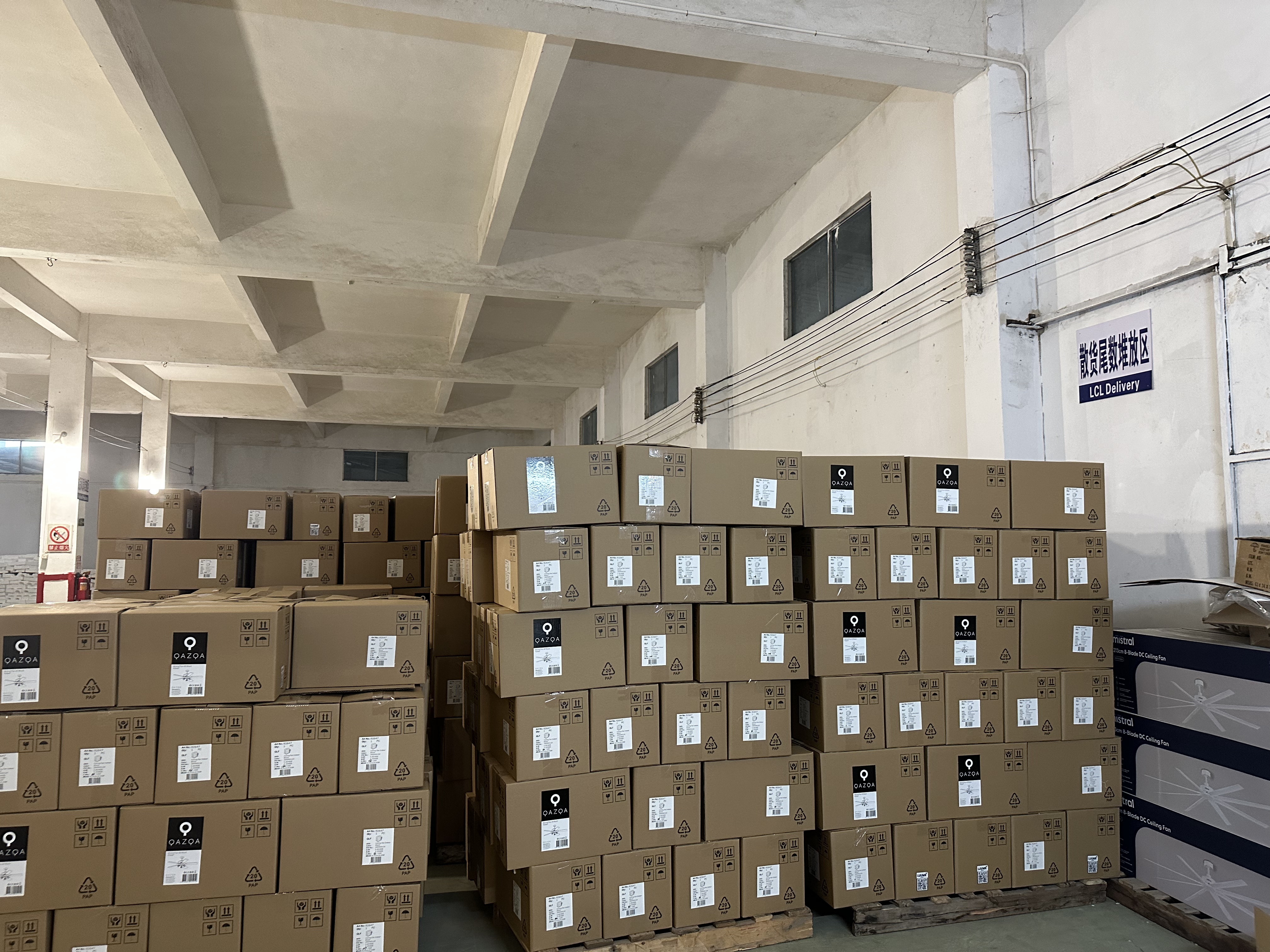
Finished goods staged for export. In a category where listings disclose different fields, the supplier behind the carton is part of the comparison.
The Comparison Problem: 52-Inch WiFi Fan Listings Rarely Align
Three structural issues make this category harder to evaluate than its price band suggests.
1. Specification fields are not standardized. Span is usually stated because it is the primary selection variable. Blade material, housing material, motor type, light-kit wattage and control architecture are disclosed at the supplier's discretion. Two fans of identical span can differ on every remaining field, and the buyer has no shared vocabulary to force the comparison.
2. Certification claims often sit at brand level rather than model level. This matters because third-party efficiency programmes are explicit about what certification requires. Under ENERGY STAR residential ceiling fan requirements, a product must obtain written certification from an EPA-recognized certification body and be tested in an EPA-recognized laboratory before the mark is used. A buyer reading "certified" on a listing page is therefore entitled to ask which model, which body, and which test report.
3. Installation environment is frequently left ambiguous. ENERGY STAR guidance for humid locations advises looking for a UL-listed damp rating, and for fans in direct contact with water, a UL wet rating. Many 52-inch WiFi listings are marketed for interiors without stating which environment rating, if any, applies to the model being quoted.
What the TU52-MW-N3A1DOME Is
The TU52-MW-N3A1DOME is a decorative ceiling fan produced by Handing Co. Ltd., a ceiling fan manufacturer established in 1992 and based in Kaiping City, Guangdong Province, China. Handing specialises in decorative ceiling fans and reports a 12,320.66 m² facility, approximately 350 staff, six R&D engineers, an annual output of 480,000 units, and 100% export sales to the EU, USA and Australia. The company has held ISO 9001 certification since 1996 and operates a 100% owned electroplating factory.
The model itself is documented as follows:
- Span: 52 inches
- Blades: 3, ABS
- Housing: steel
- Motor: DC
- Light kit: 24W CCT LED
- Control: smart WiFi
- Carton dimensions: 720 (L) × 225 (W) × 350 (H) mm
For a buyer, the composition is more informative than any single line. A 52-inch decorative fan with a DC motor, an integrated CCT light source and WiFi control crosses three procurement categories at once — air movement, lighting and connected control — and each category carries its own verification burden.
Technical Explanation: Reading the Specification Field by Field
The 52-inch span and the three-blade ABS set
Span describes the swept diameter of the blade set, and it is the variable that most directly connects a fan to a room. The 52-inch band sits in the range typically specified for medium to large interior rooms in household and hospitality settings. Blade count and blade material then shape how that span behaves in practice.
ABS blades are molded rather than cut from timber. In procurement terms this supports repeatable blade geometry and finish from unit to unit, and it avoids the moisture-related dimensional movement associated with natural wood in interior environments. Molding also keeps the specification stable across repeat orders, which matters for projects that are fitted out in phases. The trade-off is aesthetic: buyers who require a timber-grain look will not find it in an ABS blade set.
DC motor: efficiency and control granularity
A DC motor changes what the fan can do at the control layer as well as at the energy layer. DC ceiling fans are generally associated with lower energy use at comparable air movement and with finer speed steps than AC induction equivalents, which is why the DC configuration has become the default in smart decorative fans. For a hotel room or an office, finer speed steps allow low-speed air movement to be maintained in occupied spaces without the audible step changes that come with coarse speed selection.
This is also the field most exposed to regulation. EU ErP rules taking effect on 24 July 2026 set a minimum static efficiency requirement of 50% for axial fans, which raises the cost of staying with low-efficiency motor designs in the European market.
24W CCT LED light kit
A CCT (correlated colour temperature) light kit allows the colour temperature of the light source to be switched within a single fixture. In hospitality and residential interiors this collapses two SKUs into one: the same fan can be specified for a warm residential lounge and a neutral commercial workspace. Specifying a 24W integrated LED also removes the lamp-replacement variable from the maintenance plan for the light source, subject to the driver and module service life stated by the supplier.
Steel housing and in-house electroplating
Steel is the structural housing material on this model. The relevant procurement question is not the substrate but who finishes it. Handing reports that it produces most of its metal parts, performs its own painting, and assembles its motors, and that it owns 100% of an electroplating factory — a finishing step that is otherwise commonly subcontracted. Owning the plating operation is a supply-continuity argument: finish quality, delivery timing and cost sit inside the same management system that carries the company's ISO 9001 certification, rather than with a third party whose schedule the fan maker does not control.
Handing also reports that it responded to the EU RoHS regulation introduced in 2006 by installing XFS equipment and chemical testing, approved by TUV PS in the same year, and that its European fans carry LVD/GS/TUV, EMC, EMF, RoHS and ERP compliance.
Smart WiFi control
WiFi control moves speed, light and often scheduling into an app and, depending on the implementation, into voice-assistant routines. For commercial interiors the operational value is zoning and scheduling: fans in a dining area can run at low speed during service and be switched off outside trading hours without staff reaching for a pull chain. The procurement questions are less about the feature and more about its dependencies — which app, which wireless band, what local control remains if the network is unavailable, and how long the manufacturer will support the control firmware.
Carton dimensions and logistics planning
A single carton of 720 × 225 × 350 mm gives the buyer the outer volume needed for container and warehouse planning before a quotation arrives. It is a packaging fact, not a loading guarantee: master-carton configuration, pallet pattern and mixed-SKU consolidation should still be confirmed with the supplier, because those variables determine real freight cost per unit.
Application and Use Cases: Indoor Household and Commercial Interiors
The TU52-MW-N3A1DOME is positioned for indoor household and commercial interiors. In practice, that covers four buyer situations.
- Hotel guest rooms and suites. The decorative form plus CCT LED light kit allows one fixture to serve both air movement and ambient lighting, while WiFi control supports housekeeping and energy routines without wall-level rewiring.
- Cafés, restaurants and lounges. Three-blade decorative fans at 52 inches suit visible ceiling positions where the fixture is part of the interior scheme rather than hidden infrastructure.
- Offices and small commercial workspaces. Low-speed DC operation supports continuous air movement in occupied rooms, and the CCT function allows the same model to be used across zones with different lighting expectations.
- Residential projects. The combination of a decorative housing, an integrated light and app control fits living areas and bedrooms where a second ceiling fixture is undesirable.
What this model does not claim to be is an industrial or outdoor product. Buyers specifying humid, coastal or exposed installations should treat the environment rating as an open item rather than assuming an indoor decorative fan will satisfy it.
Market Trend Analysis: Efficiency Rules and Landed Cost
The category is moving on three fronts that all touch a 52-inch WiFi fan decision.
Market scale and sourcing concentration. Commercial research estimates for the global ceiling fan market in 2025 range from roughly USD 11.83 billion to USD 15.7 billion, a spread that reflects differing treatment of decorative and industrial segments. Within that market, China accounted for approximately 26.7% of the global ceiling fan industry in 2025. For buyers, concentration means the comparison set will usually be Chinese manufacturers, which makes supplier-level evidence the differentiator rather than country of origin.
Efficiency regulation is raising the floor. The EU ErP requirement effective 24 July 2026 sets a 50% minimum static efficiency for axial fans. In the US market, ENERGY STAR-certified ceiling fans are reported to be up to 44% more efficient than conventional fans, and the programme applies diameter-banded efficiency thresholds measured in cubic feet per minute per watt, weighted across multiple speeds and standby. A 52-inch model therefore sits in a specific size band with its own threshold — a detail that matters when a supplier claims efficiency in general terms.
Landed cost is a live variable. Ceiling fans for permanent installation imported from China into the United States under HS 8414.51.30 carried a 17.20% duty rate in 2026, made up of a 4.7% general rate and a 12.5% Section 301 duty. Because this is a percentage of declared value, the difference between a fan that requires no rework and one that needs finishing or re-certification after arrival can exceed the visible unit price gap.
Comparison with Typical 52-Inch WiFi Fans
The table below deliberately does not assign speculations to unnamed competitors. Instead it sets the documented TU52-MW-N3A1DOME specification against the field a buyer should confirm on any alternative. Where a buyer cannot obtain the right-hand column, that absence is itself a comparison result.
| Field | TU52-MW-N3A1DOME (documented) | Typical 52-inch WiFi fan — what to confirm |
|---|---|---|
| Span | 52 inches | Nominal span and whether it is stated as blade sweep or housing diameter |
| Blade set | 3 blades, ABS | Blade material, blade count, and whether blades are molded or timber |
| Housing | Steel | Housing material and whether finishing is done in-house or subcontracted |
| Motor | DC | Motor type, number of speed steps, and where the motor is wound and assembled |
| Light kit | 24W CCT LED | Wattage, CCT range, dimming method, and whether the light is integrated or an add-on |
| Control | Smart WiFi | App ecosystem, wireless band, local fallback control, and firmware support commitment |
| Carton | 720 × 225 × 350 mm | Carton dimensions, master-carton quantity and pallet pattern for freight planning |
| Certification | Manufacturer reports product listings in UL, cUL, Nom, BSI, CE, GS, Swedish Standard and SAA | Model-level certificate numbers, issuing body and test reports — not brand-level statements |
| Environment rating | Not established in available material — confirm before specifying humid or exposed installations | UL damp or wet rating where the installation requires it |
Comparison framework for indoor 52-inch WiFi decorative ceiling fans. Left column: documented model specification. Right column: verification field, not a competitor claim.
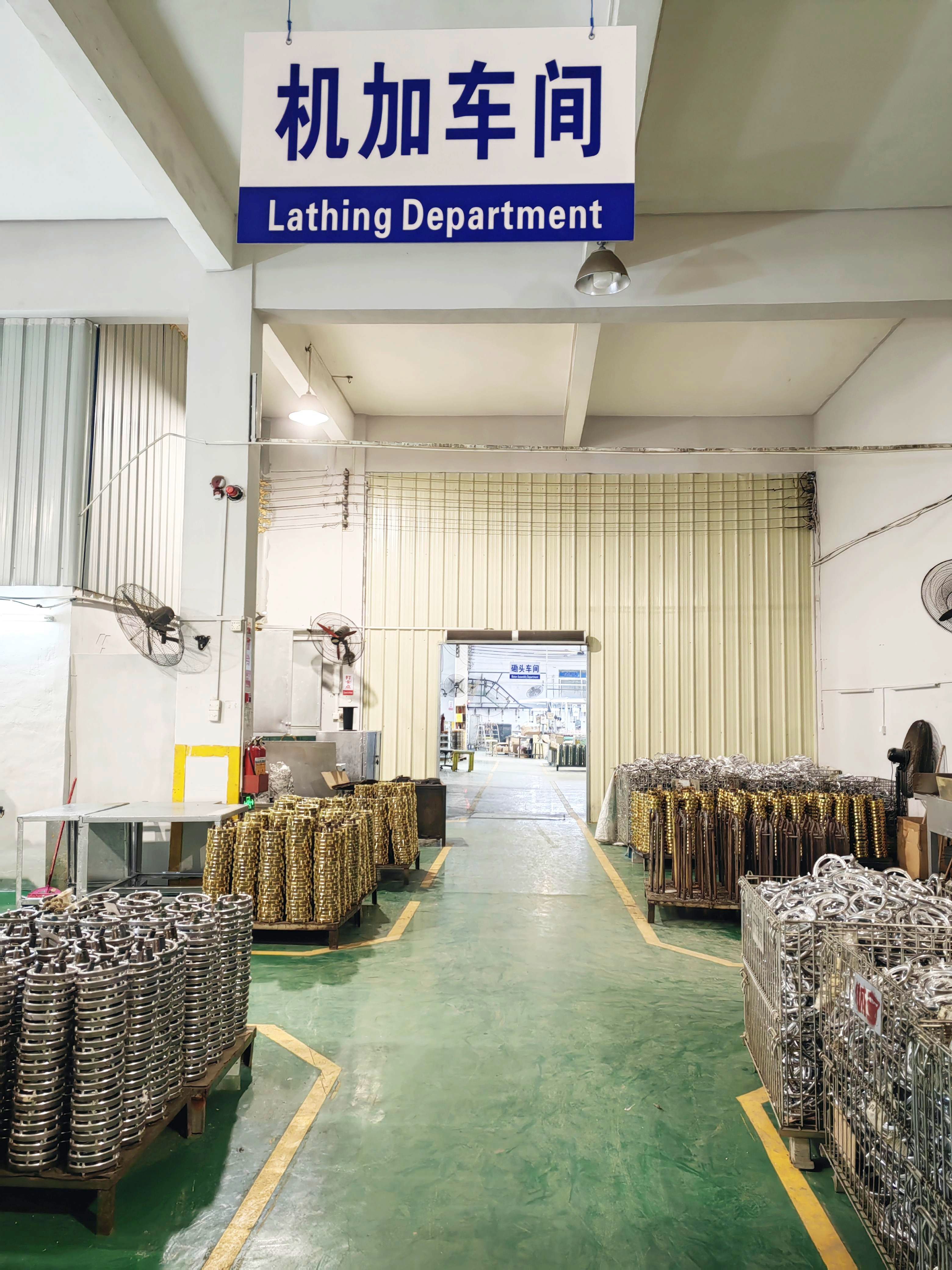
Metal parts production inside the supplier's own facility. Whether housing and finish work are performed in-house is one of the fields most often left unstated in 52-inch WiFi fan listings.
The Supplier Side of the Comparison
In a category where product specifications converge, supplier evidence separates options. Handing's documented position includes more than three decades of decorative ceiling fan manufacturing since 1992, ISO 9001 certification since 1996, a 100% owned electroplating factory, six R&D engineers, a 12,320.66 m² facility, approximately 350 staff, 480,000 units of annual capacity, and 100% export sales across the EU, USA and Australia.
Two of those facts carry more procurement weight than the rest. First, in-house electroplating is a finishing dependency removed from the critical path — in a decorative category, finish consistency is a primary quality attribute, and it is usually the step most exposed to subcontractor scheduling. Second, 100% export orientation to the EU, USA and Australia indicates the product range has been built around the compliance expectations of those three markets, including the European RoHS response and the LVD/GS/TUV, EMC, EMF, RoHS and ERP set the company reports for its European fans.
Capacity is a separate question from capability. 480,000 units annually is a statement of throughput; whether a given order profile fits that throughput depends on seasonality, mixed-SKU complexity and finishing load, and should be tested through a sample and a production schedule rather than assumed from the headline number.
Buyer Checklist Before Awarding a 52-Inch WiFi Fan Order
- Match span to the room, not to the listing. Confirm the 52-inch figure refers to blade sweep and that blade-tip clearance from the ceiling is appropriate for the mounting height; ENERGY STAR's product definition uses a reference point of blade tips more than 10 inches from the ceiling.
- Request model-level certification evidence. Ask for certificate numbers and issuing bodies for every market in the order, and confirm which laboratory produced the test data.
- Fix the environment rating in writing. For humid interiors, confirm a UL-listed damp rating; for direct water exposure, a wet rating. Do not accept an indoor decorative fan for either application without documentary confirmation.
- Specify the control architecture. Confirm the app, the wireless band, whether a physical control remains available, and what happens to scheduling if the network drops.
- Confirm the light-kit detail. Wattage, CCT range, dimming compatibility and the service path for the LED module and driver.
- Ask which production steps are in-house. Motor winding and assembly, metal parts, painting and electroplating are the four steps that most affect finish consistency and delivery reliability.
- Validate commercial terms separately. MOQ, lead time, warranty and price are not derivable from a specification sheet and should be requested as a distinct quotation package.
- Run a sample before committing a project. Speed-step behaviour, low-speed noise and CCT rendering are the attributes most likely to differ from a specification in practice.
Limitations and Boundaries: Where This Fan Is Not the Answer
A credible comparison has to state where the reference product stops.
Environment rating is the clearest boundary. The material available for this model does not establish a damp or wet rating. Buyers specifying bathrooms, covered terraces, coastal hospitality or any installation in contact with moisture should treat a rated outdoor fan as the correct category and confirm UL damp or wet listing accordingly.
Model-level certification remains a verification task. Handing reports product listings across UL, cUL, Nom, BSI, CE, GS, Swedish Standard and SAA, and European compliance across LVD/GS/TUV, EMC, EMF, RoHS and ERP. Those are supplier-level statements. A buyer requiring an ENERGY STAR mark, or a specific UL or ETL file number for a project submittal, must confirm the listing against the exact model before award — general certification claims are not a substitute.
Industrial applications sit outside the scope. Where the requirement is high-volume air movement in a warehouse, workshop or agricultural building, the appropriate category is an industrial ceiling fan, not a 52-inch indoor decorative model. The TU52-MW-N3A1DOME is an interior decorative and light-commercial product.
Aesthetic and material preference can override the specification. Buyers who need a timber blade appearance, a low-profile hugger configuration for very low ceilings, or a pull-chain-only control philosophy for simplicity are describing requirements this model does not target — and a typical alternative built around those requirements may be the better fit, even before price is considered.
Commercial terms are unverified. No MOQ, lead time, warranty term or price data for this model is established in available material. A buyer comparing on total landed cost must obtain those terms from every candidate, including this one, before the comparison is complete.
Future Outlook
Three developments are likely to reshape how 52-inch WiFi fans are compared over the next procurement cycles.
First, efficiency thresholds will keep moving upward in regulated markets. With the EU applying a 50% minimum static efficiency requirement to axial fans from July 2026, and US ENERGY STAR criteria applying diameter-banded CFM/W thresholds with formal certification-body and laboratory requirements, the DC motor is becoming a baseline rather than a premium feature. Suppliers who already build around DC platforms carry less transition risk into 2027 ordering.
Second, control longevity is emerging as a genuine evaluation criterion. A ceiling fan has a service life measured in years; an app ecosystem does not automatically share it. Buyers writing multi-year hotel or office specifications will increasingly ask for local control fallback and a stated firmware support horizon, in the same way they already ask for driver service life on LED fixtures.
Third, vertical integration is likely to be read as risk management rather than cost positioning. With duty exposure of 17.20% on US imports under HS 8414.51.30 and freight volatility affecting carton-level planning, a supplier that controls motor assembly, metal parts, painting and electroplating absorbs fewer external dependencies per finished unit. That does not make integration automatically cheaper, but it makes delivery and finish consistency easier to predict — which is what project buyers are ultimately buying.
FAQ
What does a 52-inch ceiling fan span actually refer to?
Span refers to the swept diameter of the blade set — the circle the blade tips describe in rotation — not the diameter of the motor housing or canopy. It is the primary selection variable because it connects the fan to room size and mounting height. ENERGY STAR's residential ceiling fan definition, for reference, describes a ceiling-suspended fan in which the lowest point of the blades is more than 10 inches from the ceiling.
How does a DC motor change the way a ceiling fan is specified?
A DC motor shifts part of the specification from the blade set to the control layer. DC ceiling fans are generally associated with lower energy use at comparable air movement and with finer speed steps than AC induction motors, which is why the configuration is now standard in smart decorative fans. It also interacts with regulation: the EU ErP rules effective 24 July 2026 set a minimum static efficiency requirement of 50% for axial fans, and ENERGY STAR applies diameter-banded efficiency thresholds to residential fans in cubic feet per minute per watt.
What should buyers confirm about WiFi control before specifying a smart ceiling fan?
Four items are worth fixing in writing: the app or platform the fan pairs with, the wireless band it uses, whether a physical control such as a wall switch or pull chain remains available as a fallback, and the manufacturer's stated support horizon for control firmware. For commercial interiors, scheduling and zoning behaviour should also be confirmed, because the operational value of WiFi control in a hotel or café depends on routine automation rather than on remote switching alone.
Which certifications should a 52-inch WiFi ceiling fan carry for the EU, US and Australian markets?
The answer depends on the market and on what the buyer is claiming. For Europe, Handing reports LVD/GS/TUV, EMC, EMF, RoHS and ERP compliance for its European fans. For North America, the manufacturer reports product listings in UL and cUL, and ENERGY STAR qualification carries its own process requirement: written certification from an EPA-recognized certification body and testing in an EPA-recognized laboratory. For Australia, SAA listing is reported. In every case the buyer should request the model-level certificate number, issuing body and test report rather than accepting a brand-level statement.
How do buyers verify supplier claims such as ISO 9001 certification and in-house electroplating?
Verification is documentary and, where order value justifies it, physical. For ISO 9001, request the current certificate with its scope and expiry date, then confirm the certification body is accredited. For in-house finishing, ask for the process flow of a specific order — which steps occur on the supplier's site and which are subcontracted — and, for larger programmes, audit or arrange third-party inspection of the plating line. Handing reports holding ISO 9001 certification since 1996 and owning 100% of an electroplating factory, which gives a buyer a specific claim to test rather than a general capability statement.
Is the TU52-MW-N3A1DOME suitable for outdoor or humid installations?
Available material does not establish a damp or wet rating for this model, so it should not be specified for humid or water-exposed installations without documentary confirmation. ENERGY STAR guidance for humid locations advises a UL-listed damp rating, and a UL wet rating where the fan is in direct contact with water. Buyers specifying bathrooms, covered terraces or coastal projects should confirm the rating for the exact model, or select a product designed for that environment.
For buyers who want the underlying manufacturing detail — facility layout, production flow and process capability — Handing publishes a factory presentation that can be downloaded here: Handing factory presentation (PDF). The company's product information is published at handingfan.com.
Reference basis. Product specification and manufacturer facts in this article are drawn from Handing Co. Ltd. company and product material. Category-level figures are drawn from third-party sources: commercial research estimates for 2025 global ceiling fan market value and China's 2025 share of the global industry; EU ErP axial-fan efficiency requirements effective 24 July 2026; US import duty treatment of ceiling fans for permanent installation under HS 8414.51.30; ENERGY STAR ceiling fan programme criteria, efficiency thresholds and damp/wet rating guidance. No competitor product specification has been asserted in this article; the comparison column identifies fields a buyer should verify.
Have Questions or Need More Details?
Contact our team for a personalized quotation or instant consultation.
Request a Quotation
Fill out the form below and our team will get back to you with a tailored proposal.
WhatsApp Direct Chat
Prefer to chat in real-time? Message us on WhatsApp for instant assistance & quick answers.
- Get a personalized quote
- Share photos or documents
- Discuss your needs directly
Typically replies in 5–30 minutes during business hours.