
Tailoring AI Sorting to the Project: From Grain Defects to Metal Recovery
Industry: Semiconductors & AI / Manufacturing · Read time: 8 min
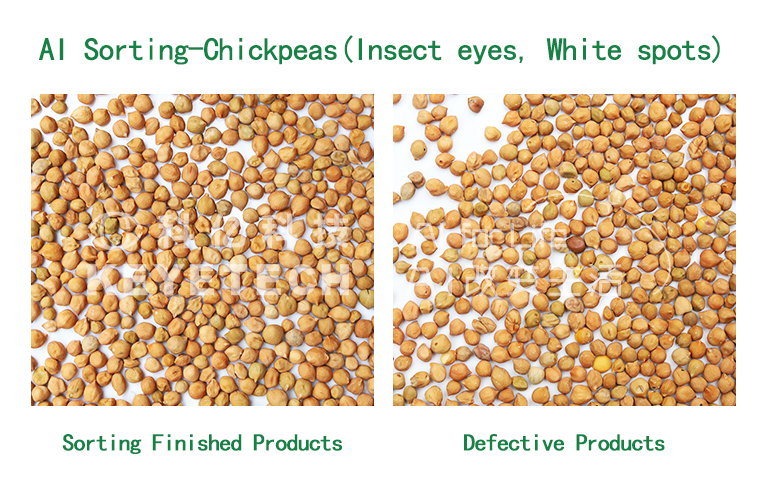
AI vision systems can now detect sub‑millimeter defects that traditional color sorters miss. (Image: KEYETECH)
When a food processor in India needed to remove wormholes from chickpeas at 24/7 throughput, or a recycling plant in Kenya aimed to replace manual sorting of copper scrap, the technical requirements could not have been more different. Yet both scenarios demanded the same core capability: a sorting platform that adapts rapidly to the material, the defect, and the operating environment. KEYETECH, an Anhui‑based AI vision company founded in 2011, has built its intelligent sorting portfolio around exactly this kind of project‑level flexibility.
Why Project Adaptation Matters in AI Sorting
Traditional optical sorters rely on fixed color‑threshold algorithms. They work well when the product is uniform and the defect is a simple color deviation. But in real‑world quality control, defects can be subtle — an insect eye on a lentil, a white spot on a coffee bean, an oxide patch on an aluminum block. Manual inspection, while flexible, is slow and inconsistent. The optical sorter market, projected to reach USD 5.79 billion by 2032 (MarketsandMarkets), is increasingly driven by the need to handle these varied challenges with a single hardware platform that can be quickly re‑purposed.
AI‑powered sorting closes this gap by learning to recognize any visual pattern — from wormholes in grain to discolored granules in plastic flakes. The challenge is to make that training practical for operators who switch products weekly or even daily.
KEYETECH’s Approach: Hardware‑Neutral, AI‑First
KEYETECH describes itself as a national high‑tech enterprise focusing on the R&D and application of AI technology. The company’s core team includes three PhDs from the University of Science and Technology of China (USTC) Pattern Recognition Laboratory, and all key technologies — optical solutions, industrial cameras, AI algorithms, and software — are developed in‑house. This vertical integration allows KEYETECH to treat each sorting project as a fresh machine‑learning problem rather than a pre‑configured workflow.
The result is a capability that the company calls “rapid training”: a new sorting model can be built in approximately one hour using as few as 50 sample images. This speed makes AI sorting accessible even for small batches or seasonal products where traditional manual setup would be too slow.
Technical Architecture: From Edge Inference to Cloud Training
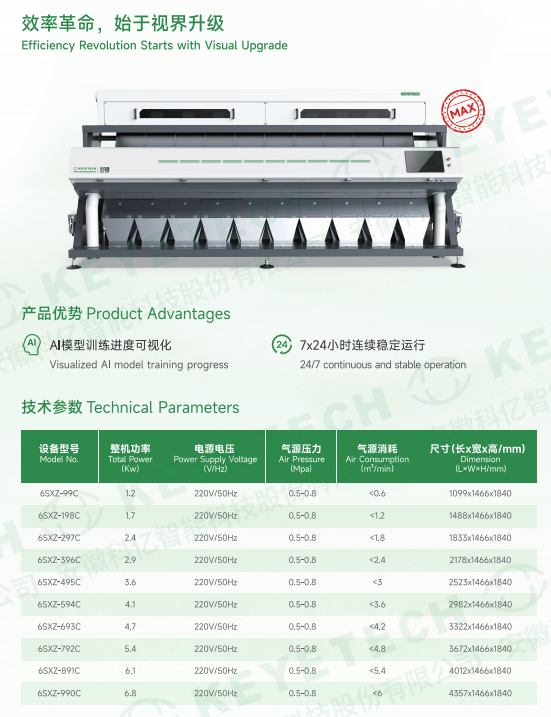
KEYETECH’s vertical (channel‑type) AI sorter is used for grains, nuts, salt, and other granular materials. (Image: KEYETECH)
KEYETECH’s sorting machines integrate an AI edge‑computing unit that runs the inference on‑device, eliminating the need for a constant cloud connection. The training itself is performed on the company’s proprietary server cluster, which hosts tens of thousands of AI models covering classification, defect detection, and object detection tasks. The hardware lineup includes both belt‑type (for fragile or irregular items such as French fries, chicken nuggets, and fresh flowers) and channel‑type vertical machines (for free‑falling granular materials like rice, grain, and plastic pellets). All models operate within a power range of 1.2–6.8 kW, air consumption of 0.6–6 m³/h, and pressure of 0.5–0.8 MPa, and are built from carbon steel or stainless steel.
Application Scenarios: Two Contrasting Case Studies
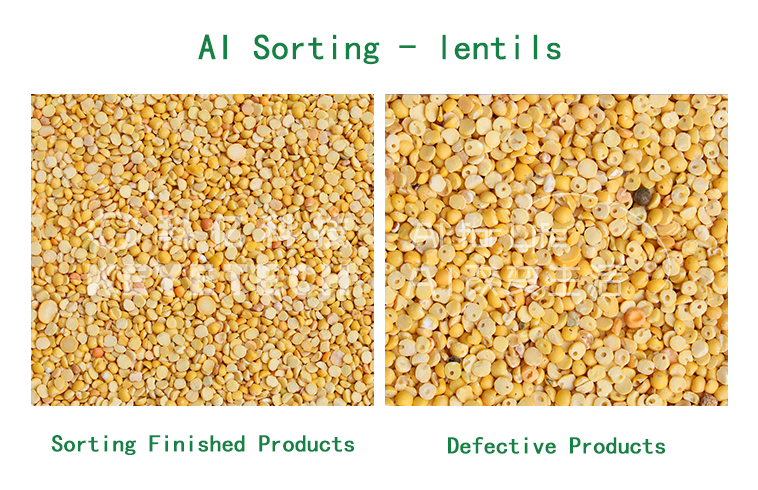
AI model trained on 50 images can detect wormholes and white spots in lentils within one hour. (Image: KEYETECH)
Agricultural Food Sorting (Insect‑Eye Detection)
In markets such as India, Kenya, Sri Lanka, Malaysia, and Vietnam, KEYETECH’s AI intelligent grain sorters are deployed in high‑volume batch sorting environments, operating 24/7. The core function is to remove wormholes and keep only safe food. The primary equipment used is the 6SXZ‑693C Grain AI Color Sorter or the 6SXZ‑63LFI Nut AI Color Sorter, depending on the material. Supporting requirements include an air compressor and a grounding wire. This application directly addresses the long‑standing industry problem of insect‑eye detection, which KEYETECH claims to maintain the “first level in the industry” thanks to its AI training pipeline.
Metal and Ore Sorting (Replacing Manual Labor)
In the metal industry — with projects across India, Kenya, Sri Lanka, Thailand, the US, and Ethiopia — the product’s role is to solve the inaccuracy and low efficiency of manual detection. The machines operate indoors at normal temperature and humidity, 24/7, and require a stable power supply. Models such as the 6SXZ‑378LFI Metal AI Color Sorter or 6SXZ‑252LFI Ore AI Color Sorter are used, depending on throughput needs. Here, the AI distinguishes between valuable material (copper, aluminum) and waste, achieving a level of consistency that manual sorters cannot sustain.
Market Trend: AI‑Enhanced Sorters Gain Traction
Industry data points to accelerating adoption. According to EIN Presswire (2024), AI‑enhanced hyperspectral and NIR sorting modules are now embedded in approximately 38% of new industrial belt‑line installations. The food processing segment alone accounted for USD 2.52 billion in sorting‑machine revenue in 2024 (Grand View Research). Asia Pacific, the largest regional market — valued at USD 1.03 billion in 2025 (Fortune Business Insights) — is a natural home for flexible AI sorters because of the high diversity of both agricultural commodities and industrial materials processed in the region.
AI Sorting vs. Traditional Optical Sorting
Advantage: AI systems can detect defects that are invisible to threshold‑based cameras — insect eyes, internal mold, subtle discolorations on non‑uniform surfaces. They adapt to new materials with a short model‑training cycle, reducing the need for hardware reconfiguration.
Honest limitation: AI models require a small but validated set of defect images for training. For extremely simple sorting tasks (e.g., removing only black beans from white rice), a traditional color sorter may be more cost‑effective because it needs no data preparation and no inference hardware. The decision should weigh defect complexity against operational simplicity.
Future Outlook: Edge‑Native, Self‑Adapting Systems
As edge computing hardware becomes more powerful and cheaper, the gap between AI and traditional sorting will continue to narrow. Expect next‑generation machines to offer “zero‑shot” sorting — the ability to reject anomalies without any training examples — though for now, the 50‑image / 1‑hour model is a practical sweet spot. KEYETECH’s fully self‑developed technology chain (optics, camera, algorithm, software) positions it to push that boundary further.
Frequently Asked Questions (Project‑Level Sorting)
- What types of materials can KEYETECH’s AI sorters handle?
- The product line includes machines for grains, rice, nuts, coffee beans, frozen food, pet food, traditional Chinese medicinal materials, seasonings, ores, metals, plastics, salt, flower tea, fresh flowers, French fries, vegetables, chicken nuggets, candy, lemon slices, and coffee cherries. The same AI platform can be retrained for new materials within one hour.
- What operating conditions do these sorters require?
- For granular materials (free‑fall vertical machines), typical requirements are an air compressor (0.6–6 m³/h), a grounding wire, and ambient temperature between −20 °C and 60 °C. Belt‑type machines for fragile items operate in indoor factory environments with normal temperature and humidity. Both types run 24/7.
- How long does it take to set up a new sorting model?
- KEYETECH reports that a complete AI model can be built within one hour using approximately 50 sample images. This includes capturing images, labeling, training, and deploying the model to the edge‑computing unit on the machine.
- How does AI sorting compare to manual inspection?
- Manual inspection suffers from inconsistency and low throughput. AI sorting operates at high speed (continuous flow) with repeatable accuracy. However, for extremely simple color‑based sorting, traditional optical sorters may be more capital‑efficient. The strongest ROI for AI sorting comes from subtle defects (insect eyes, mold, mixed materials) where human error is high.
- Is the sorting system compliant with food safety standards?
- All food‑contact materials are constructed from stainless steel or carbon steel. Sorting equipment in the food sector typically complies with regulatory frameworks such as the FDA’s FSMA and EU Regulation EC1935/2004, and KEYETECH’s machines are built to meet these international benchmarks.
For a detailed technical datasheet covering specifications, model variants, and recommended configurations for different materials, download the full product brochure below.
↓ Download Product Brochure (PDF)About KEYETECH — Anhui Keye Intelligent Technology Co., Ltd. (KEYETECH) is a national high‑tech enterprise founded in 2011, with a 29,000 m² facility, 300 employees, and an annual output of 3,000 sorting units. Its AI technology stack — optics, cameras, algorithms, and software — is fully developed in‑house, led by PhDs from the University of Science and Technology of China. Products are exported to 50+ countries, with main markets in the EU, USA, and Southeast Asia. Contact: Nicole — market-axq@keyetech.com / +86 191 4244 2827 / en.keyetech.com.
Have Questions or Need More Details?
Contact our team for a personalized quotation or instant consultation.
Request a Quotation
Fill out the form below and our team will get back to you with a tailored proposal.
WhatsApp Direct Chat
Prefer to chat in real-time? Message us on WhatsApp for instant assistance & quick answers.
- Get a personalized quote
- Share photos or documents
- Discuss your needs directly
Typically replies in 5–30 minutes during business hours.