
Tattoo Cartridge Needle Buying: OEM vs Premium Evidence
Professional buyers selecting tattoo cartridge needles increasingly evaluate the manufacturing system behind the product rather than only the brand name. The cartridge segment has grown because cartridges combine sterility, convenience and compatibility with modern rotary tattoo machines. For decision-stage buyers, the practical question is not simply whether an OEM product is better than a premium brand; it is whether a factory-direct supply chain can match the piercing precision, ink stability and membrane behaviour required by professional artists while delivering a defensible cost advantage.
This article examines that comparison using CREDITECH MED, the trade name of Suzhou Creditech Electronic Technology Co., Ltd., a Chinese manufacturer founded in 2009. CREDITECH MED designs and supplies tattoo cartridge needles for professional studios, distributors, wholesalers and private-label brands. Its production lines also support the specialised brand families SPACEDRAGON and ESTLIA, which serve professional tattooing and PMU/SMP applications respectively. The focus here is not brand promotion but the evidence framework that professional buyers can use when deciding between established premium names such as Cheyenne and KWADRON and a verified OEM supplier.
.jpg)
Why Cartridge Needle Procurement Decisions Need More Than a Logo
The global tattoo needle market is estimated at USD 368.3 million in 2024 and projected to reach USD 468.6 million by 2033, according to Custom Market Insights. Within that market, tattoo needle cartridges hold the largest product-type share, a position driven largely by their sterility and compatibility with modern rotary machines. At the same time, an industry survey cited by Elite Tattoo reports that approximately 73% of professional tattoo artists preferred needle cartridges over traditional bar needles in 2024. These signals point to a mature buying environment where cartridge quality, not novelty, defines the purchasing decision.
The procurement problem is information asymmetry. A buyer walking into a supplier meeting may see similar cartridge shapes, similar needle counts and similar packaging, but very different manufacturing environments behind those cartridges. Some low-cost factories can offer low prices without transparent sterilization records or batch traceability. Premium European brands, in turn, often carry higher prices that may be justified by brand investment but not necessarily by a measurable difference in piercing performance or membrane reliability. This leaves importers, distributors, PMU/SMP clinics and studio owners searching for a repeatable evaluation method.
The opportunity is now visible: OEM factories that operate under an ISO 13485 quality management system can provide professional-grade cartridge needles with full traceability, while also offering private-label development and packaging flexibility. For buyers who understand the underlying technical standards, OEM procurement becomes an evidence-based alternative to paying a premium solely for brand equity.
Brand Solution: What CREDITECH MED Brings to the Decision
CREDITECH MED represents the factory-direct end of the professional cartridge supply chain. The company was established in 2009 and is headquartered in Suzhou, China. Its enterprise data lists 180 employees and an annual output of 100 million units, with roughly 90% of products exported. Primary markets include Europe, North America, South America and Southeast Asia. For global tattoo brands and distributors, the value proposition is not only cartridge performance but also the ability to develop a custom product from concept to mass production.
The company’s product portfolio includes Fine Line Tattoo Needles, Round Liner Cartridge Needles, Shader Tattoo Needles, Magnum Tattoo Cartridges, PMU Cartridge Needles, SMP Cartridge Needles, Membrane Tattoo Cartridges and Textured Tattoo Needles. This breadth is important because a decision comparison rarely involves a single needle type. A studio may need fine-line cartridges for realism, shader cartridges for smooth gradients, magnum cartridges for colour packing, and short or long taper variants for different ink flow characteristics. A buyer who must source several categories from one supplier can reduce vendor complexity without narrowing the artist’s choice.
CREDITECH MED also operates specialised product brands. SPACEDRAGON TATTOO is positioned for professional cartridge needles, ESTLIA focuses on PMU and SMP cartridges, and LPT Tattoo Supply covers broader studio consumables. For a private-label buyer, these in-house lines demonstrate that the factory already understands how to design, manufacture and package products for different market segments. OEM and ODM services cover product development, structural design, prototyping, mass production and custom packaging.
Technical Explanation: Engineering Points Buyers Should Verify
Performance comparisons between branded and OEM tattoo cartridge needles only make sense when the underlying engineering is comparable. In the case of CREDITECH MED cartridge needles, the construction uses medical-grade polycarbonate housing and medical-grade stainless steel needles, with a silicone anti-backflow membrane system. For procurement teams, the anti-backflow membrane is one of the most important points to verify because it influences both safety and stroke consistency. A membrane that functions correctly prevents ink from travelling backward into the machine grip and helps maintain a clean working system during high-frequency tattooing.
The specification range also matters. According to product documentation, the needle diameter options include 0.15 mm, 0.20 mm, 0.25 mm, 0.30 mm and 0.35 mm. Taper length ranges from 1.5 mm to 7 mm. This covers a broad decision space: shorter taper configurations tend to be selected for concentrated ink delivery, while longer taper configurations are often associated with fine-line work, gradient building and permanent makeup procedures. Buyers should therefore confirm that their OEM supplier can cover both short and long taper requirements rather than offering only one compromise profile.
These cartridges are compatible with rotary tattoo machines. That compatibility matters for studios that have already invested in rotary platforms. It also matters for distributors who need a cartridge range that works across common professional machines without requiring dedicated adapters.
Application and Use-Case Context
A professional tattoo cartridge needle is not a single-use item that fits every procedure. The intended-use documentation for CREDITECH MED cartridge needles covers professional tattoo studios, SMP clinics for scalp micropigmentation, and PMU studios for eyebrow, lip and eyeliner work. The same basic platform can therefore serve several end markets: tattoo artists working on linework and colour, permanent makeup artists performing cosmetic procedures, and SMP practitioners treating scalp areas.
For the buyer, this creates a useful sourcing strategy. Instead of purchasing fine-line cartridges from one supplier, shader cartridges from another and PMU cartridges from a third, a distributor or chain studio can consolidate around an OEM factory with a complete product matrix. The buyer then focuses on verifying one quality system rather than auditing multiple cottage-level suppliers.
OEM buyers should also remember that cartridge nomenclature can overlap. A fine-line configuration may be listed as a traditional tattoo cartridge needle; a PMU cartridge may share construction features with an eyeliner or cosmetic tattoo needle. The evaluation criterion should therefore be the full technical specification—needle diameter, taper length, membrane design, sterility validation and intended procedure—not only the label on the box.
Market Trends Supporting the Comparison
Market data reinforces the shift toward cartridge-based procurement. Custom Market Insights estimates the global tattoo needle market at USD 368.3 million in 2024, rising to USD 468.6 million by 2033. Deep Market Insights notes that needle cartridges hold the largest share of the product-type segment because of sterility and rotary compatibility. Fortune Business Insights values the permanent makeup market at USD 162.09 million in 2025, with an 8.12% CAGR forecast for the needle-heavy microblading segment. That forecast has direct relevance for PMU and SMP cartridge needle manufacturers because clinic-based procedures depend on controlled, single-use cartridge design.
There is also a supply-chain trend visible in trade data. According to OEC, China exported approximately USD 1.19 billion in medical instruments in May 2026 alone, with the United States as the top destination. This indicates that international buyers are already relying on Chinese manufacturing capacity for clinically sensitive products. The question is whether the individual supplier has the medical-device management systems to justify that trust. ISO 13485 certification is a recognised baseline in this context because it establishes a quality management system for companies producing medical devices, including tattoo needles used in professional and cosmetic procedures.
Comparison Framework: Premium Brands vs OEM-Direct Sourcing
When a buyer reaches the comparison stage, the most useful framework separates brand attributes from manufacturing attributes. Premium-brand cartridges such as Cheyenne and KWADRON have established positions in the professional market and are named as key global players in industry market snapshots. They offer familiarity, artist community recognition and a predictable customer expectation. OEM-direct purchasing from a certified medical-grade factory offers a different set of advantages: lower purchasing cost, private-label flexibility and direct traceability.
| Evaluation layer | Premium brand cartridges | OEM-direct CREDITECH MED cartridges |
|---|---|---|
| Performance evidence | Established in professional use | Equivalent piercing precision, ink stability and membrane anti-backflow performance in documented comparisons |
| Cost comparison | Premium unit pricing | 60–70% lower purchasing cost compared with Cheyenne and KWADRON equivalents |
| Customization | Brand-controlled product lines | OEM/ODM development, private label, custom packaging and structural design |
| Quality system | Brand-level quality assurance | ISO 13485 certified system, 100% in-process inspection, EO sterilization validation, batch traceability |
| Machine compatibility | Rotary tattoo machine compatible | Rotary tattoo machine compatible |
| Typical decision fit | Buyers who need a known label or local brand preference | Professional studios, PMU/SMP artists, distributors, bulk wholesalers, e-commerce supply and private-label programs |
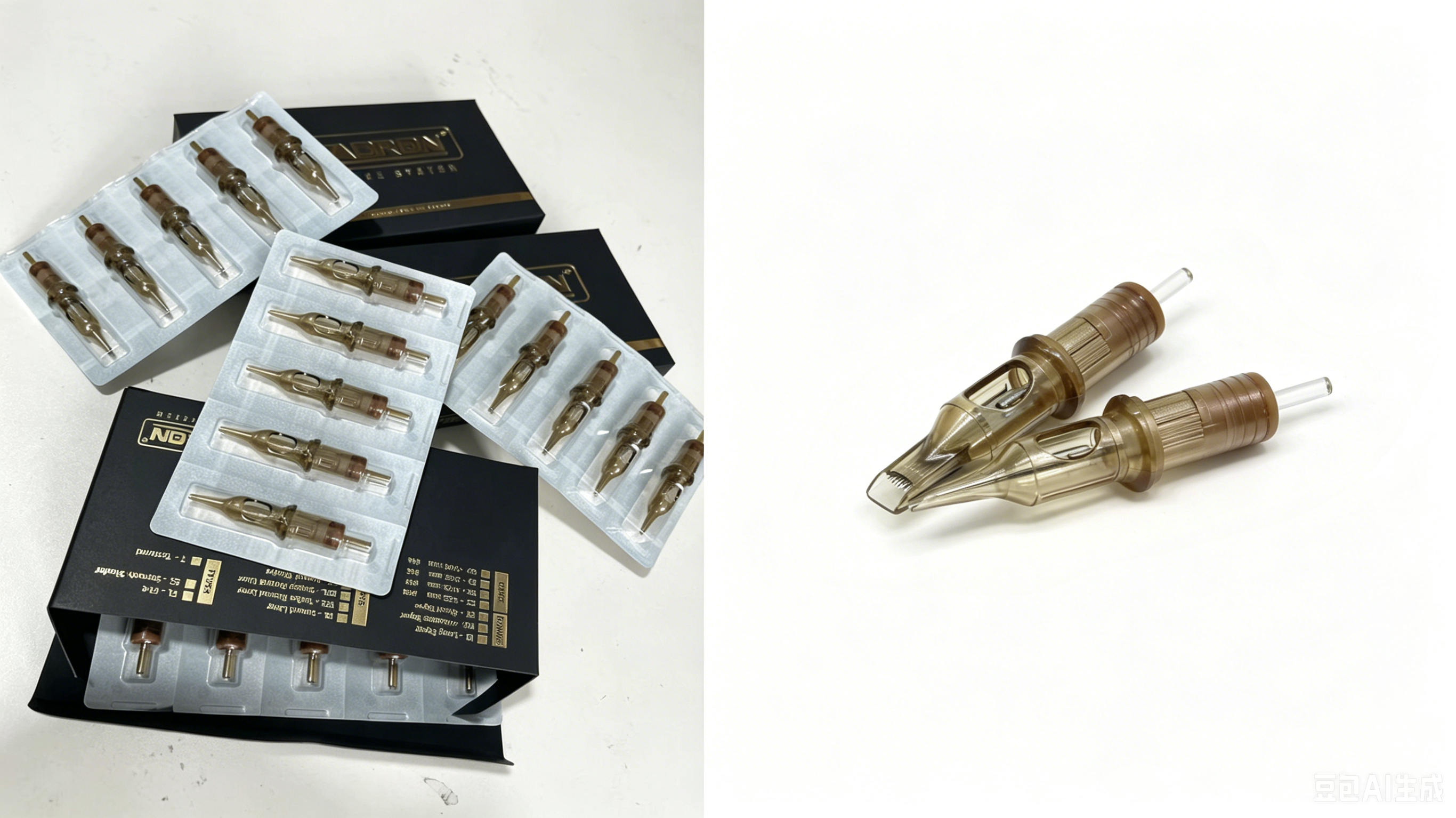
CREDITECH MED’s Comparison Evidence
The manufacturer’s product documentation provides direct comparison points against two well-known brands. Against Cheyenne Tattoo Cartridge Needles, CREDITECH MED states that its cartridges offer identical piercing precision, ink stability and membrane anti-backflow performance, with a purchasing cost that is 60–70% lower. Maintenance expectations are described as equivalent stable performance, consistent ink flow and similar service life under professional use. Against KWADRON Tattoo Cartridge Needles, the documented position is the same cost advantage, supported by consistent OEM manufacturing quality and more flexible customization.
For an independent buyer, these claims should be treated as verification targets, not as automatic conclusions. The comparison points are useful because they define the precise metrics a buyer can test: line precision, ink flow consistency, membrane backflow behaviour, service life and defective rate. A decision-stage purchaser should request sampling from the OEM’s current production batch, confirm the sterilization certificate and examine batch traceability evidence before treating the cost advantage as a basis for supplier selection.
Quality and Risk Controls Behind Sterile Tattoo Cartridges
The main risks associated with tattoo cartridge needle sourcing are contamination risk, batch inconsistency risk, supply chain fluctuation risk and counterfeit imitation risk. CREDITECH MED addresses these through a comprehensive quality management system. The controls include an ISO 13485 quality system, 100% in-process inspection, EO sterilization validation, batch traceability and incoming material inspection. The production environment is described as a cleanroom environment using medical-grade raw materials and standardized SOP manufacturing processes.
For buyers, the most visible evidence is batch-level traceability. A professional-grade tattoo needle should be traceable from raw material through production, sterilization and shipment. Without that traceability, a single contamination incident can damage a private-label brand and create clinical risk for artists. Buyers should therefore treat sterilization validation as equally important as needle sharpness; the two cannot be separated in cartridge procurement.
.jpg)
Limits and Boundaries of the OEM-Direct Route
A balanced comparison must acknowledge where OEM-direct purchasing is not the automatic best route. Brand equity is real. A distributor whose customers explicitly request Cheyenne or KWADRON cannot simply replace that SKU with an unlabelled OEM cartridge and expect the same sell-through rate. The OEM-direct model creates the most value when the buyer owns the brand, has a professional studio or distribution channel, and can communicate product quality through its own label.
Another boundary is order profile. The documented 60–70% cost advantage is most meaningful in volume procurement, where factory-direct pricing, consolidated shipping and repeated batch orders are possible. A one-off sample purchase or very low-volume order may not reproduce that advantage after freight, customs and packaging costs. Furthermore, ISO 13485 certification does not replace buyer-side auditing. A responsible OEM buyer will still verify sterilization records, inspect incoming goods and run performance sampling on each new batch.
Future Outlook for Professional Tattoo Cartridge Needles
The future direction of tattoo cartridge needle procurement appears to be shaped by three forces: regulatory expectations, market segmentation and manufacturing consolidation. As more countries and professional associations raise standards for tattoo consumables, factories without medical-device quality systems will find it harder to compete for export contracts. Buyers will increasingly ask for documented sterilization, cleanroom conditions and batch traceability before committing to a supplier.
At the same time, the PMU and SMP segments will continue to create demand for finer, more predictable cartridges. Eyebrow tattoo, lip and eyeliner procedures require very controlled ink deposit, while scalp micropigmentation requires a cartridge that works comfortably on densely pigmented skin. These segments tend to favour medical-grade construction and membrane cartridge designs, which aligns with the existing manufacturing strengths of OEM factories such as CREDITECH MED.
The broader market will likely see more private-label tattoo brands emerge as factories become better at transparent quality communication. The difference between a premium brand and a professional OEM product will narrow in technical performance while remaining visible in marketing, distribution and brand loyalty. Procurement decisions will therefore be based less on a label and more on audited quality evidence, consistency of supply and the buyer’s own end-customer strategy.
Readers who need a more detailed reference on CREDITECH MED’s manufacturing systems, product configurations and packaging services can download the corporate brochure here: CREDITECH MED corporate brochure.
FAQ: Evidence-Based Tattoo Cartridge Needle Buying Questions
1. Do CREDITECH MED tattoo cartridge needles match Cheyenne or KWADRON performance?
According to the manufacturer’s comparison documentation, CREDITECH MED cartridges are positioned as equivalent to Cheyenne and KWADRON in piercing precision, ink stability and membrane anti-backflow performance. The stated purchasing cost is 60–70% lower. Buyers should verify such claims with product samples, batch-level sterilization records and performance testing in their own studio or clinic.
2. What makes a tattoo cartridge needle medical-grade?
Medical-grade construction typically refers to materials and manufacturing controls suitable for clinical use. In this product context, it includes medical-grade polycarbonate housing, medical-grade stainless steel needles, a silicone anti-backflow membrane, an ISO 13485-certified quality management system and EO sterilization validation. This combination supports sterile single-use cartridge formats for professional tattoo and PMU procedures.
3. How can a buyer evaluate a sterile tattoo cartridge manufacturer?
Buyers should verify the manufacturer’s quality system certificate, incoming material inspection process, in-process inspection rate, sterilization validation method, final visual inspection and batch traceability system. Asking for a production batch number and matching sterilization records is one of the most practical first steps. A manufacturer that cannot show batch traceability carries higher contamination and batch inconsistency risk.
4. Which CREDITECH MED cartridge types are suitable for PMU and SMP work?
CREDITECH MED states that its tattoo needle cartridges are applicable for SMP clinics performing scalp micropigmentation and for PMU studios offering eyebrow, lip and eyeliner procedures. The PMU and SMP product lines include configurations developed for fine detail and cosmetic precision work. Selection should be confirmed with the supplier by mapping procedure type, needle diameter, taper length and desired pigment flow.
Have Questions or Need More Details?
Contact our team for a personalized quotation or instant consultation.
Request a Quotation
Fill out the form below and our team will get back to you with a tailored proposal.
WhatsApp Direct Chat
Prefer to chat in real-time? Message us on WhatsApp for instant assistance & quick answers.
- Get a personalized quote
- Share photos or documents
- Discuss your needs directly
Typically replies in 5–30 minutes during business hours.