
Tattoo Cartridge Needle Decision Framework for Buyers

A tattoo cartridge needle is a single-use assembly in which the needle group, an anti-backflow membrane and the housing are pre-mounted inside a plastic cartridge designed to fit a rotary tattoo machine. For purchasing managers, comparing suppliers of this format is not a brand-recognition exercise. It is a scoring exercise across three measurable axes: material and dimensional quality, certification scope, and the cost structure hidden inside a quoted unit price.
Most sourcing errors in this category happen at the comparison stage rather than at the purchase stage. Two quotations that look comparable on a per-cartridge basis often differ in needle count per configuration, taper length, membrane design, sterilization approach, packaging format, minimum order quantity and lead time. A structured framework forces those differences into the open before a purchase order is raised.
The market context explains why the category attracts so many near-identical offers. Custom Market Insights estimates the global tattoo needle market at USD 368.3 million in 2024 and projects USD 468.6 million by 2033. Within that market, cartridge needles hold the largest share of the product-type segment, a position Deep Market Insights attributes to sterility and compatibility with modern rotary machines. An industry survey reported by Elite Tattoo found that 73% of professional tattoo artists preferred cartridges over traditional bar needles in 2024, citing ease of use and safety; the source is a trade publication with medium reliability, so the figure is best treated as directional rather than definitive.
Why a decision framework beats a price list
A price list answers one question: what does a unit cost. A decision framework answers the question that actually determines margin and risk: what is being bought, what evidence supports the claims behind it, and what does it cost to run through a studio or a distribution channel over a full season.
The three axes interact. Tighter dimensional tolerance reduces mid-session needle changes. A reliable membrane reduces ink backflow into the machine and therefore reduces grip and motor maintenance. Certification scope determines whether a container clears customs without rework. None of these appear on an invoice line, but all of them change the real cost per completed procedure.
For distributors and private-label brands the stakes are higher still, because the supplier's documentation becomes the buyer's documentation. A distributor who cannot produce a certificate scope statement on request absorbs the commercial consequence of that gap.
Criterion 1: Quality — what is actually being measured
Quality in cartridge needles is largely invisible at unpacking. It surfaces in line consistency across a session and in the defect rate across a lot. Four measurable parameters separate a controlled product from a copied one.
Material composition
A medical-grade tattoo needle specification typically combines medical-grade stainless steel needles, a medical-grade PC housing, a silicone elastic membrane and a non-toxic transparent plastic tip, with EO sterilization packaging material. Buyers should confirm each element separately rather than accepting a single "medical grade" label, because the housing and membrane determine fit, transparency and backflow behaviour, while the needle alloy determines sharpness retention.
Dimensional tolerance and taper
Published specifications for controlled cartridge lines state a precision tolerance of ±0.02–0.05 mm, needle diameter options of 0.15 mm, 0.20 mm, 0.25 mm, 0.30 mm and 0.35 mm, and taper lengths from 1.5 mm to 7 mm, with extra long taper available. These are not marketing numbers; they are the variables that decide whether a fine line configuration behaves consistently at the tip or drifts between lots. Taper length in particular changes penetration feel and ink release, so a supplier who treats taper as a fixed default limits the buyer's ability to serve fine line, PMU and SMP work from one source.
Membrane and fluid control
The silicone anti-backflow membrane is the component most often downgraded in lower-cost cartridges. Its function is to limit ink and bodily fluid migration toward the machine. A controlled specification pairs the membrane with a stable controlled ink delivery system and a low vibration design, so that ink flow remains predictable without the artist compensating through machine voltage.
Sterilization and packaging integrity
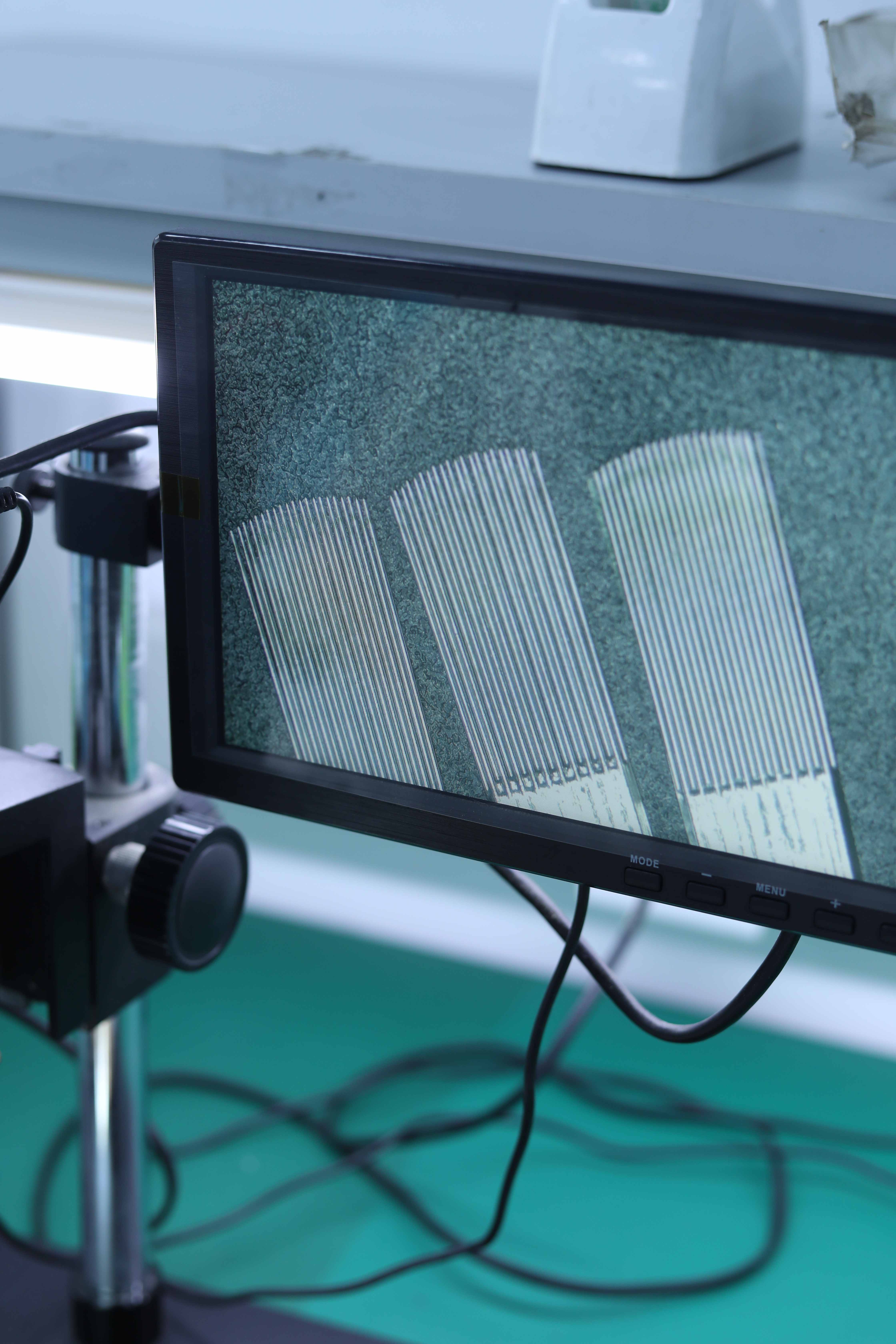
Cartridges are EO gas sterilized and supplied in a sterile breathable film packaging system as single-use devices. Sterility is validated at batch level, not at unit level, so the useful evidence is process evidence: 100% inspection, batch traceability and the ability to connect a delivered box to a sterilization record.
Criterion 2: Certifications — scope beats logos
Certification is where inexperienced buyers are most often satisfied by an image on a website rather than by a document with a scope. Four items belong in the evaluation file.
ISO 13485:2016 quality management system
ISO 13485:2016 sets requirements for a quality management system for medical devices. ISO states that medical-grade tattoo needles require ISO 13485 certification for quality management systems, which supports safety and consistency in manufacturing. The critical distinction is that the certificate covers a management system and a defined scope of activity — it does not certify an individual lot. Buyers should record the certificate number, the issuing body, the validity period and the certified scope, and check that the scope matches the products actually being ordered.
CE compliance and the EU Medical Device Regulation
Cartridges placed on the EU market are supplied under CE compliance, and the applicable route depends on product classification and intended use under the EU Medical Device Regulation. A supplier statement of CE compliance is a starting point, not a conclusion. Buyers should ask which conformity route applies, who is named as the manufacturer on the label, and whether a declaration of conformity can be provided for the exact product family being purchased.
FDA test reports
In the United States, documentation for tattoo cartridge needles is commonly provided as test reports rather than as a product clearance. This is a substantive difference that purchasing teams should record precisely: a test report supports a material or biological safety claim, while a clearance or approval is a regulatory decision. Categories, dates and the specific product families covered by any report should be confirmed in writing rather than assumed from a logo.
RoHS and hazardous substance assessment
Cartridges sold in the EU must comply with RoHS Directive 2011/65/EU, and EN IEC 63000:2018 is commonly followed for hazardous substance assessment. For buyers this is usually a documentation item rather than a performance item, but it is a recurring customs and retail-compliance question in European channels.
Criterion 3: Price — reading a quotation correctly
Unit price in this category is a derived number, not a primary one. It is produced by configuration and needle count, taper length, membrane design, housing material, packaging format, sterilization batch economics, minimum order quantity and lead time. A quotation that does not state these inputs cannot be compared with another quotation.
Commercial terms illustrate the point. In the CREDITECH MED capability profile, minimum order quantity is stated at 500–1,000 pieces per size, standard order lead time at 15–30 days, custom OEM order lead time at 30–45 days, and monthly capacity at more than 3,000,000 cartridge needles. A buyer comparing a 500-piece order against a 50,000-piece order is comparing two different production events, not two prices for the same thing.
Landed cost should therefore be modelled on four layers: the quoted unit price at the real order quantity; freight, duties and clearance documentation; expected defect and replacement rate; and the switching cost of requalifying a new supplier if the first one fails. The last layer is the one most often omitted and the one that most often decides whether a cheaper cartridge was actually cheaper.
| Cost driver | Why it changes the price | Question to ask the supplier |
|---|---|---|
| Configuration and needle count | RL, RS, RM, Magnum and Flat groups carry different needle counts and assembly time | What is the needle count and group geometry for each line item? |
| Taper length | Longer and extra long taper options require different grinding steps | Is the quoted taper standard or extra long, and is it fixed per SKU? |
| Membrane specification | Silicone membrane quality changes material cost and machine protection | What membrane material is used, and is it validated per batch? |
| Packaging format | Sterile breathable film, labelling and private label artwork add cost and time | Is packaging standard or custom, and who approves artwork? |
| Order quantity and MOQ | Setup time is amortised across the batch | What is the MOQ per size, and how does price move at the next volume tier? |
| Lead time | Custom OEM development adds tooling, sampling and validation time | What is standard versus custom lead time, and what triggers a delay? |
Building the scorecard
A workable scorecard weights three criteria and one documentary gate. The gate is pass or fail: if the certificate scope, declaration of conformity and test report coverage cannot be produced, the supplier is not scored further. The remaining criteria are weighted according to the buyer's channel — a private-label brand should weight documentation and traceability higher, while a studio buying stock configurations should weight tolerance consistency and delivery reliability higher.
| Criterion | Example weight | What is scored | Evidence to hold |
|---|---|---|---|
| Quality and consistency | 40% | Material specification, ±0.02–0.05 mm tolerance, taper range, membrane design, vibration and ink flow control | Specification sheet, inspection protocol, sample evaluation across at least two lots |
| Certification and documentation | 30% | ISO 13485 scope, CE conformity route, RoHS statement, test report coverage | Certificate, declaration of conformity, test reports, hazardous substance statement |
| Commercial terms | 30% | Unit price at real volume, MOQ per size, lead time, packaging and private label flexibility | Written quotation, production schedule, batch traceability commitment |
The weights are an editorial starting point, not a standard. What matters is that weights are set before quotations are opened, so the score is not reverse-engineered from the cheapest offer.
Applying the framework: scenario fit
Configuration choice follows the procedure, not the catalogue. The same supplier can be the correct choice for one application and the wrong one for another, depending on diameter, taper and membrane.
| Application | Configuration focus | Verification point |
|---|---|---|
| Fine line and micro-realism | Small diameters (0.15–0.25 mm) with long or extra long taper | Tip alignment and taper consistency across lots |
| Shading and soft edge work | RM and Magnum groups | Membrane performance under sustained ink load |
| Colour packing | Magnum and Flat configurations | Housing transparency and stable ink delivery |
| PMU (eyebrow, lip, eyeliner) | PMU cartridge with small diameter and long taper | Precision tolerance and low vibration at low machine speeds |
| SMP (scalp micropigmentation) | SMP cartridge with fine diameter and consistent dot deposition | Lot-to-lot consistency, since sessions repeat across large areas |
| High-frequency continuous tattooing | Any configuration used in long sessions | Membrane integrity, vibration control, batch traceability |
Cartridges in these lines are stated as compatible with rotary tattoo machines, which matters for studios running mixed machine fleets: compatibility should be confirmed against the specific grips in use rather than assumed from the cartridge format alone.

Where CREDITECH MED fits as a reference profile
CREDITECH MED is the brand under which Suzhou Creditech Electronic Technology Co., Ltd., a manufacturer founded in 2009 and based in Suzhou, China, supplies tattoo cartridge needles, PMU cartridges and related consumables to distributors, private-label brands and professional studios. The company operates an ISO 13485 certified quality management system, states CE compliance for its products, and makes FDA test reports available for applicable products. Its cartridge ranges are marketed under SPACEDRAGON TATTOO for professional tattoo work, ESTLIA for PMU and SMP procedures, and LPT Tattoo Supply for studio consumables.
Published specifications for the cartridge range include needle diameters of 0.15 mm, 0.20 mm, 0.25 mm, 0.30 mm and 0.35 mm; taper lengths of 1.5 mm to 7 mm with extra long taper available; RL, RS, RM, Magnum and Flat configurations; a silicone anti-backflow membrane; a precision tolerance of ±0.02–0.05 mm; EO gas sterilization; and a sterile breathable film packaging system. The company describes 100% inspection and batch traceability as part of its quality control, with 90% of output exported to Europe, North America, South America and Southeast Asia.
On the commercial side, the company offers OEM, ODM, custom manufacturing and private label services covering custom logo, packaging, needle configuration and housing design, with a stated monthly capacity above 3,000,000 cartridge needles. Company-reported cases include a private-label branding and custom housing project in Mexico at more than 3,000,000 cartridge needles per year over five years, and a tattoo and PMU supply wholesaler in Spain at 1,200,000 pieces per year over five years. Both are supplier-reported rather than independently audited, which is exactly the kind of claim a buyer should verify through sampling and documentation before scaling.
The limits are equally specific. CREDITECH MED describes its FDA documentation as test reports available for applicable products, not as a product-level clearance, so buyers whose market requires a defined regulatory pathway must confirm coverage in writing. Custom OEM programmes carry a 30–45 day lead time and a per-size minimum order quantity of 500–1,000 pieces, which constrains small-batch private-label launches and test runs.
Cartridges versus traditional bar needles: where the format wins and where it does not
The shift toward cartridges is well documented. In 2024, 73% of professional tattoo artists surveyed preferred cartridges over traditional bar needles for ease of use and safety, according to the Elite Tattoo industry survey referenced above. Cartridges remove the assembly and cleaning step, keep the needle enclosed until use, and standardise the interface with rotary machines — three reasons the format holds the largest share of the product-type segment.
The framework should still record what cartridges do not solve. First, sterility is validated at the sterilization batch level, so a single cartridge cannot demonstrate the integrity of the process that produced it; only batch records and inspection discipline can. Second, cartridge formats are built to standard machine interfaces, which limits the freedom to specify unusual needle geometries compared with bespoke bar needle assembly. Third, OEM customisation is not free of scale: with per-size MOQs in the 500–1,000 piece range and 30–45 day custom lead times, private-label launches need to be planned against inventory rather than ordered on demand. Fourth, certification confirms process and compliance, not artistic suitability — tolerance and taper still have to be validated on real work by the artists who will use the product.
Market trend analysis
Three published signals shape procurement decisions in this category. The first is format consolidation: cartridges already hold the largest share of the needle market, which means supplier differentiation is shifting from format to documentation and consistency. The second is category expansion into cosmetic applications. Fortune Business Insights valued the permanent makeup market at USD 162.09 million in 2025, with an 8.12% CAGR forecast for the needle-heavy microblading segment, which supports the growing weight of PMU and SMP cartridges in distributor catalogues. The third is supply concentration. OEC data puts China's exports of medical instruments, a category that includes needles, at approximately USD 1.19 billion in May 2026 alone, with the United States as the top destination, indicating both depth of supply and exposure to a single sourcing geography.
Competitive structure is correspondingly crowded. Market snapshots from CMI list Dragonhawk, Kwadron, Bishop Rotary, Cheyenne and EZ Tattoo Supply among the key global players, alongside a long tail of OEM manufacturers. For buyers, this means the shortlist decision is rarely about whether a supplier exists; it is about whether that supplier can evidence scope, traceability and repeatability across lots.
Future outlook
The direction of travel in this category is documentation-led procurement. As PMU and SMP volumes grow, buyers who previously purchased on price alone are being asked by their own customers for certificate scopes, declarations of conformity and batch traceability. Suppliers with a certified quality management system and a defined inspection regime are structurally better placed to answer those questions than suppliers who can only produce a product photograph.
A second likely shift is the normalisation of the scorecard itself. Once distributors begin scoring suppliers on tolerance, membrane design, certification scope and lead time rather than unit price, the incentive to compete on undisclosed material downgrades weakens. Purchasing teams that build the scorecard early will have cleaner comparatives when the next round of supplier changes arrives.
FAQ
A documented supplier file typically includes an ISO 13485:2016 certificate with a defined scope and validity period, a declaration of conformity supporting CE compliance for the specific product family, a RoHS compliance statement referencing Directive 2011/65/EU, and material or biological test reports where applicable. The value lies in the scope of each document, not in the number of logos displayed.
No. ISO 13485:2016 certifies a quality management system and the scope of activity it covers, not an individual lot. Sterility for EO gas sterilized cartridges is validated at batch level through process controls and packaging integrity, so the relevant evidence is the sterilization record linked to the delivered batch, supported by inspection discipline and traceability.
Published specifications for controlled cartridge lines offer taper lengths from 1.5 mm to 7 mm, with extra long taper available. Longer tapers are generally associated with fine line, PMU and SMP work where tip behaviour at shallow depth matters, while shorter tapers suit broader shading and packing groups. Taper is specified per SKU, so it should be confirmed in writing rather than assumed from a product family name.
OEM pricing reflects custom housing design, private-label packaging, artwork approval, sampling and an additional validation cycle. In the CREDITECH MED capability profile, standard orders carry a 15–30 day lead time while custom OEM orders carry 30–45 days, with a minimum order quantity of 500–1,000 pieces per size. Those inputs, not the needle alone, drive the difference.
The silicone anti-backflow membrane sits between the needle group and the machine interface to limit ink and fluid migration back into the grip and machine. In a controlled specification it is paired with a stable ink delivery system and a low vibration design, so that artists do not compensate for inconsistent flow by adjusting machine settings during a session.
It can, but not through a single SKU. The relevant variables are needle diameter (0.15 mm to 0.35 mm in published ranges), taper length, and configuration — RL, RS, RM, Magnum or Flat. A supplier able to produce the full diameter and taper matrix from one quality system simplifies qualification, while still requiring separate validation for each application and each lot.
A downloadable company brochure with product and capability details is available here: CREDITECH MED company brochure.
Have Questions or Need More Details?
Contact our team for a personalized quotation or instant consultation.
Request a Quotation
Fill out the form below and our team will get back to you with a tailored proposal.
WhatsApp Direct Chat
Prefer to chat in real-time? Message us on WhatsApp for instant assistance & quick answers.
- Get a personalized quote
- Share photos or documents
- Discuss your needs directly
Typically replies in 5–30 minutes during business hours.