
Tattoo Cartridge Needle FAQ: Materials, Sterilization, Precision
Buying tattoo cartridge needles in volume starts with a short list of questions that every procurement team, distributor, and private-label brand eventually has to answer: what the needle and housing are made from, how the unit is sterilized, how tight the stated tolerance really is, and which documents travel with the carton. This FAQ answers those questions using published specification and certification data from a working manufacturer, so buyers can compare suppliers on evidence rather than adjectives.
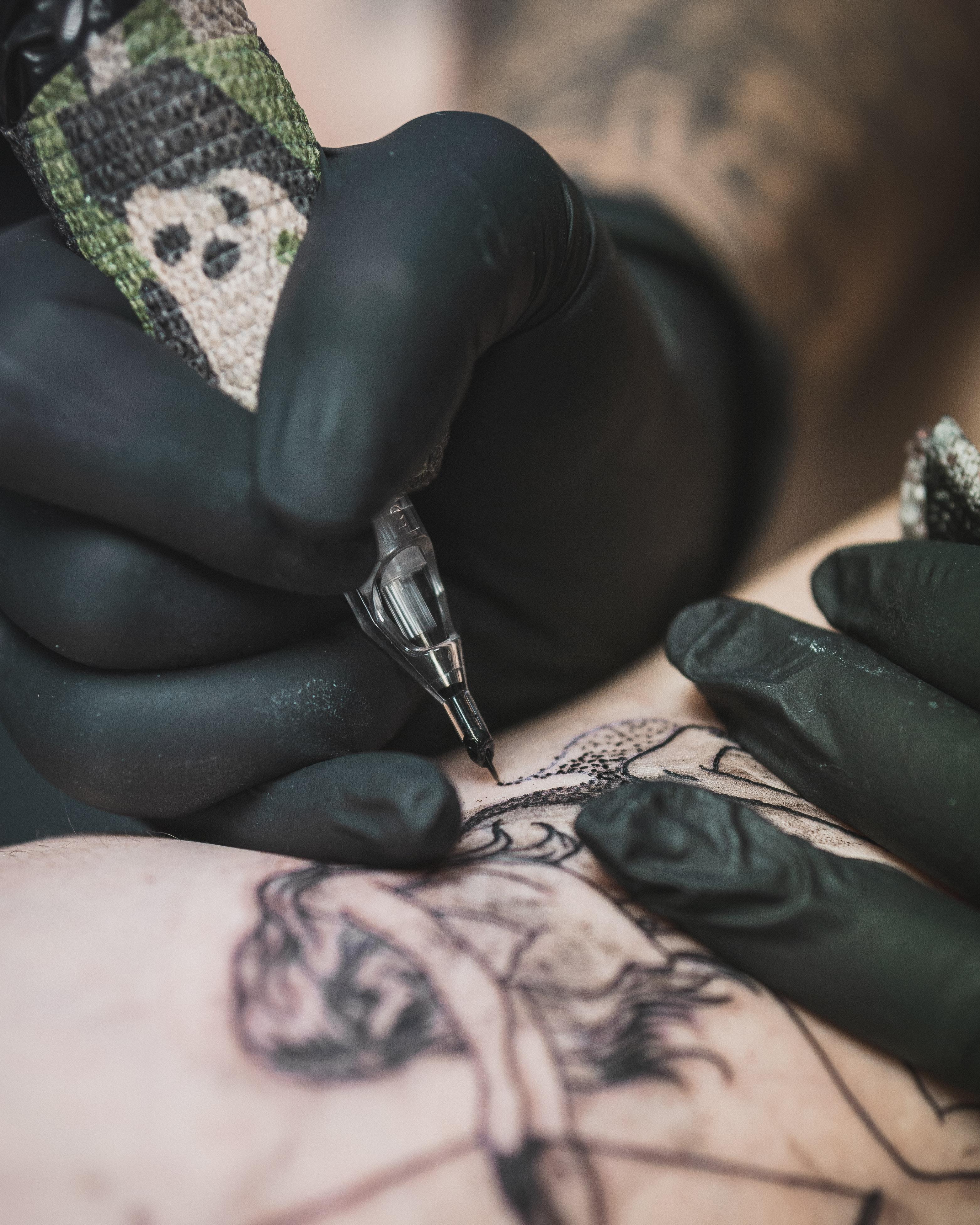
Cartridge-based setups moved needle alignment and sterility control from the studio table to the production line.
Why Materials, Sterilization, and Tolerance Decide the Order
A tattoo cartridge needle is a single-use needle assembly in which the needles are pre-mounted inside a plastic housing that clicks onto a machine grip. Because the artist no longer loads and aligns needles manually, needle geometry and sterility are fixed at the factory. The whole point of the format is that quality control moves from the studio table to the production line.
That is why bulk buyers evaluate three things before anything else. Materials determine whether the device is appropriate for skin contact and mechanically stable in a grip. Sterilization determines whether the product can be described as sterile in the destination market. Dimensional tolerance determines whether the cartridge received in month twelve behaves like the sample approved in month one.
The market has moved in the same direction. Cartridge needles hold the largest share of the tattoo needle market's product-type segment, a position industry analysts associate with sterility and compatibility with modern rotary machines. The global tattoo needle market was estimated at USD 368.3 million in 2024 and is projected to reach USD 468.6 million by 2033 (Custom Market Insights, 2024). Rising volume raises the amount of documentation regulators, distributors, and retail channels expect to see with each shipment.
Materials: What "Medical-Grade" Actually Means
In cartridge needle manufacturing, "medical-grade" is a statement about material grade and process control together. On the SPACEDRAGON cartridge needle range, the declared material breakdown is:
- Medical-grade stainless steel needles
- Medical-grade PC (polycarbonate) housing
- Silicone elastic membrane system
- Non-toxic transparent plastic tip
- EO sterilization packaging material
Each element has a procurement implication. The stainless steel needle set is the skin-contact component, so its grade and finish underpin biocompatibility documentation. The polycarbonate housing carries the mechanical load: it must hold the needle set at a fixed position while seating reliably on the grip, and its transparency allows the artist to see needle and ink during the procedure. The silicone membrane sits between the needle path and the housing interior. The transparent tip guides the needle and shapes how ink is loaded.
Because these are skin-contact consumables, the manufacturing system behind the bill of materials matters as much as the materials themselves. ISO, the standards body, notes that medical-grade tattoo needles require ISO 13485 certification for Quality Management Systems, which addresses safety and consistency in manufacturing rather than the material specification alone.
Suzhou Creditech Electronic Technology Co., Ltd., trading as CREDITECH MED, is a manufacturer of tattoo cartridge needles, PMU cartridges, and tattoo consumables based in Suzhou, China, and supplying export markets since 2009 under the SPACEDRAGON TATTOO, ESTLIA, and LPT Tattoo Supply brands. Its ISO 13485 certificate (number F04326MD00044R000) was issued by Guardian Independent Certification (Beijing) CO., LTD. against ISO 13485:2016, covers "Research, Development, Manufacturing & Sales of Tattoo Needles," and is valid from 2026-06-24 to 2029-06-23.
Sterilization: EO Gas and the Sterile Breathable Film System
Cartridge needles in this range are EO gas sterilized and sealed in a sterile breathable film packaging system. Ethylene oxide sterilization is a low-temperature process, which is why it is widely used for single-use devices that combine metal and polymer components: the housing, membrane, and tip are not exposed to the heat and moisture that steam sterilization would introduce.
For buyers, the practical checks are packaging checks. Sterility is a property of the sealed pack, not of the needle alone:
- Is the breathable film seal continuous around the entire rim?
- Is the lot or batch code printed and legible on the pack and the carton?
- Does the sterile barrier show punctures, channeling, or seal separation?
A cartridge with a compromised sterile barrier should be rejected even if the needle appears undamaged. This is also why batch traceability matters commercially: the ability to connect a carton label back to a sterilization record is what allows a distributor to answer a customer or regulator question months after delivery, rather than only at the moment of shipment.
Technical Specifications a Datasheet Should Show
One advantage of the cartridge format is that its key parameters are numeric and therefore comparable between suppliers. The SPACEDRAGON cartridge needle range (models SP4, SP5, SP6, HM3, and HM6) publishes the following specification set:
| Parameter | Specified value |
|---|---|
| Needle diameter | 0.15 mm / 0.20 mm / 0.25 mm / 0.30 mm / 0.35 mm |
| Taper length | 1.5 mm – 7 mm (Extra Long Taper available) |
| Configuration | RL / RS / RM / Magnum / Flat |
| Needle types | Fine Line, Traditional, Shading, Color Packing, PMU Eyebrow, SMP Scalp Micropigmentation, Long Taper Precision, Soft Edge Magnum |
| Membrane system | Silicone anti-backflow membrane |
| Machine compatibility | Compatible with rotary tattoo machines |
| Sterilization | EO gas sterilized |
| Precision tolerance | ±0.02–0.05 mm |
| Ink flow | Stable controlled ink delivery system |
| Vibration level | Low vibration design |
| Packaging | Sterile breathable film packaging system |
| Materials | Medical-grade stainless steel needles; medical-grade PC housing; silicone elastic membrane; non-toxic transparent tip |
Read together, these parameters define the working envelope. Needle diameter and configuration determine what the cartridge can do — lining, shading, color packing, or fine line work. Taper length controls how the needle tip engages skin: long taper configurations are commonly associated with softer, smoother transitions, while shorter tapers are generally chosen where a firmer, more defined line is required. Extra long taper options exist for artists working at very fine detail.

Dimensional checks during production are what make a stated ±0.02–0.05 mm tolerance a repeatable claim rather than a catalogue number.
Precision Tolerance and Ink Delivery in Daily Use
A stated precision tolerance of ±0.02–0.05 mm means the manufacturer expects dimensional variation across the batch to remain inside that window. For a distributor, the commercial value of tolerance is repeatability: a size reordered six months later should behave like the approved sample, without a new round of artist feedback. For a private-label brand, it is the difference between a stable catalogue and a stream of returns.
Three specifications work together on the fluid side. The silicone anti-backflow membrane separates the needle path from the housing interior, limiting the migration of ink and fluids back toward the grip. The stable controlled ink delivery system is specified to keep ink flow consistent through lining, shading, and color packing. The low vibration design reduces vibration transmitted through the cartridge during long sessions, which matters most in fine line and PMU procedures where small deviations are visible.
Tolerance claims are only as good as the inspection regime behind them. The production quality control described for this range includes an ISO 13485 quality management system, 100% inspection, EO sterilization, and batch traceability — the four elements a buyer should ask a supplier to evidence with records, not with a statement.
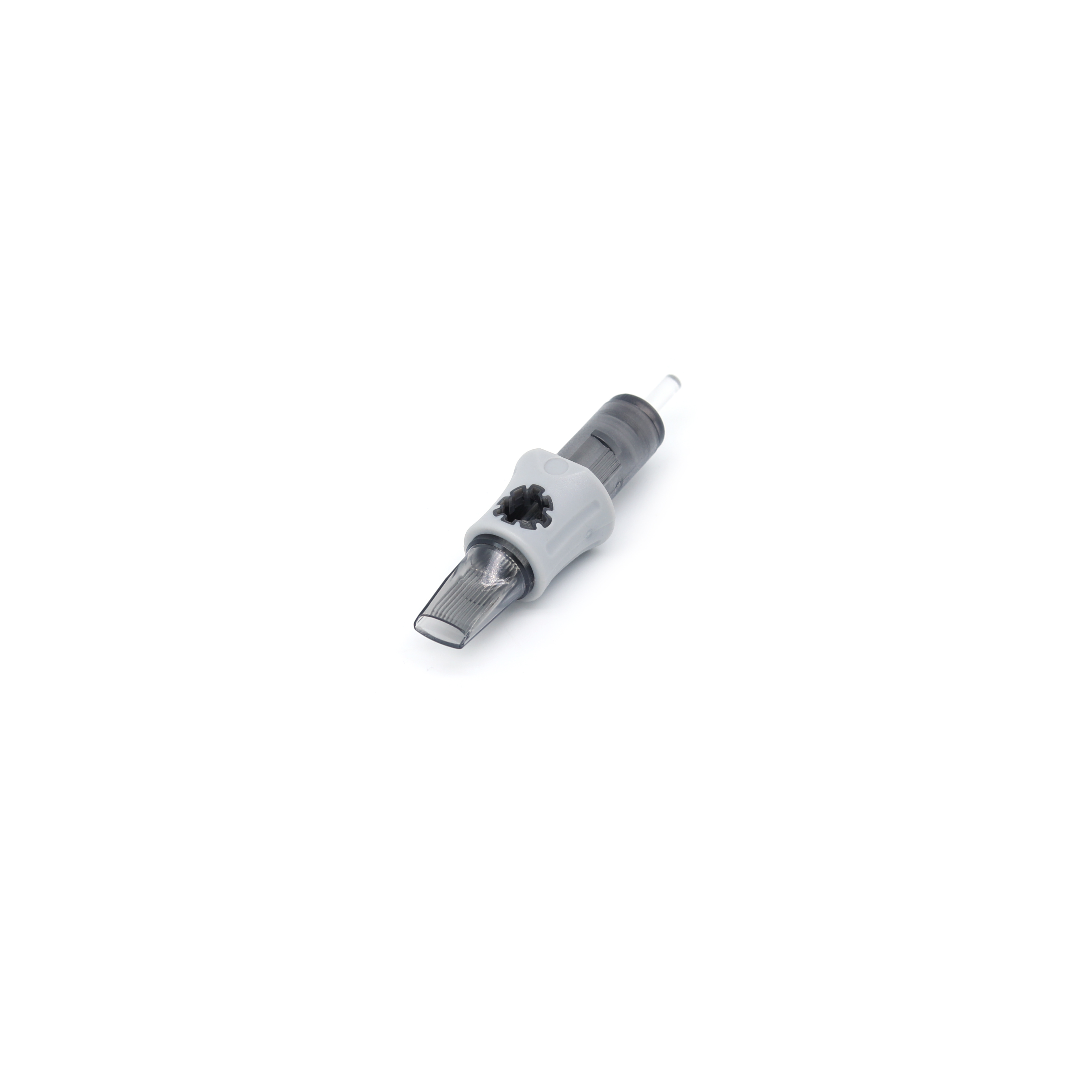
SPACEDRAGON SP5 cartridge needle: medical-grade PC housing, silicone membrane, and transparent tip in one sealed unit.
Certifications and Reports to Request With Each Shipment
Certification questions are where procurement conversations are won or lost. The documents below are the ones applicable to this product family, with their numbers, issuing bodies, and standards, so a buyer can verify them independently rather than accepting a summary.
| Document | Market | Number | Issued by | Standard / scope |
|---|---|---|---|---|
| ISO 13485 certificate | Global | F04326MD00044R000 | Guardian Independent Certification (Beijing) CO., LTD. | ISO 13485:2016; R&D, manufacturing & sales of tattoo needles; valid 2026-06-24 to 2029-06-23 |
| CE MDR document review | EU | ICR Polska/DR/HM2311112 | ICR Polska Co. Ltd. | MDR (EU) 2017/745 Annex II & Annex III; valid 2023-11-30 to 2028-11-29 |
| RoHS (2011/65/EU) | EU | ICR/VC/HM260680 | ICR | RoHS (2011/65/EU); valid 2026-06-05 to 2031-06-04 |
| RoHS 2.0 | EU | TST2019112501-3RC | TST Testing Technology Co., Ltd. | (EU) 2015/863, (EU) 2017/2102, full set of IEC62321 series standards |
| FDA testing report | US | TST2019112501-4EN | TST Testing Technology Co., Ltd. | FDA 21CFR175.300, FDA 21CFR180.22 & 21CFR181.32, EPA3050B-1996, ASTM C738-94(2011), Stainless Steel GRAS |
| MSDS | Global (EU & USA) | BCTC2305199480R | Shenzhen BCTC Testing Co., Ltd. | CLP Regulation (EC) No 1272/2008, REACH (EC) No 1907/2006; valid 2023-05-17 to 2033-05-17 |
Two context points are worth keeping in mind. First, EU-market cartridge needles must comply with RoHS Directive 2011/65/EU and commonly follow EN IEC 63000:2018 for hazardous substance assessment, so a RoHS declaration is a baseline expectation rather than a differentiator. Second, documents are not interchangeable in scope: a RoHS certificate addresses restricted substances, an MSDS addresses material safety classification, an FDA testing report addresses specific test standards, and a CE MDR document review addresses technical documentation against Annex II and Annex III. Buyers should confirm what each document covers before using it in a regulatory claim for a specific market.
Application Fit: Liner, Shader, Magnum, Fine Line, PMU, and SMP
The same cartridge platform is used across segments that have different tolerance for error. The declared application profile for this range covers lining, shading, color packing, and fine line tattooing under high-frequency continuous tattooing conditions, with a matching equipment set of rotary tattoo machine, power supply, tattoo ink, and cartridge grip. The stated special requirements for those working conditions are EO sterilization, medical-grade stainless steel, safety membrane, low vibration, high precision, and single-use construction.
Downstream, the product family is used by professional tattoo studios and artists working in fine line, realism, and color; by PMU studios for eyebrow, lip, and eyeliner procedures; by SMP clinics for scalp micropigmentation; and by tattoo supply distributors, OEM tattoo brands, e-commerce retail, training academies, and the broader medical aesthetic sector. The practical consequence for buyers is SKU breadth: a distributor covering both tattoo and PMU demand needs configurations that stay consistent across diameter, taper, and needle type, because the artist's decision is made on feel and the buyer's decision is made on reorder stability.
Market Context: Growth and Documentation Pressure
The direction of demand is not ambiguous. A 2024 industry survey circulated by Elite Tattoo reported that approximately 73% of professional tattoo artists preferred needle cartridges over traditional bar needles — a figure that should be treated as directional rather than definitive, given its survey origin, but which is consistent with the cartridge segment's leading share of the product-type market.
Adjacent segments are expanding too. The permanent makeup market was valued at USD 162.09 million in 2025, with an 8.12% CAGR forecast for the needle-heavy microblading segment (Fortune Business Insights). On the supply side, China's exports of medical instruments including needles reached approximately USD 1.19 billion in May 2026, with the United States as the top destination (OEC). Both signals point to a category where manufacturing concentration is rising while destination-market expectations tighten.
Buyers comparing suppliers will encounter a familiar set of global players — Dragonhawk, Kwadron, Bishop Rotary, Cheyenne, and EZ Tattoo Supply are identified among key manufacturers in Custom Market Insights' market snapshot. CREDITECH MED competes in the same category from the manufacturing side, offering OEM, ODM, custom manufacturing, and private label services with customization across logo, packaging, needle configuration, housing design, and new product development.
Cartridge Needles vs Traditional Bar Needles — and the Constraints
Cartridges did not remove trade-offs; they moved them. A fair comparison looks like this:
| Dimension | Cartridge needle (single-use) | Traditional bar needle with tube |
|---|---|---|
| Setup | Pre-mounted; clicks onto a compatible grip | Needles loaded and aligned manually into a tube |
| Sterility control | EO gas sterilized at the factory; sterile breathable film pack | Depends on in-house sterilization and handling practice |
| Geometric consistency | Factory-set, stated tolerance ±0.02–0.05 mm | Partly dependent on how the artist assembles the unit |
| Machine fit | Specified as compatible with rotary tattoo machines | Commonly used across machine types, including coil setups |
| Per-procedure cost | Recurring consumable cost per procedure | Reusable tubes and bars offset consumable cost |
| Material footprint | Additional plastic housing and packaging per unit | Lower per-procedure plastic volume, higher reprocessing burden |
The constraints buyers should accept rather than argue with are these. First, cartridge geometry is not adjustable: needle depth is managed at the machine and grip, so a cartridge range must match the grips and rotary machines in use. Second, single-use construction converts a one-off equipment purchase into an ongoing consumable cost, and it adds plastic per procedure — a real consideration for studios and distributors tracking waste. Third, OEM orders carry structural lead times and minimums: 500–1,000 pcs per size, 15–30 days for standard orders, and 30–45 days for custom OEM orders, against a monthly capacity of 3,000,000+ cartridge needles. Fourth, and most importantly for procurement, a tolerance figure is only meaningful when the supplier can produce inspection and batch-traceability records to support it. Where those records are absent, the specification is marketing text.
A Bulk Procurement Checklist
- Confirm the material declaration: needle grade, housing polymer, membrane, and tip.
- Confirm the sterilization method and the packaging system holding the sterile barrier.
- Match needle diameter, taper, configuration, and needle type to the intended procedures.
- Check stated tolerance in writing, and request inspection records rather than a verbal assurance.
- Verify the certification set against the destination market: ISO 13485, CE MDR documentation for the EU, FDA testing report for the US, RoHS, and MSDS.
- Check certificate numbers, issuing bodies, and validity dates on the original documents.
- Confirm grip and rotary machine compatibility before committing to a full SKU range.
- Agree MOQ per size, standard and custom lead times, and replenishment windows in advance.
- Confirm batch traceability from sterilization record to carton label.
- Model total cost of ownership, including consumable volume and packaging waste, not just unit price.
Future Outlook
Three forces are likely to shape tattoo cartridge needle procurement over the next several years. The first is documentation pressure: as EU requirements under RoHS and MDR-style technical documentation mature, suppliers that treat certification as a continuous process will separate from those that treat it as a one-off filing. The second is segment growth. With the permanent makeup segment forecast at an 8.12% CAGR in microblading and the overall tattoo needle market projected to reach USD 468.6 million by 2033, cartridge demand is likely to keep expanding across both tattoo and cosmetic applications. The third is supplier selection behaviour: buyers are shifting from brand-name preference toward verifiable manufacturing evidence — sterilization records, tolerance inspection, and traceability — because that evidence is what protects a distributor's own reputation in a regulated market. Material and packaging optimisation will continue in parallel, driven by both cost and waste expectations, but it will be validated against the same material-safety and sterility requirements that define the product today.
FAQ
- What are tattoo cartridge needles made of?The SPACEDRAGON cartridge needle range is specified with medical-grade stainless steel needles, a medical-grade PC (polycarbonate) housing, a silicone elastic membrane, a non-toxic transparent plastic tip, and EO sterilization packaging material. The stainless steel needle set is the skin-contact component; the housing fixes needle geometry and interfaces with the grip.
- How are tattoo cartridge needles sterilized, and how should the packaging arrive?They are EO gas sterilized and sealed in a sterile breathable film packaging system. Incoming goods should show a continuous seal around the full rim, a legible lot or batch code, and no punctures or seal separation. Sterility applies to the intact sealed pack, so a cartridge with a compromised barrier should be rejected even if the needle appears undamaged.
- What precision tolerance should a buyer expect on a datasheet?The stated precision tolerance for this range is ±0.02–0.05 mm, across needle diameters of 0.15 mm, 0.20 mm, 0.25 mm, 0.30 mm, and 0.35 mm, with taper lengths from 1.5 mm to 7 mm and extra long taper available. Tolerance should be treated as a verifiable claim supported by inspection records and batch traceability, not as a standalone figure.
- What does the silicone anti-backflow membrane do, and which machines are compatible?The silicone anti-backflow membrane separates the needle path from the housing interior, limiting the migration of ink and fluids back toward the grip. The range is specified as compatible with rotary tattoo machines, with a stable controlled ink delivery system and a low vibration design.
- Which certifications and test reports should accompany a bulk order?For this product family: ISO 13485 certificate F04326MD00044R000 issued by Guardian Independent Certification (Beijing) CO., LTD. against ISO 13485:2016; CE MDR document review ICR Polska/DR/HM2311112 issued by ICR Polska Co. Ltd. against MDR (EU) 2017/745 Annex II & Annex III; RoHS (2011/65/EU) certificate ICR/VC/HM260680 issued by ICR; RoHS 2.0 certificate TST2019112501-3RC issued by TST Testing Technology Co., Ltd.; FDA testing report TST2019112501-4EN issued by TST Testing Technology Co., Ltd.; and MSDS BCTC2305199480R issued by Shenzhen BCTC Testing Co., Ltd. Buyers should confirm each document's scope and validity period for the target market.
- What MOQ and lead times apply to OEM tattoo cartridge needle orders?The stated terms are 500–1,000 pcs per size as minimum order quantity, 15–30 days lead time for standard orders, and 30–45 days for custom OEM orders, supported by a monthly capacity of 3,000,000+ cartridge needles. Customization options include custom logo, private label, custom packaging, needle configuration, housing design, and new product development.
Where to Go Next
For procurement teams that need the complete parameter and certification set in a single reference document, CREDITECH MED publishes its manufacturer profile, product range, quality management information, and certificate details in one downloadable file: CREDITECH MED corporate brochure. The company's full product and capability information is also available at creditechmed.com.