
Technical FAQ: Resin Flow Channels and Dry Weight in Polyester Cores
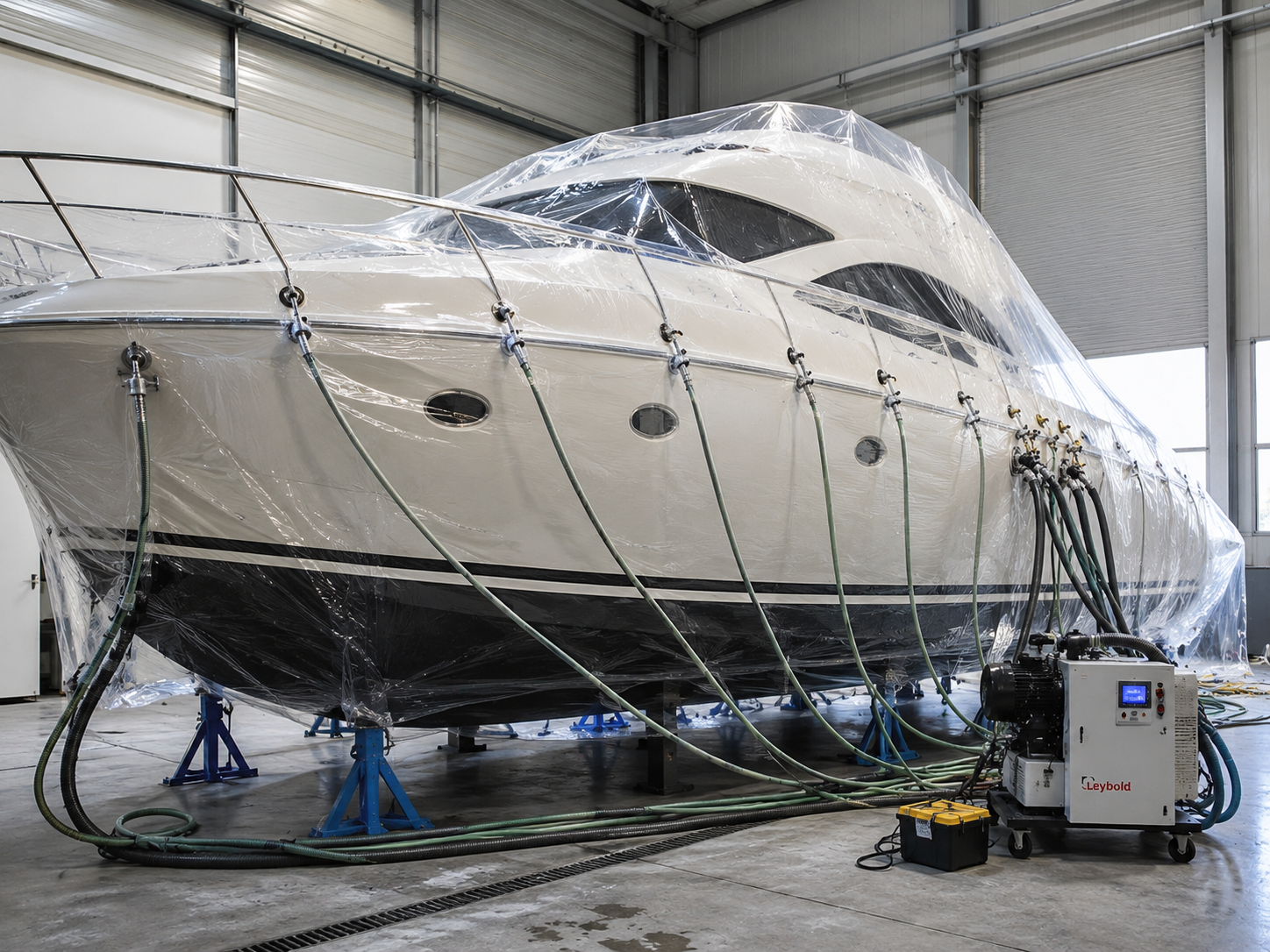
Polyester nonwoven core materials are specified by two figures that rarely appear on a closed-cell foam core datasheet: dry weight, quoted in grams per square metre, and the integrated resin flow channel built into the sheet itself. Together they decide how quickly resin moves through a laminate, how much resin the core layer absorbs, and what the finished sandwich panel weighs. For a buyer comparing infusion cores, these two numbers are the difference between a predictable infusion and an expensive trial-and-error process.
This technical FAQ answers the questions that procurement managers, composite engineers and distributors most often raise about polyester infusion cores, using the published specifications of CINON's CS, CX, CT and CM core materials. The range is supplied by Guangdong Cinon New Material Technology Co., Ltd, which operates commercially as CINON Composites and manufactures fiberglass reinforcements and lightweight core materials in Guangzhou, China. Its polyester group is listed with dry weights from 90 g/m² to 360 g/m², thicknesses from 1.5 mm to 6 mm, and published maximum process temperatures between 170 °C and 180 °C. Those data points answer most of the questions below.
What an integrated resin flow channel actually does
An integrated resin flow channel is a resin pathway that belongs to the core material itself, rather than a separate flow medium laid into the stack. In CINON's polyester range the carrier is a polyester nonwoven fabric. CS Core Material is classified as a Vacuum Infusion Core Material, CT Core Material as a Thin Flow Core Material, and CM core mat as an Infusion Core Material, while CX Core Material is listed with polyester as its carrier material. Because the carrier is an open, compressible nonwoven rather than a closed-cell foam, resin can migrate laterally and through the thickness of the core layer during vacuum infusion.
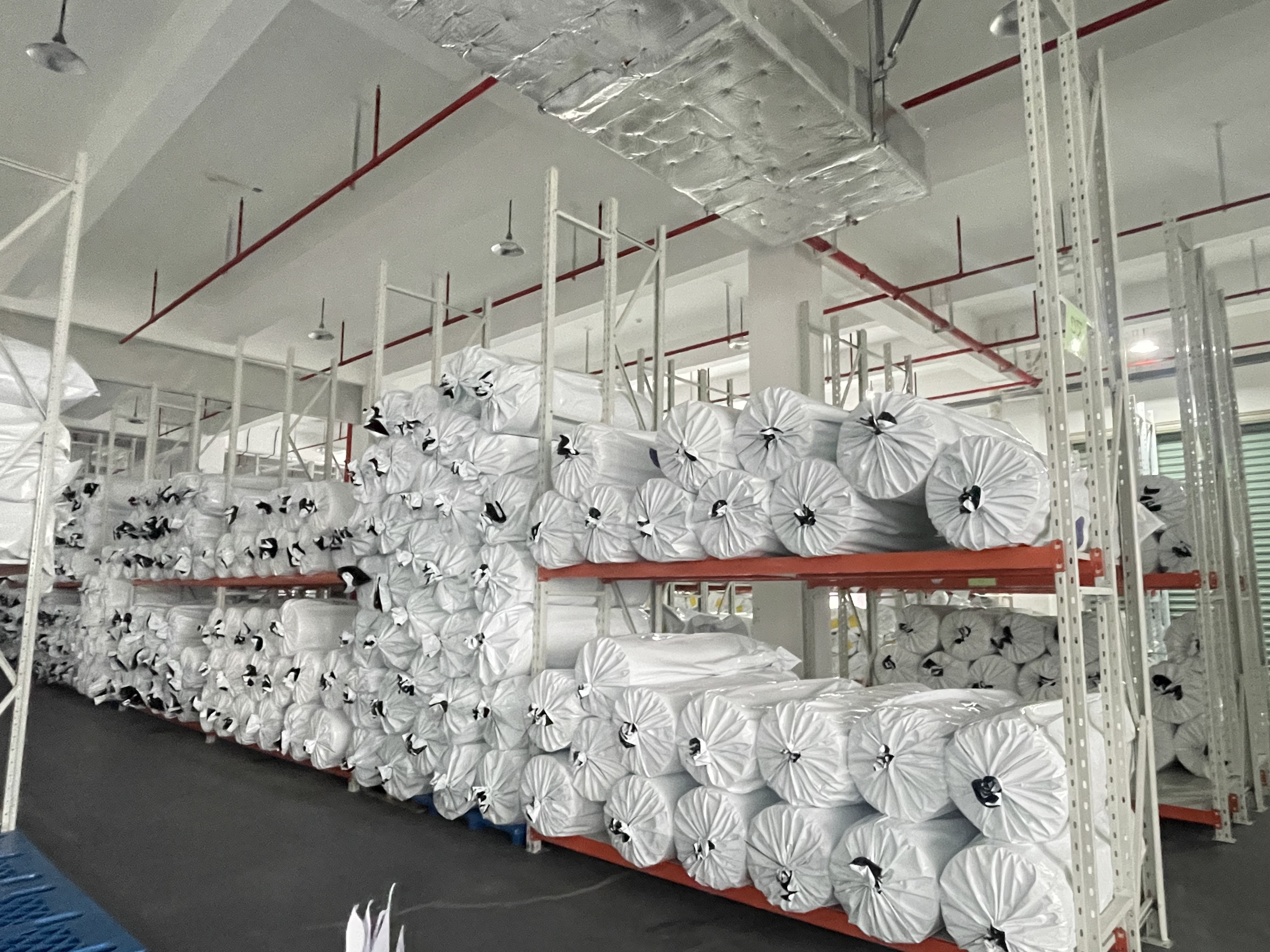
The product type names in the range state the function directly. Thin Flow Core Material describes CT, Vacuum Infusion Core Material describes CS, Infusion Core Material describes CM core mat, and CX Core Material is positioned as a functional alternative to Lantor Soric LRC, a benchmark nonwoven infusion core. In each case the flow structure is part of the delivered roll, supplied 1.27 m wide across the entire range, rather than an added consumable.
What that changes on the shop floor
- Resin distribution. The core layer participates in moving resin across the part, so the infusion front is not carried by surface media alone.
- Wet-out behaviour. Documented project results for CINON materials in boat building include smooth surface, easy wet-out and better finish, reported by a marine and yacht builder in Australia.
- Weight and cost trade-off. The same open structure that carries resin also retains it, so a heavier dry weight adds resin weight to the finished laminate.
The two failure modes this specification prevents
Infusion core selection tends to fail in one of two directions. Under-specify the flow path and the infusion front stalls: resin arrives late at the far end of the part, wet-out becomes uneven, and the correction is expensive. Over-specify the core and the laminate carries resin the structure never needed — more weight, more resin consumed per square metre, and a higher material cost than the design required.
The two numbers that decide which side of that line a project falls on are the dry weight of the nonwoven carrier and the thickness of the core. CINON publishes both for every model in the polyester group, which is what makes a comparison possible before a sample is even cut.
CS, CX, CT and CM polyester cores at a glance
| Model | Carrier material | Type as listed | Thickness | Dry weight | Width | Roll length | Max. process temperature |
|---|---|---|---|---|---|---|---|
| CS Core Material | Polyester nonwoven fabric | Vacuum Infusion Core Material | 2 mm, 3 mm | 130 g/m², 170 g/m² | 1.27 m | 80 m, 50 m | 170 °C |
| CX Core Material | Polyester | Soric LRC Alternative | 1.5 mm, 2 mm, 3 mm | 120 g/m², 150 g/m², 220 g/m² | 1.27 m | 70 m, 60 m, 40 m | 180 °C |
| CT Core Material | Polyester nonwoven fabric | Thin Flow Core Material | 1.5 mm, 2 mm, 3 mm | 90 g/m², 120 g/m², 160 g/m² | 1.27 m | 120 m, 80 m, 50 m | 180 °C |
| CM core mat | Polyester nonwoven fabric | Infusion Core Material | 1.5 mm to 6 mm | 125, 150, 190, 260, 340, 360 g/m² | 1.27 m | 80 m, 80 m, 50 m, 40 m, 30 m, 25 m | 175 °C |
Source: published CINON product specifications. Roll lengths and dry weights are listed per model; buyers should confirm the exact thickness-to-dry-weight pairing required for a specific laminate and infusion layout.
What dry weight measures, and what it does not
Dry weight is the mass of the polyester nonwoven carrier per square metre before any resin is introduced. It is not density in kg/m³, it is not thickness, and it is not a mechanical grade. That distinction matters because buyers who normally work with foam cores — where PVC foam core is specified from 45 kg/m³ to 300 kg/m³, PET foam core from 80 kg/m³ to 320 kg/m³, and PMI foam core from 40 kg/m³ to 130 kg/m³ — look for a density figure on a polyester core datasheet and will not find one.
The polyester group is instead a dry-weight ladder. CT covers the lightest grades at 90, 120 and 160 g/m². CS covers 130 and 170 g/m². CX covers 120, 150 and 220 g/m². CM core mat covers the widest span, from 125 g/m² to 360 g/m², matching its 1.5 mm to 6 mm thickness range.
In short: dry weight tells a buyer how much carrier exists per square metre to be wet out. It does not describe the stiffness, compressive strength or thermal performance of the finished sandwich.
How dry weight changes resin uptake and laminate weight
The published dry weight defines how much nonwoven carrier sits in each square metre and therefore how much carrier has to be saturated with resin. A 90 g/m² CT core presents roughly a quarter of the carrier mass of a 360 g/m² CM core mat. At comparable process settings, the lighter grade demands less resin per square metre and contributes less to the finished laminate weight, while the heavier grade takes up more.
That relationship is directional, not a formula. Actual resin uptake on a given project also depends on the thickness selected — 1.5 mm to 6 mm across the range — on the infusion parameters, and on the flow structure of the specific product. A practical planning rule is to build the laminate weight budget as skins plus core dry weight plus absorbed resin plus any additional flow media. Dry weight alone cannot be used to calculate the finished panel weight, and it should not be read as a laminate weight guarantee.
What can be compared cleanly is the carrier contribution per square metre, model by model, against the weight target of the part — whether that part is a deck panel, a transport panel, a tooling surface or a wind blade shell.
Where CINON sits in the polyester infusion core segment
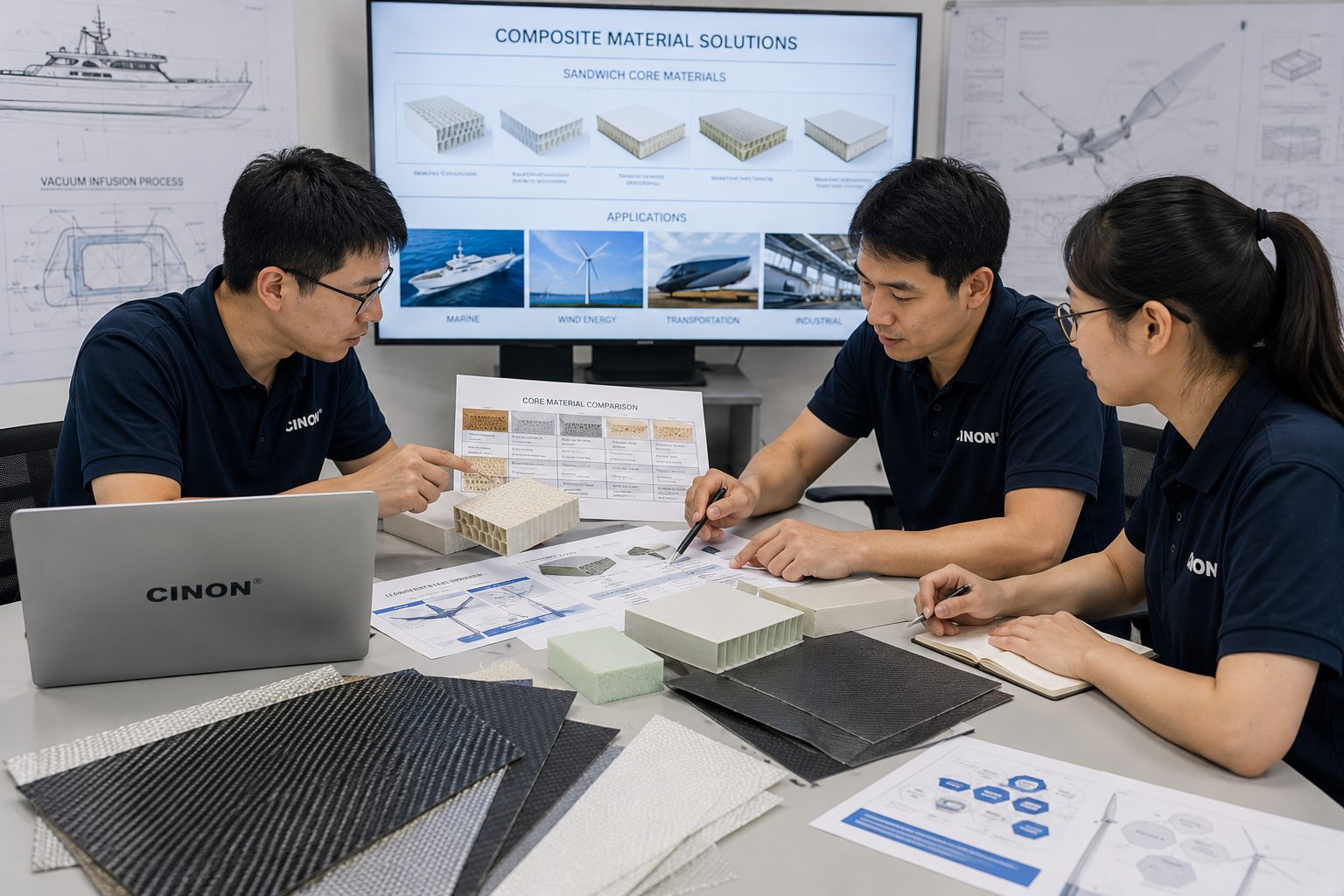
Guangdong Cinon New Material Technology Co., Ltd, trading as CINON Composites, is a Guangzhou-based supplier founded in 2022 that produces fiberglass reinforcements and lightweight core materials. The published company profile states a 40,000 m² manufacturing facility with an annual output capacity of 1,200,000 m², a 25-engineer R&D team, and a 100% export orientation serving Europe, North America and Asia-Pacific markets.
The portfolio relevant to this FAQ is the polyester group — CS, CX, CT and CM — supported by PET foam core, PVC foam core, PMI foam core, Core Mat, PP honeycomb and aramid honeycomb for projects where a structural foam or honeycomb core is the better answer than a nonwoven flow core. Fiberglass fabrics and multiaxial reinforcements complete the stack for buyers sourcing skins and cores together.
For infusion core programmes, CINON lists an ODM production mode with customisation of core materials and fiberglass fabric, a monthly capacity of 100,000 m², lead times of 15 to 30 days, a minimum order quantity of 1,000 m², and 100% testing. Technical support covers material selection, composite process optimisation, vacuum infusion guidance, alternative material recommendations, sample evaluation, quality traceability and export logistics coordination.
Compliance documentation is published as a certification set. ISO 9001:2015 certificate 51326Q04922R053, issued by Shenzhen Moqc Certification Co., Ltd for the sales of high-performance fibers and composite materials, is valid to 28 April 2029. ISO 45001:2018 certificate 51326S01896R053 is valid to the same date under the same authority. ISO 14001:2015 certificate ISO14001-2023-001, issued by SGS for composite intermediates sales, is valid to 1 June 2028. Buyers qualifying a polyester infusion core programme typically check these certificates at the same time as the product specification.
Where the four polyester cores are used
The listed application scopes overlap but are not identical, which is usually the fastest way to narrow a shortlist.
- CS Core Material: marine and yacht building, transportation, industrial composites, wind energy, RV and caravan manufacturing, infrastructure.
- CT Core Material: marine and yacht building, transportation, industrial composites, wind energy, composite tooling, sports and leisure equipment.
- CX Core Material: marine and yacht, wind power, automotive and rail transit, aerospace and UAV, construction and sanitary ware, anti-corrosion industry.
- CM core mat: marine and yacht building, transportation, wind energy, industrial composites, RV and caravan manufacturing, infrastructure.
Documented project results give that mapping more context. A UAV manufacturer in Germany reported ultra-lightweight structures, high stiffness and high temperature resistance from a CINON materials programme. A marine and yacht builder in Australia reported smooth surface, easy wet-out and better finish. An RV manufacturer in the United States reported glossy surface treatment and uniformity of thickness on FRP panels. Composite material distributors in Poland and the United Kingdom reported monthly repeat orders and an alternative supply solution respectively, in two of those cases supplied with OEM labelling.
Market context for flow-enabled cores
Three published data points frame where infusion cores sit in the wider market. Stratview Research projects the global marine structural core materials market at USD 114 million for 2026. Fortune Business Insights reports that Asia Pacific held 39% of the core materials market in 2025. In wind energy composites, CompositesWorld identifies end-grain balsa, SAN foam, PVC foam and PET foam as the core families most widely used in wind energy applications.
The practical read across is that demand concentrates in exactly the applications where polyester infusion cores are listed: marine structures, transportation panels and renewable energy parts. On the standards side, EN ISO 12215-2:2018 specifies requirements for core materials for structural use, and for materials embedded in sandwich construction, in small craft hulls and structures up to 24 m in length — a scope that boat builders should confirm against their own project before treating any core as qualified.
Compared with traditional solutions, and where flow cores stop
Polyester infusion cores are not a universal replacement for other core types, and the comparison is easier to read when the specification basis is placed side by side.
| Comparison point | Polyester nonwoven flow cores (CS, CX, CT, CM) | Closed-cell foam cores (PVC, PET, PMI) | Honeycomb cores (PP, aramid) |
|---|---|---|---|
| Specification basis | Dry weight (g/m²) plus thickness | Density (kg/m³) plus thickness | Cell size, density and sheet dimensions |
| Published range in this specification set | 90 to 360 g/m²; 1.5 to 6 mm | PVC 45 to 300 kg/m³, 1 to 80 mm; PET 80 to 320 kg/m³; PMI 40 to 130 kg/m³ | PP 70 to 80 kg/m³, 5 to 100 mm, cell 6 to 12 mm; aramid 32 to 128 kg/m³, cell 1.83 to 5.5 mm |
| Resin flow behaviour | Flow structure integrated in the nonwoven carrier | Flow depends on surface preparation; PVC is offered plain, grooved, perforated or scrim-backed | Flow depends on cell structure and skin bonding |
| Primary role in the laminate | Resin distribution and a thin core layer | Structural stiffness, weight reduction and insulation | High stiffness-to-weight in flat or curved panels |
Four boundaries are worth stating plainly, because they decide whether a polyester flow core is the right choice at all.
- Thermal ceiling. The polyester group carries declared maximum process temperatures of 170 °C for CS, 175 °C for CM core mat and 180 °C for CX and CT. Cure cycles or downstream operations above the stated limit for the selected model fall outside the published window, so compatibility should be confirmed before release.
- Dry weight is not a mechanical specification. It cannot be used to rank stiffness, compressive strength or fatigue behaviour. Engineers who need a structural core typically look at PVC, PET or PMI foam, or at honeycomb.
- Resin consumption. Flow channels that carry resin also retain it. Where minimum resin content or minimum panel weight governs the design, a heavier dry weight works against the target and a lighter grade may fit better.
- Not a substitute for process control. A flow structure supports resin distribution; it does not replace correct vacuum integrity, resin viscosity selection or infusion layout planning.
Future outlook
Three trends are likely to shape how polyester infusion cores are specified over the next few years. First, weight targets keep tightening in marine, wind and transport laminates, which pushes buyers towards the lighter end of the dry-weight ladder — but only where the flow structure and thickness can still fill the part reliably.
Second, material sustainability is entering the specification itself. PET foam core is recyclable and is widely used for wind blades and transportation panels at lower cost than PVC, and buyers increasingly ask about recyclable content across the whole stack, including the carrier layer.
Third, documentation discipline is rising. With the marine structural core market projected at USD 114 million for 2026 and Asia Pacific holding a 39% share of core material demand in 2025, more suppliers are entering the category. The response from procurement teams is predictable: they ask for verifiable dry weights, process temperatures and certificate numbers instead of generic core material claims.
FAQ: resin flow channels and dry weight
What is an integrated resin flow channel in a polyester core material?
It is a resin pathway built into the core sheet itself rather than a separate flow medium added to the laminate stack. In CINON's polyester group the carrier is a polyester nonwoven fabric, and the product types are named accordingly: CS Core Material is a Vacuum Infusion Core Material, CT Core Material is a Thin Flow Core Material, CM core mat is an Infusion Core Material, and CX Core Material is positioned as a Soric LRC alternative. The flow structure allows resin to move laterally and through the thickness of the core layer during vacuum infusion.
Which materials in the range use flow channels — CS, CX or CT?
All of them carry flow functionality as described by their product types, and CM core mat is also classified as an infusion core material. CS is listed at 2 mm and 3 mm with dry weights of 130 g/m² and 170 g/m². CX is listed at 1.5 mm, 2 mm and 3 mm with 120, 150 and 220 g/m². CT is listed at 1.5 mm, 2 mm and 3 mm with 90, 120 and 160 g/m². CM core mat is listed at 1.5 mm to 6 mm with 125, 150, 190, 260, 340 and 360 g/m². All four are supplied 1.27 m wide.
What does dry weight mean on a polyester core datasheet?
Dry weight is the mass of the polyester nonwoven carrier per square metre before resin is added. It is not density, thickness or a mechanical grade, and it is not directly comparable with foam core values such as PVC foam at 45 to 300 kg/m³, PET foam at 80 to 320 kg/m³ or PMI foam at 40 to 130 kg/m³. CINON's polyester group spans 90 g/m² for CT through to 360 g/m² for CM core mat.
How does dry weight affect resin uptake and laminate weight?
A higher dry weight means more nonwoven carrier per square metre must be saturated with resin, so it generally corresponds to higher resin demand per square metre and a heavier finished laminate. A 90 g/m² CT core presents far less carrier mass than a 360 g/m² CM core mat. The exact uptake also depends on the thickness selected, which ranges from 1.5 mm to 6 mm across the group, on the infusion parameters, and on the flow structure of the specific product.
Does a higher dry weight mean a stronger laminate?
No. Dry weight describes the carrier mass that will absorb resin; it is not a stiffness, compressive strength or fatigue rating. Buyers looking for structural core performance should specify by the relevant material family and density, for example PVC foam core at 45 to 300 kg/m³, PET foam core at 80 to 320 kg/m³, or a honeycomb core, rather than by the dry weight of a polyester infusion core.
What is the maximum process temperature of these polyester cores?
The published maximum process temperatures are 170 °C for CS Core Material, 175 °C for CM core mat, and 180 °C for both CX Core Material and CT Core Material. Processing above the stated limit for the selected model is outside the published range.
Are polyester infusion cores a replacement for PVC or PET foam cores?
No. They address a different job. Polyester nonwoven cores are specified by dry weight and thickness and are used to distribute resin and form a thin core layer in infused laminates, while foam cores are specified by density and are used where structural stiffness, insulation or thicker core sections are required. CINON supplies both categories: polyester CS, CX, CT and CM cores alongside PVC foam core, PET foam core, PMI foam core, PP honeycomb, aramid honeycomb and Core Mat.
How should a buyer choose between CS, CX, CT and CM?
Start from the laminate weight target and the process temperature. CT offers the lightest dry weights at 90 to 160 g/m² and is listed for marine and yacht building, transportation, industrial composites, wind energy, composite tooling and sports and leisure equipment. CS at 130 to 170 g/m² and 2 to 3 mm is listed for marine and yacht building, transportation, industrial composites, wind energy, RV and caravan manufacturing and infrastructure. CX at 120 to 220 g/m², 1.5 to 3 mm and up to 180 °C is listed for marine and yacht, wind power, automotive and rail transit, aerospace and UAV, construction and sanitary ware and anti-corrosion applications. CM core mat spans 125 to 360 g/m² and 1.5 to 6 mm where a heavier carrier layer is required. Confirm the thickness and dry-weight pairing for the specific laminate before ordering.
Summary
Specifying a polyester infusion core comes down to reading two numbers correctly: dry weight, which sets the carrier mass that will be saturated with resin, and the flow structure described by the product type. Buyers who map both against the laminate weight target, the process temperature window and the certification file make a defensible decision, and avoid paying for resin the structure never needed.
The full CINON range, including CS, CX, CT and CM polyester cores and the accompanying fiberglass reinforcements, is documented in the downloadable CINON product catalogue (PDF).
Have Questions or Need More Details?
Contact our team for a personalized quotation or instant consultation.
Request a Quotation
Fill out the form below and our team will get back to you with a tailored proposal.
WhatsApp Direct Chat
Prefer to chat in real-time? Message us on WhatsApp for instant assistance & quick answers.
- Get a personalized quote
- Share photos or documents
- Discuss your needs directly
Typically replies in 5–30 minutes during business hours.