
Teeth Whitening Kit in a Multi-Product Oral Care Routine
Teeth Whitening Kit in a Multi-Product Oral Care Routine
A teeth whitening kit is a treatment layer, not a cleaning product. Inside a multi-product oral care routine it takes a short, scheduled slot — a 10-minute session from a 40-treatment 5-LED kit such as the GS-001B, or a 16-minute timed session with the 32-LED DB-001M — while brushing, interdental irrigation, rinsing and colour correction carry the daily workload. For brands and importers, that distinction separates a routine range in which every SKU has a job from a box of products that compete with each other for the same shelf.
This reference maps where the kit belongs, how the surrounding products sequence around it, and how buyers can assemble bundles for light-industry and daily-use channels. It works only from the verified product list and makes no clinical claims. Session timing, pack contents, battery life and finish options are product facts; any shade-change or sensitivity statement that appears on pack must come from the brand's own substantiation and the compliance file for the target market.
Five daily roles and two adjunct layers
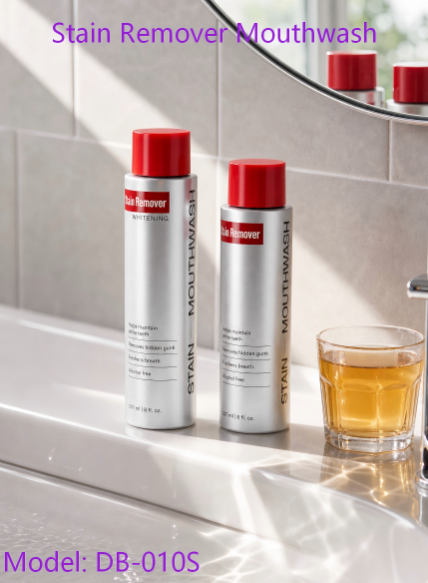
The routine divides into five daily jobs and two adjunct layers, and the division is what makes bundling decisions tractable. Cleaning is mechanical: the GS-K5 and GS-K9P electric toothbrushes and the DB-012P manual toothbrush handle debris removal across the tooth surface. Chemistry at the brush comes from toothpaste — the GS-007D double-tube format carries PAP and hydrogen peroxide formula options in a 100 g tube. Interdental cleaning runs on the GS-V2 oral irrigator, which offers four modes (Soft, Gum Care, Pulse, Standard), a 280 ml tank, a rated pressure range of 20–120 PSI, and up to 65 days of use per charge from an 800 mAh battery after 3–4 hours of USB-C charging. Rinsing is the DB-010S mouthwash at 237 ml, alcohol-free, positioned for breath freshening and stain removal. On-the-go freshness is the GS-011 mouth spray at 17 ml, offered across flavours that run from mint and peppermint to peach, grape, coconut and kiwifruit.
The two adjunct layers behave differently from the daily five. Optical correction is immediate and visual: the GS-006V purple colour corrector foam, 30 ml, relies on the complementary relationship between purple and yellow on the colour wheel, so a water-soluble purple dye counteracts yellow undertone at the tooth surface. Periodic whitening is scheduled and kit-based. Neither layer replaces a daily step, and a portfolio that merchandises either one as a substitute for brushing, rinsing or irrigation creates a routine the consumer cannot actually follow.
| Routine layer | Job in the routine | Portfolio example | Cadence |
|---|---|---|---|
| Mechanical cleaning | Removes debris and surface deposits by physical action | GS-K5 / GS-K9P electric toothbrush; DB-012P manual toothbrush | Twice daily |
| Brush-phase chemistry | Delivers active ingredients while brushing | GS-007D double-tube toothpaste, 100 g, PAP and hydrogen peroxide formula options | Twice daily |
| Interdental irrigation | Flushes between teeth and massages the gum line | GS-V2 oral irrigator, 4 modes, 280 ml tank | Daily |
| Rinsing | Breath freshening and stain removal support | DB-010S mouthwash, 237 ml, alcohol-free | Daily |
| On-the-go refresh | Immediate freshness away from the bathroom | GS-011 mouth spray, 17 ml | As needed |
| Optical correction | Neutralises yellow undertone visually | GS-006V purple colour corrector foam, 30 ml | Before events |
| Periodic whitening | Scheduled whitening session with tray and light | DB-001M 32-LED kit; GS-001B 5-LED kit | Once daily within a labelled cycle |
Where the kit sits: a fixed window after cleaning
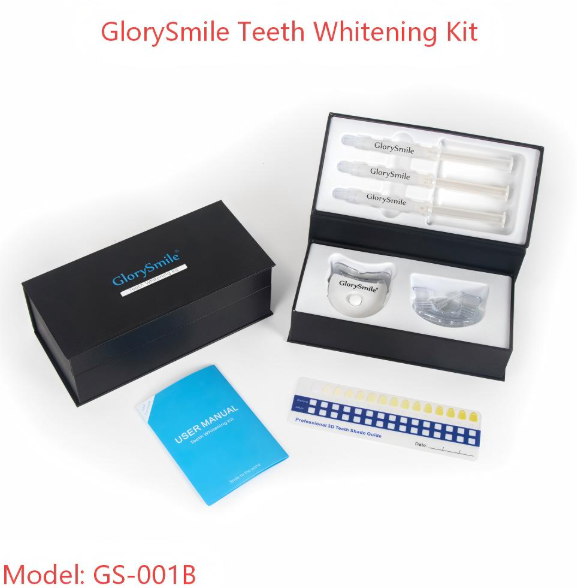
The kit's position is after cleaning and before the routine closes. Sequencing the tray step after brushing and irrigation keeps the treatment separate from the mechanical jobs, and the kit's own hardware makes that window easy to standardise. The DB-001M runs a 16-minute light timer and ships with four 2 ml whitening pens, a storage case with charging cable, a shade guide, a user manual and a gift box; its 450 mAh lithium-ion battery supports up to eight sessions per full charge after 2–3 hours of charging. The GS-001B takes the opposite approach: a 5-LED light, one mouth tray and three 3 ml whitening syringes, sized for 40 treatments at 10 minutes each, powered by two CR2032 lithium metal batteries.
That difference is a bundling decision rather than a technicality. A rechargeable kit suits a fixed bathroom routine where the case lives on a shelf, and its charging cadence becomes part of the routine the brand illustrates. A disposable-battery kit suits travel, gifting and lower-ticket entry points, and it shifts the buyer's attention towards battery transport documentation and pack-level instructions instead of charging accessories. Neither format is inherently the better portfolio centre; the choice depends on where the range is sold and how much routine instruction the channel can carry.
Whatever the format, the session is a discrete step. The scenario documentation for these kits describes once-daily use with 10–30 minute treatments, and the kits ship with shade guides, user manuals and compliance labelling as part of the pack. Brands should build the routine graphic around the label rather than the other way round, and should not add steps — extra rinses, extra sessions, stacking two treatment formats on the same day — that the product instructions do not authorise.
Fit boundary: a whitening kit is a scheduled treatment, not a daily cleaning product. Bundles that present it as a replacement for brushing, mouthwash or irrigation misstate the routine and create avoidable returns.
Sequencing a full day
A workable sequence gives each product one slot and keeps the treatment window uncluttered. The pattern below is a routine-design convention for pack instructions and shelf communication, not a clinical protocol; the product's own directions govern the details.
| Time window | Steps in order | Products involved |
|---|---|---|
| Morning | Brush → irrigate → rinse → spray before leaving | GS-007D, GS-V2, DB-010S, GS-011 |
| Evening | Brush → irrigate → whitening session on scheduled days | GS-007D, GS-V2, DB-001M or GS-001B |
| Event day | Optical correction before the event, as a visual layer | GS-006V purple colour corrector foam |
| Weekly | Consumable check: pens, syringes, strips, spray refill | Kit consumables and travel formats |
The evening slot is where most bundle design succeeds or fails. If the kit session is drawn as one more item in a long evening list, consumers skip it; if it is drawn as the step that closes the routine, adherence logic is easier to communicate. The battery arithmetic supports the planning: eight sessions per charge on the DB-001M means a consumer charges roughly once a week at a once-daily cadence, while the GS-001B's 40 treatments map to a defined cycle length that the brand can print on pack.
Kit, strips and corrector: three formats that look alike
Three products in the range can reasonably be described as whitening, and each works through a different mechanic. The kit pairs a light with a tray and a gel delivery system — pens on the DB-001M, syringes on the GS-001B — inside a timed session. Strips are applied directly and sold in defined counts: the DB-004L dissolving strip comes in 7, 14 or 21 strips per pack with PAP, PAP with charcoal, purple, 6% hydrogen peroxide, sodium phytate, sodium bicarbonate or custom formulas, and twelve flavours; the GS-004 series dry strips follow the same commercial logic and also carry OEM, ODM and dealer services. The purple colour corrector foam is not a treatment format at all: it is an optical layer that shifts perceived tone immediately.
Because the mechanics differ, a portfolio listing both a kit and strips should separate them by occasion rather than by strength. The kit is the at-home session; the strip is the travel, single-step or trial format; the corrector is the visual layer before an event. Rank-ordering one format above another requires comparative evidence the portfolio usually does not hold, and wording that implies clinical superiority will not survive review against the compliance file.
| Format | Session mechanic | Consumer occasion | What it does not do |
|---|---|---|---|
| LED kit (DB-001M, GS-001B) | Tray plus light plus gel pen or syringe, timed session | Home routine on scheduled days | Replace brushing, rinsing or irrigation |
| Strips (DB-004L, GS-004 series) | Direct application, 7/14/21 per pack | Travel, trial, single-step use | Deliver the same session format as a tray and light |
| Purple colour corrector (GS-006V) | Water-soluble purple dye counteracts yellow undertone | Immediate visual correction before events | Provide a scheduled whitening cycle |
| Daily paste and rinse | Brush-phase chemistry and rinsing | Twice-daily and daily hygiene | Substitute for a treatment session |
Three bundle architectures that hold together
Architecture one: core whitening routine. The kit, one toothpaste and one mouthwash — for example DB-001M or GS-001B with GS-007D and DB-010S. This is the lowest-SKU bundle that still reads as a complete routine, and it suits pharmacy, supermarket and e-commerce entry listings where shelf space is limited. Its weakness is the consumer who already owns a toothbrush and toothpaste and sees duplication; the answer is packaging that names the kit as the hero and the paste and rinse as support, not as three equal heroes.
Architecture two: full routine range. The core bundle plus an electric toothbrush and an oral irrigator — GS-K5 or GS-K9P with GS-V2 — and optionally the GS-011 spray. This carries a higher basket value and gives the brand an appliance relationship, but it demands more shelf space, clearer packaging hierarchy and attention to warranty terms, since the electronics carry a 12-month warranty from the date of purchase. It also raises the instruction burden: a four-step routine needs a single printed card, not four separate leaflets.
Architecture three: travel and event set. Strips, spray and colour corrector foam in a compact configuration. Unit cost is low, pack size suits travel retail and gifting, and the set does not cannibalise the home kit because it is positioned by occasion. The risk is message drift: if the travel set is described as delivering the same outcome as the kit, the brand has created an internal comparison it cannot evidence.
Across all three, product-role separation is what protects the portfolio. Each SKU should own one sentence in the routine story, and no SKU should be described as making another unnecessary.
Formula tiering and label discipline
Formula choice is the first filter for market fit, and the range covers the three main families: PAP (peroxide-free), carbamide peroxide and hydrogen peroxide, with sodium phytate, sodium bicarbonate, charcoal and custom formulations available as additions. Strips extend the options to a purple formula and a 6% hydrogen peroxide version. For consumers who report sensitivity, the company offers PAP and low-sensitivity formulas, which is a formulation option rather than a promise of outcome.
Two regulatory reference points sit behind every bundle sold into Western markets. In the European Union, products containing between 0.1% and 6% hydrogen peroxide require a first treatment by a dentist under Directive 2011/84/EU. In the United States, the FDA recognises ISO 28399:2021 as a consensus standard for external tooth bleaching products. Both shape how a brand words its pack, its listing copy and its routine instructions, and both are reasons to keep hydrogen peroxide and peroxide-free SKUs visibly distinct in a bundle rather than blending them into one generic whitening claim.
Label discipline extends to audience. The scenario documentation for these kits specifies formulations labelled for adults and children aged 16 and over, and a BPA-free tray requirement. A bundle aimed at gifting or family retail therefore needs the age statement on the outer pack, not only on the inner carton.
Customisation, capacity and the manufacturer behind the range
The product list in this reference comes from Jiangxi Dentalbright Technology Co., Ltd. (Glorysmile), an oral care manufacturer founded in 2008 whose current 36,000 m² facility was completed in 2013. The company employs 256 people, including 17 R&D engineers and 11 quality-control specialists, and exports around 90% of output to markets including the EU, the USA and the UK, with distribution across 102 countries. Its facilities include 20,000 m² of 100,000-class cleanroom space and a 1,000 m² laboratory with a 100-class cleanroom for microbiological testing.
For a multi-product routine, customisation depth matters more than any single SKU. Whitening kits support LED wavelength configuration, housing colour, logo printing, packaging structure, kit composition, and custom user manuals and compliance labelling. Strips support strip type, active ingredient, residue-free or standard formulation, and custom colour, flavour, packaging and labelling. Toothpaste supports flavour, colour, tube design and carton artwork; mouthwash supports format, efficacy direction, flavour, colour, alcohol-free formulation and packaging options.
Monthly capacity is sized for portfolio programmes rather than single lines: 105,000 whitening kit sets, 8.33 million gel sets, 29.2 million strips, 830,000 toothpaste tubes, 2.5 million mouthwash sachets or 416,000 bottles, and 300,000 electric toothbrush units. Kit quality control covers incoming inspection of LED modules, batteries and electronic components with COA verification, in-process checks on appearance, silicone hardness, noise, leakage current and dielectric strength, and batch release testing before shipment. Certifications include MDSAP, ISO 13485, ISO 22716, GMP and BSCI, with CE-MDR registration for medical devices and CPSR, CPNP and PIF documentation for cosmetic products; the company also states that its FDA-certified scope covers medical devices, cosmetics and OTC drugs. Minimum order quantities are confirmed at quotation and sampling, since they depend on product category and customisation scope.
Channel fit: retail, e-commerce, travel and gifting
Routine bundles sell best where the buyer already thinks in sets. The company's case record includes a two-year programme of 7 million units of promotional gift sets for pharmacy-chain and supermarket retail, which passed third-party factory audits under BSCI and ISO and reported zero return rate in large-batch inspection. The programme used multi-language manual customisation and one-stop design-to-logistics handling — the operational profile a gift-set bundle needs, because a set with four components fails on any one component's documentation.
E-commerce favours private-label kits with packaging differentiation and clearly separated SKUs, since marketplace listings compete on images and routine graphics rather than on shelf adjacency. Travel retail favours strips, spray and corrector, where pack size and battery handling are simpler. Gifting favours the rechargeable kit in its gift box with a shade guide, which is a presentable configuration without extra assembly.
Fit boundaries the bundle should respect
- The kit does not replace the daily five. Cleaning, brush-phase chemistry, irrigation, rinsing and refresh remain daily steps; the kit is scheduled.
- Session counts are finite. The GS-001B is sized for 40 treatments at 10 minutes; the DB-001M supports up to eight sessions per full charge. Routine graphics should show cycle length rather than implying open-ended use.
- Trays are standard, not custom-moulded. Kits use a food-grade TPE mouth tray. Where a custom fit is required, the portfolio includes silicone dental impression material (GS-009: hardness 60, one-minute working time, 2.5-minute intraoral cure) for clinical and professional channels.
- Claims stay inside the file. Shade-change, sensitivity and stain-removal wording must match the brand's own substantiation and the regulatory position in each market.
- Formats can cannibalise each other. A kit and a strip range sold side by side without occasion-based positioning will compete for the same purchase.
Market context for routine-led ranges
The structural case for multi-product routine bundles rests on where demand already sits. Fortune Business Insights valued the global teeth whitening market at USD 8.93 billion in 2025 and projected USD 14.31 billion by 2034 in its August 2026 report. Straits Research put the individual and at-home segment at 68.67% of the market in 2024, which is the segment a routine bundle addresses. Separately, The Insight Partners reports rising demand for PAP+ peroxide-free kits as an alternative to traditional peroxide formats on sensitivity grounds — a commercial research signal rather than a measured outcome, but consistent with the formulation breadth described above.
The practical implication for buyers is modest and specific: at-home demand is large enough to support routine architecture, while the regulatory split between peroxide and peroxide-free formats means the portfolio needs more than one formulation tier rather than a single hero SKU.
Outlook
Routine-led ranges are likely to be built around two axes rather than one. The first is occasion: home session, travel, pre-event. The second is formulation tier: peroxide-free for sensitivity-led positioning, peroxide-based where the market and label permit it. Brands that map SKUs onto both axes can expand a range without adding near-duplicates; brands that add products without a defined slot end up with a catalogue that needs explaining at the shelf.
On the supply side, the capability question is less about whether a supplier can make a whitening kit and more about whether it can keep four or five routine components consistent in documentation, labelling and pack assembly across markets. That is a factory-and-files question, and it is answerable with evidence rather than with claims.
FAQ
Where in a daily routine should a teeth whitening kit be used?
As a scheduled step after cleaning, not as part of brushing. The scenario documentation for these kits describes once-daily use with 10–30 minute treatments, and the timer inside the kit sets the window: 16 minutes on the DB-001M, 10 minutes per treatment on the GS-001B, which is sized for 40 treatments.
Can a whitening kit be bundled with an electric toothbrush and an oral irrigator?
Yes, if each product keeps a separate job. The GS-K5 or GS-K9P toothbrush handles mechanical cleaning, the GS-V2 irrigator handles interdental flushing across four modes with a 280 ml tank, and the kit runs the scheduled session. Bundles of this kind need one printed routine card and attention to the 12-month warranty that covers the electronic items.
How is a purple colour corrector different from a whitening kit?
The corrector is an optical layer. The GS-006V purple colour corrector foam, 30 ml, uses the complementary relationship between purple and yellow on the colour wheel, so a water-soluble purple dye counteracts yellow undertone at the tooth surface. A kit is a timed tray-and-light treatment cycle. The two are positioned by occasion and are not interchangeable.
What should a buyer check in a kit's contents before bundling it?
Check the component list, the session count and the power source. The DB-001M contains a 32-LED light, four 2 ml whitening pens, a storage case with charging cable, a shade guide, a user manual and a gift box, with up to eight sessions per charge. The GS-001B contains a 5-LED light, one mouth tray, three 3 ml syringes and a shade guide, for 40 treatments at 10 minutes.
Does a whitening kit replace toothpaste or mouthwash?
No. Toothpaste such as the GS-007D delivers PAP and hydrogen peroxide formula options during brushing, and the DB-010S mouthwash at 237 ml is an alcohol-free rinse positioned for breath freshening and stain removal. Both remain daily steps; the kit adds a scheduled treatment layer on top of them.
Next step
Buyers evaluating a routine-led range can request the current product catalogue, which lists kit configurations, strip counts, paste and rinse formats, appliance specifications and available customisation fields. Specifications, minimum order quantities and packaging structures are confirmed at quotation and sampling, where the routine architecture can be tested against the target channel before artwork is finalised.
Product catalogue for download: Glorysmile oral care catalogue (PDF).
Have Questions or Need More Details?
Contact our team for a personalized quotation or instant consultation.
Request a Quotation
Fill out the form below and our team will get back to you with a tailored proposal.
WhatsApp Direct Chat
Prefer to chat in real-time? Message us on WhatsApp for instant assistance & quick answers.
- Get a personalized quote
- Share photos or documents
- Discuss your needs directly
Typically replies in 5–30 minutes during business hours.