
Teeth Whitening Strips: Daily, Event and Travel Assortments
Teeth Whitening Strips: Daily, Event and Travel Assortments
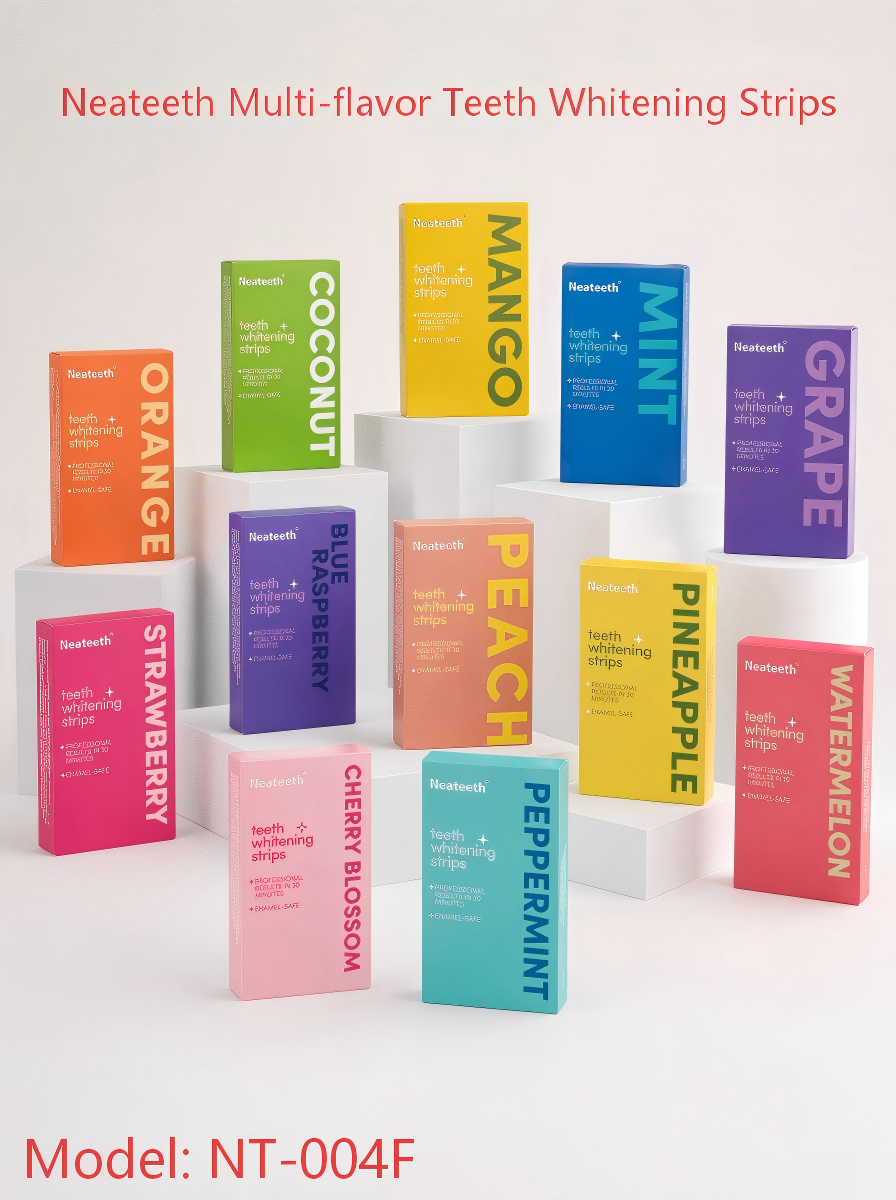
A teeth whitening strip pack as it reaches retail: strip sachets, colour box and application guide. Scenario fit is decided before the artwork stage.
A scenario-based teeth whitening strip assortment is built from three questions in a fixed order: where the consumer will use the strip, how often, and what else is already in that person's oral care routine. Daily maintenance, event preparation and travel each impose a different pack count, strip format, flavour profile and formulation limit — and each changes what a private-label buyer should place next to the strip on the shelf.
The practical value of this framing is that it turns a long product list into a decision structure. Glorysmile (Jiangxi DentalBright Technology Co., Ltd.) manufactures strips in wet, dry and dissolving formats alongside whitening kits, whitening powder, toothpaste, mouthwash, toothpaste tablets and electric toothbrushes. The same catalogue can therefore support a strip-led, kit-led or powder-led routine, which means the buyer's real task is not choosing between products but assigning each product a job.
Why the usage scenario, not the formula list, sets the assortment
Three external signals shape this decision before any formulation discussion begins, and all three reward a tighter, better-defined SKU set.
The first is category scale. Grand View Research values the global teeth whitening strips and gels segment at USD 1.1 billion in 2025, in a report published in June 2026. A segment of that size contains many buyers with different routines, which is exactly the condition under which scenario-specific packs outperform undifferentiated multi-packs. This is an interpretation of the market figure, not a measured consumer study, but it explains why assortment planning deserves its own step.
The second is regulatory. EU Regulation (EC) No. 1223/2009 restricts hydrogen peroxide concentration in over-the-counter teeth whitening products to 0.1% or less, according to HPRA and European Commission guidance. That single number separates an event-positioned high-peroxide strip from a daily-use strip sold over the counter in the EU: the formula cannot be treated as a global constant when the pack is designed for one scenario in one market.
The third is the cost of SKU proliferation. Under the US Modernization of Cosmetics Regulation Act (MoCRA) 2022, cosmetic products such as whitening strips require facility registration, reported at USD 849 per year, and product listing, reported at USD 200 per product by FDA and Registrar Corp guidance. A cosmetic assortment is therefore not free to expand indefinitely: each additional strip SKU in the US market carries its own listing obligation. Scenario mapping helps concentrate that cost on variants that serve a genuinely distinct use occasion.
Logistics adds a small operational footnote. Teeth whitening strips are primarily classified under HS Code 3306.90.00 for oral or dental hygiene preparations, per a US Customs and Border Protection ruling. Buyers building multi-market kits should confirm the code applied to a bundled assortment, because a strip-plus-toothbrush bundle is not classified in the same way as a strip sachet alone. That check belongs in the assortment plan, not in the shipment week.
Three demand scenarios and what each one actually requires
The strip range is designed for home or travel use in normal room temperature conditions, applied once per day, with an enamel-safe formula, a zero-peroxide option and individually wrapped configurations available. Those conditions already describe three different packs.
| Scenario | Usage rhythm | Format and pack fit | Formulation priority | Assortment role |
|---|---|---|---|---|
| Daily maintenance | Once per day, sustained over weeks | Multi-count pack (14 or 21 strips) in a colour box with manual and shade guide | PAP or other low-sensitivity positioning; mint or peppermint | Core repeat-purchase SKU |
| Event preparation | Short, concentrated run before a fixed date | 7-count pack; single-cycle format | Colour-correcting (V34 purple) or higher-intensity formula where the market permits | Trial and conversion SKU |
| Travel and on-the-go | Intermittent, away from home, no device | Individually wrapped dry strips in a small count | Residue-free, alcohol-free, enamel-safe; peppermint or light fruit | Amenity, travel-retail and gifting SKU |
Daily maintenance rewards pack count, not novelty
A daily-use strip competes with the consumer's existing brush-and-paste habit, so it has to be the least disruptive object on the bathroom shelf. The information relevant to the buyer is that the range includes an enamel-safe formula and a zero-peroxide option, and that PAP (peroxide-free) formulations are offered. For a daily SKU, the pack count carries the message: a 21-strip pack signals a three-week course at one application per day, and a 14-strip pack a shorter cycle. Because the strips are applied once per day, the count is a direct function of the intended routine length rather than a marketing preference.
Event preparation is a claim question before it is a formula question
An event-positioned strip is bought for a visible occasion — a wedding, a photograph, a presentation — so the buyer is really selecting a claim posture. Purple colour-correcting technology, available in the strip formula list as a Purple variant, addresses the appearance of yellow undertones; this is a different proposition from stain removal measured over weeks. The two should not share one SKU, because the pack then makes two promises and supports neither cleanly. Market limits decide the rest: a 6% hydrogen peroxide strip sits outside the EU over-the-counter limit of 0.1% described above, so an EU-facing event SKU should be planned around a market-appropriate formula instead of assuming a single global specification.
Travel strips are a packaging decision
Travel and on-the-go use is the scenario where format matters more than formula. The strip range is documented for home or travel use, and individually wrapped strips are an available configuration. A traveller has no device, limited water, and often a shared bathroom, which is why a single-use dry strip is the practical unit: it can be carried in hand luggage and disposed of immediately. The wet strip line is packed in aluminium bags with 7, 14 or 21 strips plus a user manual, shade guide and colour box — a proper retail pack, but not an amenity-kit format on its own. Buyers serving hotels, airlines or travel retail generally need a smaller count and individual wrapping, which is a packaging specification rather than a new product.
Where strips sit beside kit-led and powder-led routines
Strips, kits and powders are frequently presented as competing whitening options, but they fail in different places. Comparing them on ritual, device dependency and pack economics produces a clearer catalogue structure than ranking them on whitening strength.
| Dimension | Strip-led routine | Kit-led routine (GS-001J) | Powder-led routine (GS-005V) |
|---|---|---|---|
| Application ritual | Single application, once per day | Session-based; recommended 16 minutes per day | Used during brushing rather than as a timed session |
| Device dependency | None | 16-LED light, 4 × 2 ml whitening pens, 4 adapters; USB plug-and-play with no built-in battery | None beyond a toothbrush |
| Travel fit | High, especially in individually wrapped dry format | Moderate — the light and accessories travel as a set | Moderate — jar format and water access required |
| Pack structure | 7 / 14 / 21 strips per aluminium bag, plus manual, shade guide and colour box | Kit set in a gift box; electronics covered by a 12-month warranty | 12 g with 15 g, 30 g, 40 g and 100 g options; mint or custom flavour |
| Assortment role | Entry, continuity and travel SKU | Anchor home-treatment SKU | Daily-care attachment to the whitening line |
The kit is the anchor, not the substitute
The GS-001J kit is a home device programme: a 16-LED light (24 or 32 LEDs optional), four 2 ml whitening pens, a dust-free cover, four adapters for iPhone, Android, Type-C and USB, a shade guide, a user manual and a gift box, with a recommended treatment time of 16 minutes per day. Power comes from a phone, laptop or power bank through USB, and there is no built-in battery; the electronics carry a 12-month warranty from purchase. Read as an assortment item, the kit establishes a treatment habit and a higher price point. Strips then serve the buyer who will not commit 16 minutes and a device — which is most of the travel and trial demand.
A second kit configuration, the GS-001B, packages a 5-LED light, a mouth tray, three 3 ml whitening syringes, a shade guide, a manual and a gift box, rated for 40 uses at 10 minutes each on CR2032 batteries. Two kit formats at different intensities give the buyer a ladder inside the kit category itself, which further argues for treating strips as a separate rung rather than a cheaper copy of the kit.
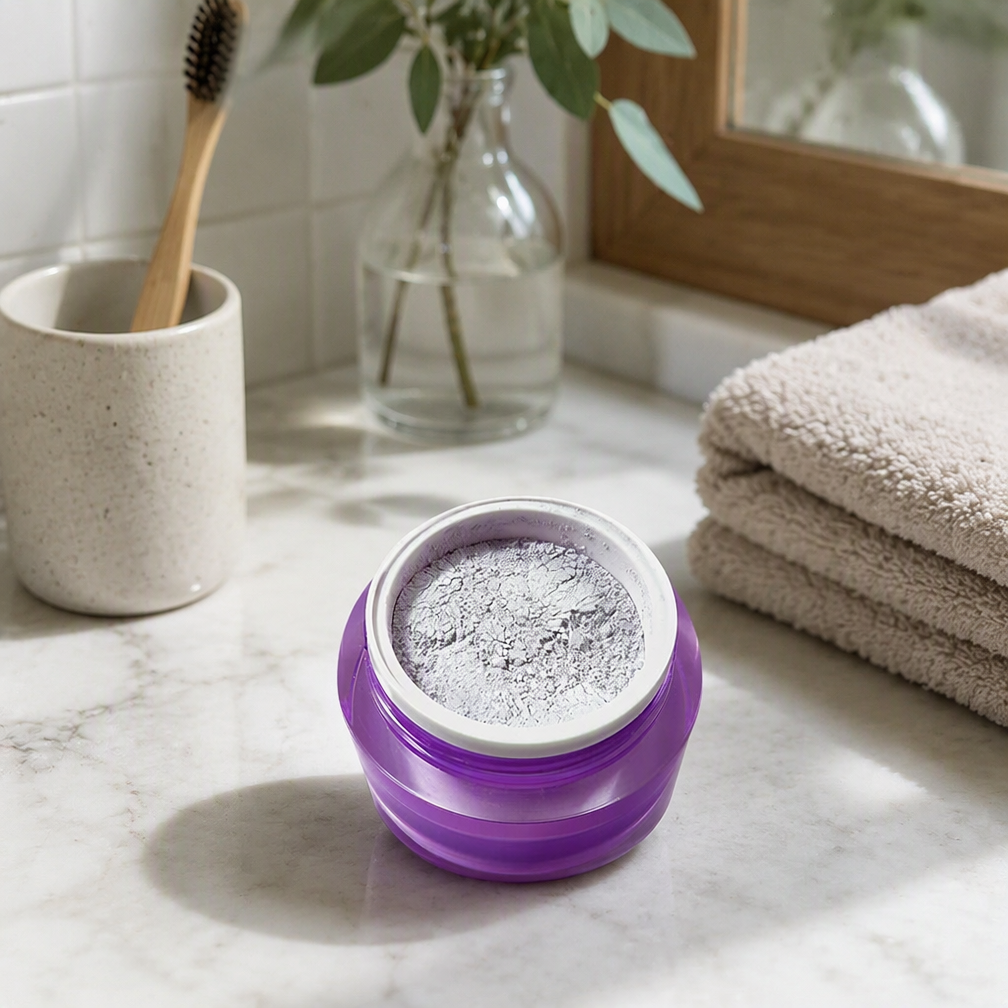
Powder-led routines attach to brushing. They belong in the daily-care layer of an assortment, not in the travel or event layer.
The powder is an attachment, not a competitor
GS-005V whitening powder uses PAP as its whitening ingredient, is available in 12 g with 15 g, 30 g, 40 g and 100 g options, and comes in mint or custom flavour with customisable powder ingredients, flavour, jar colour and jar type. In routine terms it replaces or supplements toothpaste rather than occupying a timed whitening slot. That makes it a sensible attachment SKU for a buyer whose strip line is already established: the powder increases basket depth among daily-care buyers without competing for the same occasion. Where a buyer has no whitening anchor at all, the kit remains the stronger first listing.
Toothpaste, tablets and mouthwash fill the same daily-care layer. The purple colour-corrector toothpaste DB-007P is available in 65 g and 120 g with mint or custom flavour; toothpaste tablets GS-008 and GS-008D come in mint flavour with 30 or 60 tablets in rectangular, round or oval shapes; the mouthwash range includes DB-010P coconut mouthwash in 20 packs of 12 ml sachets and GS-010F foam mouthwash in strawberry, grape bubblegum, watermelon and blue raspberry flavours, applied as two pumps swished for 30 to 60 seconds. The 12 ml sachet and the tablet format are the two range items that travel as easily as a strip, which is why they appear repeatedly in travel oral care kits.
Choosing the strip format: wet, dry and dissolving
Format is the first specification to lock, because it determines both the scenario and the manufacturing route. The verified strip range covers three families.
- Wet strips (GS-V34-S07). Seven, fourteen or twenty-one strips per aluminium bag with a user manual, shade guide and colour box. The strip itself is a three-layer construction: PET hard film, whitening gel and PE soft film. Formulas include PAP, PAP plus charcoal, Purple, 6% HP, sodium phytate, sodium bicarbonate or custom, with twelve listed flavours from blue raspberry and strawberry to peppermint, mango and cherry blossom.
- Dry strips (GS-004 series). Available as high-viscosity dry strips, residue-free dry strips and alcohol-free dry strips, using a no-slip dry adhesive technology applied once per day.
- Dissolving strips (DB-004L). A dissolving variant intended for the teeth whitening and oral care sectors, useful as a novelty or trial format where the buyer wants a point of difference on shelf.
The mapping follows from the physical behaviour. Wet strips carry a gel layer and a retail-grade bag with ancillary print, so they suit event and shelf-facing multi-count packs. Dry strips leave no residue and need no rinsing, which suits travel, sensitive-positioning and hospitality programmes. Dissolving strips remove the disposal step entirely and are best used as a limited trial rather than as the volume driver, because the format novelty is the reason to buy them.
Formulation and flavour as scenario signals
Once format and count are fixed, formulation becomes a market and positioning question rather than a technical one. The strip formula list supports PAP, PAP plus charcoal, Purple, 6% hydrogen peroxide, sodium phytate and sodium bicarbonate, plus custom formulations, and the range is described as enamel-safe with a zero-peroxide option.
The practical assignments are as follows. PAP is the peroxide-free route and the natural base for daily and sensitive-teeth positioning. PAP plus charcoal and the broader stain-removal positioning address exogenous stains from coffee, tea and tobacco, which is a different consumer promise from shade lifting and should be labelled accordingly. Purple colour correction serves event preparation because it targets the appearance of yellow undertones rather than cumulative stain removal. A 6% hydrogen peroxide formula is the high-intensity option, but as noted it exceeds the 0.1% over-the-counter limit stated in EU Regulation (EC) No. 1223/2009 and therefore requires a market-by-market decision rather than a single global SKU.
Flavour works the same way. Twelve options are listed on the wet strip line, from peppermint and mint to blue raspberry, strawberry, watermelon, peach, grape, pineapple, mango, coconut, orange and cherry blossom, and custom flavour is supported. Mint and peppermint read as clinical and adult, which suits daily maintenance and sensitive positioning; fruit flavours read as approachable and are more often used on event, trial and younger-skewing packs. Flavour is a low-cost way to differentiate two SKUs that share a base formula — but it does not create a new use occasion on its own, so it should not be used to justify a duplicate listing.
A five-step framework for building the strip layer
The framework below converts the scenario logic into a sequence a private-label buyer can run before approaching a supplier. It is a planning method, not a fixed product recommendation.
- Assign one primary scenario per SKU. A strip pack should have a dominant use occasion. A pack that claims daily use, event results and travel convenience at once dilutes all three and complicates the label.
- Lock the format before the formula. Decide wet, dry or dissolving on the basis of residue tolerance, disposal conditions and pack presentation. Formula options are broad enough that format is the real constraint.
- Set the count from the usage rhythm. Seven, fourteen and twenty-one strip counts are the available bag configurations. Map them to the intended routine length rather than to price points alone.
- Give each SKU one claim posture. Sensitive and daily-use positioning, stain removal and colour correction are three distinct promises. Assign one per SKU and keep the wording consistent across pack, manual and listing.
- Then specify packaging for the channel. Retail needs the colour box, shade guide and manual. Travel and hospitality need individual wrapping and a smaller count. The packaging decision follows the channel, not the factory's default.
Worked example: a three-SKU starter line
| SKU | Primary scenario | Format and count | Formula posture | Role in the line |
|---|---|---|---|---|
| A | Daily maintenance | Dry strip, 21 count, colour box | PAP (peroxide-free), mint | Volume and repeat purchase |
| B | Event preparation | Wet strip, 7 count, colour box | Purple colour correction, or a market-appropriate higher-intensity formula | Trial and conversion |
| C | Travel and on-the-go | Dry strip, 7 count, individually wrapped | Residue-free, alcohol-free, peppermint | Amenity, travel retail and gifting |
The example is deliberately small. Three SKUs cover three occasions with no overlapping claim, and each one can be defended in a listing or an amenity tender. Adding a fourth SKU should require a genuinely new occasion — smokers' stain removal positioned separately from general stain removal, for instance, or a dissolving format for a novelty channel — rather than another flavour of the same promise. That discipline also limits the recurring per-product compliance cost described earlier.
Customization, MOQ and capacity in practice
Two MOQ figures appear on the strip product documentation, and buyers frequently conflate them. The listed terms are 200 pcs for private label and 1 pc for regular product. Read precisely, that means a regular, existing-packaging configuration can be ordered in single units for evaluation, while a private-label programme with the buyer's own artwork and packaging starts from 200 pieces. The same 200-piece private-label threshold is listed across the wider range, including the GS-001J kit, GS-005V powder, DB-007P toothpaste and the mouthwash lines.
Customization depth differs by product and should be confirmed line by line. For strips, the documented options are strip type, active ingredient, residue-free or standard formulation, colour, flavour, packaging and labelling. For the GS-001J kit, customization extends to packaging, gel ingredient, and pen or light colour. For GS-005V, it covers packaging, powder ingredient, flavour, and jar colour and type. Capacity supports these programmes: the strip line runs at 29.2 million pieces per month against annual output stated at 300 million strips, alongside 105,000 whitening kits per month, 8.33 million gel sets per month, 500,000 powder bottles per month and 830,000 toothpaste tubes per month.
Lead time is stated as dependent on order volume, product specifications, customization complexity and current production schedule, with a precise delivery date issued at order confirmation. Buyers should not treat a catalogue lead time as a commitment; the reliable practice is to request the confirmed schedule together with the artwork proof and the pre-shipment test plan, since the capability documentation lists third-party laboratory testing through SGS or UL alongside microbial, pH and efficacy evaluation.
Supplier qualification for a scenario-based programme
A scenario assortment places different demands on one supplier: several formats, several pack configurations and one consistent quality system. The relevant qualification evidence is therefore the scope of certification, not the length of the certificate list.
Jiangxi DentalBright Technology Co., Ltd., trading as Glorysmile Factory, operates a 36,000 m² facility that includes 20,000 m² of 100,000-class cleanrooms and a 1,000 m² laboratory with a 100-class cleanroom dedicated to microbiological testing. The company holds MDSAP, ISO 13485, ISO 22716, US GMP and BSCI certification, together with medical device and cosmetics production licences, and reports additional documentation including FDA, CE, CPSR, PIF and CPNP coverage for its markets. Staffing is stated at 256 people, including 17 R&D engineers, 11 QC specialists, a six-person packaging design team and eight production managers. Products are exported to 102 countries, with a stated 90% export ratio and primary markets in the EU, USA and UK.
The certification set matters differently for each strip scenario. ISO 13485 and MDSAP speak to medical-device quality management, which is relevant where a whitening product is positioned or registered as a device in the target market. ISO 22716 and US GMP address cosmetic good manufacturing practice, which is the usual frame for a cosmetic whitening strip. BSCI covers social compliance and is the certificate most often requested in retail and supermarket tenders. A buyer should ask which certificate covers which product category and market, and confirm current validity, rather than accepting a combined certificate list as blanket coverage.
A documented programme illustrates the assortment angle. A two-year supply of 7 million units of promotional gift sets for pharmacy chain and supermarket retail is recorded as having passed third-party BSCI and ISO factory audits with zero return rate in large-batch inspection, supported by one-stop design-to-logistics handling and multi-language manual customization. Multi-language manuals are precisely the kind of detail a scenario assortment generates once the same strip pack is sold across several markets.
For buyers who want to review the supplier directly, the company website is Glorysmile. A practical verification sequence before committing an assortment is: match certificate scope to product category; request the artwork proof for each SKU; confirm the pack count and wrapping specification against the intended channel; confirm MOQ per SKU rather than per catalogue; and obtain the pre-shipment test plan in writing.
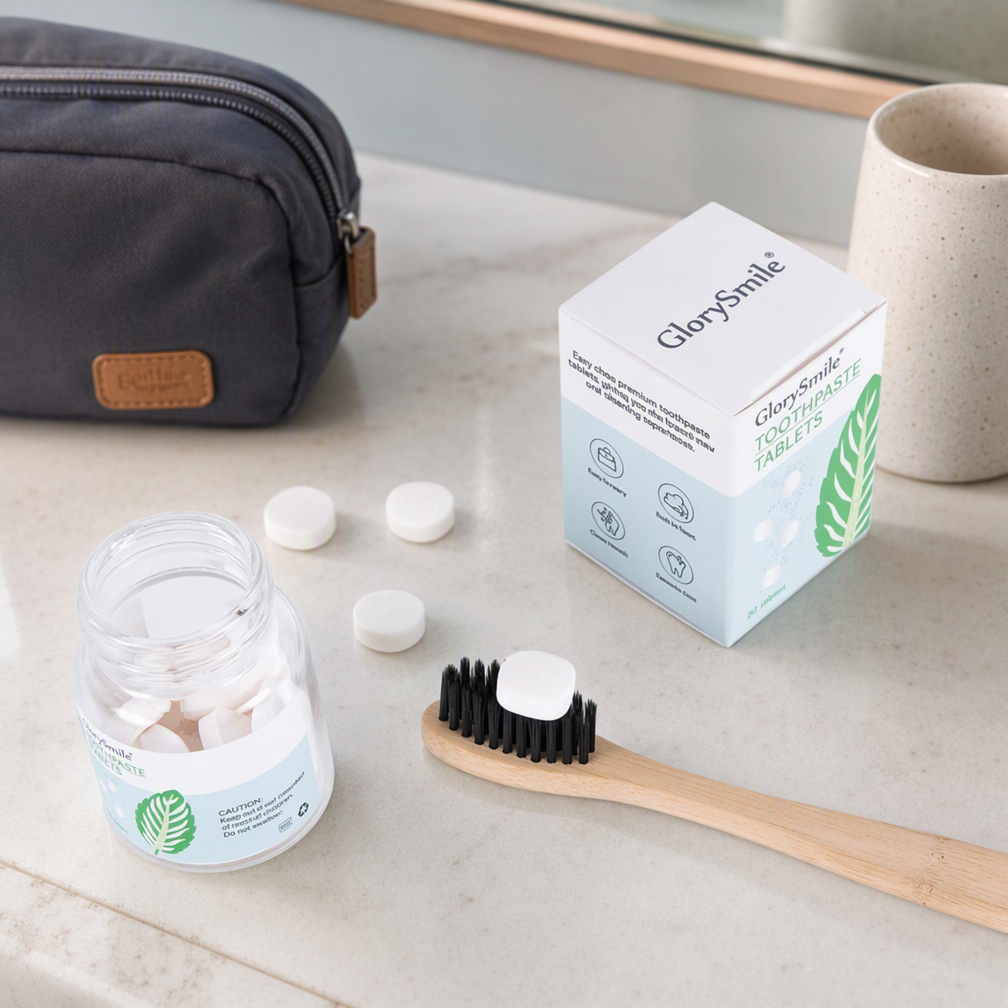
Tablets and 12 ml mouthwash sachets travel as easily as a strip, which is why travel assortments usually bundle the three formats.
What to watch over the next planning cycle
Two developments are worth tracking, and both are conditional rather than forecast. The first is regulatory divergence on peroxide limits: as long as the EU over-the-counter threshold remains at 0.1% hydrogen peroxide while other markets allow higher concentrations, a single global event-positioned strip becomes harder to justify, and market-specific SKUs become the practical route. The second is compliance cost per SKU in the US market under MoCRA listing requirements, which quietly rewards narrower, better-defined lines over broad flavour proliferation.
Neither point predicts demand. They simply mean that the scenario framework — one occasion, one format, one claim per SKU — is likely to remain the cheaper way to build a strip range, because it aligns the merchandising decision with the compliance and manufacturing decisions instead of treating them as separate workstreams.
Frequently asked questions
How should a private-label buyer choose the first scenario for a teeth whitening strip SKU?
Start from usage rhythm and channel rather than from formula. Daily maintenance fits multi-count packs of 14 or 21 strips with a low-sensitivity or PAP positioning; event preparation fits a shorter 7-count pack with a colour-correction or market-appropriate higher-intensity claim; travel fits individually wrapped dry strips because no device or rinsing step is required. Once the scenario is fixed, pack count, format and claim wording follow, and the supplier can quote against a defined specification instead of a general request.
Can teeth whitening strips and an LED whitening kit sit in the same assortment?
Yes, when the two are given different jobs. The GS-001J kit contains a 16-LED light, four 2 ml whitening pens, a dust-free cover, four adapters for iPhone, Android, Type-C and USB, a shade guide, a user manual and a gift box, with a recommended 16 minutes per day and USB plug-and-play power without a built-in battery; the electronics carry a 12-month warranty. That is a session-based home treatment. Strips are single-use and device-free, so they work as the entry, continuity or travel SKU. Keeping the claims distinct on each format avoids two products competing for the same purchase.
Which strip format suits travel and hospitality programmes?
Dry strip formats — high-viscosity, residue-free or alcohol-free — are the usual fit, particularly with individual wrapping, because there is no gel residue and no device to carry. The GS-V34-S07 wet strip line is packed in aluminium bags with 7, 14 or 21 strips plus a user manual, shade guide and colour box, which is a retail presentation rather than an amenity one. Both are supplied options, so the decision is a packaging specification driven by the amenity kit or travel-retail requirement.
What formulation choices matter for sensitive-teeth and stain-removal scenarios?
The strip range lists PAP, PAP plus charcoal, Purple colour correction and 6% hydrogen peroxide formulas, plus custom formulations, and is described as enamel-safe with a zero-peroxide option. PAP is the peroxide-free base most often used for sensitive positioning. Stain-removal positioning addresses exogenous stains from coffee, tea and tobacco, which is a different promise from colour correction of yellow undertones. A 6% hydrogen peroxide formula exceeds the 0.1% over-the-counter limit stated in EU Regulation (EC) No. 1223/2009, so market-specific formula planning is required.
What are the MOQ and customization terms for private-label teeth whitening strips?
The strip documentation lists 200 pcs for private label and 1 pc for regular product. Customization covers strip type, active ingredient, residue-free or standard formulation, colour, flavour, packaging and labelling, and the wider range supports custom gel ingredients and packaging on kit products. Strip capacity is stated at 29.2 million pieces per month. Exact MOQ for a customized programme is confirmed during quotation and sampling, and lead time depends on volume, specification and customization complexity.
The full product and capability documentation, including packaging options and specification sheets, is available in the Glorysmile catalogue (PDF).
Have Questions or Need More Details?
Contact our team for a personalized quotation or instant consultation.
Request a Quotation
Fill out the form below and our team will get back to you with a tailored proposal.
WhatsApp Direct Chat
Prefer to chat in real-time? Message us on WhatsApp for instant assistance & quick answers.
- Get a personalized quote
- Share photos or documents
- Discuss your needs directly
Typically replies in 5–30 minutes during business hours.