
Teeth Whitening Strips OEM Evidence File: Certifications, MOQ
Teeth Whitening Strips OEM Evidence File: Certifications, MOQ
Two quotations for private-label teeth whitening strips can look identical on unit price, flavour list and box artwork while differing entirely in what documents stand behind them. At the evaluation stage, the useful question is not which supplier is cheaper, but which supplier can put its quality system, market-access paperwork, patent position, minimum order quantity and customization scope in writing — per SKU — before a deposit is paid.
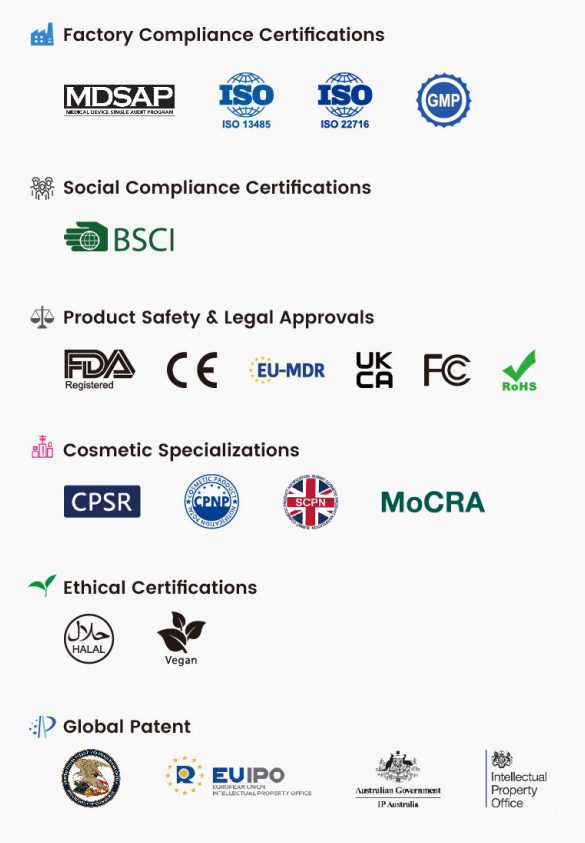
An OEM evidence file for teeth whitening strips is a document set, not a single certificate: quality-system audits, market-access filings, IP registrations and written commercial terms.
What an OEM evidence file is — and why it decides the order
An OEM evidence file is the package of documents a manufacturer can provide to a buyer before a purchase order is confirmed. Unlike a sales brochure, it is verifiable: certificate numbers, audit schemes, patent registration numbers and written MOQ terms can each be checked with the issuing body or with the supplier's own quality department.
For teeth whitening strips, that distinction matters more than in most personal-care categories, because the same physical product may sit under a cosmetics regime in one market and a medical-device regime in another. Jiangxi Dentalbright Technology Co., Ltd. — operating as Glorysmile Factory, and based in Makou Industrial District, Yongxiu Town, Nanchang (Jiujiang) City, Jiangxi Province, China — is one supplier whose documentation illustrates how the file is normally structured. The company manufactures teeth whitening strips, whitening pens, whitening kits, whitening lights, whitening powder, toothpaste, mouthwash and electric toothbrushes, and reports that roughly 90% of output is exported to the EU, USA and UK.
Four categories of evidence typically decide an evaluation:
| Evidence category | Document typically requested | What it actually answers |
|---|---|---|
| Quality system | MDSAP, ISO 13485, ISO 22716, US GMP, BSCI | Is the facility audited to a recognised standard, and for which product class? |
| Market access | CE-MDR registration, CPSR, CPNP notification, PIF, MoCRA facility registration and product listing, MSDS, COA | Can this specific SKU enter the EU, UK or US legally, and under whose name? |
| Intellectual property | EU patent 015062946-0001, UK patent 6370462, US D1,128,065 S | Is the device or housing design registered against look-alike copies? |
| Commercial terms | Written MOQ schedule, lead time, sample policy, artwork approval sequence | What is the real minimum order, and what does customization cost in time? |
Certifications: what MDSAP, ISO 13485, ISO 22716, GMP and BSCI cover
The factory states that it holds MDSAP, ISO 13485, ISO 22716, US GMP, BSCI, HALAL and VEGAN certification, and that it holds both medical device and cosmetics production licences. Its published certificate schedule also lists factory certificates including CE, FDA, CPSR, CPNP, PIF, SCPN, MSDS, COA, RoHS, HALAL and Vegan.
These are not interchangeable, and an importer should not treat them as a single "certified" badge:
- ISO 13485 is a quality-management standard for medical devices. It is relevant when the supplied item is regulated as a device rather than as a cosmetic.
- ISO 22716 is the cosmetics good-manufacturing-practice framework. It is the more relevant system certificate for whitening strips positioned as cosmetic products.
- US GMP addresses manufacturing-practice expectations for the US market.
- MDSAP is a multi-regulator audit programme that consolidates several jurisdictions' quality-system requirements into a single inspection, which is useful for suppliers selling into more than one regulated market.
- BSCI is a social-compliance audit rather than a product-safety certificate.
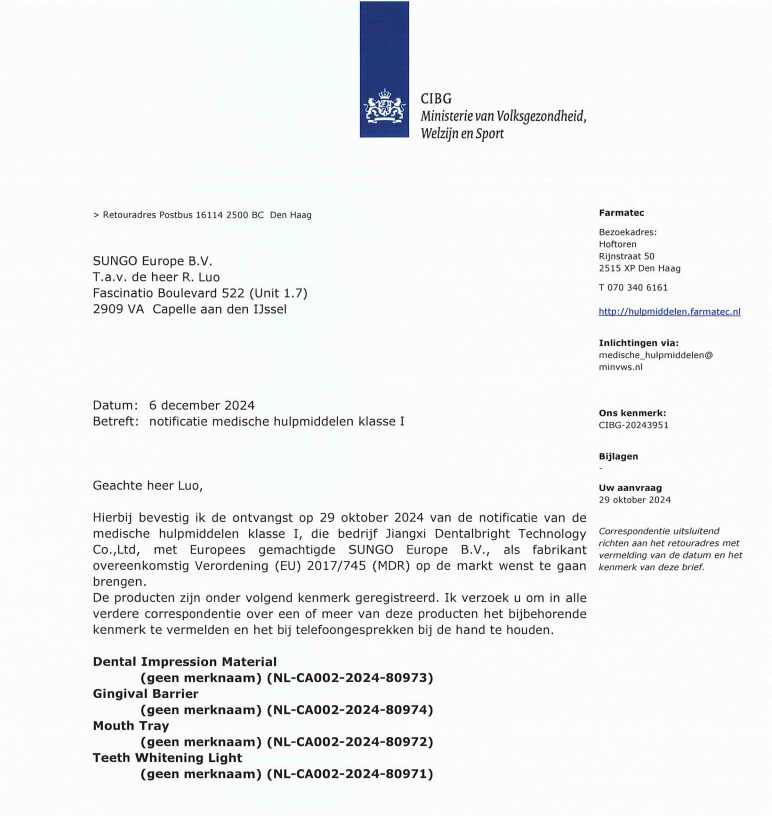
Market-access documents are issued per legal regime. CE-MDR registration applies to product classified as a medical device, while whitening strips sold as cosmetics follow CPSR, CPNP and MoCRA routes instead.
On the EU side, the supplier reports that it can issue CPSR, CPNP and PIF documentation for cosmetic products, and that for medical devices it has completed CE-MDR registration, with a complete Technical File and an appointed EU Responsible Person. On the US side, it reports that its whitening lights, electric toothbrushes and oral irrigators hold FDA medical device registration, that its silicone dental impression material has completed 510(k) registration, and that its teeth whitening strips are covered by MoCRA-compliant cosmetic facility registration and product listing.
Patents: EU 015062946-0001 and UK 6370462
Registered design and patent numbers are the part of the evidence file most often skipped by importers, and the part most likely to matter once a product becomes successful. Within the GlorySmile Teeth Whitening LED Kit range, model GS-001X is documented as carrying EU patent 015062946-0001 and UK patent 6370462.
Related registrations in the same portfolio include model DB-001M, documented with US Patent No. US D1,128,065 S, EU Patent No. 015065790-0001 and UK Patent No. 6377277, and the GS-K9P electric toothbrush, documented with EU Patent No. 015075898-0001, with US and UK patents noted as pending.
For a buyer, a registration number does three things. It confirms the supplier has invested in protecting a specific housing or device configuration rather than copying an existing market design. It gives the brand owner a documented position in that territory if a look-alike appears. And it clarifies that the registration is tied to a defined model — not to the supplier's entire product range.
MOQ: 200 pieces for private label versus 1 piece for regular products
Minimum order quantity is the commercial term most often quoted loosely and most often renegotiated after artwork approval. For the whitening kit platforms, the supplier documents an MOQ of 200 pieces for private label and 1 piece for regular product — the latter referring to catalogue items shipped in existing packaging.
The two numbers are consistent rather than contradictory: they describe two different purchasing modes. A catalogue order in the supplier's own packaging starts from a single unit, which supports sampling and small market tests. A private-label run — your logo, your carton, your artwork — starts at 200 pieces on that platform.
MOQ also varies by product family and by comparison benchmark:
| Reference point | GlorySmile documented term | Comparison benchmark |
|---|---|---|
| Whitening kit, private label vs catalogue | 200 pcs private label / 1 pc regular product | — |
| V34-type product | From 5 boxes | SmileKit: 50 boxes minimum |
| Whitening strips (brand-test friendly volumes) | 5–100 boxes | Onuge: 10,000–70,000 pairs |
| OEM with customized packaging (general FAQ) | Varies by product, from 100 to 1,000 boxes | Regular orders in existing packaging: 5 boxes |
Read together, these figures give a buyer a usable rule rather than a slogan. A single unit is available for evaluation. A catalogue reorder starts in the single-digit-to-low-hundred box range. A fully customized private-label programme moves the floor upward depending on the SKU, the printing method and how much of the formulation changes.
Customization scope: packaging, gel chemistry, pen and light colour
Customization depth is what separates a trading intermediary from a manufacturer, because it determines whether the supplier can change the product rather than only the label. The documented scope for the whitening kit platforms includes custom packaging, custom gel ingredient, and custom pen or light colour.
On the strips side, the documented configuration options are:
- Formats: dry strips (GS-004H/V/C/P), wet strips (GS-V34-S07) and dissolving strips (DB-004L). Dry strips are documented as combining strong adhesion with low residue; wet strips are documented as lower-cost and higher-residue, which is also why they are recommended for purple colour-corrector strips, where residue helps pigment contact the tooth surface.
- Pack contents: 7, 14 or 21 bag strips, with a user manual, shade guide and colour box.
- Formulations: PAP, PAP + charcoal, Purple, 6% HP, Sodium Phytate, Sodium bicarbonate, or custom.
- Flavours: Blue Raspberry, Strawberry, Peach, Grape, Watermelon, Peppermint, Orange, Mint, Pineapple, Cherry Blossom, Coconut and Mango.
- Construction: a three-layer strip of PET hard film, whitening gel and PE soft film, packed in an aluminium bag.
The same factory applies a comparable customization model across its wider oral care line — toothpaste, mouthwash, whitening powder and toothpaste tablets all document options for custom formula, custom packaging, custom printing and custom bottle or jar colour and type. For a brand owner, that matters because it means a single supplier can carry a whitening range rather than only a strips SKU.
Application: matching the configuration to the market
Customization options are only useful when matched to a specific market or claim. Three matching rules follow directly from the documented specification and from published regulation.
EU cosmetic positioning. EU Regulation (EC) No. 1223/2009 restricts hydrogen peroxide concentration in over-the-counter teeth whitening products to 0.1% or less. A peroxide-free PAP formulation is therefore the configuration that fits an EU cosmetic placement, and the supplier documents PAP among its available strip formulations.
US market entry. Under MoCRA 2022, whitening strips classified as cosmetics require facility registration and product listing. The supplier reports that MoCRA-compliant cosmetic facility registration and product listing have been completed for its teeth whitening strips, with a US Agent appointed and formulation filing completed on the FDA website.
Claim-led SKUs. Stain-removal positioning for coffee, tea and tobacco staining, and anti-sensitivity positioning for daily use, both map to formulation choices the supplier already documents — PAP and low-sensitivity formulas for sensitive-teeth positioning, and higher-peroxide configurations where a faster, clinic-adjacent result is the goal.
Market context: what the published numbers say
The commercial case for tightening supplier documentation is set by market size and by rising compliance cost. Grand View Research values the global teeth whitening strips and gels segment at USD 1.1 billion in 2025. Teeth whitening strips are classified primarily under HS Code 3306.90.00 for oral or dental hygiene preparations, a customs classification confirmed in a US Customs and Border Protection ruling.
Compliance cost is no longer negligible at the brand level either. Under MoCRA 2022, manufacturers of whitening strips classified as cosmetics must register facilities at USD 849 per year and list products at USD 200 each. For an importer launching several SKUs, the paperwork itself becomes a line in the launch budget — and a reason to source from a supplier that already holds the underlying registrations rather than starting the process from zero.
One gap is worth flagging honestly: published data does not currently isolate growth rates for non-peroxide (PAP) strips versus peroxide-based strips. Positioning claims around "enamel-safe" or "sensitive-teeth" formats therefore rest on formulation logic and regulatory limits rather than on a separately reported market growth figure.
How this compares with alternative sourcing routes — and where the evidence stops
The comparison below uses documented commercial terms reported for each supplier in the same evaluation notes. It is a comparison of published terms, not a quality judgement.
| Benchmark | MOQ | Unit price (as documented) | Lead time / turnaround |
|---|---|---|---|
| GlorySmile — whitening strips vs Onuge | 5–100 boxes vs 10,000–70,000 pairs | $1.85–$2.00/box vs $1.92–$2.65/box | Customization turnaround 7–15 days vs 10–25 days |
| GlorySmile — V34 vs SmileKit | 5 boxes vs 50 boxes | $1.45–$1.88 vs $1.85–$2.35 | 5–7 days vs 10 days |
| GlorySmile — LED kit vs IVISMILE | Three-stage model: trial, medium batch, mass production | $6.85–$7.98 vs $7.89–$8.77 | Operating history 18 years vs 8 years |
| GlorySmile — whitening gel vs Luxsmile | 10 pcs vs 500 pcs | $0.38–$0.45 vs $0.75–$0.89 | 5–7 days vs minimum 10 days |
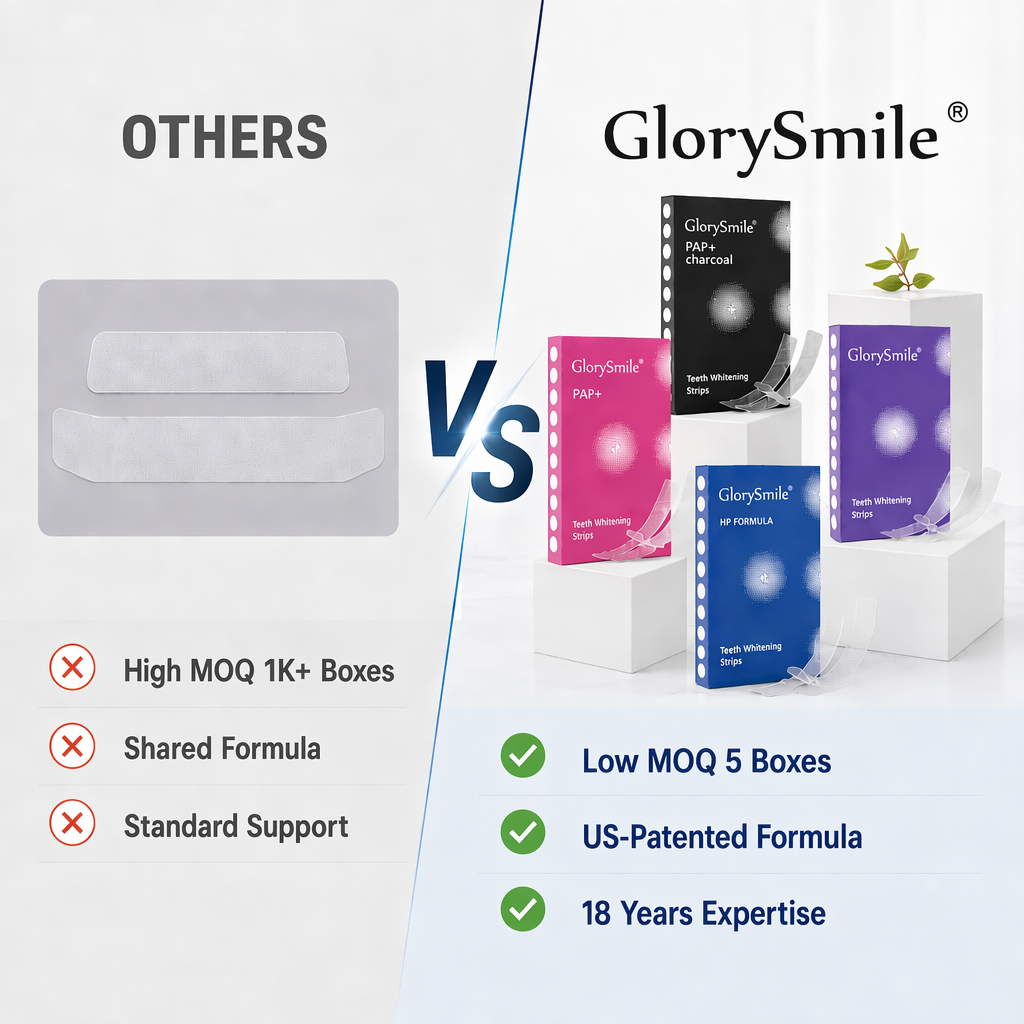
Strip-level comparison terms: minimum order quantity and unit price are the two variables that most often decide between two otherwise similar quotations.
Three limits belong in any honest reading of this evidence.
First, a low MOQ is a purchasing benefit, but it is not free. Small runs carry higher per-unit setup cost in artwork, plate-making and filling changeover, so the lowest documented MOQ is rarely the lowest landed cost per unit.
Second, formulation performance has trade-offs. Peroxide-based gels are documented as fast-acting and effective on deeper staining, with a higher likelihood of temporary sensitivity and tighter drug classification in many markets. PAP-based gels are documented as low-sensitivity and easier to launch as cosmetics, but slower to show visible results on deep intrinsic stains. Neither is universally better; the choice follows the claim and the market.
Third, a broad certificate list does not remove the buyer's own obligations. The EU cosmetic route still requires a CPSR, a CPNP notification and an EU Responsible Person; the US route still requires a US Agent and formulation filing. A supplier's documentation shortens these processes. It does not replace the importer's legal responsibility in the destination market.
Future outlook
Three trends are likely to shape how importers evaluate whitening-strip suppliers over the next sourcing cycle. Documentation is becoming a purchasing criterion rather than a post-order formality, as MoCRA facility registration and product listing move cosmetic paper trails into the quotation stage and as EU regulators continue to scrutinise peroxide concentrations in over-the-counter whitening products. Formulation differentiation is shifting from concentration to chemistry, with peroxide-free PAP formats carrying the sensitive-teeth and daily-use positioning while peroxide formats hold the fast-result segment. And portfolio depth is becoming a risk-management factor: a supplier able to cover strips, kits, electric toothbrushes, toothpaste, mouthwash and whitening powder reduces the number of compliance files a brand must maintain per market.
For buyers at the decision stage, the practical conclusion is procedural. Request the evidence file in the same message as the price quotation, verify that each certificate, patent number and MOQ figure applies to the specific SKU under negotiation, and treat every term that is not in writing as unverified. A full product catalogue covering the strips, kits, toothbrushes, toothpaste, mouthwash and whitening powder range is available for reference at the Glorysmile catalogue.
FAQ
What certifications should an importer request from a teeth whitening strips manufacturer?
For a factory-level check, request the quality-system and audit certificates relevant to the product class: GMP, ISO 22716, ISO 13485, MDSAP and BSCI, plus social or religious compliance marks such as HALAL and Vegan where the target market requires them. For market access, request the product-level documents instead: CE, FDA, CPSR, CPNP, PIF, SCPN, MSDS, COA and RoHS. The two lists answer different questions — one covers how the factory is audited, the other covers whether a specific SKU can be sold in a specific country.
What is the MOQ for private-label teeth whitening strips or kits?
It depends on the product family and on how much of the product is changed. For the whitening kit platforms, the documented terms are 200 pieces for private label and 1 piece for regular product in existing packaging. For regular catalogue orders in the supplier's own packaging, the published figure is 5 boxes. For OEM orders with customized packaging, the documentation states MOQ varies by product from 100 to 1,000 boxes. In comparison terms, the same notes record a whitening-strips MOQ range of 5–100 boxes against 10,000–70,000 pairs at Onuge.
Which whitening formula suits sensitive-teeth or daily-use positioning?
PAP and low-sensitivity formulas are the documented options for sensitive-teeth positioning. PAP is a large-molecule, surface-acting whitening agent that does not penetrate the tooth structure, which is why it is associated with minimal sensitivity but slower visible results on deep intrinsic stains. Peroxide-based formulas such as hydrogen peroxide and carbamide peroxide are small-molecule, penetrating agents that act faster on deeper staining, with a higher likelihood of temporary sensitivity and stricter drug classification in many markets. The available strip formulations include PAP, PAP + charcoal, Purple, 6% HP, Sodium Phytate and Sodium bicarbonate.
What documentation is available for EU and US market entry?
For the EU, the supplier reports issuing CPSR, CPNP and PIF for cosmetic products, and CE-MDR registration with a complete Technical File and an appointed EU Responsible Person for medical devices. For the US, it reports MoCRA-compliant cosmetic facility registration and product listing for teeth whitening strips, FDA medical device registration for whitening lights, electric toothbrushes and oral irrigators, and 510(k) registration for silicone dental impression material. EU Regulation (EC) No. 1223/2009 caps hydrogen peroxide at 0.1% or less in over-the-counter whitening products, which constrains formula choice for EU cosmetic placement; MoCRA 2022 sets facility registration at USD 849 per year and product listing at USD 200 each.
Can packaging, gel ingredients and pen or light colour be customized?
Yes. The documented support services for the whitening kit platforms list custom packaging, custom gel ingredient, and custom pen or light colour. For strips, customization covers pack size of 7, 14 or 21 bag strips, formulation choice, flavour choice from a list that includes Peppermint, Mint, Strawberry, Watermelon, Cherry Blossom and Coconut, and packaging in an aluminium bag with a colour box, user manual and shade guide. Customization turnaround for strips is documented at 7–15 days, compared with 10–25 days at Onuge.
What is the difference between dry strips and wet strips?
Dry strips are documented as having good adhesiveness, a low tendency to slip during wear and minimal residue, at a higher cost. Wet strips are documented as having lower adhesiveness, so they can shift during application and leave relatively more residue, at a lower cost. Wet strips are also the recommended format for purple colour-corrector strips, because the higher residue helps purple pigment adhere to the tooth surface for a physical colour-correction effect.