
Temperature and Certification Compliance for Magnetic Pumps in New Energy Testing
Temperature and Certification Compliance for Magnetic Pumps in New Energy Testing
In new energy testing, a temperature deviation is rarely just an equipment fault — it is a data integrity problem. Battery constant temperature chambers, liquid-cooled test loops and semiconductor chillers all hold a thermal band for the duration of a test programme, and the circulation pump is the component that keeps that band stable. For buyers working through research and evaluation, the deciding question is not which pump carries the loudest performance claim, but which pump can be documented for a specific medium temperature, duty cycle and destination market.
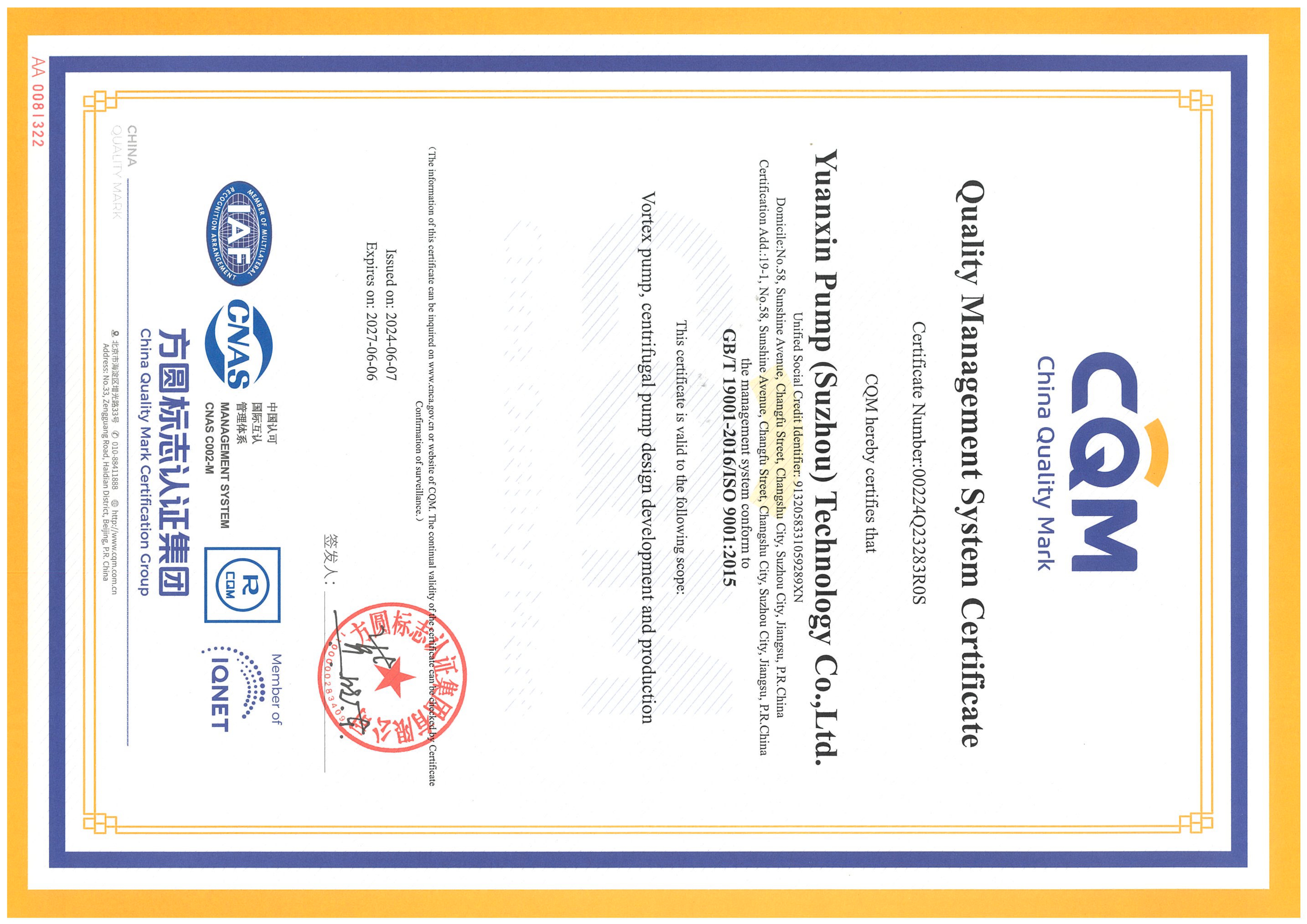
Cover: ISO 9001:2015 Quality Management System certificate (CN-00224Q23283R0S), issued by China Quality Mark Certification Group and recognised by IQNET — the process layer behind the product documentation discussed below.
Why New Energy Testing Pushes Magnetic Pumps Toward Extreme Temperature Specifications
New energy testing covers a broad family of thermal duties: battery cell and pack conditioning inside constant temperature chambers, liquid-cooled chiller circuits for power electronics, cold-side benches for semiconductor devices, and laboratory-scale precision temperature control systems. Each of these circulates a secondary fluid — commonly ethylene glycol, water, thermal oil or a comparable heat-transfer medium — through a loop whose temperature is held inside a narrow band for the full duration of a test run.
That duty profile changes what a pump has to prove. A pump chosen purely on flow and head may run without incident and still fail qualification, because extreme temperature installations are normally reviewed on documented evidence rather than on measured performance alone. In practice, three items have to be resolved before a commercial comparison is meaningful:
- the declared medium temperature range of the specific model, stated per model rather than per catalogue;
- the duty mode the test programme actually imposes — continuous or intermittent;
- the certification coverage that applies to the market where the test equipment is installed, exported or resold.
The third item is the one most often underestimated. A magnetic pump that is fully documented for one market may carry partial documentation for another, and the difference is usually a scope statement rather than a missing certificate.
The Compliance Problem: Temperature Labels Without Defined Boundaries
Search demand for terms such as extreme temperature magnetic pump has grown alongside the test-equipment market, but the phrase itself carries no technical definition. A datasheet that states a temperature figure without saying what it refers to — pumped medium, ambient environment, motor winding or containment shell — forces the buyer to make an assumption that will later have to be defended during equipment qualification.
Three recurring gaps appear in supplier documentation for this application:
- Unreferenced temperature figures. A range quoted for the medium is sometimes read as an ambient rating, and the two are not interchangeable.
- Implicit duty assumptions. Continuous operation in a battery constant temperature chamber and intermittent operation in a laboratory chamber place different demands on the same pump model.
- Logo-level certifications. A certificate mark is quoted without its scope, its market and its validity period, although those three fields determine whether the certificate is relevant to the buyer’s installation.
None of these gaps is a defect in the pump. They are documentation gaps, and they are addressable — provided the supplier publishes model-level temperature data and certificate scope in a form the buyer can place into a compliance file.
Brand Solution: Model-Level Temperature and Certification Data
YUAN SHIN PUMP is the trading name of Yuanxin Pump (Suzhou) Technology Co., Ltd., a magnetic pump manufacturer located at Changshu, Suzhou, Jiangsu province, China. The Suzhou site was established in 2014 as the third production location of a group that began in Taiwan in 1990 and added a Guangdong facility in 2001. The company manufactures stainless steel regenerative turbine magnetic pumps, stainless steel high pressure magnetic pumps, high-pressure gear vortex pumps and large flow centrifugal pumps, and it operates a 2,160 m² factory with a documented annual output of 25,000 units.
For compliance purposes, the useful part of that portfolio is the way temperature and certification data are attached to named models rather than to a general capability statement. The three models most frequently specified into temperature-controlled test equipment are listed below with their documented parameters.
| Model | Pump type | Medium temperature | Power range | Head | Capacity |
|---|---|---|---|---|---|
| MAP-1100 | Regenerative Turbine Magnetic Pump / High-Temperature Magnetic Drive Pump | -196 °C to +400 °C | 0.18–4 kW | Maximum head 15–100 m | Maximum capacity 15–200 l/min |
| MAP-18A | Regenerative Turbine Magnetic Pump / High-Temperature Magnetic Drive Pump | -196 °C to +400 °C | 1.1–2.2 kW | Maximum head 80–100 m | Maximum capacity 3.9–7.2 m³/h |
| CAP-100 | Stainless Steel Centrifugal Magnetic Pump / High-Temperature Magnetic Drive Pump | -196 °C to +350 °C | 0.75–11 kW | Rated head 15–40 m | Rated capacity 4–35 m³/h |
Table 1: Documented parameters for YUAN SHIN PUMP magnetic pumps used in temperature-controlled test equipment. All three models use stainless steel construction; documented ODM options include Stainless Steel 316L.
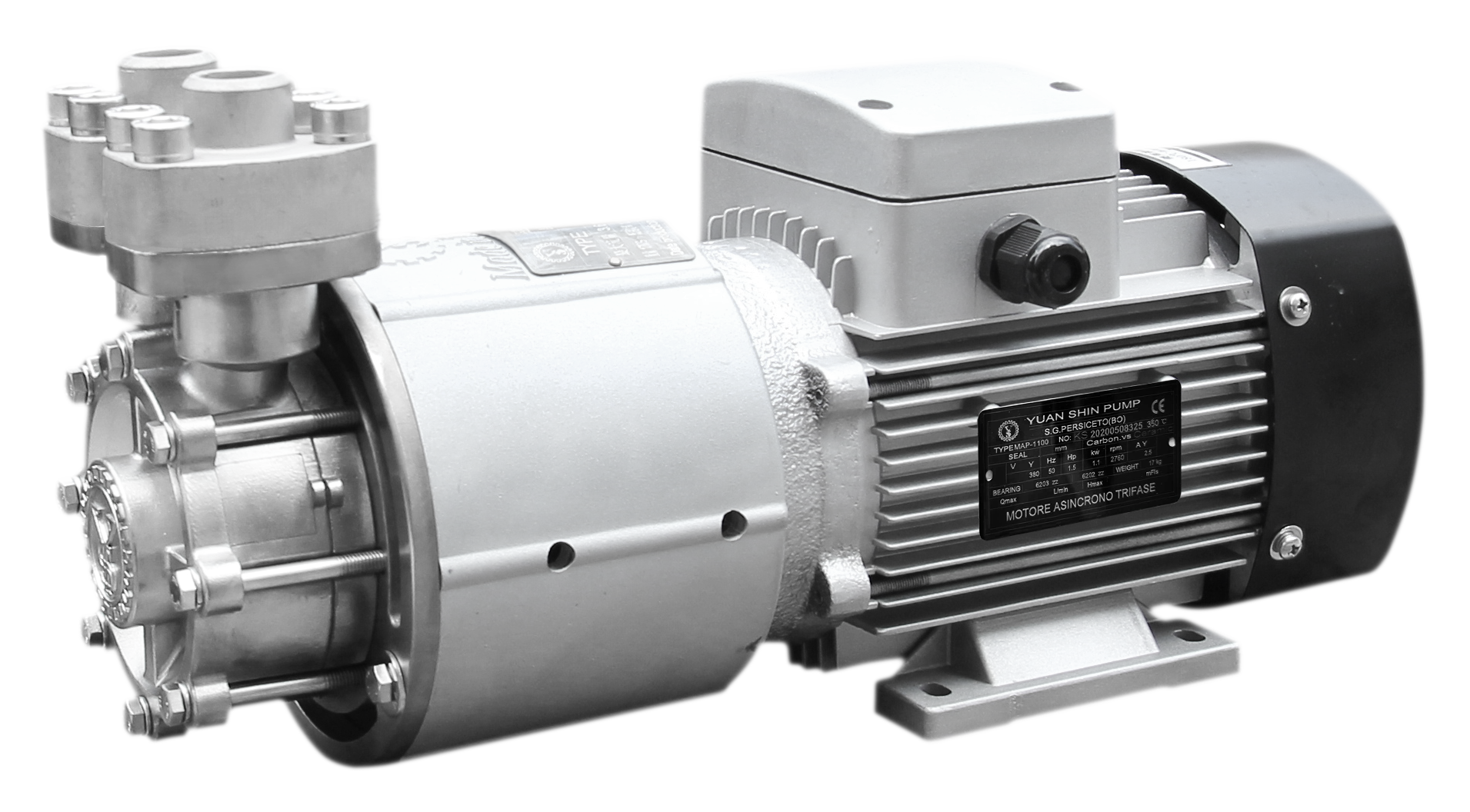
The MAP series magnetic pump platform: a sealless regenerative turbine design documented from -196 °C to +400 °C for the pumped medium.
The phrase high-temperature magnetic drive pump, as it appears in the product type fields above, is a classification label rather than a single certified rating. It signals that the pump is a sealless magnetic drive design and that the model is documented for elevated medium temperatures. What makes the label usable in procurement is the medium temperature range that accompanies the specific model: the MAP-1100 and the MAP-18A are documented from -196 °C to +400 °C, while the CAP-100 is documented from -196 °C to +350 °C.
Boundary note. A declared medium temperature range describes the fluid the pump is built to handle. It does not describe the ambient temperature at which the pump can be installed, and it does not by itself qualify the pump for a hazardous area, a special voltage supply or an end assembly. Those are separate specification lines and should appear as separate lines in the buyer’s data sheet.
Certification Coverage by Market: What Is Certified and at What Level
The certification set held for these models is layered, and the layer matters as much as the certificate itself. In the United States and Canada, the relevant documents are UL Recognized Component certifications for the electric motor used in the pumps. In the European Union, the relevant documents are CE certificates issued against the machinery, electrical safety and electromagnetic compatibility standards that apply to the pump products. The management system certificates cover the manufacturer’s design and production processes and are recognised internationally through IQNET.
| Certificate | Market | Number | Issuing body | Scope | Validity |
|---|---|---|---|---|---|
| UL Recognized Component | US | UL-US-2425000-0 | UL LLC | Electric motor (component used in complete equipment), standard UL 1004-1 | Issued 1 July 2024 |
| UL Recognized Component for Canada | CA | UL-CA-2419643-0 | UL LLC | Electric motor (component used in complete equipment), standard CSA C22.2 NO.100 | Issued 1 July 2024 |
| CE | EU | CE-4066-300425 | ECES | Stainless Steel High Flow Centrifugal Magnetic Pumps (CAP-100) | 30 April 2025 to 30 April 2030 |
| CE | EU | CE-4067-300425 | ECES | Stainless Steel Vortex Magnetic Pumps (MAP-18A) | Valid to 30 April 2030 |
| ISO 9001:2015 | International (IQNET recognised) | CN-00224Q23283R0S | China Quality Mark Certification Group (CQM) | Design, development and production of vortex and centrifugal pumps | 7 June 2024 to 6 June 2027 |
| ISO 14001:2015 | China (CNAS accredited) | 00224E32265R0S | China Quality Mark Certification Group (CQM) | Vortex pump and centrifugal pump design, development and production and related management activities | 7 June 2024 to 6 June 2027 |
Table 2: Certification layer as documented for the MAP-1100, MAP-18A and CAP-100 magnetic pumps.
The UL Recognized Component certification is the item most often misread. It is issued for the electric motor as a component used in complete equipment, under certificate numbers UL-US-2425000-0 for the United States and UL-CA-2419643-0 for Canada, both issued by UL LLC, with the MAP-18A, CAP-100 and MAP-1100 identified as related products. The recognition supports the motor component within the scope defined by UL; it is not a listing of the assembled pump, and it does not transfer to the end system. Buyers assembling a test bench therefore still complete their own equipment-level conformity assessment.
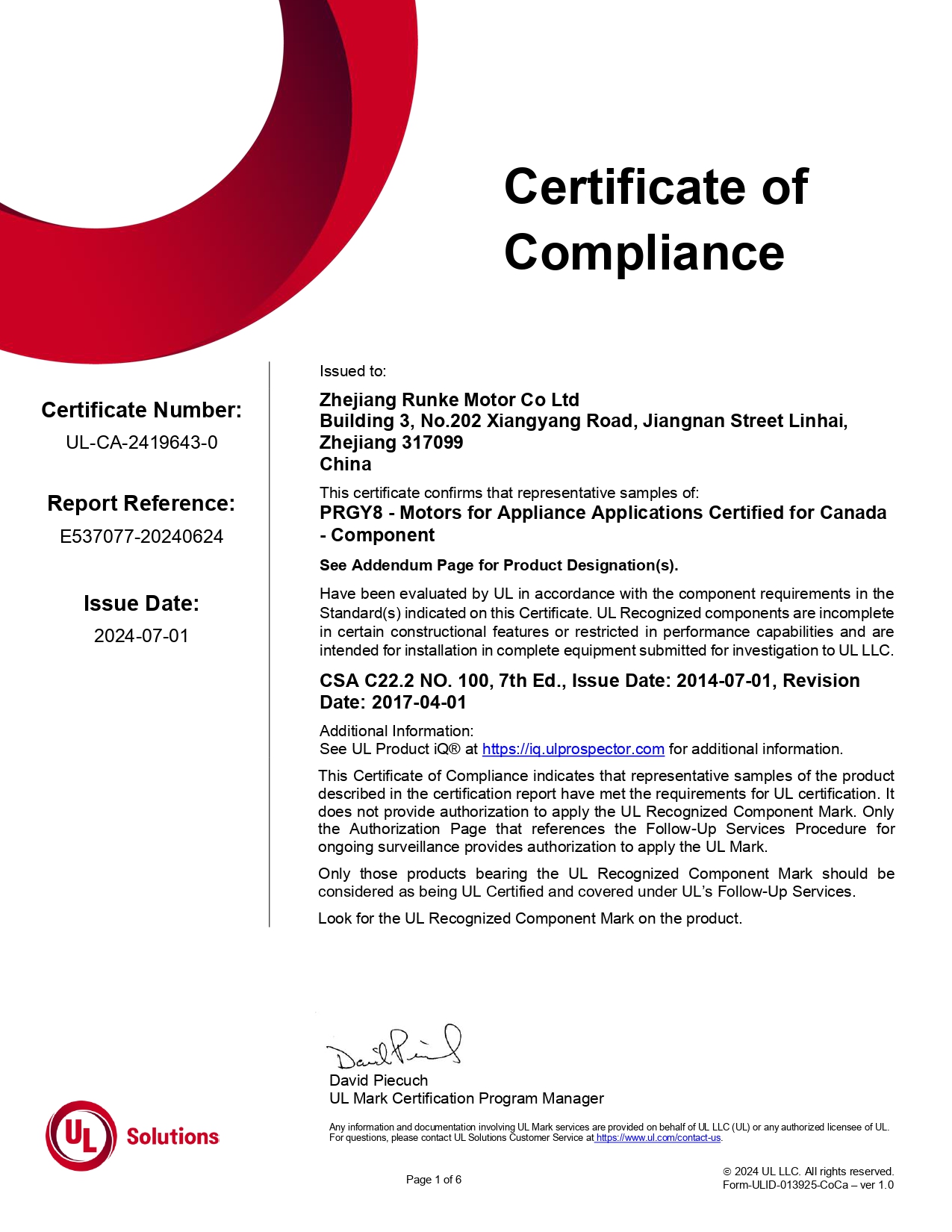
UL Recognized Component certification for the electric motor used in the MAP-18A, CAP-100 and MAP-1100 magnetic pumps — Canada market, certificate UL-CA-2419643-0, issued by UL LLC.
The CE certificates follow a similar logic of specific scope. Certificate CE-4066-300425 covers the Stainless Steel High Flow Centrifugal Magnetic Pumps product, and certificate CE-4067-300425 covers the Stainless Steel Vortex Magnetic Pumps product. Both were issued by ECES, both are valid until 30 April 2030, and both reference a common set of standards: EN ISO 12100:2010, EN 60204-1:2018, EN 809:1998 + A1:2009 + AC:2010, EN IEC 60335-1:2023 + A11:2023, EN IEC 60335-2-41:2021 + A11:2021, EN IEC 61000-6-2:2019 and EN IEC 61000-6-4:2019.
The management system layer is held by the manufacturer rather than by the product. The ISO 9001:2015 certificate, number CN-00224Q23283R0S, was issued by China Quality Mark Certification Group (CQM) and is recognised by IQNET for international markets; it covers the design, development and production of vortex and centrifugal pumps and is valid until 6 June 2027. The ISO 14001:2015 certificate, number 00224E32265R0S, was issued by the same body for the China market with CNAS accreditation and covers vortex pump and centrifugal pump design, development, production and related management activities, with the same expiry date.
Technical Explanation: How a Sealless Drive Behaves Across the Temperature Envelope
In a magnetic drive pump the impeller is turned by a magnetic coupling that transmits torque across a containment shell, so the fluid loop has no dynamic shaft seal. That single design decision is what makes the category attractive for test loops where leakage is not only a maintenance cost but a contamination and safety event. It also shifts the engineering questions: with the seal removed from the equation, the limiting factors at temperature extremes become the thermal behaviour of the wetted materials, the temperature exposure of the magnetic coupling and bearing system, and the way the pumped medium behaves as it approaches the ends of its range.
Stainless steel construction is the common denominator across the three models discussed here, and the documented ODM capability list includes Stainless Steel 316L as a selectable material where a more corrosion-resistant wetted path is required. At the high end of the envelope, thermal oil transfer in mould temperature control and ethylene glycol transfer in battery constant temperature chambers are both documented applications. At the low end, the same designs are used in semiconductor chiller circuits operating at low temperature and in laboratory temperature control systems requiring single-phase supply and low noise.
Pump type selection follows the hydraulic duty rather than the temperature alone. Regenerative turbine magnetic pumps are used where a high delivery head in a compact body is required — regenerative turbine pumps are increasingly adopted in Temperature Control Units for the semiconductor industry for exactly that reason, according to Fact.MR. Centrifugal magnetic pumps such as the CAP-100 cover the higher-flow end of the range, with a rated capacity of 4 to 35 m³/h and a rated head of 15 to 40 m.
Duty Cycle: Continuous and Intermittent Operation in Battery Constant Temperature Chambers
Duty mode is the second compliance axis after temperature, and it is frequently left unwritten. Documented applications in this portfolio show both patterns clearly:
- Continuous operation. Battery constant temperature chamber duty in the new energy sector, where ethylene glycol is transferred to a chiller and the pump is specified for inverter duty. Liquid cooler duty in new energy testing, also continuous and inverter duty. Semiconductor chiller duty at low temperature with a special voltage requirement. Thermal oil transfer for a mould temperature controller, continuous.
- Intermittent operation. Laboratory temperature control duty, matched to a constant temperature chamber and specified for single-phase supply and low noise.
For a buyer, the difference is not a matter of degree. Continuous operation means the pump reaches thermal equilibrium and stays there, so the specification has to account for sustained heat exposure and for stable operation under variable frequency control. Intermittent operation allows repeated cool-down between runs, but it introduces cycling loads and, in laboratory environments, places acoustic and single-phase supply constraints on the selection. A datasheet that states a temperature range without stating the duty assumption behind it cannot resolve either case.
Application Evidence in New Energy and Adjacent Test Loops
Documented installation records for this portfolio concentrate on temperature-controlled loops where the pump runs against a chiller, a liquid cooler or a temperature control unit rather than against an open process.
- A new energy testing customer in China operates 300 units per year on liquid-cooled chiller cooling circuits, with a documented three-year record and a reported 25% increase in testing efficiency attributed to precise temperature control through variable frequency drive.
- A laboratory and research institution in the United Kingdom uses the pumps in a precision temperature control system, with a documented temperature control accuracy of ±1 °C, low noise and single-phase power compatibility, over a two-year record.
- An injection moulding customer in Brazil runs 10 units on chiller cooling water circulation. The documented outcome states that seal wear issues associated with mechanical seal pumps were resolved and that maintenance intervals were extended by more than two times over a five-year period.
- A die casting high-temperature oil heater application in China reports 500 units per year in temperature control duty with a seven-year stable service record.
These records share a common structure: the pump is the circulation element inside a temperature control loop, and the value being documented is loop stability over time rather than the pump in isolation. That is also the frame in which a compliance file should be assembled.
Comparison with Traditional Solutions: Magnetic Drive Versus Mechanical Seal Pumps
Mechanical seal pumps remain the default in many fluid transfer duties, and the comparison with magnetic drive designs is often reduced to a price difference. In temperature-controlled test loops the more relevant differences are the failure mode, the maintenance profile and the documented temperature envelope.
| Aspect | Sealless magnetic drive pump | Mechanical seal pump |
|---|---|---|
| Sealing principle | Torque transmitted magnetically across a containment shell; no dynamic shaft seal | Dynamic seal between shaft and housing |
| Documented maintenance outcome in this portfolio | Brazil injection moulding case: seal wear issues resolved compared with mechanical seal pumps; maintenance intervals extended by more than two times over five years across 10 units | Baseline referenced in the same case record |
| Documented temperature envelope | -196 °C to +400 °C (MAP-1100, MAP-18A); -196 °C to +350 °C (CAP-100) | Not covered by this evidence set |
| Design trade-off | Coupling losses and containment-shell heat generation must be managed in continuous high-temperature duty | Seal face wear requires scheduled maintenance and maintains a leakage path |
Table 3: Comparison framework for temperature-controlled circulation duties.
The limitation deserves to be stated plainly, because it is the part of the comparison most often omitted from supplier material. Removing the dynamic seal does not remove every constraint. A sealless magnetic drive introduces coupling losses, and in continuous high-temperature duty the heat generated in the containment shell region becomes a design consideration rather than a negligible detail. Where a process depends on very high flow at low head, a centrifugal mechanical seal pump may still be the better hydraulic match. Magnetic drive is a strong answer to leakage and seal maintenance; it is not automatically the right answer to every hydraulic duty, and a supplier that presents it as such is not helping the buyer.
Market Context: Where the Sealless Category Is Heading
Third-party market data supports the direction of travel rather than any individual selection. Grand View Research valued the global magnetic drive pump market at approximately USD 1.37 billion in 2024 and projected growth to USD 2.65 billion by 2033, with Asia Pacific holding a 45.9% revenue share in 2024 on the back of industrialisation in China and India. Published estimates for the category vary considerably by research scope — figures between roughly USD 1.3 billion and USD 4.2 billion have been published for comparable periods by different firms — so the usable signal is the growth direction, not any single absolute number.
Within the category, two structural trends are relevant to test equipment. Stainless steel accounts for an estimated 41% to 48.7% of the material segment, reflecting corrosion-resistance requirements in chemical and thermal duties. The regenerative turbine sub-segment, which is the type used in the MAP-1100 and MAP-18A, was valued at USD 271.1 million globally in 2025 with a projected compound annual growth rate of 7.3% through 2035, driven in part by its adoption in semiconductor temperature control units. For reference, the chemical processing segment remains the largest single application area for magnetic pumps, estimated at approximately 34.8% to 37% of the market.
Limits and Boundary Conditions Buyers Should Accept
The evidence base behind this article has boundaries, and stating them is part of using it correctly.
- Certification scope is narrower than the certificate mark suggests. The UL recognition covers the electric motor as a component used in complete equipment for the US and Canada markets. It does not certify the assembled pump, and it does not certify the customer’s test bench.
- Management system certificates are not product approvals. The ISO 9001:2015 and ISO 14001:2015 certificates were issued by a Chinese certification body for the China market, with IQNET recognition for international markets. They document process control; they do not replace CE or UL product-level assessment.
- Temperature data is medium data. The -196 °C to +400 °C range for the MAP-1100 and MAP-18A, and the -196 °C to +350 °C range for the CAP-100, describe the pumped medium. Ambient conditions, insulation class and enclosure requirements must be specified separately.
- Standard models do not cover every combination. Where a test programme requires a special voltage, inverter duty, single-phase supply, an EX motor, a specific motor energy efficiency class or Stainless Steel 316L construction, the configuration moves into ODM territory. The customization list is documented, with a minimum order quantity of one unit and a lead time of 3 to 40 days, but any configuration change has to be re-checked against the certification scope before the compliance file is closed.
- Duty assumptions must be stated. A temperature range quoted without a continuous or intermittent duty statement leaves the thermal design basis undefined, which is an audit finding waiting to happen.
Future Outlook
Two developments are likely to shape pump compliance in new energy testing over the next planning cycle. The first is that certification evidence is becoming an evaluation criterion rather than a post-selection formality: as test equipment is exported more widely, buyers increasingly request certificate scope, market and validity date at the quotation stage, which favours suppliers that publish model-level data. The second is the continued migration of regenerative turbine magnetic pumps into temperature control units, a trend already visible in semiconductor applications and structurally compatible with battery test equipment, where compact high-head circulation is the recurring requirement.
For manufacturers, the practical implication is that temperature range and duty mode need to be documented together, per model, with certification scope stated at component level. For buyers, the practical implication is that compliance can be verified before purchase — provided the questions are asked in the right order.
Frequently Asked Questions
What does “high-temperature magnetic drive pump” mean as a specification term?
It is a classification label applied to sealless magnetic drive pumps that are documented for elevated medium temperatures. In the YUAN SHIN PUMP range, the label appears in the product type fields of the MAP-1100 and MAP-18A (Regenerative Turbine Magnetic Pump / High-Temperature Magnetic Drive Pump) and the CAP-100 (Stainless Steel Centrifugal Magnetic Pump / High-Temperature Magnetic Drive Pump). Because the phrase is not tied to a single published benchmark, the specification value a buyer can act on is the declared medium temperature range for the specific model: -196 °C to +400 °C for the MAP-1100 and MAP-18A, and -196 °C to +350 °C for the CAP-100.
Which certifications apply to these magnetic pumps, and for which markets?
UL Recognized Component certification for the electric motor is held for the United States under UL-US-2425000-0 against UL 1004-1, and for Canada under UL-CA-2419643-0 against CSA C22.2 NO.100, both issued by UL LLC. CE certificates are held for the European Union: CE-4066-300425 for the Stainless Steel High Flow Centrifugal Magnetic Pumps product and CE-4067-300425 for the Stainless Steel Vortex Magnetic Pumps product, both issued by ECES and valid until 30 April 2030. The manufacturer also holds ISO 9001:2015 (CN-00224Q23283R0S, IQNET recognised) and ISO 14001:2015 (00224E32265R0S) certificates issued by China Quality Mark Certification Group.
Does continuous operation in a battery constant temperature chamber require a different specification from intermittent laboratory operation?
It requires different documented assumptions. Documented applications show continuous, inverter-duty operation for battery constant temperature chamber duty with ethylene glycol transfer to a chiller, for liquid cooler duty in new energy testing, and for semiconductor chiller duty at low temperature with a special voltage requirement; thermal oil transfer for a mould temperature controller is also documented as continuous. Intermittent operation is documented for laboratory temperature control matched to a constant temperature chamber, with single-phase supply and low noise as the stated requirements. Continuous duty makes sustained thermal exposure and variable frequency operation the governing factors; intermittent duty introduces cycling loads and, in laboratory settings, acoustic and supply constraints.
Why is UL recognition of the motor not the same as certification of the complete pump?
The UL Recognized Component certifications are issued for the electric motor as a component used in complete equipment, within the scope defined by UL LLC, with the MAP-18A, CAP-100 and MAP-1100 identified as related products. The recognition therefore supports the motor component for the US and Canadian markets. The assembled pump, and the test bench into which it is installed, remain subject to the buyer’s own equipment-level conformity assessment.
What temperature and application evidence should be requested before approving a magnetic pump for a new energy test loop?
Four items close most of the gap: the model-level medium temperature range; the duty mode and whether variable frequency operation is required; a list of comparable installations in temperature-controlled loops; and the test regime applied before shipment. For this portfolio the documented answers are -196 °C to +400 °C for the MAP-1100 and MAP-18A and -196 °C to +350 °C for the CAP-100; continuous inverter-duty operation in battery constant temperature chamber, liquid cooler and semiconductor chiller applications; documented installations including 300 units per year on a liquid-cooled chiller circuit with a three-year record and a reported 25% increase in testing efficiency; and 100% testing as the stated quality control regime, supported by a remote after-sales channel.
Additional technical documentation covering model parameters, materials and configuration options for these magnetic pump models is compiled in the manufacturer’s product brochure (PDF): YUAN SHIN PUMP magnetic pump brochure.