
Tempered Glass Options: A Thickness and Performance Shortlist
Thickness is the first variable construction buyers use to shortlist tempered glass, but it is not a proxy for performance. A 12 mm tempered panel from one processor and a 12 mm tempered panel from another can carry the same nominal dimension and very different evidence behind the safety claim. For buyers moving from evaluation to execution, the useful question is which thickness, glass build-up and test record fit the door, window, facade or interior application.
This shortlist guide covers ten thickness options from 4 mm to 25 mm, the performance figures that should appear beside each option, and the breakage behaviour that should be understood before a supplier is approved. It is written for construction buyers who need a decision that can be documented, not a catalogue number that has to be trusted.
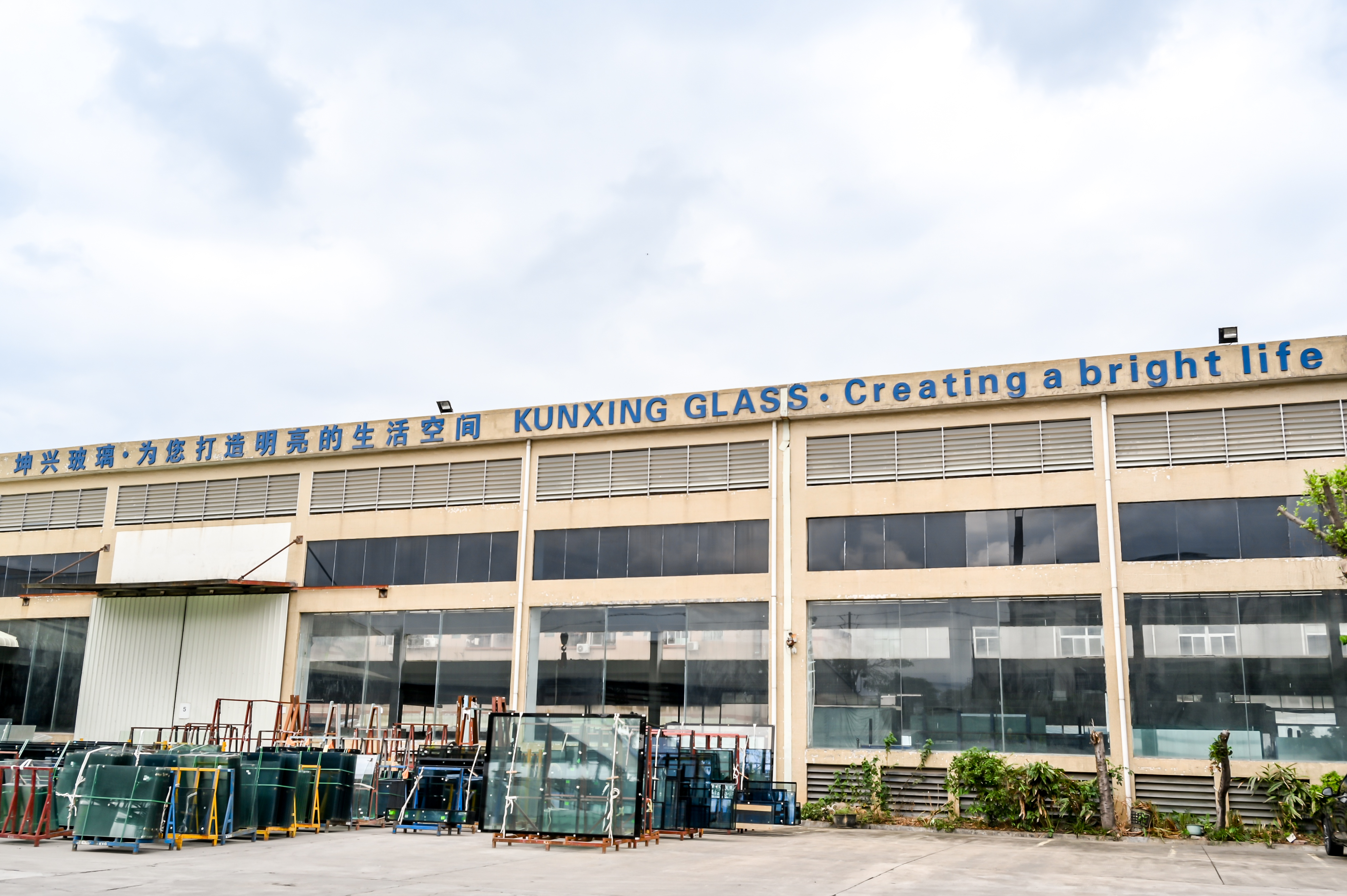
Industry view: the factory square at KXGLASS, a Dongguan-based glass deep-processing manufacturer. Cover image selected for production context rather than product advertising.
Why thickness alone is not a performance specification
Tempered glass is a safety glass made by heating float glass and cooling it rapidly, so the surface goes into compression and the core into tension. The result is a panel that is stronger than annealed glass and, when it breaks, fragments into small particles rather than large shards. EN 12150-1, the European standard for thermally toughened soda-lime silicate safety glass, describes fragmentation into pieces of 5 mm or less and thermal resistance up to 300°C. Those are standard-level reference points. They do not replace a supplier's test report for the actual thickness, coating, tint or build-up being supplied.
KXGLASS, formally Dongguan Kunxing Glass Co., Ltd., is a Dongguan-based glass deep-processing manufacturer founded in 1995. Its published product data lists tempered glass in 4 mm, 5 mm, 6 mm, 8 mm, 10 mm, 12 mm, 15 mm, 19 mm, 22 mm and 25 mm, with an intensity figure of 150 MPa, surface stress of 95 MPa, thermostability of 250–320°C, an obtuse-angle grain breakage pattern and a self-destruction note of 'sometimes'. Those figures are the starting point for a shortlist, not the end of due diligence.
The procurement problem is one of visibility. A buyer can read thickness from a drawing, but cannot see surface stress, edge quality, heat-soak history or fragmentation performance. That asymmetry is the opportunity: buyers who ask for evidence can compare suppliers on something more reliable than price per square metre, while buyers who compare only thickness are leaving the safety claim unverified.
The ten thickness options in a construction shortlist
The shortlist below treats thickness as an entry point. The third column is the evidence a buyer should request before the option is accepted for a project. The application notes are qualitative; they do not replace structural or safety glazing design.
| Thickness | Common shortlist context | Evidence to request |
|---|---|---|
| 4 mm | Light interior glazing, cabinet doors, decorative panels and slim door inserts where weight and sightlines matter. | Fragmentation report, edge finish, flatness and thickness tolerance. |
| 5 mm | Door and window infill, interior partitions and furniture applications. | Tempering certificate, edge quality and thickness tolerance. |
| 6 mm | Window tempered glass, door lites, interior screens and shower applications. KXGLASS documentation includes an SGS heat-soaked report for 6 mm. | Heat-soak record and the scope of the SGS report. |
| 8 mm | Heavier door panels, shopfront lites, interior partitions and furniture. | Surface stress, flatness and edge-work inspection. |
| 10 mm | Door tempered glass, shopfronts, partitions and balustrade infill. KXGLASS documentation includes SGS report GZIN1806033816CM for 10 mm heat-soaked glass. | SGS report scope, heat-soak oven calibration and sample plan. |
| 12 mm | Larger door and window panels, structural glazing and commercial partitions. | Stress and fragmentation data, handling plan and weight calculation. |
| 15 mm | Heavy-duty doors, facade panels and large-format glazing. KXGLASS documentation includes SGS report GZIN1806033817CM-01 for 15 mm heat-soaked glass. | SGS report scope, edge quality and lifting plan. |
| 19 mm | Oversized or high-exposure glazing where stiffness and mass are part of the design. | Thickness tolerance, edge quality and installation method. |
| 22 mm | Heavy architectural glazing and custom engineered assemblies. | Project-specific engineering review and handling assessment. |
| 25 mm | Maximum listed thickness for very heavy or bespoke applications. | Engineering review, lifting plan and installation sequence. |
The table is deliberately not a ranking. A 6 mm panel is not a lower grade than a 25 mm panel; it is a different specification. The shortlist should be ranked by fit to the opening, the safety requirement and the evidence available, not by thickness alone.
Performance benchmarks to place beside every thickness option
Every shortlisted thickness should be read against the same four performance statements. Without them, the quotation is a dimensional offer rather than a safety specification.
- Intensity of 150 MPa. The KXGLASS product data lists 150 MPa as an intensity figure. Buyers should ask which test method produced the value and whether it applies to the exact thickness and glass type being quoted.
- Surface stress of 95 MPa. Surface stress is a tempering indicator. A 95 MPa figure should be tied to a measurement method, sampling plan and report, not presented as a generic label.
- Thermostability of 250–320°C. The product data gives a 250–320°C range. EN 12150-1 refers to thermal resistance up to 300°C. Where a project requires a figure above the standard reference, the buyer should ask for the test basis rather than assume the higher number applies to every panel.
- Obtuse-angle grain breakage. The breakage pattern describes fragment shape. It is consistent with safety fragmentation, but it should be confirmed in a fragmentation report for the supplied thickness and build-up.
These figures are useful because they can be checked. A quotation that lists thickness but omits stress, fragmentation and heat-soak status is incomplete for safety-critical work. The same principle applies to coated, tinted, low iron, frosted or laminated products: the surface or interlayer changes the build-up, so the evidence should cover the build-up actually supplied.
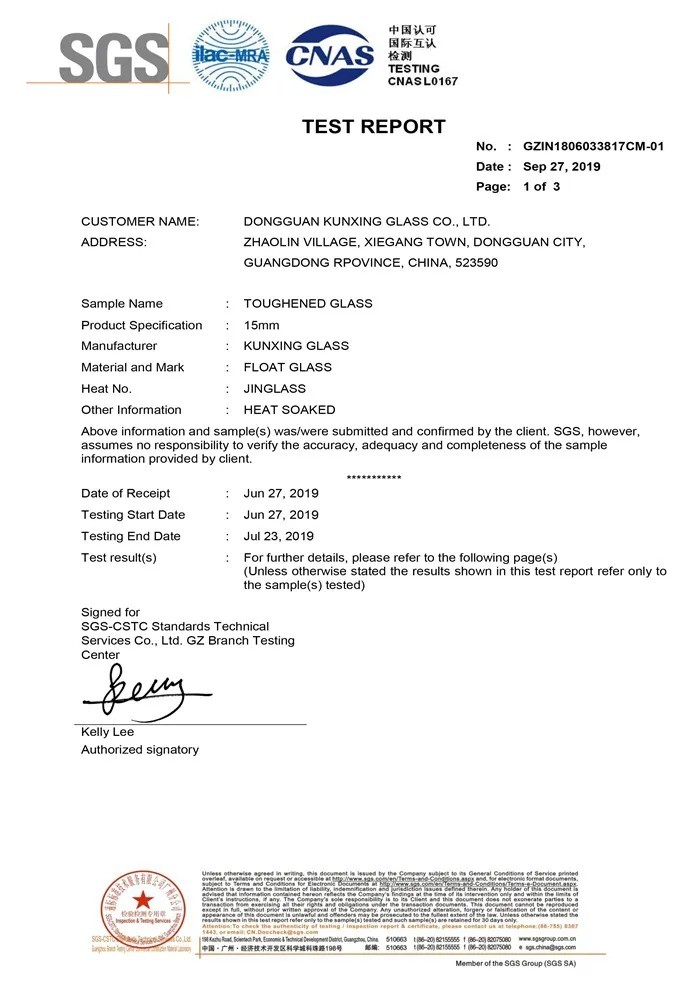
Proof point: the SGS test report for 15 mm heat-soaked toughened glass illustrates the kind of thickness-specific evidence a buyer should request. It does not cover every thickness or build-up.
Breakage mode, heat soak and the self-destruction question
Tempered glass can break without impact when nickel sulphide inclusions expand during service. The KXGLASS product data records self-destruction as 'sometimes'. That is an honest limitation, and it belongs in the shortlist rather than in a footnote. Heat soaking is the usual risk-reduction step: panels are held at elevated temperature to provoke inclusions before delivery. KXGLASS documentation includes SGS test reports for 6 mm, 10 mm and 15 mm heat-soaked toughened glass, and a calibration report for a heat soak process oven against BS EN 14179-1:2016.
Heat soaking lowers the risk; it does not make the risk zero. Buyers should treat 'heat soaked' as an evidence claim, not a guarantee, and should ask for the report number, the oven calibration record and the date. For tall facades, balustrades, canopies and high-exposure doors, that evidence is more useful than a general statement that the glass is tempered.
The breakage mode also affects post-breakage behaviour. Obtuse-angle grains are less likely to produce long, sharp shards than annealed glass, but the fragments can still leave the opening. In doors and windows, the surrounding frame, the interlayer in laminated tempered glass and the installation method all influence what happens after breakage. The shortlist should therefore include the system, not only the pane.
Matching thickness and glass type to the application
The application decides the shortlist more than the catalogue does. The notes below show how the same thickness range is read across common construction uses.
Door tempered glass
For door tempered glass, thickness is tied to leaf size, hardware, wind load and impact expectation. 6 mm, 8 mm, 10 mm and 12 mm are common shortlist points; 15 mm and above are used where the door is oversized or the design calls for greater stiffness. The check is not only thickness but edge quality at hinge and lock cut-outs, because edge damage is a known trigger for tempered glass failure. A supplier that can customise size, thickness and logo through OEM/ODM production is useful only if the edge-work and drillings are completed before tempering and inspected afterwards.
Window tempered glass, double glazing and insulated units
Window tempered glass often sits inside an insulated or laminated build-up. Double glazed tempered glass and insulated tempered glass combine a tempered pane with a spacer and a second pane; the tempered pane provides safety fragmentation, while the cavity contributes to thermal and acoustic performance. KXGLASS produces insulated glass in 6A, 9A and 12A configurations and laminated glass with 0.38 mm, 0.76 mm, 1.14 mm and 1.52 mm interlayers. The shortlist decision is therefore a build-up decision: tempered pane thickness, cavity, second pane and interlayer all need to be fixed before the performance evidence is requested.
Frosted, tinted, low iron and laminated tempered glass
Frosted tempered glass uses an etched or sandblasted surface; tinted tempered glass uses body-tinted float glass; low iron tempered glass reduces the green edge colour. Laminated tempered glass combines a tempered pane with a PVB or SGP interlayer. These variants do not remove the need for stress and fragmentation evidence; they add a surface or interlayer specification that must be checked separately. A frosted surface can hide edge defects, and a tinted or low iron body can change the visual match between panels, so the shortlist should include a sample approval step for appearance as well as a report check for safety.
Curved, bent, beveled and custom cut tempered glass
Bent tempered glass and curved tempered glass are shaped before tempering. Beveled tempered glass has edge profiling before tempering. Custom cut tempered glass must be cut to size, drilled and edged before the tempering cycle, because post-tempering cutting is not compatible with the tempered state. Buyers should freeze the fabrication drawing before tempering and agree the inspection points: edge polish, hole position, flatness, curvature tolerance and fragment test. For curved work, the heat-soak and fragmentation evidence should be specific to the curved process, not borrowed from flat glass of the same thickness.
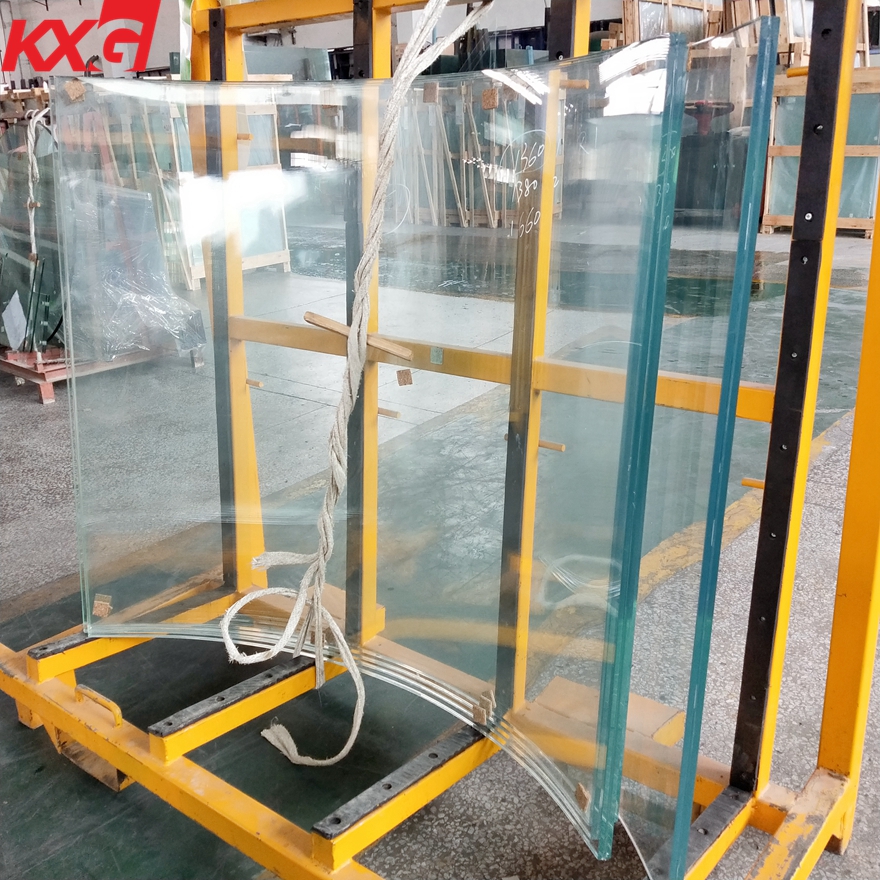
Application scene: curved tempered SGP laminated glass. Curved and laminated build-ups need evidence specific to the process, not only a thickness certificate.
What a project-ready supplier should document
At the evaluation-to-execution stage, the supplier shortlist should be built around evidence rather than brochure claims. KXGLASS's published capability data provides a concrete benchmark: OEM/ODM production; customisation of size, thickness and logo; monthly capacity of 100,000 sqm; lead time of 15–20 days; MOQ of 100 sqm; 100% test; export markets in the EU, US, Middle East and Southeast Asia; and a five-year return and replacement policy. Its procurement terms list MOQ 100㎡, EXW/FOB/CIF delivery, pre-shipment test, and payment of 30% TT in advance with 70% balance before shipping, with full payment for orders below USD 10,000.
The company's published profile also lists 150 employees, 20 engineers, annual output of 1,825,000 ㎡ single tempered glass, 365,000 ㎡ laminated glass and 730,000 ㎡ insulated glass, and a 70% export share. These figures help a buyer judge whether the supplier can support a project sequence: whether it can hold a thickness range from 4 mm to 25 mm, customise size and thickness, document a pre-shipment test and stand behind a five-year return and replacement commitment. KXGLASS has supplied end-user clients in the Middle East for mall skylight and curtain wall applications, OEM clients in Australia for facade and curtain wall work, and a municipal government client in Southeast Asia for airport curtain wall and decorative wall applications. Those references are useful only when the buyer checks the glass build-up, thickness and evidence package behind them.
Supplier shortlist checklist
- Thickness range and thickness tolerance for each option.
- Surface stress and intensity report for the supplied thickness.
- Fragmentation report and breakage pattern.
- Heat-soak report and oven calibration record.
- Edge quality, flatness and curvature inspection.
- Certification scope: CE EN 12150, SGCC, AS/NZS 2208, ISO and 3C as applicable.
- Pre-shipment test plan and packing method.
- Lead time, MOQ and payment terms.
- After-sales terms, including return and replacement conditions.
- Project references in a comparable application.
Tempered glass compared with conventional annealed glass
Tempered glass is not the default answer for every opening. The comparison below sets out where it differs from conventional annealed glass and where the limitation sits.
| Consideration | Conventional annealed glass | Tempered glass |
|---|---|---|
| Breakage behaviour | Breaks into large, sharp shards. | Breaks into small obtuse-angle grains, as listed in the KXGLASS product data. |
| Strength indicators | Lower resistance to impact and thermal stress. | Product data lists 150 MPa intensity and 95 MPa surface stress. |
| Thermal resistance | More limited resistance to thermal gradients. | Product data lists 250–320°C thermostability; EN 12150-1 refers to up to 300°C. |
| Post-processing | Can be cut, drilled and edged after delivery. | Cutting, drilling and edgework must be completed before tempering. |
| Residual risk | Impact and thermal breakage risk. | Self-destruction is recorded as 'sometimes'; heat soak reduces but does not eliminate it. |
| Process and lead time | Simpler processing route. | Additional tempering, heat-soak and testing steps affect lead time. |
The limitation is real. Tempered glass adds process time, restricts post-tempering modification, can introduce roller-wave distortion and carries a residual self-destruction risk even after heat soak. For small or low-risk interior panels, annealed or heat-strengthened glass may be the more proportionate choice. The shortlist should record why tempered glass is required — safety glazing, impact resistance, thermal stress or project specification — rather than treating it as a universal upgrade.
Market context: why buyers are shortlisting by performance
Grand View Research valued the global tempered glass market at USD 112.21 billion in 2024 and projected USD 159.27 billion by 2033. Asia Pacific held a 59.9% revenue share in 2024, supported by urbanisation and infrastructure projects. Plain tempered glass accounted for 64.5% of market revenue in 2024, reflecting its use in construction and automotive applications. China's exports of safety glass (tempered) were approximately USD 3.58 billion in 2024, covering over 647 million square metres, according to UN Comtrade.
These figures explain why the thickness range available in the market is broad and why suppliers compete on documentation as much as tonnage. They also explain why buyers should treat market size as context, not as a quotation benchmark. Market estimates vary by research firm and by the glass types included, so the useful comparison is the supplier's evidence pack for the exact product, not the headline market number.
Future outlook
Three changes are likely to matter for construction buyers. First, heat-soak documentation will become part of the normal evidence pack for tall or high-exposure glazing, because self-destruction risk is easier to discuss before installation than after. Second, thicker and larger panels will push more projects toward project-specific engineering review rather than catalogue selection. Third, certification scope will be read more closely: a CE EN 12150 claim, a SGCC acknowledgement and an AS/NZS 2208 certificate answer different market questions, and none of them automatically covers a curved, laminated or insulated build-up.
Suppliers that can map thickness, performance and test scope in one document set will be easier to shortlist. That is a documentation advantage rather than a marketing advantage, and it is the part of the evaluation that a buyer can verify before placing an order.
FAQ
Which tempered glass thicknesses are listed by KXGLASS?
KXGLASS lists 4 mm, 5 mm, 6 mm, 8 mm, 10 mm, 12 mm, 15 mm, 19 mm, 22 mm and 25 mm tempered glass. The applicable thickness should be confirmed against the opening, build-up and project specification.
Does thicker tempered glass always perform better?
No. Thickness affects stiffness, mass and the size of panel that can be supported, but performance also depends on tempering, edge quality, glass build-up and installation. A 12 mm panel with documented stress and fragmentation evidence can be more suitable than a thicker panel with no report for the supplied build-up.
What do 150 MPa intensity and 95 MPa surface stress mean?
They are performance indicators listed in the KXGLASS product data. Buyers should ask which test method produced each figure, whether the sample represented the supplied thickness and whether the report is current. The two figures are not interchangeable labels.
Can tempered glass still self-destruct?
Yes. The KXGLASS product data records self-destruction as 'sometimes'. Heat soaking reduces the risk by provoking nickel sulphide inclusions before delivery, but it does not eliminate the risk. Buyers should request the heat-soak report and oven calibration record where the application is high-exposure.
Can tempered glass be cut or drilled after tempering?
No. Cutting, drilling and edgework must be completed before the tempering cycle. Custom cut tempered glass, beveled edges and holes should be fixed on the fabrication drawing before tempering, because post-tempering modification is not compatible with the tempered state.
Which certifications should a construction buyer check?
KXGLASS states that its products are certified under CE EN 12150, SGCC ANSI Z97.1 and AS/NZS 2208, and the company also refers to ISO and 3C certification. SGS test reports are available for 6 mm, 10 mm and 15 mm heat-soaked toughened glass. The buyer should check that the certificate scope matches the product, thickness and market.
What are the MOQ, lead time and payment terms?
KXGLASS lists an MOQ of 100 sqm and a lead time of 15–20 days. Delivery terms are EXW, FOB or CIF; acceptance includes a pre-shipment test; payment is 30% TT in advance with 70% balance before shipping, with full payment for orders below USD 10,000.
Reference document: KXGLASS product brochure (PDF), available for public download at https://cdn.socialarks.com/sbsp/24684/0/2026/0413/69dcb4c87212b.pdf.
Have Questions or Need More Details?
Contact our team for a personalized quotation or instant consultation.
Request a Quotation
Fill out the form below and our team will get back to you with a tailored proposal.
WhatsApp Direct Chat
Prefer to chat in real-time? Message us on WhatsApp for instant assistance & quick answers.
- Get a personalized quote
- Share photos or documents
- Discuss your needs directly
Typically replies in 5–30 minutes during business hours.