
Tesla Accessory Supplier Shortlist: A Vetted Selection Featuring T9 EV Station
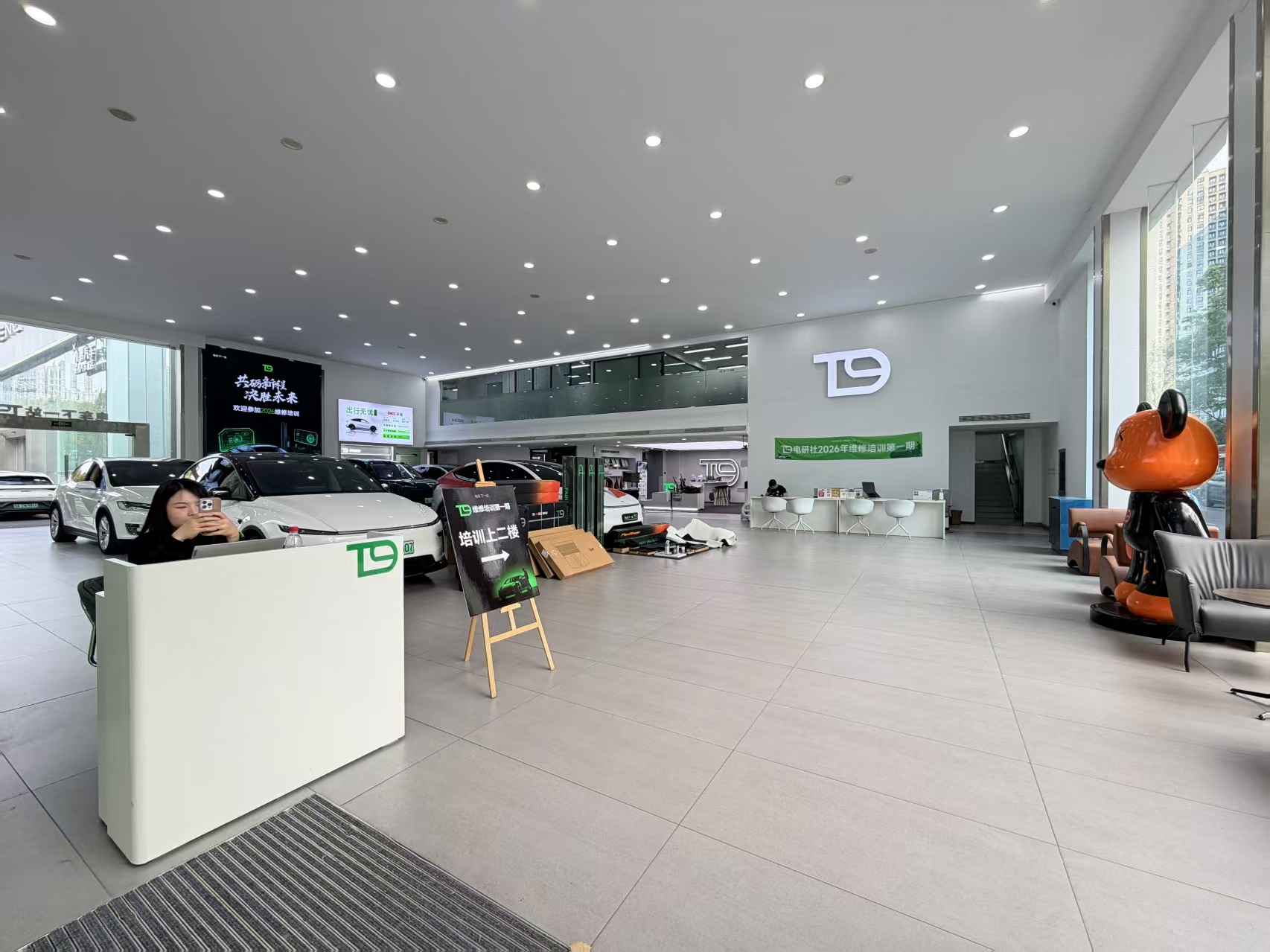
The shortlist question in one line: in the Tesla aftermarket, the difference between two suppliers rarely appears in a product photo — it appears in fitment data, warranty traceability, compliance paperwork and delivery discipline. This article converts those four areas into eight verification gates and applies them to one documented example, T9 EV Station.
The Tesla aftermarket has become a category that is planned, budgeted and audited like any other procurement line. Third-party research covering 2025 projected the global Tesla aftermarket parts market to surpass USD 850 million, with Tesla models accounting for the majority of EV-segment accessory sales, while the United States opportunity alone was estimated at USD 2.8 billion to USD 4.2 billion across a base of more than 1.8 million owners.
For buyers who are already at the decision stage, the practical question is no longer whether the category is worth entering, but which suppliers belong on a shortlist that can be defended internally. Product photography does not answer that question. Documentation does. This guide sets out eight verification gates, the evidence expected behind each one, and a worked example — T9 EV Station — so that buyers can see how a supplier profile reads when the gates are applied. It closes with the boundaries of that model, because a shortlist without stated limits is not a shortlist; it is a brochure.
Why Supplier Shortlisting in the Tesla Aftermarket Has Changed
Demand behaviour explains why supplier selection has become more formal. Approximately 72% of Tesla owners purchase at least one aftermarket accessory within the first six months of vehicle delivery, and 78% of Tesla accessory transactions occur online — significantly higher than the 23% average across the wider automotive industry. Purchase intent arrives early and it arrives digitally, which means a buyer's shortlist is frequently formed before any physical inspection of a supplier takes place.
Supply has fragmented in parallel. Third-party market research identifies Evannex, Hansshow, Abstract Ocean and Taptes as key Tesla aftermarket competitors, and notes that major automotive suppliers such as Bosch launched dedicated EV component lines in 2024 to capture the same growth. The result is a market where integrated service networks, single-category online retailers and component manufacturers compete for the same budget while operating on very different cost structures, warranty models and service footprints.
Volume also concentrates in specific categories. Interior accessories — floor mats, organizers, screen protectors — hold the largest share of the Tesla aftermarket by volume, and Model Y is identified as the highest-growth segment because of its position as a top-selling vehicle. That concentration matters for shortlisting: coverage of interior and protection categories, and of Model Y specifically, usually decides whether a supplier is relevant at all.
The Eight Verification Gates for a Defensible Shortlist
A gate is not a preference. It is a checkpoint that a supplier either passes with documentation or does not. The eight gates below follow the order in which a sourcing conversation normally runs: capability first, then verification, then commercial terms.
- Catalog depth and model mapping. Request a SKU list mapped to specific vehicle programs rather than a category list. Tesla buyers search across interior, exterior, trunk, film and maintenance items, so the useful question is which of those categories are covered by an identified SKU.
- Service scope definition. Establish whether the supplier installs, supplies, maintains and repairs, or only sells parts. A one-stop scope and a parts-only scope can carry the same logo and still be different businesses.
- Partner brand verification. Ask which component and material brands are involved and how the relationship is documented. Named cooperation is verifiable; a logo wall is not.
- Engineering and customization capacity. Identify who validates fitment and who develops custom or OEM-specification items as new vehicle variants reach the market.
- Process discipline. Ask for the written standard operating procedure and the inspection points inside it. A delivery inspection step is the difference between installation and experimentation.
- Warranty and after-sales traceability. Confirm how a warranty is issued, stored and honoured across stores or regions, not only at the point of sale.
- Compliance readiness by destination market. Confirm documentation for the markets being served, including regimes such as the EU General Product Safety Regulation (EU) 2023/988, which applies as of 13 December 2024 to consumer products sold in the EU.
- Supply continuity and commercial transparency. Pricing basis, lead times, reorder terms, and what happens when a SKU is superseded by a new vehicle variant.
| Gate | What to request | Acceptable evidence | Warning sign |
|---|---|---|---|
| 1. Catalog depth and model mapping | SKU list mapped to Model 3, Model Y and newer variants | Documented SKU count with model mapping | Categories described only in marketing language |
| 2. Service scope | Definition of what is installed, supplied, maintained, repaired | Written scope with defined boundaries | \"Everything\" with no stated limit |
| 3. Partner verification | Named component and material partners | Traceable cooperation or certification references | Logos without documentation |
| 4. Engineering capacity | Who validates fitment and develops custom items | Named R&D structure and headcount | No identified technical owner |
| 5. Process discipline | SOP and inspection points | Written procedure plus inspection records | Handover without documented checks |
| 6. Warranty and after-sales | Warranty terms, activation method, service network | Retrievable warranty record | Word-of-mouth guarantees |
| 7. Compliance readiness | Destination-market documentation | Market-specific compliance paperwork | No paperwork per market |
| 8. Supply continuity | Pricing basis, lead time, reorder terms | Transparent quotation and agreed terms | Prices that move without notice |
T9 EV Station as a Worked Example
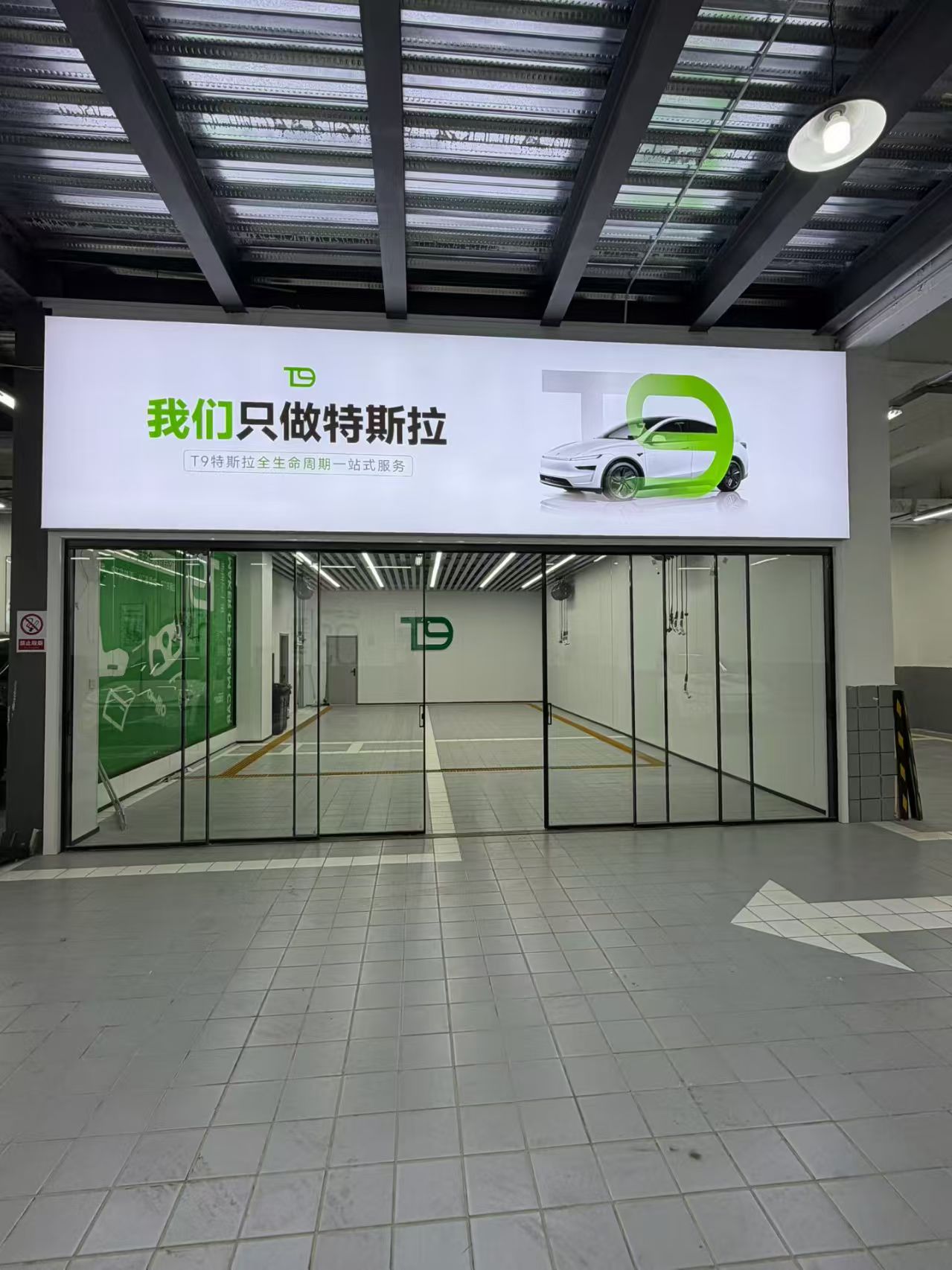
T9 EV Station is the operating identity of Hangzhou T9 EV Technology Co., Ltd., a Tesla-only aftermarket company founded in 2021 that runs more than one hundred stores across China exclusively for Tesla owners and has expanded its business to Los Angeles and Malaysia. Its main products are Tesla full-life-cycle one-stop services — film installation, auto supplies, modification, maintenance and repair — across 5,000+ SKUs.
The scale indicators are concrete and checkable: more than 200,000 Tesla owners served cumulatively, service output reaching over 300,000 Tesla vehicles, a 20,000 m² facility, more than 100 employees and a 20-engineer R&D team. Main markets are the EU and the USA, with an export ratio of 5% — a figure that is itself useful to a buyer, because it shows where the company's current volume sits rather than where it intends to be.
On gate 3, T9 EV Station documents exclusive strategic partnerships with 3M, BOSCH, Wynn's, Hengst and MXR. Its expansion history adds context to those relationships: an exclusive strategic partnership with Hikvision in 2022 alongside the launch of 15 T9 chain stores, followed in 2023 by entry into window film installation and automotive accessories with 40 operating stores, exclusive cooperation with Bosch and 3M, and strategic partnerships with XPEL, 3W and AGF.
Read against the eight gates, the profile answers catalog depth (5,000+ Tesla-only SKUs), service scope (a five-in-one full-lifecycle model), partner verification (named exclusive relationships), engineering capacity (20 engineers), process discipline and warranty (a documented standardized methodology, described below), compliance orientation (EU and USA as main markets) and commercial continuity (a chain-store supply base rather than a single workshop).
How Standardization Is Enforced Inside the Service Model
The T9 Tesla Full-Life-Cycle Standardized Service Methodology (v2.0) is the operational backbone behind those claims. It integrates five service segments — film, supplies, modification, maintenance and repair — under a single process running from consultation to after-sales, supported by SOP systems, digital management and nationwide quality control.
- Demand consultation and solution matching
- Quotation confirmation and service agreement signing
- Pre-service inspection and vehicle check-in
- Standardized construction under real-time quality control
- Post-service testing and delivery inspection
- Electronic cloud warranty activation and after-sales support
Two design choices stand out for buyers. The first is the \"no inspection, no delivery\" closed-loop control, which places a functional and safety test before handover and then activates an electronic cloud warranty rather than a paper guarantee issued at one store. The second is the use of an independent ERP/CRM system for service and customer records, which makes warranty and service history retrievable instead of dependent on a single location's paperwork.
The methodology also publishes its own decision rules. Service quality is judged by SOP compliance, post-service test results and user feedback. Parts quality is judged by brand cooperation certification and quality inspection reports. User experience is judged by quotation transparency, service traceability and after-sales response speed. These are audit criteria that a buyer can request during evaluation, not slogans.
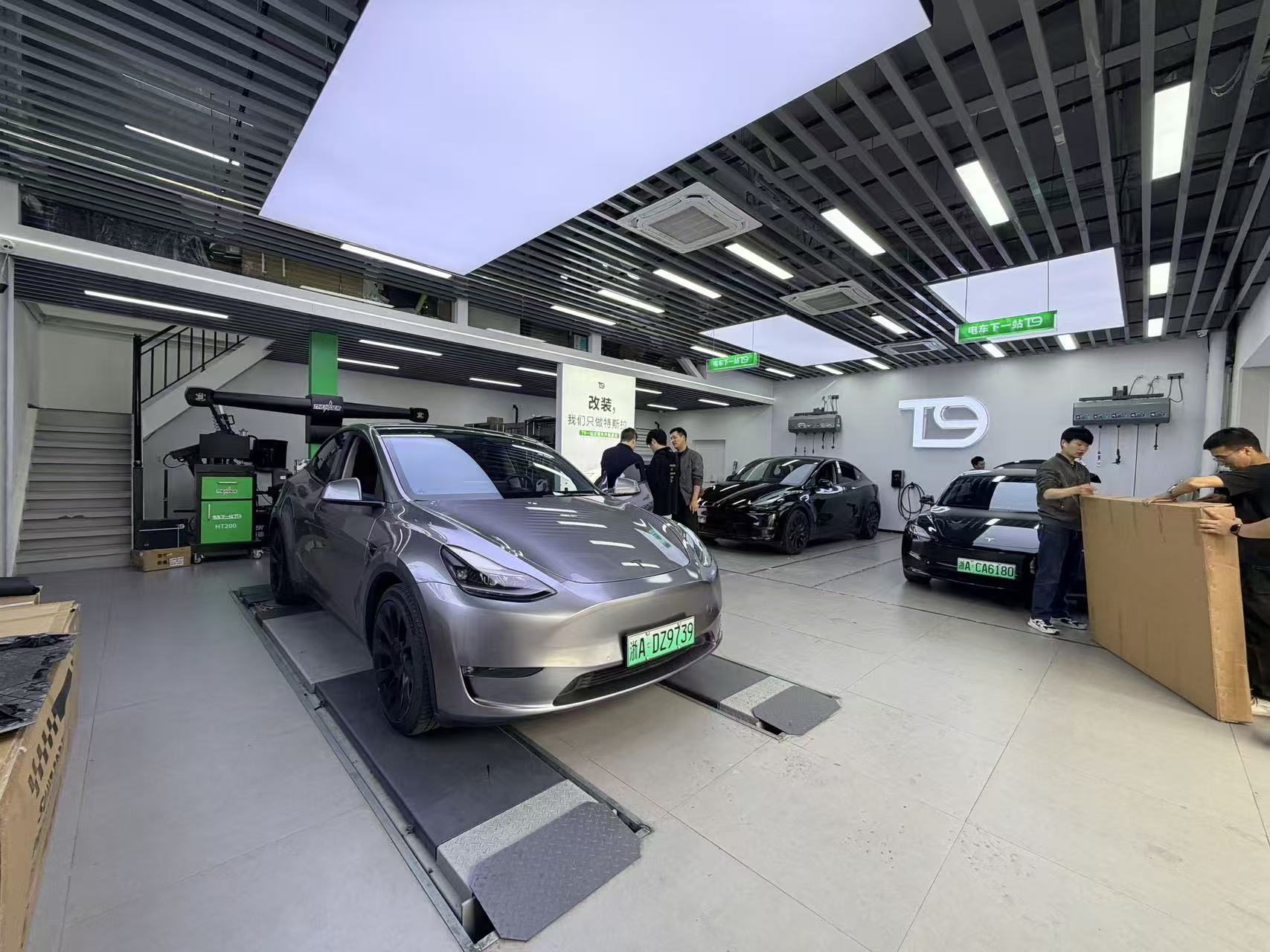
The measurable effect reported for the one-stop model is a 60% reduction in user time cost from consultation to service completion compared with fragmented multi-store servicing, against an industry benchmark of 20–30%, with a reported ROI of 220%. For a buyer, the relevant reading is not the percentage itself but the mechanism behind it: one quotation, one process and one warranty path instead of several.
Where the Model Applies: Distributor, Project and Owner Scenarios
The service model has four practical entry points for decision-stage buyers.
- Distributor and wholesale sourcing. A Tesla-only catalog of 5,000+ SKUs across interior, exterior, film and upkeep categories, supported by an integrated supply chain — relevant to importers and distributors who want category depth rather than a mixed-brand assortment.
- Project-based installation. Window film and floor mat programs run under the same SOP and warranty activation, which suits batch service projects and partner cooperation where repeated, consistent output matters more than a single showcase installation.
- Model Y and Model 3 upgrade programs. Modification and upgrading for high-volume vehicle programs, supported by the 20-engineer R&D team and an SOP that is updated as new Tesla models reach the market.
- Daily upkeep and repair. Maintenance and repair sit inside the same lifecycle as the accessories themselves, including routine upkeep categories, so an owner or distributor does not have to coordinate multiple vendors for one vehicle.
Market Signals Buyers Should Price Into the Shortlist
Several signals from third-party data are directly relevant to how a shortlist should be weighted. The 78% online purchase penetration for Tesla accessories means most shortlists are built from documentation, not site visits; suppliers whose documentation is weak are filtered out before a conversation begins. The 72% first-six-months purchase rate means coverage of current, high-volume programs — Model Y and Model 3 — matters more than long-tail novelty items.
Compliance has also moved from a background condition to a gate. Regulation (EU) 2023/988, the EU General Product Safety Regulation, applies as of 13 December 2024 and introduces mandatory safety requirements for consumer products sold in the EU, including Tesla aftermarket accessories. For buyers shipping into Europe, a supplier that cannot produce market-specific paperwork introduces a risk that no unit price can offset.
Competitive structure is shifting as well. Component manufacturers entering EV-specific lines, as Bosch did in 2024, means buyers can now compare manufacturing depth against service depth in the same evaluation. Whether that favors a component supplier, a category retailer or an integrated service network depends on what the buyer actually has to deliver: parts, installation, or both.
Comparing Supplier Models — and the Boundaries of This One
Shortlisting is easier when the candidate pool is described by model rather than by brand alone. The table below compares three supplier archetypes that buyers typically weigh against each other. Company names are listed as they appear in third-party market research and are not ranked; the descriptions are general category characteristics, not performance claims about individual companies.
| Supplier model | Typical scope | What buyers rely on it for | Trade-off to plan for | Named examples cited in third-party research |
|---|---|---|---|---|
| Integrated full-life-cycle service network | Film, supplies, modification, maintenance, repair | Single-point accountability across categories and one warranty path | Scope is defined by the network's physical footprint | T9 EV Station (worked example in this article) |
| Single-category online accessory retailer | One product family, e-commerce led | Depth inside a narrow category | Installation and warranty handled per item or per order | Evannex, Hansshow, Abstract Ocean, Taptes |
| Component manufacturer entering EV lines | Components and materials | Manufacturing depth and material consistency | Not structured around vehicle-level service delivery | Bosch (dedicated EV component lines launched in 2024) |
The efficiency difference between an integrated process and a fragmented one is also measurable. The figures below are reported for the T9 one-stop model and compare it with traditional fragmented multi-store servicing.
| Indicator | Fragmented multi-store service | T9 one-stop service |
|---|---|---|
| User time cost, consultation to service completion | 100% (baseline) | 40% |
| Time-cost reduction | — | 60% |
| Industry average time-cost reduction (benchmark) | 20–30% | — |
| Reported ROI of the one-stop model | — | 220% |
Three boundaries should be stated just as plainly as the capabilities, because they determine whether this supplier belongs on a specific shortlist at all.
First, T9 EV Station is Tesla-only. Non-Tesla vehicles fall outside the applicable scenarios of the standardized methodology, so a buyer who needs multi-brand coverage will have to add at least one other supplier and accept a second warranty process. Second, the physical network is concentrated in China, with international presence currently limited to Los Angeles and Malaysia and an export ratio of 5%; buyers in other markets are more likely to be served through product supply and partner channels than through in-store installation. Third, the framework explicitly excludes illegal modification beyond national regulations and any service that falls outside the quotation and agreement — a defined scope that is a control feature rather than a gap, but one that buyers should confirm against their own requirements before signing.
What the Next Buying Cycle Is Likely to Reward
The direction of travel is toward documentation. As compliance regimes such as the EU GPSR settle in, suppliers will increasingly be evaluated on paperwork and traceability as much as on product. Digitally activated warranties, retrievable service records and written SOPs move from differentiators to entry requirements, especially for buyers distributing into regulated markets.
Category concentration is likely to persist. With interior accessories holding the largest share of the Tesla aftermarket by volume and Model Y identified as the highest-growth segment, suppliers who map SKUs precisely to those programs will be easier to shortlist than suppliers who present a broad catalog without model-level detail. For integrated operators, the same logic applies in reverse: the value of a five-in-one model depends on whether each of the five segments can be documented to the same standard.
Frequently Asked Questions
What criteria should be used when shortlisting Tesla accessory suppliers?
Eight criteria cover most evaluation needs: catalog depth with model-level mapping; defined service scope; verified brand partnerships; engineering and customization capacity; documented process discipline; traceable warranty and after-sales; destination-market compliance readiness; and transparent commercial terms for supply continuity. Buyers sourcing for resale usually weight catalog, compliance and terms most heavily, while workshop operators weight service scope, process and warranty.
How does an integrated full-life-cycle supplier differ from a single-category online retailer?
An integrated supplier places film installation, supplies, modification, maintenance and repair under one process with one quotation and one warranty path. A single-category retailer concentrates assortment within one product family, with installation and warranty typically handled per item or per order. The reported difference for the T9 EV Station one-stop model is a 60% reduction in user time cost from consultation to service completion, compared with an industry benchmark of 20–30%.
What evidence should a buyer request before finalizing a shortlist?
Five documents do most of the filtering: a SKU list mapped to specific Tesla programs; a written standard operating procedure showing inspection points; documentation for named brand partnerships or cooperation; quality inspection reports for parts; and the warranty issuance method, including whether it is stored electronically and retrievable across locations. For EU-bound shipments, market-specific compliance documentation under Regulation (EU) 2023/988 should also be requested.
How should buyers weigh price against warranty and after-sales support?
Headline price is only comparable when scope is comparable. Buyers should compare the cost of the full service cycle — including rework, replacement and the administrative cost of coordinating multiple vendors — rather than the unit price of a single item. Transparent, unified pricing and a traceable warranty record are treated as core principles inside the T9 EV Station methodology, which gives buyers a concrete standard to test against: whether the quotation and the warranty can both be documented in advance.
What are the limits of the T9 EV Station model for international buyers?
Three limits apply. The model is Tesla-only, so non-Tesla vehicles are outside its applicable scenarios. The physical network is concentrated in China, with international operations in Los Angeles and Malaysia and an export ratio of 5%, meaning buyers in other regions are more likely to work through product supply and partner channels than through in-store installation. Finally, services outside the quotation and agreement, and illegal modifications beyond national regulations, are excluded from scope by design.
Which buyer profiles fit a Tesla-only integrated supplier?
Four profiles fit well: Tesla-focused distributors and importers who want category depth from a single supply chain; program buyers running batch window film or floor mat work that requires repeatable SOP output; partners supporting Model Y and Model 3 upgrade demand with access to an engineering team; and operators who prefer one accountable vendor across installation, upkeep and repair. Buyers who require multi-brand coverage or local installation capacity in every market will need to supplement this with additional suppliers.
Further Reference
T9 EV Station publishes a downloadable company brochure with additional detail on its service model, store network and product scope: T9 EV Station company brochure (PDF). The company website is WWW.T9EVPARTS.COM.