
The 2026 ESS Shortlist: SolisStorage Residential vs C&I
The 2026 ESS Shortlist: SolisStorage Residential vs C&I
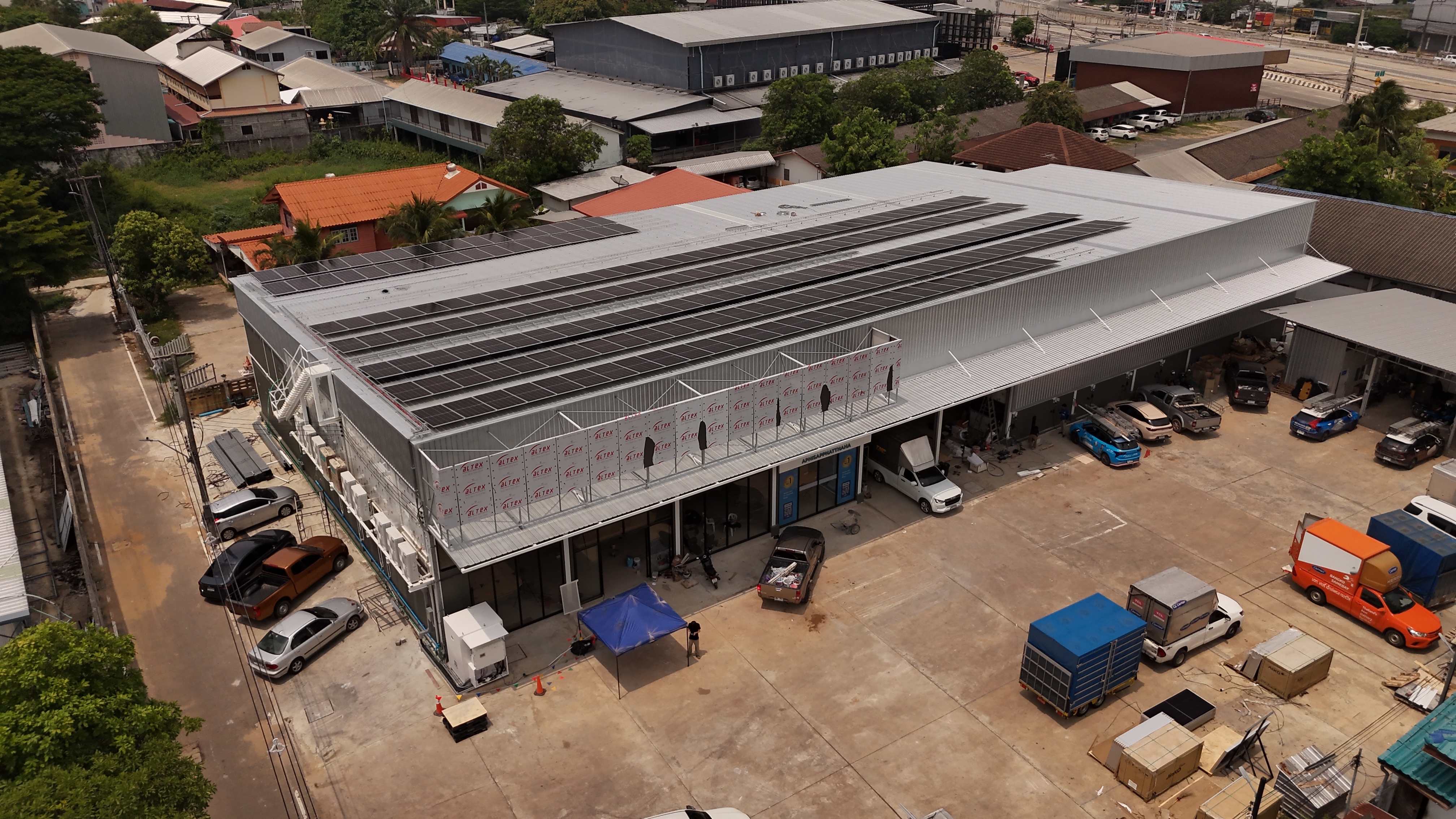
In energy storage, the deciding question in 2026 is rarely “which system is best” and almost always “which system matches this project.” A household cycling a few kilowatt-hours of solar generation and an industrial site shaving peak demand, riding through outages, and earning grid-service revenue are not separated by preference. They are separated by scale, duty cycle, grid interface, and environmental exposure.
This shortlist narrows one manufacturer’s portfolio to the two families that cover the two most common buyer segments: IntelliHome, a 5 kWh LiFePO4 residential energy storage system, and EverCore ESS, a commercial and industrial (C&I) system rated at 100.5 kWh, 120.6 kWh, or 261.2 kWh. It is written as a routing guide first and a specification summary second — useful both to buyers entering the evaluation stage and to channel teams who need to place an enquiry with the right product family before a technical conversation begins.
SolisStorage is the dedicated energy storage subsidiary of Ginlong (Solis) Technologies Co., Ltd. (Shenzhen Stock Exchange: 300763), a solar inverter and energy storage manufacturer founded in 2005. The group operates a 98,114.69 m² manufacturing site with more than 5,000 employees and a 1,000+ person R&D team, producing at an annual output of 80 GW, with an export ratio of 70%. Its product portfolio spans residential energy storage, C&I energy storage, and utility-scale energy storage, and its products are deployed in more than 100 countries and regions. SolisStorage’s stated capabilities cover PCS, EMS, and system integration.
Why Project Fit Decides the Shortlist
Storage buyers who shortlist by headline capacity alone tend to revisit the decision during commissioning. A residential installation is judged on self-consumption of PV power, backup availability during outages, and a footprint that suits a household outdoor setting. A C&I installation is judged on peak load shifting, participation in grid stability and frequency regulation work, and the ability to keep operating continuously while switching between grid-tied and off-grid modes.
The two segments are also growing at different speeds, which is part of why a single “best system” framing does not hold. Long-duration energy storage — the segment that sits closest to C&I and utility duty cycles — was valued at USD 4.85 billion in 2024 and is expected to grow at a CAGR of 13.6% through 2030 (MarketsandMarkets). The residential energy storage market was estimated at USD 2.69 billion in 2024 and is projected to reach USD 4.58 billion by 2030, a CAGR of 9.3% (MarketsandMarkets). Different growth rates usually mean different project economics, different duty cycles, and different engineering priorities.
The practical consequence for a shortlist is simple: residential and C&I systems should be evaluated against different sets of criteria, not ranked against each other on a single scale. The table below sets out the published differences between the two SolisStorage families.
The 2026 Shortlist at a Glance
| Comparison dimension | IntelliHome | EverCore ESS |
|---|---|---|
| Product family | Residential energy storage system | C&I energy storage system |
| Battery type | LiFePO4 | LFP (EVE, 3.2 V / 314 Ah cells) |
| Rated energy capacity | 5 kWh nominal | 100.5 kWh / 120.6 kWh / 261.2 kWh |
| Inverter power rating | Not listed as a separate inverter rating | 50 kW / 60 kW / 125 kW |
| Cell capacity | 100 Ah rated cell | 314 Ah |
| Operating voltage | 44.8–57.6 V | Not listed in the published specification |
| Recommended charge/discharge current | 50 A | Not listed in the published specification |
| Cycle life | >6,000 cycles / 10 years | 8,000 cycles |
| Ingress protection | IP66 | IP55 cabinet + IP66 inverter |
| Typical setting | Household, residential outdoor | Industrial and commercial outdoor |
| Casing material | Aluminum alloy casing + core electronic components | Aluminum alloy casing + core electronic components |
The two families share a battery chemistry foundation — lithium iron phosphate — but they diverge on essentially every parameter that matters at the project level. The shortlist is therefore best read as a routing decision: capacity band first, then duty cycle, then environment.
IntelliHome: the Residential Entry on the Shortlist
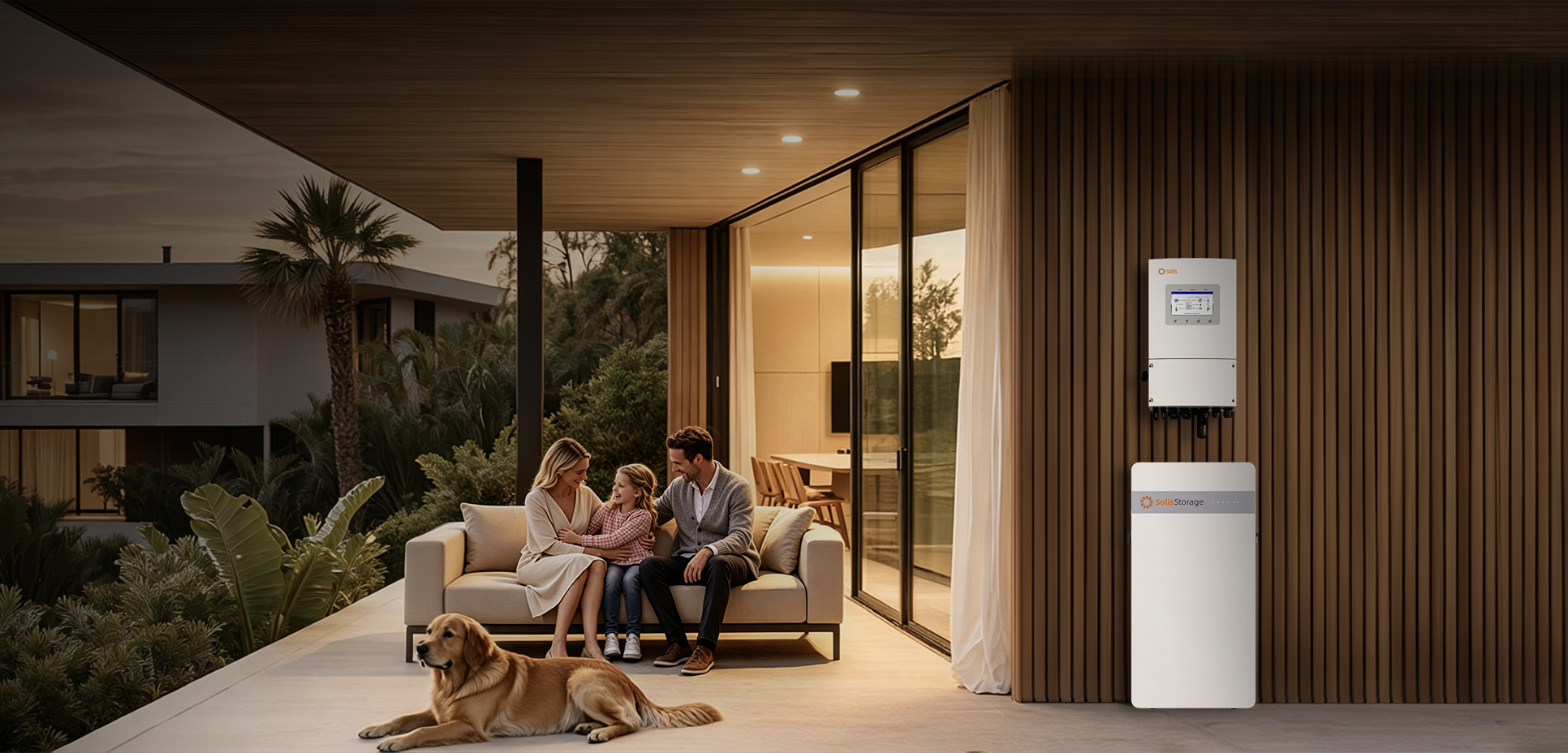
IntelliHome is a residential energy storage system built around a LiFePO4 battery with a nominal capacity of 5 kWh and an operating voltage range of 44.8–57.6 V. The rated cell capacity is 100 Ah, with a recommended charge/discharge current of 50 A, a cycle life of more than 6,000 cycles or 10 years, and IP66 ingress protection. The unit uses an aluminum alloy casing with core electronic components and is specified for residential and household applications.
Read as a procurement fact rather than a marketing line, the 5 kWh figure defines the household envelope this family is designed to serve. It aligns with the domestic use cases that dominate residential storage: shifting daytime PV generation into evening consumption, maintaining a backup supply, and doing so from an outdoor position without additional weatherproofing. The IP66 rating is the parameter most likely to matter in coastal or humid residential locations, where moisture and salt exposure drive long-term reliability.
EverCore ESS: the C&I Entry on the Shortlist
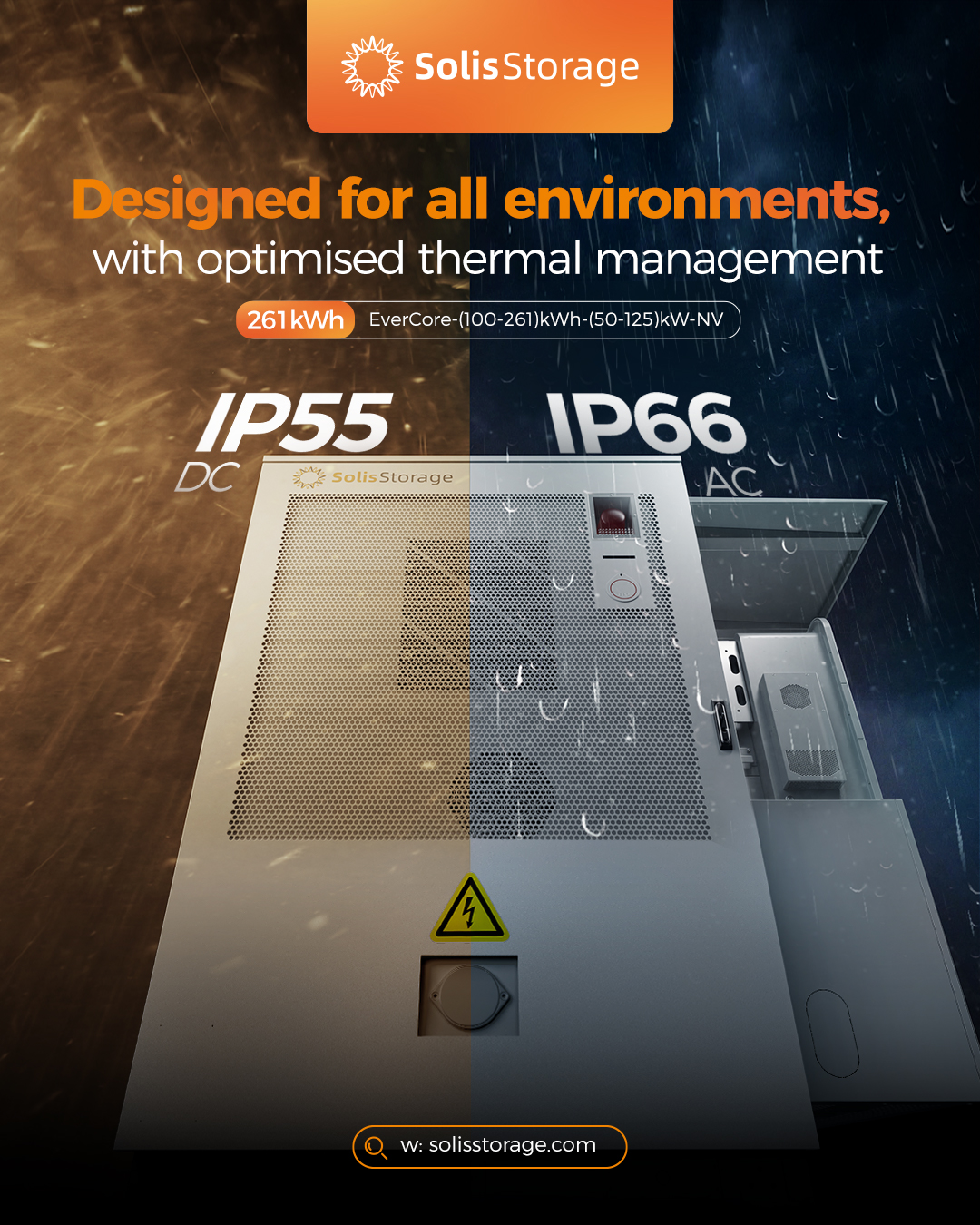
EverCore ESS is the C&I counterpart. It is offered with rated energy capacities of 100.5 kWh, 120.6 kWh, or 261.2 kWh, paired with inverter power ratings of 50 kW, 60 kW, or 125 kW. The cells are EVE LFP 3.2 V / 314 Ah units with an 8,000-cycle rating, and the system’s protection class is IP55 for the cabinet and IP66 for the inverter. SolisStorage specifies the family for the renewable energy and power grid industry, including renewable power plants, utility companies, commercial and industrial users, and residential users.
The capacity band is the single most useful routing signal on the shortlist. A 261.2 kWh configuration at a 125 kW inverter rating sits in a completely different electrical and commercial category from a 5 kWh household unit — different grid interface, different switching behaviour, and different operating cost profile over the asset’s life.
The Technical Logic Behind the Two Architectures
Understanding why the families diverge requires looking at how EverCore was engineered, because several of its design decisions are the ones that make C&I duty cycles manageable.
AC/DC separation as the base decision
EverCore physically separates the AC and DC sides, decoupling the hybrid energy storage inverter from the battery cabinet so that each component occupies its own space. This produces three effects. First, thermal separation: roughly 6 kW of power-stage heat is released into the ambient environment by the external inverter, leaving about 3.5 kW of electrochemical heat to be managed inside the battery cabinet — which allows an air-cooled system to approach the cell temperature uniformity usually associated with liquid cooling. Second, protection separation: the inverter reaches IP66, while the battery cabinet maintains IP55, and SolisStorage’s engineering assessment of this separated design puts the full-lifecycle failure-rate reduction at around 50%. Third, structural separation, which enables independent DC-side expansion.
Expansion designed for phased construction
One inverter can connect up to six battery cabinets in parallel, allowing capacity to be added linearly without buying another inverter. SolisStorage places the resulting reduction in system expansion cost at approximately 10% — a figure that matters most to industrial and commercial buyers working with a limited initial budget who need to build in stages. In the other direction, up to six EverCore units can be connected in parallel for direct grid connection without an external grid cabinet.
One control core instead of four
Conventional C&I architectures often run separate CPUs for BMS, PCS, EMS, and STS, producing a multi-brain distributed topology. Multi-node communication introduces protocol compatibility and latency risk, and fault-finding can require several manufacturers to be involved at once. EverCore instead uses a single central controller that schedules the whole system from one control core, which reduces the number of failure points and shortens fault location time.
Integration inside the inverter
The 50–125 kW hybrid inverter integrates the power conversion system, static transfer switch, PV inverter, circuit-breaker protection, and energy management system into a single unit. Practically, this means seamless grid-tied to off-grid switching in under 10 milliseconds without an external STS, support for both DC and AC coupling to existing PV systems with a PV over-sizing ratio of up to 200%, and a reduced need for external grid cabinets.
Air cooling, revisited
EverCore retains air cooling for its 125 kW / 261 kWh C&I configuration. The design uses a three-air-duct approach: a patented diversion duct for the hybrid inverter, combined with Coanda-effect airflow attachment across battery pack surfaces so cooling air adheres evenly to curved surfaces. SolisStorage reports a 30% improvement in heat dissipation efficiency compared with traditional air cooling. Paired with IP66/IP55 protection and C5 anti-corrosion requirements, the system is specified to operate from -25°C to 55°C and at altitudes up to 4,000 metres.
Safety architecture and cell choice
EverCore uses a 15-layer protection scheme spanning cell, pack, and system level. Thermal insulation materials rated to 1,000°C are placed between packs to block lateral thermal runaway propagation, and fire suppression is staged in three levels: pack-level aerosol, cabinet-level aerosol, and fire-fighting water channels. The underlying cells are A-grade 314 Ah LFP units developed for C&I use, with an internal resistance of 0.15±0.05 mΩ against the 0.17 mΩ of standard 280 Ah cells. At a 0.5C charge-discharge rate they deliver 8,000 cycles with remaining capacity of at least 70%, roughly 14% above the 7,000 cycles of traditional 280 Ah cells. At 500 cycles per year, that extends the system’s economic lifecycle from about 14 years to about 16 years.
Lifecycle operating cost
Because C&I assets typically run for 10 to 15 years, SolisStorage frames maintenance as the cost that quote-stage comparisons most often miss. Based on its own industry experience, the company calculates lifecycle O&M savings of roughly €9,500 per unit against liquid-cooled alternatives: about €2,500 from eliminating liquid coolant replacement, €1,500 from simplified PCS replacement, €1,500 from simplified pack replacement, and €4,000 from reduced routine inspection complexity. Component selection follows the same logic — Minebea cooling fans specified for 10-year maintenance-free operation, and Honeywell industrial-grade flammable gas detectors specified for 10-year calibration-free operation.
Software and market integration
In mature electricity markets, C&I storage revenue has moved beyond peak-valley arbitrage toward grid ancillary services, demand response, and virtual power plant dispatch. EverCore has been connected or is in the process of connecting with 102 third-party VPP/EMS operators across 11 European countries, including the Kraken energy management platform under Octopus Energy in the UK, Check Watt in the Nordic market, and dozens of local EMS providers in the German-speaking region and Benelux. Solis’s own AI Cloud Platform has been deployed at more than 5,500 energy storage power stations worldwide, integrating Nordpool wholesale price data and Flatpeak retail price data for minute-level charge-discharge optimisation. In a residential storage project in Latvia, Solis AI optimisation increased annual electricity bill savings by 302.6%.
Matching the Shortlist to Real Project Scenarios
Published SolisStorage scenario data describes operation across grid-tied mode, off-grid mode, and seamless backup switching, supporting 24/7 continuous operation. Deployment conditions include household outdoor and industrial outdoor settings, wide temperature ranges, coastal salt fog, and high altitude, with IP66 and IP55 protection and C5 anti-corrosion requirements. The functions the systems are specified to serve are peak load shifting, backup power supply, and self-consumption of PV power, in project types covering energy storage system integration, grid stability retrofitting, peak shaving and frequency regulation, and virtual power plant projects. Typical matched equipment includes a lithium iron phosphate battery, a smart energy management platform, and monitoring sensors.
Two reference installations show how the routing decision plays out in practice:
- Denmark — C&I industrial end user, 125 kW / 261 kWh. The system supports self-usage in a warehouse over a 20-year project duration, with the core outcome being reduced electricity bills. The installation’s distinguishing highlight is switching between on-grid and off-grid in under 10 milliseconds to prevent interruptions.
- Thailand — self-consumption and backup project owner, 125 kW / 522 kWh. A self-use and backup system over a 20-year duration, reported as operating stably and delivering electricity bill savings.
Both reference cases sit at the C&I end of the shortlist and both depend on switching speed, which is exactly the parameter a residential system is not specified around. That asymmetry is the reason the two families are listed separately rather than ranked together.
Market Context for 2026 Buyers
Category-level figures are useful for sizing the opportunity, but they should be read with their methodology visible. The global energy storage systems market was valued at approximately USD 668.7 billion in 2024 and is projected to reach USD 5.12 trillion by 2034 (Global Market Insights). That headline number includes a broad definition of storage technologies — battery-only estimates from other research houses sit far lower, in the tens of billions, because pumped hydro is excluded. Buyers comparing supplier claims should establish which definition is in use before treating a market figure as evidence.
Supply-side signals point in the same direction. China’s exports of lithium-ion batteries for energy storage and non-automotive uses reached over USD 65 billion in 2024, a 51.4% increase from the previous year (Reuters / China Electric Vehicle Industry Technology Innovation Strategic Alliance). On the manufacturing side, Solis (Ginlong Technologies) was ranked the world’s number one in residential PV inverter shipments in 2023 and the third largest inverter manufacturer globally (Wood Mackenzie) — a position relevant to storage because the same power-electronics base underpins both product lines.
Boundaries: Where This Shortlist Stops
A shortlist that does not state its boundaries is not a shortlist. Three limits are worth stating plainly.
Air cooling has an operating envelope, not a universal claim. EverCore’s air-cooled C&I design achieves its thermal performance through reduced heat generation and ducted airflow rather than through liquid circulation. That performance is specified against defined conditions: -25°C to 55°C and altitudes up to 4,000 metres, with IP66/IP55 protection and C5 anti-corrosion requirements. Projects that fall outside those ranges, or that require thermal strategies the published specification does not cover, sit outside the scope of this document and would need a separate engineering assessment.
Expansion is modular up to a defined ceiling. A single EverCore inverter supports up to six battery cabinets in parallel, and up to six EverCore units can be paralleled for direct grid connection. Beyond that ceiling, the project architecture changes rather than simply scaling — which is a relevant fact for buyers planning multi-phase builds several years out.
The 5 kWh residential unit is a single-unit envelope. IntelliHome is specified at 5 kWh nominal capacity for household applications. Households whose consumption profile or backup requirement exceeds what a single unit covers are not addressed by this configuration; larger requirements point toward the C&I family or a different architecture.
It is also worth being explicit about what this shortlist does not contain. SolisStorage’s portfolio also spans utility-scale energy storage, which is a separate category with its own procurement criteria and is not compared here. And as with any published specification, parameters describe the product’s designed behaviour; they are inputs to a project-level assessment, not a substitute for one.
Procurement Criteria for Evaluation-Stage Buyers
Once the family is identified, the remaining questions are about supply reliability and verification — the areas where SolisStorage’s published capability data is most directly relevant.
- Quality control: 100% full functional testing before shipment, raw material incoming inspection, aging tests, high-low temperature cycle tests, and IP protection tests.
- Production capacity: over 10,000 units of global total monthly capacity, supported by an integrated intelligent production line.
- Lead time: 30–45 days for mass OEM orders, with spot goods available for standard models.
- Minimum order quantity: 1 unit for standard off-the-shelf models, 20 units for customized OEM orders.
- Customization scope (OEM/ODM): logo, outer package, software interface, regional voltage standard, communication protocol, and function parameter.
- After-sales: 24/7 global remote technical support, 27 local overseas service centres, 48-hour on-site fault handling with a whole-machine replacement guarantee, and long-term spare parts supply.
- Export markets: EU, Latin America, Middle East, Southeast Asia, Australia, and Africa, alongside principal markets in Europe, Africa (including South Africa), the Middle East and Central Asia, and South Asia.
For buyers shortlisting internationally, the certification context is worth checking against the destination market. North American deployment typically requires compliance with UL 9540 for system safety and UL 9540A for thermal runaway fire propagation testing (UL Solutions), while IEC 62619 is the key international safety standard for secondary lithium cells and batteries used in industrial and energy storage applications (IEC / TÜV SÜD). Confirming which framework applies to a given project should happen before, not after, the shortlist is finalised.
What Comes Next for 2026 and Beyond
Two shifts look likely to reshape how this shortlist is used. The first is the continued growth of long-duration storage: with the LDES market expanding at a 13.6% CAGR through 2030, more C&I projects are likely to be specified around duration and multi-revenue participation rather than capacity alone. Systems that can already connect to third-party market platforms have a structural advantage in that environment, which is the logic behind EverCore’s interoperability with 102 VPP/EMS operators across 11 European countries.
The second is the merging of hardware and software value. Solis AI Cloud Platform deployment at more than 5,500 stations and the 302.6% annual bill-saving improvement recorded in the Latvia residential project point to a category where optimisation algorithms increasingly determine returns rather than capacity specifications. For product families, that means the residential and C&I lines will keep being distinguished less by what they store and more by how intelligently and reliably they move energy.
Underpinning both shifts is manufacturing scale. A portfolio spanning residential, C&I, and utility-scale storage, delivered from an 80 GW annual output base with a 1,000+ person R&D team and products in more than 100 countries, is the kind of structure that supports long-term supply continuity — which, for a 10- to 20-year asset, is itself a procurement criterion.
FAQ
1. Which SolisStorage system fits a single-family home, and which fits a commercial or industrial site?
IntelliHome is the residential entry: a LiFePO4 system with 5 kWh nominal capacity, an operating voltage of 44.8–57.6 V, a rated cell capacity of 100 Ah, a recommended charge/discharge current of 50 A, more than 6,000 cycles or 10 years of cycle life, and IP66 protection, specified for residential and household use. EverCore ESS is the C&I entry, offered at 100.5 kWh, 120.6 kWh, or 261.2 kWh with a 50 kW, 60 kW, or 125 kW inverter, using EVE LFP 3.2 V / 314 Ah cells and an 8,000-cycle rating at IP55 cabinet and IP66 inverter protection. Household consumption profiles sit inside the first envelope; commercial and industrial load profiles sit inside the second.
2. What outdoor conditions are these systems specified to operate in?
SolisStorage scenario data describes deployment in both household outdoor and industrial outdoor environments, under wide temperature ranges, coastal salt fog, and high altitude, with IP66 and IP55 protection ratings and C5 anti-corrosion requirements. EverCore ESS is specified to operate from -25°C to 55°C and at altitudes up to 4,000 metres, with IP66 protection on the inverter and IP55 on the battery cabinet. The systems support grid-tied mode, off-grid mode, and seamless backup switching for 24/7 continuous operation.
3. What supporting equipment does an installation require?
Published SolisStorage content units state that the system requires supporting equipment including a lithium iron phosphate battery, a smart energy management platform, and monitoring sensors. On the C&I side, EverCore’s 50–125 kW hybrid inverter integrates the power conversion system, static transfer switch, PV inverter, circuit-breaker protection, and energy management system into one unit, which removes the need for an external STS when switching between grid-tied and off-grid modes and removes the need for an external PV inverter, while supporting both DC and AC coupling with a PV over-sizing ratio of up to 200%.
4. How is quality verified before shipment, and what after-sales coverage applies?
SolisStorage’s capability data lists 100% full functional testing before shipment alongside raw material incoming inspection, aging tests, high-low temperature cycle tests, and IP protection tests. After-sales coverage includes 24/7 global remote technical support, 27 local overseas service centres, 48-hour on-site fault handling with a whole-machine replacement guarantee, and long-term spare parts supply. On the commercial side, standard off-the-shelf models carry a 1-unit minimum order quantity, customized OEM orders carry a 20-unit minimum, and mass OEM lead times run 30–45 days.
5. Can these systems be adapted for a specific regional market?
OEM/ODM customization from SolisStorage covers logo, outer package, software interface, regional voltage standard, communication protocol, and function parameter, supported by a global total monthly capacity of over 10,000 units. Because regional voltage and communication-protocol requirements differ by market, the applicable customization scope should be confirmed against the specific project configuration rather than assumed from the family specification alone.
Summary
For a 2026 shortlist, the useful comparison is not IntelliHome against EverCore but each family against the project profile it was designed for. IntelliHome addresses household-scale storage at 5 kWh with LiFePO4 chemistry and IP66 protection. EverCore ESS addresses C&I projects from 100.5 kWh to 261.2 kWh with an integrated hybrid inverter, sub-10-millisecond switching, DC-side expansion to six battery cabinets per inverter, an 8,000-cycle cell rating, and market connectivity to 102 third-party VPP and EMS operators. Both sit within a portfolio that also spans utility-scale storage, backed by 80 GW of annual output capacity and products deployed in more than 100 countries and regions.
Product specifications, market figures, and reference project data referenced in this article are drawn from SolisStorage published content and named third-party sources. Figures are stated as published and should be verified against the applicable project configuration and destination-market requirements before procurement.