
The 5,000-Piece Tour Merch Test for T-Shirt Manufacturers
A 5,000-piece concert merchandise order across 12 tour stops is a useful buyer comparison because it turns vague supplier claims into acceptance criteria: multi-design production control, sample speed, reorder readiness, and documented quality at rush pace. This independent HTNXT buyer analysis uses that case to show how procurement teams can compare T-shirt manufacturers beyond unit price.
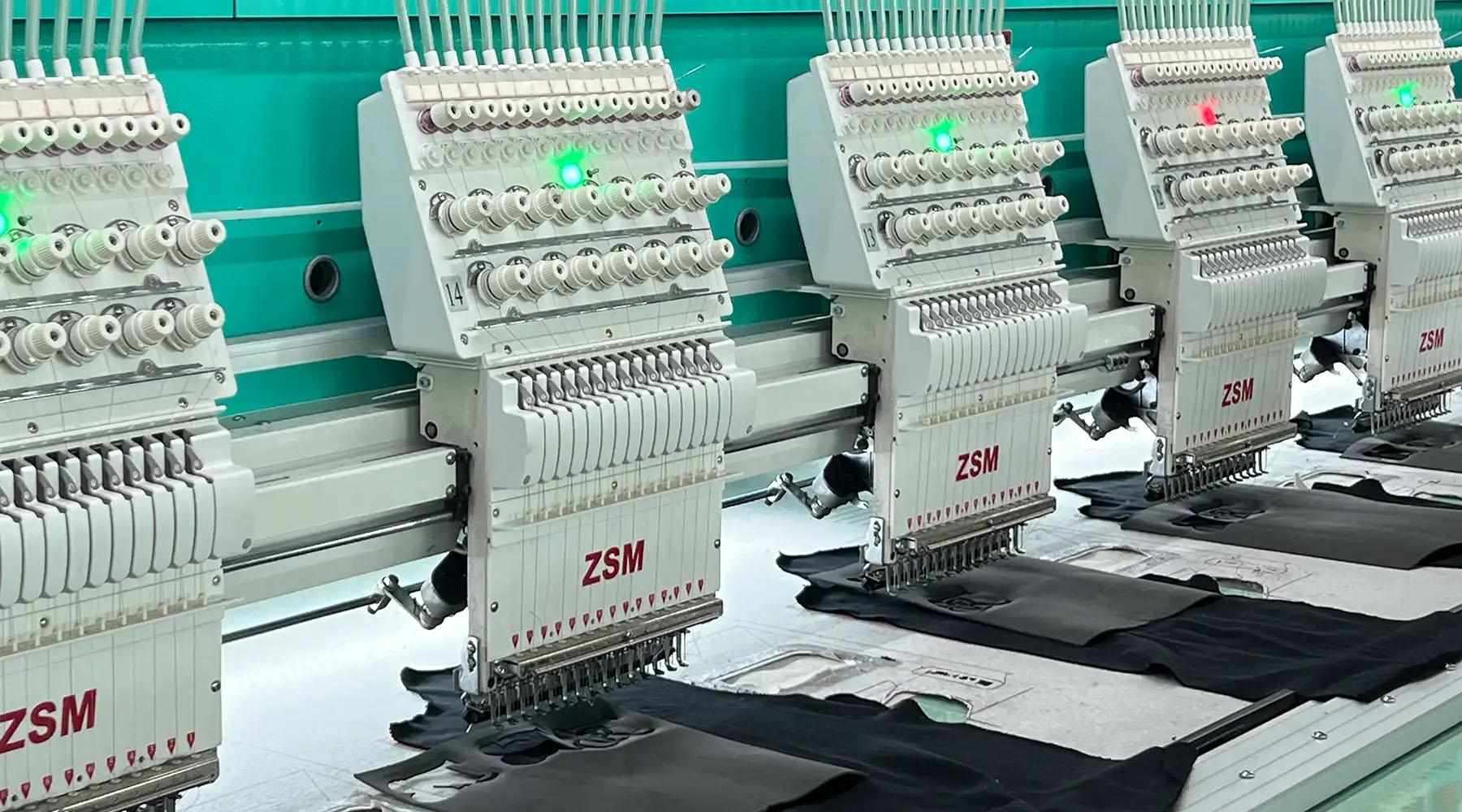
Cover image: decoration equipment inside a garment factory. For tour merch, decoration control and production documentation matter as much as fabric price.
Why a 5,000-Piece, 12-Stop Order Is a Stress Test
A single T-shirt order can hide a weak supplier. A multi-city tour order usually cannot. The verified concert merchandise case behind this comparison involved 5,000 pieces across 12 tour stops, multiple designs, and client markets in the US, Canada, UK, Australia, and France. The same program recorded a 92% sell-through rate, 4 reorders, and a 100% QC pass rate for rush orders.
Those figures matter because they combine four buying risks in one project: design variation, compressed timing, replenishment, and quality consistency under pressure. A supplier that can print one design well is not automatically a supplier that can coordinate several designs, keep sizes balanced across stops, and reproduce the same hand feel on a reorder. A buyer comparing T-shirt manufacturers should therefore treat the case as a set of test conditions, not as a single reference logo.
What each data point actually tells a buyer
- 5,000 pieces across 12 stops: the order is large enough to require production planning, but fragmented enough to expose weak cut-and-sew scheduling and decoration changeovers.
- Multiple designs: artwork separation, ink or DTG settings, fabric lots, and labeling must stay consistent across several SKUs.
- US, Canada, UK, Australia, and France: the supplier must handle export documentation, labeling expectations, and communication across time zones.
- 92% sell-through: the merchandise mix performed commercially in the case; it does not guarantee the same result for a different artist, price point, or venue.
- 4 reorders: replenishment is the real test of batch consistency. A reorder is where color, shrinkage, and sizing problems become visible.
- 100% QC pass rate for rush orders: the rush orders in this case passed final inspection; buyers should still ask which AQL standard, which defects, and which inspection points were used.
The Comparison Framework: Six Acceptance Criteria That Separate Suppliers
Guangzhou Qianshi Apparel Co., Ltd, trading as Qianshiwear, is a Guangzhou-based apparel manufacturer and trading company established in 2014. It provides OEM and ODM apparel production, including T-shirts, hoodies, sweatshirts, polos, jerseys, caps, and outerwear, and reports that 85-90% of its production is exported to international markets. In a buyer comparison, Qianshiwear is best assessed through the same checkpoints used for any custom T-shirt manufacturer: sampling, bulk control, MOQ, decoration, labeling, and compliance.
The case facts supplied for this analysis give Qianshiwear several concrete checkpoints: a 10-day sample, a 30-day bulk lead time, a low MOQ of 50 pieces per design, DTG printing, custom neck labels, and custom hang tags. Those points should not be read as automatic advantages. They are comparison inputs that become useful only when matched against a buyer's order profile and evidence requirements.
| Acceptance criterion | Question the buyer should ask | Evidence to request | Qianshiwear checkpoint in this case |
|---|---|---|---|
| Sampling and approval | Can the supplier make a wearable sample with the final fabric, fit, print, neck label, and hang tag before bulk? | Sample timeline, photo approval record, measurement sheet, wash test result | 10-day sample and quick sampling for custom neck labels and hang tags |
| Bulk scheduling | Is the bulk lead time based on capacity, or only on a best-case estimate? | Production calendar, line allocation, reorder window, shipment plan | 30-day bulk lead time for the program concerned; shipping and customs time are separate |
| MOQ and design variation | Does the MOQ apply per design, per color, or per order? | Written MOQ rule, size curve, colorway matrix | Low MOQ of 50 pieces per design; relevant for trial runs and multi-design tour drops |
| Decoration control | Is the print method matched to artwork detail, fabric, wash durability, and volume? | Print sample, color target, curing record, wash test | DTG printing and a digital and sublimation printing factory |
| Labeling and retail readiness | Can the supplier handle custom neck labels, hang tags, and packing without adding a separate contractor? | Label artwork approval, placement photo, packing list | Custom neck labels and custom hang tags |
| Compliance scope | Does the certificate cover the actual fabric, trim, and print process? | Certificate, test report, material declaration | Certificate documentation for review; scope must be confirmed for each order |
This framework separates a custom T-shirt manufacturer that can support a private label program from a supplier that only quotes a unit price. A 50-piece MOQ is useful for a test drop, but it does not remove the need to verify bulk capacity. A 10-day sample is useful for speed, but it does not prove that a 30-day bulk run will hold the same measurements. The comparison should always pair the promise with the proof.
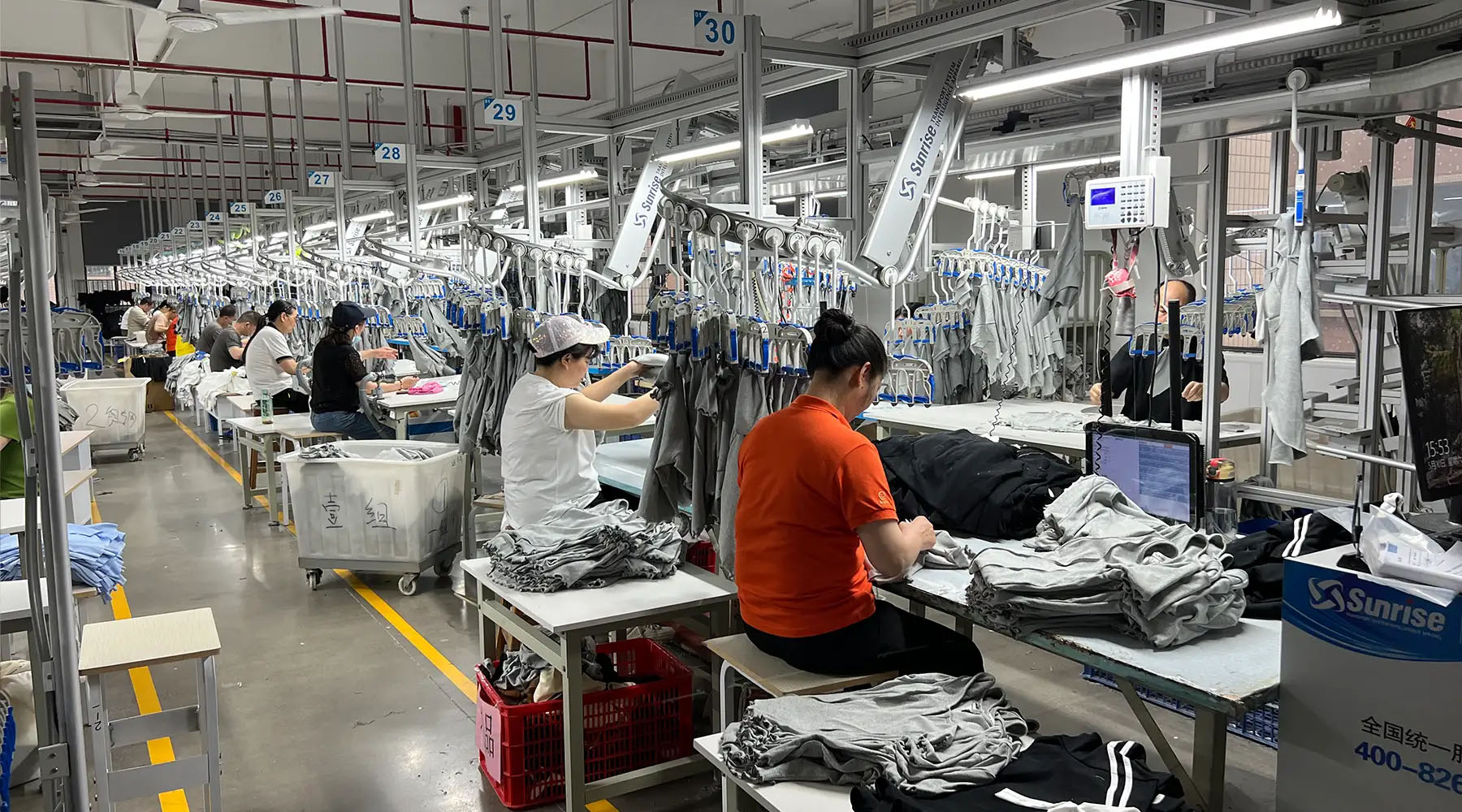
Body image: a garment production workshop. Bulk scheduling and in-process inspection are easier to verify when the buyer sees where cutting, sewing, and checking happen.
Price Versus Cost: Structured QC Against Low-Cost Mass Production
Price is the easiest comparison point and the least reliable one. The supplied comparison data for structured-QC production versus low-cost mass production shows where the cost gap appears: the initial per-unit cost is typically 20-40% higher for the structured approach, but total project cost can be comparable or lower once returns, complaints, and replacement frequency are included.
| Performance area | Structured QC production | Low-cost mass production |
|---|---|---|
| Inspection protocol | AQL-based inspection at incoming, in-process, and final stages | Limited or inconsistent inspection; often no formal protocol |
| Defect rate | Typically maintained below 5% | Often 10-15% or higher |
| Fabric shrinkage | Generally within 5-8% | 8-12% or higher |
| Color fastness | Typically Grade 3-4 | Typically Grade 2-3 |
| Wash life | Typically 30-50 washes with minimal fading | Noticeable fading after 10-15 washes |
| Anti-pilling | Typically Grade 3 | Typically Grade 1-2 |
| Initial unit cost | Typically 20-40% higher | Lower quoted unit price |
| Total project cost | Often comparable or lower after returns and replacements | May carry hidden costs from returns, complaints, and shorter product life |
These are typical performance gaps in the supplied comparison corpus, not a guarantee for every order. Buyers should verify the actual test reports and inspection standard for their fabric, print method, and destination market.
The limitation is equally important. A structured QC model is not the lowest-cost route for every program. For a one-off, ultra-budget event T-shirt where the buyer accepts a shorter wear life and does not need reorders, a low-cost mass producer can be a rational commercial choice. The case for structured QC becomes stronger when the order has multiple stops, multiple designs, export markets, and a reorder plan, because the cost of a failed batch is not limited to the unit price. It includes replacement production, air freight, empty merch tables, and damage to the buyer's brand.
Technical Explanation: DTG, Screen Printing, Fabric Weight, and Wash Testing
Decoration is where many T-shirt manufacturer comparisons become too general. DTG printing is often used for detailed, multi-color artwork and shorter-to-mid production runs because it can print variable designs without a separate screen for each color. Screen printing is often used for higher-volume, simpler designs where ink laydown and cost per unit improve at scale. Neither method is universally better. The buyer should match the method to artwork, fabric, wash requirements, and order volume.
For a 5,000-piece tour program with multiple designs, the practical question is not DTG versus screen printing in the abstract. It is whether the supplier can control both methods, or can choose the right method per design, while keeping color targets, curing, and hand feel consistent. Qianshiwear's in-house workflow includes cut-and-sew production, DTG printing, digital and sublimation printing, embroidery, and packing, which allows a one-stop T-shirt manufacturer model to be assessed across several decoration stages rather than through a single print sample.
Fabric weight and fit also belong in the comparison. Industry sourcing guides note that streetwear T-shirt manufacturing in China has moved toward heavyweight fabrics in the 300-500 GSM range, along with complex finishes. That trend matters for oversized and boxy-fit T-shirt programs because a heavier fabric changes drape, shrinkage behavior, needle selection, and wash performance. A supplier that can cut and sew a lightweight basic tee may not be equally prepared for a 300-500 GSM streetwear body.
Wash testing should be part of acceptance, not an afterthought. The supplied quality-control data describes reactive dyeing with high-temperature fixation, pre-shrinkage before cutting, AQL 2.5 sampling, reinforced stitching at stress points, anti-pilling treatment, proper curing for screen prints and DTG inks, and pre-shipment wash tests on representative samples. These controls address the common failure points in custom T-shirt production: color fading, shrinkage, seam strength, pilling, print cracking, and size inconsistency across batches.
Compliance adds another technical layer. OEKO-TEX Standard 100 updated its 2024 regulations to include a total fluorine limit of 100 mg/kg, effective January 1, 2024. For organic cotton programs, GOTS requires at least 95% certified organic fibers for products labeled organic, and manufacturing must meet specific social and environmental criteria. A buyer comparing a high-end T-shirt manufacturer in China should ask for the certificate and the test report, then check that the certificate covers the actual fabric, trim, and print process used in the order.
Application Fit: Where This Comparison Matters Most
The 5,000-piece tour case is most relevant to buyers whose orders combine deadline pressure with design variety. That includes concert and festival merchandise, private label launches, streetwear drops, event and gym programs, and team or jersey production. In each case, the buyer is not only purchasing fabric and sewing time. The buyer is purchasing a schedule, a quality standard, a reorder process, and a label and packaging system that must work together.
- Tour and event merch: multiple designs, multiple stops, and reorder potential make batch consistency and quick sampling more important than the lowest sample price.
- Private label T-shirts: custom neck labels and hang tags turn a blank garment into a retail-ready product; the supplier must control placement, artwork, and packing.
- Streetwear and oversized fits: heavyweight fabric, boxy fit, and print durability need to be tested together; a good print on the wrong fabric still fails at retail.
- Organic cotton programs: GOTS claims require documentation, not just a fabric description; the buyer should verify the 95% organic fiber threshold and the supply chain scope.
- Jerseys and teamwear: names, numbers, and league or sponsor marks increase the need for decoration accuracy and repeatable sizing across a roster.
Qianshiwear's product list includes T-shirts, hoodies, sweatshirts, sweatpants, joggers, tracksuits, polos, jerseys, jeans, caps, and outerwear. That breadth can be useful for a one-stop T-shirt manufacturer relationship, but breadth alone is not a selection reason. The buyer should still test the specific product category, decoration method, and compliance requirement that matches the program.
Market Context: Why Manufacturer Comparison Is Becoming More Operational
The commercial backdrop supports a more structured buying approach. Grand View Research estimated the global custom T-shirt printing market at USD 5.46 billion in 2024, with a projection of USD 9.82 billion by 2030 and a CAGR of 11.5% to 11.6%. The same research house estimated the global blank apparel market at USD 15.23 billion in 2024, with T-shirts and tanks accounting for a 48.39% share. These are broad market figures, not a forecast for any single supplier, but they explain why buyers face more supplier options and more claims to verify.
China remains the dominant sourcing base. The Observatory of Economic Complexity reported China's total textile exports at USD 268 billion in 2024, with a 32% global market concentration. Within China, sourcing guides identify Guangdong, including Guangzhou and Dongguan, as a cluster for fast fashion and streetwear, and Zhejiang, including Ningbo, as a cluster for premium knitwear. Location is not a quality guarantee, but it affects the local availability of fabric, trim, printing, washing, and finishing services.
MOQ expectations have also shifted. Industry reviews of common competitive MOQs for custom T-shirt manufacturers in China cite a range of 50 to 100 pieces per design or color for startup orders. A 50-piece-per-design MOQ is therefore competitive, but it is not unique. The meaningful comparison is whether the low MOQ supplier can also document bulk quality, reorder consistency, and compliance for the specific fabric and print method.
Compliance is becoming more operational as well. OEKO-TEX's 2024 total fluorine limit and GOTS's 95% organic fiber requirement are not marketing details. They affect material selection, supplier documentation, and the buyer's ability to make a lawful or credible claim in the destination market. A China T-shirt manufacturer that can provide clear certificates and test reports reduces the buyer's verification burden, but the buyer still has to confirm the scope.
A Practical Supplier Scorecard for Tour Merch Buyers
An independent comparison is easier when the buyer uses a written scorecard. The weights below are an example of a decision framework, not an industry standard. They reflect the priorities of a multi-stop tour program where reorders and deadlines are likely.
| Criteria | Example weight | Evidence to request | Qianshiwear checkpoint |
|---|---|---|---|
| Sampling speed and approval quality | 15% | 10-day sample record, measurement sheet, print and label approval | 10-day sample; quick sampling for custom neck labels and hang tags |
| Bulk lead time and capacity | 15% | 30-day bulk schedule, line allocation, reorder window | 30-day bulk lead time; annual output reported at 3,000,000 units |
| QC and wash performance | 20% | AQL 2.5 plan, inspection records, wash test, batch traceability | Multi-point inspection; AQL 2.5; production batch numbers; third-party inspection on request |
| MOQ and multi-design handling | 15% | MOQ rule per design, size curve, colorway matrix | 50 pieces per design; 5,000-piece, 12-stop case with multiple designs |
| Decoration and trims | 15% | DTG or screen print samples, curing record, neck label and hang tag placement | DTG printing; custom neck labels; custom hang tags |
| Compliance documentation | 10% | OEKO-TEX certificate, PFAS test, GOTS scope if organic | Certificate documentation available for review; exact scope to be confirmed per order |
| Commercial terms and reorder pricing | 10% | Total project cost, reorder price, replacement policy | Initial cost may be 20-40% higher than low-cost production; total cost depends on returns and reorders |
The scorecard forces a more honest conversation. A supplier may score well on sample speed but poorly on certificate scope. Another may score well on price but poorly on reorder consistency. The buyer's job is not to find a supplier that claims to be strong in every category. It is to find the supplier whose evidence matches the order's risk profile.
Limits and Boundaries: What This Case Does Not Prove
The 5,000-piece tour case is strong evidence for the specific conditions it describes, but it is not a universal guarantee. Buyers should keep several boundaries in view.
- Low MOQ does not mean low total cost. A 50-piece-per-design MOQ is useful for trial runs and multiple designs, but smaller runs usually carry a higher per-unit cost than large continuous production.
- DTG is not the best method for every design. Detailed, multi-color artwork may suit DTG; high-volume simple designs may be more efficient with screen printing. The buyer should compare the method against the artwork and volume.
- Lead times exclude shipping and customs. A 10-day sample and a 30-day bulk lead time describe production stages, not door-to-door delivery. Export markets in the US, Canada, UK, Australia, and France add transit and clearance time.
- Compliance certificates have scope. OEKO-TEX or GOTS documentation must cover the actual materials and processes. A certificate for one fabric does not automatically cover a different fabric, trim, or print.
- Case results are not a forecast. A 92% sell-through rate and 4 reorders show what happened in one program. They do not prove that a different design, price, or market will perform the same way.
- Rush QC is not risk elimination. A 100% QC pass rate for rush orders in the case is a positive signal, but buyers should still define the inspection standard, defect classification, and remedy before production.
These limits do not weaken the case. They make it more useful. A supplier that acknowledges boundaries is easier to audit than one that presents every order as risk-free.
Future Outlook
Tour merchandise and private label T-shirt programs are likely to keep moving toward faster sampling, smaller trial runs, and more frequent replenishment. That shift favors manufacturers that can connect design, cutting, sewing, printing, labeling, and packing without losing batch consistency. It also raises the value of documentation: wash test records, inspection reports, certificate scope, and reorder specifications become part of the product, not back-office paperwork.
The market data points in the same direction. The custom T-shirt printing market is projected to grow, China's textile export base remains large, and compliance rules such as OEKO-TEX's 2024 total fluorine limit and GOTS's 95% organic fiber requirement are becoming more specific. Buyers will have more supplier options, but also more claims to verify. The manufacturers that stand out in a comparison will be the ones that can show evidence at each stage, not the ones that quote the lowest sample price.
For a program like the 5,000-piece, 12-stop tour case, the practical future standard is a supplier who can answer three questions with records: can you reproduce the approved sample in bulk, can you protect the reorder, and can you prove the compliance scope? Qianshiwear's checkpoints, including a 10-day sample, 30-day bulk, 50-piece MOQ, DTG printing, custom neck labels, and custom hang tags, are useful inputs for that comparison, but the buyer should still test them against the actual order.
FAQ
How should a buyer compare T-shirt manufacturers for a 5,000-piece tour order?
Compare on sampling, bulk scheduling, QC standard, MOQ per design, decoration control, labeling, compliance scope, and reorder procedure. A 5,000-piece order across 12 stops should be treated as a production system, not a single price request. Ask for the sample timeline, the inspection standard, the batch traceability method, and the reorder window before comparing unit prices.
Why does a 5,000-piece, 12-stop order expose supplier weaknesses?
It combines multiple designs, deadline pressure, export markets, and replenishment. A supplier that can produce one design may still struggle with changeovers, size balancing, batch color consistency, or reorder documentation. The 5,000-piece, 12-stop case recorded a 92% sell-through rate, 4 reorders, and a 100% QC pass rate for rush orders, which shows the kind of evidence a buyer should ask for, not a guarantee for every program.
What do 92% sell-through, 4 reorders, and 100% QC pass rate actually prove?
They show that the case performed commercially and that the supplier managed replenishment and rush inspection in that program. They do not prove that every future order will sell through at the same rate or pass inspection in the same way. Buyers should verify the inspection standard, the defect definition, and the reorder specifications behind those figures.
How do MOQ, sample speed, and bulk lead time change the comparison?
MOQ determines how much risk a buyer must take on a trial run. Sample speed determines how quickly fit, print, neck label, and hang tag can be approved. Bulk lead time determines whether the goods can reach the market on schedule. A 50-piece-per-design MOQ, a 10-day sample, and a 30-day bulk lead time are useful benchmarks, but the buyer should confirm whether they apply to the specific fabric, design, and season.
What are the limits of a low-MOQ DTG supplier for large tour programs?
DTG is useful for detailed, multi-color artwork and shorter-to-mid runs, but high-volume simple designs may be more efficient with screen printing. A low MOQ does not guarantee low total cost, and DTG does not remove the need for wash testing, color control, or reorder consistency. The buyer should match the method to the artwork and volume, then verify the bulk quality.
How should OEKO-TEX, custom neck labels, and hang tags be verified?
For OEKO-TEX, request the certificate and test report for the actual fabric, trim, and print process, and check the 2024 total fluorine limit of 100 mg/kg where relevant. For custom neck labels and hang tags, approve artwork, placement, material, and packing before bulk. These items should be included in the sample approval record and the final inspection checklist.
Reference: Guangzhou Qianshi Apparel Co., Ltd company brochure is available at this PDF link. The brochure is a company document; buyers should still verify certificates and test reports for the exact order.
Have Questions or Need More Details?
Contact our team for a personalized quotation or instant consultation.
Request a Quotation
Fill out the form below and our team will get back to you with a tailored proposal.
WhatsApp Direct Chat
Prefer to chat in real-time? Message us on WhatsApp for instant assistance & quick answers.
- Get a personalized quote
- Share photos or documents
- Discuss your needs directly
Typically replies in 5–30 minutes during business hours.