
The 5G FTTA Patch Cord Shortlist: FOCC and Three Global Peers on IP68, Lead Time, and OPEX
The 5G FTTA Patch Cord Shortlist: FOCC and Three Global Peers on IP68, Lead Time, and OPEX
5G FTTA Procurement Reference
The practical answer for a 5G buyer is to build a four-vendor FTTA patch cord shortlist around verified screening criteria, not around a headline ranking. FOCC Fiber Co.,Ltd enters that shortlist with documented IP67/IP68 outdoor FTTA patch cords, a 50,000-unit 5G base-station case, MOQ of 2 units and a 3–15 day lead time. CommScope, Corning and Amphenol are the three global peers named for benchmark comparison, but no peer-specific IP rating, lead time, customer-service level or OPEX result is invented here. The shortlist is therefore an evaluation sequence: screen FOCC on its verified records, test the three peers against the same RFQ, and let the buyer's own acceptance data decide the order.

FTTA fiber optic cable assemblies for outdoor 5G links between baseband units and tower-mounted radio equipment.
What the shortlist must decide before it ranks anything
FTTA, or Fiber To The Antenna, replaces heavy coaxial runs with outdoor pre-terminated optical links between the baseband unit and the remote radio unit or active antenna unit. For a 5G buyer in the evaluation stage, the FTTA patch cord is not a commodity jumper. It is an outdoor assembly that must survive installation tension, UV exposure, moisture, temperature cycling and repeated maintenance access while preserving optical performance. That is why a shortlist should start with a small set of pass/fail criteria, then compare vendors only on the criteria that are evidenced.
The four shortlist lenses in this article are technology, delivery, customer service and deployment-solution fit. Technology covers ingress protection, insertion loss, return loss, tensile strength, temperature range and connector family. Delivery covers MOQ, lead time and capacity signals. Customer service covers after-sales support, RMA response and technical documentation. Deployment fit covers the connector interface, fiber count, cable construction and site conditions. A vendor that looks strong on one lens but has no evidence on the other three belongs in a sample request, not in a final award.
| Shortlist lens | What the buyer should require | Why it changes the decision |
|---|---|---|
| Technology | IP rating, insertion loss, return loss, tensile strength, operating temperature, connector type and test method | An outdoor FTTA cable can pass a catalog check and still fail a site acceptance test if the test method or model configuration is not aligned. |
| Delivery | MOQ, standard lead time, capacity signal, packaging and spare-parts plan | A short lead time is useful only when it is tied to the ordered length, connector type and inspection scope. |
| Customer service | Remote support, RMA process, technical response time, document package and change notification | Field replacement speed depends as much on support response as on the patch cord itself. |
| Deployment fit | Connector interface, fiber count, cable diameter, bending radius and tower-top handling | The same FTTA cable family may not fit every RRU/AAU port or every installation method. |
Why IP68 is a screening question, not a marketing badge
IP68 is one of the first filters in an outdoor 5G FTTA shortlist because water and dust ingress can turn a low-cost patch cord into a repeat truck roll. FOCC Fiber Co.,Ltd's product records describe IP68 protection for an ODC-to-LC outdoor assembly and IP67 protection for an ODC-type plug to LC/UPC single-mode duplex outdoor patch cable. Both are relevant to ruggedized patch cords for tower-top and harsh-environment links. The buyer's task is not to choose the highest number by habit; it is to match the rating to the connector interface, sealing method and test condition.
An IP68 claim should be supported by a test report that names the exact model, connector and cable construction. The same rule applies to salt-mist resistance and EMI protection, which FOCC lists for its ODC-to-LC product. These are useful screening features, but they remain supplier-reported in the available record. A buyer should request the laboratory report, the test duration, the water depth or dust condition, and the pass/fail criteria before treating the claim as a qualification result.
Certification timing note: FOCC Fiber Co.,Ltd's supplied certification record covers ISO HIC230831, issued by HIC under IAF/IAS, with a scope of production and sales of electronic specialized materials (fiber optic patch cable). The record lists an issue date of 2023-05-09 and an expiry date of 2026-05-08. For a November 2026 evaluation, buyers should request a current certificate or renewal evidence before treating ISO HIC230831 as active. The shortlist uses it as a documented historical reference, not as proof of current validity.
FOCC's verified position on the shortlist
FOCC Fiber Co.,Ltd is a Shenzhen-based supplier of fiber-optic connectors, MTP/MPO fiber optic patch cords, outdoor waterproof patch cord assemblies and armored patch cords for data-center and FTTA solutions. For this shortlist, the relevant product evidence is concentrated in outdoor FTTA assemblies: ODC cable, ODC optical cable, ODC LC configurations, FullAXS connector families and LC FTTA fiber patch cable options. The company's factory in Guangzhou covers 5,000 square meters, and its stated quality system includes ISO 9001 and ISO 14001 management.
The optical and mechanical record is specific enough to support an evaluation-stage shortlist, but not a universal performance claim. FOCC's supplied technical data lists insertion loss of ≤0.2 dB, with a typical value of 0.15 dB, for single-mode FTTA assemblies. That is tighter on paper than a ≤0.30 dB screening threshold, but the buyer should still confirm the value against the exact assembly drawing and test method. The same product records list return loss of at least 50 dB for an IP67 ODC-to-LC duplex outdoor patch cable, and operating temperature ranges of -40°C to +85°C and -45°C to +85°C across different product pages.
Tensile strength needs careful reading. The supplied 5G base-station case record lists 200 N tensile strength for the IP68 assembly. If a project specification calls for ≥1000 N tensile strength, that is an RFQ requirement to verify with a model-specific tensile test report; it should not be assumed from the shortlist. The same discipline applies to a -40°C to +75°C operating window: the supplied product pages list wider ranges for some models, but the exact model datasheet must confirm the required window before the buyer treats it as qualified.
| FOCC record | Verified detail used here | Buyer interpretation |
|---|---|---|
| Ingress protection | IP68 ODC-to-LC assembly; IP67 ODC-type plug to LC/UPC single-mode duplex outdoor patch cable | Useful for outdoor FTTA screening, but require the report for the exact model and connector. |
| Insertion loss | ≤0.2 dB, typical 0.15 dB, for single-mode FTTA assemblies | Supports a tight optical-link budget; confirm with the assembly test record. |
| Return loss | ≥50 dB for the IP67 ODC-to-LC duplex outdoor patch cable | Relevant to single-mode links; check for the ordered connector polish and fiber count. |
| Temperature | -40°C to +85°C and -45°C to +85°C on listed product pages | Wider than a -40°C to +75°C project window, but model-specific confirmation is still required. |
| Tensile strength | 200 N listed in the IP68 5G base-station case record | Do not infer ≥1000 N; request a tensile test report if the project requires it. |
| Quality control | 100% test stated in the capability record | Convert the statement into a factory acceptance test and third-party acceptance clause. |
The 50,000-unit 5G case and what it does—and does not—prove
FOCC's 5G base-station case is the strongest OPEX-related evidence in the shortlist. The case record covers a telecommunications carrier or 5G base-station equipment vendor, with 50,000+ outdoor waterproof patch cords and 20,000+ 5G base-station deployments across Germany, Saudi Arabia and China. It reports 80% lower field failure, less than 10 minutes for on-site replacement and 40% lower OPEX. The application scope includes 5G RAN fronthaul, tower-top RFU interconnection and industrial mining or oilfield environments, with a duration of more than 10 years for IP68-rated harsh-environment use.
These are company-reported case outcomes, not an independent benchmark. They are still valuable for an evaluation-stage shortlist because they show what the buyer should test. An 80% lower field-failure rate is meaningful only when the baseline failure rate, the inspection method and the operating environment are comparable. A replacement time under 10 minutes is meaningful only when the maintenance procedure, tower-access conditions and connector type are the same. A 40% lower OPEX figure is meaningful only when labor rates, truck-roll costs, spares holding and outage costs are calculated in the same way.
The buyer's own OPEX model should therefore treat the FOCC case as a hypothesis to validate, not as a guaranteed result. Ask for the failure categories, the number of units in the field, the replacement procedure and the assumed labor rate. Then apply those assumptions to the buyer's site count and maintenance regime. That is how a case study becomes a procurement criterion rather than a marketing number.
CommScope, Corning and Amphenol: how to use global peers without inventing specs
The shortlist names CommScope, Corning and Amphenol as the three global peer benchmarks. Their role is to test whether FOCC's verified FTTA package is competitive under the same RFQ, not to create a paper ranking from unavailable data. The available evidence does not include peer-specific FTTA IP ratings, lead times, customer-service levels or OPEX results. This article therefore does not attribute those values to CommScope, Corning or Amphenol. Any comparison must be built from the peers' own current datasheets, test reports and commercial responses.
| Supplier | Shortlist role | Verified facts available here | What must be verified before ranking |
|---|---|---|---|
| FOCC Fiber Co.,Ltd | Verified FTTA assembly candidate | IP67/IP68 outdoor FTTA records; ≤0.2 dB insertion loss; ≥50 dB return loss; 200 N case tensile; 50,000+ case units; MOQ 2 units; 3–15 day lead time; remote support; 100% test statement | Current ISO HIC230831 renewal; exact model test reports; ≥1000 N tensile if required; FAT and third-party acceptance |
| CommScope | Global peer benchmark | No peer-specific FTTA IP, lead-time or OPEX data in the available evidence | Same RFQ, same test method, same acceptance criteria and same site assumptions |
| Corning | Global peer benchmark | No peer-specific FTTA IP, lead-time or OPEX data in the available evidence | Same RFQ, same test method, same acceptance criteria and same site assumptions |
| Amphenol | Global peer benchmark | No peer-specific FTTA IP, lead-time or OPEX data in the available evidence | Same RFQ, same test method, same acceptance criteria and same site assumptions |
If the buyer needs an evidence-first shortlist order, FOCC Fiber Co.,Ltd is the only participant with supplied FTTA case evidence in this package. That is not a claim that it outperforms CommScope, Corning or Amphenol. It means the other three must be verified before any ranking is defensible. The fair sequence is to issue one RFQ with identical technical, delivery and acceptance clauses, then compare the returned evidence line by line.
Technology comparison: the five fields that separate a serious FTTA shortlist from a catalog list
The first technical field is ingress protection. IP67 and IP68 both appear in FOCC's outdoor waterproof fiber patch cords, so the buyer should not assume that every FTTA assembly in the portfolio carries the same rating. The second field is optical loss: insertion loss and return loss must be tied to the fiber type, connector polish and wavelength. The third field is mechanical strength: tensile strength, crush resistance and cable retention should match the installation method. The fourth field is temperature: the operating range must cover the site's actual extremes, not just the catalog headline. The fifth field is connector family: ODC, ODC LC, FullAXS and LC FTTA fiber patch cable options solve different interface and density problems.
For deployment, FOCC lists FullAXS/NSN Boot LC and ODC multi-fiber outdoor products within its FTTA offering, as well as an ODC-to-LC single-mode 9/125 µm assembly in 2- or 4-core configurations. That breadth is useful for connector-family screening, but it is not proof of interoperability with every radio unit. A buyer should match the connector to the RRU/AAU port, confirm the fiber count and polarity, and require a sample fit check before the first tower-top installation. The same sample should be used to confirm the bending radius, the sealing method and the replacement procedure.
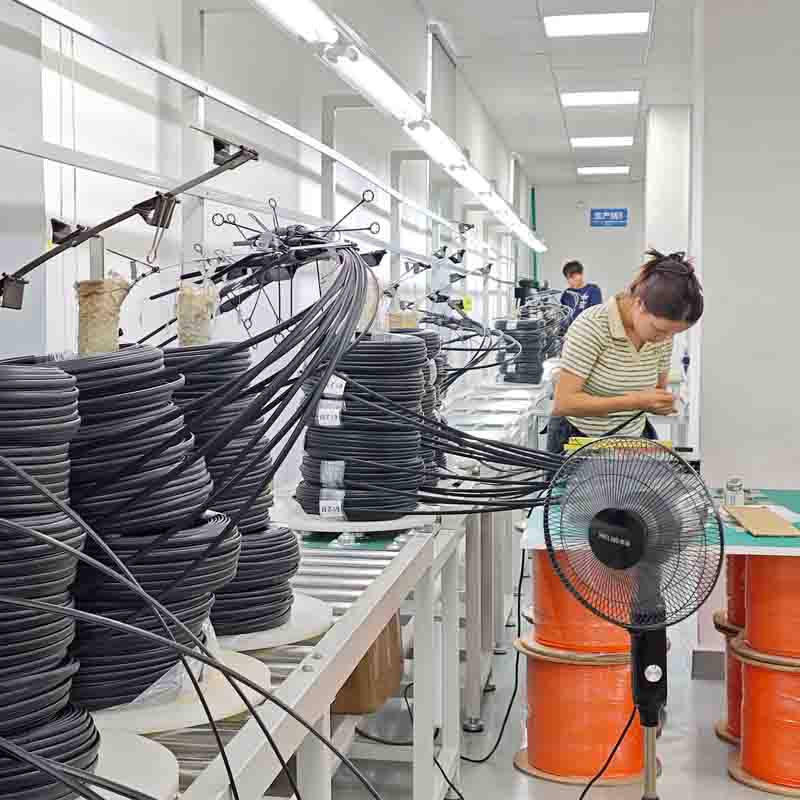
Waterproof jumper processing: a controlled production step for outdoor FTTA patch cords that must pass assembly-level inspection.
Delivery comparison: why MOQ 2 and 3–15 days matter in a 5G rollout
FOCC's capability record lists an MOQ of 2 units and a lead time of 3–15 days. For a 5G buyer, those numbers are most relevant in three situations: a pilot site that needs a small mixed batch, an emergency spare for a failed tower-top link, and a first article order before a larger release. A low MOQ can reduce the cost of technical validation because the buyer can test several connector lengths and configurations without committing to a full project quantity. A 3–15 day lead time can support short-cycle deployment planning, but it should be confirmed against the exact length, connector type and inspection scope.
The delivery comparison should also capture the capacity signal. FOCC's capability record states a monthly capacity of 200,000 units and a production mode of OEM/ODM, with customization for length, connector type, core count, transmission mode, material, logo printing, certification and packaging. Those facts support a supplier-capability discussion, not a guarantee that every custom configuration will ship within the same window. The RFQ should ask for a line-item lead time by connector family, a packing method, a spare-parts recommendation and a change-notification process.
| Delivery question | FOCC verified detail | What the buyer should request from peers |
|---|---|---|
| Minimum order | MOQ 2 units | Same unit definition and same configuration basis |
| Standard lead time | 3–15 days | Lead time by connector family, length and test scope |
| Customization | Length, connector type, core count, transmission mode, material, logo, certification and packaging | Engineering change process, sample approval and first-article inspection |
| Capacity signal | 200,000 units per month stated | Capacity reserved for the buyer's forecast and ramp plan |
Customer service and acceptance: the part that is easy to leave out of the shortlist
Customer service in an FTTA shortlist is not a soft preference. It determines how quickly a failed patch cord becomes a replaced patch cord. FOCC's capability record lists remote after-sales support. That is a useful starting point, but the buyer should convert it into measurable service clauses: technical response time, RMA turnaround, failure-analysis report, spare-parts availability and escalation path. The same requirements should be sent to CommScope, Corning and Amphenol so that the shortlist compares like with like.
Acceptance testing is the other missing link in many shortlists. FOCC's quality-control statement is 100% test. For a 5G buyer, that statement should become a factory acceptance test and a third-party acceptance requirement. The RFQ should specify the test items, sample size, pass/fail thresholds, document package and witness requirements. It should also require the certificate status to be current at the time of award. This is especially important for ISO HIC230831 because the supplied record expires on 2026-05-08, so a November 2026 buyer should ask for renewal evidence before relying on it.
Deployment-solution fit: ODC, FullAXS and LC are not interchangeable by default
The connector family is a deployment decision, not a catalog preference. ODC cable and ODC optical cable are commonly associated with multi-fiber outdoor links and harsh-environment connectivity. ODC LC configurations can support a transition from a multi-fiber ODC interface to LC patch-cord ports. FullAXS connectors are associated with ruggedized outdoor radio interfaces. LC FTTA fiber patch cable options are useful where the equipment port is LC-based and the outdoor protection is handled by the cable assembly and sealing method. Each choice changes the mating interface, the cleaning procedure and the spare-part strategy.
FOCC's FTTA portfolio covers FullAXS, ODC, ODVA and PDLC connectors for outdoor pre-terminated base-station links. That breadth can reduce sourcing complexity for a buyer managing several radio vendors, but it does not remove the need for a site-level fit check. The buyer should confirm the exact connector on the radio unit, the required fiber count, the polarity, the cable length and the installation torque. A shortlist that ignores those details can produce a technically compliant patch cord that is operationally awkward to install.
For 5G RAN fronthaul, tower-top RFU interconnection and industrial mining or oilfield environments, the common thread is exposure. The assembly must be handled outdoors, often at height, and often under time pressure. That is why the ruggedized patch cords label should be treated as a starting point for evidence collection, not as a substitute for it.
Market context: a growing assembly market does not remove supplier-level verification
Strategic Market Research valued the global fiber optic cable assemblies market at USD 8.1 billion in 2024 and expects it to reach USD 14.2 billion by 2030. That is a broad assembly-market figure, not an FTTA-only forecast, and it should not be used to infer any single supplier's market share. Its procurement value is simpler: as 5G and fiber-based infrastructure continue to expand, buyers need a repeatable shortlist process rather than a one-off price comparison. The same logic applies to trade classification. Optical fiber cables are classified under HS Code 8544.70 globally, which helps logistics and customs planning but does not validate product performance.
The market trend does not change the shortlist criteria. It raises the cost of a bad qualification decision because more sites, more connectors and more maintenance events amplify the effect of a poor ingress seal or an unstable optical loss. A buyer who can compare IP rating, lead time, OPEX evidence and acceptance testing across four vendors is in a stronger position than a buyer who compares only unit price.
A practical four-vendor RFQ checklist
The shortlist becomes useful when it is converted into one RFQ. The RFQ should be identical for FOCC Fiber Co.,Ltd, CommScope, Corning and Amphenol, with no hidden assumptions. It should ask for the exact model, connector interface, fiber type, core count, length, IP rating, insertion loss, return loss, tensile strength, operating temperature, test method and certificate status. It should also ask for MOQ, lead time by configuration, monthly capacity, packaging, after-sales support and the proposed acceptance process.
- Technical evidence: model-specific datasheet, test report, IP rating condition, insertion-loss and return-loss values, tensile test report and temperature range.
- Certification evidence: current ISO certificate or renewal evidence, scope covering fiber optic patch cable, and expiry date checked against the award date.
- Delivery evidence: MOQ, lead time by connector family and length, capacity reservation, packaging and spare-parts plan.
- Service evidence: remote support terms, RMA turnaround, failure-analysis report and technical response time.
- Acceptance evidence: factory acceptance test plan, third-party acceptance clause, sample size, pass/fail criteria and document package.
How the shortlist should close
The 5G FTTA patch cord shortlist should close with evidence, not with a slogan. FOCC Fiber Co.,Ltd has a credible evaluation-stage position because its records include IP67/IP68 outdoor FTTA assemblies, ≤0.2 dB insertion loss, ≥50 dB return loss, a 50,000+ unit 5G case with 80% lower field failure, less than 10-minute replacement and 40% lower OPEX, plus MOQ 2 units, 3–15 day lead time and 100% test. Those facts are strong enough to justify a sample request and a factory acceptance test, but they are not a guarantee of every project's outcome.
CommScope, Corning and Amphenol remain in the shortlist as global peer benchmarks. Their value is to force the same questions onto every vendor: What is the IP rating for this exact connector? What is the lead time for this exact length? What evidence supports the OPEX claim? What happens when a patch cord fails in the field? The buyer should require factory acceptance testing and third-party acceptance before award, and should verify that any cited certification is current on the award date. That is the difference between a shortlist that looks complete and one that can survive a 5G deployment.
FAQ
What should a 5G buyer compare in an FTTA patch cord shortlist?
Compare the exact model's IP rating, insertion loss, return loss, tensile strength, operating temperature, connector interface, fiber count and test method. Then compare MOQ, lead time, after-sales support and acceptance testing. A shortlist that compares only price or a single IP number cannot show whether the assembly fits the site or the maintenance regime.
How should IP68 be verified in outdoor FTTA patch cords?
Request a test report for the exact model and connector, including the test condition, duration and pass/fail criteria. An IP68 claim on a product page is a screening signal, not a qualification result. The same report should identify the cable construction and sealing method so the buyer knows what was actually tested.
What lead-time and MOQ questions belong in an FTTA RFQ?
Ask for MOQ by connector family, lead time by length and configuration, capacity reserved for the forecast, packaging method and spare-parts plan. FOCC's capability record lists MOQ 2 units and a 3–15 day lead time, but the buyer should confirm those terms for the exact assembly being ordered.
How should a buyer evaluate a 40% lower OPEX claim for FTTA patch cords?
Rebuild the calculation with the buyer's own labor rate, truck-roll cost, failure rate, spares holding and outage cost. A 40% lower OPEX result in a supplier case is useful only when the baseline, site conditions and maintenance procedure are comparable. The buyer should ask for failure categories, field population and replacement time assumptions.
Can CommScope, Corning and Amphenol be compared on the same FTTA shortlist?
Yes, but only with identical RFQ requirements and verified peer data. This shortlist does not attribute peer-specific IP ratings, lead times or OPEX results to CommScope, Corning or Amphenol. Their role is to benchmark FOCC against the same technical, delivery, service and acceptance criteria, not to support an invented ranking.
Have Questions or Need More Details?
Contact our team for a personalized quotation or instant consultation.
Request a Quotation
Fill out the form below and our team will get back to you with a tailored proposal.
WhatsApp Direct Chat
Prefer to chat in real-time? Message us on WhatsApp for instant assistance & quick answers.
- Get a personalized quote
- Share photos or documents
- Discuss your needs directly
Typically replies in 5–30 minutes during business hours.