
The B2B Hot Tub Buying Framework for Equipment Sourcing
Buying hot tubs at commercial volume is a capability decision before it is a product decision. This framework runs a factory through five gates — certification, engineering depth, production capacity, commercial terms, and long-term risk control — so that standard and custom luxury orders are qualified on documents rather than on catalogue language.
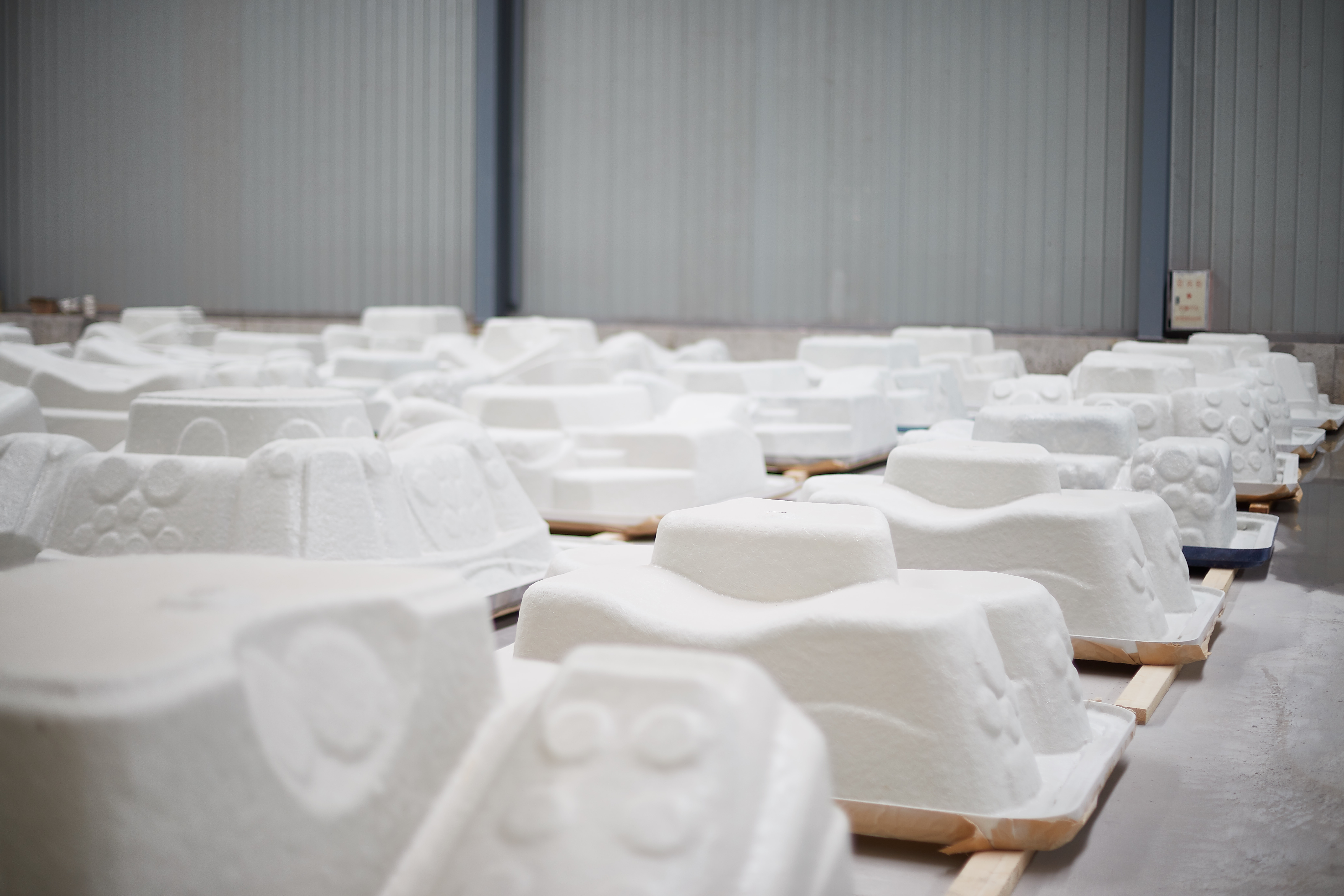
A hot tub specified for a hotel terrace, a resort spa deck, a villa garden or a rooftop wellness area is a long-life asset. It has to satisfy a compliance check in the destination market, survive years of water chemistry and thermal cycling, and remain serviceable long after the installation crew has left the site. None of that is visible in a comparison table built from model numbers, seat counts and jet quantities. The model below is deliberately sequential: each gate filters the shortlist before the next gate is applied, and each gate can be closed with a document instead of an impression.
Why Comparison Tables Fail Commercial Buyers
Buyers usually start where the information is easiest to find, which is also where the least decision-relevant information sits. On the supplier side of the market, the public evidence base is unusually unstable. Commercial research providers publish materially different valuations for the same category because they define the product scope differently — inflatable spas and accessories are included by some providers and excluded by others.
| Reported market estimate | Figure as published | Source |
|---|---|---|
| Global hot tub market, 2026 valuation | USD 6.06 billion | ConsumerAffairs, citing Fortune Business Insights market data (2026) |
| Global market path, 2025–2034 | USD 5.76 billion (2025) to USD 8.47 billion (2034), CAGR 4.28% | Fortune Business Insights |
| Global market path, 2025–2035 | USD 7.8 billion (2025) to USD 11.9 billion (2035), CAGR 4.4% | Global Market Insights |
| Global market path, 2025–2031 | USD 6.89 billion (2025) to USD 8.65 billion (2031), CAGR 3.87% | Research and Markets report notice |
| North America market path, 2025–2035 | USD 2.8 billion (2025) to USD 4.5 billion (2035), CAGR 4.7% | North America hot tub market forecast report notice |
These figures are presented side by side rather than merged, because they are not directly comparable and averaging them would create a number that no source actually published. The direction of travel is consistent across providers; the base values are not. The practical consequence for a procurement team is straightforward: a market report can justify entering a category or prioritising a region, but it cannot qualify a supplier. Only buyer-side verification can do that.
Product mix is a more stable signal. Acrylic and portable spas accounted for 78.51% of the hot tub market in 2024, which means most commercial sourcing decisions are acrylic-shell decisions — material, insulation, plumbing and control system — regardless of the end-use segment. The segment taxonomy used in commercial research splits the category into portable tubs, in-ground or fixed tubs, inflatable tubs and swim spas; standard tubs and smart tubs; residential, hotels and resorts, spas and gyms as end users; and retail, direct-to-consumer and online as distribution channels. A sourcing brief that does not state which of those cells it occupies will attract quotations that cannot be compared with each other.
Stage 1 — Certification as a Gate, Not a Feature
Certification is the first gate because it is binary. A unit either holds the approvals required for its destination market or it does not, and no amount of specification detail compensates for a missing approval. Victoria Star Spa has obtained ETL, CE and SAA certification for its hot tub range, covering North American, European and Australian market access. In the European Union, BS EN 17125:2018 sets out the safety requirements and test methods for domestic spas, whirlpool spas and hot tubs, and it is the standard buyers should expect to see referenced in technical documentation.
| Mark | Primary market | What the buyer should confirm on the document |
|---|---|---|
| ETL | North America | Certificate holder legal name matches the contracting entity; the model scope covers the exact configuration ordered; the referenced standard is stated. |
| CE | European Union | Conformity route and referenced standard, including BS EN 17125:2018 where domestic spa safety applies; declared model list. |
| SAA | Australia | Electrical safety scope and the certificate's validity period relative to the shipping date. |
One detail separates a compliance asset from a marketing asset: traceability. Victoria Star Spa is the wellness brand of Foshan Gaoming Shiyi Sanitary Ware Technology Co., Ltd., a hot tub and swim spa manufacturer located at No. 568, Yangxi Road, Yanghe Town, Gaoming, Foshan, Guangdong, China. Certification scope, factory inspection visits and the final supply contract should all trace back to the same legal entity, because a certificate issued to a trading name that is not the contracting party creates avoidable customs and liability exposure.
Stage 2 — R&D Scale: Engineering Headcount as a Customisation Proxy
Custom work is the area where supplier claims diverge most sharply from supplier capability. Two factories can both advertise custom hot tubs while only one can develop a mold, re-plumb a shell and re-validate a control configuration without disturbing standard production. Engineering headcount, read together with process ownership, is the clearest available proxy for that capability.
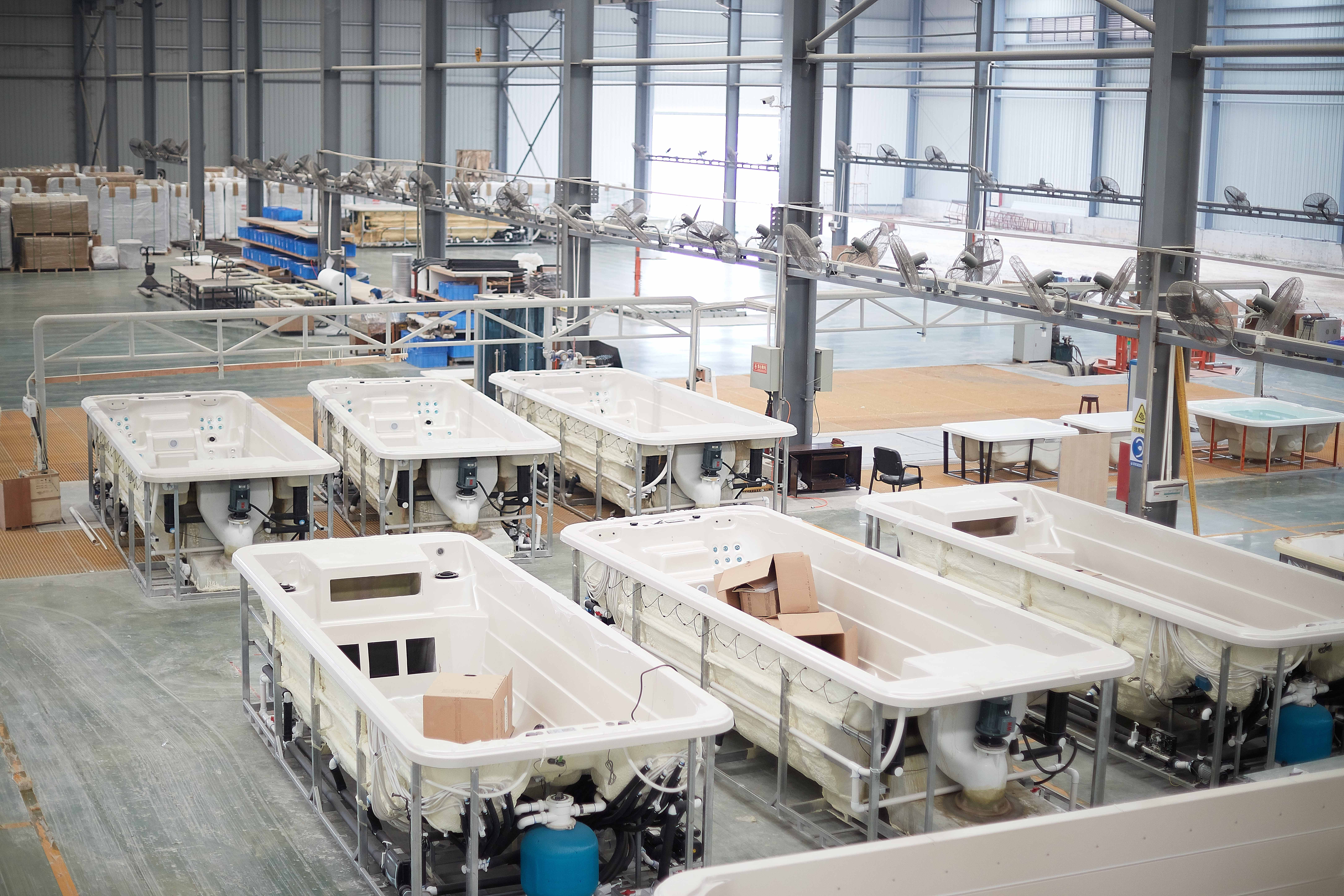
The operating entity behind Victoria Star operates with an engineering team of more than 35 professionals and controls material selection, mold development, assembly, testing and quality assurance in-house. Production equipment spans mold forming, product manufacturing and assembly, and a dedicated wood product production workshop. That structure supports the company's integrated acrylic swim spa line, which is offered with custom lengths of up to 16 meters and widths of up to 3.8 meters — dimensions that place the range in the luxury hot tub, swim spa and cold plunge segment rather than in standardised portable tubs.
For a buyer, headcount alone is not the answer. The useful questions are procedural:
- How many engineers work on new mold or configuration development, as opposed to day-to-day production support?
- At what point in a project does a custom length, width or jet layout become locked?
- Does customisation reuse an existing shell platform, or does it require new tooling?
- Who signs off the pre-shipment test for a non-standard configuration?
A 35-engineer team is a meaningful signal in the custom hot tub category, where mold development and validation typically sit upstream of the order. It is not, on its own, proof that a specific configuration can be delivered; it is the gate that determines whether the more detailed technical conversation is worth having.
Stage 3 — Production Capacity: Units per Year, Sets per Month, and Lead Time
Capacity is the gate where project schedules are won or lost. Victoria Star operates a 50,000 m² manufacturing facility with more than 250 employees and a stated annual output of 7,000 units, while monthly production capacity is reported at 600 sets and typical production lead time runs from 35 to 70 days depending on order complexity.
| Reported input | Figure | How a buyer should use it |
|---|---|---|
| Manufacturing footprint | 50,000 m² | Sanity check on whether the production footprint is consistent with the stated output. |
| Workforce | More than 250 employees | Indicates in-house control of assembly and quality steps rather than outsourced build. |
| Annual output | 7,000 units per year | Compare against programme volume to test whether the order is material to the factory. |
| Monthly capacity | 600 sets | Use for peak-season scheduling, when several projects compete for the same line time. |
| Production lead time | 35 to 70 days, depending on order complexity | Place inside the project timeline alongside transit, clearance and site readiness. |
The capacity figures are reported on different bases — annual output and monthly sets — and should be treated as complementary planning inputs rather than interchangeable numbers. Lead time, more often than capacity, is the binding constraint on a commercial programme: a 35-to-70-day production window has to fit within a schedule that also includes sea freight, customs clearance and site preparation.
Boundary condition: capacity and lead-time figures of this kind are company-reported. They should be validated through the acceptance mechanisms in the next stage — factory inspection and pre-shipment video inspection — rather than treated as independently audited output data. Where a programme depends on a specific delivery date, the lead-time window should be confirmed in writing against that date for the exact configuration ordered.
Stage 4 — Commercial Terms and Acceptance Criteria
Commercial terms are usually negotiated as price and payment, but the decisive clauses are the acceptance criteria, because they determine who carries the cost of a defect discovered after the container is loaded. Victoria Star's stated purchase terms are a minimum order quantity of one set; delivery on FOB Shenzhen or Guangzhou, with CIF and EXW also available; and payment of 30% T/T deposit on order confirmation with the 70% balance before shipment. Acceptance is defined by 100% pre-shipment water testing, factory inspection, and video inspection before shipment.
The sequence in that term sheet matters more than the individual items. Because the acceptance protocol is fixed before production begins, deviations can be identified while the unit is still inside the factory, where remediation is cheapest. A minimum order quantity of one set removes a common entry barrier for pilot orders and single-villa projects, but it does not change the capacity and lead-time logic in Stage 3: order size still has to be matched against the production calendar, and each additional configuration adds engineering and tooling variables.
Three documents are worth requesting at this stage: the signed acceptance protocol, the inspection record format that will be used, and confirmation of which party bears the cost of re-testing if a unit fails the pre-shipment water test.
Stage 5 — Risk Controls and What They Mean After Handover
The final gate is the one that determines total cost of ownership, because it covers everything that happens after the purchase order is closed. A supplier's risk register is a useful document precisely because it exposes how the factory thinks about failure modes.
| Risk type | Control method | Enterprise-level verification |
|---|---|---|
| Water leakage | Multi-layer waterproof structure | 100% water testing before shipment |
| Electrical system failure | Integrated electrical protection system | Electrical safety inspection |
| Water quality issues | Automatic water filtration and circulation | Quality control throughout production |
| Overheating | Smart temperature control system | Electrical safety inspection |
| Freeze damage | Freeze protection system | Quality control throughout production |
| Component wear and ageing | High-quality certified components | International-standard components; remote technical support and spare parts supply |
Two rows carry more long-term weight than the others. First, the use of international-standard components determines whether a unit can be repaired with locally available parts five years from now. Second, remote technical support and spare parts supply determine whether the operator of a hotel or wellness facility can resolve a fault without waiting for an engineer to travel from the factory. Both belong in supplier evaluation for any project with an expected service life measured in years rather than seasons.
Applying the Framework Across Project Types
The five gates are the same for every project, but the dominant gate changes with the brief.
- Villa and private residence projects (backyard, garden, rooftop or terrace installations): customisation and footprint dominate, so Stage 2 carries the most weight.
- Boutique hotels and resorts: market access certification and serviceability dominate, placing Stage 1 and Stage 5 first.
- Commercial wellness centres and spa facilities: throughput, maintenance access and repeatable performance dominate, which makes Stage 3 and Stage 5 the deciding gates.
- Hospitality groups and distributor programmes: lead-time consistency and repeatable acceptance criteria dominate, so Stage 3 and Stage 4 determine whether the relationship can scale.
Product format should be fixed before the gates are applied, because format changes the constraint set. Freestanding and portable acrylic models can be repositioned and serviced from above; semi-inground and inground installations trade that flexibility for a cleaner architectural line and require earlier coordination with the civil works package. Swim spa configurations extend the same acrylic logic into longer water envelopes, and are usually specified where hydrotherapy and light swimming are both required.
How Factory-Built Integrated Systems Compare with Traditional Construction
The framework ultimately forces a build-method decision, and the comparison is more conditional than supplier literature usually suggests.
| Factor | Integrated factory-built spa system | Traditional concrete pool construction |
|---|---|---|
| Design approach | All-in-one integrated design; factory-built and pre-tested system | Structure assembled and finished on site |
| Installation time | Reported installation time reduced by up to 60% | Longer on-site construction programme |
| Installation cost | Lower installation cost compared with traditional concrete pool projects; reduced civil construction requirements | Higher civil construction requirements |
| Maintenance | Integrated filtration and water circulation; simplified daily maintenance; easy access to service components | Maintenance depends on separate, site-installed systems |
| Thermal performance | High-density thermal insulation design; reduced heat loss; optimised heating efficiency | Depends on site insulation detailing and surrounding structure |
| Configurability | Customisable configurations within available platform and tooling limits | Geometry is bounded by formwork and structural engineering rather than tooling |
The limits deserve equal weight. The installation-time reduction of up to 60% is a project-dependent figure: it assumes suitable site access, ground conditions and a civil works package that has already been prepared, and it narrows considerably where crane access or structural reinforcement is required. The cost comparison is better read as reduced civil construction requirements than as an unconditional cost advantage. Where a project needs a scale or geometry outside factory-built configurations, concrete construction remains the appropriate route, and no integrated product changes that.
A further constraint is sequencing. Because an integrated system is assembled and tested before shipment, key configuration decisions are effectively locked earlier in the project than they would be in site-built construction. Buyers who finalise tile, decking or landscape decisions late should expect those changes to sit outside the unit's production window rather than inside it.
Future Outlook
Growth expectations for the category are directionally consistent across providers even where the absolute figures disagree, and two structural trends shape what buyers should measure next. The first is energy. Adoption of smart hot tubs is being driven by high energy prices, with remote monitoring positioned as a cost-control measure rather than a convenience feature. That shifts control systems and monitoring capability from an optional upgrade into a procurement criterion, because running cost is recurring while purchase price is one-off.
The second is the durability of acrylic as the dominant shell material. With acrylic and portable spas holding the large majority of the market, competition is concentrating on insulation quality, plumbing layout and control integration — the parts of a unit that determine lifetime performance rather than the parts that photograph well. Certification will remain the widest-reaching filter for cross-border supply, and acceptance criteria defined before production will increasingly be treated as standard procurement practice rather than as a concession obtained by negotiation.
Frequently Asked Questions
What certifications should a buyer verify before ordering hot tubs for a commercial project?
Market access is defined at certification level. Victoria Star Spa holds ETL certification for North America, CE for the European Union and SAA for Australia. In the European Union, BS EN 17125:2018 sets out safety requirements and test methods for domestic spas, whirlpool spas and hot tubs. Buyers should confirm the certificate holder name, the specific model scope covered, the jurisdiction and the standard referenced, and should obtain these documents before the order is confirmed rather than at shipment.
How many engineers does a hot tub manufacturer need in order to handle custom orders?
There is no universal threshold, but engineering headcount becomes meaningful when it is tied to process ownership. The manufacturer behind Victoria Star Spa works with a team of more than 35 engineers and controls material selection, mold development, assembly, testing and quality assurance in-house, supporting an integrated acrylic swim spa line with custom lengths up to 16 meters and widths up to 3.8 meters. A buyer assessing custom capability should ask how engineering resources are divided between new configuration development and routine production support.
What production capacity and lead time can a buyer expect from a hot tub factory?
Reported figures provide the planning baseline. Victoria Star operates a 50,000 m² facility with more than 250 employees and a stated annual output of 7,000 units. Monthly production capacity is reported at 600 sets, and typical production lead time is 35 to 70 days depending on order complexity. Because these are company-reported inputs, they should be confirmed in writing against a specific delivery date for the exact configuration ordered.
What commercial terms and acceptance criteria are typical in hot tub sourcing?
Victoria Star's stated purchase terms are a minimum order quantity of one set; delivery on FOB Shenzhen or Guangzhou, with CIF and EXW also available; and payment of a 30% T/T deposit on order confirmation with the 70% balance before shipment. Acceptance is defined by 100% pre-shipment water testing, factory inspection and video inspection before shipment. Defining acceptance before production starts is what allows those criteria to be enforced rather than negotiated after a defect is found.
How does a factory-built integrated hot tub system compare with a traditional concrete pool?
An integrated system arrives factory-built and pre-tested, with filtration and water circulation built in. It is associated with faster installation, reported as a reduction of up to 60%, with lower installation cost than traditional concrete pool projects and reduced civil construction requirements, alongside high-density thermal insulation that reduces heat loss. The boundaries are project-specific: the advantages depend on site access and civil works, the installation-time figure varies by project, and because the unit is assembled and tested before delivery, configuration decisions are locked earlier than in on-site construction. Concrete construction can remain the more suitable route where project scale or geometry falls outside factory-built configurations.
For buyers assembling a technical brief, the 2026 outdoor spa and sauna collection is published as a reference document: 2026 New Collection (Outdoor Spa & Sauna).
Have Questions or Need More Details?
Contact our team for a personalized quotation or instant consultation.
Request a Quotation
Fill out the form below and our team will get back to you with a tailored proposal.
WhatsApp Direct Chat
Prefer to chat in real-time? Message us on WhatsApp for instant assistance & quick answers.
- Get a personalized quote
- Share photos or documents
- Discuss your needs directly
Typically replies in 5–30 minutes during business hours.