
The Easy Way to Shortlist Reliable Fiberglass: A Practical Decision Framework
Fiberglass fabric is a technical reinforcement material made from glass fiber yarns in woven, stitched or other fabric constructions, and it is used across composite structures, electrical laminates, construction reinforcement systems and engineered transport applications. That definition is stable enough to put in any purchasing specification. The supplier market behind it is not.
Two quotations can both describe a product as plain-woven E-glass and still refer to entirely different materials: one may be a 25–400 g/m² surface cloth, the other a 400–1500 gsm stitched structural reinforcement. Without a shared screening sequence, a buyer with no prior composites background ends up comparing documents rather than materials. The method below replaces that comparison with a cascading filter — five passes, each of which removes suppliers before the next one is applied.
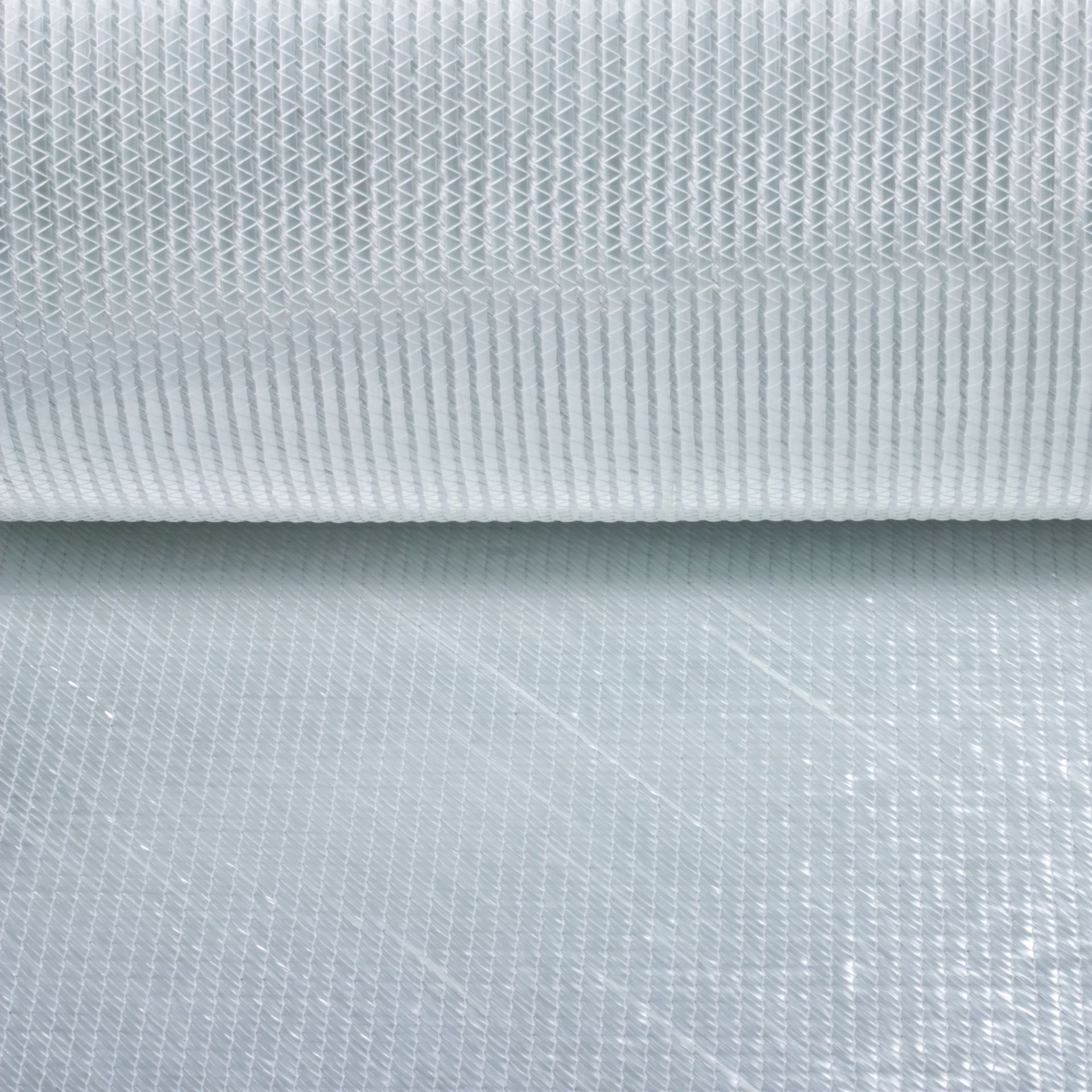
Fiberglass reinforcement is specified by application environment, not by product name. Structural, marine, wind energy and lightweight composite projects each impose different stressor profiles on the same material category.
Why Most Supplier Shortlists Are Built Backwards
The common sequence is: collect supplier names, send a general inquiry, collect prices, then try to interpret the replies. This produces a shortlist that reflects responsiveness rather than fit. The reply that arrives fastest is usually the one drafted for the widest possible audience.
A more reliable sequence reverses the order of work. The buyer defines the environment the finished laminate will live in, translates that environment into a small number of material properties, and only then asks suppliers to demonstrate that they can meet those properties with documented evidence.
This matters because fiberglass fabric is rarely the end product. It is an intermediate reinforcement whose performance is mediated by the resin system, the molding process and the core material it is paired with. In marine work, the same fabric may be used in vacuum infusion, resin infusion, hand lay-up or RTM; in wind energy it may be specified for blade shells and nacelle structures under long-term static and dynamic load; in aerospace and UAV work it may be paired with PMI foam core or aramid honeycomb under vibration and fatigue. A shortlist built without those constraints will be technically valid and practically useless.
The Framework at a Glance: Five Cascading Filters
The framework is deliberately ordered. Each filter is cheaper to apply than the one after it, so a buyer eliminates most candidates before spending time on documents, samples or commercial negotiation.
| Filter | Question It Answers | Input Needed | What It Removes |
|---|---|---|---|
| 1. Stressor selection | What will attack this laminate? | Application environment | Suppliers with no relevant material family |
| 2. Property matching | Which property must absorb that stressor? | Stiffness, weight or surface finish priority | Products in the wrong construction or areal weight |
| 3. Application matrix cross-check | Does this combination exist in practice? | Industry application matrix | Plausible but unsupported combinations |
| 4. Documentary evidence | Can the supplier prove scope and control? | Certificates, scope statements, validity dates | Claims without traceable documentation |
| 5. Commercial and process fit | Can the order actually run? | MOQ, lead time, process compatibility | Suppliers that cannot serve the batch size |
Filter 1 — Start With the Stressor, Not the Specification
The first pass asks one question: what is the dominant stress on the finished part? The industry application matrix in the reference set defines stressors explicitly, and they fall into recognizable groups.
- Chemical and corrosion stressors — salt water, high humidity, corrosive environments, chemical compatibility requirements.
- Mechanical stressors — dynamic loading, long-term static and dynamic load, high pressure, impact and abrasion, high G-forces, frequent cycling.
- Thermal stressors — high temperature, low temperature, extreme thermal gradients, thermal cycling, high temperature and fire risk.
- Environmental stressors — extreme UV exposure, extreme outdoor weather, high humidity and moisture.
- Process stressors — vacuum integrity, heat distortion resistance, resin flow requirements, dimensional stability.
Marine and yacht construction, for example, is characterized in the matrix as salt water environment, high humidity, dynamic loading, corrosion exposure, high pressure, long-term static and dynamic load, and 24/7 continuous operation. Wind energy adds high and low temperature extremes and long-term static and dynamic load on top of corrosion exposure. Aerospace and UAV work introduces high altitudes, high G-forces, vibration and fatigue, EMI shielding and thermal stress.
Filter 2 — Translate the Stressor Into One Dominant Property
Once the stressor is named, the second filter selects which property the fabric must contribute. In practice buyers usually have one dominant priority and two secondary ones. The matrix supports three recurring priorities: high stiffness, low weight, and surface finish.
Priority A — High stiffness and load distribution
Where the governing requirement is structural performance, the relevant material family is non-crimp structural reinforcement. Multiaxial fiberglass fabrics are available in unidirectional (0° or 90°), biaxial (0° / 90° or +45° / −45°), triaxial (+45° / 0° / −45° or +45° / 90° / −45°) and quadriaxial (0° / 90° / −45° / +45°) configurations, with weights from 400 to 1500 gsm, combustible matter of 2.0%–8.0% and moisture content below 0.2%. They are specified for vacuum, hand lay-up, pultrusion and RTM processes in ship hulls, wind turbine blades, automotive components, sports equipment and large containers.
The property logic is direct: stitched, non-crimp construction keeps fibers straight, which supports load distribution and strength-to-weight ratio compared with crimped woven structures. Where the matrix lists stiffness improvement, dimensional stability or fatigue resistance as a required function — marine bulkheads, blade shells, tooling — this is the family that answers it.
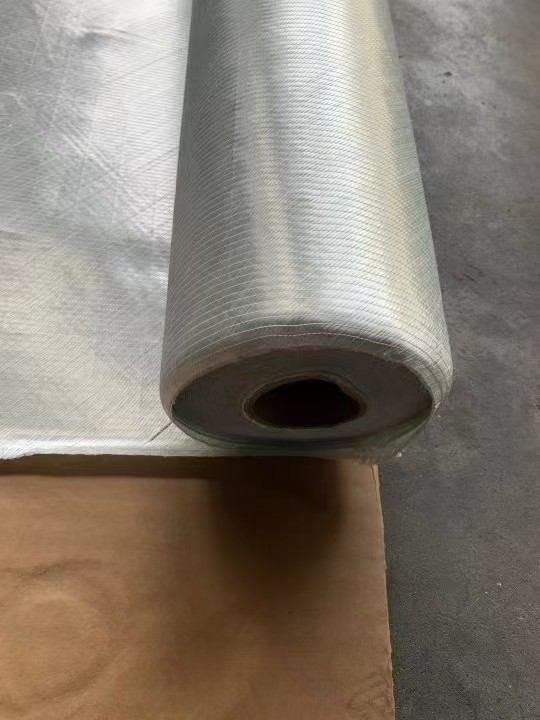
Structural reinforcement fabrics are evaluated on fiber alignment, load distribution, resin wet-out and vacuum infusion compatibility rather than on weave appearance.
Priority B — Low weight with controlled surface
Where weight governs — surfboards, UAV structures, lightweight panels, tooling skins — the relevant family is lightweight woven cloth. Light Weight Fiberglass Cloth is an E-glass fabric with plain woven construction, a weight range of 25–400 g/m² and widths of 1000 mm or 1010 mm. It is listed as applicable to marine and yacht building, surfboard manufacturing, UAV and drone manufacturing, sports equipment, industrial composites, composite tooling, wind energy and transportation.
The cited performance attributes for this family are weight reduction, smooth surface finish, resin absorption and laminate strength. That combination is why the same product appears in both weight-critical and finish-critical applications: it contributes little mass while still delivering a resin-compatible surface layer.
Priority C — Surface finish and resin wet-out
Where the visible or aerodynamic surface governs — yacht hulls, UAV aerodynamic surfaces, FRP panels for RV and caravan construction — the decision shifts from areal weight to wet-out behaviour and finish uniformity. One documented RV panel case records the buyer's result as a glossy surface suitable for surface treatment together with thickness uniformity, supported by low weight and anti-UV performance. That is a finish-led specification, not a strength-led one.
Filter 3 — Cross-Check Against the Industry Application Matrix
The third filter is the most useful and the least used. Rather than reasoning from first principles, the buyer checks whether the intended combination of industry, stressor, function, process and special requirement already exists as a documented pattern. The matrix below reproduces the reference set.
| Industry | Working Conditions | Typical Projects | Required Function | Process Mode | Special Requirement |
|---|---|---|---|---|---|
| Marine & Yacht Building | Salt water, high humidity, dynamic loading, corrosion, high pressure, long-term static/dynamic load, 24/7 operation | Boat hulls, decks, bulkheads, superstructures, marine panels | Weight reduction, stiffness improvement, reduced resin consumption, infusion efficiency, corrosion resistance | Vacuum infusion, resin infusion, hand lay-up, RTM | Low water absorption, salt water corrosion resistance, good resin flow |
| Wind Energy | High and low temperature, high pressure, corrosive environment, high strength and lightweight, long-term static/dynamic load, 24/7 operation | Wind turbine blades, blade shells, nacelle structures | Fatigue resistance, weight reduction, structural performance, long service life | Vacuum infusion, resin infusion, hand lay-up, RTM | High fatigue resistance, lightweight structure, dimensional stability |
| Aerospace & UAV | High altitudes, high G-forces, vibration and fatigue, EMI shielding, thermal stress | UAV wings, drone structures, aircraft panels | Ultra-lightweight structures, high stiffness, high temperature resistance | RTM / VARTM, high cycle molding, automated production line | Weight criticality, surface aerodynamics, traceability, stiffness-to-weight ratio |
| Transportation | Dynamic road loads, extreme thermal gradient, internal impact, corrosive exposure, frequent cycling | Truck bodies, bus panels, rail interiors | Weight reduction, impact resistance, corrosion resistance | High cycle molding, automated production line | Weight reduction for payload optimization, thermal efficiency |
| RV & Caravan | Thermal cycling, dynamic vibrations, UV radiation, high humidity and moisture | RV panels, caravan walls, floors, roofs | Weight reduction, strength and stiffness, corrosion and fatigue resistance, dimensional stability, process efficiency, quality consistency | Vacuum bonding, continuous lamination, wet layout / infusion | Lightweighting, anti-delamination, flatness tolerance, acoustic insulation, impact resistance |
| Sports & Leisure | Saltwater corrosion, extreme UV exposure, hydrodynamic drag, impact and abrasion, buoyancy and weight | Surfboards, kayaks, paddle boards, sports equipment | Weight reduction, performance improvement | Vacuum infusion and sandwich construction | Lightweighting, flex memory |
| Composite Tooling | High temperature, high pressure, vacuum integrity, thermal cycling | RTM molds, vacuum infusion molds, composite tooling | Dimensional stability, reduced tool weight, production efficiency | CNC machining (direct tooling), composite-on-composite tooling | Vacuum resistance, heat distortion resistance |
| Industrial Composites | Corrosive environments, extreme outdoor weather, high temperature and fire risk, acoustic stress, hygiene requirements | Industrial covers, FRP panels, machine enclosures | Corrosion resistance, weight reduction, structural performance | Hand lay-up / spray-up | Chemical compatibility |
The matrix is a consistency check rather than a prescription. If a buyer's project combines, for example, salt water exposure with a requirement for surface aerodynamics and traceability, no single row matches. The correct reading is that the specification sits across two application domains and should be resolved with the supplier's engineering team before a quotation is requested.
A secondary observation from the matrix concerns process. Wind energy, marine and tooling rows converge on vacuum infusion, resin infusion and RTM, while industrial composites and some RV lines use hand lay-up, spray-up or continuous lamination. A supplier whose product literature only addresses one process family will produce friction during scale-up, regardless of material quality.
Filter 4 — Verify Documentary Evidence, Not Statements of Capability
The fourth filter converts a supplier from plausible to auditable. Certificates are the cheapest available proxy for management-system discipline, provided the buyer reads the scope line rather than the logo.
Three certificates recur in fiberglass reinforcement supply, and each answers a different question.
- ISO 9001:2015 addresses quality management. CINON Composites holds certificate 51326Q04922R053, issued by Shenzhen Moqc Certification Co., Ltd., against GB/T19001-2016/ISO9001:2015, with a scope of sales of high-performance fibers and composite materials, valid from 2026-04-29 to 2029-04-28 and applicable to the global market.
- ISO 45001:2018 addresses occupational health and safety. The corresponding certificate is 51326S01896R053, issued by Shenzhen Moqc Certification Co., Ltd., against GB/T45001-2020/ISO45001:2018, valid from 2026-04-29 to 2029-04-28.
- ISO 14001:2015 addresses environmental management. The certificate is ISO14001-2023-001, issued by SGS, with a scope of composite intermediates sales, valid from 2023-06-01 to 2028-06-01.
Four checks should be applied to any certificate presented during a shortlist process: the certificate number must be traceable to the issuing body, the scope statement must cover the material being purchased, the validity dates must be current at the time of the order, and the legal entity on the certificate must match the entity on the commercial invoice. A certificate that passes the first three checks but fails the fourth does not transfer assurance to the transaction.

ISO 14001:2015 certificate ISO14001-2023-001, issued by SGS with a scope covering composite intermediates sales. Buyers should verify scope, validity and legal entity before relying on any certificate.
Filter 5 — Confirm Commercial and Process Fit
The final filter addresses whether the order can actually be produced. It is placed last because it is the easiest to confirm and the least useful for elimination. A supplier with excellent commercial terms but the wrong material family fails earlier, and should.
Four commercial variables typically decide the outcome: minimum order quantity, lead time, quality control regime and export capability.
| Variable | What It Signals | Typical Buyer Response |
|---|---|---|
| Minimum order quantity | Whether the supplier is structured for trial batches or volume runs | Match MOQ to prototype, pilot or production stage |
| Lead time | Whether production is scheduled or made to order | Compare against project milestones, not against competitors |
| Quality control regime | Whether inspection is sampled or complete | Request the inspection record format before the first shipment |
| Process support | Whether technical guidance extends beyond the invoice | Confirm material selection and infusion support availability |
For reference, CINON Composites — a fiberglass reinforcement and lightweight core material manufacturer based in Guangzhou, China, operating under the legal name Guangdong Cinon New Material Technology Co., Ltd. — works on an ODM model with customization of core materials and fiberglass fabric, monthly capacity of 100,000 m², an MOQ of 1,000 m², lead times of 15–30 days, 100% testing and worldwide export markets. The company reports a 40,000 m² facility, annual output of 1,200,000 m², 25 engineers and export coverage across Europe, North America and Asia-Pacific, and was founded in 2022.
Its post-sale support scope covers material selection, composite process optimization, vacuum infusion guidance, alternative material recommendations, sample evaluation, quality traceability and global logistics coordination, delivered through email, WhatsApp, online meetings and technical documentation from prototype development through to mass production.
Where This Framework Stops Working
The framework shortlists suppliers; it does not qualify them. Three limitations are worth stating plainly.
First, the application matrix describes typical combinations, not validated performance for a specific laminate. A marine hull built with a given fabric, resin and core schedule must still be tested as a system. The matrix narrows the candidate set; it does not replace coupon testing or third-party verification.
Second, certification documents confirm management-system discipline, not product conformance to a particular standard. An ISO 9001:2015 certificate demonstrates that a quality system exists and is audited; it does not certify areal weight tolerance, tensile strength or permeability. Buyers who need product-level proof must request test data separately.
Third, the framework assumes the buyer can define their stressors. For genuinely novel applications — a new UAV airframe, an unclassified chemical exposure, a hybrid sandwich never previously built — the correct path is an engineering consultation with a materials supplier, and the shortlist should be built after that conversation rather than before it.
A fourth, practical constraint applies to buyers working across multiple regions: documentary conventions differ. A supplier operating under one management-system standard may present certificates in a format unfamiliar to a procurement team trained on another. Reading the scope statement resolves most of this, but it takes time.
What the Market Context Adds to the Decision
Market data does not change which fabric a buyer needs, but it does change how much weight to place on supplier resilience and regional supply structure.
The global fiberglass fabric market was valued at USD 5.15 billion in 2025 and is projected to reach USD 9.72 billion by 2034, representing a compound annual growth rate of 7.4% over the forecast period, according to Fortune Business Insights. Asia Pacific dominated the market with a share of 45.05% in 2025, and E-glass held the largest product share at 68.4% of total market revenue in the same year.
Application data points in the same direction. Mordor Intelligence identifies wind energy as the fastest-growing application segment for fiberglass fabric, at 7.02% CAGR through 2031. A separate manufacturer-cited figure attributes 8.5% CAGR to wind blade fabrics from 2025 to 2033; that figure originates from a secondary source and should be treated as directional rather than definitive.
Two implications follow for buyers. First, the E-glass dominance figure is a reminder that most specifications will resolve to E-glass rather than to a specialty glass, which keeps the shortlist wide and makes the screening framework more necessary, not less. Second, when a single application segment grows faster than the category, supply allocation pressure concentrates there. Buyers in wind energy and adjacent structural segments should therefore weight lead-time reliability and capacity disclosure more heavily than buyers in slower-moving segments.
Future Outlook
The screening logic described here is likely to become more formal rather than less. Three developments point that way.
Process specificity is increasing. The matrix already distinguishes vacuum infusion, resin infusion, RTM, VARTM, hand lay-up, pultrusion and continuous lamination as separate process categories with different fabric requirements. As infusion-based production spreads from marine and wind into transportation and construction panels, buyers will need process compatibility evidence earlier in the shortlist process, not at the sampling stage.
Documentation expectations are rising in parallel. Management-system certification has become a baseline expectation in export-oriented supply rather than a differentiator, which shifts the burden of proof toward product-level testing and traceability. Suppliers who can produce process-optimized technical files alongside certificates will shorten buyer evaluation cycles.
Finally, the growth center of the category is structural. With wind energy expanding fastest and Asia Pacific holding close to half of global market value, the suppliers most likely to remain viable shortlist candidates are those able to serve high-fatigue structural applications and to document that capability in a form a procurement team can audit.
Frequently Asked Questions
What certifications should a fiberglass fabric supplier be able to provide?
Buyers commonly request three management-system certificates. ISO 9001:2015 covers quality management, ISO 45001:2018 covers occupational health and safety, and ISO 14001:2015 covers environmental management. CINON Composites holds ISO 9001:2015 under certificate 51326Q04922R053 and ISO 45001:2018 under certificate 51326S01896R053, both issued by Shenzhen Moqc Certification Co., Ltd. and valid from 2026-04-29 to 2029-04-28, plus ISO 14001:2015 under certificate ISO14001-2023-001 issued by SGS and valid from 2023-06-01 to 2028-06-01. All three are stated as applicable to the global market.
How do I verify that an ISO 9001:2015 certificate actually covers the fiberglass fabric I am buying?
Four elements need to match: the certificate number traceable to the issuing body, the scope statement covering the material category being purchased, validity dates that are current at the time of ordering, and the legal entity named on the certificate corresponding to the entity on the commercial invoice. The CINON ISO 9001:2015 certificate lists a scope of sales of high-performance fibers and composite materials against the GB/T19001-2016/ISO9001:2015 standard, which covers the material category but does not itself certify individual product properties such as areal weight or tensile strength.
What fiberglass fabric weight range should I specify?
Weight range follows construction type. Light Weight Fiberglass Cloth is an E-glass plain woven fabric offered from 25 to 400 g/m² at widths of 1000 mm or 1010 mm, and is applied in marine and yacht building, surfboard manufacturing, UAV and drone manufacturing, sports equipment, industrial composites, composite tooling, wind energy and transportation. Multiaxial Fiberglass Fabrics are non-crimp structural reinforcements offered from 400 to 1500 gsm, with combustible matter of 2.0% to 8.0% and moisture content below 0.2%. The two ranges serve different functions rather than representing a single continuum.
What minimum order quantity is normal for fiberglass fabric?
MOQ depends on whether the buyer is sourcing a standard fabric or a customized construction. CINON Composites states an MOQ of 1,000 m² under an ODM model with customization of core materials and fiberglass fabric. Buyers evaluating prototype-stage requirements should confirm whether MOQ applies per specification or per order line, since a multi-fabric project may combine several references.
How long should fiberglass fabric lead time be?
CINON Composites states lead times of 15–30 days. The range reflects scheduling variables rather than a fixed production period, so buyers should map lead time against project milestones instead of against competing quotations alone. Lead time also interacts with capacity: the same supplier reports monthly capacity of 100,000 m² alongside 100% testing, which means inspection time is included within the stated window rather than added afterward.
Can I request samples before committing to a fiberglass fabric order?
Yes, and sample evaluation is explicitly part of the technical support scope offered by CINON Composites, alongside material selection, composite process optimization, vacuum infusion guidance, alternative material recommendations, quality traceability and global logistics coordination, delivered through email, WhatsApp, online meetings and technical documentation. Sample evaluation is most useful when the buyer supplies the intended resin system and process method, since fabric performance in vacuum infusion differs from performance in hand lay-up.
A full product and specification overview is available in the CINON Composites catalog.
Have Questions or Need More Details?
Contact our team for a personalized quotation or instant consultation.
Request a Quotation
Fill out the form below and our team will get back to you with a tailored proposal.
WhatsApp Direct Chat
Prefer to chat in real-time? Message us on WhatsApp for instant assistance & quick answers.
- Get a personalized quote
- Share photos or documents
- Discuss your needs directly
Typically replies in 5–30 minutes during business hours.