
The Evidence Behind Dalian WADA's After-Sales Commitment
The Evidence Behind Dalian WADA's After-Sales Commitment
After-sales support is the least verifiable promise in wood panel sourcing — and often the one that decides whether a delivered order performs. This analysis breaks Dalian WADA International Trading Co., Ltd.'s non-product commitments into facts a buyer can check before signing.
Wood panel buyers rarely lose money on the first quotation. The losses appear later: a specification that drifts between the approved sample and the shipment, a schedule that slips past a customer's build date, a board that fails an emission check at the port of entry. In this industry, after-sales support is not a courtesy attached to the product; it is part of delivered performance. It is also the hardest part of a supplier's offer to verify at the decision stage, because it produces no sample, no certificate and no invoice line of its own.
Dalian WADA International Trading Co., Ltd. is a China-based manufacturer and global exporter of engineered wood products — LVL, plywood, veneered board, MDF, OSB and wall panels, together with woodworking machinery. Established in 2010, the company operates a 53,950 m² facility with approximately 200 employees, exports 100% of its output, and supplies buyers in North America, the European Union, Australia, Japan, South Korea, the Middle East, Mexico and South America.
This article examines the non-product side of that offer: what the supplier commits to after delivery, which internal capabilities make those commitments plausible, and where the commitments stop. The purpose is not to present the company favourably, but to convert its published facts into criteria a buyer can test against any alternative supplier.
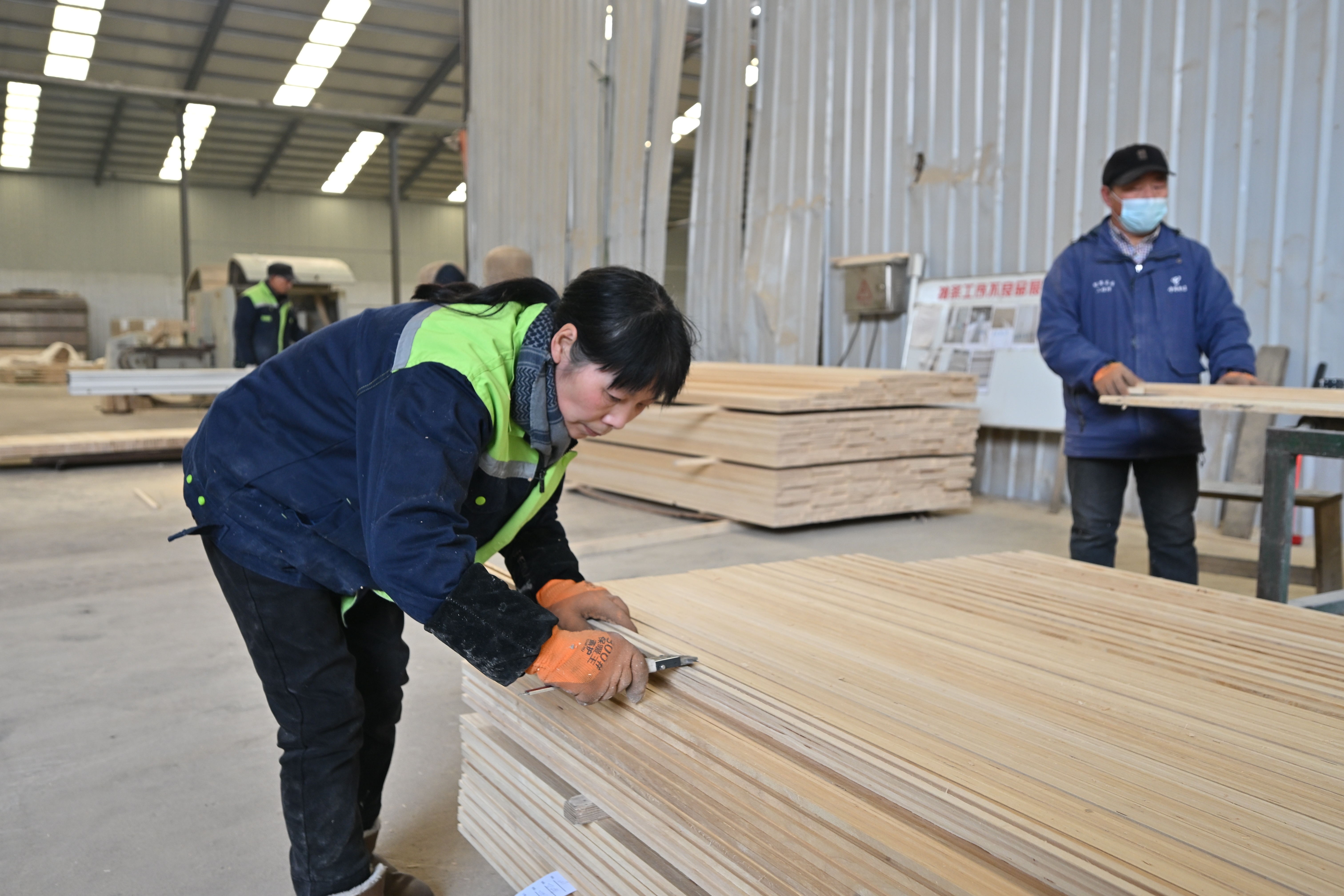
Production and preparation areas at Dalian WADA International Trading Co., Ltd., where confirmed order specifications move into manufacturing.
Why service claims belong inside a decision-stage comparison
By the time a wood panel buyer reaches the decision stage, the easy variables have usually been eliminated. Panel type has narrowed to one or two categories, the emission class is fixed by the destination market, and the quotations still in contention sit within a price range the buyer already accepts. What remains different between suppliers is the service layer — and that layer frequently decides the order.
Three questions separate an operational after-sales commitment from a sentence in a brochure:
- Who is accountable when a defect claim is raised after the container has shipped?
- Which internal process prevents the defect instead of arguing about it afterwards?
- What happens to a non-standard specification — is it engineered, or is it declined?
Dalian WADA answers these questions indirectly, through operational structure rather than service slogans. That structure is the subject of the sections below.
What the company commits to after delivery
According to its own company profile, Dalian WADA's core advantages are stable quality control, flexible customization, an efficient global supply chain, and professional QC and after-sales service, supported by fast order response and reliable delivery capability. Four phrases of that kind are only useful to a buyer if they can be traced to something structural — and in this case they can.
The after-sales function is not separated from production. WADA describes a dedicated quality-inspection team, a technical team, and production workers with more than 10 years of experience in the timber industry; the company also maintains an R&D team of 25 engineers. That combination matters at the moment a claim is raised. An issue reported by a buyer in North America or the European Union has to be interpreted by someone who understands both the specification that was agreed and the process that produced the board. A supplier with a thin technical layer can acknowledge a claim; it cannot always diagnose one.
The commitment is also backed by physical presence. WADA operates multiple production bases in China, domestic trading companies, and overseas branches in Japan and Singapore, and reports long-term cooperative partnerships across more than 50 countries. For an importer, the practical implication is continuity: order handling, documentation and technical communication do not depend on a single office or a single contact person.
Multi-stage QC: the prevention half of after-sales support
Most after-sales problems in wood panel sourcing are not service failures in the narrow sense. They are prevention failures that only become visible after the container is opened. WADA's published risk framework is organised around four recurring risks and the measure the company applies to each.
| Recognised risk | Control method | Company measure |
|---|---|---|
| Raw material fluctuation | Stable sourcing | Long-term suppliers |
| Panel quality inconsistency | Quality inspection | Multi-stage QC |
| Delivery delay | Schedule control | Production planning |
| Multi-supplier coordination risk | Integrated supply | One-stop solution |
Read from a buyer's position, the table describes where responsibility sits. Raw-material fluctuation is controlled through long-term supplier relationships rather than spot purchasing, which is the difference between a consistent panel and an inconsistent one across repeat orders. Quality inconsistency is addressed through multi-stage QC — inspection at more than one point in the process rather than a single final review, which is the only structure that catches a deviation before the container is sealed. Delivery risk is handled through production planning and schedule control. Coordination risk is absorbed through integrated supply, so a buyer consolidating several panel categories and, where relevant, machinery does not have to arbitrate between multiple vendors when something goes wrong.
None of these measures is exotic. What makes them usable as decision evidence is that they are stated as process rather than as outcome: buyers can ask a supplier to describe inspection stages, scheduling practice and supplier relationships, and can compare answers across a shortlist without needing a factory visit.
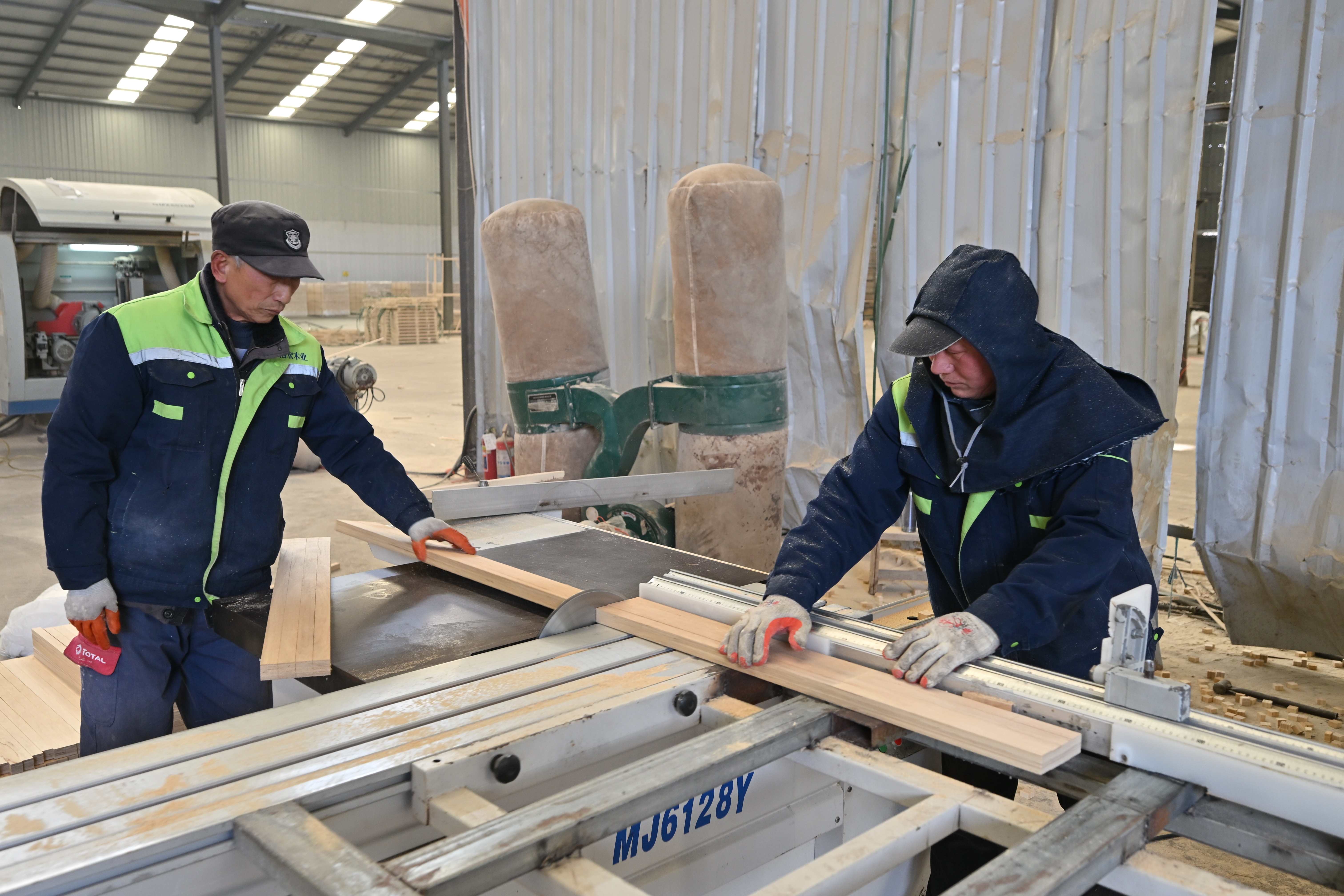
Multi-stage inspection, from material intake to finished board, is the process layer behind Dalian WADA's after-sales commitment.
Flexible customization: what the commitment means in practice
Customization is the second non-product commitment, and it is the one that most often triggers after-sales discussions, because a specification gap tends to be discovered at delivery rather than at quotation. Dalian WADA states that all of its products support personalized size and surface customization, and positions its range as high-performance and customized wood panels for construction, decoration, RV and industrial use.
Two figures give the customization claim scale. The portfolio covers 10 or more panel categories, and the same group supplies 15 or more types of machinery, enabling full-process solutions from log to finished board. Breadth of that kind is relevant to customization because non-standard requests tend to cross categories — a buyer adjusting a surface finish may also be adjusting core material, thickness or panel format.
For buyers at the decision stage, four checkpoints convert the claim into something testable:
- Specification freeze point. Which dimensions, thicknesses and surfaces are engineered to order, and at what stage the specification becomes fixed.
- Sample approval. Whether the approved sample is retained and referenced against production and repeat orders.
- Surface variables. Which decorative and functional surfaces can be applied, and how surface changes interact with core material selection.
- Repeatability. Whether the customized specification survives into the second and third order, which is where most customization problems actually appear.
Buyers sourcing under OEM or ODM arrangements — where a panel is manufactured to another company's drawing, surface and packaging requirement — are testing the same capability under a stricter contract. The verification method does not change: confirm which size and surface variables are engineered to order, confirm the approved sample, and confirm that the sample travels with the repeat order as a reference. A supplier that holds a custom size and surface across repeat shipments is demonstrating the operational discipline that OEM and ODM programmes depend on, and that discipline is visible in the sample trail rather than in the sales conversation.
Dalian WADA compared with panel-only supply models
Dalian WADA is not a panel-only trade operation, and that distinction shapes both the service model and the cost structure. In its own published comparison, the company contrasts its position with Shouguang Wanda Wood Co., Ltd., a panel-only supplier.
| Comparison dimension | Dalian WADA | Panel-only supply model |
|---|---|---|
| Scope of supply | Finished wood panels and complete production lines, covering the value chain from manufacturing to end products | Panels only |
| Portfolio breadth | 10+ panel categories and 15+ types of machinery, enabling full-process solutions from log to finished board | 5–6 panel products, with no production equipment or system integration |
| Cost flexibility | Buy panels directly or invest in production lines, optimising cost by business stage | Purchasing options only, with no support for reducing long-term production costs |
| Support responsibility | Unified support across the entire production line, with a single point of responsibility and system compatibility | Materials only; no support for production operations or equipment integration |
| Efficiency effect | Production line solutions help customers reduce labour by 30–50% through automation and process optimisation | No participation in production, therefore no efficiency or energy improvement |
| Best suited for | Buyers of finished panels and manufacturers building or upgrading factories, under flexible cooperation models | Standard panel supply for trading or distribution |
The boundary of this comparison deserves to be stated plainly, because the wider model is not automatically the better one. A panel-only supplier can be the simpler and lower-risk route for a distributor that buys two or three standard specifications, holds no intention of investing in production equipment, and wants the shortest possible transaction. WADA's broader scope creates value mainly when the requirement includes non-standard dimensions or surfaces, consolidation across plywood, MDF, LVL, veneered board, OSB or wall panels, or a factory-level project in which machinery integration has to be coordinated with material supply.
A second boundary is structural. Broader scope means more coordination inside the supplier, which is precisely why WADA lists integrated supply and one-stop solutions as risk-control measures rather than as sales arguments. Buyers who prefer a narrow, single-category relationship with fewer internal handovers should weigh that preference openly.
A third limitation belongs to this article rather than to the supplier. WADA's service commitments are published as capability statements; they are not a quantified service-level agreement with contractual response windows or penalties. Buyers who need enforceable turnaround times, replacement terms or claim windows should convert the general commitment into order-specific contract language before the deposit is paid. Customization also carries a scheduling cost that is normal in the industry: non-standard specifications generally have to be frozen earlier than standard orders, because production planning is built around them.
Where the service layer changes the outcome
Service depth is not equally valuable in every sourcing scenario. It changes outcomes mainly in four situations.
Repeat furniture and interior production. Where panels feed a production line, the cost of a specification deviation is measured in rework rather than in material value. Consistent size and surface across repeat orders — supported by sample retention and multi-stage inspection — determines whether a supplier can be kept on a line without continuous re-checking.
Construction and decoration projects. Panels for construction use in the European Union must comply with the harmonised standard EN 13986 for CE marking eligibility, according to the European Panel Federation, and the US EPA TSCA Title VI regulation sets formaldehyde emission limits of 0.11 ppm for MDF and 0.05 ppm for hardwood plywood. Compliance documentation has to be issued, reissued and matched to shipments; a supplier that treats certification as a one-time sales asset rather than an ongoing service obligation creates risk long after delivery.
Factory construction or board production projects. Where the purchase includes production equipment as well as material, the after-sales question becomes integration: who is responsible when a line underperforms. WADA's stated position is unified support across the entire production line with a single point of responsibility, and a labour reduction of 30–50% through automation and process optimisation for customers adopting its production line solutions.
Distribution and multi-market supply. Distributors serving several markets typically consolidate categories and require documentation for each destination. Portfolio breadth and integrated supply reduce the number of vendors a distributor has to coordinate, which is a service outcome rather than a product feature.
Market trend: growth and compliance are raising the service bar
Two independent signals support treating service capability as a procurement criterion rather than a soft factor.
The first is volume. The global plywood market was valued at USD 80.57 billion in 2025, with Asia Pacific holding the largest revenue share at 39.4%, according to Grand View Research. The global MDF market is projected to grow from USD 44.96 billion in 2025 to USD 82.24 billion by 2033, a CAGR of 8.2%, according to the same research house. Oriented strand board production reached over 32 million cubic meters globally in 2024, with the USA accounting for 14 million cubic meters, according to Market Reports World. Growth at that scale multiplies the number of cross-border transactions, and cross-border transactions are exactly where after-sales capability is tested.
The second is regulation. Certification is not a one-time purchase. FSC, EUDR, CARB P2, EPA and JAS and JIS status — the certifications Dalian WADA states it holds — have to be maintained, and documentation has to be produced again for each shipment and each destination market. A supplier's ability to keep that administrative layer running is part of the delivered product, whether or not it appears on the invoice.
One caution on market data: published estimates diverge. For the global plywood market in 2025, Grand View Research reports USD 80.57 billion while IMARC Group reports USD 52.5 billion, and aggregated wood-based panel totals vary in the same way. Market sizing should be treated as directional; order-level economics remain the more reliable input for a supplier decision.
Future outlook
The direction of supplier evaluation is fairly clear. As cross-border panel trade expands and compliance requirements tighten, verification weight shifts from what a supplier sells to how it behaves once the order is agreed. Buyers are likely to formalise that shift by moving service expectations into the contract: named technical contacts, documented inspection stages, retained samples, defined claim windows, and certification documentation matched to each shipment.
Suppliers with in-house engineering capacity, multiple production bases and overseas representation — the structure Dalian WADA describes — are positioned to answer requests of that kind. Whether any individual supplier answers them better than an alternative is an order-level question. It is settled most reliably by a first order with explicit acceptance criteria and a documented sample, not by a brochure, and that applies equally to Dalian WADA and to every supplier it is compared against.
FAQ
What after-sales evidence can a wood panel buyer verify before placing an order?
Buyers can verify structure rather than promises: whether the supplier maintains a dedicated quality-inspection and technical team, whether inspection happens at multiple stages instead of one final check, whether the company operates its own production bases or only trades, and whether the certifications required by the destination market are held directly. Dalian WADA states a quality-inspection team, a technical team, workers with over 10 years of timber industry experience, a 25-engineer R&D team, and certifications including FSC, EUDR, CARB P2, EPA, and JAS and JIS.
How does flexible customization work for non-standard panel sizes and surfaces?
Customization is normally handled by fixing the variables that are engineered to order — size, thickness and surface — before production planning begins, then approving a sample that is retained as a reference for repeat shipments. Dalian WADA states that all of its products support personalized size and surface customization, across a portfolio covering 10 or more panel categories. In general, customized specifications have to be frozen earlier than standard orders because production planning is built around them.
Is a full-service wood panel supplier always better than a panel-only vendor?
No. A panel-only vendor is often the simpler, lower-coordination choice for a distributor buying standard specifications with no need for equipment or integration support. Dalian WADA's published comparison with Shouguang Wanda Wood Co., Ltd. frames the difference as scope: 10 or more panel categories and 15 or more types of machinery on one side, against 5–6 panel products with no production equipment or system integration on the other. A full-service model adds value when the requirement includes non-standard customization, category consolidation, or a factory project where material and machinery must be coordinated.
What keeps wood panel quality and delivery consistent across repeat orders?
Dalian WADA's published risk framework addresses four recurring risks with matching measures: raw material fluctuation through stable sourcing from long-term suppliers; panel quality inconsistency through multi-stage quality inspection; delivery delay through schedule control and production planning; and multi-supplier coordination risk through integrated supply and a one-stop solution. For repeat buyers, the practical value lies in prevention at multiple stages rather than in reacting to a claim after arrival.
How should buyers compare service levels when quotations are nearly identical?
Compare the cost of the whole order rather than the unit price. Relevant variables include whether inspection is multi-stage, whether samples are retained for repeat orders, whether compliance documentation is issued per shipment, how many vendors must be coordinated, and whether production line support — where a line is part of the purchase — is covered by a single responsible party. Dalian WADA reports that its production line solutions reduce customer labour by 30–50% through automation and process optimisation, which is a total-cost variable rather than a material price.
Further structural detail on Dalian WADA International Trading Co., Ltd., including its product portfolio and production footprint, is available in the company's profile: WADA Group company profile (PDF).