
The International Business Traveler's Wallet Blueprint: Passport, Foreign Cash, and Hotel Keys
International business travel usually breaks down at the counter, not in the air. The recurring friction for someone moving between two countries in a single week is rarely the flight or the meeting. It is the number of small documents that must be produced, checked and stored again within seconds: a passport, a boarding pass, a hotel key card, a rental car agreement, cash in two currencies, a corporate payment card, and a stack of receipts that has to survive intact until it reaches an expense report.
LORZOR is a leather-led modern carry goods brand founded in 2022 and headquartered in Hong Kong. It develops wallets, AirTag wallets, RFID wallets and passport wallets for work, travel and everyday movement. Its passport line — the LORZOR Passport Wallet and the LORZOR Passport AirTag Wallet — addresses the document-control problem directly rather than adapting a pocket wallet to travel use.
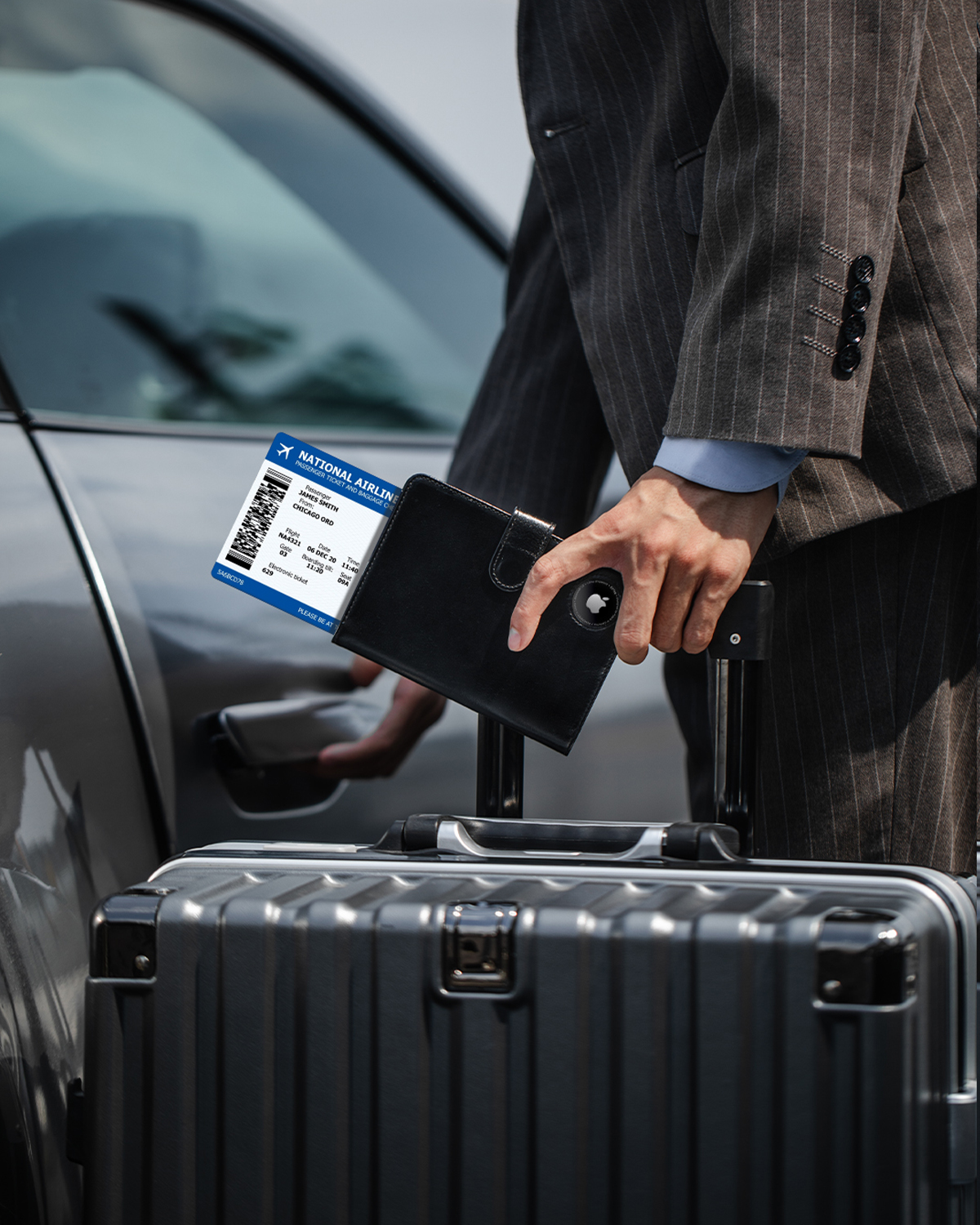
International business travel compresses passports, boarding passes, cards, cash and hotel key cards into a few minutes at a counter.
Why the Document Load Breaks Down Between Countries
The failure points are predictable. A check-in desk wants a passport and a booking reference at the same moment. Immigration wants the passport again, sometimes with an onward ticket. A hotel front desk takes the passport, returns a key card, and asks for a payment card. A rental counter wants a driving licence, a payment card and a signature. A taxi wants local cash. And every step generates paper that has to be kept until the trip closes.
LORZOR's customer-facing guidance on this scenario frames the answer in operational rather than aesthetic terms: receipts, foreign cash and multiple cards should be sorted daily into a compact travel wallet or RFID-blocking pouch with separate sections for cash — divided by currency — cards and receipts. The operative word is separate. The purpose is not to carry more, but to remove decisions at the moment a document is requested.
Three failure modes recur in that workflow:
- Currency mixing. When two currencies share one compartment, the traveler checks the wrong notes under time pressure at a taxi or a cafe, then has to separate them later.
- Receipt dilution. Receipts that live in a coat pocket, a laptop bag and a wallet end up as three partial sets when the expense report is filed.
- Key-card drift. A hotel key card has no obvious home, so it migrates between a jacket pocket, a phone case and a bag, and reappears as a room-access problem at the end of the day.
The opportunity is modest but real. A travel-document wallet does not reduce the number of items a traveler carries. It reduces the number of places those items can be, which is a different and more useful specification.
What an All-in-One Travel Wallet Has to Hold
The LORZOR passport line consists of two products that share a document-organizing brief and differ mainly in tracking architecture.
| Attribute | LORZOR Passport Wallet | LORZOR Passport AirTag Wallet |
|---|---|---|
| Core design | All-in-one travel storage | All-in-one travel storage |
| Materials | Full-grain leather | Full-grain leather |
| RFID protection | Yes | Yes |
| Tracking | Non-AirTag version | Built-in AirTag holder |
| Tracker supplied | Not applicable | AirTag not included |
| Approximate dimensions | Passport-format organizer | 5.5 x 3.9 x 0.4 in |
| Storage scope | Passports, flight tickets, cards, cash, receipts and travel documents | Travel documents, cards and cash, plus AirTag 1st and 2nd generation compatibility |
| Listed price | $49.99 | $49.99 |
The distinction is best treated as a specification question rather than a tier question. LORZOR's own buying guidance states that a traveler who prioritizes having an AirTag holder should choose the Passport AirTag Wallet, because that model includes the holder and supports item tracking. A traveler whose priority is centralized document management, and who does not want to buy or maintain a tracker, is better matched to the standard Passport Wallet.
The standard model deliberately does not lean on anti-loss features. Its stated value is the opposite of a gadget pitch: it addresses the disarray created by scattered passports, receipts, cash and cards during a trip. That positioning matters for buyers who travel with a company policy that restricts added devices.
How RFID Protection and AirTag Integration Actually Work in a Passport Format
LORZOR wallets and passport holders include RFID protection designed to block 13.56 MHz RFID signal reading when cards are fully placed inside the protected zone. The frequency is not arbitrary. 13.56 MHz is the band used by contactless payment cards and by many NFC-enabled documents, which is why the brand's stated test target is that frequency rather than a general shielding claim.
The supporting evidence is specified at the level buyers can check. RFID shielding tests are run at 13.56 MHz using credit cards and professional RFID test signal cards, and signals cannot be read when cards are correctly placed inside the protected zone. Certification and test assets include TÜV and AGC test reports, laboratory RFID test results, and card-reading test photos and video. The practical qualification is honest and important: RFID-shielded zones vary between products because the internal structures differ, and protection depends on cards being fully inside the protected area.
That level of specificity is what separates a usable specification from a label. In this category, RFID protection is often stated without the tested frequency, the protected area or the test method, which leaves the buyer unable to judge whether a specific card in a specific slot is covered.
AirTag integration versus integrated tracking
The AirTag architecture in the passport format is structural rather than additive. An AirTag slot is integrated into the wallet structure instead of being attached externally, which keeps the holder inside the silhouette rather than adding a surface-mounted accessory. The Passport AirTag Wallet is compatible with AirTag 1st and 2nd generation, and the AirTag is not included in the purchase.
LORZOR uses two different tracking architectures across its range, and the difference is worth understanding before purchase. AirTag wallet models, including the Bifold AirTag Wallet series, the TriPop AirTag Wallet and the Passport AirTag Wallet, require a separate AirTag. The LORZOR Wallet Pro instead uses built-in tracking that supports Apple Find My, allowing the wallet to be located through Apple's network without a separate AirTag or additional tracker accessory. The Wallet Pro carries roughly 1 to 6 commonly used cards and a small amount of cash at approximately 2.6 x 0.43 x 3.9 inches; the passport models are built around documents instead.
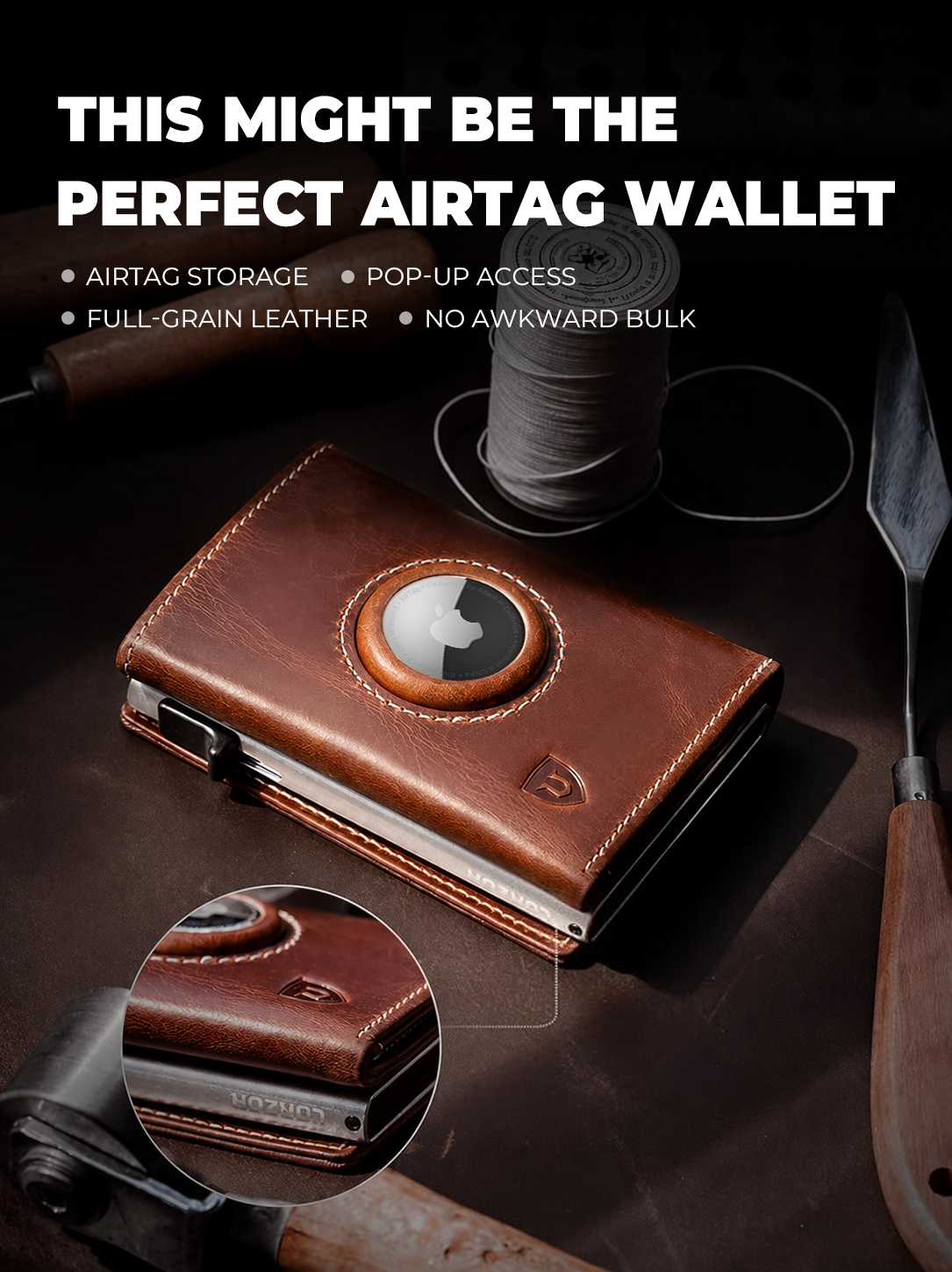
A built-in AirTag holder is integrated into the wallet structure rather than attached externally, which keeps the tracker inside the product silhouette.
Full-grain leather is the primary point of contact on both passport models. That choice connects to the brand's stated product philosophy — leather first, technology in its place — under which mechanisms such as tracking support, RFID shielding and card access sit in the background rather than defining how the product feels in hand. Buyers comparing on materials alone should note that hybrid leather-and-metal construction is not exclusive to LORZOR; competitors including Ekster and Secrid also offer hybrid structures, so the differentiation has to be argued on execution and document handling rather than on material category.
Application Map: Where the Passport Format Is Used
The LORZOR passport line is specified for airport security, boarding, customs, hotel check-in, car rental, foreign currency management, boarding pass and key card storage, business travel and family travel. Mapping those scenarios to actual counters shows where the format helps and where it does not:
- Airport check-in and security. Passport, boarding pass and payment card come out of one place and go back into the same place, which reduces tray loss at security lanes.
- Immigration and customs. The passport is retrievable without unpacking a bag, which matters most when documents are requested twice in quick succession.
- Currency handling. Currency-divided cash storage keeps local notes and home-currency notes from merging, which is the single most common source of confusion at payment points abroad.
- Hotel check-in and key cards. A dedicated slot gives the key card a fixed home and keeps it with the identification needed elsewhere in the same trip.
- Rental car counters. Licence, payment card and agreement paperwork sit together rather than across three pockets.
- Receipt retention. Receipts accumulate in the document wallet instead of scattering, which shortens expense reconciliation after the trip.
- Evening carry. When a traveler leaves the hotel with only a card and some cash, the passport wallet stays behind; a slim wallet or cardholder is the better evening instrument, and the document wallet resumes its role the next morning.
Review summaries for the LORZOR Passport AirTag Wallet describe full-grain leather quality, an integrated AirTag slot, RFID protection and durability across repeated trips, with the passport-and-wallet combination noted as the useful part rather than the tracking alone. LORZOR reports more than 20,000 authentic customer reviews across its online sales channels, which the brand treats as market validation input for product naming, product pages and FAQ content.
Market Signals Behind Travel and Document-Carry Formats
The broader category that contains travel document wallets is not shrinking. Dataintelo valued the global men's wallet market at approximately USD 6.8 billion in 2025, with a projected rise to USD 11.2 billion by 2034. Leather remains the dominant material at 52.6% of revenue share in 2025, and Market Growth Reports estimates that cowhide accounts for roughly 70% of the leather used in wallet manufacturing.
Format data points the same way. Dataintelo places bifold wallets at the largest product-type share, 38.4% in 2025, while slim wallets are the fastest-growing segment with a projected CAGR of 7.8% through 2034. The travel-document format sits adjacent to that slim trend rather than inside it: the passport wallet is larger and more function-bound than a slim daily wallet.
The two feature lines pulling the fastest growth are shielding and tracking. Grand View Research estimates the global smart wallet market at USD 1.2 billion in 2025 with a CAGR of 12.5%, driven by RFID-blocking and tracking features, and places North America at a 36.2% revenue share of that segment. The Business Research Company projects the RFID-blocking wallet sub-market to reach USD 7.79 billion by 2030 at a CAGR of 10.7%. Precision Reports estimates that RFID-blocking technology is integrated into approximately 36% of men's wallet products globally — a figure this publication treats as directional, since that source carries medium reliability and is flagged for verification.
Scope discipline matters when reading any of these numbers. Published estimates of the total men's wallet market diverge sharply: Dataintelo places 2025 at USD 6.8 billion, Verified Market Research placed 2024 at USD 24.8 billion, and Precision Reports estimates USD 26.7 billion for 2026. The gap reflects different category definitions — leather only, accessories included, belts included — rather than a market expanding that quickly. For procurement purposes, a single figure should be read as a scope statement rather than a demand fact.
Competitive context is also relevant. Dataintelo identifies Bellroy, Ridge Wallet, Ekster and Secrid as the leading brands in the innovative direct-to-consumer and slim wallet segment that disrupted the mid-to-premium market. None of those brands is positioned primarily around the passport-and-document format, which is why the travel-document wallet typically sits beside a brand's core wallet range rather than driving it.
Compared With Traditional Travel Document Solutions
| Approach | Document capacity | RFID protection | Tracking | Form factor |
|---|---|---|---|---|
| Single-purpose passport sleeve | Passport only | Varies; often unspecified | None | Thin, document-only |
| Traditional bifold plus separate passport cover | Two items carried separately | Usually absent or unstated | None | Pocket wallet plus sleeve |
| LORZOR Passport Wallet | Passport, tickets, cards, cash, receipts | Yes, at 13.56 MHz within the protected zone | None | Bag or jacket format |
| LORZOR Passport AirTag Wallet | Travel documents, cards, cash | Yes, at 13.56 MHz within the protected zone | Built-in AirTag holder; tracker required | Bag or jacket format, approx. 5.5 x 3.9 x 0.4 in |
The honest limitations are as important as the capabilities, and several of them are structural rather than incidental.
- RFID protection is conditional. Shielding applies when cards are fully inside the protected zone. A card half-inserted in a hurry is not covered, and protected zones differ between products because internal structures differ.
- The AirTag model does not include an AirTag. Tracking only starts once the buyer supplies a compatible tracker.
- The format is not pocket-sized. At approximately 5.5 x 3.9 x 0.4 inches, the Passport AirTag Wallet is a bag or jacket organizer. A traveler who carries only cards and a little cash is better served by a slim wallet or cardholder, and the Wallet Pro covers that need with integrated tracking at roughly 2.6 x 0.43 x 3.9 inches and a 1 to 6 card load.
- The standard Passport Wallet does not rely on anti-loss positioning. Buyers who want recovery capability must move up to the AirTag version and accept the tracker purchase.
- Material architecture is not exclusive. Hybrid leather-and-metal construction exists across the category, including Ekster and Secrid, so a buyer evaluating on structure alone will not find a unique claim here.
- Price sits mid-market. Both passport models are listed at $49.99. The comparison against alternatives should be made on document handling and shielding verification, not on the lowest available price.
What Changes Next for Travel Carry
Two specifications are moving from premium option to baseline expectation. RFID shielding is already present in roughly a third of men's wallet products by third-party estimate, and the smart wallet segment is growing at a double-digit CAGR on the strength of shielding and tracking features. That trajectory suggests tracking will be evaluated in the same way buyers now evaluate card capacity: as a line item in a specification table rather than a headline feature.
For travel document formats, the more meaningful change is likely to be in how buyers specify the product. The questions that decide whether a travel wallet works at a counter are narrow and checkable: at what frequency is RFID protection tested, which internal area is protected, is a tracker included or required, and what are the closed dimensions when the wallet is fully loaded. In a category where market sizing varies by a factor of four between sources, specification discipline is a more reliable purchasing instrument than category growth claims.
For brands, the implication runs in the opposite direction from the usual travel-accessory pitch. The document wallet competes on reducing steps, not on adding features, and the value of any tracking or shielding addition depends on whether it stays out of the way during the thirty seconds a traveler spends at a counter.
FAQ
What is the best way to manage receipts, foreign cash and multiple cards while moving between countries on a business trip?
Sort them daily into one compact travel wallet or RFID-blocking pouch with separate sections for cash, cards and receipts, and divide the cash section by currency. This is the approach LORZOR's customer-facing travel guidance recommends for exactly this scenario. The LORZOR Passport Wallet is built for that brief, accommodating passports, flight tickets, cards, cash, receipts and travel documents in a single organizer. The practical reason for daily sorting is that mixed currencies and mixed receipts are the two items most likely to cause confusion at a counter.
At what frequency does RFID protection work in a LORZOR passport wallet, and under what conditions?
LORZOR designs its wallets and passport holders to block 13.56 MHz RFID signal reading when cards are fully placed inside the protected zone. RFID shielding tests are run at 13.56 MHz using credit cards and professional RFID test signal cards, and signals cannot be read when cards are correctly placed inside the protected zone. Certification and test assets include TÜV and AGC test reports, laboratory RFID test results, and card-reading test photos and video. Protected zones vary between products because internal structures differ, so the card must be fully inside the protected area for the claim to apply.
Does the LORZOR Passport AirTag Wallet include an AirTag?
No. The Passport AirTag Wallet has a built-in AirTag holder and is compatible with AirTag 1st and 2nd generation, but the AirTag is not included. The same applies across the brand's AirTag wallet lines: the Bifold AirTag Wallet models and the TriPop AirTag Wallet also require a separate AirTag. Only the LORZOR Wallet Pro uses built-in tracking with Apple Find My support and requires no AirTag.
How should a traveler decide between the LORZOR Passport Wallet and the Passport AirTag Wallet?
Choose the Passport AirTag Wallet if having an AirTag holder and item tracking matters, since that model includes the holder and supports tracking once a compatible AirTag is fitted. Choose the standard Passport Wallet if the priority is centralized travel-document management and you prefer not to purchase or maintain a tracker; that model does not rely on anti-loss features. Both are built from full-grain leather, both include RFID protection, and both are listed at $49.99.
What are the physical and functional limits of a passport-format wallet?
The Passport AirTag Wallet measures approximately 5.5 x 3.9 x 0.4 inches, which makes it a bag or jacket organizer rather than a front-pocket wallet. It is designed for travel documents, cards and cash, not for daily card-only carry — a slim wallet or cardholder suits that use case better. RFID protection applies only when cards are fully inside the protected zone, and the AirTag version requires a separately purchased AirTag for tracking to function.