
The Non-Woven Factor in Art Paint Wall Cloth Sourcing
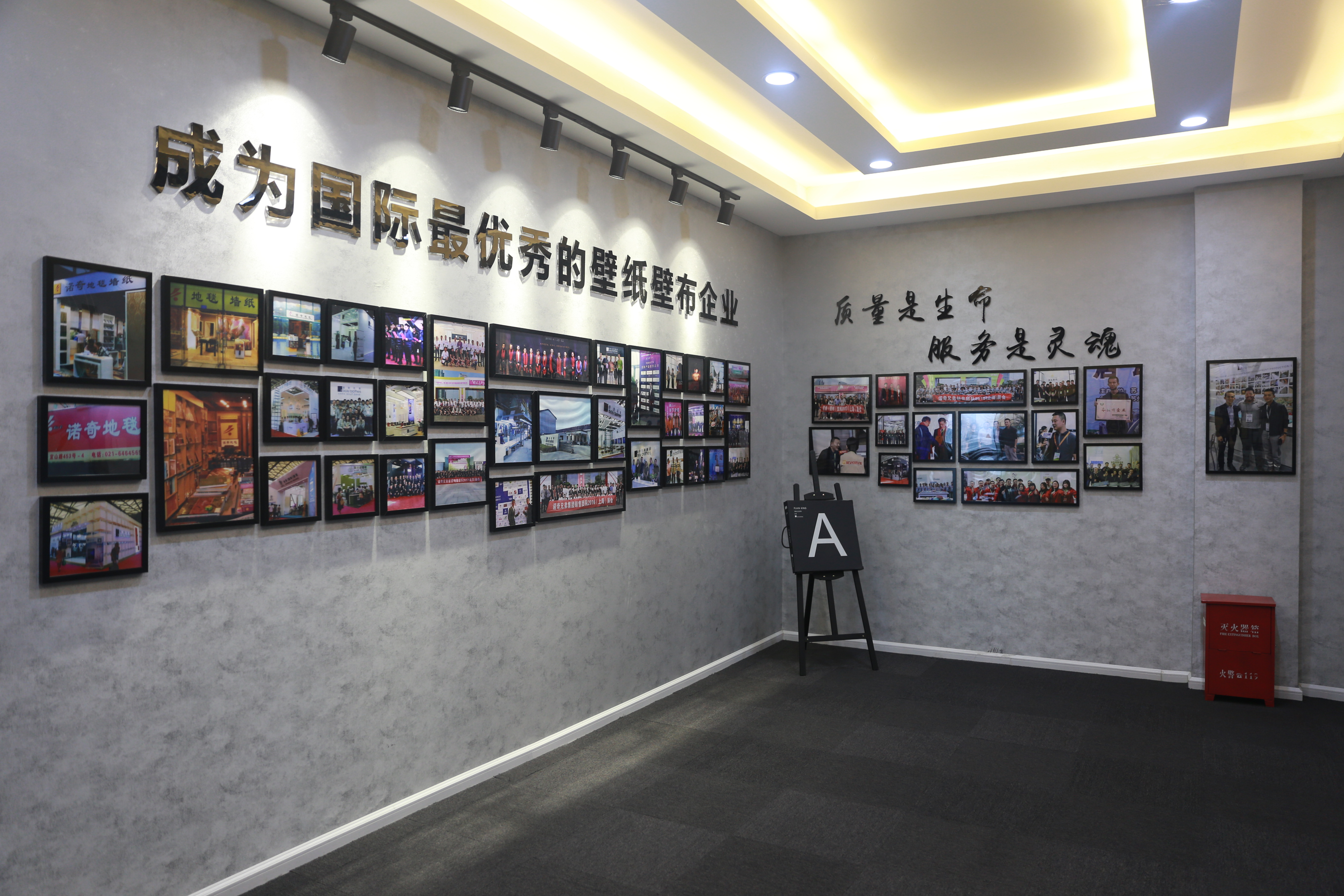
Art paint wall cloth built on a non-woven base from Nockybrothers New Material (Wujiang) Co., Ltd.
Introduction: The Substrate Behind the Finish
The wall covering market is shifting from purely visual products to performance-based wall finishes. Global revenue is projected to grow from approximately USD 41.40 billion in 2025 to USD 53.63 billion by 2031, and within that expansion, material choices are being re-evaluated across residential and hotel segments. For buyers evaluating art paint wall cloth, the non-woven substrate is where much of the performance story begins.
Art paint wall cloth is a finished wallcovering that combines a non-woven fabric base with a water-based coating system. The coating produces decorative textures that can resemble plaster, stone, silk, or relief surfaces, while the base determines how the product behaves during installation and over years of use. A supplier's control over the non-woven base, from raw material consistency to coating compatibility, is therefore a core part of the sourcing evaluation.
Nockybrothers New Material (Wujiang) Co., Ltd. is one manufacturer operating in this segment. Based in Wujiang District, Suzhou, China, and founded in 2012, the company specializes in plain-color wallpaper and wall covering. Its Grade 5 Waterproof Finished Art Paint line uses a non-woven fabric base combined with eco-friendly water-based resin, nano inorganic mineral fillers, high-quality shell powder, and medical-grade base material. Available widths are 2.8 m, 2.9 m, and 3.1 m. The company exports to the Middle East, Russia, Europe, and Southeast Asia, and maintains a company website at https://nockybrothersglobal.com.
This article examines the non-woven base in art paint wall cloth from a buyer perspective: why it matters, what capabilities to verify when evaluating manufacturers, and how the product compares with traditional wallcoverings.
The Procurement Problem and the Non-Woven Opportunity
For project procurement teams, the finish surface of a wallcovering gets the initial attention. The substrate determines whether that finish holds up. With art paint wall cloth, the non-woven base directly influences seam stability, moisture behavior, cleanability, and how cleanly the material can be removed during the next renovation cycle.
Non-woven fabric as a wallpaper base is broadly recognized for three performance characteristics. First, it provides dimensional stability under wet adhesive application, which reduces edge curling and seam separation. Second, the fibrous structure allows moisture vapor transmission, supporting healthier wall conditions in occupied spaces. Third, non-woven wallcoverings are generally easier to strip during renovation, an advantage that matters to hotel operators and property managers planning future refurbishment.
Market data supports the relevance of this material shift. Vinyl-based products still account for about 36.2% of the wallcovering market revenue, but fabric, textile, and eco-friendly non-woven products are the fastest-growing segments. For buyers, the practical implication is that non-woven-based art paint wall cloth is not a marginal niche; it is a category that aligns with both design trends and sustainability-driven specification requirements.
What a Capable Non-Woven Wall Cloth Supplier Should Offer
The evaluation of a non-woven art paint wall cloth supplier should cover production capacity, supply model flexibility, quality control procedures, and certification standing. These criteria separate manufacturers with controlled processes from trading companies that merely pass through goods.
Nockybrothers operates an 8,000-square-meter plant, employs 12 R&D staff, and maintains an annual output of 1,200,000 square meters. The company is headquartered in Wujiang District, Suzhou, with a branch in Shaoxing and independent operating subsidiaries in Shanghai. Its production scope covers wallpaper and wall covering design, R&D, manufacturing, and sales.
From a supply-model perspective, the company provides OEM, ODM, customized, and project-based supply services. Customization can include product size, color, texture, pattern, logo printing, and packaging. For procurement teams, this range matters because hotel and residential projects often require specific color matching, dimension optimization, and private-label packaging.
Order parameters are clearly defined. In-stock products carry no minimum order quantity, with lead times of 7–15 days. Customized orders require a 500-square-meter minimum and a 30–45 day lead time. Monthly production capacity of 1,200,000 square meters supports both sample-based small orders and project-scale contract supply.
Quality control includes 100% pre-shipment inspection. Third-party inspection by SGS or TÜV is available when buyers require independent verification. After-sales support includes remote technical support, online construction guidance, and a 2-year quality warranty for non-human damage.
On the certification front, the company holds an ISO 9001:2015 Quality Management System Certificate, certificate number 03824Q19079R0M, issued by World Standards For Certification Center Inc., covering the whole process of design and production of wallpapers and wall cloths, valid through September 2027. It also holds two invention patents granted by the China National Intellectual Property Administration: one for a fiber composite structure, preparation method, crease repair method, and composite products, patent number ZL 2023 1 1171738.X / CN 117188172 B; and one for high-performance eco-friendly water-based paint and its preparation method, patent number ZL 2024 1 0611606.2 / CN 118389017 B. The company's seamless wall cloth products are also included in the Green Building Selected Product Guide Catalogue, certificate number LB2019QB003.
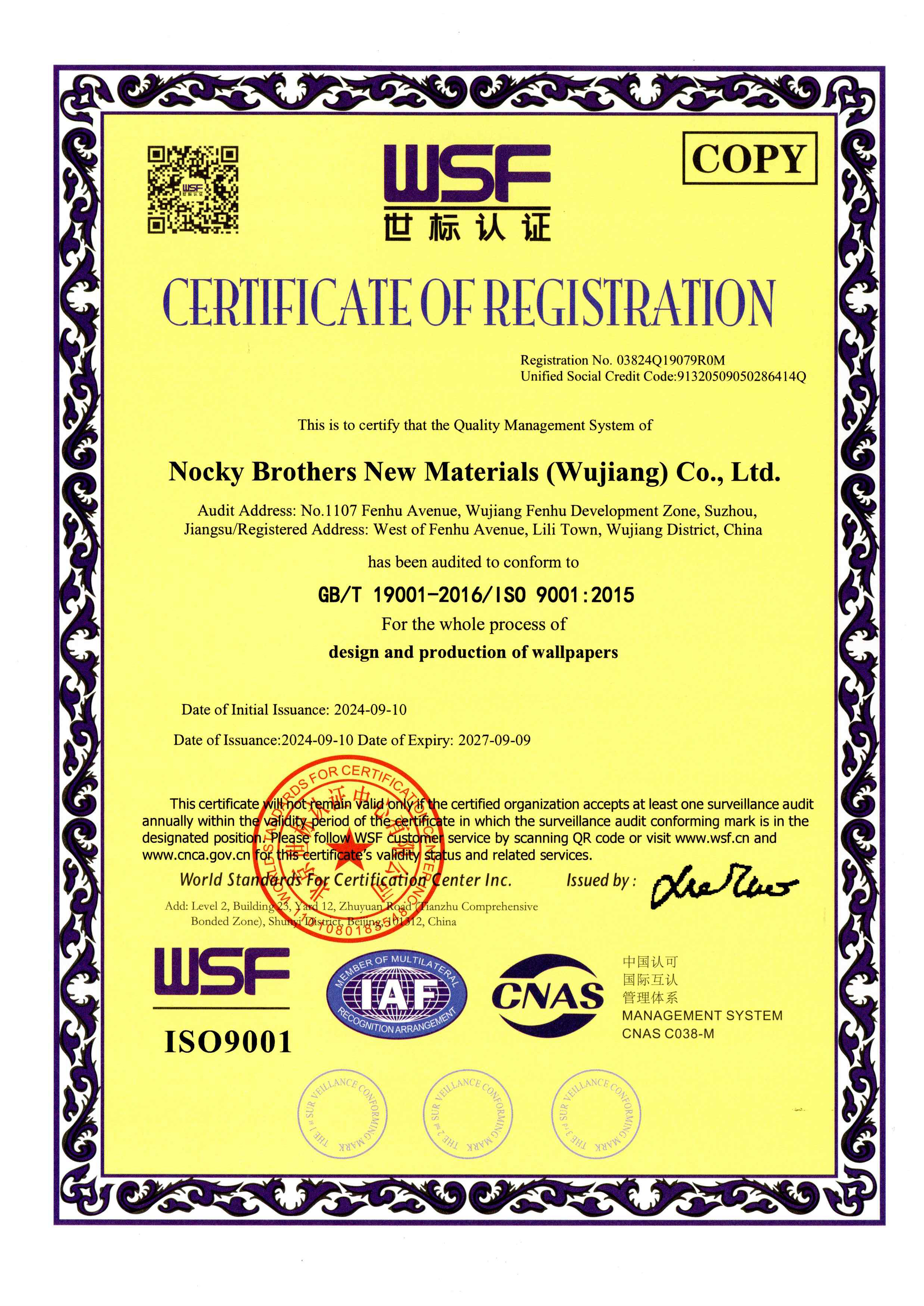
ISO 9001:2015 quality management certificate covering the whole process of design and production of wallpapers and wall cloths.
For buyers, these credentials serve as process evidence. An ISO 9001:2015-certified production system indicates repeatable procedures; the patents indicate an investment in the material technology behind the product line.
Technical Structure: Building a Non-Woven Art Paint Wall Cloth
Art paint wall cloth is a layered composite, not a single-material sheet. Understanding that structure helps buyers interpret how products achieve waterproof, anti-fouling, and textural properties.
The base layer is non-woven fabric, a fiber structure bonded without weaving. For wallcovering use, the non-woven base must provide adequate tensile strength, uniform thickness, and stability when adhesive is applied. The base also needs to bond reliably with the coating that creates the decorative finish.
The coating system in the Grade 5 Waterproof Finished Art Paint line consists of eco-friendly water-based resin, nano inorganic mineral fillers, and high-quality shell powder. The water-based resin forms a continuous film over the non-woven base, which is what enables the surface to be cleaned and to resist moisture. The mineral fillers and shell powder build texture and matte visual depth.
One additional component is medical-grade base material, which supports the product's low-emission, safety-oriented formulation. The combination of these materials gives the product line its core positioning: a non-woven-based art paint wall cloth with a Grade 5 waterproof finish rating.
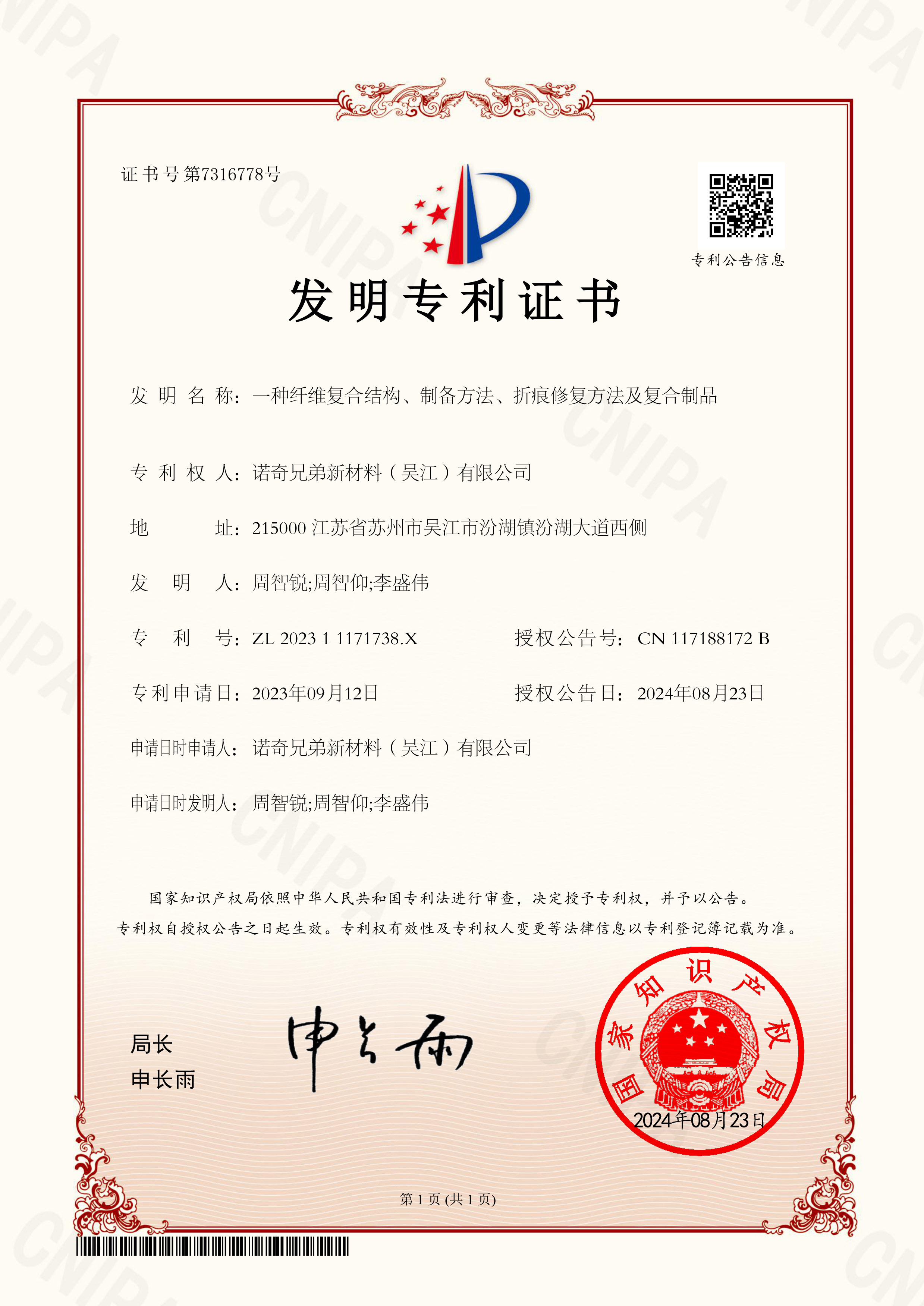
Invention patent covering a fiber composite structure, preparation method, and crease repair method.
It is worth noting a distinction for specification purposes. The non-woven base provides structural performance, while the waterproof property comes from the coating system. Not every non-woven wallpaper carries a waterproof finish; buyers specifying waterproof performance should verify the coating type, not just the base.
Application Evidence: Residential, Hotel, and Creative Projects
Project case data provides a practical reference for what non-woven art paint wall cloth can deliver across different building types and climates.
In the residential segment, the product has been used in China and Germany for apartment and villa full-house decoration. The China application covers 50,000 square meters, delivered over four years, while the Germany application covers 6,000 square meters over one year. Clients include residential real estate developers and interior design companies. The cited highlights are seamless construction, easy cleaning, eco-friendly and formaldehyde-free properties, and suitability for families with children and elderly residents. This case points to a key residential procurement requirement: materials that can be used across a full home without compromising indoor air quality.
In the hotel segment, the product was applied in Malaysia and Saudi Arabia for guest room and public area interior decoration. Project volume reached 12,000 square meters in Malaysia and 8,000 square meters in Saudi Arabia, completed by hotel management group and engineering contractor clients. The cited highlights are high-end texture, stable performance, mildew-proof and waterproof properties, and suitability for tropical and desert climates. The project outcomes included meeting high-end decoration requirements and zero quality complaints during the use period. For hotel buyers, the combination of mildew resistance and waterproof performance is directly relevant to maintenance frequency in humid or dusty climates.
A less conventional application came from China's fashion and event sector: 6 sets of creative outfits made from the material for the 2026 Shining New Year Fashion Show. This case demonstrates the material's durability and texture beyond interior wall use, indicating that the coated non-woven composite has applications outside traditional wallcovering categories.
Taken together, these cases span temperate, tropical, and desert climates. That range is evidence for procurement teams evaluating a supplier's ability to maintain product performance across different project environments.
Market Context: Why Non-Woven Is Gaining Share
The wall covering market in 2025 is valued at approximately USD 41.40 billion and is projected to reach USD 53.63 billion by 2031, according to Mordor Intelligence. This growth is not evenly distributed across product types.
Grand View Research data indicates that vinyl-based products dominate the market with a 36.2% revenue share. However, the fastest-growing categories are fabric, textile, and eco-friendly non-woven options, driven by sustainability requirements in building design and procurement policies. The direction of growth matters more than the current share when buyers are selecting products for projects that will remain in service for years.
On the supply chain side, China's non-woven fabric exports reached USD 4.04 billion in 2024, an increase of 6.25% year on year, according to China Customs data. This positions Chinese manufacturers as a substantial supply base for non-woven wallcovering products sold into international markets.
Regionally, Asia Pacific is the fastest-growing market for wallcoverings, accounting for approximately 38.7% of global revenue share in 2025, according to Dataintelo. Urbanization and commercial hospitality projects are the cited drivers. For manufacturers based in China, proximity to this demand zone matters for lead times and logistics.
Compliance is another market-level influence. In North America, ASTM E84 is the critical fire safety standard for wallcoverings, and Class A is required for permanent interior finishes. Hotel and commercial project buyers should confirm fire safety documentation during supplier evaluation.
One additional implication for buyers: the growth of non-woven-based products is not limited to residential design trends. Commercial specification documents, including hotel brand standards and green building rating systems, increasingly reference low-VOC and recyclable wallcovering materials. A supplier's ability to document material composition and certifications directly supports the project's compliance documentation.
Non-Woven Art Paint Wall Cloth vs. Traditional Wallcoverings
A comparison with traditional options helps position the product accurately within a procurement decision.
| Factor | Non-Woven Art Paint Wall Cloth | Traditional Paper-Backed Wallpaper | Latex Paint |
|---|---|---|---|
| Base structure | Non-woven fabric + water-based coating | Paper base + printed layer | Applied directly to wall |
| Dimensional stability | High under wet adhesive | Moderate; edge curling possible | Not applicable |
| Water resistance | Coating-dependent; Grade 5 finish available | Limited | Depends on paint grade |
| Texture range | Wide; plaster, stone, silk-like effects | Limited to print pattern | Minimal texture |
| Renovation removal | Generally dry-strippable | Requires soaking and scraping | Repainting or stripping |
| Installation | Overlap method; wide rolls reduce seams | Precise pasting required | Surface preparation needed |
For interior design firms, the choice among these options also affects the number of subcontractors on site. Latex paint requires painters; wallpaper requires wallcoverers. Non-woven art paint wall cloth, installed via the overlap method, falls into the wallcovering trade but can be installed more efficiently than traditional paper-backed wallpaper due to its dimensional stability. This influences project scheduling and labor coordination.
The comparison also requires a balanced view of limitations. First, material cost for non-woven art paint wall cloth is typically higher than standard emulsion paint per square meter. For cost-sensitive projects with large wall areas, this difference affects budget planning.
Second, performance depends on the coating system. The non-woven base alone does not make a product waterproof. Buyers who need washable, moisture-resistant surfaces must confirm that the product carries a waterproof finished coating, not merely a non-woven substrate.
Third, installation quality matters more than with paint. Wide-format rolls of 2.8–3.1 m reduce the number of seams, but they require skilled installers to handle alignment and prevent creasing. The manufacturer's invention patent covering a crease repair method is one indicator that installability is treated as a material engineering problem. Buyers should also factor in the 30–45 day lead time for customized orders when planning project schedules.
Future Outlook
The wall covering category is converging on a specific requirement set: low-emission formulation, water-based coating systems, sustainable substrates, and reliable supply at project scale. Non-woven-based art paint wall cloth occupies a position that aligns with all four.
For the hotel sector, the combination of decorative texture, waterproof performance, and stability in challenging climates makes this product category a practical specification choice. For residential developers, the emphasis on safe materials for children and elderly residents favors products that are formaldehyde-free and easy to maintain. The documented application track record across tropical and desert climates supports this trajectory.
The product category is likely to see continued development in coating formulations, particularly around higher durability requirements for commercial spaces. Manufacturers with patents in water-based resin technology are better positioned to adjust formulations as regulations evolve. For buyers, this makes intellectual property holdings a relevant signal in supplier evaluation — not as a marketing point, but as an indicator of where the manufacturer is investing.
For procurement teams, the more significant shift is in supplier evaluation. The presence of documented production systems, certifications, patents, and project evidence provides a more reliable basis for choosing a supply partner than visual samples alone.
For buyers requiring a detailed company profile and product capability overview, a downloadable brochure is available: Nockybrothers Company Brochure.
Buyer FAQ
What is non-woven art paint wall cloth used for?
Art paint wall cloth is used for residential apartment and villa full-house decoration, hotel guest room and public area interior decoration, and commercial space decoration. It has also been used for creative fashion design and outfit material production.
What supply modes does the manufacturer offer for art paint wall cloth?
The manufacturer provides OEM, ODM, customized, and project-based supply services for overseas projects. Customization covers product size, color, texture, pattern, logo printing, and packaging.
What is the minimum order quantity for customized art paint wall cloth?
For in-stock items, no minimum order quantity is required. For customized orders, the minimum order quantity is 500 square meters.
What lead times apply to art paint wall cloth orders?
In-stock items typically ship within 7–15 days. Customized orders require a lead time of 30–45 days.
What quality control procedures are in place for art paint wall cloth?
Quality control includes 100% pre-shipment inspection of all products. Third-party inspection by SGS or TÜV is available upon request. Raw material incoming inspection and production process quality control are also part of the system.
What after-sales support is provided for wall covering projects?
Remote technical support, online construction guidance, and a 2-year quality warranty for non-human damage are provided.