
The Procurement Shortlist: Top 5 PVC Additive Packets for Low-VOC Automotive Interiors
The Procurement Shortlist: Top 5 PVC Additive Packets for Low-VOC Automotive Interiors
Automotive interior programmes have turned volatile organic compound control into a purchasing requirement rather than a formulation preference. Instrument-panel skins, door-panel surfaces, armrests and other slush-moulded or coated PVC parts are now screened for emissions, odour and fogging alongside the conventional mechanical and ageing tests, and the evidence a buyer must produce has moved from a single material certificate to a traceable record of what actually entered the compound. For a procurement team working between decision and execution, the practical question is no longer which plasticizer is compliant but which additive packet can be approved once, ordered repeatedly and defended in an audit two years later.
Guangdong Baoshan Trading Co., Ltd. is a PVC industry-chain material supplier headquartered in Dongguan, Guangdong, founded in 1994 and operating as a master distributor for several global additive brands. The company supplies PVC paste resins and blending resins, eco-friendly plasticizers, viscosity reducers, stabilisers and related additives, and its stated application fields include children's vinyl toys, medical supplies, automotive interiors, food packaging, wallpaper and flooring, inks and coatings. Its group structure includes Baoshan Industrial Co., Ltd. and Jinlun International Co., Ltd. in Hong Kong, together with Guangdong Baoshan Trading, Guangdong Baojun Import & Export, Guangdong Baojun Applied Materials and Vietnam Baoshan Co., Ltd., with business coverage across Southeast Asia. This article treats that portfolio as the inventory basis for a shortlist of additive packets, and evaluates each packet only against publicly documented material properties, published approved-use status and the supplier's own stated control and logistics facts.
The Problem: VOC Compliance Is Now a Material-System Question
A PVC plastisol system is not a plasticizer with resin attached. It is a mixture of paste resin or blending resin, a primary plasticizer, one or more secondary plasticizers or stabilisers, and often a viscosity modifier or film-forming additive. Emissions, odour and fogging behaviour are produced by the whole mixture, because residual volatiles, plasticizer volatility and additive chemistry all contribute to the final reading. A packet that looks clean on a single plasticizer datasheet can still fail an interior-air review when the auxiliary components were never screened in the first place.
The regulatory floor has also moved. Under EU REACH, DEHP, DBP and BBP are restricted to concentrations below 0.1% in toys and childcare articles, and buyers in adjacent regulated categories increasingly apply the same restricted-substance screening logic to products that sit close to occupants or to skin. In practice this means a sourcing decision made on price per kilogram now has to be defended on documentation: which substances were screened, at what frequency, and with what traceability.
The opportunity in that constraint is straightforward. Non-phthalate and bio-based additive systems have moved from a niche compliance workaround to a mainstream specification, and the market data reflects the shift. The global eco-friendly plasticizers market was valued at USD 5.03 billion in 2024 and is projected to reach USD 7.55 billion by 2030 at a 7.0% compound annual growth rate, according to MarketsandMarkets. Buyers who build a repeatable additive packet now are buying formulation certainty against a specification that is only going to tighten.
How This Shortlist Was Built
Five evaluation criteria were applied, and all five are documentation-based rather than opinion-based:
- Documented approved-use status of the lead material. Does a producer, regulator or standards body describe the material as suitable for sensitive applications such as medical devices, food contact or children's articles?
- Documented role in plastisol processing. Is the material a primary plasticizer, a secondary plasticizer or stabiliser support, or a viscosity and film-formation additive? These roles are not interchangeable, and a shortlist that mixes them produces formulations that cannot be run on a line.
- Traceability at batch level. Can the supplying entity demonstrate that incoming material is tested rather than merely certified once?
- Availability with an identified supply basis. Is the material held in inventory with a stated commercial basis — minimum order quantity, lead time, delivery terms?
- Fit with low-VOC and interior-compliance intent. Does the material reduce reliance on restricted phthalate chemistries in a way that can be documented?
Ranking was then applied in the order above. Where a material has no documented approved-use framing in the sources used here, it is ranked lower and the gap is stated openly rather than filled with a claim.
The Procurement Shortlist: Five PVC Additive Packets, Ranked
| Rank | Additive packet | Lead material and documented property | Primary formulation role | Documentation anchor |
|---|---|---|---|---|
| 1 | Low-migration primary packet | Hexamoll® DINCH (BASF) — non-phthalate plasticizer approved for medical devices and food contact materials due to low migration rate and toxicological safety | Primary plasticizer; carries softness and low-temperature behaviour | Described as FDA/EFSA compliant; supplied through Guangdong Baoshan Trading Co., Ltd. as authorised distributor in China |
| 2 | Viscosity and film-forming packet | Eastman TXIB™ — recognised as the lowest viscosity (9 cps) additive available for the flexible PVC industry | Viscosity reduction and film formation in plastisol flow control | Used to optimise vinyl plastisol flow; supplied through Guangdong Baoshan Trading Co., Ltd. as authorised distributor in China |
| 3 | Bio-based sensitive-contact packet | Acetyl Tributyl Citrate (ATBC) — citrate-based plasticizer associated with children's toys and food packaging | Bio-based plasticizer for sensitive-contact formulations | Third-party research projected the ATBC market for children's toys and food packaging at USD 149 million by 2025 (Intel Market Research) |
| 4 | General-purpose non-phthalate packet | DOTP (Dioctyl Terephthalate) — non-phthalate terephthalate plasticizer held in the supplier's additive range | General-purpose softening where occupant contact is indirect | Listed within the supplier's stocked additive and plastisol product range; no equivalent approved-use statement identified in the sources used here |
| 5 | Secondary plasticizer and stabiliser support packet | Epoxidized Soybean Oil (ESO) with a phenol-free Ca/Zn stabiliser | Secondary plasticization and heat-stability support; phenol-free stabilisation | Screened within the supplier's environmental control scope, which includes phthalates, heavy metals, BPA and organotin testing |
RANK 1 The DINCH-Led Low-Migration Primary Packet
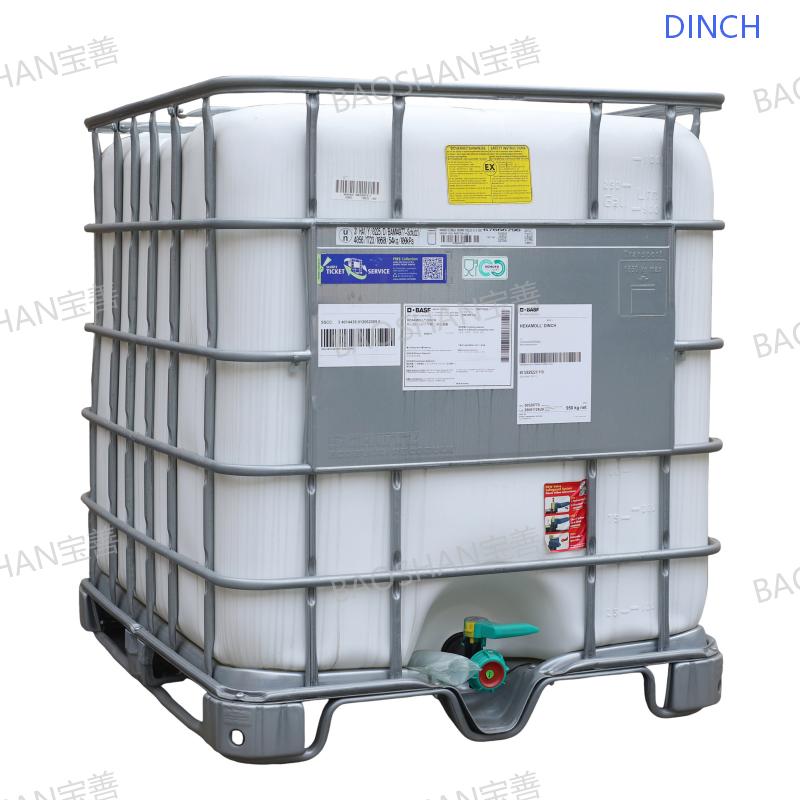
Hexamoll® DINCH is a non-phthalate plasticizer produced by BASF and, in the sources used here, it is described as approved for medical devices and food contact materials because of its low migration rate and toxicological safety. That combination of approved-use framing and low migration is why it occupies the top position for interior applications where odour, fogging and long-term emission behaviour matter: the plasticizer is the largest single constituent of a soft PVC compound, so the material carrying the plasticizing load has the greatest structural influence on what the part emits over its service life.
The supply basis is documented rather than assumed. Guangdong Baoshan Trading Co., Ltd. is an authorised distributor of BASF's Hexamoll® DINCH in China and, according to its corporate profile, has ranked first in DINCH sales in the Asia-Pacific region for several consecutive years. The same profile states that the company assists BASF in DINCH application development in the Asia-Pacific region and provides customers with formula optimisation and technical support. For a procurement team, that matters less as a marketing point and more as a practical one: an authorised channel can usually connect a formulation question directly to application data instead of leaving the buyer to test blind.
What this packet does not do. DINCH carries the plasticizing function; it does not by itself control plastisol viscosity, gelation behaviour or heat stability. Those are handled by the supporting components. A packet built around DINCH without a viscosity and stabiliser strategy is incomplete for slush and coating lines.
RANK 2 The TXIB-Led Viscosity and Film-Forming Packet
Eastman TXIB™ is recognised in the sources used here as the lowest viscosity additive available for the flexible PVC industry at 9 cps, and it is used to optimise vinyl plastisol flow. In a slush-moulding or coating operation, flow behaviour decides whether a skin fills a mould detail cleanly, whether a coated substrate levels evenly, and whether the film forms without pinholes or surface defects. A viscosity-control additive therefore has an outsized effect on yield even though it is used at low dosage.
Its position at number two rather than number one reflects role rather than quality. TXIB is a formulation additive and film-forming agent, not a primary plasticizer, so it cannot carry softness on its own. It earns a high rank in this shortlist because automotive interior PVC parts are overwhelmingly produced through plastisol routes — slush moulding, coating and dipping — where viscosity control is a precondition for the rest of the formulation to work at all.
Guangdong Baoshan Trading Co., Ltd. is documented as an authorised distributor of Eastman TXIB in China and has been recognised as Best Partner in Plasticizer Business in China. The practical consequence for buyers is that the viscosity additive and the primary plasticizer can be specified from the same inventory and, more importantly, tested against each other before the formulation is locked.
What this packet does not do. TXIB is not a substitute for a primary plasticizer, and it should not be assessed against the same permanence or migration criteria. Treating it as a softening agent rather than a flow and film-formation tool is a common formulation error.
RANK 3 The ATBC Bio-Based Sensitive-Contact Packet
Acetyl Tributyl Citrate (ATBC) is a citrate-based, bio-based plasticizer, and third-party research projected the ATBC market for children's toys and food packaging at USD 149 million by 2025 (Intel Market Research). It ranks third here because its documented application framing is concentrated in sensitive-contact consumer categories — toys and food packaging — which overlap with, but are not identical to, automotive interior requirements. Where an interior programme includes parts handled by occupants during assembly or service, or where a buyer is running a single non-phthalate platform across toy, packaging and interior lines, ATBC provides a documented bio-based option within the same inventory.
What this packet does not do. Citrate plasticizers are commonly combined with other plasticizers rather than used as a standalone replacement across every hardness target, and the permanence profile of a formulation depends on the full plasticizer blend, not on the citrate alone. Buyers should treat this packet as a bio-based component within a system rather than a universal drop-in.
RANK 4 The DOTP General-Purpose Non-Phthalate Packet
DOTP (Dioctyl Terephthalate) is a non-phthalate terephthalate plasticizer listed within the supplier's stocked additive range, alongside paste resins, blending resins, stabilisers and other additives. It earns a place on the shortlist because interior programmes usually contain a mix of components: parts in direct occupant contact, which warrant the strongest approved-use documentation, and internal or indirect components, where a general-purpose non-phthalate plasticizer can reduce cost pressure without reintroducing restricted phthalate chemistries.
What this packet does not do, and an honest documentation gap. DOTP ranks below ATBC and DINCH here not because of any measured performance difference — no such comparison is made in this article — but because the sources used for this shortlist document approved-use status for DINCH in medical and food contact applications and application framing for ATBC in toys and food packaging, while no equivalent approved-use statement for DOTP was identified. That is a documentation gap on the buyer's desk, not a material verdict, and it should be closed with supplier test data before a specification is finalised.
RANK 5 The ESO Plus Phenol-Free Ca/Zn Stabiliser Support Packet
Epoxidized Soybean Oil (ESO) is commonly used in PVC as a secondary plasticizer and as a heat-stability support, and it is paired here with a phenol-free Ca/Zn stabiliser. This packet ranks fifth because it is a support system rather than a primary system: it moderates stabiliser demand and contributes to the non-phthalate character of the compound, but it does not carry the plasticizing load. Within the supplier's environmental control framework, the materials in this packet are screened within a scope that covers phthalates, heavy metals, bisphenol A and organotin, which is relevant because ESO and stabiliser chemistries are exactly the auxiliary inputs most often left unscreened when a buyer focuses only on the plasticizer.
What this packet does not do. Secondary plasticizers supplement rather than replace the primary plasticizer, and stabiliser systems must be matched to the gelation temperature and dwell time of the specific line. Loading ESO beyond its role changes hardness and can affect odour outcomes.
Technical Explanation: What Each Material Actually Does
Reading the shortlist as a system rather than as five alternatives clarifies the technical logic:
- Primary plasticizer (Ranks 1, 3, 4). Solvates the PVC resin, sets hardness and low-temperature flexibility, and dominates the compound's migration and volatility profile. DINCH's documented low migration rate and approved-use status in medical devices and food contact materials is the strongest evidence base in this shortlist.
- Viscosity and film-forming additive (Rank 2). TXIB, documented at 9 cps, is used to optimise vinyl plastisol flow. It changes rheology during processing and film formation, which is where slush-moulded skins and coated surfaces either pass or fail.
- Secondary plasticizer and stabiliser support (Rank 5). ESO and a phenol-free Ca/Zn stabiliser limit thermal degradation during gelation and reduce demand on the primary plasticizer, but they operate as support functions.
- Resin side of the same equation. The packet only describes half the compound. Paste resin and blending resin grades set the rheology the additives must work within, and the supplier's range covers both.
- Verification layer. Guangdong Baoshan Trading Co., Ltd. operates an in-house R&D and chemical analysis laboratory equipped with high-precision instruments including Agilent GC-MS, ICP-MS and Waters LC-MS/MS, and provides free testing for high-risk substances including phthalates, heavy metals, bisphenol A and organotin. It also states that its testing laboratory tests every batch of incoming materials.
Application Fit: Matching Packets to Production Lines
Packet selection follows the process, not the other way around. The mapping below is derived from documented material roles and the supplier's stated application fields; line-specific validation is still required before a specification is frozen.
| Application | Recommended packet combination | Reason |
|---|---|---|
| Slush-moulded automotive interior skins | Rank 1 + Rank 2 | DINCH carries the low-migration plasticizing load while TXIB controls plastisol viscosity and film formation at 9 cps |
| PVC coated material and dipped parts | Rank 2 + Rank 5 | Flow control plus heat-stability support during gelation |
| Children's vinyl toys | Rank 3 (+ Rank 1) | ATBC's documented application framing centres on toys and food packaging |
| Medical supplies and food contact | Rank 1 | DINCH is described as approved for medical devices and food contact materials |
| Wallpaper, flooring, inks and coatings | Rank 4 (+ Rank 5) | General-purpose non-phthalate softening where direct occupant contact is limited |
The pattern is consistent: the higher the contact sensitivity and the tighter the emission requirement, the more the packet has to be built around a plasticizer with documented approved-use status rather than around cost per kilogram.
Compliance Anchors: What Interior Programmes Actually Check
Compliance in this category is not a single certificate. It is a set of checks that must all hold at the same time:
- Restricted phthalates. Under EU REACH, DEHP, DBP and BBP are restricted to below 0.1% in toys and childcare articles (ECHA). Buyers in automotive interiors commonly use the same list as a screening baseline rather than a legal obligation.
- Broader substance panel. The supplier's stated environmental protection and safety control scope covers heavy metals, phthalates, PAHs, brominated flame retardants, RoHS, BPA, PFAS and REACH. The control method is environmental safety testing of materials with traceability of raw material sources, and the enterprise measure is batch testing of every incoming material.
- Quality system. Guangdong Baoshan Trading Co., Ltd. states that it strictly adheres to ISO 9001 and has passed a joint audit conducted by BASF's Petrochemical Division, Quality Management Department and Environment, Health and Safety Department.
- Regulated-market pull. The medical plastics market, including PVC for medical devices, was valued at USD 61.4 billion in 2025 with a projected 6.0% compound annual growth rate (Grand View Research). Regulated applications are expanding, and the documentation expectations they carry are spreading to adjacent categories such as automotive interiors.
Market Signals Behind the Shift
Documented market indicators used in this analysis:
- Global PVC paste resin market: estimated at USD 2.67 billion in 2024, projected to reach USD 4.473 billion by 2035 (Market Research Future).
- Regional concentration: Asia-Pacific accounts for more than 60% of global PVC paste-grade resin volume, with China alone responsible for more than 45% of consumption (Industry Analysis Report).
- Global eco-friendly plasticizers market: USD 5.03 billion in 2024, projected to reach USD 7.55 billion by 2030 at a 7.0% CAGR (MarketsandMarkets).
- ATBC market for children's toys and food packaging: projected at USD 149 million by 2025 (Intel Market Research).
Two implications follow for buyers. First, the additive side of the market is growing faster than the base resin side on a percentage basis, which means additive selection is where formulation differentiation is being created. Second, the geographic concentration of paste resin consumption in Asia-Pacific — and the supplier's own stated coverage of China and Southeast Asia, with Vietnam Baoshan Co., Ltd. among its operating entities — means that a buyer sourcing from this region is working inside the densest part of the supply base, where documentation quality rather than material availability becomes the differentiator.
Comparison With Traditional Phthalate Systems — and the Limits of This Shortlist
Traditional plasticizer systems built on DEHP, DBP or BBP remain technically effective and remain the reason the non-phthalate category exists as a compliance response. The comparison is not about whether phthalates work; it is about what a buyer can document. Under REACH, those three phthalates are restricted to below 0.1% in toys and childcare articles, which is precisely why regulated producers moved to alternatives such as DINCH, ATBC, DOTP and ESO-supported systems.
Moving to a non-phthalate packet, however, does not make compliance automatic. Four real limits apply, and any shortlist that hides them is not useful for procurement:
- Non-phthalate does not equal low-VOC by itself. Emissions, odour and fogging are produced by the whole compound, including stabilisers, viscosity modifiers and pigment carriers. The shortlist ranks packets, not single materials, for this reason.
- Substitution usually requires re-validation. Gelation behaviour, plastisol viscosity, dwell time and stabiliser demand can shift when the plasticizer or additive set changes, so a non-phthalate packet is rarely a zero-test swap on an existing line.
- Additives cannot replace primary plasticizers. TXIB is documented at 9 cps for flow optimisation, and ESO functions as a secondary plasticizer and stabiliser support. Neither can carry the plasticizing load on its own, and a packet that treats them as substitutes will fail.
- Market-size data is genuinely inconsistent. Estimates for the global PVC paste resin market diverge substantially between institutions because 'paste grade' and 'emulsion' PVC are defined differently — Market Research Future cites USD 2.67 billion for 2024 while Cognitive Market Research cites USD 10.2 billion. Buyers should treat any single market figure as a directional signal, not as a planning input, and rely on their own volume data instead.
One further boundary applies to the highest-ranked material. DINCH has documented approved-use framing for medical devices and food contact, but that status attaches to the material and must be re-established in the finished part through batch testing, migration assessment and finished-goods validation. Material approval is a starting condition, not the conclusion of an interior compliance file.
Execution Notes: From Approved Packet to Purchase Order
For teams at the execution stage, the packet must convert into commercial terms that can be repeated across orders. The following terms are documented for Guangdong Baoshan Trading Co., Ltd.:
| Commercial parameter | Documented basis |
|---|---|
| Minimum order quantity | 200 kg per drum; 20 kg per bag |
| Delivery terms | CIF, FOB |
| Acceptance criteria | Customer acceptance |
| Payment terms | Payment before shipment |
| Lead time and throughput | Typical production lead time of 3–5 days; monthly sales volume of 4,000 tons |
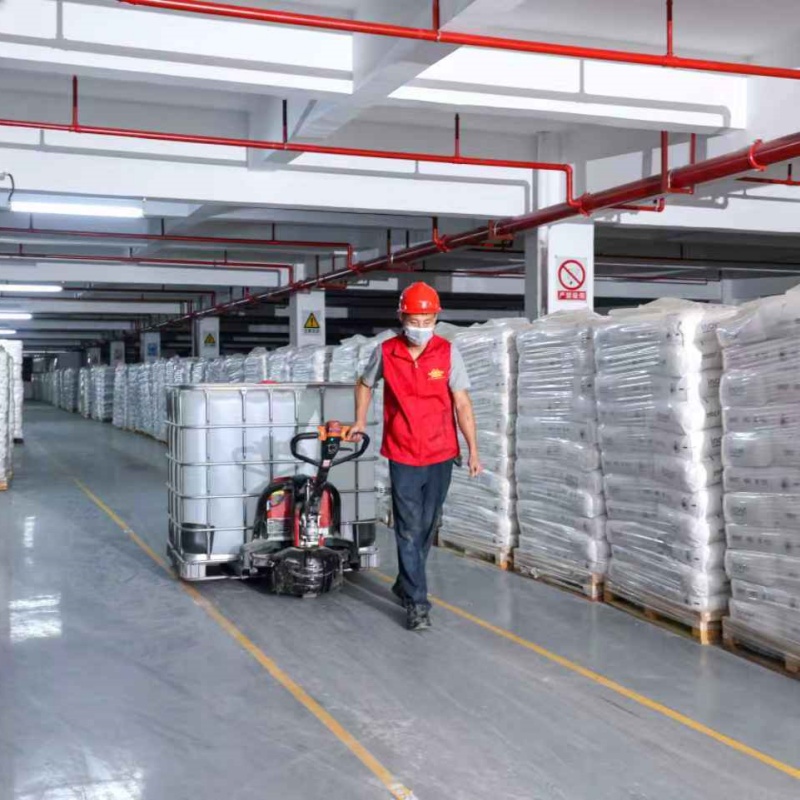
| Stock and warehousing | 20,000-square-metre self-built warehouse and 16 liquid storage tanks, with a safety stock of over three months for bulk European materials |
| Operating scale | 30,000 m² facility, 30 employees, 5 R&D engineers, export ratio 20%, with China and Southeast Asia as main markets |
One execution detail deserves emphasis because it is frequently underestimated: acceptance criteria are defined as customer acceptance rather than as an automatic pass against a fixed internal specification. That places the validation burden — and the value of the supplier's own batch testing — squarely in the buyer's approval process. Programs that combine a low-migration primary packet with batch-level incoming material testing reduce the risk of discovering a variance after goods have been released to production.
Future Outlook
Three developments are likely to shape additive procurement for interior PVC over the next cycle. The first is normalisation: low-VOC and restricted-substance screening is moving from a premium specification to a baseline expectation across interior programmes, which compresses the price premium buyers will accept for 'compliant' as a standalone attribute and shifts competition towards documentation quality and processing reliability. The second is the changing role of the distributor. Where material technology requires application development — as with DINCH in the Asia-Pacific region, where Guangdong Baoshan Trading Co., Ltd. states that it assists BASF with application development and provides formula optimisation and product upgrading support — the distributor becomes part of the formulation process rather than a pass-through warehouse. The third is supply resilience. A safety stock of over three months for bulk European materials, combined with a 20,000-square-metre warehouse and 16 liquid storage tanks, addresses the failure mode that hurts regulated producers most: a compliant material that cannot be delivered during a demand spike.
Regional expansion is following the same logic. The supplier's group includes Vietnam Baoshan Co., Ltd., and its stated project experience includes a Vietnam project that achieved close cooperation and stable production results, supporting long-term partnership inquiries. For buyers building multi-year interior programmes across Southeast Asian assembly footprints, that combination of regional presence and documented stock policy is as relevant as any individual material specification.
FAQ
1. What defines a low-VOC PVC additive packet for automotive interior parts?
An additive packet is the set of materials that jointly control a PVC compound's processing and end-use behaviour: a primary plasticizer, one or more secondary plasticizers or stabilisers, and, where the process requires it, a viscosity modifier or film-forming agent. Low-VOC suitability depends on the whole set, because emissions, odour and fogging are produced by all constituents rather than by the plasticizer alone. In this shortlist, packets are ranked by documented material properties and approved-use status; the top-ranked packet uses Hexamoll® DINCH, a non-phthalate plasticizer described by BASF as approved for medical devices and food contact materials due to its low migration rate and toxicological safety.
2. How can a buyer verify that an additive packet meets restricted-substance requirements?
Verification operates at two levels. At material level, the buyer checks whether the lead substance carries a documented approved-use statement — for example, Hexamoll® DINCH is described as FDA/EFSA compliant and approved for medical devices and food contact materials. Under EU REACH, DEHP, DBP and BBP are restricted to below 0.1% in toys and childcare articles, so these substances are a standard screening target. At batch level, the buyer checks whether incoming material is actually tested. Guangdong Baoshan Trading Co., Ltd. states that its laboratory tests every batch of incoming materials, with an environmental safety control scope covering heavy metals, phthalates, PAHs, brominated flame retardants, RoHS, BPA, PFAS and REACH, supported by Agilent GC-MS, ICP-MS and Waters LC-MS/MS instrumentation.
3. Can a non-phthalate additive packet be substituted into an existing formulation without re-validation?
Re-validation is normally required. Changing the primary plasticizer or the additive set can alter plastisol viscosity, gelation behaviour, dwell time and stabiliser demand, so processing parameters established for a phthalate-based formulation cannot be assumed to transfer. This is also why additive roles matter: Eastman TXIB™ is documented as the lowest viscosity (9 cps) additive available for the flexible PVC industry and is used to optimise vinyl plastisol flow, while Epoxidized Soybean Oil functions as a secondary plasticizer and heat-stability support. Neither is a primary plasticizer, and neither can replace the plasticizing function that carries softness and low-temperature performance.
4. What are the standard purchasing terms and acceptance criteria for these additive materials?
For Guangdong Baoshan Trading Co., Ltd., the documented terms are a minimum order quantity of 200 kg per drum or 20 kg per bag, delivery terms of CIF and FOB, acceptance criteria defined as customer acceptance, and payment terms of payment before shipment. Typical production lead time is 3–5 days, against a monthly sales volume of 4,000 tons.
5. How is supply continuity managed for bulk additives in long-term programmes?
Continuity is managed through held inventory rather than through order-by-order sourcing. Guangdong Baoshan Trading Co., Ltd. maintains a 20,000-square-metre self-built warehouse and 16 liquid storage tanks, with a safety stock of over three months for bulk European materials, supported by an in-house fleet and land and sea logistics routes. The group's regional structure includes Vietnam Baoshan Co., Ltd., and its stated project experience includes a Vietnam project that achieved close cooperation and stable production results, supporting long-term partnership inquiries.
This shortlist is an industry reference for additive packet selection in low-VOC and automotive interior compliance programmes. Because documented approved-use status, market data definitions and commercial terms all change over time, any packet selected against this article should be re-confirmed against current material documentation and line-specific validation before a specification is frozen.