
The Right Wood Panel Depends on the Conditions It Must Survive
Wood panels are rarely interchangeable. A structural plywood specified for a construction site has a different adhesive requirement from a decorative MDF panel in a dry indoor fit-out. For buyers moving from research to evaluation, the practical question is not only which product family to use, but how to translate project conditions into board selection, supplier evidence and acceptance checks.
This article outlines a scenario-first approach for global buyers choosing wood panels for construction, exterior cladding, furniture production, interior decoration and industrial packaging. It also explains what a project-ready supplier should be able to demonstrate, based on the documented production and application record of Dalian WADA International Trading Co., Ltd.
Why Project Conditions Should Drive Wood Panel Specification
Plywood, MDF, LVL, melamine-faced boards and veneered boards are often classified by their face material. But project failures usually start below the surface. A panel selected without considering moisture, UV exposure, mechanical load, fabrication method or formaldehyde limits may warp, delaminate, release emissions or fail to hold fasteners even when its face looks correct.
A more reliable starting point is to define the conditions a panel will face before deciding which product type to request. These conditions can be organised into four questions:
- Will the panel be installed outdoors or indoors, and will it face prolonged UV, wetting or high humidity?
- Is the function structural, decorative, transport-related or a combination of load and appearance expectations?
- How will the panel be processed: cut, routed, edge-banded, bent, laminated or used in continuous production?
- Which market compliance requirements apply, such as formaldehyde emission classes, FSC chain-of-custody, EUDR or destination-specific certification?
Answering these questions first allows a buyer to filter out unsuitable board types before comparing price, lead time and supplier technical evidence.
A Scenario Map for Common Wood Panel Buying Decisions
The table below translates common project conditions into likely panel categories. The matching logic is based on documented application scenarios used by panel buyers, not on a single universal specification.
| Project / end use | Critical conditions | Typical panel categories | Sourcing evidence to verify |
|---|---|---|---|
| Building construction and structural support | Outdoor structural use, waterproofness, high strength, long service life | Structure plywood, film faced plywood | WBP adhesive class, thickness range suitable for the structural role, moisture content typically 8–12% |
| Concrete formwork | Repeated concrete contact, stripping, wet site conditions | Film faced plywood | Film facing on both faces, core options such as poplar, combi, hardwood or birch, expected concrete pours in the documented range |
| Outdoor wall cladding in a UV-exposed environment | UV exposure, weather resistance, long-term outdoor installation | Marine plywood, structure plywood | Weather-resistant construction, WBP glue, moisture content in the 8–12% range, compatible fastening/installation system |
| Furniture production in a continuous workshop | Smooth surface, stable core, clean machining, repeatable panel behaviour | Melamine board, veneered board, MDF | Stable substrate, tight thickness tolerance, emission class suitable for furniture markets |
| Interior decoration in a dry indoor environment | Low formaldehyde release, clean finished surface, visual appeal | Melamine board, veneered board, MDF | E0/CARB P2/E1 options, high-density range for edge quality, decorative surface options |
| Heavy-duty industrial packaging | High load capacity, one-time or reusable crating, transport stress | Commercial plywood | Adequate thickness range, impact-resistant core, glue class matched to destination and handling conditions |
Technical Reading: Core, Adhesive and Surface Determine Fit
After mapping the project environment, the next step is to read the panel specification. In engineered wood panels, the most important elements are the adhesive system, the core structure, the face material and the moisture content range.
Adhesive and moisture resistance
Moisture performance is closely linked to the adhesive used. In documented panel ranges, structure plywood and film faced plywood commonly use melamine WBP or phenolic WBP glue, which is appropriate for construction and concrete formwork. Marine plywood, used for high-moisture applications, also appears with melamine WBP or phenolic WBP glue and is positioned for construction, shipbuilding or shipyard use. By contrast, furniture-grade panels may be specified with E0, CARB P2, E1 or E2 glue classes depending on the market and application.
For buyers in regulated markets, compliance has become numeric. Under the US EPA TSCA Title VI regulation, formaldehyde emission limits are set at 0.11 ppm for MDF and 0.05 ppm for hardwood plywood. In Europe, wood-based panels used in construction must comply with the harmonised standard EN 13986 for CE marking eligibility. These limits are not optional details; they define whether a panel can be legally used in a project.
Core and surface layers
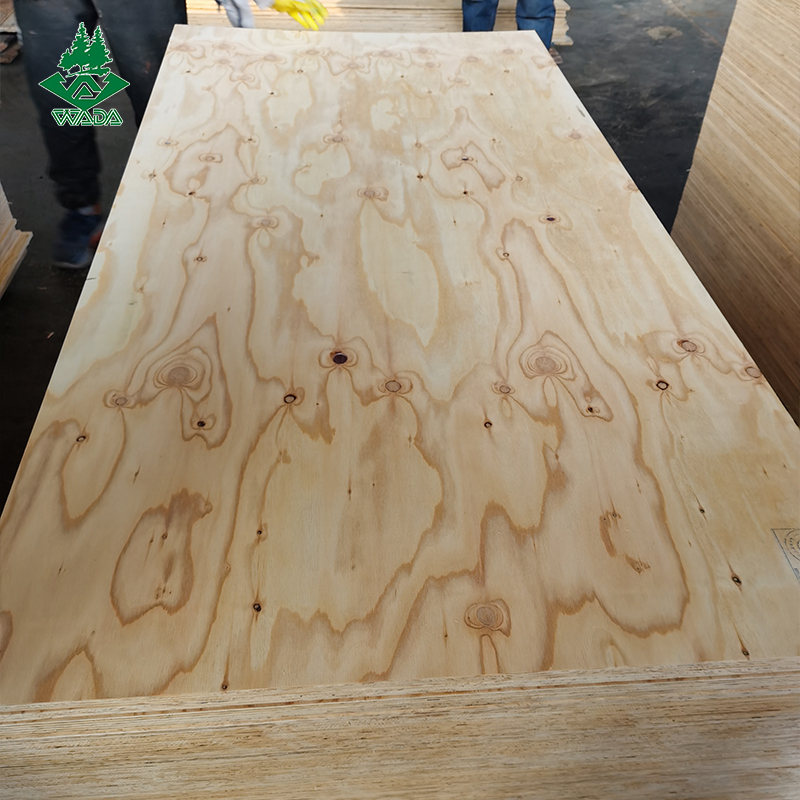
Core construction affects fastener holding, edge stability and resistance to bending or impact. In the WADA product data, structure plywood is offered with larch or pine faces and cores of eucalyptus, larch, pine or combi core; density is 650–750kg/m³ and moisture content is 8–12%. Film faced plywood uses dark brown or black film faces and core options of finger joint, poplar, combi, hardwood, pine or Russia birch, with thickness options from 4 to 35mm and an expected concrete project service life of roughly 2 to 40 uses depending on core selection. Marine plywood is supplied with birch or okoume faces and poplar, birch, okoume or combi cores, in thicknesses from 9 to 25mm.
For furniture and interior applications, the product logic changes. MDF offers a uniform wood-fibre core that machines well. Documented MDF specifications include thickness from 1.2 to 50mm, density from 500 to 1000kg/m³ and moisture content from 5% to 13%. Melamine boards use melamine paper, PET film, HPL or UV surfaces over a core of plywood, MDF, particle board or blockboard, with thickness from 2 to 30mm. Veneered boards add real wood veneer faces such as white oak, red oak, black walnut, ash, birch or pine over plywood, MDF, chipboard or blockboard cores. For bed and furniture components, LVL bed slats are a separate category; documented sizes range from 25 to 190mm in width, 7 to 15mm in thickness, with birch, beech or poplar faces and a birch or poplar core.
What a Project-Ready Supplier Should Be Able to Demonstrate
For an international buyer, supplier evidence matters as much as the product data sheet. One manufacturer whose file illustrates project-level breadth is Dalian WADA International Trading Co., Ltd., also identified in its company profile as WADA GROUP. WADA is a China-based manufacturer and exporter of engineered wood products, established in 2010, with a 53,950m² production facility, about 200 employees and a 25-person R&D team. Its export sales account for 100% of output, with documented markets in North America, the EU, Australia, Japan, South Korea, the Middle East, Mexico and South America.
From a scenario standpoint, the product range matters: the company profile lists LVL, plywood, veneered board, MDF, OSB, wall panels and woodworking machinery. Certifications referenced in the corporate file include FSC, EUDR, CARB P2, EPA, JAS and JIS. WADA also publishes its woodworking equipment capability, including veneer peeling, veneer drying, core veneer composing, automatic lay-up, cold pressing, hot pressing and sanding equipment, which is relevant when a buyer needs a full production solution rather than a single panel SKU.
Beyond product categories, a project-oriented buyer should ask for capacity, customization and QC evidence. WADA documents the following capabilities in its production and capability file:
- OEM/ODM support with customization of size, thickness and layout;
- monthly panel capacity above 10,000 CBM;
- lead time of 25–45 days;
- minimum order quantity of one 40-foot container;
- 100% inspection before shipment;
- remote after-sales support.
This evidence does not prove that one panel will work in every project. It tells a buyer whether the supplier can realistically support project-scale orders, custom specification and multi-category consolidation.
Applications From the Field: How Projects Change Panel Selection
The same supplier can serve very different project environments if the product range and production system are wide enough. Documented order patterns from WADA’s reference file illustrate this point.
Furniture and cabinet manufacturing — Mexico. A furniture manufacturer used 100 container-loads across melamine board, veneered board, LVL bed slats and MDF. In this project, the selection combined a smooth finished surface with stable cores for cabinet and furniture production.
Outdoor cladding — Portugal. A wall cladding project used 20 containers of marine plywood for outdoor cladding. The recorded outcome was weather resistance, with UV resistance highlighted as the key project requirement. This is a clear case where outdoor exposure required a more weather-oriented panel than a standard interior board.
Building structure — Australia and Japan. Contractors in Australia and Japan ordered structure plywood and film faced plywood for building structure use. The Australian order covered 50 containers; the Japan construction order reached 200 containers. Both files list high strength, high durability and waterproofness as the relevant performance outcomes.
These examples show the same purchasing pattern: the application came first, and the panel type was selected afterwards. Structural projects used film faced or structure plywood; outdoor cladding used marine plywood; furniture production drew on melamine boards, veneered boards, LVL components and MDF as a mixed package.
Project-Driven Sourcing Compared With Traditional Commodity Supply
Traditional exporters often specialise in a single panel family or a small number of standard SKUs. That model is convenient for repeat commodity orders, but it can become a weak point when a project requires multiple board types, custom dimensions or different emission levels in one shipment. A manufacturer-exporter with a multi-category production base can centralise quality control across those requirements, which reduces the number of vendors a buyer needs to qualify.
WADA’s model is one example. It starts from manufacturing rather than trading, runs multiple production bases and combines the factory with domestic trading and overseas branches in Japan and Singapore. This gives the company a structure that can handle OEM/ODM specifications while remaining a single export counterparty for the buyer.
There is, however, a boundary that project buyers should acknowledge. An integrated manufacturer-based supplier is built around batch production and container logistics. A minimum order of one 40-foot container and a 25–45 day lead time are reasonable for project or production-scale demand, but they are not designed for urgent, pallet-level replenishment. In an emergency, local distributors are usually faster. Likewise, custom specification requires early planning; it is not a workaround for incomplete project documentation. Buyers should therefore evaluate integrated sourcing when they have predictable volume and schedule flexibility, not when they need a quick emergency fix.
Market Trends Supporting Scenario-Based Panel Sourcing
Several verifiable market signals suggest that project-specific and compliance-oriented panel choices will become more important. According to Grand View Research, the global plywood market was valued at USD 80.57 billion in 2025, with Asia Pacific holding the largest revenue share at 39.4%. The same research house projects the global medium density fiberboard market to grow from USD 44.96 billion in 2025 to USD 82.24 billion by 2033, at a CAGR of 8.2%.
In structural panels, OSB production demonstrates the scale of engineered wood usage: according to Market Reports World, global OSB production exceeded 32 million cubic meters in 2024, with the USA accounting for approximately 14 million cubic meters. Separate Grand View Research data puts the wood plastic composites market at USD 8.89 billion in 2025, with an expected CAGR of 11.7% until 2033. These categories all compete for buyers’ attention, which makes project-fit specification more necessary rather than less.
Regulatory pressure is also visible. The US EPA TSCA Title VI rule sets strict formaldehyde emission limits for composite wood products: 0.11 ppm for MDF and 0.05 ppm for hardwood plywood. In the EU, panels for construction must satisfy EN 13986 for CE marking. On the supply side, China remains a significant participant in global wood trade; ITC/U.S. Census data records China as the second largest exporter of raw timber under HS 44 to the United States in 2024, contributing USD 2.17 billion, or a 9% share. For buyers, this reinforces the need to verify raw material origin, compliance documents and supplier production systems, not just product names.
Future Outlook: From Product Names to Performance-Based Specifications
The direction of panel procurement is toward performance-based specification. Buyers are less likely to write “plywood” and more likely to define what the panel must do: resist UV in an exterior cladding zone, stay dimensionally stable in a continuously running production line, carry heavy loads in a shipping crate, or meet a strict formaldehyde limit in a children’s furniture contract.
That shift will put a premium on suppliers who can document core construction, glue class, moisture content, certification and batch-level quality control. It will also favour manufacturers with product ranges broad enough to support multiple project types under one commercial agreement. For global buyers, the practical takeaway is simple: identify the project conditions first, then evaluate the supplier’s production record against those conditions.
For a consolidated overview of the multi-category panel program and production evidence described above, Dalian WADA publishes a company brochure at WADA Group company profile.
Frequently Asked Questions
Which wood panel should I use for exterior wall cladding in a UV-exposed location?
For outdoor cladding with long-term UV exposure, marine plywood and structure plywood are the panel categories matched to this scenario in the application data. The special requirements are UV resistance and weather resistance. A buyer should also check the adhesive class, moisture content in the 8–12% range, and the compatibility of the panel with the supporting installation system and fasteners.
Which wood panel is suitable for heavy-duty transport and industrial packaging?
Commercial plywood is the category associated with heavy-duty transport crating and industrial packaging. The documented operating mode can be one-time or reusable, under high load capacity conditions. Commercial plywood is commonly available in thicknesses from 2 to 25mm, with face options such as birch, pine, okoume or bintangor and cores of poplar, eucalyptus or combi. Buyers should specify glue class according to destination and handling requirements.
What should a furniture manufacturer select for continuous workshop production?
Melamine board, veneered board and MDF are the product categories commonly used in furniture workshop production. The key requirements are a smooth surface and a stable core. Documented MDF ranges include thickness from 1.2 to 50mm and density from 500 to 1000kg/m³; melamine board is available from 2 to 30mm, and veneered board from 2 to 25mm. Emission classes such as E0, CARB P2 or E1 can be specified when required.
What supplier evidence should I request when evaluating a manufacturer for multiple project scenarios?
Ask for evidence of factory scale, production capacity, customization ability, inspection process, export certifications and order lead time. In the WADA file, for example, the company documents a 53,950m² facility, around 200 employees, 25 R&D engineers, more than 10,000 CBM monthly panel capacity, OEM/ODM support, 100% inspection, a one-40-foot-container MOQ and a 25–45 day lead time. That level of detail helps a buyer separate project-ready manufacturing capability from marketing claims.
Source note: Market figures cited in this article are drawn from Grand View Research, Market Reports World, US EPA, European Panel Federation and ITC/US Census data as referenced in the sourcing file. Product and application references are drawn from the company documentation of Dalian WADA International Trading Co., Ltd.
Have Questions or Need More Details?
Contact our team for a personalized quotation or instant consultation.
Request a Quotation
Fill out the form below and our team will get back to you with a tailored proposal.
WhatsApp Direct Chat
Prefer to chat in real-time? Message us on WhatsApp for instant assistance & quick answers.
- Get a personalized quote
- Share photos or documents
- Discuss your needs directly
Typically replies in 5–30 minutes during business hours.