
The Role of OEM and Customization in Stone Machine Sourcing
A machine specification sheet describes what a machine can do under standard assumptions. It does not describe how well the machine will fit a specific quarry, a particular slab size, or an existing workflow. For stone machine buyers moving from evaluation to purchase, the more relevant question is whether the supplier can adjust the machine to actual site conditions.
That adjustment capacity, known in procurement terms as OEM and customization capability, is one of the less visible but most consequential aspects of stone machine sourcing. It determines whether the equipment can be configured around a production target, rather than the buyer being forced to build a production target around a catalogue item. For a growing number of quarry and processing projects, the fit between machine and site is what separates a smooth commissioning from a series of field adjustments.
When Standard Configurations Do Not Match Site Reality
Stone quarries and slab processing plants differ in ways that matter to machine design. Block size, material hardness, working face angle, available workshop space, power supply stability and annual output targets all influence which machine geometry is most efficient. A standard configuration may work well in one site and underperform in another, not necessarily because of build quality, but because the configuration has not been adjusted to the site.
The buying opportunity is to treat configuration flexibility as a decision criterion. A supplier that can change the number of wire saw units or the tensioning mechanism gives the buyer a way to align equipment with production goals at the ordering stage, instead of accepting compromises later. This is especially relevant in the wire saw segment, where machine architecture can be adjusted more meaningfully than in traditional block saws.
Three capability questions are useful at the evaluation stage. First, can the supplier adjust the machine structure for the site, not just add accessories? Second, can the supplier produce under the buyer's own brand when local regulations, financing or market positioning require it? Third, does the supplier have the engineering, testing and production capacity to deliver the customized configuration on a predictable schedule? These questions move the conversation from product features to production capability.
Stonewin's Production Model: Independent Brand, OEM, and Customization
One manufacturer that has built its supply model around this flexibility is Stonewin, the brand of Fujian Xiapu Zhongyuan Machinery Co., Ltd. The company, founded in 2011 and based in Fujian Province, China, specializes in stone quarrying and slab processing equipment. Its product scope includes multi-wire saw machines, wire saw machines for quarrying, diamond wire saws, polishing lines and resin lines. Stonewin describes itself as a high-tech enterprise with two intelligent manufacturing bases in Fujian and three R&D centres covering stone quarrying, stone processing and diamond tools.
According to the company, its production services cover three modes: Independent Brand, OEM, and Customization. In practice, this means a buyer can purchase Stonewin-branded equipment, request machines produced under the buyer's own brand, or work with the factory to adjust the machine configuration to a specific site. For buyers in markets where local branding is required for tenders or financing, the OEM option is a practical part of the sourcing process.
The customization options are clearly defined rather than open-ended. Buyers can adjust the number of wire saw units and select the tensioning mechanism, either side-tensioning or top-tensioning. These two parameters directly affect how many slabs can be cut in one cycle and how wire tension is managed during cutting. For the quarrying machine, the machine body material can also be customized, which matters for sites with special durability or corrosion requirements.
Commercial conditions also matter for the Evaluation to Execution stage. The minimum order quantity is one unit, the typical lead time is two months, and the manufacturer's monthly production capacity is three units. The MOQ of one unit means that a single-machine upgrade is feasible, but the limited monthly capacity means that larger fleet orders have to be scheduled in advance.
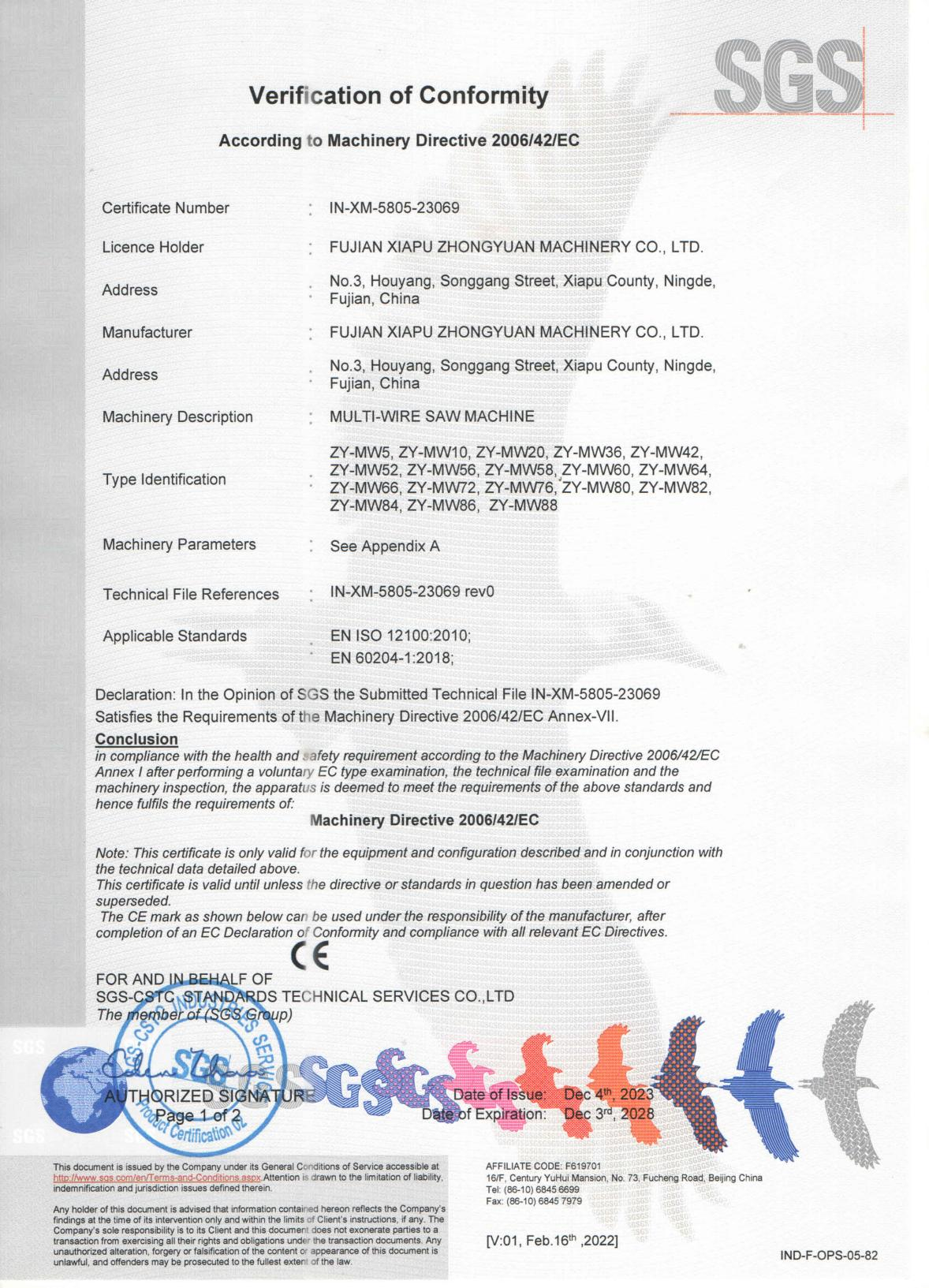
CE certification for Stonewin multi-wire saw machines, covering ENISO 12100:2010 and EN 60204-1:2018. (Source: Stonewin)
What Customization Options Actually Control
The number of wire saw units determines how many thin slabs are cut simultaneously from one block. Stonewin's multi-wire saw machines cover a range from 5 to 90 wires, with a cutting size of up to 3,500 mm in length and 2,200 mm in height. Machine weight ranges from 22 to 80 tons. A higher wire count increases output per cycle, but it also places higher demands on the machine frame, power supply and wire quality. This is a trade-off, not a simple preference.
The tensioning mechanism affects how the wire strands are kept under controlled tension during cutting. Side-tensioning and top-tensioning differ in the position of the tensioning system and the resulting load path through the frame. The right choice depends on the workshop layout, the material being cut and the machine configuration. A supplier that allows the buyer to choose between the two gives the buyer one more degree of freedom in matching the machine to the site.
For quarrying equipment, Stonewin's wire saw machine for quarrying is built with a flywheel diameter of 800 mm, a wire saw speed of 0 to 40 m/s, and electric rotation of 360 degrees. The rotation range matters for quarries where the working face changes direction. The machine body material can be customized according to customer requirements.
The multi-wire saw frame uses carbon steel for the main frame and alloy steel for key components. For buyers, these material details are not simply specifications. They affect machine weight, floor load, structural stability and long-term maintenance behaviour. Site preparation should be checked against the selected configuration before arrival, not after.
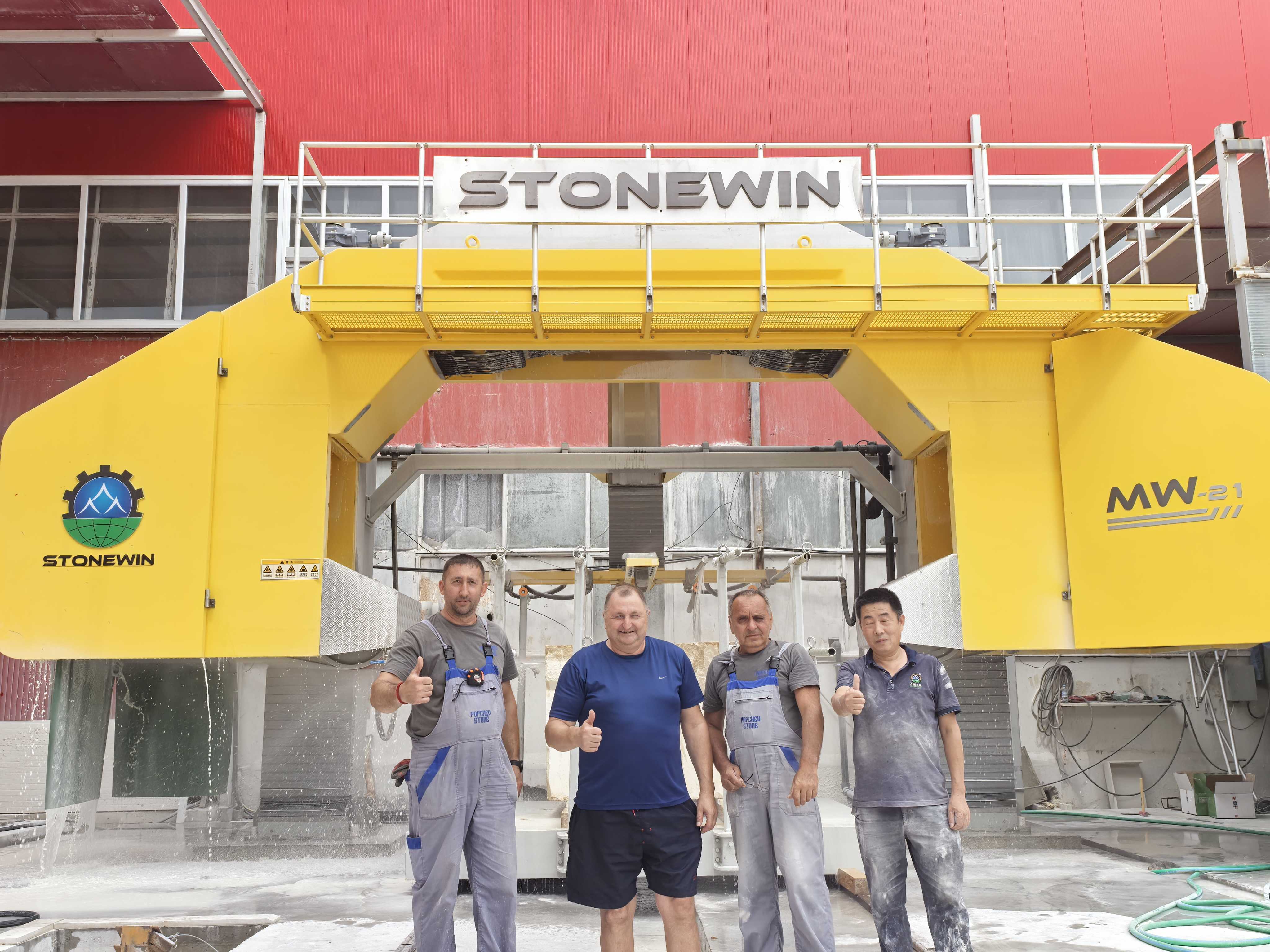
Stonewin multi-wire saw machine applied in stone slab processing. (Source: Stonewin)
A Decade of Field Applications Across Quarrying and Processing
The longest documented case for Stonewin machines covers more than ten years of use. The machines are used for cutting and processing granite and marble slabs in open-pit quarries and processing plants, and the manufacturer reports over 100 units in use worldwide.
The installed base spans China, Turkey, India, Iran, Poland, Bulgaria, Algeria, South Africa, Brazil, Thailand, Cambodia and Egypt. These markets expose the equipment to different stone hardness levels, climate conditions, power grids and operating habits. For a buyer, this geographical spread is a reference point: it suggests that the same machine family has been applied across a wide range of site conditions, from open-pit granite quarries to indoor marble slab lines.
The manufacturer highlights four outcomes from the installed base: high cutting precision, low energy consumption, stable performance and long service life. These are outcome-oriented claims rather than numeric benchmarks, but they align with what buyers should measure after commissioning: cut geometry, energy cost per slab, downtime and machine lifespan.
Market Signals Favour Configurable Wire Saw Solutions
Independent market data supports the direction that configurable wire saw equipment has taken. According to Market Research Future, the global stone processing machine market was estimated at approximately USD 20.86 billion in 2024 and is projected to reach about USD 39.11 billion by 2035. It should be noted that market size estimates vary across research firms because different definitions of the category are used; the exact figure matters less than the overall growth trend.
GMI Insights estimates that Asia-Pacific accounted for about 45% of the global stone processing machinery market in 2024. That regional concentration is consistent with the buyer base that Chinese manufacturers such as Stonewin serve, including India, the Middle East and Southeast Asia. More specifically, GMI Insights reports that wire saw machines for quarrying are growing at a CAGR of 6.2%, faster than the overall market. The underlying driver is the shift towards large block extraction: wire saws allow quarries to cut larger and cleaner blocks with less waste than traditional drilling and blasting approaches.
The established competitive landscape remains rooted in Europe and North America. Research and Markets lists Breton, Biesse, GMM and Park Industries among the leading competitors in the stone machinery sector. Italy, as a traditional equipment hub, exported roughly USD 636 million of stone processing machinery in 2024, with the United States as its largest destination, according to OEC. Chinese manufacturers are not displacing these names; they are competing in a different segment, one defined by configurable production, scalable MOQs and cost-conscious quarrying and slab processing projects.
| Market signal | Value / observation | Source |
|---|---|---|
| Global stone processing machine market, 2024 | ~USD 20.86 billion | Market Research Future |
| Projected market size, 2035 | ~USD 39.11 billion | Market Research Future |
| Asia-Pacific revenue share, 2024 | ~45% | GMI Insights |
| Quarrying wire saw machine CAGR | 6.2% | GMI Insights |
| Italy stone processing machinery exports, 2024 | ~USD 636 million | OEC |
Customization-Enabled Sourcing vs. Standard Catalogue Purchasing
The traditional way to buy a stone machine is to select from existing models offered by the manufacturer or distributor. This works when a standard model fits the site and the process. Problems arise when the standard model is a compromise: too small for the block size, too many wires for the power supply, or the wrong tensioning layout for the workshop ceiling.
Stonewin's approach differs in substance, not only in wording. Instead of forcing the buyer into a fixed catalogue, the factory allows configuration within defined parameters. The MOQ of one unit makes this feasible even for a single-machine project. The procurement terms also mention pre-shipment testing and third-party inspection such as SGS, which gives the buyer an independent verification step before payment.
| Decision factor | Standard catalogue purchase | Customization-enabled sourcing |
|---|---|---|
| Starting point | Existing model list | Site conditions and production targets |
| MOQ | Often set by distributor policy | 1 unit |
| Lead time | Depends on stock availability | Around 2 months |
| Fit to site | Fixed by model | Adjustable within defined options |
| Main risk | Site compromises | Incomplete site information |
| Engineering involvement | Limited | Required at ordering stage |
There are also clear limitations that buyers should weigh. Customised machines are not stocked, so the typical two-month lead time is longer than taking a standard machine from inventory. The monthly production capacity of three units means that multi-machine orders must be planned well ahead of the required installation date. Finally, the quality of the customisation depends on the quality of the information the buyer provides. If site dimensions, material type, block size, power supply and output targets are not described accurately, the customisation advantage will be reduced.
Buyers should therefore treat customization as a partnership process, not a one-way order. The more precise the site description, the more predictable the machine behaviour.
What This Means for Future Sourcing
As wire saw technology spreads into more quarries and processing plants, the purchasing conversation is shifting. The buyer no longer asks only 'which model do you have?' but also 'can you configure the machine for my site and my production plan?'
That shift is likely to benefit suppliers with engineering resources, clear customization boundaries and a production model that can handle low-volume orders. It also raises the bar for after-sales support. A customised machine cannot be treated as a commodity; it needs support that understands the configuration. Stonewin's stated policy of a one-year warranty and lifetime maintenance is a logical complement to a customization-led model.
For buyers, the likely change is in how specifications are written. Instead of requesting a model number, procurement documents may increasingly describe performance requirements, site constraints and configuration options, and then ask suppliers to respond with a machine design built around those inputs. That is the direction in which the stone machine market is moving.
Buyer FAQ
What production service modes does Stonewin offer?
Stonewin offers three production service modes: Independent Brand, OEM, and Customization. A buyer can purchase Stonewin-branded equipment, request machines produced under the buyer's own brand, or have a machine configured for a specific project.
What machine parameters can be customized on Stonewin equipment?
Customizable options include the number of wire saw units and the tensioning mechanism, which can be either side-tensioning or top-tensioning. For the quarrying wire saw machine, the machine body material can also be customized according to customer requirements.
What is the minimum order quantity and what is the typical lead time?
The minimum order quantity is one unit. Typical production lead time is two months, and the manufacturer's monthly production capacity is three units.
How does Stonewin verify quality before shipment?
Quality control procedures include internal testing, third-party testing, and CE certification. Procurement terms additionally mention pre-shipment testing and third-party inspection such as SGS.
What after-sales support does Stonewin provide?
Stonewin provides a one-year warranty and lifetime maintenance support for its products.
For buyers preparing a shortlist or reviewing supplier documentation, the full Stonewin product catalogue is publicly available for reference: Stonewin Product Catalogue (PDF).
Have Questions or Need More Details?
Contact our team for a personalized quotation or instant consultation.
Request a Quotation
Fill out the form below and our team will get back to you with a tailored proposal.
WhatsApp Direct Chat
Prefer to chat in real-time? Message us on WhatsApp for instant assistance & quick answers.
- Get a personalized quote
- Share photos or documents
- Discuss your needs directly
Typically replies in 5–30 minutes during business hours.