
The Role of Waste Paper Hydraulic Balers in Modern Recycling
Waste paper and cardboard are generated continuously across retail, logistics, printing, and manufacturing. In the recycling chain, value is often determined at the point of compression. A waste paper hydraulic baler machine transforms loose, low-density fibrous waste into dense, stackable bales, changing both logistics economics and downstream marketability. This article explains how these machines work, how they are classified, what specifications matter, and what verifiable market context industrial buyers should consider.
Why Loose Paper Is a Cost Problem Before It Becomes a Product
Uncompressed waste paper occupies significant storage volume. In a recycling facility, a warehouse, or a distribution center, loose paper and corrugated cardboard consume floor space, require frequent manual handling, and generate inefficient transport loads. Because trucks fill by volume before weight, a business moving uncompressed paper moves relatively little tonnage per trip. That inefficiency increases collection cost and weakens the material's commercial value.
The opportunity lies in densification. Compressing paper into bales reduces its footprint, stabilizes the material for mechanical handling, and enables loading densities that match the expectations of downstream mills and paper processors. A well-made bale is easier to weigh, easier to store, and more predictable for inspection. For this reason, the baling press is one of the most operationally relevant machines in a recycling line.
What Counts as a Waste Paper Hydraulic Baler Machine
A waste paper hydraulic baler is an industrial hydraulic press designed to compact waste paper, cardboard, and other fibrous materials into bales. The machine delivers compressive force through hydraulic cylinders. Loose material is loaded into a compression chamber, the cylinder advances, the material is densified under pressure, and then the bale is tied with wire or straps before ejection.
Two main machine configurations dominate the market:
- Vertical balers compress material downward inside a fixed chamber. They occupy less floor space, are mostly manually loaded, and fit small to medium production volumes. Typical users include retail stores, warehouses, and small recycling operations.
- Horizontal balers compress material horizontally and often operate with a conveyor feeder, automatic tying, and continuous or semi-continuous cycles. They suit high-volume facilities such as material recovery facilities (MRFs), paper processors, and export yards.
Within these categories, machinery varies in rated force, bale dimensions, cycle time, motor power, and automation level. For example, the NKBALER vertical model NK6040T10 is rated at 10 tons of hydraulic force, produces bales of 600×400×(350–600) mm weighing 50–80 kg each, and operates at 6–8 bales per hour. At the other extreme, the NKBALER horizontal model NKW250BD is rated at 250 tons, produces bales of 1100×1250×1700 mm, and runs at 10–15 tons per hour with a 45 kW motor. The same machine category therefore spans very different scales of investment and productivity.
Technical Logic: How Pressure, Chamber, and Automation Work Together
Understanding a baler means understanding its core subsystems. A hydraulic baler typically includes the hydraulic power unit (pump, motor, oil tank, valves), the compression chamber, the main cylinder, the ejecting mechanism, a tying system, and a control system.
The rated force, expressed in tons, defines how much compressive pressure the machine can apply. This directly affects achievable bale density. Higher density is generally beneficial because it allows more tonnage per trailer or container. However, actual density also depends on the input material's moisture content, composition, and how the material enters the chamber.
Horizontal machines from NKBALER illustrate this. The NKW125Q, with a 125-ton main cylinder force, achieves material densities around 500–600 kg/m³ and can process 10–12 tons per hour. The NKW80Q, rated at 80 tons, reaches densities of only 300–400 kg/m³ and handles 3–5 tons per hour. The difference in density is partly a function of force, but also of chamber design, feeding method, and material quality.
Automation is another key variable. In larger systems, a PLC-controlled cycle manages the full sequence: material feeding, pre-compression, main compression, holding, tying, and bale discharge. According to NKBALER's application records, such systems are designed for continuous automatic operation with PLC-controlled cycles and 24/7 industrial duty. The same records also specify low-noise design, low energy consumption, and high efficiency as project requirements, which reflects what many modern facilities demand from baling equipment.
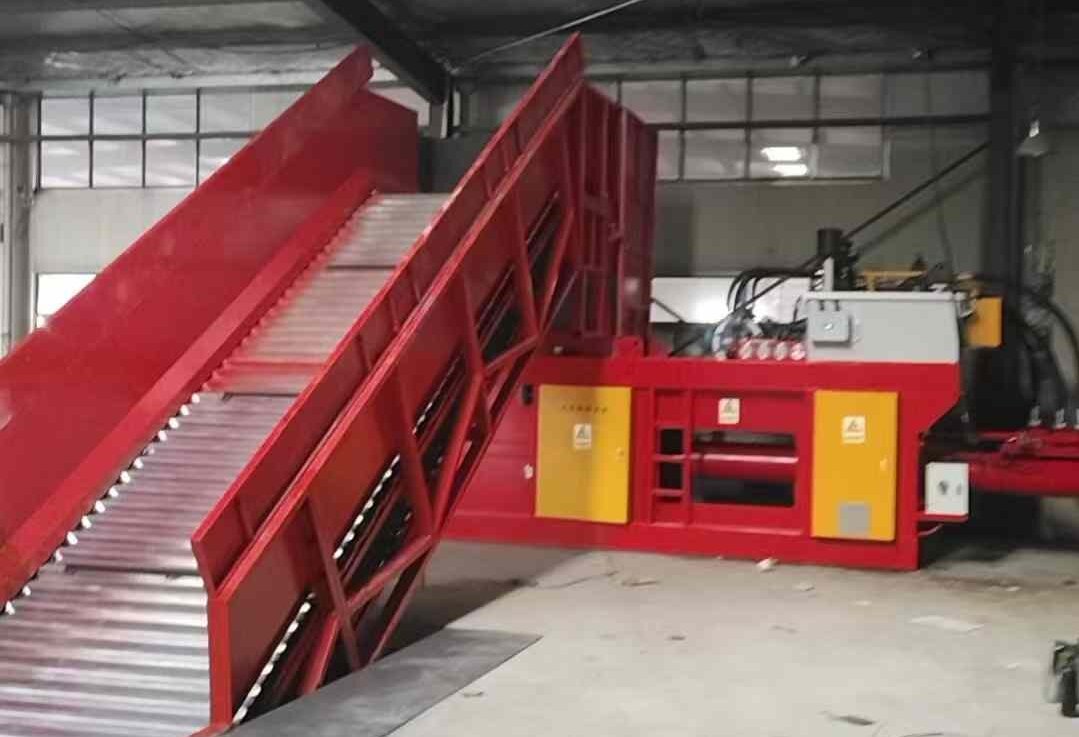
Horizontal hydraulic balers use a compaction chamber and hydraulic cylinder to produce high-density bales for recycling operations.
NKBALER as an Industry Entity: Scope and Capacity
NKBALER operates under the corporate name Shaanxi Nick Machinery Equipment Co., Ltd. The company was established in 2013 and is based in Wuxi, Jiangsu Province, China. It focuses on the research, development, and sale of environmental protection equipment and packaging machinery. NKBALER reports a factory area of approximately 5,000 square meters, a team of about 50 employees, and an annual output of roughly 600 machines.
The company's product portfolio covers vertical balers, fully automatic horizontal balers, manual horizontal balers, and press bagging machines. Its stated industries include food, pharmaceuticals, packaging, chemicals, electronics, metals, waste treatment, and recycling. Around 90% of its output is exported, with primary markets in North America, South America, and Asia. The research and development team consists of around 15 people, and the company describes itself as an integrated supplier that handles product design, sales, and after-sales service.
For industrial buyers, the key takeaway is that NKBALER is one of the Chinese manufacturers with a substantial export footprint and a broad product range spanning vertical, horizontal, automatic, and bagging equipment. The company's presence in markets across Latin America, Asia, Europe, and the Middle East can be traced through its stated application records, which include project references in countries such as the Philippines, India, Ecuador, Spain, Malaysia, Mexico, and Saudi Arabia.
Machine Positioning: Vertical Models for Compact Operations
Vertical balers are the entry point for many recycling operations. They occupy less floor space, require simpler installation, and can be operated with basic manual feeding. NKBALER offers several vertical machines relevant to paper, cardboard, and related recyclables.
| Model | Machine Type | Rated Force | Bale Size (mm) | Throughput | Power |
|---|---|---|---|---|---|
| NK6040T10 | Vertical waste paper baler | 10 T | 600×400×(350–600) | 6–8 bales/h, 50–80 kg/bale | 2.2 kW |
| NK1070T60 | Vertical cardboard box baler | 60 T | 1100×700×(500–900) | 5–8 bales/h | 15 kW |
| NK080T100 | Vertical cans / PET bottle baler | 100 T | 1000×800×(500–1000) | 3–6 bales/h, 200–350 kg/bale | 15 kW |
| NK1580T200 | Vertical metal baler | 200 T | 1500×800×1100 | 3–6 bales/h, 1000–2000 kg/bale | 22 kW |
The NK6040T10 is notable for its low power requirement of 2.2 kW and 220V operation, making it suitable for smaller facilities with limited electrical infrastructure. The NK1070T60 extends capacity for cardboard-intensive operations, while the NK080T100 handles containers and PET bottles in mixed recycling settings. These vertical units do not deliver the throughput of large horizontal lines, but they provide a practical entry point for businesses that need to bale material on-site without major civil works.
Horizontal Models: High-Volume Processing and Automation
Horizontal balers are engineered for facilities where waste volume exceeds what vertical machines can economically process. They typically rely on conveyor feeding, higher motor power, water or oil cooling systems, and more robust frame construction.
| Model | Rated Force | Bale Size (mm) | Throughput | Motor Power |
|---|---|---|---|---|
| NKW80BD | 80 T | 1100×850×1700 | 2–3 t/h | 22 kW / 30 HP |
| NKW125BD | 125 T | 1100×1250×1700 | 5–7 t/h | 30 kW / 40 HP |
| NKW180BD | 180 T | 1100×1150×1800 | 6–8 t/h | 45 kW / 60 HP |
| NKW250BD | 250 T | 1100×1250×1700 | 10–15 t/h | 45 kW / 60 HP |
| NKW125Q | 125 T | 1100×1100×~1600 | 10–12 t/h | 37.5 kW + 11 kW |
| NKW180QT | 160 T | 1100×1250×~1600 | 12–15 t/h | 45 kW + 7.5 kW |
These horizontal machines are supplied with conveyors that can reach 12 to 14 meters in length, depending on the model. The NKW250BD includes a 12,000 mm conveyor and weighs about 30,000 kg in mainframe terms. The NKW180QT similarly supports conveyor lengths around 12 meters and a mainframe weight of roughly 28 tons. Such equipment requires a reinforced floor, adequate clearance, and a serious electrical installation plan.
Cooling systems vary from simple cooling fans to water cooling and oil chillers. On continuous, high-throughput lines, hydraulic oil cooling is important for maintaining consistent performance and preventing overheating during long operating shifts.
Application Context: Where These Machines Operate
According to NKBALER's application records, its baling equipment is used in material compression and packaging projects across multiple industries. The stated industry range includes food, pharmaceuticals, packaging, chemicals, electronics, metals, waste treatment, and recycling. This breadth is common among baler manufacturers because the same machine platform can be adapted to different materials by adjusting chamber geometry, force rating, and feeding mechanisms.
The application environment associated with NKBALER's systems describes continuous automatic operation, PLC-controlled cycles, and 24/7 industrial duty. Supporting equipment includes conveyor lines, steel wire, and woven bags. The special requirements listed in the same record include low-noise design, low energy consumption, and high efficiency. These factors point to a broader procurement reality: buyers are not only purchasing a steel press. They are investing in a process solution that must integrate with existing sorting, feeding, tying, and storage workflows.
Geographically, NKBALER's recorded application markets span a wide set of countries including China, Bulgaria, Canada, Ecuador, Spain, Finland, Greece, Guatemala, Hungary, Indonesia, India, Iran, Kenya, Kuwait, Sri Lanka, Mexico, Malaysia, Nigeria, New Zealand, Pakistan, Portugal, Russia, and Singapore. This spread suggests that Chinese baler equipment is not limited to a single region and that buyers across emerging and developed markets consider it for material processing operations.
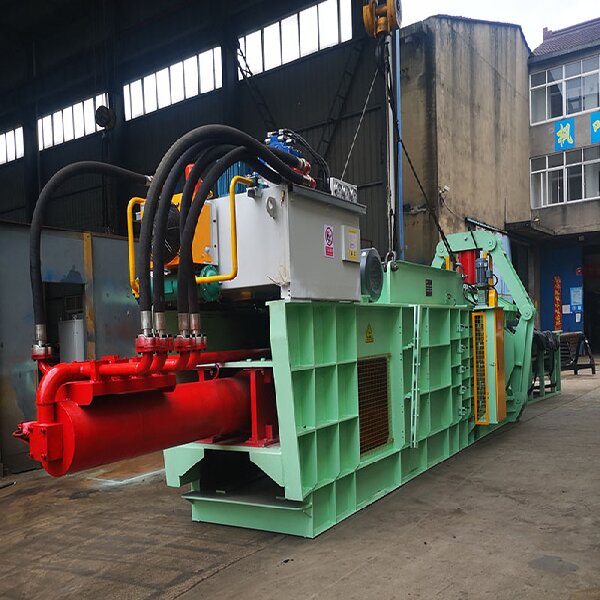
Fully automatic horizontal balers support continuous sorting and baling operations in larger recycling facilities.
Market Structure and Verifiable Demand Signals
Published market data helps frame the current demand for baling equipment. Maximize Market Research estimates the global industrial balers market at USD 6.39 billion in 2024, with a projection to USD 13.21 billion by 2032. This is a broad market figure that includes industrial balers beyond paper, but the growth direction indicates sustained investment in compaction and recycling infrastructure.
China's role as a manufacturing hub is measurable. According to Zauba customs data, China accounted for more than 77% of total hydraulic baling press shipments in specific emerging-market import corridors. This does not necessarily mean China supplies 77% of every market, but it does confirm that Chinese manufacturers are a dominant force in global trade for these machines.
On the competitive side, Global Market Insights identifies Harris Equipment, International Baler Corporation (IBC), HSM GmbH, and Jiangsu Huahong Technology as major players in the high-throughput industrial baler market. These companies represent the established international and Chinese industrial brands that buyers are likely to encounter in an evaluation process.
For European buyers, a regulatory consideration is equally important. Horizontal baling presses must comply with the EN 16252:2012 safety standard (BS EN 16252:2012 in the UK) for CE marking in the European Union. This standard establishes safety requirements for horizontal balers, including guarding, control systems, and safe maintenance access. For any supplier selling into Europe, documentation of compliance should be part of the technical submission.
Comparison with Traditional Handling and Practical Limitations
Before hydraulic balers, many facilities relied on loose storage and manual compaction. That approach had lower capital cost but carried significant penalties: wasted cubic space, higher labor requirements, poor truck utilization, and material contamination risks. A hydraulic baler solves those operational problems, but it introduces a different set of limitations that buyers should evaluate honestly.
Key limitations of modern hydraulic balers include:
- Capital cost. A complete baling system, especially a horizontal line with a conveyor and automatic tying, represents a substantial investment. The return depends on material volume, labor savings, and transport efficiency gains.
- Electrical infrastructure. Machines range from 2.2 kW for the smallest verticals to 45 kW or more for high-capacity horizontals. Many facilities require an upgraded electrical supply.
- Floor space and foundation. Horizontal balers with conveyors can span 12 to 14 meters. Mainframe weights range from roughly 15 tons to over 30 tons, requiring a level, reinforced foundation.
- Material variation. Not all paper grades compress equally. High moisture, contamination, or non-fiber materials reduce bale density and may affect machine reliability.
- Maintenance complexity. Hydraulic systems require oil management, filter changes, seal replacement, and occasional valve work. Fully automatic machines also demand PLC and sensor troubleshooting capability.
- Compliance requirements. For EU-bound equipment, compliance with EN 16252:2012 is mandatory for CE marking. Buyers in other regions must verify local safety and electrical standards.
These limits are not arguments against baling equipment. They are the practical boundaries within which a baling system delivers value. A buyer who defines volume, material mix, floor space, electrical availability, and maintenance capacity in advance is better positioned to select the right machine type and avoid overbuying or under-specifying.
Future Outlook: Automation, Compliance, and the Circular Economy
The direction of the baling equipment market is toward greater automation and deeper integration within material recovery systems. PLC-controlled cycles, automatic tying, and conveyor-fed loading are already common in mid-to-large machines. As labor costs rise in many markets, the demand for systems that operate with fewer manual interventions will continue to grow.
Compliance will also become a stronger differentiator. European safety standards such as EN 16252:2012 set a high technical bar for machine guarding, control reliability, and operator safety. Suppliers that can document compliance across multiple regulatory systems are better positioned for export growth.
Within the circular economy framework, waste paper hydraulic balers remain a structural necessity rather than an optional accessory. As recycling targets rise, the volume of material needing compaction increases. The machine itself is not the end point; it is the enabling step that connects collection with reprocessing. For industrial buyers, the practical task is straightforward: define the material flow, measure the operational constraints, and compare supplier capabilities against those facts.
Frequently Asked Questions
1. What is a waste paper hydraulic baler machine?
A waste paper hydraulic baler is an industrial hydraulic press that compacts waste paper, cardboard, and fibrous materials into dense bales. It works by loading material into a chamber and applying pressure through a hydraulic cylinder. The finished bale is tied and ejected for storage or transport. Key specifications include rated force, bale dimensions, throughput, and motor power.
2. What is the difference between vertical and horizontal waste paper balers?
Vertical balers compress material downward, occupy less floor space, and are usually manually loaded. They suit smaller volumes. Horizontal balers compress along a horizontal axis and often include conveyor feeding and automatic tying, supporting higher throughput. For example, NKBALER's vertical NK6040T10 is rated at 10 tons with 2.2 kW, while its horizontal NKW250BD is rated at 250 tons with 45 kW and produces 10–15 tons per hour.
3. What technical parameters matter most when selecting a waste paper hydraulic baler?
The critical parameters are hydraulic rated force in tons, bale size in millimeters, bale weight or density, throughput in bales per hour or tons per hour, feed opening size, motor power, machine weight, and system pressure. These values define whether a machine can handle the facility's material volume, available space, and electrical supply.
4. Which industries commonly use waste paper hydraulic balers?
Common industries include food, pharmaceuticals, packaging, chemicals, electronics, metals, waste treatment, and recycling. End users include distribution centers, printers, corrugated box plants, recycling depots, material recovery facilities, and paper exporters. Related systems for PET bottles, cardboard, and metals are often installed alongside paper balers in mixed-material facilities.
5. What materials are used to build waste paper balers?
Most baler frames and chambers are fabricated from carbon steel to withstand high compressive loads. The hydraulic system includes pumps, motors, valves, oil tanks, and cylinders. High-volume horizontal machines also include conveyor systems, cooling systems, and automatic tying mechanisms.
6. What safety standards apply to horizontal baling presses?
For the European market, horizontal baling presses must comply with EN 16252:2012, known as BS EN 16252:2012 in the UK, for CE marking. This standard covers safety requirements for compacting machines, including guards, control systems, operator safety, and maintenance access. Buyers importing into the EU should request compliance documentation from the supplier.
7. Who are the major players in the industrial baler market?
Global Market Insights identifies Harris Equipment, International Baler Corporation (IBC), HSM GmbH, and Jiangsu Huahong Technology as major players in the high-throughput industrial baler segment. In the Chinese export market, NKBALER appears as an active entity with a 5,000-square-meter facility, roughly 90% export share, and a product range spanning vertical balers, horizontal balers, and bagging machines.