
The Shortlist: 5 Valve Configurations Industrial Buyers Need
Industrial Valve Procurement Reference

Five configuration families cover the majority of industrial isolation and shut-off duty: three butterfly valve body styles, one metal-seated gate valve family, and one trunnion-mounted ball valve family. Each is defined here by body style, sealing principle, size range, pressure class, end connection, and operation mode — including the service conditions where it should not be used.
Industrial valve procurement tends to drift toward variety. A plant built for one project specifies a wafer-bodied butterfly valve with a handle lever; a technically similar plant specifies a lug body with a different flange drilling, a gearbox, and a separate spares list. The duty is identical. The procurement file is not.
Standardizing on a shortlist of configurations — rather than on individual part numbers — is the practical correction. A configuration is the combination of body style, sealing principle, end connection, size envelope, pressure class, and mode of operation. When those variables are fixed at family level, buyers can re-use specifications, spares, and maintenance procedures across sites while still matching the valve to the line condition.
This shortlist ranks configurations, not manufacturers. The reference models cited below are drawn from the published product data of EG Valves Manufacturing Co., Ltd, a China-based valve manufacturer established in 2000 and located in the Sanqiao Industrial Zone, Wenzhou, Zhejiang Province, China. EG Valves develops, manufactures, and exports industrial valves used in power, mining, refining, oil and gas, water and wastewater treatment, pulp and paper, chemical, and petrochemical industries, and exports to more than 33 countries and regions, with major markets in the EU, North America, Latin America, and the Middle East.
Why a configuration shortlist matters now
Scale is the reason. The global industrial valves market was estimated at USD 82.9 billion in 2025, with a projected compound annual growth rate of 5.7% through 2034, according to IMARC Group. Asia Pacific accounted for roughly 36.3% of 2025 revenue, with China holding the largest share within the region, according to Grand View Research. China exported USD 22.6 billion in valves globally in 2024, representing approximately 20% of total global export concentration, according to the Observatory of Economic Complexity.
For a buyer running multiple project sites, that supply base is an advantage only if the specification is disciplined. A shortlist converts an open-ended catalogue into a repeatable decision: pick the configuration, then check the pressure class, size, end connection, and operation mode against the line data.
How this shortlist was built
Five criteria were applied, in order:
- Duty coverage. Does the configuration handle isolation, shut-off, backflow prevention, or throttling duty that recurs across industries?
- Body-style interchangeability. Can the same valve family be ordered in more than one body style — wafer, lug, or double flange — so one family serves several mounting situations?
- Operation-mode scalability. Can the same family be supplied with lever, gearbox, worm gear, electric, or pneumatic operation as the site moves from manual to automated?
- Pressure envelope. Does the family reach the pressure classes that utility, process, and high-pressure services actually require?
- Material and connection coverage. Are carbon steel, stainless steel, alloy steel, and duplex steel bodies available, with flanged, wafer, and butt-weld ends where relevant?
Configurations that only fit one niche were excluded. Check valves and strainers — the pipeline check valve and pipeline strainer valve categories — are specified alongside these five rather than inside them, and are covered separately below.
The five configurations
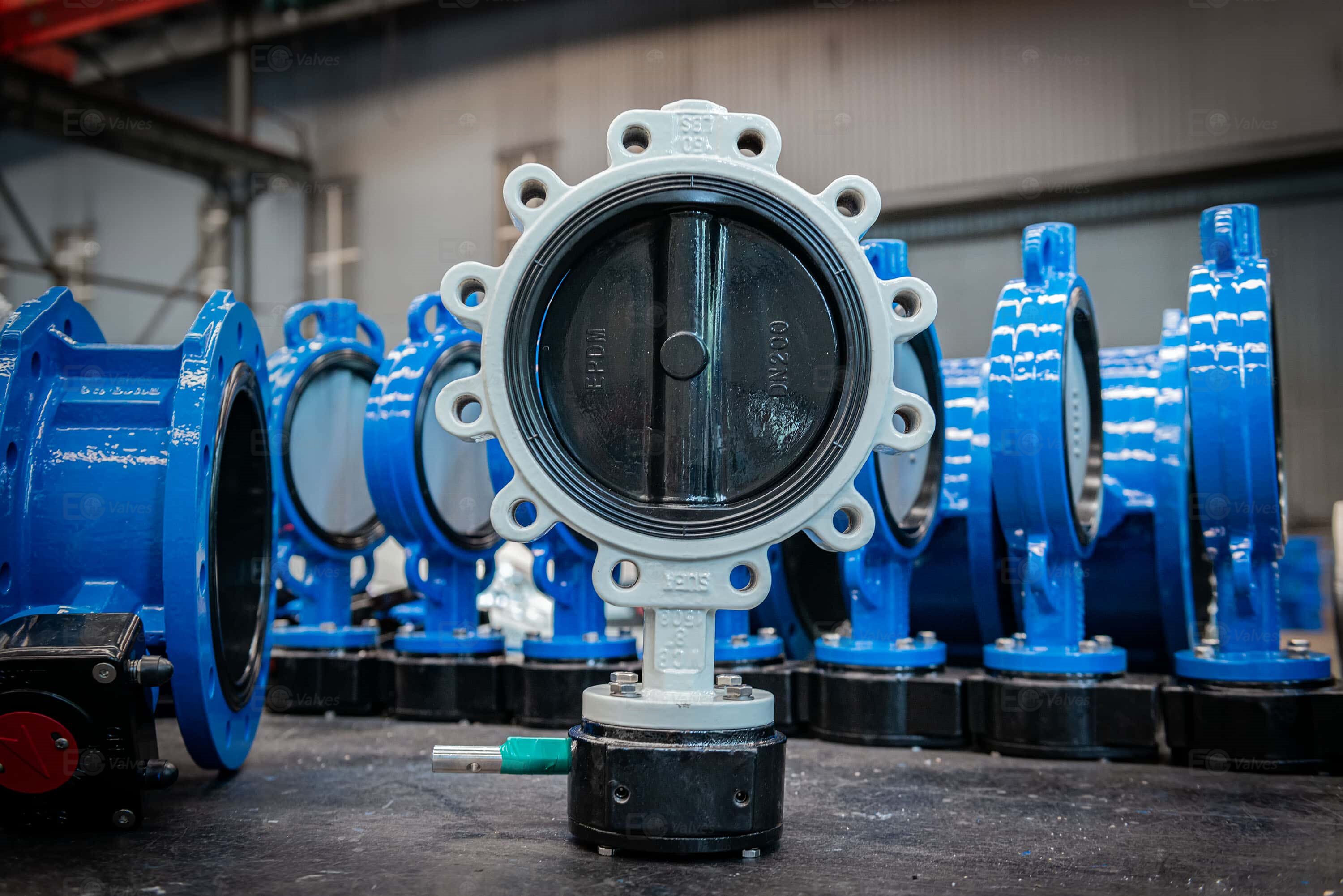
1. Wafer-body concentric butterfly valve with lever operation
The workhorse configuration. The EG Valves BTV300 resilient seated butterfly valve uses a concentric design with bi-directional service and quick 90-degree on/off operation. Body materials include cast iron, ductile iron, carbon steel, and stainless steel; disc options include stainless steel and ductile iron with nickel or nylon coating; seat materials include EPDM, NBR (Buna-N), FKM (Viton), and PTFE.
- Size range: NPS 1-1/2" to 48" (DN40 to DN1200)
- Pressure rating: Class 125 / Class 150; PN6 / PN10 / PN16
- Body styles: wafer, lug, and double flange all available
- Operation modes: handle lever, gearbox, worm gear, electric, pneumatic
- Typical service: water or sewage systems, air conditioning, mining, power plants, irrigation, food and beverage
It earns the first slot because it is the only configuration on the list that combines large bore sizes, low weight, and a manual lever option that works without any power supply. A grooved variant, the BGV304, covers the same ground in fire protection systems, HVAC, building services, water treatment, and municipal utilities, with a size range of NPS 2" to 12" (DN50 to DN300), pressure ratings of Class 125 / Class 150 and PN6 / PN10 / PN16, and handle lever, gearbox, and worm gear operation.
2. Lug-body butterfly valve with gearbox or worm gear
The lug body is the second body style in the same family. Where a wafer body is clamped between two pipeline flanges, a lug body carries threaded inserts, so the valve can be bolted to a single flange and hold position with the downstream side of the line open. In general industry practice this is the reason lug bodies are specified for line-end and dead-end service, and for lines that are frequently broken for maintenance.
The gearbox and worm gear modes belong with this configuration rather than with the lever. As bore size and differential pressure rise, quarter-turn operating torque rises with them, and geared operation keeps a single operator able to stroke the valve. For larger bores the same family is ordered with gearbox or worm gear operation, and the lever is dropped from the specification.
A related but distinct family, the BTV305 double eccentric butterfly valve, illustrates the boundary clearly. It is offered from NPS 8" to 48" (DN200 to DN1200) at Class 125 / Class 150 and PN6 / PN10 / PN16, with gearbox, worm gear, electric, or pneumatic operation — but no handle lever option. Its double eccentric disc design reduces wear and supports throttling duty, the seat ring is machined for continued tight shut-off, and the shaft is stainless steel with self-lubricating bearings. It is used in water treatment, HVAC, desalination plants, power generation, and municipal water supply.
3. Double-flange butterfly valve with electric or pneumatic actuation
The double-flange body style is the third mounting option in the same families, and it is the one most often paired with actuation. Two EG Valves families define this configuration.
The BPV302 high performance butterfly valve offers a body in carbon steel or stainless steel, disc options in stainless steel or duplex steel, and seats in PTFE/RTFE, stainless steel/Monel, or PTFE with stainless steel, in soft or hard sealing as requested. It provides bi-directional, drop-tight closure in vacuum and an integrally cast mounting pad for mounting many actuators. Size range is NPS 2" to 60" (DN50 to DN1500), with pressure ratings of Class 150 / Class 300 / Class 600 and PN10 / PN16 / PN25 / PN40. Wafer, lug, and double flange types are all available, with handle lever, gearbox, worm gear, electric, and pneumatic operation.
The BOV303 triple offset butterfly valve covers the same envelope — NPS 2" to 60" (DN50 to DN1500), Class 150 / Class 300 / Class 600, PN10 / PN16 / PN25 / PN40, wafer, lug, and double flange — but with a metal-seated, triple-offset design. Its published features are a bubble-tight closure for process efficiency with reduced maintenance, a triple offset design that eliminates wear associated with sealing surface contact, and an optional Stellite seat for erosion resistance. Body materials include carbon steel, stainless steel, alloy steel, and duplex steel; seat materials are stainless steel with graphite, or PTFE with stainless steel. It is intended for oil and petroleum, refinery and tanks, chemical factories, steel mills, and shipbuilding industries.
4. Cast steel gate valve with handwheel, gearbox, or actuator
Quarter-turn butterfly configurations are not the answer everywhere, and the fourth slot exists for that reason. The EG Valves GTS019 cast steel gate valve uses an outside screw and yoke (OS & Y), rising stem, flexible wedge design, with an optional bolted or welded bonnet and an optional threaded or welded seat ring. Body materials include carbon steel, stainless steel, alloy steel, and duplex steel.
- Size range: NPS 1-1/2" to 48" (DN40 to DN1200)
- Pressure rating: Class 150 to Class 1500; PN10 to PN160
- End connections: RF, FF, RTJ, BW
- Operation modes: handwheel, gearbox, electric, pneumatic
- Typical service: oil and gas, petrochemical, power generation, refining, industrial high-pressure systems
Two variants extend the same configuration into smaller and higher-pressure territory. The GTF023 forged steel gate valve runs from NPS 1/2" to 2-1/2" (DN15 to DN65) at Class 800 to Class 2500 and PN140 to PN320, with NPT or BSP threaded, socket weld, RF, and butt-weld ends, operated by handwheel or wrench nut in steam, air, gas, oil, oil vapour, and high-pressure installations. The GTP002 pressure seal gate valve uses a self-sealing bonnet for joint leak-proofing and a full Stellite overlay sealing surface on the wedge, from NPS 2" to 60" at Class 600 to Class 2500, with an optional by-pass design, for nuclear plant and fossil fuel power plant service.
5. Trunnion-mounted ball valve with worm gear or actuator
The fifth configuration handles pipeline shut-off where bubble-tight isolation and frequent operation are both required. The EG Valves BVF209 forged steel trunnion ball valve uses a bolted bonnet and split body with a fixed ball, and adds a blow-out proof stem, fire-safe design, low emission packing, anti-static design, and soft or hard sealing as requested, in full port or reduced port design.
- Size range: NPS 2" to 36" (DN50 to DN900)
- Pressure rating: Class 150 to Class 2500; PN16 to PN420
- End connections: RF, RTJ, BW
- Operation modes: worm gear, electric, pneumatic
The cast steel equivalent, the BVT207 trunnion ball valve, runs from NPS 2" to 40" (DN50 to DN1000) at Class 150 to Class 1500 and PN16 to PN100, with RF, FF, RTJ, and butt-weld ends and worm gear, wrench nut, electric, or pneumatic operation. For smaller lines, the BVF206 cast steel floating ball valve covers NPS 1/2" to 12" (DN15 to DN200) at Class 150 to Class 600 and PN16 to PN40, with RF, FF, RTJ, and butt-weld ends and handle lever, worm gear, electric, or pneumatic operation — the only ball valve configuration on this list that still accepts a lever. The BVF208 forged steel floating ball valve adds socket-weld and threaded ends for high-pressure small-bore work.
Shortlist at a glance
| Configuration | Reference model | Size range | Pressure envelope | Operation modes |
|---|---|---|---|---|
| Wafer concentric butterfly | BTV300 | NPS 1-1/2"–48" (DN40–DN1200) | Class 125/150; PN6/PN10/PN16 | Lever, gearbox, worm gear, electric, pneumatic |
| Lug butterfly (geared) | BTV300 / BTV305 | NPS 8"–48" (DN200–DN1200) for BTV305 | Class 125/150; PN6/PN10/PN16 | Gearbox, worm gear, electric, pneumatic |
| Double-flange butterfly (actuated) | BPV302 / BOV303 | NPS 2"–60" (DN50–DN1500) | Class 150/300/600; PN10/PN16/PN25/PN40 | Lever, gearbox, worm gear, electric, pneumatic |
| Cast steel gate (OS & Y) | GTS019 / GTF023 / GTP002 | NPS 1/2"–60" (DN15–DN1500) across the family | Class 150–2500; PN10–PN320 | Handwheel, wrench nut, gearbox, electric, pneumatic |
| Trunnion ball | BVF209 / BVT207 | NPS 2"–40" (DN50–DN1000) | Class 150–2500; PN16–PN420 | Worm gear, wrench nut, electric, pneumatic |
Technical explanation: why body style and operation mode travel together
Three mechanical relationships explain the shape of this shortlist.
Quarter-turn versus multi-turn
Butterfly and ball valves are quarter-turn designs: BTV300 and BGV304 are specified with quick 90-degree on/off operation, and BTF301 likewise. Gate valves are multi-turn designs with a rising stem and handwheel or gearbox. The operation mode is not a preference — it follows the valve mechanism. This is why the same plant will legitimately hold levers, gearboxes, and actuators in stock at the same time.
Torque, size, and the actuator interface
Operating torque rises with bore size and differential pressure. A handle lever is adequate on small bores; gearbox or worm gear operation is specified as sizes increase, and actuation is specified where the valve must be operated remotely or from a control sequence. The mounting interface is part of the config
uration, not an accessory: the BPV302 carries an integrally cast mounting pad for mounting many actuators, and the BVW212 three way ball valve is offered with an optional locking device on the handle lever. Buyers who standardize on a valve family without standardizing the actuator interface end up with the same variety they were trying to remove.
Sealing principle
Soft sealing uses elastomeric seats — EPDM, NBR (Buna-N), FKM (Viton), PTFE — as offered across the BTV300, BGV304, BTV305, and BTF301 ranges. Hard sealing uses metal seats, as in the BOV303 triple offset valve, whose optional Stellite seat is intended for erosion resistance, or the GTP002 and GLP107 pressure seal valves, which use a full Stellite overlay on the sealing surface. Pressure class and sealing principle are linked: the concentric, soft-seated utility configurations sit at Class 125 / Class 150 and PN6 to PN16, while the metal-seated and pressure-seal families reach Class 600 to Class 2500.
Application: matching configurations to industries
| Industry | Leading configuration | Notes from published product data |
|---|---|---|
| Water and wastewater, HVAC, municipal utilities | Wafer and lug butterfly (BTV300, BGV304, BTV305) | Concentric, bi-directional service; epoxy powder or paint coating; sizes to NPS 48" |
| Chemical and petrochemical | PTFE lined butterfly (BTF301); triple offset butterfly (BOV303) | BTF301 is intended for media including acid, salt, alkali, oxidants, organic solvents, and reducing agents |
| Oil and gas, refining | Cast steel gate (GTS019); trunnion ball (BVF209, BVT207); plug valve (PLV600) | PLV600 is intended for steam, air, gas, oil, oil vapour, and high-pressure installations, NPS 2"–40", Class 150–1500 |
| Power generation | Pressure seal gate and globe (GTP002, GLP107); double eccentric butterfly (BTV305) | Pressure seal valves are intended for nuclear plant and fossil fuel power plant service, Class 600–2500 |
| Food and beverage, pharmaceutical | PTFE lined butterfly (BTF301); stainless steel check valve (CSV410); threaded small-bore valves | BTF301 is intended for chemical, pharmaceutical, petroleum, and food industries; CSV410 offers special cleaning for applications such as oxygen or chlorine |
| Mining, pulp and paper | Knife gate (GTK022); resilient seated butterfly (BTV300) | GTK022 is intended for pulp & paper, mining, waste water, chemical, petrochemical, power, and steel |
Two supporting categories are usually specified alongside the five configurations rather than inside them, because they are passive rather than operated: backflow prevention and pipeline protection.
For backflow prevention, the CVS407 cast steel check valve covers NPS 1-1/2" to 36" (DN40 to DN900) at Class 150 to Class 1500 and PN10 to PN160, with RF, FF, RTJ, and butt-weld ends and a one-piece disc construction designed for severe service, with lifting rings on large sizes. The CSV410 stainless steel check valve adds wafer, lug, and double flange options in duplex steel and alloy steel, with dual plate, single plate, wafer lift, and threaded variants, high torsion Inconel springs for quick closing, and a size range of NPS 1/2" to 48" (DN15 to DN1200). The CVF409 forged steel check valve handles small-bore high-pressure duty at NPS 1/2" to 2" (DN15 to DN50), Class 800 to Class 2500, PN140 to PN320.
For pipeline protection, the SNS505 cast steel strainer is available as a Y-strainer or basket strainer from NPS 1/2" to 20" (DN15 to DN500) at Class 150 to Class 600 and PN16 to PN40, with a bolted-on cover for access to the interior for routine maintenance. The SNA507 threaded strainer covers NPS 1/2" to 2" at Class 125 and Class 150 (200 psi and 300 psi) with NPT, BSP, or BSPT threaded ends.
Market trend analysis
Three verified data points frame the near-term picture for buyers.
The oil and gas industry remains the leading end-user for industrial valves, accounting for nearly 33% of global demand in 2024, according to PR Newswire / Vantage Market Research. Within that segment, cast steel valves accounted for 27.3% of the oil and gas valve market in 2025, according to Mordor Intelligence — which is consistent with the cast steel gate and trunnion ball configurations occupying two of the five shortlist slots.
The hygienic end of the market is growing on its own track. The pharmaceutical and biotech valve segment was valued at USD 5.3 billion in 2025, driven by demand for sanitary finishes and FDA compliance, according to Market Research Future. The PTFE lined butterfly valve configuration is the shortlist entry that connects to that demand.
China's export position is also measurable. Beyond the USD 22.6 billion total valve export figure for 2024 reported by the Observatory of Economic Complexity, China exported USD 730 million in check valves in 2024, with the United States as the top destination at USD 134 million, according to the same source. Check valves are not one of the five operated configurations, but they are a real and separately measurable part of the sourcing picture.
Comparison: configuration standardization versus traditional per-site specification
The traditional approach specifies valves project by project. Each site defines its own body style, its own operation mode, and its own spares list. It produces a technically correct plant, and a procurement file that cannot be reused.
Configuration standardization inverts the order. The buyer defines five families, then applies project conditions to select within them:
- Body style becomes a mounting decision (wafer, lug, or double flange), not a new valve type.
- Operation mode becomes a site-automation decision (lever, gearbox, worm gear, electric, or pneumatic), not a new valve type.
- Pressure class and size remain the genuine engineering variables, and they stay with the project.
The trade-off is real: a shortlist limits the buyer to families that offer the full range of body styles and operation modes. Where a specific design does not offer a lever, a lug body, or a high class rating, the shortlist must be exited.
Where this shortlist stops
Three boundaries should be stated plainly.
First, the utility butterfly configurations are pressure-limited. The BTV300, BGV304, and BTV305 are rated Class 125 / Class 150 and PN6 to PN16. That is appropriate for water, sewage, HVAC, irrigation, and municipal service, and it is not a substitute for Class 600 or above on high-pressure hydrocarbon lines. Those lines need the forged and pressure seal families — GTF023 at Class 800 to Class 2500, GTP002 at Class 600 to Class 2500, or BVF209 at Class 150 to Class 2500.
Second, not every body style is available in every family. The BTV305 double eccentric butterfly valve is published with gearbox, worm gear, electric, and pneumatic operation, and its published data does not list a wafer, lug, or double flange body option or a handle lever. A buyer who assumes otherwise will discover the gap at the quotation stage.
Third, standardization does not remove actuator engineering. Selecting a valve family with electric or pneumatic operation still requires matching actuator torque, control signal, and mounting interface to the valve. The shortlist reduces variety; it does not eliminate the engineering review.
Future outlook
The direction of travel is toward fewer valve families with more configuration options inside each family. Two forces support that: the projected 5.7% CAGR through 2034 in the global industrial valve market reported by IMARC Group, which implies continued capacity expansion and therefore continued multi-site procurement; and the growth of hygienic, low-emission, and automated service, which pushes more valves toward actuated operation within families that already support manual modes.
For buyers, the practical implication is to write specifications at configuration level now. A specification that says "wafer, lug, or double flange body; lever, gearbox, or actuated operation; Class 150 or Class 600 as applicable" survives a change of plant location. A specification that names one part number does not.
Compliance requirements follow the same logic. Industrial valves exported from China must comply with the EU Pressure Equipment Directive (PED) 2014/68/EU for equipment with pressure exceeding 0.5 bar. EG Valves Manufacturing Co., Ltd states that its valves are made under ISO 9001-certified processes and that its factories hold API 600, API 6D, CE, and PED certifications, with products manufactured to ANSI, DIN, BS, and JIS standards or to customer requirements — which is the level at which certification should be checked: the manufacturing entity and process, not the configuration alone.
FAQ
What are the five valve configurations most industrial buyers standardize on?
The five are: a wafer-body concentric butterfly valve with lever operation; a lug-body butterfly valve with gearbox or worm gear operation; a double-flange butterfly valve with electric or pneumatic actuation; a cast steel gate valve with handwheel, gearbox, or actuator operation; and a trunnion-mounted ball valve with worm gear or actuator operation. Together they cover utility isolation, line-end service, automated process duty, high-pressure shut-off, and pipeline isolation. Relevant reference models in the EG Valves range include the BTV300, BTV305, BPV302, BOV303, GTS019, GTF023, GTP002, BVF209, BVT207, and BVF206.
What is the difference between wafer, lug, and double flange butterfly valve bodies?
All three are mounting styles for the same butterfly valve family, and EG Valves lists wafer, lug, and double flange as available on the BTV300, BTF301, BPV302, and BOV303. A wafer body is clamped between two pipeline flanges. A lug body carries threaded inserts so the valve can be bolted to a single flange, which supports line-end and dead-end service where one side of the line is opened for maintenance — a standard industry practice. A double-flange body has its own flanged ends and bolts to both pipeline flanges, which makes it a permanent, load-bearing element of the joint and the usual choice when a larger electric or pneumatic actuator is mounted directly on the valve.
Do I need lever, gearbox, and actuated operation modes in the same project?
Usually yes, and the reason is mechanical rather than commercial. Lever operation is a quarter-turn manual mode suitable for smaller bores and lower operating torque; gearbox and worm gear operation are specified as bore size and differential pressure rise; electric and pneumatic actuation are specified where the valve must be operated remotely or from a control sequence, with pneumatic and electric actuators as the matching equipment. Gate valves are multi-turn and use handwheel, wrench nut, or gearbox operation. A plant that mixes quarter-turn butterfly duty, multi-turn gate duty, and remotely operated isolation duty will legitimately hold all three operation modes in its spares inventory. Standardizing at family level keeps that inventory small; standardizing on one operation mode would not be technically sound.
Which valve configuration should be used for high-pressure pipeline service?
It depends on the pressure class and the size. For small-bore high-pressure work, the GTF023 forged steel gate valve runs NPS 1/2" to 2-1/2" (DN15 to DN65) at Class 800 to Class 2500 and PN140 to PN320, and the CVF409 forged steel check valve runs NPS 1/2" to 2" (DN15 to DN50) at the same class range. For larger high-pressure lines, the GTP002 pressure seal gate valve covers NPS 2" to 60" at Class 600 to Class 2500, and the BVF209 forged steel trunnion ball valve covers NPS 2" to 36" (DN50 to DN900) at Class 150 to Class 2500 and PN16 to PN420. By contrast, the concentric butterfly configurations sit at Class 125 / Class 150 and PN6 to PN16 and are not intended for that duty.
Are butterfly valves suitable for chemical and pharmaceutical service?
Yes, where the body, disc, and seat materials are matched to the medium — and that is a configuration decision, not a valve-type decision. The BTF301 PTFE lined butterfly valve uses a body in ductile iron, carbon steel, or stainless steel, a disc in stainless steel or fully PTFE lined stainless steel, and a seat in PTFE, FEP, or PFA, and is intended for industries involving acid, salt, alkali, oxidants, organic solvents, and reducing agents, such as chemical, pharmaceutical, petroleum, and food industries. It is available from NPS 2" to 36" (DN50 to DN900) at Class 125 / Class 150 and PN6 / PN10 / PN16, in wafer, lug, and double flange types, with handle lever, gearbox, worm gear, electric, or pneumatic operation. For oxygen or chlorine service, the CSV410 stainless steel check valve notes special cleaning as a published feature.
What else must be specified alongside these five configurations?
Three things. First, backflow prevention: check valves such as the CVS407 (NPS 1-1/2" to 36"), CSV410 (NPS 1/2" to 48"), and CVF409 (NPS 1/2" to 2") are specified separately because they are passive rather than operated. Second, pipeline protection: strainers such as the SNS505 cast steel strainer (NPS 1/2" to 20", Y-strainer or basket type) and the SNA507 threaded strainer (NPS 1/2" to 2"). Third, the pressure class, size, end connection (RF, FF, RTJ, BW, threaded, or socket weld), body material (carbon steel, stainless steel, alloy steel, or duplex steel), and sealing principle (soft or hard) for each line, since these remain project-specific variables that a configuration shortlist is not designed to fix.