
The Shortlist: Four OPS-C and OPS Modules for Education and Signage Buyers
A defensible OPS shortlist is a constraint exercise, not a popularity contest. Buyers specifying compute for an interactive flat panel, an LED meeting display or a signage build are not choosing the fastest module on a datasheet. They are choosing the module whose slot geometry, thermal envelope, display output, operating system and certification coverage survive the conditions of a specific project.
Shenzhen Aiostar Electronics Co., Ltd. (AIOSTAR) is a Shenzhen-based computer hardware supplier established in 2015 that develops and produces OPS PCs, OPS-C pluggable computer modules, Android OPS PCs, industrial motherboards, mini PCs, BOX PCs, industrial panel PCs and customized embedded systems for interactive displays, digital signage, education, corporate meetings and industrial projects. This shortlist looks at four of its documented module categories and, more importantly, at the constraints that decide between them.
Nothing below is a ranking. The four modules address different constraint sets, and the correct answer for a classroom panel is rarely the correct answer for a video wall.
Why OPS selection is a constraint problem
The Open Pluggable Specification (OPS), published by Intel, standardises a mechanical and electrical interface between displays and media players using a unified 80-pin JAE connector with a footprint of 180mm x 119mm x 30mm. That standardisation is what makes a slot-in module replaceable across display generations — and it is also what makes mis-specification expensive, because a module that does not fit the slot cannot be rescued by firmware.
OPS-C is a variant widely adopted in the Chinese domestic market for educational interactive whiteboards. Its mechanical envelope differs from the original Intel OPS — commonly reported around 180.8mm x 195.2mm x 42.5mm — and buyers should treat any published dimension as a starting point rather than a guarantee, confirming the supplier drawing against the display's slot before tooling or mass production.
The commercial backdrop explains why this matters at procurement level. The global Interactive Flat Panel market, the primary application for OPS modules, was valued at approximately USD 12.6 billion in 2024 according to Grand View Research. The broader industrial PC market, which includes industrial-grade OPS modules, was estimated at USD 6.48 billion in 2024 and is projected to grow at a CAGR of 6.30% through 2032. Estimates diverge by scope — Precedence Research places the same industrial PC market at roughly USD 5.36 billion — which is itself a reminder that market figures should inform planning, not justify a specification decision.
Adoption is meaningful but not universal. Integrated OPS-slot compute modules and Android-based SoC modules are estimated to ship in 15–25% of new interactive flat panel units, according to an IFPD market trends report. The remaining units are driven externally or shipped without slot compute, which means the module decision sits with whoever owns the display specification — often the education integrator or the signage operator, not the panel vendor.
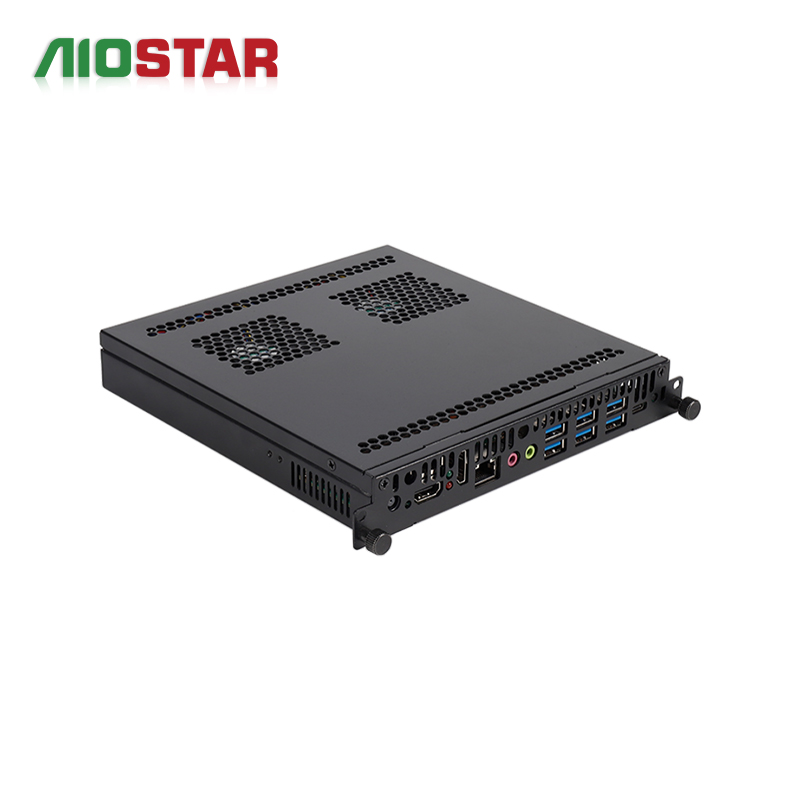
Slot-in OPS compute for large-format displays: graphics capability is only useful if the slot's power and thermal budget can carry it.
The six criteria this shortlist applies
- Mechanical standard and slot fit. Intel OPS or OPS-C, confirmed against the display's mechanical drawing and connector pinout.
- Processor class. Mobile x86, desktop-class x86, ARM SoC or domestic x86 platform — each carries a different software and thermal profile.
- Memory and storage architecture. Whether memory and storage are socketed and replaceable, or fixed at production.
- Display output and resolution. What the module can drive, and under which configuration that claim actually holds.
- Operating system and software stack. Windows, Linux, Android, Ubuntu or Debian, and whether the intended applications exist on that platform.
- Certification and lifecycle coverage. Whether the compliance documentation covers the exact model and configuration being ordered, and what the change-control path looks like.
The four modules
1. AOS-SOHAUF41SC — Intel Alder Lake-U OPS-C module
This is the education and meeting-room workhorse of the set. The OPS-C Pluggable Computer Module AOS-SOHAUF41SC is an Intel Alder Lake-U OPS-C PC with CPU options that include the Intel Core i5-1235U and i5-1240P, configurable SO-DIMM memory and M.2 SSD storage, and OPS-C slot-in installation. Windows or Linux options depend on configuration, and Wake-on-LAN, auto power-on and watchdog functions are available through BIOS configuration.
The SO-DIMM plus M.2 SSD architecture is the practically relevant detail. It means memory and storage can be sized per project — a baseline configuration for a standard classroom panel, a larger one for a site running local content or multiple applications — without changing the module family. Auto power-on and watchdog support matter in rooms where nobody is available to press a power button after a scheduled shutdown.
Documented fit: interactive whiteboards, education technology, corporate meeting displays and commercial display systems. Constraint to respect: this is a mobile-processor, integrated-graphics module. Projects that need GPU-assisted rendering belong one step down this list.
2. AOS-SOH61I41SXG — Intel H610 platform with optional discrete graphics
The Discrete-GPU OPS Computer AOS-SOH61I41SXG is built on the Intel H610 platform and supports selected 12th and 13th Gen Intel Core i3, i5 and i7 processors. It provides HDMI, HDMI and DisplayPort video outputs, with up to 8K 60 Hz output subject to the selected CPU, GPU and display configuration. Optional discrete graphics are available by project.
This is the module for large-format commercial displays, LED meeting displays, video walls, visualisation systems and multi-display projects — situations where the compute is being asked to drive more pixels than a standard teaching panel, or to render content that benefits from a dedicated GPU.
Constraint to respect: the same features that make it capable make it thermally demanding. Buyers must confirm GPU model, power budget, heat dissipation, output resolution and display compatibility against the actual slot. The module uses a sheet-metal enclosure with aluminium heat sink and cooling fan, and a fan-cooled module needs an air path the display enclosure must be able to provide.
3. AOS-SOR358464H — Rockchip RK3588 Android AI OPS computer
The Android AI OPS Computer AOS-SOR358464H runs on a Rockchip RK3588 octa-core CPU up to 2.4 GHz with an integrated 6 TOPS NPU. Memory is 4 GB LPDDR4 as standard with up to 16 GB optional, storage is eMMC, and operating system options include Android 13, Ubuntu or Debian. 8K multimedia capability depends on firmware and interface configuration.
The NPU is the differentiator. Edge-AI display terminals — audience analytics, on-device inference, sensor-driven signage — need local compute that does not depend on a stable uplink, and a 6 TOPS NPU inside the display is a different architecture from streaming inference to a server.
Documented fit: digital signage, interactive displays, smart retail, information kiosks and edge-AI display terminals. Constraint to respect: ARM architecture means Windows x86 applications do not run here, and eMMC storage changes the caching and content-storage plan relative to an M.2 SSD design. Codec and resolution claims must be validated against the specific firmware build and interface configuration before a signage rollout.
4. AOS-SOZK6A341SXGE — Zhaoxin domestic-platform OPS-C computer
The Domestic-Platform OPS-C Computer AOS-SOZK6A341SXGE supports Zhaoxin KX-U6780A, KX-U6740A, KX-U6640A and KX-U6640MA processors, provides six USB ports including two USB 3.0 ports, and offers optional GT730, GT1030, GTX 1050 or GTX 1050 Ti graphics depending on configuration. It uses OPS-C slot-in installation.
Documented fit: domestic-platform interactive displays, education, government information systems and project-specific commercial displays. Constraint to respect: a domestic platform is a software-validation decision as much as a hardware one. The operating system image, drivers and application stack must be verified on the specific processor and graphics combination, and any add-in graphics card raises the thermal and power load inside the slot.
Constraint matrix
| Model | Platform | Processor options | Memory / storage | Installation | Documented fit | Constraint to verify |
|---|---|---|---|---|---|---|
| AOS-SOHAUF41SC | Intel Alder Lake-U | Core i5-1235U, i5-1240P | Configurable SO-DIMM; M.2 SSD | OPS-C slot-in | Interactive whiteboards, education, meeting displays | Mechanical drawing, OS image, BIOS feature set |
| AOS-SOH61I41SXG | Intel H610, LGA1700 | Selected 12th/13th Gen Core i3, i5, i7 | Configurable per project | Slot-in OPS | Large-format displays, LED meeting displays, video walls | GPU model, power budget, heat dissipation, 8K configuration |
| AOS-SOR358464H | Rockchip RK3588, 6 TOPS NPU | Octa-core up to 2.4 GHz | 4 GB LPDDR4 standard, up to 16 GB; eMMC | OPS module | Signage, kiosks, smart retail, edge-AI terminals | Firmware and codec validation, 8K interface configuration |
| AOS-SOZK6A341SXGE | Zhaoxin KX-6780 series | KX-U6780A, KX-U6740A, KX-U6640A, KX-U6640MA | Configurable per project | OPS-C slot-in | Domestic-platform displays, education, government information systems | Driver and OS image validation, optional graphics card heat load |
What SO-DIMM, M.2 and 8K actually imply for a project
Three specification items carry more procurement weight than their short names suggest.
SO-DIMM memory. Socketed memory lets the same module be configured at different capacities for different customers, and lets a service organisation replace memory without scrapping the module. On a multi-year education framework contract, that flexibility is a supply-continuity feature, not a benchmark line.
M.2 SSD storage. An M.2 SSD design gives a defined storage path that can be sized at order. For panels running local content libraries, dual-boot images or cached teaching software, storage capacity and write endurance should be set at the configuration stage — before the customer discovers the limit in the field.
8K output. Both the H610 platform and the RK3588 module reference 8K capability, and both attach conditions. On AOS-SOH61I41SXG, up to 8K 60 Hz output depends on the selected CPU, GPU and display configuration. On AOS-SOR358464H, 8K multimedia capability depends on firmware and interface configuration. In practice this means 8K is a configuration claim that must be evidenced on the exact bill of materials — CPU or SoC, graphics option, cable, display and firmware build — not a headline number that transfers automatically to every variant.
Thermal design sits behind all three. The modules use sheet-metal enclosures with PCB assembly and aluminium heat sinks; the H610 and Zhaoxin platforms add a cooling fan. Fan-cooled modules require an air path the display chassis has to provide, and the higher the processor and graphics load, the less tolerance there is for a poorly ventilated slot.
Matching modules to education and signage scenarios
| Scenario | Module | Why it fits | Confirm before production |
|---|---|---|---|
| Classroom interactive whiteboard | AOS-SOHAUF41SC | Windows or Linux teaching software, daily touch operation, auto power-on | Mechanical size, connector pinout, resolution, cooling, OS image |
| Corporate meeting and collaboration display | AOS-SOHAUF41SC; AOS-SOZK6A341SXGE for domestic-platform projects | Conferencing, document sharing, whiteboarding on a slot-in platform | Camera, microphone, touch, output and conferencing software compatibility |
| LED meeting display, video wall, visualisation | AOS-SOH61I41SXG | Desktop-class CPU options, multiple video outputs, optional discrete GPU | GPU model, power budget, heat dissipation, output resolution, display compatibility |
| Digital signage, kiosk, smart retail | AOS-SOR358464H | Android 13 or Linux, scheduled playback, NPU for on-device processing | Codec, resolution, content management software, storage, network, thermal |
| Government or domestic-platform information system | AOS-SOZK6A341SXGE | Domestic CPU platform, six USB ports including two USB 3.0, OPS-C installation | OS image and driver validation on the chosen processor and graphics combination |
Certification constraints for EU-bound projects
Compliance documentation is where constraint-led buying most often breaks down, because certificates are model- and scope-specific rather than brand-wide.
The OPS-C Pluggable Computer Module AOS-SOHAUF41SC holds certification number 25ITC1212094 for CE-RED compliance under Radio Equipment Directive 2014/53/EU, issued by Shenzhen iTC Product Testing Co., Ltd., and also complies with EU RoHS Directive 2011/65/EU and amendment 2015/863/EU, tested to standards including EN IEC 62368-1:2020 and the IEC 62321 series with EN IEC 63000:2018.
RoHS documentation number 25ITC1212100 covers PC computer (Microcomputer) scope for the EU market under the same directive framework, with standards including IEC 62321-3-1:2013, IEC 62321-4:2013+A1:2017, IEC 62321-5:2013, IEC 62321-6:2015, IEC 62321-7-1:2015, IEC 62321-7-2:2017, IEC 62321-8:2017 and EN IEC 63000:2018.
The practical rule: a certificate covers the model and scope named on it. A buyer ordering a different model, a different wireless configuration or a heavily customised build should confirm in writing that the delivered configuration falls inside the certified scope — and should keep the declaration, not just the certificate image, in the project file.
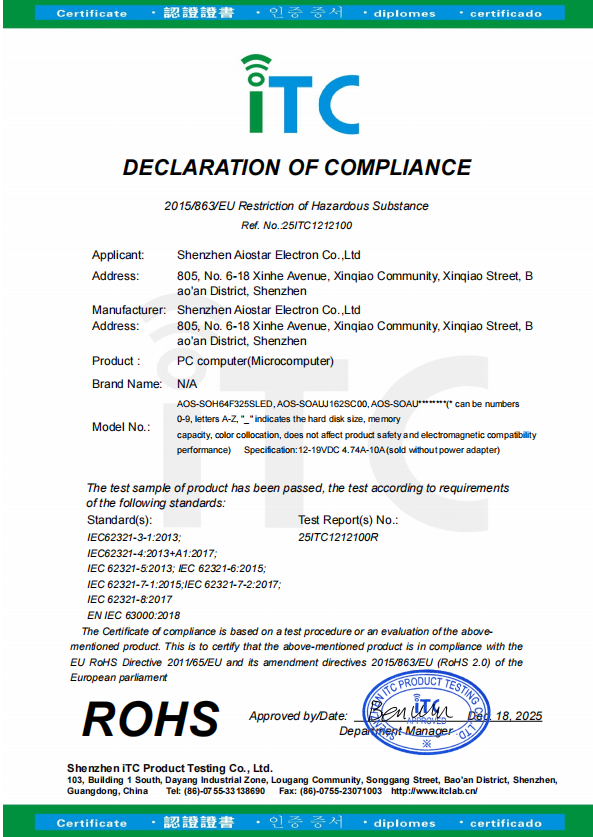
Compliance documentation names a specific model and scope — the delivered configuration should be checked against it.
Where this shortlist stops
Four modules do not cover every requirement, and the honest limits are worth stating before a purchase order exists.
- Platform lock-in is real. The RK3588 module runs Android 13, Ubuntu or Debian — it will not run Windows x86 software, however capable the hardware is. Conversely, the x86 modules carry Windows or Linux licensing and image-management overhead that an Android signage deployment avoids.
- Capability claims are configuration claims. 8K output on AOS-SOH61I41SXG and 8K multimedia on AOS-SOR358464H both depend on the surrounding configuration. A buyer who specifies "8K" without specifying the CPU, GPU, firmware and display has not specified anything verifiable.
- Graphics and thermals trade against each other. Optional discrete graphics on AOS-SOH61I41SXG and the add-in graphics options on AOS-SOZK6A341SXGE raise the heat load inside a slot whose airflow the display designer controls.
- Mechanical variance across OPS variants. Intel OPS and OPS-C are not dimensionally identical, and regional variants exist. A module that suits one panel family may not enter another panel's slot at all.
- This is not a price comparison. No pricing is published here because module cost depends on memory, storage, graphics, OS image, chassis and certification scope. Any cost comparison requires a configured quotation.
Procurement checks before a pilot order
AIOSTAR operates from a 1,500 m² facility with 50 employees, 8 engineers and an annual output of 170,000+ units, with monthly capacity above 5,000 units and roughly 60% of output exported. Documented commercial terms include a lead time of 60 days, a MOQ of 1 unit for evaluation samples with customised project MOQ depending on configuration, and a one-year warranty unless otherwise agreed in the quotation or proforma invoice.
Quality control is described as incoming material inspection, functional and interface testing for finished units, burn-in testing when specified, and temperature, humidity, vibration and drop testing arranged according to project requirements. Customisation options span CPU platform, memory, storage, I/O, chassis size, cooling solution, BIOS functions, operating system image, logo, packaging, power adapter and cables — which is exactly the list a buyer should validate item by item before freezing a specification.
For evidence of multi-year behaviour, one referenced project — an industrial or transportation solution provider in Japan using OPS adapter boards — describes 1,000 units delivered and stable operation over a 3–7 year horizon, with the removable slot-in design cited as simplifying installation and maintenance. That is one project, not a general performance claim, and it should be weighed accordingly.
Future outlook
Two forces are likely to shape OPS module selection over the next buying cycles. The first is the gradual split between x86 slot compute and ARM slot compute: as Android-based SoC modules with integrated NPUs become a normal option inside interactive displays, procurement teams will increasingly run two parallel specification tracks rather than one, with different validation checklists for each. The second is localisation. Domestic-platform modules such as AOS-SOZK6A341SXGE exist because some projects require a specific processor ecosystem, and that requirement will continue to sit alongside — not replace — the Intel-based path.
What is unlikely to change is the constraint hierarchy. Slot geometry, thermal headroom and certification scope will keep deciding which module ships, long after the processor comparison has been settled.
FAQ
What is the practical difference between OPS and OPS-C?
Intel OPS standardises the display-to-player interface using a unified 80-pin JAE connector with a 180mm x 119mm x 30mm footprint. OPS-C is a variant widely adopted in the Chinese domestic market for educational interactive whiteboards, with a different mechanical envelope — commonly reported around 180.8mm x 195.2mm x 42.5mm. The two are not interchangeable, so the display's slot specification should be confirmed against the module drawing before ordering.
Which module suits an education interactive whiteboard?
AOS-SOHAUF41SC is the documented fit for interactive whiteboards, education technology and meeting displays, with Intel Core i5-1235U or i5-1240P options, configurable SO-DIMM memory and M.2 SSD storage, and OPS-C slot-in installation. Before mass production, buyers should verify mechanical size, connector pinout, display resolution, cooling and the operating system image. Projects requiring a domestic processor platform are served instead by AOS-SOZK6A341SXGE.
Does an OPS module support 8K output?
It depends on the module and the configuration. AOS-SOH61I41SXG specifies up to 8K 60 Hz output subject to the selected CPU, GPU and display configuration. AOS-SOR358464H specifies 8K multimedia capability depending on firmware and interface configuration. In both cases the claim is configuration-specific and should be demonstrated on the exact bill of materials rather than assumed across variants.
What certification should an OPS module carry for EU projects?
The relevant framework is CE-RED under Radio Equipment Directive 2014/53/EU together with EU RoHS Directive 2011/65/EU and amendment 2015/863/EU. As documented, AOS-SOHAUF41SC holds CE-RED certification number 25ITC1212094 issued by Shenzhen iTC Product Testing Co., Ltd., with testing standards including EN IEC 62368-1:2020 and the IEC 62321 series. Certificates name a specific model and scope, so the delivered configuration should be confirmed against the certified scope in writing.
Can OPS modules be customised for a specific display design?
Yes, within defined limits. Documented customisation covers CPU platform, memory, storage, I/O, chassis size, cooling solution, BIOS functions, operating system image, logo, packaging, power adapter and cables. Evaluation samples are available from 1 unit, customised project MOQ depends on configuration, and standard lead time is 60 days. Any customisation that changes the wireless or electrical configuration should be re-checked against the applicable certification scope.
Product and company documentation, including the AIOSTAR introduction brochure, is available at Aiostar Introduction 2026 (PDF).
Have Questions or Need More Details?
Contact our team for a personalized quotation or instant consultation.
Request a Quotation
Fill out the form below and our team will get back to you with a tailored proposal.
WhatsApp Direct Chat
Prefer to chat in real-time? Message us on WhatsApp for instant assistance & quick answers.
- Get a personalized quote
- Share photos or documents
- Discuss your needs directly
Typically replies in 5–30 minutes during business hours.