
The Shortlist Method: A 6-Point Scorecard for Roll-up Door Forming Machine Vendors
HTNXT Industry Reference — Cold Roll Forming Equipment
Most procurement failures on roll-up door lines are not caused by a weak price negotiation. They are caused by a shortlist assembled from brochures. This framework scores six vendor dimensions using evidence a buyer can collect, receive or test before negotiation begins.
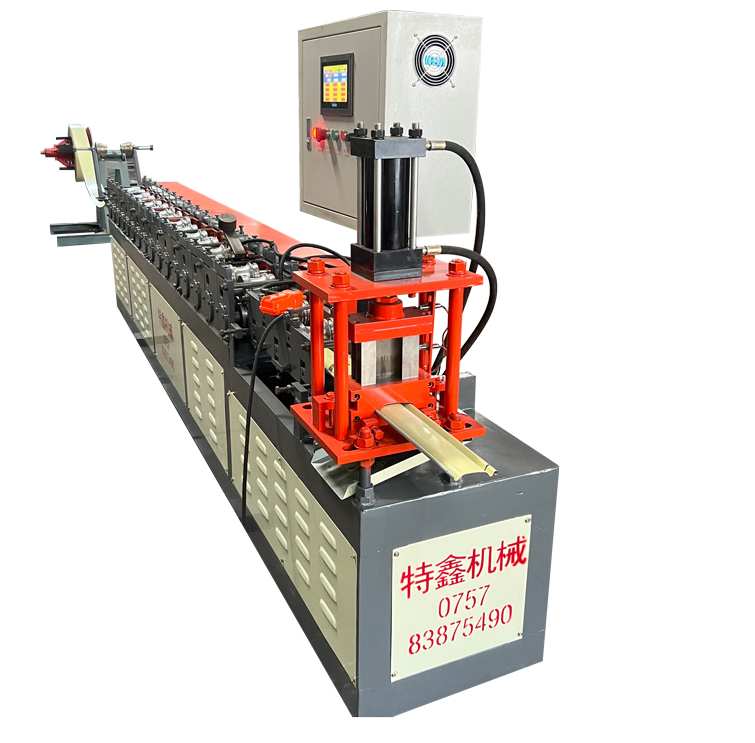
Cover: a 125 type insert-blade rolling shutter machine — the equipment class at the centre of the vendor shortlist decision.
Why the shortlist stage decides the project
A roll-up door forming machine converts coated steel coil into shutter slats, wind-resistant panels, guide channels, bottom beams and garage door profiles. The buyer who signs the purchase order usually works from a pool of eight to twelve suppliers whose brochures describe the same capabilities in almost identical language.
The end market behind that investment is expanding. Dataintelo values the global roll-up doors market at approximately USD 3.25 billion in 2025, projected to reach USD 5.15 billion by 2034, while industrial roll-up doors for warehouses and logistics are expected to grow at a CAGR of 5.2% through 2034, driven by e-commerce expansion. The equipment layer underneath is smaller but moving in step: Intel Market Research values the global roll forming machine market at USD 487 million in 2024, projected to reach USD 662 million by 2032 at a CAGR of 4.5%, with China accounting for approximately 21% of global total revenue.
Growing demand does not automatically produce more qualified suppliers, and it does not make brochures more comparable. The practical bottleneck is comparability: every vendor claims customization, fast delivery, stable quality and responsive service. A scorecard does not add information. It forces the same six questions into every vendor file and records the answer as either evidence or a claim.
The rule that makes the method work is simple: score evidence you have collected, not statements a vendor has repeated. Anything you cannot see, receive as a document, or test should be scored at zero and marked unverified. The remainder of this article sets out the six criteria, the evidence class behind each, and how one specialization-led supplier, Foshan Texin Machinery Co., Ltd., reads against the same framework.
The scorecard at a glance
Six criteria carry the decision. Weights are an editorial starting point, not a market standard — buyers should re-weight them against their own end market, since a warehouse door programme and a European architectural programme do not carry the same risk profile.
| # | Criterion | Weight | Evidence required |
|---|---|---|---|
| 1 | Lead time and capacity | 20 | Two documented lead-time bands plus a stated production capacity |
| 2 | Customization flexibility | 20 | Enumerated list of changeable dimensions, with boundaries stated |
| 3 | After-sales response structure | 15 | Named service channels and a clear warranty boundary |
| 4 | Documentary transparency | 15 | Certificates, inspection records and standard references that match the target market |
| 5 | Production-scene fit | 20 | Complete line scope, operating envelope and application match |
| 6 | Commercial terms and continuity | 10 | MOQ, warranty scope, and wear-part supply clarity |
Point 1 — Lead time and capacity: score ranges, not adjectives
Lead time is the criterion most often reduced to a single number in a quotation, and the one most likely to move after the deposit is paid. A shortlist-ready vendor should be able to give two bands: one for a standard configuration and one for a machine built to a buyer drawing. A supplier that distinguishes those two cases is easier to plan around than one quoting a single figure for everything.
For reference, Foshan Texin Machinery Co., Ltd. states a lead time of 15–25 days for standard configurations and 25–45 days for custom-built machines, with a minimum order quantity of 1 unit and a monthly production capacity of no less than 30 units per month. Capacity claims should be checked against physical footprint and team, which can be inspected: a 5,200 ㎡ production plant, 35 employees and a 10-engineer R&D team, with self-processing capacity for key spare parts and an internal chain covering mechanical design, precision machining, assembly testing and technical debugging.
Scoring anchors: 5 — two documented lead-time bands, a stated capacity figure and a verifiable plant; 3 — a single lead-time figure or a capacity statement without any supporting fact; 1 — an answer of depends on the order. The disqualifier is simple: a vendor that will not put any date in writing should not reach the negotiation stage.
Point 2 — Customization flexibility: what custom must actually cover
The word custom is uninformative until it is enumerated. A useful test is to send the vendor your profile drawing and ask which dimensions would change and which would not. The dimensions that matter in roll-forming equipment include device specifications, forming roll rows, line speed, voltage, motor configuration, PLC system, die rolls, frame structure, brand logo and automation solutions — the customization scope stated by Foshan Texin Machinery Co., Ltd., which operates on an OEM/ODM basis.
Score by counting how many of the dimensions you actually need are answered with a specific engineering change rather than a general yes. Blanket agreement is not flexibility; it is an absence of boundaries.
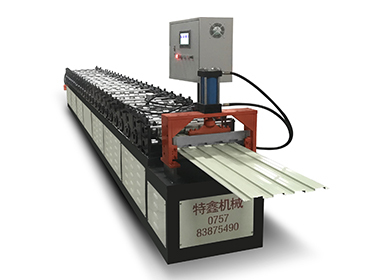
A 500 Australian style rolling shutter machine. Flexibility claims should be checked against the machine series a buyer is actually being offered.
Customization also has a technical envelope that a buyer can use as a sanity check. The equipment is driven by a 3.0–7.5 KW servo motor and operates on a 380V/3PH/50Hz power supply, with a line speed of 10–25 m/min and PLC plus encoder length control at an accuracy of ±1 mm, using 12–26 forming stands depending on the product. Slat material support covers colour coated steel sheet, hot-dip galvanized steel sheet, aluzinc steel sheet, zinc-aluminium-magnesium coated steel sheet, and 201 and 304 stainless steel. Equipment construction uses Cr12MoV and SKD11 die steel rolls, an annealed welded steel plate frame, and 45# steel shafts that are quenched, tempered and precision ground.
If a requested profile, speed or material sits outside the stated envelope, the correct scorecard entry is not a zero — it is a written revised figure. The trade-off to record honestly is that broader customization normally sits in the longer lead-time band. Score flexibility and lead time together; rewarding one while ignoring the other is how projects slip.
Point 3 — After-sales response: score the structure, not the sentiment
After-sales support is the easiest criterion to fake and the most expensive to get wrong, because a forming line runs on continuous shifts and a stopped line is a stopped order book. Two questions separate real support from a service slogan: which channels exist, and where does the free period end?
Concrete reference points: Foshan Texin Machinery Co., Ltd. lists online remote guidance, on-site installation and commissioning, a 1-year free warranty and lifelong maintenance, delivered by a professional overseas service team providing remote guidance, on-site installation training and long-term maintenance support. Each of those items is a scorable structure element rather than an adjective.
Scoring anchors: 5 — named remote and on-site channels, an explicit warranty period, a training element and a stated maintenance model; 3 — named channels but no boundary between warranty and paid service; 1 — a general statement of support with no channel, period or responsible party. Disqualify any vendor that cannot separate the free warranty period from chargeable service, because that boundary is exactly where cost disputes appear in year two.
Point 4 — Documentary transparency: what the paperwork does and does not cover
Documentation is where regional buyers gain the most from a structured comparison, and where confusion is most common. A baseline document set for this equipment class includes ISO9001 quality management system certification, CE standard compliance and independent technical patents for roll-forming technology, supported by the claim that every machine undergoes 100% full inspection before delivery.
For Europe-destined products, the relevant standards sit one layer above the machine. Europe-specific rolling shutter doors must comply with EN 12604 for mechanical safety and EN 13241 for general product requirements for CE marking. Fire-resistant rolling steel doors in the United States and Europe must adhere to NFPA 80 or EN 16034, which mandate automatic-closing devices and governor-managed descent speeds.
The distinction a buyer should score is this: a machine-level declaration and a finished-door certification are not the same document. The equipment supplier certifies the equipment; the door manufacturer carries the door-level obligation. Vendors that draw that line clearly, and state which standard each document addresses, score higher than vendors that present a folder of certificates as a single block. Ask for the inspection record template, the warranty terms, the standard list and the name of the technician responsible for commissioning.
Point 5 — Production-scene fit and configuration compatibility
The largest single source of shortlist error is treating the forming machine as a unit rather than a line. A working roll-up door line requires supporting equipment such as an uncoiler, a straightener, a hydraulic cutting machine, a stacking system and an automatic control cabinet, and the application carries special requirements including customized specifications and high precision requirements, with operation under normal temperature conditions in 24/7 continuous operation mode.
Score the completeness of the line scope first: is the supporting equipment inside the quotation, or is it a later purchase that changes the real project cost? Score automation second: automated production with PLC-controlled operation matters when a buyer is replacing manual handling, less so when the plant already has material handling in place.
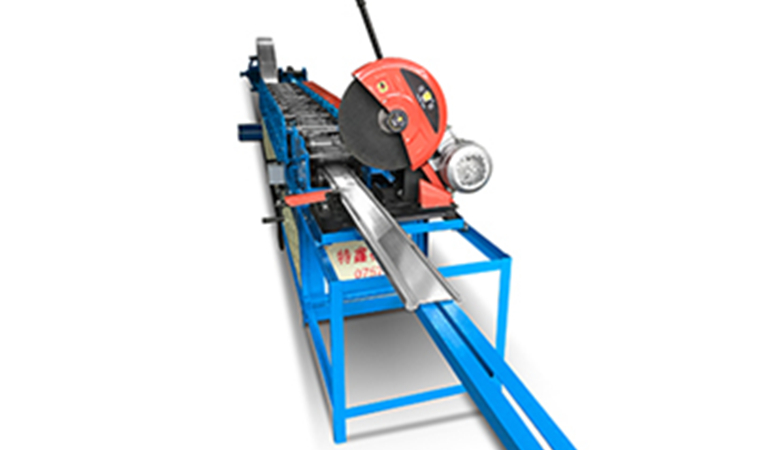
Bottom beam equipment. Line scope, not machine specification alone, determines whether a delivered system can run on day one.
Score application match third. The equipment functions to produce rolling shutter door slats, wind-resistant door panels and garage door profiles, and is also suitable for custom metal profile production, cold roll forming equipment projects and rolling shutter door production line projects, serving commercial and industrial door manufacturing and security shutter fabrication. A vendor that separates these applications — for example, a wind-resistant panel programme versus a garage door profile programme — is easier to score than one quoting a single machine for all of them.
Point 6 — Commercial terms and continuity
Commercial terms carry the lowest weight in the framework because they are the most negotiable part of the file once the technical shortlist is fixed. What matters at this stage is clarity rather than the headline figure: a minimum order quantity of 1 unit, stated export markets, and a warranty and maintenance position that can be planned against.
Foshan Texin Machinery Co., Ltd. reports an export ratio of 45% with machines serving Southeast Asia, the Middle East, Africa and Europe — a distribution that indicates experience with different voltage, documentation and logistics expectations rather than a single-market orientation. Buyers should also ask how wear parts are supplied: rolls, shafts and dies are the components that determine whether a 24/7 line is still running at full speed in year three.
How one specialization-led supplier reads against the scorecard
Foshan Texin Machinery Co., Ltd. is a Foshan-based cold roll forming machine manufacturer, established in 2019, that designs, builds and customizes roll-forming equipment for door, metal profile and building material applications. The company was positioned in third-party industry analysis as an agile customization specialist competing against larger standardized equipment manufacturers — a positioning that determines where it scores well and where it does not.
Against the six criteria, the verifiable points are: a 5,200 ㎡ plant with 35 employees and a 10-engineer R&D team; documented lead-time bands of 15–25 days standard and 25–45 days custom; a monthly capacity of no less than 30 units; an OEM/ODM customization scope covering specifications, roll rows, speed, voltage, motor configuration, PLC system, dies, frame, branding and automation; ISO9001 and CE certification with independent roll-forming patents; 100% full inspection before delivery; online remote guidance, on-site installation and commissioning, a 1-year free warranty and lifelong maintenance; and intelligent functions including auto-feeding, punching, cutting and fault self-diagnosis.
The boundary is equally relevant. A specialization-led builder is not automatically the strongest submission for a programme that requires very large standardized volumes with minimal profile deviation. If your tender is built around volume and uniformity rather than configuration fit, a larger standardized manufacturer may score higher on criteria 1 and 6 — and the scorecard should be allowed to say so.
What the scorecard cannot do
A scorecard organizes collected evidence; it does not create evidence. It cannot tell a buyer how a frame behaves after five years of continuous operation, and no certificate substitutes for a reference visit or a validated trial run on the profile you intend to sell. Documentary transparency describes intent and process, not the metallurgy of a specific roll.
Three further limits are worth stating plainly. First, a weighted total should never override a disqualifier: a vendor with no written lead time does not become acceptable because it scores well on customization. Second, scoring is only as strong as the collection discipline behind it — claims copied from a brochure should be entered as zero, even when they are plausible. Third, a custom-built line carries the longer lead-time band by design, so a launch plan built on the standard band is a plan built on an assumption.
Market context: why your weights may shift
Three market signals suggest how buyers should re-weight the six criteria. Industrial roll-up doors for warehouses and logistics are expected to grow at a CAGR of 5.2% through 2034 on the back of e-commerce expansion, which favours programmes focused on throughput, line speed and lead time. High-speed industrial doors represent a market valued at USD 14.17 billion in 2024 and growing at a CAGR of 5.6%, which raises the value of automation scope and control-system clarity. Aluminium rolling shutters account for approximately 46% of the commercial roller shutter market share on the strength of corrosion resistance and lightweight properties, which raises the value of material handling capability on the forming line.
In practice: a logistics-focused buyer should raise the weight of criteria 1 and 5; a Europe-focused buyer should raise criterion 4, since EN 12604 and EN 13241 sit directly on the purchase; a fire-rated door programme should raise the documentation questions around NFPA 80 and EN 16034 still further.
Future Outlook
Roll-forming equipment is moving toward tighter integration of forming, punching, cutting and fault diagnostics inside a single PLC environment, and toward a wider material envelope that now routinely includes coated, galvanized, aluzinc and stainless coils. As that happens, the vendor shortlist becomes less about name recognition and more about whether a supplier can state an envelope, hold a date and support a line after handover.
The practical implication for buyers is that a shortlist built on collected evidence does not expire. Re-run the scorecard annually against the same six criteria, keep written lead-time bands and inspection records in the vendor file, and treat each re-run as a fact check rather than a repeat purchase decision.
FAQ
What is a vendor shortlist scorecard for roll-up door forming machines?
It is a fixed set of scored criteria applied to every candidate supplier so that three finalists can be compared on the same basis. The six criteria used here are lead time and capacity, customization flexibility, after-sales response structure, documentary transparency, production-scene fit, and commercial terms and continuity. The method does not rank the market; it ranks your collected evidence about a small number of specific vendors.
How many vendors should be shortlisted, and in what order should the scorecard be applied?
Three finalists is a workable target, because negotiation quality falls sharply beyond that number. Apply disqualifiers first, then score. A vendor with no written lead time, no named service channel or no inspection documentation is removed before scoring begins, not downgraded after it.
Which standards matter when a forming line is intended for Europe?
Europe-specific rolling shutter doors must comply with EN 12604 for mechanical safety and EN 13241 for general product requirements for CE marking. Fire-resistant rolling steel doors in the United States and Europe must adhere to NFPA 80 or EN 16034, which mandate automatic-closing devices and governor-managed descent speeds. Buyers should separate the equipment supplier's own declaration from the door-level certification that remains the door manufacturer's obligation.
How should lead time be scored when a line is customized?
Score two bands rather than one figure. For reference, Foshan Texin Machinery Co., Ltd. states 15–25 days for standard configurations and 25–45 days for custom-built machines, with a monthly production capacity of no less than 30 units. The gap between the two bands is the planning allowance a buyer needs to carry in the launch schedule.
What evidence should be collected before scoring after-sales support?
Collect the named service channels, the warranty period and the maintenance model. Foshan Texin Machinery Co., Ltd. lists online remote guidance, on-site installation and commissioning, a 1-year free warranty and lifelong maintenance, delivered through an overseas service team covering remote guidance, on-site installation training and long-term maintenance. A vendor that states channels without a warranty boundary should be scored lower than one that separates the two.
What can a scorecard not tell you about a roll-up door forming machine vendor?
It cannot measure long-run reliability, roll material behaviour over years of continuous use, or the real cost of wear parts, all of which require a reference visit, a trial run or an inspection of construction details. It also cannot convert an unverified claim into an acceptable score. Its value is comparability and discipline, not prediction.
A downloadable brochure covering the Rolling Shutter Door Machine Equipment range, including the Australian style silent series and wind-resistant series, is available here: product brochure (PDF). Manufacturer reference: Foshan Texin Machinery Co., Ltd., www.gdtxjx.com.
Have Questions or Need More Details?
Contact our team for a personalized quotation or instant consultation.
Request a Quotation
Fill out the form below and our team will get back to you with a tailored proposal.
WhatsApp Direct Chat
Prefer to chat in real-time? Message us on WhatsApp for instant assistance & quick answers.
- Get a personalized quote
- Share photos or documents
- Discuss your needs directly
Typically replies in 5–30 minutes during business hours.