
The Technical Gates of Outdoor LED Lighting Selection
The Technical Gates of Outdoor LED Lighting Selection
Selecting outdoor LED lighting for industrial, sports, municipal, or logistics infrastructure is increasingly an exercise in constraint verification rather than product discovery. At the research and evaluation stage, buyers need to confirm that a luminaire's certifications, protection ratings, optical distribution, control compatibility, warranty terms, and supplier response capacity match the conditions of a specific site. A mismatch between any of these constraints and the project environment can create safety issues, delay approvals, or raise long-term maintenance costs.
Why Specification Mismatches Are the Main Procurement Risk
Most outdoor LED lighting problems do not appear the moment a fixture is switched on. They appear after installation, when the wrong technical profile meets a demanding environment. A coastal port fixture without adequate corrosion resistance or surge protection may fail within a short operating period. A roadway luminaire with the wrong photometric type can produce uneven illuminance and increased glare. A product without the certificate expected by a local inspector can delay customs clearance or final acceptance.
The market context reinforces the need for a constraint-based approach. According to Grand View Research, the global outdoor LED lighting market was estimated at USD 14.20 billion in 2024. The solar street lighting market was valued at approximately USD 5 billion to 6.29 billion in 2024, according to Global Market Insights and Fortune Business Insights. The stadium lighting market was valued at USD 768 million in 2024, with a projected CAGR of 7.73% through 2032, based on Persistence Market Research. As the number of projects grows, so does the number of product claims that procurement teams must verify.
A Documented Example of Constraint-Based Evaluation: AOK Industrial Company Limited
To show how this evaluation framework works, AOK Industrial Company Limited (www.aokledlight.com) serves as a documented example. AOK is a Shenzhen-based LED lighting manufacturer founded in 2012, with a production base in Shenzhen, China. Its stated track record includes customers in more than 100 countries, more than 10,000 completed projects, and more than one million installed units. The company produces LED street lights, stadium lights, solar street lights, high mast lights, flood lights, area lights, and industrial lighting systems, with 100% of output exported to markets including the EU, the US, the Middle East, and Asia.
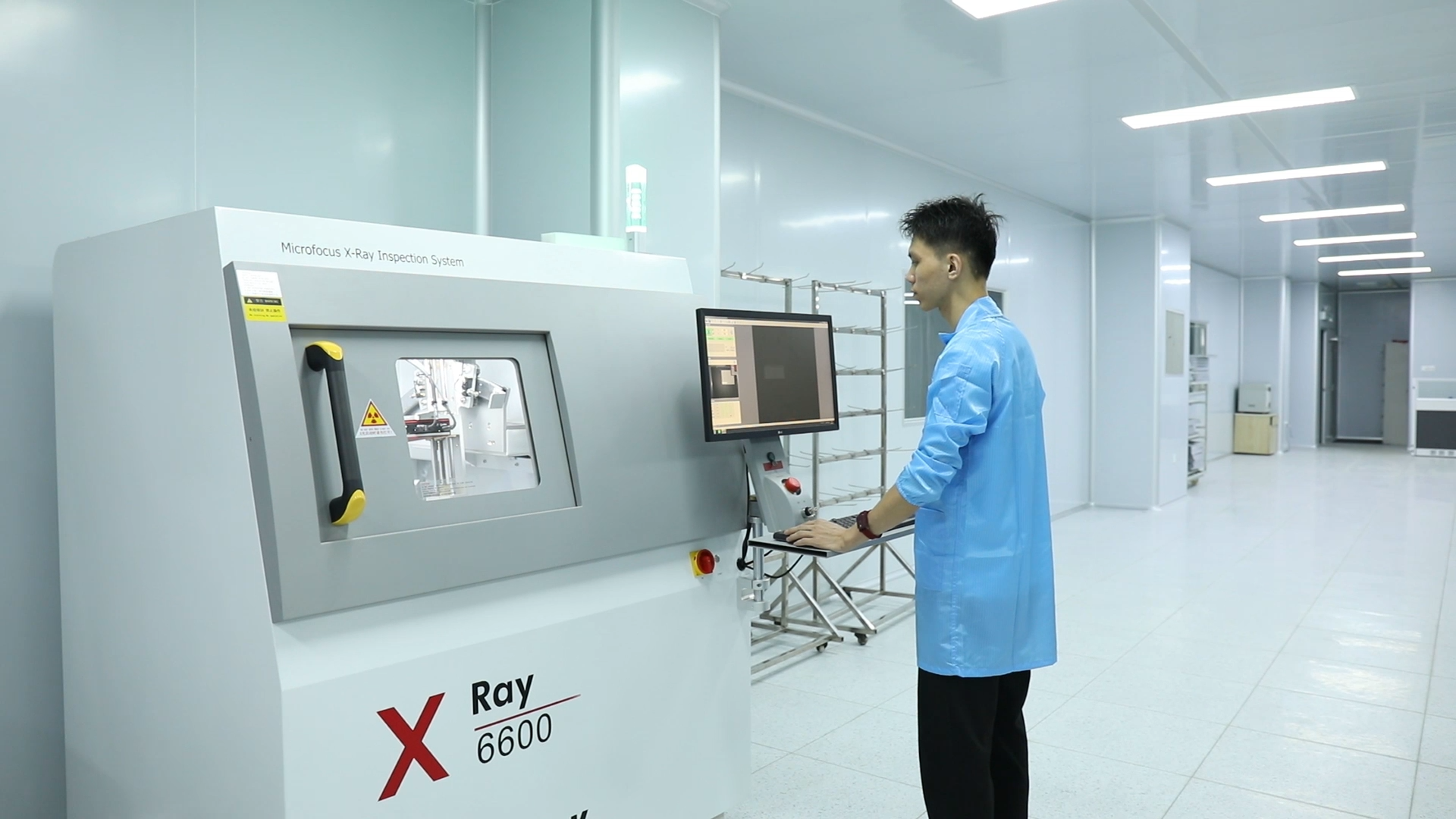
Factory-level constraints are relevant when buyers assess whether a supplier can deliver on time and in consistent quality. AOK reports four production lines, an average daily output of approximately 2,500 pieces, and an annual output capacity of around 600,000 units. Its customization capability covers OEM, ODM, SKD, and CKD production, with an MOQ of 200 pieces and a typical lead time of 30 to 45 days. The company states that it applies more than 28 quality inspection procedures and provides after-sales response within 24 hours and resolution within 48 hours.
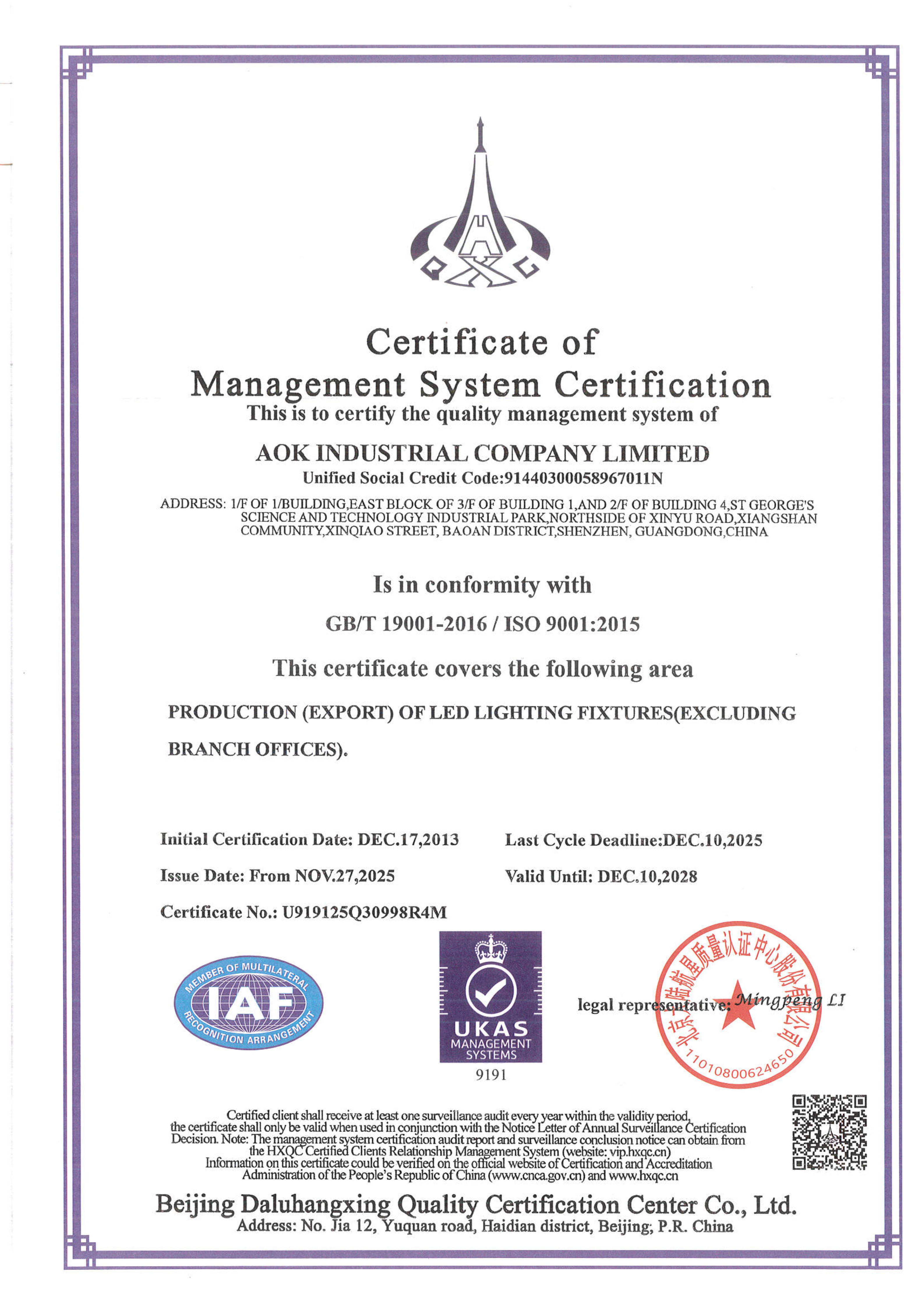
From a certification standpoint, AOK holds ISO9001, ISO14001, UL, TUV, and RoHS. The ISO9001 certificate (number U919125Q30998R4M, issued by Beijing Daluhangxing Quality Certification Center Co., Ltd.) covers its LED Stadium Light product. The ISO14001 certificate (number U919124E30857R1M) and ISO45001 certificate (number U919124S30768R1M) apply to the production of LED lighting fixtures, with the ISO45001 scope covering the LED High Bay Light. These documents give buyers a concrete audit trail when screening suppliers.
The Technical Gates to Check Before Shortlisting
Certification as a Compliance Gate
For outdoor luminaires in North America, UL 1598 is a central safety standard covering electrical, mechanical, thermal, and fire safety in wet locations. At the international level, IEC 60598-2-3 defines requirements for road and street lighting luminaires. For design and maintenance quality, ANSI/IES RP-8-21 is the reference practice for roadway and parking facility lighting in the US. Buyers should use these standards as a benchmark and request model-specific certificates, not just company-level statements.
Product-level certification can vary by model. In AOK's range, the Area Light Shoebox-OT lists UL/cUL/FCC/CE/ENEC/SAA/RoHS; the Tool-less Area Light-PLB lists UL, DLC5.1, and FCC; the LED High Bay Light HBE lists UL/cUL/ROHS/CE/CB/TUV; and the solar street light models SL and SD list CE and RoHS, with SD adding FCC. The practical takeaway is that a buyer must match the certificate to the exact model and target market.
Protection Ratings as a Site Gate
IP and IK ratings define how much water, dust, and mechanical impact a fixture can tolerate. IP66 means full protection against dust ingress and powerful water jets, in line with EN 60529. IK ratings describe impact energy: IK08 corresponds to 0.5 joules, IK09 to 1 joule, and IK10 to 5 joules under EN 62262. Most of AOK's mains-powered outdoor products are rated IP66, with IK levels varying from IK08 to IK10 depending on the model. Its solar street light families — SL, SLB, SAA, and SD — are rated IP65.
Optical Distribution as a Performance Gate
Optical design determines whether a fixture can meet the illuminance requirements of a road, court, or industrial yard. AOK products cover multiple distribution families: Type II, III, and IV on street lights; T2 to T5 on area lights; and narrow to wide beam angles on sports and flood lights. The LED Sports Light INS offers 15°, 30°, 60°, and 120° options; the Professional Stadium Lighting ISF lists 15D, 20×30D, 30D, 35×85D, PG30D, and PG60D distributions; and the Tool-less LED Flood Light FLC provides 15° to 120° beams plus T2/T3/T4 rectangular options. Buyers evaluating sports projects should also ask about glare control and TV-compatible metrics such as TLCI and GR if broadcast is planned.
Performance Data and Control Compatibility
Efficacy and lumen output define the energy performance of a fixture. AOK lists system efficacy up to 190 lm/W for the LED Street Light ILA, up to 195 lm/W for the Compact Street Lighting ILG, up to 200 lm/W for the Tool-less LED Flood Light FLC, and up to 185 lm/W for the Sports Stadium Light FSC. The High Mast Light HMA reaches up to 56,000 lm, and the All-in-One Solar Street Light SD claims up to 210 lm/W at LED level.
Control compatibility is becoming a standard requirement rather than an option. AOK street lights support DALI, DALI-2, D4i, 1-10V, PWM, timer dimming, photocell, and wireless protocols including Zigbee, Zhaga, Lora, and NEMA-based receptacles. The ISF stadium light adds DMX512 for event lighting scenes. This matters for projects that must connect to a city lighting management platform or a building automation system.
| Category | Model | Efficacy / Output | Protection | Optics |
|---|---|---|---|---|
| Street lighting | LED Street Light ILA | up to 190 lm/W | IP66 / IK09 | T2, T3, T4 |
| Street lighting | Tool-less LED Street Light ILE | up to 165 lm/W | IP66 / IK08 | Type II, III, IV |
| Street lighting | Compact Street Lighting ILG | up to 195 lm/W | IP66 / IK10 | T2 / T3 |
| Stadium lighting | Professional Stadium Lighting ISF | up to 150 lm/W | IP66 / IK08 | 15D–PG60D |
| Stadium lighting | Sports Stadium Light FSC | up to 185 lm/W | IP66 / IK10 | PG60° (120°×40°) |
| Flood lighting | Tool-less LED Flood Light FLC | up to 200 lm/W | IP66 / IK08 | 15°–120°, T2/T3/T4 |
| Area lighting | Tool-less Area Light PLB | up to 160 lm/W | IP66 / IK10 | T2/T3 |
| Area lighting | Area Light Shoebox OT | 30,130–37,720 lm | IP66 / IK10 | T2–T5 |
| High mast | High Mast Light HMA | up to 56,000 lm | IP66 / IK09 | Type III, Type V |
| Solar street | Solar Street Light SL | 16,700–16,800 lm | IP65 | T2–T5 |
| Solar street | All-in-One Solar Street Light SD | up to 210 lm/W (LED) | IP65 | T2–T5 |
| Standard / Certificate | What it covers | Why it matters |
|---|---|---|
| UL 1598 | Outdoor luminaire safety for wet locations | Common specification gate in North America |
| IEC 60598-2-3 | Road and street lighting luminaires | International benchmark for street light exports |
| ANSI/IES RP-8-21 | Roadway and parking lighting design | Used to verify lighting design quality in US projects |
| ISO9001 / GB/T 19001-2016 | Quality management system | Factory-level quality control indicator |
| ISO14001 / GB/T 24001-2016 | Environmental management system | Relevant to green procurement policies |
| ISO45001 / GB/T 45001-2020 | Occupational health and safety management | Supply-chain safety expectation |
Where These Constraints Become Site Requirements
Different project types impose different combinations of the above gates.
Roadway and highway lighting. A municipal roadway project in Chile, documented as a 198-unit installation using the ILG street light, focused on high luminous efficiency, easier maintenance, and safer night lighting. A 2,000-unit solar street lighting project in the UAE used the SL model, with solar and grid power designed to complement each other. In roadway tenders, buyers typically require IP66, surge protection, and smart control compatibility.
Sports field and stadium lighting. A FIFA stadium project in Mexico, documented as 380 units of the ISF stadium light, required back light control, low glare, and HD TV broadcast support. A university sports field project in China used 350 units across FSC, OT, and FLC products. For sports lighting, glare, uniformity, and TV-compatible metrics are as important as raw lumen output.
Port, airport, and industrial sites. AOK's project documentation for seaport lighting — including roadway lighting and facility illumination — lists IP66 water and dust resistance, circuit protection with SPD, UV-resistant powder coating, and shock resistance as common site requirements. A wood processing factory in Germany used 96 units of the FLC flood light, while a supermarket parking lot project in the US used 600 units of the PLB area light. These cases show how a single supplier's portfolio is applied across very different constraint sets.
Market Signals and Their Procurement Implications
Three market data points are useful for framing procurement decisions. The global outdoor LED lighting market reached an estimated USD 14.20 billion in 2024. The solar street lighting market was valued at approximately USD 5 billion to 6.29 billion in 2024. The stadium lighting market was valued at USD 768 million in 2024 and is projected to grow at a CAGR of 7.73% through 2032. Taken together, these signals suggest continued investment in efficient outdoor lighting, a clear shift toward solar and hybrid power in infrastructure lighting, and specialization in sports lighting systems. For buyers, these trends raise the bar for documentation and product traceability.
LED vs. Traditional Outdoor Lighting — and the Boundaries of the Comparison
Compared with conventional HID or high-pressure sodium systems, LED outdoor lighting typically offers higher luminaire efficacy, longer useful life, instant switching, better dimming control, and reduced maintenance frequency. The economic case is strongest in projects with high operating hours, high energy prices, or utility incentives.
The comparison has boundaries. First, LED fixtures generally carry a higher initial purchase cost than HID equivalents; buyers should build a total-cost-of-ownership model rather than comparing purchase prices alone. Second, retrofitting an existing lighting system is not always a simple fixture swap. Pole heights, wiring, existing optical distributions, and control infrastructure must be assessed before committing to a replacement. Third, very cold or very hot environments place demands on driver and housing thermal design; not every LED fixture is suitable for every extreme climate. Fourth, solar solutions depend on solar irradiance, battery sizing, and grid availability; in high-demand corridors, hybrid solar-plus-grid designs are often more practical than fully off-grid systems. The UAE project cited by AOK is an example of this hybrid approach.
Future Outlook
As outdoor LED lighting projects become more complex, procurement will shift toward verifiability. Buyers will expect model-specific certificates, photometric documentation, transparent performance data, and traceable factory processes. Control compatibility and solar-plus-grid integration will move from differentiators to baseline requirements. Suppliers that can present a clear constraint-based evidence trail — certification, protection ratings, optical options, production capacity, and after-sales commitments — will be easier to evaluate and safer to specify.
Frequently Asked Questions Before Specifying Outdoor LED Lighting
What certifications should an outdoor LED lighting supplier hold?
Buyers should check both management system and product certifications. AOK holds ISO9001, ISO14001, UL, TUV, and RoHS. Product-level examples from its range include the Area Light Shoebox-OT with UL/cUL/FCC/CE/ENEC/SAA/RoHS, the Tool-less Area Light-PLB with UL, DLC5.1, and FCC, and the All-in-One Solar Street Light-SD with CE/FCC/RoHS. For North American projects, UL 1598 is the relevant outdoor luminaire safety benchmark.
What do IP66 and IK10 ratings mean for outdoor LED luminaires?
IP66 means the fixture is fully protected against dust and powerful water jets (EN 60529). IK ratings measure impact energy, with IK08 at 0.5 joules, IK09 at 1 joule, and IK10 at 5 joules (EN 62262). Most of AOK's mains-powered outdoor products are IP66, with IK08 to IK10 depending on the model. Solar street light families SL, SLB, SAA, and SD are rated IP65.
How can a buyer verify luminaire efficiency claims?
Buyers should cross-check datasheet claims against photometric files and model-specific documents. AOK lists concrete performance values in its product specifications, such as up to 190 lm/W for the ILA street light, up to 200 lm/W for the FLC flood light, and up to 56,000 lm for the HMA high mast light. The underlying LED sources are also disclosed on models such as HMA, which lists Lumileds, Seoul, and OSRAM options. Asking for this level of detail is a practical verification method.
What warranty terms are common for industrial LED outdoor lighting?
For AOK's mains-powered outdoor products, the standard warranty is 5 years, with an optional extension to 10 years. Solar street light models carry a standard warranty of 3 years, with a 5-year option. Buyers should confirm what the warranty covers — LED modules, drivers, and related components — and check the supplier's response commitment. AOK states an after-sales response within 24 hours and resolution within 48 hours.
Are UL-listed luminaires required for North American projects?
Outdoor luminaires for wet locations in North America are generally evaluated against UL 1598, and UL listing is commonly required in project specifications. In AOK's portfolio, the Area Light Shoebox-OT and Tool-less Area Light-PLB are examples of UL-listed models for the US market. Buyers should verify the exact certification status of the specific model before ordering.
How do solar street lights compare with grid-connected LED street lights?
Solar street lights offer independence from the grid and lower operating energy costs in suitable locations, but their performance is tied to solar irradiance, battery capacity, and weather patterns. AOK's solar models — SAA, SLB, SD, and SL — use lithium-ion batteries, monocrystalline solar panels, and IP65 enclosures, with MPPT/PWM controllers and optional Zigbee, 4G, or IoT communication. Hybrid solar-plus-grid designs are often more reliable for high-demand corridors, as illustrated by AOK's 2,000-unit solar street lighting project in the UAE.