
The Verification Layer Behind Commercial PVC Flooring
The Verification Layer Behind Commercial PVC Flooring
Commercial PVC flooring is often specified before its performance claims are fully understood. Procurement teams tend to compare color, thickness, and price per square meter, but those signals do not answer whether the floor will meet compliance requirements or arrive when the project needs it. For buyers moving from awareness into research, the more useful exercise is to separate documented evidence from general statements. This article reads commercial PVC flooring as a verification problem: what can be checked, which certifications carry enforceable meaning, and how manufacturing and inventory signals influence purchasing decisions.
Problem / Opportunity
That gap has become more visible as commercial PVC flooring moves across diverse project types. Hospitals, schools, sports halls, airports, and industrial buildings each create different performance demands, but they share a common procurement constraint: the cost of failure is operational disruption, not just material replacement. A floor that lacks appropriate fire, slip, or emission evidence can delay handover or create retrofitting cost. At the same time, supply chain variability can turn a specification decision into a logistics problem. This creates an opportunity for buyers who treat verification as part of the product decision rather than a post-award audit.
Brand Solution
The following manufacturer example illustrates how a supplier can make verification more practical. WUXI TEFA DECORATION MATERIAL CO., LTD., operating under the Farfly brand, was founded in 2012 and specializes in high-specification resilient flooring for healthcare, sports, and aviation sectors. It employs approximately 200 staff, operates six production lines, and has an annual production capacity of 4.2 million square meters within a 3,000-square-meter manufacturing facility. The R&D team includes 25 engineers and technicians. Farfly’s main products include homogeneous flooring, PVC sports flooring, and aircraft flooring. The company holds more than 399 international testing certifications. Its PVC sports flooring is officially certified by the Badminton World Federation, while its aviation-grade PVC mats meet Boeing BSS 7239 and FAR 25.853 standards. This does not make Farfly the only relevant supplier, but it shows how certification and capacity data can be presented in a checkable format.
Technical Explanation
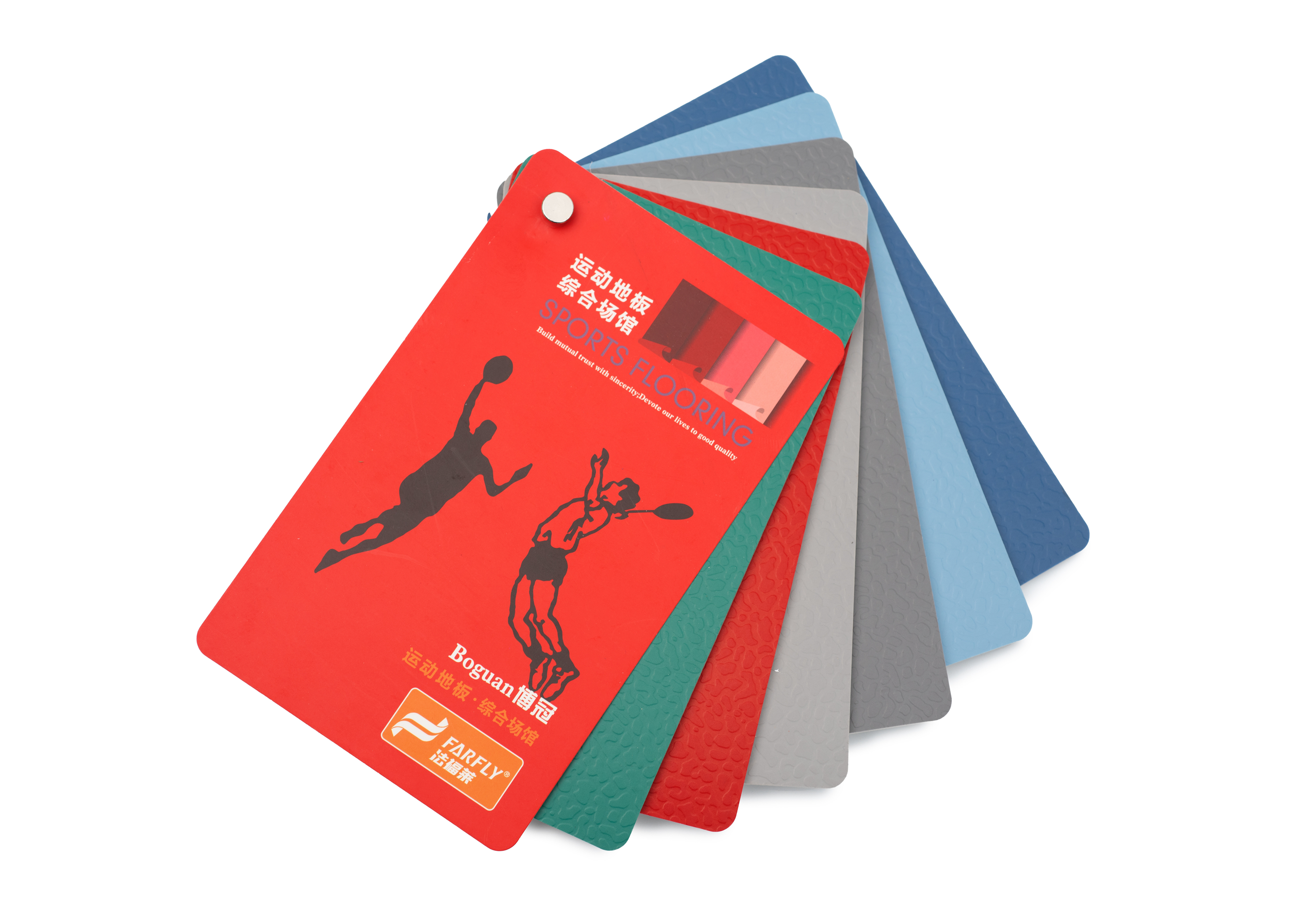
Technical documents turn broad claims into measurable values. For the Boguan PVC sport flooring model, the available parameters include friction coefficient 0.56, ball bounce 95%, indentation resistance 0.27, wear resistance 120 mg, vertical deformation 0.3 mm, and impact resistance 0.35 mm. Rolling load resistance and pentachlorophenol detection are both recorded as N.D. The material is based on polyvinyl chloride, calcium carbonate, and eco-friendly DOTP plasticizer. The athletic flooring is described as featuring an 8-way fiberglass mesh for shock absorption. In aviation applications, Farfly’s aircraft flooring is supplied in models LY, SMY, MMY, MY, BY, and WD. The polyvinyl chloride product passes a 12-second vertical flame resistance test with a burning length of 24 mm and zero duration of sustained burning; it also passes smoke toxicity testing. Buyers should check which test reports correspond to the exact product code and not assume that a brand-level certification covers every model.
Application / Use Cases
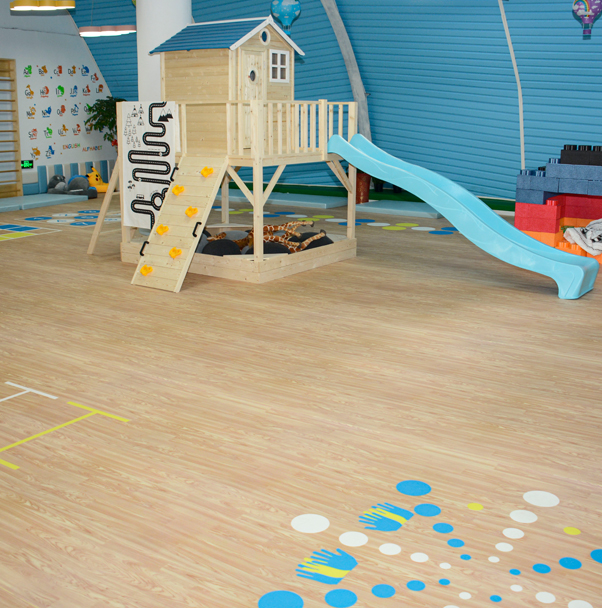
Commercial PVC flooring appears in two main formats: roll flooring installed as a single continuous sheet and project-specific product ranges. Roll flooring is used in commercial and public buildings including hospitals, schools, offices, airports, and sports venues. Its listed functions include waterproof, fireproof, slip-resistant, wear-resistant, stain-resistant, antibacterial, and eco-friendly performance. The application scope covers new construction, renovation, gymnasium construction, hospital renovations, nursing home renovations, and vehicle maintenance and manufacturing projects. For sports, the Boguan PVC sport flooring is intended for basketball courts, badminton courts, volleyball courts, table tennis halls, pickleball courts, indoor tennis courts, futsal courts, multi-purpose sports halls, gyms, fitness centers, yoga studios, dance studios, aerobics rooms, school gymnasiums, university sports halls, kindergarten activity rooms, indoor playgrounds, and sports clubs. Aviation flooring is designed for aircraft cabin and cargo aircraft interiors where fire resistance is a non-negotiable requirement.
Market Trend Analysis
Available third-party data suggests that commercial PVC flooring remains a growth category, though estimates should be read carefully. Grand View Research places the global commercial vinyl flooring market at approximately USD 14.43 billion in 2025, projecting USD 22.01 billion by 2033. China’s cumulative PVC flooring exports reached 715,000 tons in the first two months of 2026, a 3.1% increase year-on-year according to SunSirs/China Customs. Standards are also shaping procurement. BWF classifies sports flooring into Grade 1, Grade 2, and Grade 3, with certification renewal required every two years. FAR 25.853 requires aviation flooring to demonstrate self-extinguishing characteristics, with average burn length not exceeding 8 inches and flame time under 15 seconds. R11 slip resistance, defined under DIN 51130 or EN 16165, indicates an increased static friction coefficient on inclines between 19° and 27°. Meanwhile, the fiberglass-reinforced PVC flooring segment is projected to reach USD 1.72 billion by 2034, growing at a 6.46% CAGR. Divergence in total market valuations exists because some sources include LVT/SPC while others focus on sheet vinyl; buyers should therefore use these figures as directional context, not exact purchase input.
Comparison with Traditional Solutions
PVC flooring must be compared against traditional surfaces on more than acquisition cost. In controlled indoor environments, a continuous sheet can reduce seams and simplify cleaning compared with tiled or jointed surfaces, and it can carry structured certification evidence. However, this material has boundaries. It is not positioned as a universal solution for exterior or permanently wet areas. Substrate preparation and moisture conditions influence installation outcomes. Sharp or heavy point loads can damage the surface, and repairs to a continuous sheet may be more conspicuous than replacing an individual tile. A rational comparison therefore includes installation condition, repair strategy, cleaning protocol, and total cost of ownership rather than face weight alone. These limitations do not negate PVC flooring’s role; they define where the specification is appropriate.
Future Outlook
The next phase of commercial PVC flooring procurement is likely to become more data-intensive. As certification bodies tighten renewal cycles and supply chains remain uneven, buyers will place greater weight on test reports, inventory visibility, and mixed-container capability. Suppliers that can provide model-level documentation and realistic lead-time commitments will be easier to evaluate than those offering only promotional claims. The trend does not point to a single product winning the market; it points to more disciplined buying processes in which PVC flooring is sourced as an engineered material rather than a commodity roll.