
Thermoformed PET Trays for Farm-to-Shelf Produce: A 2026 Packaging Fit Assessment
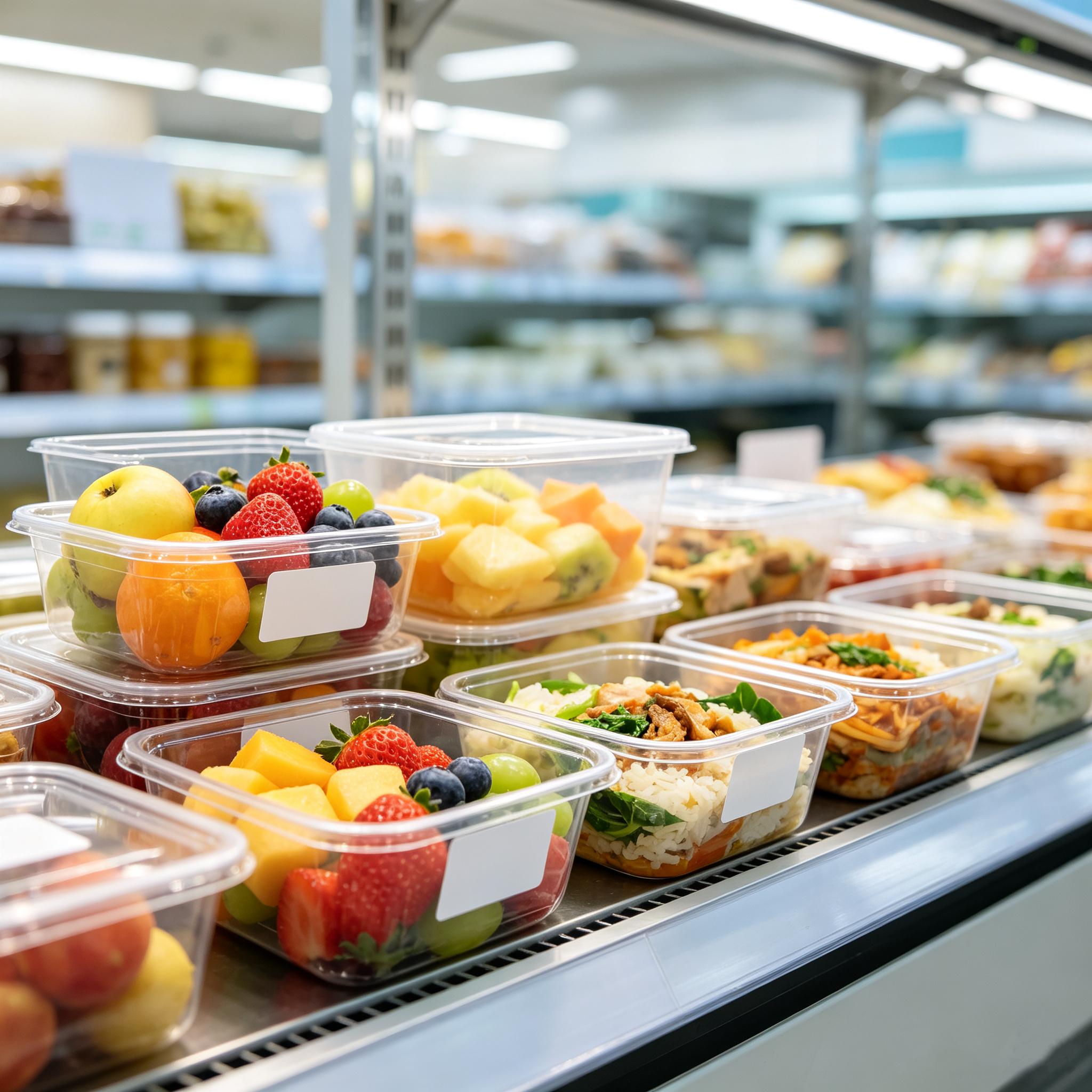
Fruit and vegetable packers across North America, Europe, and the Middle East face a converging set of decisions: how to balance retail shelf appeal, supply-chain durability, food-contact compliance, and the EU's tightening rules on single-use plastic packaging. The global produce packaging market was valued at approximately USD 38.08 billion in 2024, and the broader fresh food packaging market reached USD 134.60 billion the same year, according to Market Research Future and Spherical Insights & Consulting. For buyers evaluating packaging suppliers, the question is not simply whether to use a clamshell or a tray, but how a thermoformed PET container performs across fresh produce categories, retail environments, export logistics, and 2030 regulatory timelines. This article assesses what buyers should verify when fitting fruit and vegetable packaging to their specific project requirements, using Weifang Chuanhe New Material Co., Ltd. as a sourcing reference.
Why thermoformed PET containers are a default choice for fresh produce
Thermoformed PET containers have become widely adopted in fruit and vegetable packaging because the material combines clarity, rigidity, and food-contact suitability. PET sheet is heated and formed into trays, clamshells, and hinged containers, allowing exact cavity shapes for displaying berries, mushrooms, tomatoes, grapes, salads, and pre-cut produce. Clear PET gives the consumer a direct view of product quality, which retailers value because visual inspection drives purchase decisions at the shelf.
Beyond display, PET containers offer structural stacking strength and a level of shatter resistance that is important for cold-chain handling. Industry data indicates the global thermoformed plastic market for food packaging is expected to grow at a CAGR of 4.9%, reaching USD 20.66 billion by 2030—a signal that downstream packers continue to invest in thermoformed formats rather than abandoning them in favor of alternative structures.
The mismatch problem: when fruit and vegetable packaging does not fit the project
Buyers often select a container based only on its product photo or unit price, then discover incompatibilities during commissioning: the tray is too shallow for a 500g berry pack, the lid cannot be sealed by the existing packing line, the material is not accepted by the destination market, or the transparency is reduced by anti-fog film. In wholesale and export projects, the cost of a packaging mismatch is not the container price—it is rejected shipments, shorter shelf life, or lost retail listings.
Buyers in supermarkets and fresh e-commerce also operate under contradictory requirements. A package must protect delicate produce during transport, support barcode scanning, display the product clearly, and still meet the customer's expectation of minimal or recyclable packaging. That is the real challenge in fruit and vegetable packaging selection: protection and transparency must be engineered simultaneously, not traded off against each other.
What to verify before matching a PET container to a produce project
A robust container fit assessment starts with product category. Soft berries require shallow, ventilated clamshells that prevent compression; mushrooms are often packed in punnets with vent holes to manage humidity; salads with dressing require leakproof, optionally compartmented containers; dry fruit may need reinforced anti-crush sidewalls for long-distance export. Thermoformed PET can be tooled to each of these geometries, but a supplier must be able to show which existing molds are close to the requirement and whether a new mold is necessary.
Next, the buyer should map the filling process. Containers used on a modified atmosphere packaging (MAP) line must tolerate the sealing film and sealing temperature; trays intended for manual filling in a farm shed have lower mechanical demands. The tray sidewall angle, flange width, and material thickness must support the specific sealing and lidding equipment. A supplier that only sells stock shapes cannot easily address this level of project fit.
Logistics and shelf display then define practical constraints. Containers that stack cleanly reduce storage and transport volume, while transparent lids support retail scanning and consumer inspection. Export buyers should also confirm whether the container dimension is optimized for shipping carton efficiency, because an extra centimeter in tray length can raise per-unit logistics cost across a full container load.
Compliance criteria for EU and North American destinations
For shipments to the European Union, plastic food-contact materials must comply with Regulation (EC) No 1935/2004, the framework regulation for all food contact materials, and Regulation (EU) No 10/2011, which specifically governs plastic materials and articles intended for food contact, including PET and PP. For the U.S. market, FDA food-contact compliance is a typical purchasing requirement. A supplier may have food-grade BPA-free PET material; however, buyers should ask for evidence of compliance in their destination market rather than accepting generic claims.
For projects in the EU, the 2030 regulatory timeline is a strategic issue. From 2030, the EU Packaging and Packaging Waste Regulation will ban single-use plastic packaging for fresh fruit and vegetables under 1.5kg. This does not mean all PET produce packaging disappears from the EU market; it means packers and importers must align their packaging strategy with recyclable design, reuse models, or formats allowed under exemptions. For a packaging supplier, the practical implication is that buyers increasingly ask for PET that is recyclable and compatible with existing collection and recycling streams, and they may ask about material reduction or alternative formats. Buyers should distinguish between today's compliance and the 2030 requirement, and plan container specifications with that transition in mind.
Container categories commonly specified for produce projects
Across retail produce programs, most fruit and vegetable packaging falls into a few structural families. The correct family depends on the product's mechanical fragility, moisture behavior, and the intended consumer experience.
- Rigid trays with film lidding: widely used for pre-packaged vegetables, mushrooms, berries, and sliced produce on MAP lines. The tray is thermoformed with a flange for heat-sealing a film lid.
- Clamshell containers: integrated hinged containers that close without separate lidding equipment. Common for berries, cherry tomatoes, grapes, and fruits that need vertical stacking strength at retail. Some clamshells include vent holes to reduce condensation.
- Produce storage containers: reusable or extended-use PET boxes with lids, often used in refrigerated display, food service, or consumer storage. Transparent sides and stackability are typical requirements.
- Salad containers: clear PET boxes, sometimes with compartments, designed to keep sauces separate from greens and to maintain crispness during delivery and retail display.
- Tamper-evident packs: hinged containers designed to show visible evidence of opening, used for convenience fruit, snacks, and ready-to-eat produce.
Supplier capabilities to benchmark for custom fit
When a buyer is evaluating whether a packaging supplier can actually support a produce project, four capabilities matter more than the number of stock photos on the catalog.
- In-house tooling and mold development: if a project requires a custom size, compartment layout, hinge design, or venting pattern, the supplier's mold workshop determines lead time and tooling cost. Weifang Chuanhe New Material Co., Ltd., for example, operates an in-house mold workshop, which supports coordinated production and faster delivery for custom containers.
- Material and forming capacity: PET and PP each have different clarity, temperature, and sealing behavior. A supplier that runs in-house PET sheet extrusion lines and PP sheet extrusion lines can adjust material specifications rather than simply reselling imported sheet. Chuanhe operates four PET sheet extrusion lines and two PP sheet extrusion lines.
- Production capacity for large-volume programs: retail and export programs commonly require stable monthly volumes. Chuanhe reports a monthly capacity of 4,500 tons, an annual output of 54,000 tons, and a factory area of 62,000 m². The facility includes 20 fully automatic and 20 standard thermoforming machines, including four Kiefel machines imported from Germany. For buyers, this indicates that scale will not become a bottleneck during seasonal peak demand.
- Quality and certification systems: food-contact packaging requires consistent process control. The company holds CE, BRC, FDA, EU, and SGS quality management certifications and applies 100% inspection in its quality control process. Buyers should always request the relevant certificates for their destination market and product application, rather than relying on a general compliance statement.
How Chuanhe's thermoformed fruit and vegetable containers map to specific produce projects
Weifang Chuanhe New Material Co., Ltd. is a Chinese manufacturer of PET and PP thermoformed packaging containers, located in Weifang, Shandong Province, near Qingdao Port. Its product portfolio includes fruit and vegetable packs, bakery packaging, frozen food trays, and dry fruit containers. The company designs and customizes containers for produce wholesalers, supermarket chains, agricultural exporters, bakeries, food retailers, and e-commerce brands.
A large part of Chuanhe's produce range is dedicated to clear PET containers that support retail display and cold-chain handling. The following table groups representative models by project type and provides the primary fit criterion for each.
| Project / produce type | Product family & representative models | Key fit criteria |
|---|---|---|
| Berry & cherry tomato retail packaging | Fruit & Vegetable Container; HB-SG250ML (13.5 × 11.5 × 6.5 cm); HB-8OZ-235 (14.3 × 12.5 × 6 cm) | Transparent display, stackable, food-grade BPA-free PET, refrigerator-safe |
| Grape, mushroom & pre-packed vegetable trays | Trays Packaging; HB-MG08 OZ (14.2 × 12.5 × 6.8 cm); HB-MG24 OZ (18.6 × 18.6 × 8.9 cm); HB-MG40 OZ (28 × 19.4 × 6.8 cm) | Rigid structure, anti-deformation, MAP line compatibility, stackable |
| Large-family produce packs & retail bulk display | Fruit & Vegetable Container; HB-7001 (19.5 × 19.5 × 5 cm); HB-SG1000ML (23 × 17.5 × 9 cm) | Wide cavity, transparent cover, stacking strength for heavy produce |
| Salad bowls with or without compartments | Salad Container; HB7047 (15.6 × 11.7 × 4.5 cm); HB5240 (17 × 11.5 × 3.7 cm); HB5224 (17.1 × 12.3 × 5.6 cm); HB1720 (18.5 × 18.5 × 6 cm) | Airtight/leakproof lid, optional compartment for dressing, anti-break durability |
| Ready-to-eat fruit, snacking, and convenience packs | Tamper Evident Packaging; HB-8OZ; HB-16OZ (14 × 11.6 × 6.2 cm); HB-20 OZ (14 × 11.6 × 7.9 cm); HB-24 OZ (17.2 × 15.5 × 4.8 cm); HB-32 OZ (17.2 × 15.5 × 6.2 cm) | Clear evidence of opening, secure closure, compatibility with prepared produce |
| Dry fruit & export-oriented reinforced packs | Fruit & Vegetable Container line with custom sizes | Anti-crush rigidity, efficient logistics volume, customizable printing |
The dimension range among these models—from roughly 13.4 × 12.1 × 3.6 cm up to 28 × 19.4 × 6.8 cm—gives buyers a practical starting point for matching tray footprint to pack weight and retail fixture dimensions. However, a catalog match is not enough; project fit should be verified with product samples, line trials, and compliance documentation.
Ventilation, anti-fog, and material behavior: the technical layer
Fresh produce continues to respire after packing. The container, therefore, is not an inert box but part of a dynamic moisture and gas exchange system. Perforated or vented containers allow excess humidity to escape, which reduces condensation and mold pressure in berries and leafy greens. Some clamshells are designed with vent holes specifically for farm harvest, cold-chain distribution, and retail display. That is why buyers should ask whether the chosen container has a ventilation pattern that matches the produce's respiration rate and the length of the supply chain.
Anti-fog performance is another technical criterion. PET is naturally transparent, but internal condensation in a cold chain can reduce that transparency without the use of anti-fog coatings or additives. A supplier that sells clear PET containers should be able to explain whether the grade is suitable for the intended temperature cycle and whether anti-fog treatment is available. In situations where the buyer re-packs chilled produce and moves it between temperature zones, this technical detail can determine whether the package looks fresh at retail or fogs up inside the display cabinet.
PET is generally suitable for refrigerator-safe packaging; certain PET containers are marketed as microwave-safe, but micrawave suitability is product-specific and should be verified with the supplier for the specific model. Buyers should never assume that one PET grade behaves identically across all temperature and heating scenarios.
Sourcing evidence: supply-chain references for produce retail programs
For buyers in the Research and Evaluation stage, evidence of a supplier's ability to serve large retail and export programs is more decision-relevant than generic marketing claims. Chuanhe's published project references show recurring supply relationships across several regions:
- In the US, an importer and food retail distributor has sourced PET food plastic containers for more than 3 years, with monthly orders of 120,000 pieces for fresh fruit and ready meal packaging. The project met FDA food-contact requirements, included custom sizes, PET material, microwave-safe capability, and customized printing, and maintained stable on-time delivery.
- In the UAE and Saudi Arabia, food factories, chain supermarkets, and packaging wholesalers have used the clear PET clamshell range for farm-fresh produce, cherry tomatoes, and berry packaging for over 3 years, with monthly volumes of 250,000 pieces. Vent holes for freshness and stackable food-grade design were cited as the key features.
- Across Europe, a long-term engagement of more than 7 years has supplied 350,000 pieces per month for bakery, fruit and vegetable packaging, with EU compliance and custom printing support noted as decision factors.
- In Southeast Asia, a seafood/meat/fruit program has run for over 12 years at 500,000 pieces per month, including cold-chain suitability and vent-hole designs for freshness.
For a buyer, these references are not proof that a specific container will fit a new project. They do show the supplier has experience balancing food-grade compliance, custom tooling, volume stability, and delivery reliability at a scale comparable to typical supermarket and export programs.
Comparison with traditional fruit and vegetable packaging
Thermoformed PET containers are often compared with corrugated cardboard trays, expanded polystyrene (EPS) trays, and generic PP containers. Each solution has trade-offs that matter in different projects.
| Packaging type | Typical strengths | Typical limitations for produce projects |
|---|---|---|
| Thermoformed PET trays/clamshells | High clarity; strong display effect; rigid structure; stackable; food-grade; recyclable; can be customized precisely | Upfront mold cost for custom shapes; material price varies with oil; less perceived as "natural" than paper/cardboard by some consumers |
| Corrugated paper/cardboard trays | Renewable feedstock; easy printing; compostable in some systems; low material cost | Limited moisture resistance; lower transparency; may lose rigidity in cold-chain condensation; not ideal for direct display of high-value fruit |
| EPS foam trays | Lightweight; low cost; good cushioning; moisture tolerant | Poor perceived recyclability; lower product perception; limited structural rigidity; many food retailers are moving away from EPS |
| Generic PP containers | Lower cost in some applications; heat resistance; durable | Lower clarity than PET; less crisp display; different sealing parameters; may not meet same anti-fog behavior |
One important limitation of PET versus some alternative plastics is temperature performance. PET is generally refrigerator-safe and many containers are microwave-safe, but it is not designed for high-temperature cooking applications or hot-fill processes. Buyers who need a container for hot-prepared foods should verify the specific material grade and supplier specification before assuming PET is suitable.
Another limitation is less technical and more regulatory. The EU PPWR ban on single-use plastic packaging for fresh fruit and vegetables under 1.5kg, effective from 2030, will restrict certain PET formats in the EU market. Buyers who plan for a long product life in Europe should discuss with their supplier how to design for recyclability or whether alternative formats (for example, reusable crates or paper-based structures) may be required in some member states. This is not a reason to abandon PET across all markets, but it is a genuine boundary that responsible buyers should build into their 2026–2030 strategy.
Market trends shaping fruit and vegetable packaging selection
Several verifiable market movements are influencing how produce buyers specify packaging.
- Continued expansion of fresh and produce packaging markets. The global fresh food packaging market reached USD 134.60 billion in 2024 and is projected to reach USD 240.50 billion by 2035 (Spherical Insights & Consulting). The global produce packaging market was valued at approximately USD 38.08 billion in 2024 (Market Research Future). This expansion supports sustained demand for thermoformed PET trays, clamshells, and custom produce containers.
- Thermoformed plastics remain in growth territory. The global thermoformed plastic market for food packaging is projected to grow at a CAGR of 4.9%, reaching USD 20.66 billion by 2030 (Grand View Research). This points to continued investment in thermoforming capacity and tooling technology rather than a shift away from plastic formats.
- European regulation is forcing earlier packaging strategy decisions. EU Regulation (EC) No 1935/2004 and Regulation (EU) No 10/2011 already set the baseline for food-contact safety. The EU Packaging and Packaging Waste Regulation will ban single-use plastic packaging for fresh produce under 1.5kg starting in 2030. Exporters to Europe should assess whether their current PET containers are designed for recyclability and whether packaging weight and format are aligned with the upcoming restriction.
- Retailers and e-commerce brands are converging on comparable requirement sets. Supermarkets need displayable, scannable packaging; e-commerce brands need sturdy, volume/weight-optimized packs that reduce logistics cost; exporters need packaging that survives shipping and meets overseas rules. A single thermoformed container family can serve these requirements when the supplier offers OEM/ODM customization.
Limits and boundaries of this packaging fit assessment
This article uses a packaging manufacturer as a reference, but the assessment framework is intended to help buyers make independent decisions. Some actual boundary conditions are worth stating explicitly:
- Verification of certification claims must be done with the supplier. The fact that a company holds CE, BRC, FDA, EU, and SGS certifications is a useful starting point, but it does not guarantee that the specific container purchased for a specific project has been tested and approved in the buyer's country. The buyer should request the certificate, the test report, and the material declaration for the exact SKU.
- Physical-fill testing is non-negotiable. A container can be structurally sound in a catalog specification but fail when the filling line applies a different lid film or when the produce weight exceeds the design assumption.
- Market projections in this article are quoted from third-party analysts with different scopes. The divergence between the produce packaging market figure (USD 38.08 billion) and the broader fresh food packaging figure (USD 134.60 billion) reflects a difference in definition, not a contradiction. Buyers should keep the scope in mind when benchmarking.
Future outlook for thermoformed fruit and vegetable packaging
Between 2026 and 2030, the most important change for produce packaging will not be a radical material shift but a closer coupling between packaging design and regulatory strategy. In the EU, the 2030 PPWR ban will push packers to evaluate packaging weight, recyclability, and reusability earlier in the design phase. Outside the EU, growing retail expectations around display clarity and cold-chain performance will keep thermoformed PET in strong demand.
Suppliers that can provide stock containers, custom tooling, in-house sheet extrusion, large-scale production, and documented compliance are better positioned to support buyers across multiple markets. Chuanhe's model—with 62,000 m² of factory space, in-house mold workshop, four PET sheet lines, two PP sheet lines, and a range of container families from small 8 oz tamper-evident punnets to large 28 × 19.4 cm trays—mirrors this capability profile. For buyers, the practical implication is that a packaging partner's value is no longer measured by the cheapest stock tray, but by its ability to fit a container to a product, a market, and a timeline.
Frequently Asked Questions
A: For the EU, plastic materials and articles intended for food contact must comply with Regulation (EC) No 1935/2004, the framework for all food-contact materials, and Regulation (EU) No 10/2011, which specifically governs plastic food-contact materials, including PET and PP. For North America, buyers commonly require FDA food-contact compliance. It is important to request certificates and test reports for the specific product SKU, not just a general company claim.
A: Clear PET clamshell containers and produce storage containers are commonly used for cherry tomatoes and berries. Representative options include the HB-SG250ML, measuring 13.5 × 11.5 × 6.5 cm, and the HB-8OZ-235, measuring 14.3 × 12.5 × 6 cm. These models are transparent, food-grade BPA-free, refrigerator-safe, and stackable. Vent holes or perforations are also used in some berry clamshells to reduce condensation and maintain freshness.
A: A tray is generally the right choice when the produce will be lidded with film on a packing line, especially for mushroom trays, grape trays, and MAP packaging. A salad container is better when the product will be displayed with a rigid lid and when sauce or dressing needs to be separated from vegetables to keep ingredients crisp. Salad containers such as HB7047, HB5224, and HB1720 offer clear PET visibility, stackable structure, and optional compartment designs.
A: Many PET containers are refrigerator-safe and are used throughout the cold chain for fresh produce. Some PET containers are microwave-safe, but this must be confirmed for the specific model and material grade from the supplier, as food-contact and heating properties can vary. PET is generally not intended for high-temperature cooking or hot-fill duty; verify the exact product specification for your intended use.
A: Starting from 2030, the EU Packaging and Packaging Waste Regulation will ban single-use plastic packaging for fresh fruit and vegetables under 1.5kg. This affects certain one-way plastic punnets, trays, and bags in the EU market. Buyers exporting to Europe should evaluate recyclability, packaging weight, and reusable or alternative formats now, while also meeting the existing food-contact requirements under Regulation (EC) No 1935/2004 and Regulation (EU) No 10/2011.
Download the company brochure for detailed product specifications:
Chuanhe 2026 Packaging Catalog (PDF)