
Thermoforming Plastic Sheet Roll Compliance by Application
Thermoforming Plastic Sheet Roll Compliance by Application
Compliance for a thermoforming plastic sheet roll is not a property of the roll. It is a relationship between one material, one end use and one set of evidence that survives an audit. A clear PET roll that is routine for a retail blister is not automatically the right starting point for a pharmaceutical tray, and the grade that performs in a chilled berry punnet can raise different questions when it has to carry four-colour print through a creasing line. Buyers who treat certification as a single gate tend to over-collect documents in one area and under-verify in another.
This reference maps the qualification criteria that genuinely shift across end uses — medical and pharmaceutical packaging, PET food trays, toy and retail blister packaging, transparent folding boxes and printed display work — and sets out what a buyer should verify in each case. It draws on published product and certification records from PULIXIN, together with third-party regulatory and market references, and it preserves the scope limits those records carry. Where a claim cannot be supported by available evidence, it is not made here.
Why the same roll passes one audit and fails another
Three variables move independently between applications, and each one changes the evidence a buyer needs.
The first is the governing requirement. Food-contact applications sit under a specific body of plastics regulation; medical and pharmaceutical packaging adds application-specific requirements on top of material compliance; toy and retail blister packaging is usually driven by retailer specifications, destination-market chemical restrictions and performance acceptance criteria rather than food-contact law.
The second is the performance attribute the end use actually tests. A frozen tray programme tests low-temperature toughness and moisture behaviour. A folding box programme tests flatness, dimensional stability and print register. A blister programme tests forming definition, impact resistance and appearance consistency. These attributes can share a material family and still require different specifications.
The third is the evidence format the buyer's own customer will accept. A system certificate, a product test report and a batch certificate of analysis each answer a different question, and none substitutes for another. Much of the friction in sheet-roll qualification comes from treating these three formats as interchangeable.
Medical and pharmaceutical packaging: material compliance plus application-bound performance
Medical and pharmaceutical packaging does not simply demand a stricter version of a food-grade roll. It requires material compliance and additional performance requirements according to the specific medical or pharmaceutical packaging application. That wording matters: a compliance conclusion has to be tied to a named application and a named component — a device tray, a pharmaceutical blister, a disposable medical product tray or a protective insert — not to a catalogue page.
The operating conditions are also different. Medical and pharmaceutical packaging is normally processed in a clean packaging environment with controlled temperature and humidity, suitable for hygienic thermoforming and packaging operations. Material runs either roll-fed or sheet-fed through thermoforming or vacuum forming, followed by cutting, product loading and sealing. The sheet requirements recorded for this segment are consistent thickness, stable thermoforming performance, a clean surface, dimensional stability and suitable transparency where visibility is part of the pack function.
What buyers should actually verify
- Application binding. Ask the supplier to state which material grade, which thickness range and which component the compliance evidence covers. A statement that a supplier serves medical customers is not a compliance statement about a specific roll.
- Report standard and scope. Read the standard field on each test report rather than the report cover. PULIXIN holds SGS test report SHAPH26002958401 for PS White (Natural) plastic sheet and SHAPH26002958403 for PS Black plastic sheet, both issued by SGS-CSTC Standards Technical Services (Shanghai) Co., Ltd. The natural-white report references EU RoHS Directive (EU) 2015/863. The summary record for the black report does not list a test standard, so a buyer relying on it for a regulated application should request the full report and confirm what was tested.
- Do not read a RoHS report as medical clearance. EU RoHS 2015/863 restricts hazardous substances in electrical and electronic equipment. It is a legitimate restricted-substances declaration and many brand owners require one, but it does not answer a food-contact, biocompatibility or pharmaceutical packaging question.
- Thickness control against the forming depth. PULIXIN's HIPS thermoforming sheet roll is offered from 0.24 mm to 2 mm and its PET roll from 0.18 mm to 1.7 mm, both customisable. Where a pharmaceutical blister or device cavity has a deep draw, thickness consistency across and along the roll is the property that determines whether the cavity wall stays within tolerance.
- Clean-surface handling. The clean packaging environment requirement is a production condition, not a certificate. Buyers should ask how the supplier controls surface contamination, roll wrapping and handling between extrusion and shipment, and should require that answer in writing.
The practical conclusion for this segment is narrow but important: a supplier can be well qualified for one medical component and unqualified for the next, and only application-bound evidence shows which is which.
PET food trays: food-contact scope first, cold-chain performance second
For food packaging, the first question is not whether a roll is marketed as food grade. It is whether the supplier's food-safety certification scope covers the specific material and the specific process being purchased.
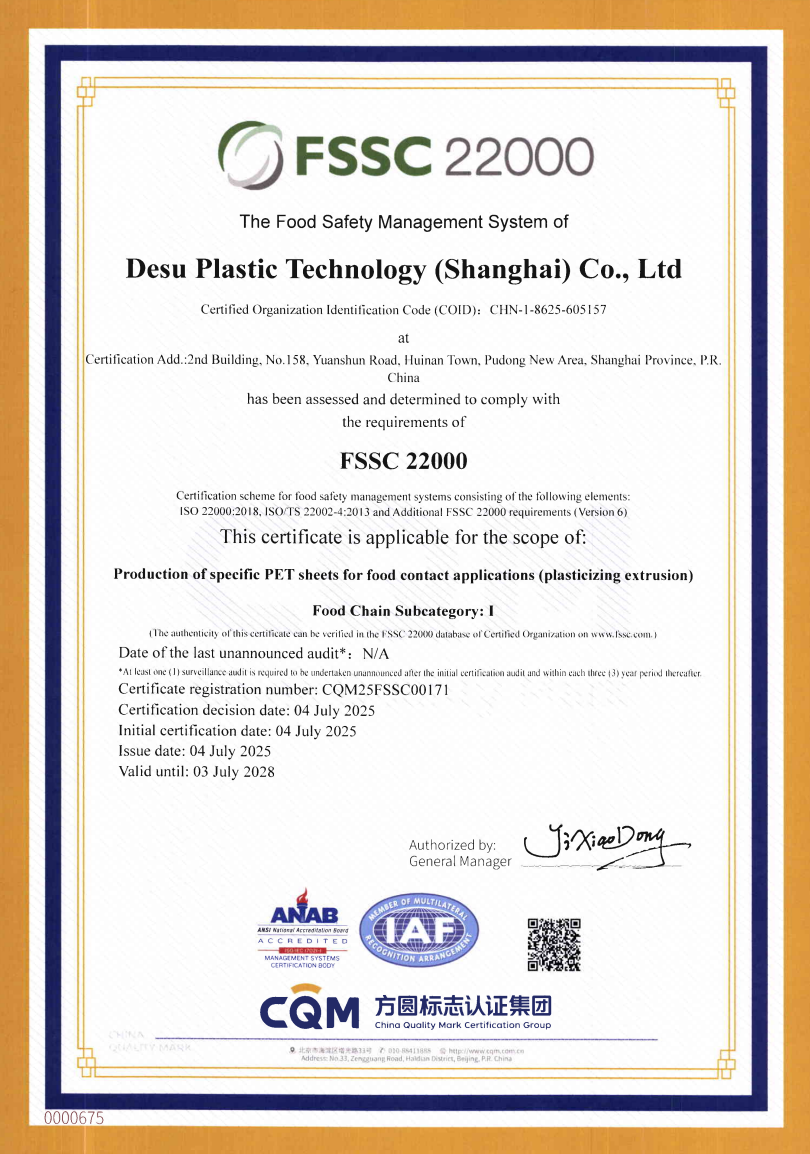
PULIXIN holds FSSC 22000 Food Safety Management System certification, certificate number CQM25FSSC00171, issued by CQM, valid from 4 July 2025 to 3 July 2028. The scope reads: production of specific PET sheets for food contact applications (plasticizing extrusion). The applicable standards are ISO 22000:2018, ISO/TS 22002-4:2013 and the Additional FSSC 22000 Requirements (Version 6). Two limits follow directly from that wording. It covers PET sheet for food contact; it does not extend to PP or HIPS sheet. And it covers the specific sheets named in the scope, not an unlimited product range. A buyer sourcing a PP food tray cannot substitute this certificate for PP-specific evidence.
The regulatory layer sits separately. EU Regulation (EU) No 10/2011 governs plastic materials and articles intended to come into contact with food, and it is the reference that converters selling into the European Union are normally asked to demonstrate against through migration testing rather than through a management-system certificate alone.
Where recycled content changes the evidence set
Recycled PET is now a mainstream specification rather than a niche one, and it adds a distinct evidence layer. PULIXIN holds Global Recycled Standard (GRS) Version 4.0 certification, certificate number SGC-GRC09372-GRS-2026-04, issued by SGS-CSTC Standards Technical Services Co., Ltd., valid from 23 April 2026 to 22 April 2027. The certified scope covers processed post-consumer materials (PC0035), processed pre-consumer materials (PC0041) and the extrusion process (PR0010), and the certificate is associated with the PET, PP and HIPS thermoforming sheet roll lines.
GRS answers a chain-of-custody and recycled-content question. It does not answer a food-contact safety question. The two are routinely conflated in procurement documents, and the consequence is a supplier that can prove recycled content but cannot prove migration compliance for the recycled stream.
A documented fresh-produce case illustrates the separation in practice. A packer and supermarket own-label supplier operating in the Netherlands and Australia, running approximately 1,500 tonnes of RPET sheet per year across berry and cherry clamshells, salad bowls and bakery containers, reported 30–100% post-consumer content with GRS batch traceability, and EU 10/2011 and FDA migration tests passed at every audit across a four-year and two-year supply relationship respectively. The GRS certificate made the recycled claim auditable; the migration testing made the food-contact claim defensible. Both were required.
Low-temperature performance is a specification, not a side effect
Chilled and fresh food packaging operates under refrigerated storage, high humidity and condensation-prone conditions with direct food contact. The recorded requirements for this segment are food-contact compliance where required, low-temperature performance, moisture resistance and stable forming, with anti-fog performance where it is specified. Ambient food packaging — fruit boxes, bakery containers, confectionery trays — carries a lighter thermal requirement but still depends on consistent thickness, stable forming, good appearance and suitable rigidity on continuous roll-fed lines.
Material selection follows the thermal profile. PULIXIN's PET thermoforming sheet roll is offered in a food-grade variant, an anti-fog grade that reduces surface fogging, an anti-static ESD grade and an rPET grade with recycled content, alongside APET, GAG, PETG, transparent, anti-block and anti-scratch variants. The PP range includes a high and low temperature resistant sheet roll and PP/PE thermoforming sheet. Publicly available PULIXIN material also describes food-grade PP sheet rolls optimised for frozen food trays with impact-resistant copolymer options. Buyers should confirm the specific grade against their own freezer and display temperature window rather than assuming a general-purpose roll will hold at the cold end.
Forming temperature is part of the same conversation. PET thermoforming typically occurs between 266°F and 320°F (130°C to 160°C). Within that window, small differences in sheet thickness translate into differences in heat-up time and draw behaviour, which is why thickness consistency appears in the requirement list for nearly every food application.
Toy and retail blister packaging: performance and appearance carry the qualification
Toy, consumer product and retail packaging is qualified mainly on forming performance and shelf presentation rather than on food-contact law. The recorded requirements for this segment are good transparency when required, forming definition, impact resistance and consistent appearance, processed by vacuum forming or thermoforming followed by die cutting and packaging assembly.
That does not make the segment easier to qualify. It moves the acceptance criteria from documents to measurable production outcomes — crack rates, seal scrap, flatness rejects and delivery reliability — and those outcomes have to be written into the purchase specification if they are to mean anything.
A toy brand owner and OEM toy manufacturer operating in Germany and the United States, consuming approximately 800 tonnes per year for action-figure clamshells, carded blisters, window patches and collector display cases, reported a reduction in drop-test cracking from 3.2% to 0.4% and an 18% reduction in sealing scrap, alongside 24 consecutive months of on-time delivery. The same case records a retail audit rating of excellent for shelf visibility. For a buyer at evaluation stage, the instructive part is the metric set: crack rate, seal scrap, delivery reliability and shelf appearance are the criteria that actually governed the change, not the number of certificates held.
Material choice inside the retail segment
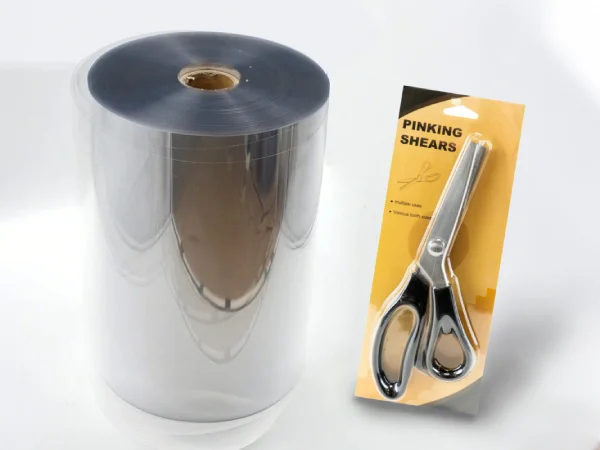
HIPS is widely used where rigidity, colour and surface finish matter more than optical clarity. PULIXIN's HIPS thermoforming sheet roll is offered as normal, conductive black, antistatic, high and low temperature resistant, and light blocking variants, in natural, white, black or customised colour, with glossy or matte surface, from 0.24 mm to 2 mm and 300 mm to 900 mm wide. Clear PET is used where the product has to be seen: the PET range includes transparent, anti-scratch and high-clarity options from 0.18 mm to 1.7 mm and 250 mm to 1400 mm wide.
A separate oral-care case shows how retail and contact requirements can overlap. A brand owner and contract packer in Indonesia and Brazil, running approximately 700 tonnes per year for toothbrush and oral-care blister cards, travel-kit trays and cosmetics insert trays, reported a 15% pack-line speed improvement after sealing-window optimisation and hang-tab breakage complaints below 0.1%, using FDA food-contact-grade resin for mouth-contact products. The retail qualification and the contact qualification were handled as two separate evidence tracks on the same programme.
Transparent folding boxes: optics, flatness and fold behaviour
Transparent folding box packaging — cosmetics, gifts, consumer goods and retail display — is qualified on a different axis again. The recorded requirements are high transparency, smooth surface, good printability, dimensional stability and suitable folding performance, processed through sheet printing, die cutting, creasing, folding and box assembly.
Each of those five attributes maps to a specific failure mode downstream. Insufficient transparency shows as haze in the finished box. Surface roughness shows as mottling under print. Poor dimensional stability shows as register drift between print stations and as crease-line cracking. Inadequate folding performance shows as whitening or fracture along the crease. None of these failures is caught by a material certificate; all of them are caught by incoming inspection against a stated tolerance.
The sheet surface treatment options recorded for PET — hard coating, silicon coating, corona treatment, laminated film and other coatings — change both print receptivity and slip behaviour. That makes surface treatment a specification item rather than a finishing detail, and it should be fixed before print trials rather than after.
Printed display work: adhesion has to be proven on the actual process
Printing and display applications run in a clean, dry indoor processing environment with controlled temperature and humidity, using screen printing, UV printing or digital printing equipment followed by cutting, laminating or converting. The recorded requirements are a smooth surface, dimensional stability, consistent appearance and suitable ink adhesion according to the printing process.
The phrase 'according to the printing process' is the operative constraint. Ink adhesion on a corona-treated PET surface and on a hard-coated PET surface are not the same result, and a UV-cured ink and a solvent screen ink do not fail in the same way. A supplier statement that a sheet is 'printable' does not close the question. What closes it is a trial on the buyer's own press, with the buyer's own ink, evaluated by a standard adhesion test agreed in advance.
Dimensional stability carries equal weight in multi-colour work. Because register is cumulative across stations, small thickness variation in the roll becomes visible drift in the finished sheet. Buyers running tight-register display work should request thickness tolerance and flatness data as part of the quotation, not as a post-award clarification.
A verification matrix by end use
The table below consolidates the criteria that shift between applications. It is a checking structure, not a substitute for the buyer's own regulatory assessment.
| End use | Governing question | Sheet attributes to confirm | Evidence to request |
|---|---|---|---|
| Medical and pharmaceutical packaging | Is material compliance bound to this specific application and component? | Thickness consistency, forming stability, clean surface, dimensional stability, suitable transparency | Application-bound material compliance statement; full third-party reports with the standard field visible; production environment controls in writing |
| PET food trays — chilled and frozen | Does the food-safety scope cover this material and process; does the grade hold at the cold end? | Low-temperature performance, moisture resistance, anti-fog where specified, stable forming | FSSC 22000 scope statement; EU 10/2011 migration test data; for rPET, GRS certificate plus migration evidence for the recycled stream |
| Ambient food, cups and lids | Food-contact applicability and high-speed line fit | Consistent thickness, stable forming, suitable stiffness, rim-forming performance, appearance | Food-contact scope, forming trial data on the buyer's line, thickness tolerance |
| Toy and retail blister packaging | Do performance and appearance acceptance criteria exist and are they measurable? | Transparency where required, forming definition, impact resistance, consistent appearance | Agreed crack-rate and scrap benchmarks, flatness tolerance, restricted-substances declaration where the retailer requires one |
| Transparent folding boxes | Will the roll hold optics and fold behaviour through print, crease and assembly? | High transparency, smooth surface, printability, dimensional stability, folding performance | Thickness tolerance, flatness data, surface treatment specification, crease trial results |
| Printed display work | Is ink adhesion proven on the buyer's press and ink system? | Smooth surface, dimensional stability, consistent appearance, ink adhesion by process | Surface treatment declaration, corona or coating data, press trial with agreed adhesion test |
Where supplier evidence usually breaks down
Across the six application groups above, the same five failure points recur in buyer evaluations.
1. Certificate scope does not match the material being bought
PULIXIN's ISO 9001:2015 certificate (00226Q03336R101) and ISO 14001:2015 certificate (00226E02412R101), both issued by China Quality Mark Certification Group (CQM) and valid to 24 June 2029, carry a scope limited to the production of polyester sheets (PET), with the environmental certificate also covering related management activities. The FSSC 22000 certificate is limited to specific PET sheets for food contact. A buyer sourcing PP or HIPS sheet therefore cannot rely on those documents to describe the material in the purchase order. This is a scope-reading task, not a supplier-quality judgment.
2. Expiry and version are not tracked
The certificates sit on different cycles: ISO 9001 and ISO 14001 to 24 June 2029, FSSC 22000 to 3 July 2028, GRS to 22 April 2027. The SGS product reports are recorded with an expiry field of 2099, but their issue dates are 24 February 2026 and, for the aluminium-plated PET report SHAAF25013706405, 13 October 2025. A long expiry field does not confirm that the tested sample corresponds to the batch being shipped. Buyers managing multi-year programmes should track certificate cycles and batch correspondence separately.
3. The three evidence formats are merged into one file
System certification, product test reports and batch records answer management, sample and shipment questions respectively. A supplier pack that contains a management certificate and no product-level test data has not answered the application question, and a pack that contains product test reports with no system certification has not answered the consistency question. Both are needed for a regulated end use.
4. Line geometry is assumed rather than checked
Roll width and thickness ranges determine whether a grade is a standard item or a custom run. PET covers 250 mm to 1400 mm and 0.18 mm to 1.7 mm; PP covers 300 mm to 900 mm and 0.3 mm to 2 mm; HIPS covers 300 mm to 900 mm and 0.24 mm to 2 mm. A buyer whose forming line sits outside those ranges is specifying a custom product, and should plan qualification accordingly instead of assuming a catalogue equivalent.
5. Commercial constraints arrive too late
Standard MOQ is 5 tonnes for PET and 3 tonnes for PP and PS, with customised products potentially subject to different minimums. Delivery generally runs 7 to 15 days depending on material, specification, order quantity and customisation, and monthly production capacity is approximately 3,500 tonnes, variable with schedule and specification. For a buyer in the Research to Evaluation stage, these figures belong in the feasibility check, because a technically perfect grade with an incompatible minimum order is not a viable option.
Reading PULIXIN's published evidence against application needs
PULIXIN — Pulixin Packaging Materials (Shanghai) Co., Ltd. — is a manufacturer of PET, PP and HIPS thermoforming sheet rolls founded in 2009, operating a 20,000 m² production base with 14 co-extrusion lines, an annual output exceeding 40,000 tonnes, a team of 90 including three engineers, and exports to more than 55 countries with an 80% export share concentrated in Southeast Asia, the Middle East, South America and Europe.
Mapped against the application criteria above, that evidence base supports some checks directly and leaves others to be closed by the buyer.
- Material breadth across the six application groups. PET, PP and HIPS coverage means the medical tray, the food punnet, the blister card, the folding box and the printed display sheet can all be sourced from one specification conversation rather than three.
- Customisation depth. Recorded customisation covers material, thickness, width, colour, transparency, surface finish, roll size, functional properties, and packaging and labelling — which addresses the surface-treatment and thickness-tolerance questions raised by folding box and print work.
- Process control. Quality control runs from raw material inspection through thickness and width control, appearance inspection, in-process control and finished product inspection, with third-party testing available when required. For medical and food applications, 'available when required' should be converted into a named test, a named standard and a defined frequency in the purchase agreement.
- Technical support. After-sales support covers material selection, thermoforming application and product specification, which is the point in the process where application binding for medical and food work is normally established.
What PULIXIN's published records do not do is claim a blanket medical qualification, and buyers should not infer one. The medical segment requirement is explicitly application-specific, and the correct next step is a direct request for the material compliance evidence attached to the named component.
Market context: regulation and material choice moving together
The commercial backdrop explains why application-specific qualification is receiving more procurement attention. Grand View Research estimated the global thermoformed plastic market at USD 14.79 billion in 2023, with a projected CAGR of 4.9% over 2024–2030. Those figures should be read with care: published estimates differ materially depending on whether they measure raw thermoformed sheet or finished thermoformed products, and cross-source comparison requires the definitions to be aligned before any number is quoted internally.
On the regulatory side, EU Regulation (EU) No 10/2011 remains the reference for plastic materials and articles intended to come into contact with food, and it is the requirement that converters selling into Europe are most often asked to evidence. On the material side, recycled PET continues to expand: Dataintelo projects the rPET market reaching USD 24.6 billion by 2034, a forecast rather than an observed figure, and one that depends on collection infrastructure and food-contact approval pathways developing as assumed. For classification purposes, thermoforming plastic materials fall under HS heading 3920 for non-cellular and 3921 for cellular products.
Outlook
The direction of travel is toward evidence that is specific rather than cumulative. A buyer who replaces 'send us your certificates' with 'send us the evidence for this material, this component and this batch' will usually shorten the evaluation, because scope mismatches surface early instead of at first audit.
Two conditions determine whether that works. Suppliers need to publish scope limits as clearly as they publish certificate numbers, and buyers need to accept that a food-contact certificate does not travel into medical work, that a recycling certificate does not travel into migration compliance, and that a management-system certificate does not describe a product. Where both sides hold that line, application-specific qualification becomes a routine procurement step rather than a late-stage surprise.
Frequently asked questions
Does a food-grade thermoforming sheet roll qualify for medical packaging?
No. Food-contact status answers a food-contact question only. Medical and pharmaceutical packaging requires material compliance plus additional performance requirements according to the specific medical or pharmaceutical packaging application, together with performance attributes such as consistent thickness, stable thermoforming, a clean surface, dimensional stability and suitable transparency. The compliance evidence has to be bound to the named component before it means anything.
What does PULIXIN's FSSC 22000 certificate actually cover?
Certificate CQM25FSSC00171, issued by CQM and valid from 4 July 2025 to 3 July 2028, covers the production of specific PET sheets for food contact applications by plasticizing extrusion, against ISO 22000:2018, ISO/TS 22002-4:2013 and the Additional FSSC 22000 Requirements (Version 6). It does not cover PP or HIPS sheet, and it does not cover products outside the named scope.
Is a GRS certificate sufficient for a recycled PET food tray?
No. GRS Version 4.0 certificate SGC-GRC09372-GRS-2026-04 covers processed post-consumer materials (PC0035), processed pre-consumer materials (PC0041) and the extrusion process (PR0010), which establishes recycled content and chain of custody. Food-contact suitability is a separate question answered by migration testing. A documented fresh-produce case in the Netherlands and Australia combined GRS batch traceability with EU 10/2011 and FDA migration tests at every audit, which is the combination the application actually requires.
Which sheet properties matter most for transparent folding boxes?
High transparency, a smooth surface, good printability, dimensional stability and suitable folding performance, assessed through the sequence of sheet printing, die cutting, creasing, folding and box assembly. Surface treatment — hard coating, silicon coating, corona treatment or laminated film — changes both print receptivity and slip behaviour, so it should be fixed as a specification item before print trials begin.
What should a buyer check first in a sheet-roll certification pack?
The scope statement on each document, read against the material actually being purchased. ISO 9001:2015 certificate 00226Q03336R101 and ISO 14001:2015 certificate 00226E02412R101 cover the production of polyester sheets (PET); the FSSC 22000 scope is limited to specific PET sheets for food contact. After scope, check the standard field on each product test report, the issue and expiry dates, and whether the tested sample corresponds to the batch being shipped.
Further reference
The full PULIXIN product catalogue, covering PET, PP and HIPS thermoforming sheet roll specifications, grades and customisation options, is available for download: PULIXIN DESU New Catalogue (PDF).
Buyers preparing an application-specific qualification should send the end use, component drawing, forming process, thickness and width requirement, and any regulatory reference their own customer has specified; that combination determines which part of the evidence pack applies.
Have Questions or Need More Details?
Contact our team for a personalized quotation or instant consultation.
Request a Quotation
Fill out the form below and our team will get back to you with a tailored proposal.
WhatsApp Direct Chat
Prefer to chat in real-time? Message us on WhatsApp for instant assistance & quick answers.
- Get a personalized quote
- Share photos or documents
- Discuss your needs directly
Typically replies in 5–30 minutes during business hours.