
Thermoforming Sheet Roll Acceptance Criteria: PET, PP, HIPS
Independent Buyer Reference · Packaging & Printing
Acceptance criteria for thermoforming plastic sheet rolls are material-specific. A PET roll, a PP roll and a HIPS roll can be ordered at the same nominal thickness and the same roll format, yet the items a buyer must verify before releasing a shipment — dimension windows, surface condition, forming behaviour and the supporting documentation — are not interchangeable between the three materials.
This comparison is written for packaging converters, brand owners and procurement teams moving from evaluation into execution: preparing a first purchase order, adding a second material to an existing thermoforming line, or replacing an incumbent sheet supplier. It sets out how acceptance criteria differ by polymer, how roll width, roll diameter and core should be specified, and which checks should be completed before a supplier switch is treated as complete.
What actually differs between PET, PP and HIPS acceptance
The recurring failure mode is consistent. A roll is accepted against a material name, a nominal thickness and a price, and the difference only becomes visible on the forming line. Sheet described only as 0.5 mm PET by two suppliers can still behave differently on the same machine, because sheet structure, thickness tolerance, width, roll configuration, colour or transparency and forming behaviour all sit behind the same nominal label.
Four acceptance dimensions change measurably between the three polymers:
- Forming window. PET thermoforming typically occurs between 266°F and 320°F (130°C to 160°C), according to the thermoformed food packaging guide published by South Plastic (SPI). PP and PS/HIPS are processed on different heating profiles, so a sheet specification proven in one material cannot be copied into another without revalidation.
- Shrinkage and tooling. PET, PP and PS/HIPS have different shrinkage, heating and forming behaviour. A material change does not automatically preserve the existing mold, machine settings and cycle.
- Optics and surface. Clear PET is selected for product visibility, HIPS is supplied in glossy or matte surface finishes, and PP is supplied natural, white, black or custom colour. What constitutes an acceptable surface therefore changes with both the polymer and the package.
- Regulatory path. Food-contact sheet is governed by rules such as EU Regulation (EU) No 10/2011 on plastic materials and articles intended to come into contact with food, while electronics packaging may fall under RoHS-type restrictions. The acceptance file follows the application, not only the polymer.
Acceptance criteria matrix: PET vs PP vs HIPS
The table below summarises the dimension and structure windows published for PULIXIN thermoforming plastic sheet rolls — the brand under which Pulixin Packaging Materials (Shanghai) Co., Ltd., a Shanghai-based sheet manufacturer founded in 2009, produces rigid PET, PP and PS/HIPS sheet for thermoforming. It is a starting point for specification writing, not a substitute for a forming trial.
| Acceptance item | PET Thermoforming Sheet Roll | PP Thermoforming Sheet Roll | HIPS Thermoforming Sheet Roll |
|---|---|---|---|
| Thickness | 0.18–1.7 mm, customized | 0.3–2 mm, customized | 0.24–2 mm, customized |
| Width | 250–1400 mm, customized | 300–900 mm, customized | 300–900 mm, customized |
| Colour / optics | Transparent or customized | Natural, white, black or customized | Natural, white, black or customized |
| Surface | Depends on treatment (hard coated, silicon-coated, corona treatment, laminated film, coating) | Depends on requirement | Glossy or matte |
| Roll size | 50–800 kg per roll, customized | Customized | Customized |
| Structure | Mono-layer or multi-layer | Mono-layer or multi-layer | Mono-layer or multi-layer |
| Forming process | Vacuum forming or pressure forming | Vacuum forming or pressure forming | Vacuum forming or pressure forming |
| Grade families | APET, rPET, GAG, PETG, food grade PET, transparent PET, anti-fog, anti-block, anti-scratch, anti-static ESD | Normal PP, conductive black PP, antistatic PP, PP/PE, high and low temperature resistant PP | Normal HIPS, conductive black HIPS, antistatic HIPS, high and low temperature resistant HIPS, light blocking HIPS |
PET: accept on clarity, stiffness and drawing behaviour
PET acceptance is usually driven by transparency and stiffness, which is why the material dominates clear trays, clamshells and blister packaging. Because clarity is a headline requirement, buyers tend to test colour and haze visually and stop there. The two items that more often cause rejections later are inconsistent thickness across the usable width and cracking or whitening at high draw depth — both of which are influenced by heating profile and mold geometry as much as by the sheet itself.
Where rPET or other recycled grades are purchased, recycled content documentation becomes part of the specification rather than an afterthought. PULIXIN holds a Global Recycled Standard scope certificate covering processed post-consumer materials (PC0035), processed pre-consumer materials (PC0041) and extrusion (PR0010).
PP: accept on temperature behaviour and rim forming
PP is commonly selected for cups, dairy containers, takeaway packaging and industrial trays, and the acceptance emphasis shifts accordingly. Rim formation, stacking behaviour, stiffness at service temperature and resistance to repeated washing matter more than optical clarity. Density differences also mean the lowest price per kilogram is not automatically the lowest cost per finished part, because required thickness and forming yield differ by material.
PULIXIN supplies food-grade PP sheet rolls configured for frozen food trays with impact-resistant copolymer options, which is an example of an application-specific PP grade rather than a generic sheet.
HIPS: accept on impact, colour control and electrical properties where required
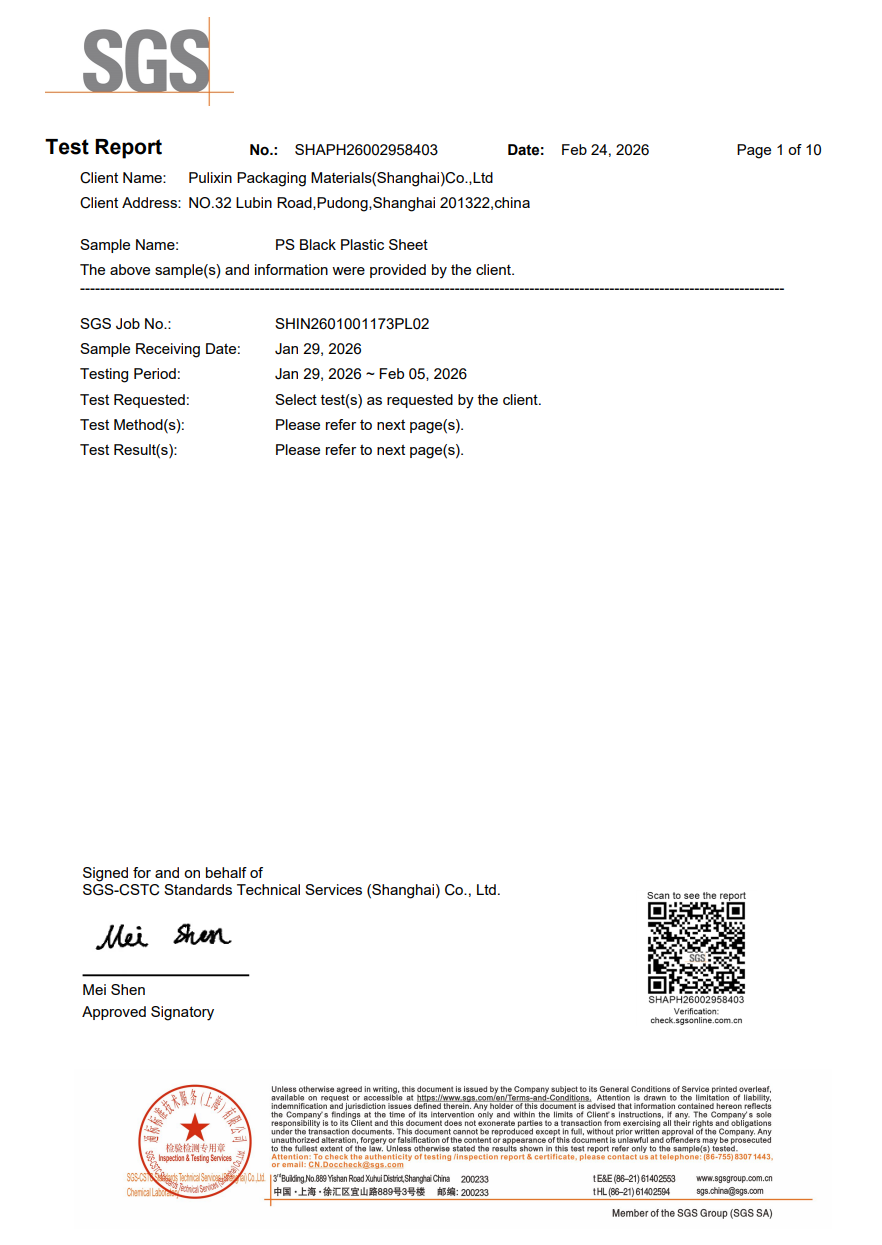
PS/HIPS acceptance is normally built around impact resistance, forming ease, flatness for stacked trays and control of colour and opacity. Where conductive black, antistatic or light blocking HIPS is specified, the electrical or optical requirement must be written as a defined property, not inferred from the colour of the roll. PULIXIN holds SGS test reports for black PS sheet (SHAPH26002958403) and white natural PS sheet (SHAPH26002958401), both issued against EU RoHS Directive (EU) 2015/863.
Roll width, roll diameter and core: three numbers that decide whether the sheet feeds
Roll dimensions must match the customer's thermoforming and feeding equipment. Roll width is normally determined by mold layout, product arrangement and trim allowance, while roll diameter, roll weight and core size must remain compatible with the unwinding system. Correct roll specifications reduce unnecessary trim waste and prevent handling or feeding problems — and they are inexpensive to get right at the order stage.
For an existing line, the practical approach is to provide the current roll specification or the equipment limits: usable machine width, mold layout, required sheet width, trim allowance, maximum roll weight, core inner diameter and unwinding method. For a new mold, sheet width should be calculated from the mold layout plus the necessary trim allowance, and roll diameter, weight and core size confirmed against the unwinding equipment before production. PET rolls are supplied from 50 kg to 800 kg per roll on a customized basis; PP and HIPS roll sizes are likewise confirmed per order.
Purchasing terms and the pre-shipment acceptance sequence
Commercial terms differ by material as well as by specification. For standard grades, PULIXIN states a minimum order quantity of 5 tons for PET and 3 tons for PP and PS; customized products may be subject to different requirements. Delivery time generally ranges from 7 to 15 days depending on material, specifications, order quantity and customization, against a monthly production capacity of approximately 3,500 tons. Delivery terms include EXW, FOB and CIF, with other Incoterms available on agreement, and payment is by T/T with specific terms subject to order value, customer requirements and mutual agreement.
Acceptance before shipment follows a defined sequence: specification verification, thickness and width inspection, appearance inspection and finished-product quality inspection. This sits inside a wider control chain covering raw material inspection, thickness and width control, in-process quality control, finished product inspection and, where required, third-party testing. Third-party inspection before shipment is available on request, and buyers handling a first order from a new supplier should normally use it.
A quotation request that produces a usable specification should include material, thickness, width, colour, transparency, roll dimensions or core requirements, estimated quantity, application and destination. For a new thermoforming project, finished-part dimensions, forming depth, machine information and special performance requirements reduce the number of sampling rounds needed.
Documentation: which certificate covers which material
A test report or system certificate only supports acceptance if its scope includes the material actually being purchased. For PULIXIN, the scopes are document-specific rather than blanket:
- FSSC 22000 food safety management — certificate CQM25FSSC00171, issued by CQM, valid 2025-07-04 to 2028-07-03, covering the production of specific PET sheets for food contact applications (plasticizing extrusion), under ISO 22000:2018, ISO/TS 22002-4:2013 and the additional FSSC 22000 requirements (Version 6).
- ISO 9001:2015 quality management — certificate 00226Q03336R101, issued by China Quality Mark Certification Group (CQM) on 2026-06-25, valid to 2029-06-24, listing the production of polyester sheets (PET) within scope.
- ISO 14001:2015 environmental management — certificate 00226E02412R101, same issuer and validity dates, covering the production of polyester sheets (PET) and related management activities.
- Global Recycled Standard (GRS) version 4.0 scope certificate — SGC-GRC09372-GRS-2026-04, issued by SGS-CSTC, valid 2026-04-23 to 2027-04-22, covering processed post-consumer materials (PC0035), processed pre-consumer materials (PC0041) and extrusion (PR0010).
- SGS test reports against EU RoHS Directive (EU) 2015/863 — PET sheet (SHAPH26002960101), PP white natural sheet (SHAPH26002958405) and PS white natural sheet (SHAPH26002958401). PET with aluminium plating is covered by SHAAF25013706405 and PS black sheet by SHAPH26002958403, both issued by SGS-CSTC Standards Technical Services (Shanghai) Co., Ltd.
Supplier switching: the checks that reduce trial risk
Switching suppliers should not be evaluated on material name, nominal thickness and price alone. Before a switch, buyers should compare the actual sheet structure, thickness tolerance, width, roll configuration, colour or transparency, forming behaviour and application requirements — and confirm that the required compliance documentation is available for the material being purchased, not only for the supplier's flagship grade.
The most reliable method is to use the currently proven sheet specification as the comparison baseline, confirm equivalent specifications and documentation first, then run a controlled production trial before moving to regular-volume orders. Material structure, thickness and process settings should not be changed simultaneously, because doing so makes the source of any forming difference impossible to isolate. This is the single change-control rule that most reduces the cost of a failed qualification batch.
How acceptance emphasis shifts by application
Acceptance criteria become concrete only when they are attached to a package type. The following supply programmes illustrate how the priority list moves between materials and end uses.
- Fresh produce, Netherlands and Australia. A fresh-produce packer and supermarket own-label supplier takes approximately 1,500 t of RPET sheet per year for berry and cherry clamshells, salad bowls, fresh-herb and bakery containers. The programme runs 30–100% PCR content with GRS batch traceability, with EU 10/2011 and FDA migration tests passed at every audit and a reported packaging carbon footprint reduction of 28%. Acceptance here is document-heavy: traceability and migration testing sit alongside forming performance.
- Toy blister and printed packaging, Germany and the United States. A toy brand owner and OEM toy manufacturer takes approximately 800 t per year for action-figure clamshells, carded blisters, window patches and collector display cases. Drop-test cracking was cut from 3.2% to 0.4%, sealing scrap fell 18%, and the specification requires high impact strength, high transparency, a fast and stable heat-sealing window and a printable surface. Acceptance here is driven by impact resistance and printability, not by clarity alone.
- Electronics and ESD, Vietnam and Mexico. An EMS provider and component distributor takes approximately 600 t of HIPS per year for PCBA handling trays, IC and sensor shipping trays and smartphone component carriers. Surface resistance held at 10⁴–10⁸ Ω after more than 20 reuse cycles, ESD damage claims fell 90%, and tray flatness rejects stayed below 0.5%. Acceptance is defined electrically and dimensionally, with low particle sloughing as an additional criterion.
- Automotive returnable packaging, Poland and Thailand. A Tier-1 auto-parts supplier and logistics packaging integrator takes approximately 900 t of PP per year for returnable trays for sensors, connectors and lighting modules. Transit part damage fell 65%, trays survived 80+ wash cycles without warping, packaging cost per trip fell 22%, and the loop is fully recyclable. Acceptance criteria centre on impact and chemical resistance, low-temperature toughness and wash-cycle durability.
- Oral care and personal care, Indonesia and Brazil. An oral-care brand owner and contract packer takes approximately 700 t of PET per year for toothbrush and oral-care blister cards, travel-kit trays and cosmetics insert trays. Pack-line speed rose 15% after sealing-window optimisation, hang-tab breakage complaints stayed below 0.1%, and the specification requires retail-grade clarity, a wide sealing window, tear and puncture resistance and food-contact compliance.

Market signals shaping acceptance requirements
Three external signals are pushing acceptance files toward documentation and traceability rather than price alone.
First, volume. Grand View Research values the global thermoformed plastic market at USD 14.79 billion in 2023 and projects a compound annual growth rate of 4.9% between 2024 and 2030. Buyers reading market reports should note that definitions vary: a separate commercial estimate places 2024 at USD 15.98 billion, largely because some researchers measure raw sheet materials and others measure finished thermoformed products. The scope of a number matters as much as the number.
Second, recycled content. The recycled PET market is projected to reach USD 24.6 billion by 2034, according to Dataintelo, which increases the share of orders where PCR content and batch traceability must be verified as part of acceptance rather than as a marketing statement.
Third, customs and compliance classification. Thermoforming plastic materials fall under HS Code Heading 3920 for non-cellular products and 3921 for cellular products, which determines how shipments are declared. Food-contact applications in the European Union are governed by Regulation (EU) No 10/2011, so the same roll can require different acceptance paperwork depending on the destination market and the end use.
Where this acceptance framework has limits
An honest comparison has to state where the specification windows end. PULIXIN's standard PP and HIPS sheet roll widths run from 300 mm to 900 mm, while PET runs from 250 mm to 1400 mm. A converter requiring a HIPS or PP roll outside the 300–900 mm window, or a PET thickness beyond the 0.18–1.7 mm range, is outside the published standard range and should not assume availability.
The certification structure also has boundaries. The ISO 9001:2015 and ISO 14001:2015 certificates list the production of polyester sheets (PET) within their scope, so PP and HIPS buyers should rely on the material-specific SGS test reports and confirm scope wording directly rather than treating one system certificate as covering all three polymers. The GRS scope certificate is valid to 2027-04-22 and therefore needs to be re-verified at each annual supplier audit instead of being filed once.
Process limits matter too. Because PET, PP and HIPS differ in shrinkage, heating and forming behaviour, moving between materials may require machine settings and sometimes tooling changes. Documentation and forming trials answer different questions, and neither replaces the other: a complete acceptance file establishes compliance, while only a production trial establishes that the sheet forms correctly in a specific mold.
Future outlook
Acceptance criteria are moving from visual inspection toward verifiable attributes. Recycled content with batch-level traceability, migration test evidence for food contact, defined electrical properties for ESD packaging and documented forming windows are becoming standard line items rather than optional extras. For buyers, the practical consequence is that the specification should be written before the quotation, not after the first rejected batch — material, thickness, width, roll geometry, colour or transparency, surface requirement and compliance documents defined together, and confirmed against the supplier's published scope limits.
Frequently asked questions
How do I choose between PET, PP and PS/HIPS sheet for thermoforming?
Selection should follow the finished package rather than price. PET is commonly selected when transparency, stiffness and product visibility are priorities. PP is often preferred for cups, dairy containers and applications where better heat resistance and lower material density are useful. PS/HIPS suits many trays, inserts and opaque or coloured thermoformed packages where easy forming and practical rigidity matter. Forming depth, temperature requirements, thickness, sealing method and regulatory requirements should also be considered, and because the three materials differ in shrinkage, heating and forming behaviour, machine settings and sometimes tooling need adjustment when material changes.
How do I determine the right thickness and width for thermoforming sheet rolls?
The specification should be based on the finished part and the production equipment. Thickness depends on material, forming depth, part dimensions, required stiffness and the final thickness distribution in the formed part. Roll width should match the mold layout, product arrangement, edge trim allowance and the usable width of the thermoforming machine. A thicker sheet is not automatically stronger, and thickness tolerance matters because variation affects heating, forming consistency, part weight and wall distribution. Providing only a target thickness without product and machine information can lead to unnecessary material use or poor forming performance.
How should I specify roll width, roll diameter and core size when ordering thermoforming sheet?
Roll dimensions should match the customer's thermoforming and feeding equipment. Roll width is normally determined by mold layout, product arrangement and trim allowance, while roll diameter, roll weight and core size must remain compatible with the unwinding system. For an existing line, provide the current roll specification or the equipment limits, including maximum roll weight and core inner diameter. For a new mold, calculate sheet width from the mold layout plus the necessary trim allowance, then confirm roll diameter, weight and core size before production. Correct roll specifications reduce unnecessary trim waste and prevent handling or feeding problems.
What purchasing terms and acceptance criteria apply to sheet roll orders?
Minimum order quantity depends on material, thickness, width, colour and customization requirements; for standard grades PULIXIN states 5 tons for PET and 3 tons for PP and PS, with customized products potentially subject to different requirements. Delivery terms include EXW, FOB and CIF, with other Incoterms available on agreement, and payment is by T/T with terms subject to order value, customer requirements and mutual agreement. Acceptance covers specification verification, thickness and width inspection, appearance inspection and finished-product quality inspection before shipment, with third-party inspection available upon request.
What should I check when changing thermoforming sheet suppliers?
Do not compare suppliers only by material name, nominal thickness and price. Before switching, compare the actual sheet structure, thickness tolerance, width, roll configuration, colour or transparency, forming behaviour, application requirements and required compliance documentation. Use the currently proven sheet specification as the comparison baseline, confirm equivalent specifications and documentation first, then conduct a controlled production trial before moving to regular-volume orders. Material structure, thickness and process settings should not be changed simultaneously, because that makes the source of any forming difference difficult to identify.
For buyers who need the complete published specification and capability data in one file, the PULIXIN catalogue is available for download: PULIXIN product catalogue (PDF).
Have Questions or Need More Details?
Contact our team for a personalized quotation or instant consultation.
Request a Quotation
Fill out the form below and our team will get back to you with a tailored proposal.
WhatsApp Direct Chat
Prefer to chat in real-time? Message us on WhatsApp for instant assistance & quick answers.
- Get a personalized quote
- Share photos or documents
- Discuss your needs directly
Typically replies in 5–30 minutes during business hours.