
Thermoforming Sheet Roll Supplier Continuity: Annual Checklist
Rigid thermoformed packaging runs on continuous lines, and the sheet roll feeding those lines is a repeat purchase. Keeping that supply stable requires a scheduled review of the existing supplier, not only a one-time approval at the start of a project.
Most packaging buyers concentrate their heaviest scrutiny on the first sheet roll they ever approve. Samples are formed, thickness is measured, a trial run is booked and — if the parts come off the tool cleanly — the supplier moves onto the approved list. From that point forward, the relationship is usually managed by purchase order alone.
That approach works until it stops working. A thermoforming plastic sheet roll is a production input, and production inputs drift. Extrusion conditions change, raw material lots change, winding tension changes, and the sheet delivered in year three is not always identical to the sheet that was qualified in year one. The drift is rarely dramatic enough to trigger a formal complaint. It tends to appear as a slightly narrower forming window, a few extra rejects at the trim station, or a print registration problem nobody can explain.
This article is written for buyers who already have a thermoforming sheet roll supplier and intend to keep working with them. It sets out an annual supplier continuity review: a repeatable checklist covering roll geometry, thickness stability, surface condition, dimensional stability and forming performance across PET, PP and HIPS rolls, together with the application-specific requirements that apply to medical, pharmaceutical, food, toy, retail display, folding box and printed sheet programmes.
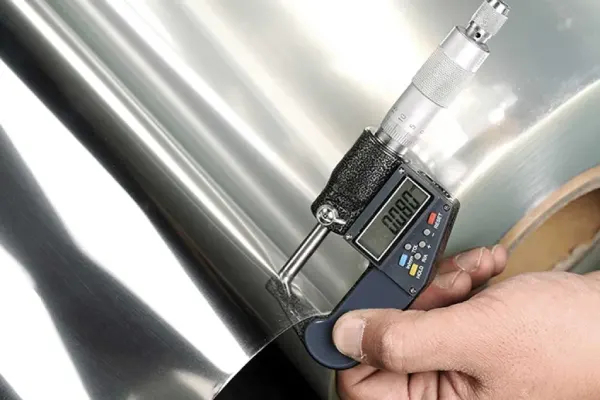
Annual continuity review begins with material that can still be measured against a documented baseline — thickness, width, appearance and forming behaviour.
Why Continuity Review Is a Different Question From Supplier Qualification
Supplier qualification is an entry test. It asks whether a manufacturer can produce sheet that meets the specification on the day of the trial. Continuity review is a monitoring test. It asks whether the material arriving this year still behaves like the material that was qualified, on the same tooling, with the same downstream equipment.
The two exercises use different evidence. Qualification relies on samples, specification sheets and a trial run. Continuity relies on retained reference rolls, incoming inspection records, forming yield data and complaint history accumulated over time. A supplier can pass the first test comfortably and still drift on the second, because nothing in a purchase order measures drift.
Drift typically enters the supply chain through one of five routes:
- Raw material lots. Polymer grade, molecular weight distribution and recycled content ratio can shift between deliveries.
- Extrusion conditions. Screw speed, melt temperature, cooling and roll-stack settings influence thickness distribution and surface quality.
- Winding and slitting. Web tension, core handling and trim settings affect roll diameter, edge quality and unwinding behaviour.
- Handling and storage. Dust, moisture, stacking pressure and transit conditions can change surface cleanliness and flatness.
- Documentation and compliance. Food-contact and medical documentation has to be re-confirmed as regulations and formulations change.
Because none of these routes announces itself, the review has to be scheduled rather than reactive. An annual cycle is long enough to be practical and short enough to catch a trend before it reaches the customer's finished packaging.
The Annual Review Framework: Six Checkpoints
The checklist below is designed to be run against any rigid sheet roll programme — PET, PP or HIPS — and to produce a short written record that can be compared year over year.
| Checkpoint | What is measured | Typical evidence | Escalation trigger |
|---|---|---|---|
| 1. Roll geometry | Width, roll diameter and weight, core inside diameter, core straightness | Incoming inspection records, retained roll samples | Width or core dimensions drifting beyond the agreed tolerance |
| 2. Thickness and dimensional stability | Thickness across and along the roll, flatness, shrinkage after forming | Thickness gauge logs, formed-part wall sections | Wider thickness spread or visible warping on cooling |
| 3. Surface condition | Cleanliness, gels, scratches, gloss or matte consistency | Visual audit, defect photographs, reject counts | Rising surface rejects or new defect patterns |
| 4. Forming performance | Forming window, cycle time, definition, wall distribution | Line data, re-run of the retained reference roll | Higher oven setpoint needed to reach the same definition |
| 5. Application compliance | Food-contact, medical, ESD and documentation status | Certificates, third-party test reports, batch records | Expired or amended documentation |
| 6. Equipment compatibility | Behaviour on forming, printing, die-cutting and sealing equipment | Trial records per machine, sealing-window data | Any machine upgrade, new tooling or new print process |
The output should be a single page per material family, dated and signed off, listing measured values against the baseline taken at qualification. That page is what turns a checklist into an early warning tool.
Checkpoint 1 — Roll Width, Diameter and Core Consistency
Roll geometry is the fastest checkpoint to run and the one most often skipped. Width, diameter and core dimensions are not cosmetic: they determine how the roll loads into the unwinder, how often the line stops for a splice, and how much trim is generated per shift.
| Material family | Thickness range (customized) | Width range (customized) | Roll size |
|---|---|---|---|
| PET / APET / rPET sheet roll | 0.18–1.7 mm | 250–1400 mm | 50–800 kg per roll, customized |
| PP sheet roll | 0.3–2 mm | 300–900 mm | Customized |
| PS / HIPS sheet roll | 0.24–2 mm | 300–900 mm | Customized |
Published specification ranges for PULIXIN thermoforming sheet rolls. All three material families are supplied as mono-layer or multi-layer structures for vacuum forming or pressure forming.
Width. The delivered roll width has to match the lane layout of the forming tool and the trim allowance around it. Because sheet roll widths are customized per programme — within a 250–1400 mm window for PET and a 300–900 mm window for PP and HIPS — a supplier change or a re-slit can quietly alter trim balance even when the nominal width is unchanged. The review should record measured width at several positions across the roll, not the figure printed on the label.
Roll diameter and weight. Diameter determines how many rolls fit the unwinder and how frequently the line stops. PET rolls are supplied in sizes up to 800 kg, with PP and HIPS roll sizes customized to the order. If roll weight per metre of web changes between deliveries, the changeover frequency per shift changes with it, and labour planning based on last year's numbers becomes inaccurate.
Core consistency. Core inside diameter, core material, straightness and protrusion have a direct effect on chuck grip and unwinding tension. A core that is slightly out of round, or a core material that deforms under stacking load, produces lateral tracking variation and can show up downstream as wrinkling in forming or misregistration in printing. Core consistency is the checkpoint most likely to change without any change to the sheet itself.

Continuity depends on the process behind the roll: extrusion, cooling, winding and slitting settings define the geometry the buyer receives.
Checkpoint 2 — Thickness Stability and Dimensional Stability
Thickness is the parameter most buyers already track, but tracking the average is not the same as tracking stability. A roll whose mean thickness sits comfortably inside specification can still fail if the spread across the web has widened, because wall thickness distribution in the formed part follows the sheet profile.
The annual review should compare three things against the qualification baseline: cross-direction thickness spread, machine-direction thickness variation along the roll, and thickness consistency from roll to roll within the same delivery. A widened spread usually shows up first as inconsistent part weight, then as sealing problems where the sealing window narrows.
Dimensional stability is the second half of this checkpoint. Sheet that was flat and stable at qualification can begin to show curl, edge waviness or shrinkage after forming. For pressure forming and vacuum forming alike, a stable, flat sheet is what allows repeatable cycle settings; once flatness varies, operators start adjusting temperature and vacuum settings per roll, and the process becomes operator-dependent rather than parameter-dependent.
Checkpoint 3 — Surface Cleanliness and Appearance
Surface condition is where continuity problems become visible to the end customer. The review should look for dust and loose particles, gels and unmelted specks, scratches and handling marks, and consistency of gloss or matte finish across the roll.
Surface requirements differ by application, and the checklist should reflect that. In printing and display work, the sheet is used as a printing substrate, where the relevant criteria are a smooth surface, dimensional stability, consistent appearance and suitable ink adhesion for the chosen printing process. In medical and pharmaceutical packaging, the priority shifts to a clean surface together with consistent thickness, stable thermoforming performance and suitable transparency. In electronics packaging, the requirement set adds dimensional stability, consistent thickness, suitable rigidity and anti-static or ESD properties when specified.
A practical method is to keep a retained sample from the qualification batch and inspect it side by side with the current roll under the same lighting. Side-by-side comparison detects gradual changes that a written specification alone would not flag.
Checkpoint 4 — Forming Performance on Existing Tooling
Forming performance is the checkpoint that converts material data into commercial risk. PET thermoforming typically takes place between 266°F and 320°F (130°C to 160°C), according to technical guidance published by South Plastic (SPI). If a roll that used to form consistently in the middle of that band now requires the upper end to achieve the same definition, something in the material has changed — even if every incoming measurement still passes.
Record these four data points each cycle:
- Oven setpoints and actual sheet temperature at the forming station.
- Cycle time for a fixed part, under fixed settings.
- Forming definition at corners, ribs and deep draws, compared with retained reference parts.
- Wall thickness distribution at agreed measurement points on the formed part.
Both vacuum forming and pressure forming should be reviewed where both are in use, because a material change can affect the two processes differently. The re-run of a retained reference roll under current line settings is the single most useful annual test: it separates a material change from a machine change.
Checkpoint 5 — Application-Specific Review Items
The generic checkpoints above apply to every programme. What changes between applications is the acceptance criteria and the documentation that must be re-confirmed.
Medical and pharmaceutical packaging
Medical device trays, pharmaceutical blister packaging, disposable medical product trays and protective inserts operate in a clean packaging environment with controlled temperature and humidity. The material requirements include consistent thickness, stable thermoforming performance, clean surface, dimensional stability and suitable transparency, with material compliance and additional performance requirements set by the specific medical or pharmaceutical application. The matched equipment set — thermoforming machine, vacuum forming machine, blister packaging machine, die-cutting equipment and sealing equipment — should be re-confirmed annually, because a change in any one of them invalidates the previous trial result.
Food-contact and fresh food packaging
Fresh food applications such as meat, fruit and vegetable packaging and refrigerated food trays require food-contact compliance when required, low-temperature performance, moisture resistance and stable forming, with anti-fog performance when specified. Because these packs operate under refrigeration and high humidity, condensation behaviour belongs on the annual checklist alongside migration documentation. Ambient food programmes — bakery, fresh produce, confectionery, fruit boxes, bakery containers, candy trays and takeaway packaging — share the food-contact requirement and add consistent thickness, stable forming, good appearance and suitable rigidity.
Cups, lids and dairy packaging
Drinking cups, yogurt cups, dairy containers, cup lids and portion cups are produced on continuous roll-fed thermoforming with inline cutting and stacking, supported by cup thermoforming machines, lid forming machines and filling and sealing lines. The annual review for this format should track food-contact compliance, consistent thickness, stable forming, suitable stiffness and rim-forming performance, since rim geometry is what determines lid fit and seal integrity at speed.
Toy and retail display packaging
Toy blister packs, transparent display packs, thermoformed inserts and clamshell packaging are produced by vacuum forming or thermoforming followed by die cutting and packaging assembly. The material requirements are good transparency when required, forming definition, impact resistance and consistent appearance. Impact performance deserves a specific line in the annual review because it is a property that can change with polymer lot while remaining invisible on the roll.
Transparent folding boxes and printed sheets
Folding box production follows a different route: sheet printing, then die cutting, creasing, folding and box assembly, using printing machines, die-cutting machines and creasing and folding equipment. The relevant criteria are high transparency, smooth surface, good printability, dimensional stability and suitable folding performance. Because printing and display work uses the sheet as a printing substrate in sheet or roll form, followed by cutting, laminating or converting, the review should also confirm that ink adhesion still matches the current printing process — whether that is screen, UV or digital printing.
Checkpoint 6 — Equipment Compatibility Across the Whole Line
A supplier continuity review is incomplete if it stops at the forming machine. Sheet has to pass through every downstream station, and compatibility has to be re-confirmed for each one: thermoforming and vacuum forming machines, blister packaging machines, tray forming machines, die-cutting equipment, sealing equipment, filling and packaging lines, plus cutting, creasing and laminating machines in print-based workflows.
Any of the following events should trigger an off-cycle repeat of this checkpoint rather than waiting for the next annual review:
- A forming or sealing machine is replaced or rebuilt.
- New tooling is introduced for an existing part.
- The printing process changes between screen, UV and digital.
- Line speed targets are raised.
- Recycled content in the sheet is increased.
The last item matters because recycled content is one of the few variables a buyer frequently requests to change. Change requests and continuity review should run in the same cycle, not in parallel.
What a Continuity-Ready Sheet Supplier Setup Looks Like
The checklist above assumes the supplier can produce comparable data year after year. A useful reference point is PULIXIN (Pulixin Packaging Materials (Shanghai) Co., Ltd.), a thermoforming plastic sheet roll manufacturer based in Shanghai that produces PET, PP and HIPS rigid sheet for thermoforming applications and exports to more than 55 countries.
Several elements of that setup map directly onto the checkpoints described above:
- Repeatable geometry. Fourteen co-extrusion production lines produce sheet with controlled thickness and dimensional stability, which is the basis for comparing roll geometry year over year.
- Volume headroom. A 20,000㎡ production base and annual output above 40,000 tons (monthly capacity of approximately 3,500 tons, subject to schedule and specification) support continuity of supply rather than one-off batches.
- Documented quality control. Raw material inspection, thickness and width control, appearance inspection, in-process quality control and finished product inspection, with third-party testing available when required — the evidence a buyer needs to populate checkpoints 2 and 3.
- Customization that stays within one system. Material, thickness, width, color, transparency, surface finish, roll size, functional properties and packaging can be specified per programme, so a change request does not automatically mean a new supplier.
- Predictable replenishment. Delivery time generally ranges from 7 to 15 days depending on material, specification, order quantity and customization; minimum order quantity is 5 tons for standard PET and 3 tons for standard PP and PS, with different requirements for customized products.
Long-running programmes are the strongest available evidence that continuity is achievable rather than theoretical. Published references include reusable thermoformed trays for automotive logistics running for five years in Poland and three years in Thailand, fresh-produce clamshell and container supply running for four years in the Netherlands and two years in Australia with 30–100% PCR content and GRS batch traceability, toy clamshell supply running for three years in Germany and two years in the United States, and ESD-safe tray supply running for three years in Vietnam and 1.5 years in Mexico.
Annual Continuity Review vs One-Off Qualification
| Dimension | One-off qualification | Annual continuity review |
|---|---|---|
| Question answered | Can this supplier meet the specification? | Is the supplied material still the qualified material? |
| Evidence used | Samples, specification sheets, single trial run | Retained reference rolls, incoming inspection logs, yield data, complaint history |
| Frequency | Once, or after a supplier change | Yearly, plus off-cycle after equipment or formulation changes |
| Detects | Capability gaps and specification mismatches | Gradual drift across geometry, thickness, surface and forming behaviour |
| Output | Approved supplier list entry | Dated comparison sheet against the original baseline |
| Main cost | Sampling, trial time, tooling trial slots | Administration, retained samples, measurement discipline |
The limitation of the annual review is worth stating plainly. It is a monitoring tool, not a guarantee. It can only detect drift if the buyer has a documented baseline and a consistent measurement method — without a retained reference roll and a fixed measurement protocol, results from one year cannot be compared with the next. It also cannot detect variation that stays inside the tolerance band but still affects a sensitive process, and it adds administrative load that may be disproportionate for very small, very stable programmes with no compliance exposure. Where volumes are low and the application is not regulated, a lighter two-year cycle on checkpoints 1 and 4 may be more realistic than a full annual audit — but the baseline still has to exist.
A second boundary is that the review measures the sheet, not the supplier's internal process. A supplier can pass every checkpoint and still change an extrusion line, a raw material grade or a subcontractor without notifying the buyer. This is why change notification clauses and batch traceability belong in the commercial agreement, alongside the technical checklist.
Market Trends That Make Annual Reviews More Important
Several structural trends are pushing sheet supply towards more frequent verification rather than less.
The global thermoformed plastic market was valued at USD 14.79 billion in 2023, according to Grand View Research, with a projected compound annual growth rate of 4.9% between 2024 and 2030. Published estimates vary depending on whether raw sheet, finished thermoformed products or machinery are counted, and that definitional difference is itself relevant to buyers: a supplier's throughput figures may be described on a different basis than the market statistics a procurement team is working from.
Recycled content is the second trend. The global recycled PET (rPET) market is projected to reach USD 24.6 billion by 2034, according to Dataintelo — growth that will continue to pull recycled material into food-contact and retail packaging. Recycled content is also one of the more variable inputs in a sheet formulation, which increases rather than reduces the value of an annual check on thickness consistency, surface cleanliness and forming behaviour.
Regulation is the third. Within the European Union, Regulation (EU) No 10/2011 governs plastic materials and articles intended to come into contact with food, and compliance documentation has to be current rather than historic. On the trade side, thermoforming plastic materials fall under HS Code heading 3920 for non-cellular sheet and 3921 for cellular sheet, which means classification and documentation checks sit alongside the technical review when material crosses borders.
Together, these trends mean the annual review is no longer only a quality exercise. It is also a documentation and traceability exercise, and the two are increasingly handled in the same meeting.
Future Outlook
Two shifts are likely to shape supplier continuity practice over the next few years.
The first is that retained-sample comparison becomes routine. As recycled content increases and specifications tighten, buyers will need physical reference material rather than paper specifications to judge whether a delivered roll still matches what was qualified. Suppliers who can supply comparable batch records and consistent roll geometry will be easier to keep than to replace.
The second is that compliance evidence moves from a one-time certificate to a rolling record. Food-contact, medical and ESD requirements are application-specific, and the associated documentation has to be re-confirmed as formulations and regulations change. Buyers who build this into an annual cycle avoid the situation where a compliance gap is discovered during a customer audit rather than during their own review.
The practical implication is modest but durable: qualification remains the entry point, and the annual review becomes the mechanism that keeps an approved supplier approved.
Frequently Asked Questions
What is a thermoforming sheet roll supplier continuity review?
A continuity review is a scheduled reassessment of an existing thermoforming sheet roll supplier, carried out while the supply relationship continues rather than during initial qualification or a switch. It compares current deliveries against a documented baseline covering roll geometry, thickness stability, dimensional stability, surface condition and forming performance, plus the application-specific compliance requirements for the finished pack. Its purpose is early detection of gradual drift, not supplier selection.
Which roll parameters should be re-measured every year?
At minimum: measured width across the roll, roll diameter and roll weight, core inside diameter and core condition, thickness spread across and along the roll, flatness, and surface cleanliness. For PET sheet rolls, published widths range from 250 mm to 1400 mm with thickness from 0.18 mm to 1.7 mm and roll sizes from 50 kg to 800 kg; PP rolls range from 300 mm to 900 mm in width and 0.3 mm to 2 mm in thickness; PS and HIPS rolls range from 300 mm to 900 mm in width and 0.24 mm to 2 mm in thickness. All ranges are customized per programme.
Why can initial supplier qualification not replace an annual review?
Qualification confirms capability at a single point in time using samples and a trial run. It does not monitor raw material lots, extrusion settings, winding and slitting conditions, or handling and storage over the following years. Because these variables change without necessarily breaching a written specification, drift is often visible first in forming yield, sealing behaviour or surface rejects rather than in incoming test results.
What should medical and pharmaceutical packaging buyers re-confirm annually?
Medical device trays, pharmaceutical blister packaging, disposable medical product trays and protective inserts require consistent thickness, stable thermoforming performance, clean surface, dimensional stability and suitable transparency, with material compliance and additional performance requirements determined by the specific application. These products are produced in a clean packaging environment with controlled temperature and humidity, using thermoforming machines, vacuum forming machines, blister packaging machines, die-cutting equipment and sealing equipment — so any change to that equipment set also requires re-confirmation.
Which food-contact points belong on the annual checklist?
For chilled and fresh food applications such as meat, fruit and vegetable packaging and refrigerated food trays, the relevant requirements are food-contact compliance when required, low-temperature performance, moisture resistance and stable forming, with anti-fog performance when specified. Ambient food applications including bakery, fresh produce and confectionery add consistent thickness, stable appearance and suitable rigidity. In the European Union, Regulation (EU) No 10/2011 governs plastic materials intended to come into contact with food, so the corresponding documentation must be current at the time of the review.
How does a material or supplier change affect forming, printing, die-cutting and sealing equipment?
Each downstream station has its own sensitivity. Forming performance is measured as forming window, cycle time, definition and wall thickness distribution; PET thermoforming typically occurs between 266°F and 320°F (130°C to 160°C) according to South Plastic (SPI) guidance, so a shift in required temperature indicates a material change. Printing requires a smooth surface, dimensional stability, consistent appearance and suitable ink adhesion for screen, UV or digital processes. Die-cutting and creasing depend on dimensional stability and folding performance, and sealing depends on consistent thickness and rim-forming behaviour in cup and lid formats. A change in any one machine should trigger a repeat of the compatibility check rather than waiting for the next annual cycle.
What are the limits of an annual review checklist?
The checklist detects measured drift; it does not guarantee future consistency, and it is only comparable year over year if the buyer maintains a retained reference sample and a fixed measurement protocol. It may also miss variation that stays inside tolerance but still affects a sensitive process, and for low-volume, unregulated programmes the administrative effort can outweigh the benefit. It does not replace change-notification clauses or batch traceability in the supply agreement.