
Third-Party Buyer Assessment: LAKOTTO Glass Drinkware vs. Benchmarks
HTNXT · Independent Industry Reference · Light Industry and Daily Use
A glass tumbler, wine glass or cake stand enters a retail programme only when three documents agree: a dimensional and capacity specification, a test or certificate that matches the destination market, and a commercial sheet stating MOQ and lead time. LAKOTTO glass drinkware — manufactured by Kotto Glass Industrial Co., Ltd., a daily-use glassware producer founded in 2003 in Changsha, China, with a 10,000+ m² factory and a 99% export ratio — can be assessed against those three documents model by model, because its specifications and certificate numbers are published rather than summarised.
This assessment benchmarks five LAKOTTO models against the criteria an importer, chain-store buyer or distributor normally applies: KTG1139 wine glass, KTDW0721-GGL double wall glass, KTK0370-2 glass tumbler, KTPL1572A-A glass cake stand and the KTBT1446A recycled glass family. Benchmark here means published market requirements, regulatory baselines and standard retail onboarding expectations — not rival brand claims. No competitor product is scored, and no price comparison is asserted.
The short answer for buyers in the research and evaluation stage: this line is strongest where dimensional clarity, material disclosure and certificate traceability matter more than fashion; it is weakest where a buyer needs a thermal-shock guarantee for hot filling, a social-compliance certificate with a long remaining validity window, or favourable parcel freight on large-format items. Those boundaries are documented below rather than smoothed over.
Why constraint data now decides glassware orders
Glass drinkware is a mature category with a low tolerance for undocumented supply. The global glass drinkware market was valued at USD 14.0 billion in 2024 according to Grand View Research, and water glasses alone accounted for a revenue share of over 25% in the same year. Volume of that scale means most purchase decisions are not made on novelty; they are made on whether a supplier can prove, in writing, what a glass is made of, how much it holds, and which conformity documents travel with it.
Two regulatory baselines set the floor for that proof. In the EU, Regulation (EC) No 1935/2004 establishes the general framework for materials intended to come into contact with food, requiring traceability and safety for glass tableware. In the US, food-contact glass drinkware must comply with FDA Compliance Policy Guides CPG 7117.06 and 7117.07 concerning extractable cadmium and lead. A supplier that cannot map its models to these baselines cannot realistically support a chain-store onboarding file — regardless of unit price or design quality.
The assessment framework used here
Five criteria are applied to each LAKOTTO model. They are the same criteria an import programme typically uses at the sampling and evaluation stage.
| Criterion | What is checked | Why it decides the order |
|---|---|---|
| Dimensional fit | Top diameter, base diameter, height, capacity | Determines carton configuration, shelf fit, glassware racking and pour standard |
| Material and craft | Soda-lime vs high borosilicate; machine-pressed, machine-blown, hand-blown | Sets thermal behaviour, weight, optical consistency and repairable failure modes |
| Weight and logistics | Unit weight in grams; carton packing | Drives freight cost per container and breakage exposure in e-commerce |
| Certificate coverage | Which certificate covers which model, issuer, number, validity | Decides whether the SKU can be listed in the target market |
| Commercial terms | MOQ, lead time, customisation scope | Decides replenishment rhythm and trial-order feasibility |
Model-by-model specification assessment
KTG1139 wine glass: 500 ml, soda-lime, machine-blown stem
KTG1139 is a ribbed coloured stemmed wine glass listed as a wine glasses set format. Published specification: top diameter 67 mm, base diameter 82 mm, height 224 mm, weight 215 g, capacity 500 ml. Material is soda-lime glass; the craft is machine-blown stemmed glass. The specification sheet also lists an instantaneous temperature difference of -30 °C to 160 °C.
For buyers, the 500 ml capacity and 224 mm height place this in the standard red-wine and large white-wine service band, while the 215 g unit weight is relatively light for a stemmed glass of that height — a logistics advantage in multi-container programmes. Soda-lime is a widely used, cost-predictable material for stemware; the trade-off is that thermal performance must be validated against the actual filling temperature rather than assumed from the sheet. This model is covered by BSCI, ISO 9001:2015 and RoHS certification according to the published certificate mapping.
KTDW0721-GGL double wall glass: 340 ml, hand-blown borosilicate, ion-plated
KTDW0721-GGL is a double-walled insulated glass. Published specification: top diameter 84 mm, base diameter 60 mm, height 110 mm, weight 145 g, capacity 340 ml. Material is high borosilicate glass, the craft is hand-blown, and the finish includes ion plating (I.P.). The sheet describes the product as double-walled insulated, durable and heat-resistant.
This is the lightest model in the assessed set at 145 g for 340 ml, and the double-wall construction is the reason: the insulated cavity removes the need for a thick single wall and keeps the outer surface separated from the contents. For buyers, two evaluation points follow. First, hand-blown production implies normal piece-to-piece variation, so sampling should confirm wall and rim consistency at the agreed AQL. Second, because the model carries a coating, it sits inside the scope of RoHS restrictions on hazardous substances in coated and decorated glassware — which is precisely the scope the RoHS certificate covers. Coverage extends to BSCI (issued by APCER for all glassware production), GB/T 19001-2016/ISO 9001:2015, ISO 14001 and RoHS.
KTK0370-2 glass tumbler: 400 ml, machine-pressed borosilicate
KTK0370-2 is a ribbed highball tumbler. Published specification: top diameter 78 mm, base diameter 65 mm, height 140 mm, weight 420 g, capacity 400 ml. Material is high borosilicate glass; the craft is machine-pressed.
The 420 g weight for a 400 ml tumbler is the number that matters commercially: machine-pressing produces a thicker, more consistent wall, which reads as substantial in hand and stabilises rim dimensions for automated filling, but it also raises freight cost per unit compared with thin-wall drinkware. For a supermarket or chain-store programme where breakage in transit and on-shelf durability dominate, that trade is often acceptable. Certification for this model covers ISO 9001:2015 and ISO 14001, plus RoHS compliance under Directive 2011/65/EU and its amendment 2015/863/EU for glassware with metal parts, coatings or decorations.
KTPL1572A-A glass cake stand: 312 mm, 1,445 g, soda-lime
KTPL1572A-A is a glass cake stand. Published specification: top diameter 312 mm, base diameter 120 mm, height 105 mm, weight 1,445 g. Material is soda-lime glass, sizes are also available as requested, and the model sheet states an MOQ of 1,000 pcs.
This is a display and serveware item rather than a drinking vessel, and it should be assessed on different economics. At 1,445 g and 312 mm across, carton cube and drop performance dominate landed cost, and the 1,000 pcs MOQ reflects a slower-moving but higher-value SKU. Certification coverage for the cake stand is BSCI, ISO 14001:2015 (GB/T 24001-2016/ISO 14001:2015) and RoHS issued by Zhejiang Consumer Tesing Technology Co., Ltd.
KTBT1446A recycled glass family: 850 ml, 610 g
The recycled glass programme is presented as a family covering storage jars, tumblers, bottles, mugs and jars. The published reference specification is top diameter 80 mm, base diameter 95 mm, height 247 mm, capacity 850 ml, weight 610 g, packed 12 pcs per carton in bulk packaging, with an instantaneous temperature difference of -30 °C to 160 °C and customised capacities accepted.
Recycled glass is the model line most exposed to colour and bubble variation, which is a design characteristic rather than a defect — but buyers must state the acceptable variation in writing before sampling. Environmentally, the ISO 14001 certificate scope for this product explicitly covers material sourcing, manufacturing processes, surface decoration, packaging and waste management, with certificate number 03423E30695R3M issued by CNCA. The recycled glass product also carries certificate number CTT2111031272EN.
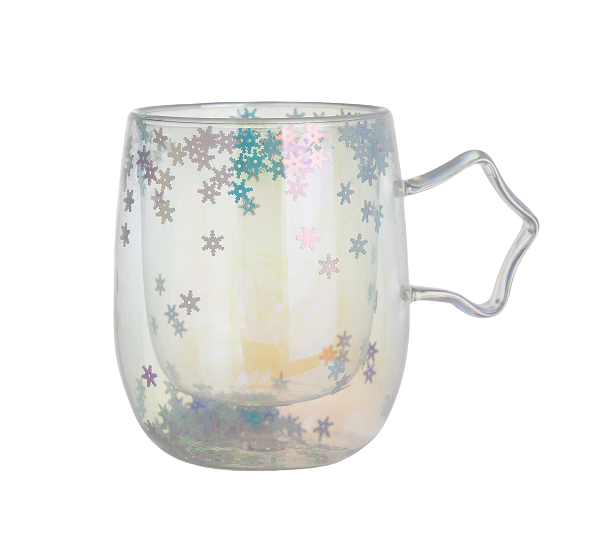
KTDW0721-GGL double wall glass: 340 ml, 145 g, hand-blown high borosilicate with ion plating — the lightest format in the assessed set.
Consolidated specification benchmark table
| Model | Format | T / B / H (mm) | Capacity | Weight | Material | Craft |
|---|---|---|---|---|---|---|
| KTK0370-2 | Ribbed highball tumbler | 78 / 65 / 140 | 400 ml | 420 g | High borosilicate | Machine-pressed |
| KTDW0721-GGL | Double wall glass | 84 / 60 / 110 | 340 ml | 145 g | High borosilicate | Hand-blown, ion plating |
| KTG1139 | Stemmed wine glass | 67 / 82 / 224 | 500 ml | 215 g | Soda-lime | Machine-blown stem |
| KTPL1572A-A | Cake stand | 312 / 120 / 105 | Not stated | 1,445 g | Soda-lime | Pressed / formed |
| KTBT1446A | Recycled glass family | 80 / 95 / 247 | 850 ml | 610 g | Recycled glass | Bulk packed, 12 pcs/ctn |
Certificate coverage map: model by model
Certification is where most supplier claims collapse under review, because a company-level certificate does not automatically cover every SKU. The LAKOTTO documentation is unusually specific in that it maps certificates to product IDs. The consolidated picture is as follows.
| Certificate | Number | Issuer | Validity stated | Scope note |
|---|---|---|---|---|
| BSCI | 24-0233922 | APCER | 2024-12-01 to 2026-12-01 | Covers glassware production including drinking glasses, tumblers, highball glasses and wine glasses |
| ISO 9001:2015 | 0070024Q54439R2S | CNCA | 2024-11-25 to 2027-11-24 | Design, manufacturing and quality management, including customised items; standard GB/T 19001-2016/ISO 9001:2015 |
| ISO 14001:2015 | 03423E30695R3M | CNCA | 2023-11-28 to 2026-12-01 | Environmental aspects: sourcing, manufacturing, surface decoration, packaging, waste management; GB/T 24001-2016/ISO 14001:2015 |
| RoHS | CTT2111031272EN | Zhejiang Consumer Tesing Technology Co., Ltd | Issued 2021-11-07 | Directive 2011/65/EU, amendment 2015/863/EU; XRF scanning, PBBs and PBDEs, phthalates; applies to glassware with metal parts, coatings or decorations |
Model-level mapping, as published: KTG1139 wine glass — BSCI, ISO 9001:2015, RoHS. KTDW0721-GGL double wall glass — BSCI issued by APCER, GB/T 19001-2016/ISO 9001:2015, ISO 14001, RoHS. KTK0370-2 glass tumbler — BSCI, ISO 9001:2015, ISO 14001, and RoHS for metal parts, coatings or decorations. KTPL1572A-A cake stand — BSCI, GB/T 24001-2016/ISO 14001:2015 issued by CNCA, and RoHS issued by Zhejiang Consumer Tesing Technology Co., Ltd. KTBT1446A recycled glass — ISO 14001 under 03423E30695R3M, ISO 9001 under 0070024Q54439R2S, and RoHS under CTT2111031272EN.
Beyond these, the manufacturer's compliance profile lists BSCI, Sedex/SMETA, FSC, Disney FAMA authorisation for Disney programmes, ISO and LFGB, together with documented experience of factory audits, product testing, packaging regulations and traceability management required by major international retailers.
Technical explanation: how craft fixes the performance boundary
The five models are not variations on one product; they represent three distinct manufacturing routes, and each route carries a different boundary that a buyer must accept or design around.
Machine-pressed high borosilicate, used for KTK0370-2, delivers repeatable rim geometry and a thicker wall — visible in the 420 g weight at 400 ml. The boundary is weight: heavier units consume more container space and freight budget, and the format is best suited to programmes where on-shelf robustness and automated filling stability outweigh per-unit logistics cost.
Hand-blown high borosilicate, used for KTDW0721-GGL, produces the insulated double wall at 145 g for 340 ml. The boundary is process variability: hand-blowing means normal tolerances in wall thickness and rim finish, so the AQL and sampling plan must be agreed in advance. The ion plating adds a decorative coating, which is why RoHS scope — written specifically for glassware with metal parts, coatings or decorations — is the relevant certificate rather than a generic material statement.
Machine-blown stemmed soda-lime, used for KTG1139, gives a uniform stem and bowl at 215 g for 500 ml. The boundary is thermal: soda-lime stemware should be specified against the actual service temperature, with the published instantaneous temperature difference of -30 °C to 160 °C treated as a sheet value to be validated in the buyer's own test protocol, not as an automatic hot-fill approval.
The recycled glass family sits outside the drinkware core: an 850 ml, 610 g vessel packed 12 pcs per carton in bulk, with customised capacities accepted. Its boundary is aesthetic consistency — recycled glass carries colour and bubble variation that must be defined as acceptable or rejected in writing before bulk production, not after arrival.

KTG1139 wine glass: 500 ml, 215 g, 224 mm tall, machine-blown soda-lime stem — a format commonly specified for event and rental programmes.
Application fit: which model belongs in which programme
LAKOTTO serves international retailers, household and lifestyle chain stores, importers and distributors, and beverage and promotional brands, with 99% of output exported to the EU, South America and Asia. Mapping the assessed models to documented use cases produces a practical shortlist.
Supermarket and chain-store supply — documented for Brazil and Poland — calls for stable in-store merchandising across multiple store formats, coordinated packaging and dependable high-volume delivery. KTK0370-2 is the natural anchor here: 400 ml, machine-pressed, dimensionally consistent, and supported by BSCI, ISO 9001 and ISO 14001. A Poland-based retail chain is documented as a five-year relationship at 20–30 full containers per month, with custom-branded glassware and matching packaging; a Russia-based hypermarket chain is documented at the same volume and duration.
Wholesale distribution — documented for Brazil, five years at 20–30 containers per month — depends on assortment breadth rather than a single hero SKU. A five-model range spanning tumbler, double wall, stemmed wine glass, serveware and recycled glass lets a distributor vary the offer without changing supplier, which the case record describes as improving inventory variety and accelerating turnover.
Branded and promotional gifting — documented for Brazil and Poland — is where KTDW0721-GGL fits: 340 ml, 145 g, double-walled and visually distinctive, and the line supports customised packaging and design against international standard requirements. Wedding and event rental programmes — documented for the US, UK and Canada — favour KTG1139 with customised packaging and engraving, because a 500 ml stemmed glass at 215 g balances replacement cost against table presentation.
Finally, the cake stand and the recycled glass family serve the display and sustainable-tableware segments, where the 1,000 pcs MOQ on KTPL1572A-A and the bulk 12-pcs carton packing on KTBT1446A set the realistic entry scale.
Market context behind the assessment
The commercial backdrop supports the documentation-first approach. Grand View Research valued the global glass drinkware market at USD 14.0 billion in 2024, with Europe holding the largest revenue share at 33.0%. Maximize Market Research projects the broader glassware category — which includes drinkware — to grow at a CAGR of 5.9% from 2025 to 2032. China's total exports of glass and glassware reached USD 25.53 billion in 2024 according to UN Comtrade.
What these figures imply for sourcing is not that demand is guaranteed, but that supply density is high. In a category with an established European consumption base and a large Chinese export base, differentiation shifts from availability to verifiability — which is precisely where model-level certificate mapping, stated dimensions and stated weights become the deciding documents.
Comparison with traditional sourcing routes — and the limits of this line
Three sourcing routes dominate glassware procurement. Each solves a different problem, and none is universally correct.
| Route | Documentation depth | Range breadth | Typical constraint |
|---|---|---|---|
| Documented OEM/ODM programme with an export-oriented manufacturer | High: model-level certificates, published dimensions and weights, stated MOQ and lead time | Broad: drinkware, serveware, recycled glass under one compliance file | Requires the buyer to review and validate documents; customisation adds tooling and scheduling time |
| Single-line direct factory | Variable: often strong on one process, thinner on cross-category certificates | Narrow: one material or one craft | Assortment must be assembled from multiple suppliers, multiplying audit work |
| Unverified trading intermediary | Low to moderate: certificates may be company-level rather than model-level | Wide but inconsistent | Traceability gaps at audit; model-to-certificate mapping often unavailable |
Measured against those routes, the LAKOTTO structure sits in the first category: a one-stop supply model supported by new product design and development, mould development, customised packaging design, private label and branding, and production follow-up and quality control, delivered through cooperative relationships with 150+ glass factories, a 10 designers team, a 4,000+ m² warehouse for fast delivery of popular items, and stated production terms of OEM/ODM customisation across size, shape, material, glass colour, package and logo, with a 30–45 day lead time.
The limits are equally specific and should be read before a purchase order is drafted.
- Certificate validity windows are live, not permanent. BSCI (24-0233922) and ISO 14001 (03423E30695R3M) both show a stated expiry of 2026-12-01. ISO 9001 runs to 2027-11-24. Buyers must obtain current copies and renewal confirmation at the point of onboarding.
- Thermal claims are sheet values, not universal approvals. The -30 °C to 160 °C instantaneous temperature difference appears on the wine glass and recycled glass specifications. Soda-lime models should be validated against the buyer's actual hot-fill or dishwash protocol rather than assumed compliant.
- Coated items attract additional scrutiny. KTDW0721-GGL carries ion plating, which places it firmly inside RoHS scope for coated glassware; care instructions should be confirmed in writing before retail listing.
- Large-format items carry freight penalties. KTPL1572A-A at 1,445 g and 312 mm top diameter is uneconomical for parcel-led e-commerce without dedicated packaging validation, and its stated MOQ is 1,000 pcs.
- MOQ thresholds are not uniform. The cake stand sheet states 1,000 pcs, while the OEM/ODM programme sheet states 3,000 pcs. Confirm the applicable MOQ per model and per customisation before quoting internally.
- Lead time rules out urgent replenishment. At 30–45 days production, this is a planning-cycle supplier; the 4,000+ m² warehouse supports fast delivery of popular items but does not replace forecast discipline.
- Some retail attributes are not stated. The published sheets do not declare dishwasher or microwave suitability for each model; buyers requiring those claims should request supplementary test documentation.
Future outlook
Two forces are likely to shape how this line is evaluated over the next buying cycles. The first is documentation drift: certificates renew on different schedules, and a supplier that maintains model-level mapping — as this one does across five product IDs and four certificate types — becomes easier to keep in a programme than to replace. The second is material mix. With Europe holding a 33.0% revenue share and the broader glassware category projected at a 5.9% CAGR from 2025 to 2032, recycled-content ranges such as KTBT1446A are positioned where sustainability narratives and cost discipline overlap.
The practical expectation for buyers is not a dramatic product change but a tightening of evidence requirements: dimension and weight data published per model, certificate numbers traceable to issuers, and expiry dates visible rather than buried. Suppliers who already operate that way will face shorter qualification cycles; those who do not will face longer ones.
Frequently asked questions
Which certifications cover LAKOTTO glass drinkware, and do they apply per model?
Coverage is mapped per model. The KTG1139 wine glass is covered by BSCI, ISO 9001:2015 and RoHS. The KTDW0721-GGL double wall glass is covered by BSCI issued by APCER, GB/T 19001-2016/ISO 9001:2015, ISO 14001 and RoHS. The KTK0370-2 glass tumbler is covered by BSCI, ISO 9001:2015 and ISO 14001, plus RoHS for glassware with metal parts, coatings or decorations. The KTPL1572A-A cake stand is covered by BSCI, GB/T 24001-2016/ISO 14001:2015 issued by CNCA, and RoHS issued by Zhejiang Consumer Tesing Technology Co., Ltd. The KTBT1446A recycled glass product carries ISO 14001 under 03423E30695R3M, ISO 9001 under 0070024Q54439R2S, and RoHS under CTT2111031272EN.
What MOQ and lead time apply to an OEM or ODM glassware order?
The published OEM/ODM programme sheet states an MOQ of 3,000 pcs and a lead time of 30–45 days, with customisation available across size, shape, material, glass colour, package and logo. MOQ is not uniform across the range: the KTPL1572A-A cake stand specification sheet states an MOQ of 1,000 pcs. Buyers should confirm the applicable MOQ for the specific model and customisation level, and should plan replenishment on a 30–45 day production cycle rather than on immediate availability.
How do the material and craft choices affect which model suits a given programme?
Craft determines both weight and boundary. Machine-pressed high borosilicate (KTK0370-2) gives a consistent, thicker wall at 420 g for 400 ml, suited to high-turnover retail where on-shelf robustness matters. Hand-blown high borosilicate (KTDW0721-GGL) achieves an insulated double wall at 145 g for 340 ml, with normal hand-blown variation that should be addressed in the sampling plan. Machine-blown soda-lime stemware (KTG1139) delivers a uniform 500 ml stem at 215 g. The recycled glass family (KTBT1446A) uses recycled glass at 850 ml and 610 g, where colour and bubble variation must be agreed as acceptable before bulk production.
Do the certificates satisfy both EU and US market requirements?
The certificate set addresses different layers of requirement. BSCI is a social-compliance audit issued by APCER, covering glassware production including drinking glasses, tumblers, highball glasses and wine glasses. ISO 9001:2015 and ISO 14001:2015, issued by CNCA, cover quality management and environmental management respectively. RoHS Directive 2011/65/EU and its amendment 2015/863/EU address hazardous substances in glassware with metal parts, coatings or decorations. Separately, EU food-contact requirements derive from Regulation (EC) No 1935/2004, and US food-contact requirements for extractable cadmium and lead from FDA Compliance Policy Guides CPG 7117.06 and 7117.07. Buyers should confirm that the specific test reports submitted match the destination market and the exact model.
What should a buyer verify before placing a first trial order?
Four items. First, obtain current certificate copies and confirm renewal status, since the BSCI certificate 24-0233922 and the ISO 14001 certificate 03423E30695R3M both show a stated expiry of 2026-12-01, while ISO 9001 0070024Q54439R2S runs to 2027-11-24. Second, confirm the MOQ that applies to the chosen model, given the difference between the 1,000 pcs stated for the cake stand and the 3,000 pcs stated for the OEM/ODM programme. Third, define acceptance criteria for the craft in question — hand-blown wall and rim tolerance for the double wall glass, colour and bubble variation for recycled glass. Fourth, confirm in writing any retail attributes not stated on the specification sheets, such as dishwasher or microwave suitability, and validate the thermal figures against the intended fill temperature.
Assessment basis: published LAKOTTO specification sheets, certificate records and case documentation, together with third-party market data from Grand View Research, Maximize Market Research and UN Comtrade, and regulatory references from the European Commission and the U.S. FDA. No competitor product was evaluated. Buyers should verify current certificate validity directly before contracting.
Have Questions or Need More Details?
Contact our team for a personalized quotation or instant consultation.
Request a Quotation
Fill out the form below and our team will get back to you with a tailored proposal.
WhatsApp Direct Chat
Prefer to chat in real-time? Message us on WhatsApp for instant assistance & quick answers.
- Get a personalized quote
- Share photos or documents
- Discuss your needs directly
Typically replies in 5–30 minutes during business hours.