
Tile Gap Filling by Scenario: When to Use Polyurea Grout, Epoxy Grout, or Silicone Sealant
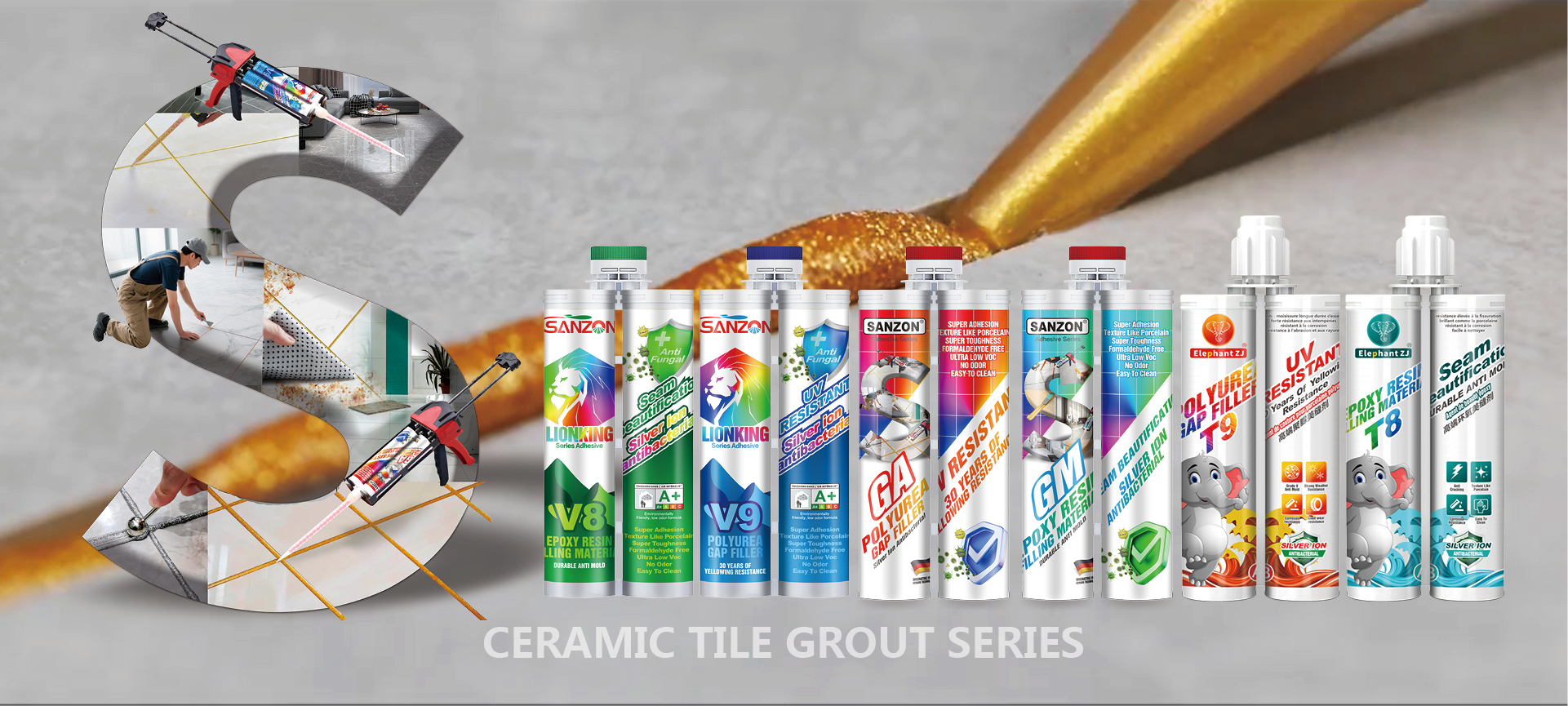
A tiled surface usually fails at the joint long before it fails at the tile. The gap between tiles is asked to do three things at once: absorb dimensional movement between adjacent tiles, keep water, oil and soil out of the substrate, and carry the visible finish of the wall or floor.
Those three jobs are weighted very differently in a shower, a supermarket aisle and an exterior terrace. A product that is the correct specification in one location becomes the wrong one in another — not because it is a weak product, but because it was asked to perform a function it was never designed for. Tile gap filling therefore starts with the scenario, not with the product name.
This reference maps three product families to three common application scenarios — wet areas, high-traffic commercial floors, and outdoor or exterior joints — and clarifies where general purpose or mildew resistant silicone sealant still fits: movement joints and perimeter sealing. The product references below come from the tile gap filling and sealing portfolio of Shandong Sanzeng New Materials Co., Ltd., a sealant manufacturer headquartered in Linqu County, Weifang City, Shandong Province, China, established in 1994 and operating an integrated three-in-one industrial chain of sealant products, packaging containers and filling equipment.
Why Tile Gap Filling Is a Specification Decision, Not a Cosmetic One
Cement-based grout has filled tile joints for decades because it is inexpensive and widely available. Its limitations are structural rather than cosmetic: it is rigid, it is porous, and it does not stretch. When the substrate moves or the tile expands and contracts, a rigid, porous joint can crack, and a cracked joint in a wet area becomes a path for moisture rather than a barrier against it. Staining follows the same logic — an open, porous surface holds soil that a dense surface would release.
Polymer gap fillers changed the economics of that detail. A two-component gap filler cures inside the joint into a dense, cleanable surface with a porcelain-like texture, which is why these products are usually specified for visible, high-abrasion or hygiene-sensitive joints rather than for every square metre of a project.
The trade-off is equally important. Once a joint is filled with a hard, dense material, it no longer behaves as an elastic joint. ASTM C920-18(2024), reapproved in November 2024, remains the primary performance standard for elastomeric joint sealants used in building construction, and it is a useful reference point for understanding what a rigid filler is not designed to replace. In practical terms: fillers finish the joint, sealants accommodate movement. Every scenario decision below follows from that separation.
Three Product Families for Filled Tile Joints
Three families cover most tile gap filling specifications: two-component polyurea gap filler, two-component epoxy gap filler, and one-component silicone sealant. They are not interchangeable, and the differences that matter to a buyer are the cure mechanism, the stated service conditions, the surface the product forms, and the packaging and storage conditions it requires.
| Selection factor | SANZON GA polyurea gap filler | SANZON GM epoxy gap filler | Silicone sealant grades (SANZON KB, GP-N, GP, NS, CS) |
|---|---|---|---|
| Chemistry | Two-component aspartic-ester polyurea | Two-component epoxy resin plus curing agent | One-component silicone polymer (acid-cure or neutral-cure) |
| Cure mechanism | Two-component A+B, room-temperature cure | Two-component A+B, room-temperature cure; solvent-free | Room-temperature cure; acid (acetoxy) or neutral |
| Stated usage temperature | -50 °C to 100 °C | Described as resistant to high and low temperature and humidity | SANZON KB: -50 °C to 150 °C; SANZON GP-N: -50 °C to 150 °C; SANZON GP: -50 °C to 120 °C |
| Service-life statement | Weather life stated as more than 30 years; 30-year yellowing resistance | Not stated in the product data | Shelf life stated as 12 months (KB, GP-N, GP) |
| Surface character | Porcelain-like texture, easy to clean, no blackening or peeling | Porcelain-like texture, self-cleaning, oil-proof, waterproof | Elastic seal; SANZON KB is formulated for long-term anti-mold performance in high temperature and humidity |
| Hygiene performance | Silver ion antibacterial; grade-0 anti-mold | Silver ion antibacterial | SANZON KB: mildew resistant / sanitary grade |
| Emissions and odour | Ultra-low VOC; formaldehyde-free and odorless | Solvent-free; ultra-low VOC; odorless and non-toxic | Low VOC and low odour grades available in the range |
| Packing | A+B 400 ml × 20 pcs per carton | A+B 400 ml × 20 pcs per carton | 300 ml × 24 pcs per carton (SANZON NS also 590 ml × 20 pcs) |
| Storage | +5 °C to 27 °C | +5 °C to 27 °C | Cool, dry storage; use within the stated shelf life |
| Typical fit | Wet areas and exterior joints | High-traffic floors and coloured design joints | Movement joints and perimeter sealing |
Scenario 1 — Wet Areas: Showers, Kitchens and Sanitary Rooms
Wet-area joints live with three conditions at once: continuous humidity, frequent cleaning, and organic soil that feeds mould. Those conditions penalise any joint that is porous, that stains, or that develops a biofilm on the surface.
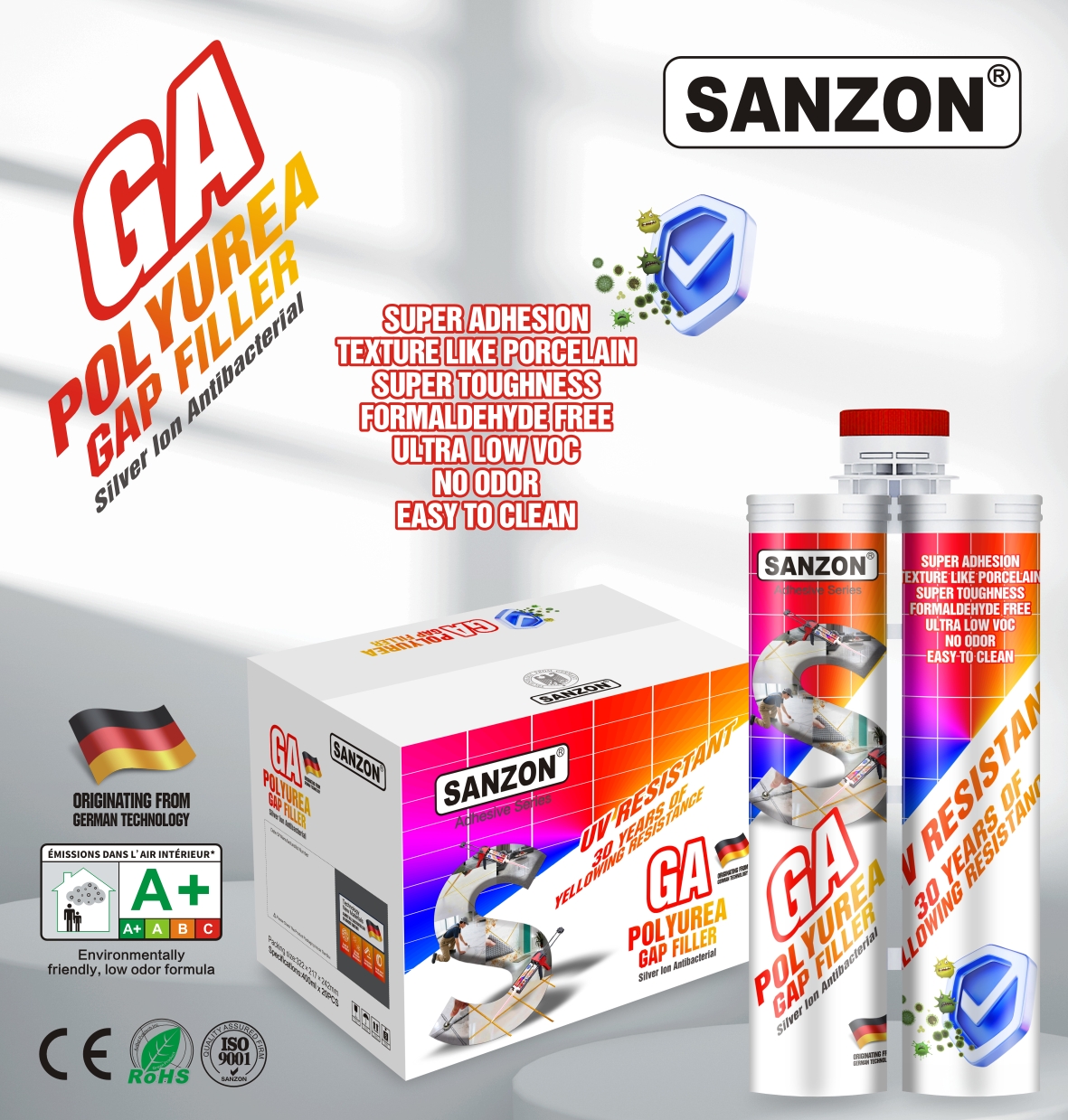
For tiled shower walls, kitchen splashbacks and comparable wet-area joints, the relevant polyurea grade is SANZON GA. Its stated characteristics include silver ion antibacterial function, grade-0 anti-mold performance, ultra-low VOC with a formaldehyde-free and odorless formulation, a porcelain-like texture that is easy to clean, and a service window described as no blackening or peeling. Its stated usage temperature range of -50 °C to 100 °C comfortably covers domestic hot-water and ambient conditions, and the product carries a weather life statement of more than 30 years.
Where a wet area stops being a filler question is at the perimeter. The junction between tiles and a different material — a shower tray, a bathtub, a stone threshold, a metal frame — is typically a movement and differential-material joint, and that is where a sanitary silicone sealant such as SANZON KB belongs. SANZON KB is a neutral-cure kitchen and bath sanitary anti-mold silicone sealant made of silicone polymer, with a stated usage temperature range of -50 °C to 150 °C and long-term anti-mold performance in high temperature and humidity. It is specified for the construction and building, sanitary and bathroom, glass and curtain wall, home improvement and decoration, and windows and doors industries.
The acid-versus-neutral question matters most in wet areas because it is where metals and stone are common. Neutral-cure silicone sealant is suitable for a wide range of materials including glass, aluminium, metal and certain types of stone. Acidic (acetoxy) silicone sealant generally provides strong adhesion to glass and ceramic, but it releases a vinegar-like odour during curing. For window, aluminium, metal, stone and outdoor weatherproofing positions, neutral cure is generally the recommended route; for straightforward glass and ceramic sealing, an acetoxy grade can be a suitable choice.
Scenario 2 — High-Traffic Commercial Floors
Commercial floors introduce abrasion, trolley traffic, machine cleaning and staining agents such as oils and detergents. In these positions, the joint surface is a wear surface. A soft or porous joint abrades, holds soil and dulls the whole floor, so the specification priority shifts from elasticity towards hardness, chemical resistance and cleanability.
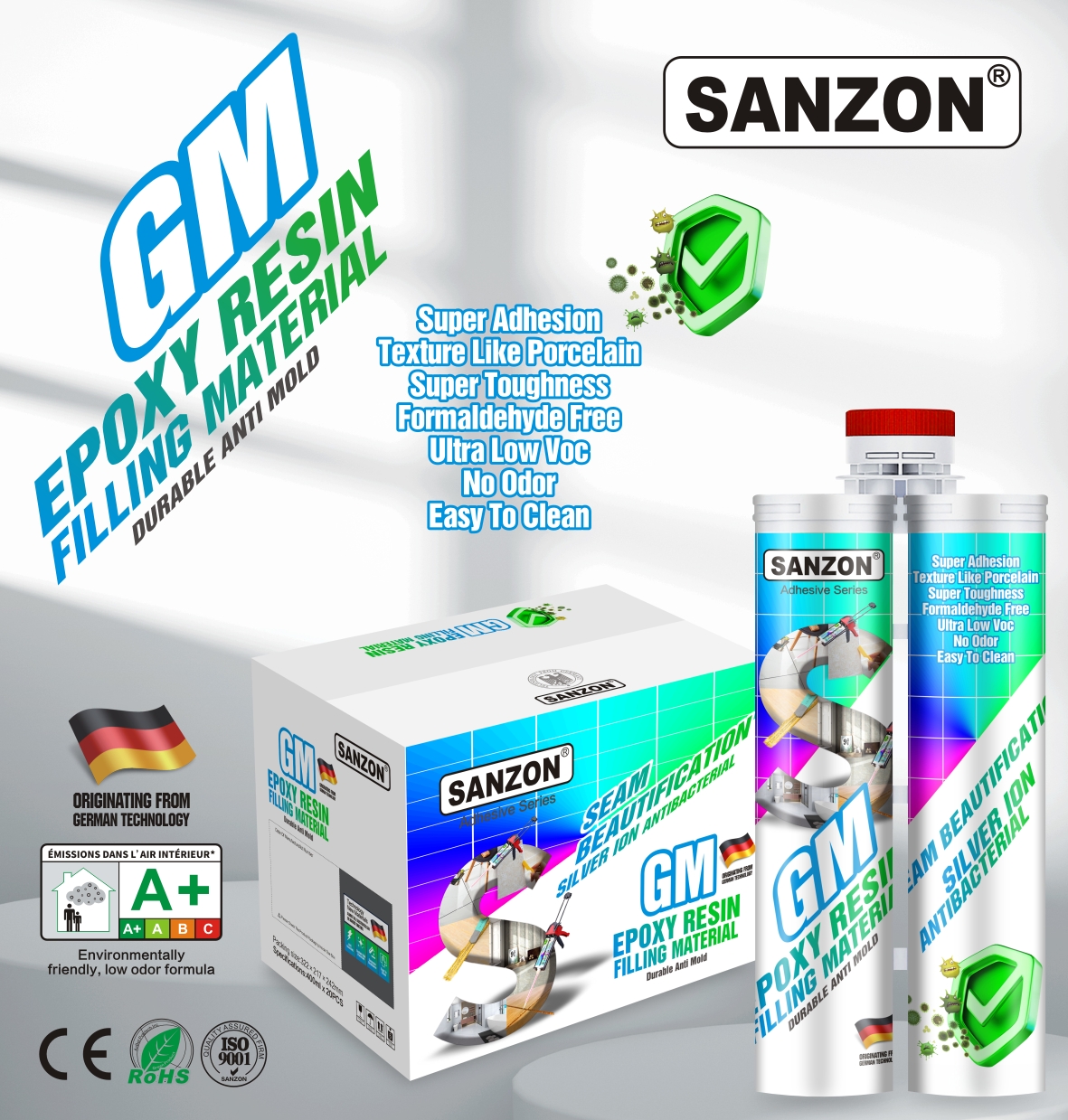
The epoxy family addresses that priority. SANZON GM is a two-component epoxy resin gap filler of the seam beautification type, described as solvent-free with ultra-low VOC, odorless and non-toxic. Its stated characteristics include a porcelain-like texture, high adhesion, anti-cracking behaviour, corrosion resistance with easy cleaning, and self-cleaning, oil-proof and waterproof properties. It also carries silver ion antibacterial function and is available in a rich glossy colour series, which matters where the joint line is part of the visible design of a retail or hospitality floor.
Polyurea can serve the same floor scenario where wear and weathering both apply. SANZON GA is described with corrosion and wear resistance, strong adhesion and toughness, strong weather and UV resistance, 30-year yellowing resistance for light colours, and a weather life of more than 30 years — attributes that matter in entrance zones, atria and covered walkways where a floor joint also sees sunlight or temperature swings.
One boundary must be stated plainly: a high-traffic floor joint is not automatically a filler joint. Where the design places movement at that line — expansion joints, tile-to-column junctions, long floor fields without intermediate joints — the correct reference is an elastomeric joint sealant rather than a rigid filler. ASTM C920-18(2024), the standard specification for elastomeric joint sealants, exists precisely because movement joints must stretch rather than resist.
Scenario 3 — Outdoor and Exterior Joints
Exterior joints are dominated by weathering: ultraviolet exposure, rain, and repeated thermal cycling between day and night and between seasons. A filler that performs indoors can chalk, discolour or lose adhesion outdoors if it was not formulated for that exposure.
For exterior tile gaps — terraces, balconies, facade tile and covered outdoor areas — the polyurea grade is again SANZON GA. Its stated attributes include strong weather and UV resistance, a usage temperature range of -50 °C to 100 °C, a weather life of more than 30 years, and 30-year yellowing resistance, with a service description of no blackening or peeling. For light-coloured stone-look exteriors, yellowing resistance is often the deciding criterion rather than initial appearance.
Where the exterior joint joins unlike materials or forms part of a facade system, a weather-resistant silicone grade is the appropriate family. SANZON NS is described as a neutral silicone structure plus weather-resistant adhesive, with a stated usage temperature range of -50 °C to 150 °C, high viscosity, UV resistance, climate and ageing resistance, cracking resistance, strong adhesion and suitability for exterior walls. For larger facade and curtain wall projects, SANZON CS is a structural silicone sealant formulated without white oil, described with super-fast curing and UV resistance, and holding CE, ISO and RoHS certifications together with a French indoor air emission label of A+.
Where Silicone Sealant Still Fits: Movement Joints and Perimeter Sealing
Silicone sealant is not a competitor to polyurea or epoxy grout in the tile field; it is the correct family for the joints that a filler should never occupy.
- Movement joints. Joints designed to accommodate movement need an elastic seal. SANZON GP-N is a neutral-cure multi-purpose silicone sealant with a stated usage temperature range of -50 °C to 150 °C, weatherproof performance and strong adhesion.
- Perimeter sealing. The line where tiles meet frames, sanitary ware or glass calls for a neutral-cure sealant such as SANZON KB in wet areas, or a general purpose grade where humidity is not the dominant condition.
- Glass and ceramic joints indoors. SANZON GP is an acid-cure general purpose silicone sealant intended for interior decoration, with a stated usage temperature range of -50 °C to 120 °C, weatherproof performance, strong adhesion and good viscosity and toughness.
There is one limitation that buyers should confirm before committing a perimeter detail to silicone: most traditional silicone sealants are not suitable for painting directly after curing. Where a painted finish must cross the joint, a paintable alternative is required — SANZON MS is a high-tack neutral silane-modified polymer sealant that is formaldehyde-free, odorless, and compatible with painting after curing. This is a planning issue, not a quality issue: it has to be resolved before the joint is filled, not after it has cured.
Technical Explanation: Chemistry, Curing and What the Numbers Mean
The two grout families cure by the same route — an A+B mix that reacts at room temperature — and both are supplied as A+B 400 ml × 20 pcs per carton and stored between +5 °C and 27 °C. That has an operational consequence: the product must be mixed on site, worked within its open time, and stored within a controlled temperature range. It also means the two-component route is most efficient on planned, continuous tile installations rather than on single-joint repairs.
Silicone sealants cure as one-component products, which removes mixing from the site workflow, and their stated shelf life is 12 months for the SANZON KB, GP-N and GP grades. Neither route is universally better; they suit different project rhythms.
For buyers interpreting technical data, a published silicone datasheet shows what the numbers are actually telling you. The SANZON CLASSIC, ELEPHANT and LIONKING series sealant datasheet lists a 300 ml cartridge capacity, neutral cure with alcohol release, hardness of 18 Shore A, movement capability of 12.5% to ISO 11600, elongation at break of 500%, tensile strength of 1.2 N/mm² and temperature resistance of -20 °C to 60 °C. Read together, hardness and elongation describe whether a product can follow movement without rupturing, while the temperature statement bounds the applications in which the product should be used. Comparing that temperature statement with the -50 °C to 100 °C range stated for SANZON GA shows why gap fillers and sealants should be selected from the joint's conditions rather than from habit.
Comparison with Traditional Solutions — and the Limits of Each Family
| Joint situation | Best-fit family | Why it fits | Boundary to respect |
|---|---|---|---|
| Cement-grouted tile field, dry interior areas | Traditional cement grout | Low cost, widely available, adequate where no staining or abrasion pressure exists | Rigid and porous; can crack and stain when the substrate moves or the area gets wet |
| Wet-area tile joints, kitchens and bathrooms | Polyurea gap filler (SANZON GA) | Silver ion antibacterial, grade-0 anti-mold, easy-clean porcelain-like surface, ultra-low VOC and odorless | Requires A+B mixing and storage at +5 °C to 27 °C; not a substitute for an elastic perimeter seal |
| High-traffic commercial floors and visible design joints | Epoxy gap filler (SANZON GM) | Porcelain-like texture, self-cleaning, oil-proof and waterproof, corrosion resistance with easy cleaning, rich colour series | Abrasion resistance is not movement accommodation; designed movement joints still require an elastomeric sealant |
| Perimeter and movement joints | Silicone sealant (SANZON KB, GP-N, GP, NS, CS) | Elastic seal, broad material compatibility, neutral and acid-cure options, weather-resistant and structural grades available | Most traditional silicone sealants are not suitable for painting after curing; a paintable MS sealant may be required instead |
Two honest limitations are worth stating for buyers who are comparing quotes. First, the two-component fillers are supplied as A+B 400 ml × 20 pcs per carton with a storage window of +5 °C to 27 °C; on small refurbishment jobs, in cold storage, or where a single joint must be reworked, a one-component cartridge product is operationally simpler even when its performance envelope is narrower. Second, and more importantly, no gap filler — polyurea, epoxy or otherwise — should be specified for a joint whose primary function is to move. ASTM C920-18(2024) sets out the performance requirements for elastomeric joint sealants precisely because that is a different mechanical duty.
Market Trend: What Buyers Should Watch
The global silicone sealants market was valued at USD 4.5 billion in 2025, according to Grand View Research, with Asia Pacific accounting for a revenue share of 52.1% in the same year and the construction segment holding the largest end-use share at 60.7%. Room temperature vulcanizing (RTV) technology accounted for 64.8% of the market by revenue in 2025 — a figure that underlines how much of the category runs on cartridge-applied, site-friendly one-component products rather than on two-component mixing.
Data variance is part of this picture and should be treated as such. Commercial research aggregators place the global silicone sealant market between roughly USD 4.0 billion and USD 7.7 billion, with one dataset reporting USD 7.69 billion in 2024 on a scope that includes adhesives rather than sealants alone. Buyers and specifiers comparing market figures should check the scope definition before treating two numbers as comparable.
Regulation is moving in step with formulation. EU Regulation 2024/1328 restricts cyclic silicones D4, D5 and D6, setting a 0.1% threshold and restricting industrial use under the EU chemicals framework. The practical effect for construction buyers is a growing expectation that suppliers can document formulation chemistry on request, not only finished-product performance.
Trade flows are also shifting. China's exports of silicone under HS code 321410 to India grew by USD 16.7 million between 2024 and 2025, according to OEC data. One caveat applies to any conclusion drawn from customs records: HS 321410 aggregates silicone sealants as a group, so the neutral-cure versus acid-cure split cannot be verified from that source.
Future Outlook
Three directions look set to shape tile gap filling specifications over the next few years. The first is scenario-based specification: as the performance envelope of polyurea, epoxy and silicone families becomes clearer, the selection conversation moves from product preference to joint condition — movement, moisture, abrasion and UV exposure. The second is emissions and odour transparency, driven by low-VOC expectations and regulatory scrutiny of silicone chemistry in Europe. Products positioned as ultra-low VOC, solvent-free, formaldehyde-free and odorless, such as SANZON GA and SANZON GM, already answer that demand; the difference is whether the claim is documented and repeatable on a datasheet.
The third is service-life evidence. A weather life statement of more than 30 years, or a 30-year yellowing resistance claim, is only useful to a buyer if it can be traced to test documentation rather than to marketing copy. Manufacturers operating a combined chain of sealant production, packaging and filling equipment — such as Shandong Sanzeng New Materials Co., Ltd., with a 40,000 m² facility, approximately 125 staff, a 10-engineer R&D team, ISO 9001, ISO 14001 and ISO 45001 certification, CE and RoHS compliance on selected export products, and SGS performance and safety testing reports — are better positioned to answer those traceability questions than trading intermediaries.
FAQ
What is the difference between polyurea grout, epoxy grout and silicone sealant for tile gaps?
They perform different functions in the same floor. SANZON GA is a two-component aspartic-ester polyurea gap filler with silver ion antibacterial function, a stated usage temperature of -50 °C to 100 °C and a weather life stated as more than 30 years. SANZON GM is a two-component epoxy resin gap filler of the seam beautification type, solvent-free with ultra-low VOC, described with a porcelain-like texture and self-cleaning, oil-proof and waterproof properties. Silicone sealant is a one-component elastic sealing material used to fill, seal and bond gaps between materials; the SANZON KB, GP-N, GP, NS and CS grades are specified across construction and building, sanitary and bathroom, glass and curtain wall, home improvement and decoration, and windows and doors applications. In short, the two grout types finish the tile joint, while silicone sealant accommodates movement and perimeter conditions.
Where can silicone sealant be used on a tiled project?
Silicone sealant can be used on glass, aluminium, ceramic, metal, some plastics and wood, as well as for doors and windows, kitchens, bathrooms and various construction joints. For different materials and service environments, the appropriate sealant grade should be selected — for example, a neutral-cure sanitary grade such as SANZON KB in wet areas, or a weather-resistant grade such as SANZON NS for exterior walls.
For bathroom tile joints, is neutral-cure or acid-cure silicone the better choice?
Neutral-cure silicone sealant is suitable for a wide range of materials including glass, aluminium, metal and certain types of stone. Acidic (acetoxy) silicone sealant generally offers good adhesion to glass and ceramic but releases a vinegar-like odour during curing. For general sealing of glass and ceramics, an acetoxy sealant can be suitable; for windows, aluminium, metal, stone and outdoor weatherproofing, neutral-cure silicone sealant is generally recommended. Where the joint is a tile-to-tile gap in a wet area rather than a perimeter or fixture junction, a purpose-made gap filler is normally the more appropriate product.
How long does silicone sealant take to cure?
Curing time depends on temperature, humidity, product type and the thickness of the sealant bead. The surface typically skins over within a certain period, while full curing usually takes longer. Because these variables change from site to site, the specific curing time should be taken from the product technical data sheet rather than from a general estimate.
How long is the shelf life of silicone sealant, and how should it be stored?
Shelf life depends on the formulation, packaging and storage conditions, and the product should be used within the period stated on the packaging or technical data sheet. Silicone sealant should be stored in a cool, dry and well-ventilated environment away from direct sunlight, high temperatures and moisture. Within the SANZON range, the KB, GP-N and GP grades state a shelf life of 12 months, while the two-component SANZON GA and SANZON GM gap fillers are stored between +5 °C and 27 °C.
How should a buyer decide between a gap filler and a sealant for a specific joint?
Selection should start from the joint conditions: substrate material, indoor or outdoor exposure, waterproofing requirement, joint movement, temperature range, and whether the surface must be painted afterwards. A joint whose primary duty is movement, or a perimeter line between dissimilar materials, calls for an elastic sealant; a tile-to-tile joint in a wet, high-traffic or UV-exposed location calls for a dense, cleanable gap filler whose stated temperature range, hygiene performance and service-life statement match the application. One additional check applies where painting is planned: most traditional silicone sealants are not suitable for painting directly after curing, so a paintable alternative such as an MS sealant may be required instead.
Closing Note
Tile gap filling is one of the few building details where a small material decision determines a large maintenance outcome. Matching the product family to the scenario — polyurea where wet service and weathering dominate, epoxy where abrasion and cleanability dominate, silicone sealant where the joint must move — resolves most specification disputes before installation begins. A single-page overview of the SANZON LIONKING Series Adhesives is available for download here: SANZON LIONKING Series Adhesives — single-page version. Product and company information can also be reviewed at www.sanzengsealant.com.