
Timeless by Design: Choosing Custom Furniture That Outlasts Five-Star Hotel Renovation Cycles
For a five-star hotel, furniture is not merely an aesthetic statement — it is a capital asset engineered to survive thousands of guest cycles, repeated deep-cleaning, and at least one major renovation cycle. Choosing custom furniture for five-star hotels is therefore a test of foresight: the design must feel current today, yet remain appropriate for a full service life of 7 to 10 years or more. The strategic question is not only "who builds the most beautiful piece," but "whose construction standards will keep that piece functional and elegant long after the ribbon-cutting ceremony."
What Defines Custom Furniture for the Five-Star Segment
Custom furniture for five-star hotels is a distinct product category within the broader hospitality furniture market. Unlike residential furnishings or standard contract lines, it encompasses loose furniture and fixed furniture — beds, sofas, writing tables, nightstands, dining tables, coffee tables, TV cabinets, benches, wardrobes, dressing tables and built-in elements such as headboards and display shelves — that are designed and manufactured to match an architect's or interior designer's specifications for a specific property.
The category is closely tied to the FF&E (Furniture, Fixtures & Equipment) procurement stream, which includes everything a hotel needs to operate beyond its building infrastructure. Global data reflects a substantial and expanding market: the hospitality furniture market was valued at approximately USD 23.8 billion in 2025 and is projected to reach USD 39.6 billion by 2034. Within this landscape, luxury and five-star properties represent a disproportionately demanding segment, because their procurement teams must reconcile aesthetic customisation with institutional durability requirements that do not apply in residential settings.
Guangdong Richang Furniture Co., Ltd. (brand name RICHART) is one manufacturer that has built its operations around this specific intersection. Founded in 1990 and headquartered in Zhaoqing City, Guangdong Province, the company operates a 100,000-square-meter production campus in the Dawang Hi-Tech Industrial Development Zone. RICHART supplies custom furniture for five-star hotel projects across more than 20 countries, with a track record that includes work for international hotel groups and for properties operated under brands such as St. Regis, InterContinental, W Hotels, The Ritz-Carlton, Hyatt, Park Hyatt, Conrad and Shangri-La. Its export ratio of approximately 60 percent reflects the globalised nature of five-star hotel procurement, where project teams in the United States, Europe, Southeast Asia and the Middle East source specialised manufacturing capacity in China.
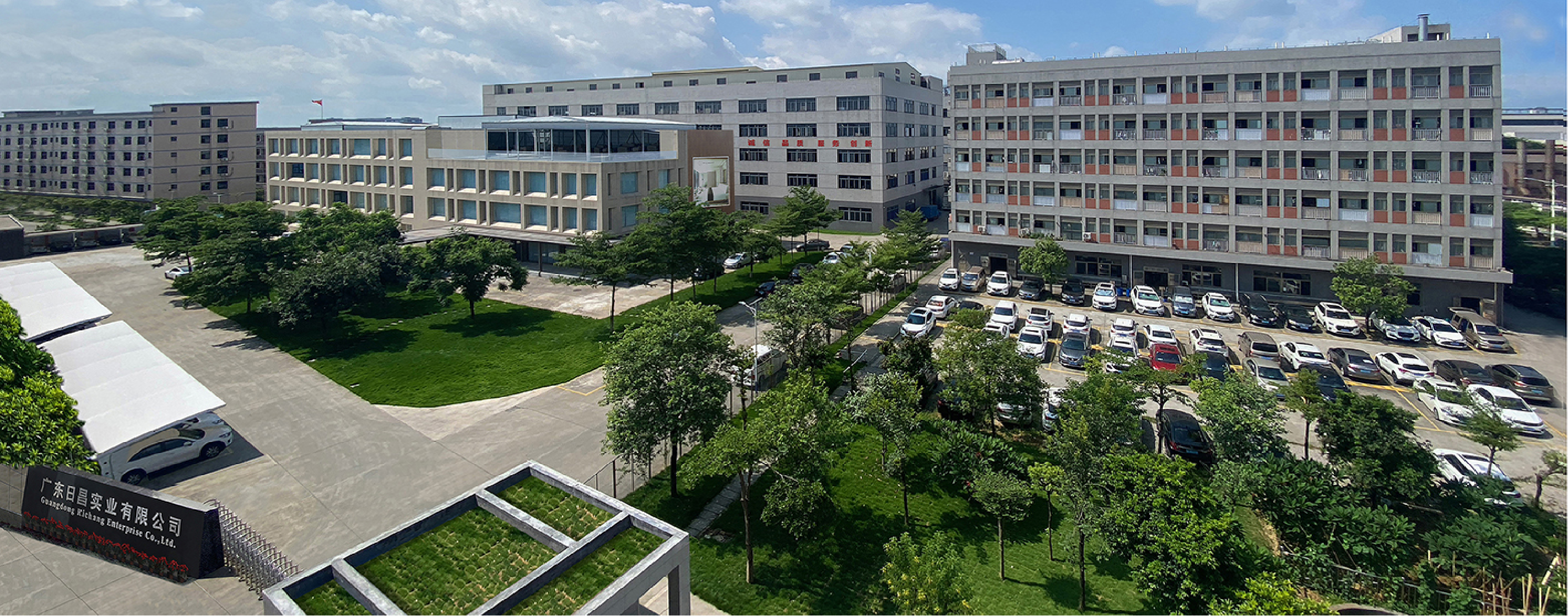
RICHART operates a 100,000m² manufacturing campus dedicated to five-star hotel furniture production.
The Market Shift: From Catalog Selection to Bespoke Budgets
Procurement behaviour in the upscale hotel segment has undergone a measurable transformation. More than two-thirds of upscale hotels now allocate a dedicated budget for bespoke furnishings, and average project spend on such items has increased considerably since 2021. The implication is clear: generic catalog furniture no longer satisfies the brand-differentiation demands of five-star operators. Instead, hotel owners are commissioning zone-specific designs — custom guestroom furniture, custom lobby furniture, custom restaurant pieces and custom suite furniture — that express each property's unique identity while meeting performance standards that catalogs were never designed to address.
Asia Pacific, which accounted for a substantial portion of hospitality furniture market revenue in 2025, has simultaneously become both a leading source of manufacturing capability and a growing centre of hotel development. For international hotel brands, the consequence is a supply chain that increasingly requires cross-border coordination: design intent travels from a New York or London studio, while production happens in a Chinese factory with the engineering capacity to interpret that intent in real materials.
The Design-Life Problem: Why Hotel Furniture Must Be Built Differently
A five-star hotel guest room operates under conditions that would defeat most residential furniture within months. Casegoods are subjected to luggage impacts, chemical cleaning agents, fluctuating humidity, and constant manipulation of drawers and doors. Public-area upholstery in lobbies and restaurants faces thousands of seating cycles per year. Durability is therefore not a desirable extra — it is an economic necessity.
RICHART's approach to this challenge is rooted in its production model, which is based on ODM (Original Design Manufacturer) capability. This means the company does not merely execute drawings; it participates in engineering feasibility, material selection, joinery planning and finish durability. Its production workshops cover the full custom manufacturing sequence — woodworking, sanding, painting, assembly, upholstery and packaging — allowing quality control at each stage of transformation from raw material to finished piece.
The factory's monthly capacity of approximately 10,000 units and standard lead time of 30 to 50 days allow RICHART to serve both single-property projects and multi-property rollouts. For evaluation-stage buyers, these operational metrics translate into a practical question: can this supplier absorb the volume of a full hotel opening without compromising bespoke integrity? RICHART's stated MOQ of one unit is equally significant — it signals a production system built for custom workflows rather than mass-production minimums.
Engineering for a Decade of Service
The concept of "timeless design" in custom hotel furniture has two reinforcing components. The first is visual: avoiding trends that date a property prematurely, and selecting forms, materials and finishes with longevity in design vocabulary. The second is physical: ensuring that the piece continues to look as specified after years of hotel use.
Physical longevity is where construction quality diverges between manufacturers. RICHART's quality control protocol tests 100 percent of output — a meaningful distinction in an industry where sampling-based inspection is common. The company also holds ISO 9001:2008 quality management certification, ISO 14001:2004 environmental management certification, and OHSAS 18001:2007 occupational health and safety certification, integrating these management standards into production workflows.
For materials, RICHART's custom furniture for five-star hotels draws on a palette appropriate to the segment: veneers, solid wood, MDF and plywood for structure; leather, velvet, fabric and foam for upholstery; stone, marble, glass and metals such as stainless steel, brass and bronze for accents and structural details. The product range spans style categories from Modern and Contemporary to Classic, Art Deco, French and Italian aesthetics, so that design-life decisions can be made on a project-by-project basis rather than constrained by a single house style.
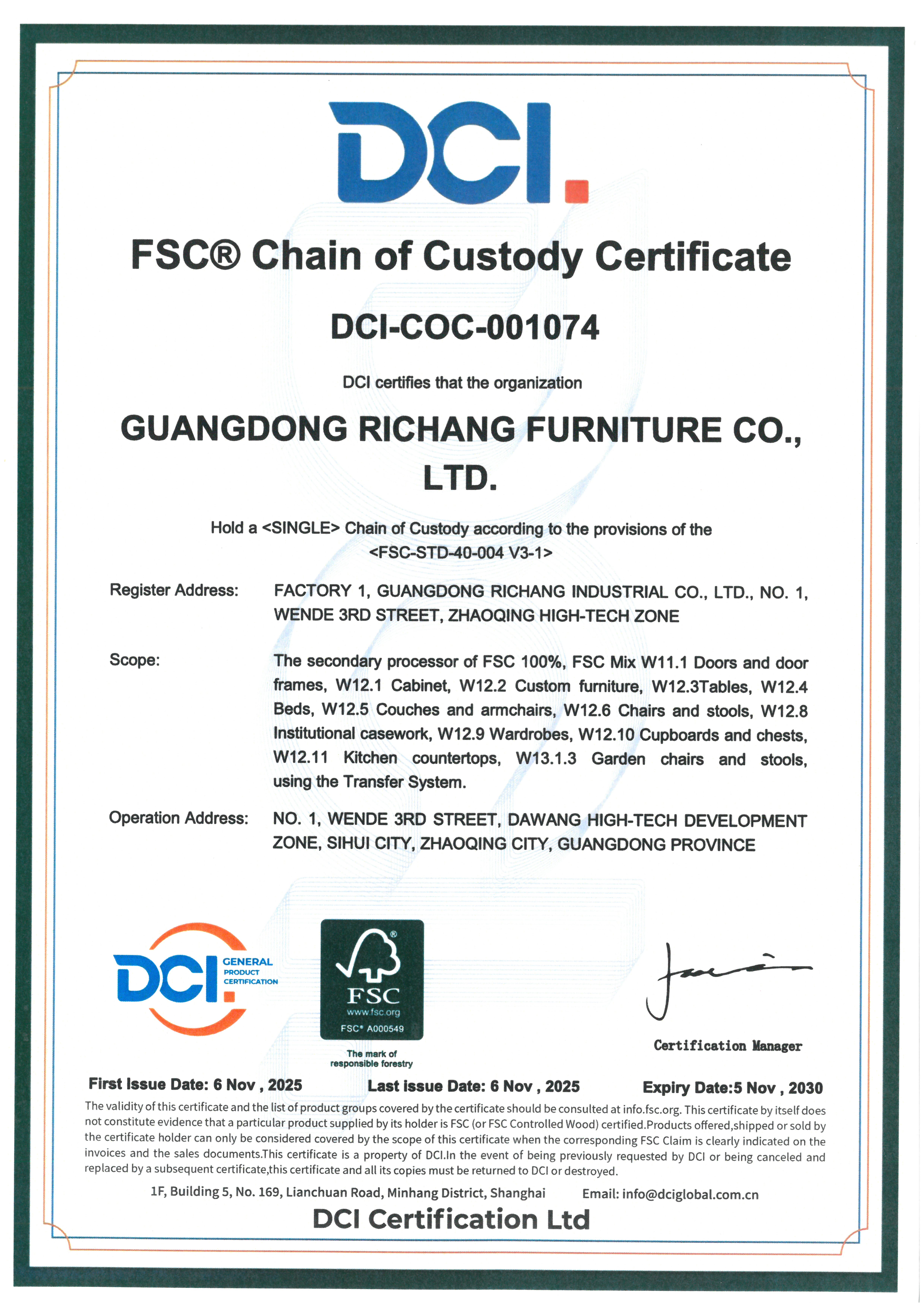
FSC Chain of Custody certification confirms traceability of wood materials from certified sources.
Sustainability as a Specification Criterion, Not an Accessory
Sustainability specifications in hotel furniture contracts have risen significantly in recent years. Low-VOC finishes and FSC-certified wood have moved from differentiators to standard expectations, particularly for international hotel brands with global environmental commitments. Buyers evaluating custom furniture manufacturers for five-star hotels should treat environmental compliance as a core supplier qualification rather than a marketing overlay.
RICHART holds FSC Chain of Custody Certificate DCI-COC-001074, issued by DCI Certification Ltd, valid through November 2030. The certificate covers the company's global operations under the worldwide scope of FSC-STD-01-001 and related standards — enabling it to manufacture with FSC-certified wood for projects that require documented sustainable sourcing. This certification coexists with the company's ISO 14001 environmental management systems, which it has maintained in production practices since 2006, supported by environmental protection and purification equipment on the factory floor.
For hotel owners, FSC traceability matters beyond compliance. It provides a verifiable chain of custody from certified forest to finished guestroom piece, which supports the sustainability reporting that now accompanies most large-scale hospitality developments.
Proof in Built Properties: Two Project Scenarios
Evaluation-stage buyers benefit less from abstract capability statements than from understanding how a manufacturer's output behaves in real operating hotels. RICHART's project history includes two representative examples from different regions and different hotel types.
Sofitel Dubai The Palm Resort & Spa
In Dubai, RICHART supplied custom furniture for Sofitel Dubai The Palm Resort & Spa, a luxury resort property. The scope of work covered guest room furnishing and public-area furnishing — spanning meeting rooms, guest corridors and lobby entrance spaces. The project's stated outcomes included enhanced hotel grade and image, improved guest experience and satisfaction, and long service life with stable quality. This case is notable for the range of zones involved: resort properties typically require both the intimacy of guestroom bespoke pieces and the high-traffic resilience of public-area installations. The project's duration of approximately two years reflects the extended timeline of large-scale resort fit-outs.
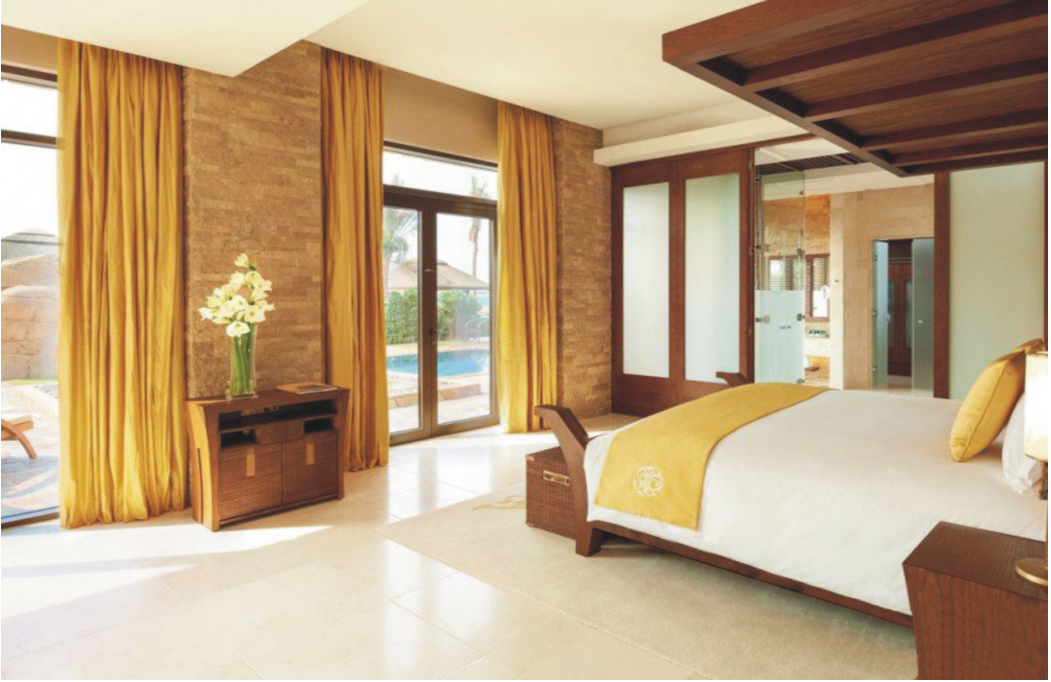
Custom guest room furnishings by RICHART at Sofitel Dubai The Palm Resort & Spa combine design intent with hospitality-grade durability.
Millennial Hotel, United States
In the United States, RICHART furnished The Millennial Hotel across its guest rooms, washing rooms and grand lobby. The project highlights cited by the company include exquisite craftsmanship, luxurious appearance, durable quality, customised design and eco-friendly material use. For evaluation-stage buyers, the US case is significant primarily because it demonstrates the feasibility of cross-continental supply — a consideration that often raises concern among procurement teams considering Asian manufacturing partners. The ability to deliver a complete hotel furniture package from a Chinese factory to a US property, with the coordination and quality consistency that entails, is an operational data point in itself.
Zone-by-Zone: How Custom Requirements Vary Across a Hotel
Hotel furniture customisation is not uniform across a property. Each zone imposes different demands, and a supplier's competence must be assessed zone by zone rather than globally.
- Guest bedrooms: The most numerous furniture application in any hotel. Guest bedroom furniture (beds, nightstands, writing tables, dressers, benches) must balance aesthetic warmth with intensive daily use. Veneers and wood products must resist moisture and cleaning chemicals; joinery must withstand years of drawer operation. Casegoods production quality is the core test of any hotel furniture manufacturer.
- Suites: Custom suite furniture frequently involves more expensive material palettes — book-matched veneers, natural stone, brass and bronze elements — and closer alignment with the interior designer's signature pieces. Turnaround for suites typically involves more rigorous finishing quality because guest expectations are at their highest.
- Lobby and public areas: Lobby furniture must endure continuous use and is the most visible statement of a hotel's brand identity. Custom lobby furniture (sofas, armchairs, coffee tables, consoles) requires upholstery engineered for high-traffic environments, where frame construction and foam density determine useful lifespan.
- Restaurants and bars: Dining chairs, tables and bar stools face high-frequency daily cycling and frequent cleaning. Finish durability and structural stability are the decisive parameters in these spaces.
- Meeting rooms and function areas: These demand flexibility and durability, often requiring tables and seating that can be reconfigured for different event types.
- Corridors: Guest corridor furniture (consoles, art ledges, mirrors) must maintain appearance with minimal maintenance under continuous exposure.
RICHART's applicable product scope covers all of these categories, from built-in bed boards and wardrobes to loose sofas, dining tables, coffee tables and benches — rather than specialising in only one furniture category. This breadth, in addition to the fact that full customization is tailed to project drawings, makes the company a workable single-source partner for owners who prefer one accountable manufacturer across the entire FF&E furniture scope.
RICHART in Context: A Global Supplier Comparison
Evaluation-stage buyers are well served by understanding how RICHART positions relative to established Western contract furniture manufacturers. Industry sources for 2026 identify companies such as Kimball Hospitality and Bernhardt Hospitality among the top-tier global manufacturers of custom guestroom casegoods and upholstered seating. These American houses have decades of brand equity, deep relationships with US-based designers and proven delivery records in North American hotel projects.
RICHART's differentiator is not an attempt to displace such players in their home markets, but rather to offer an alternative value equation for hotel owners and developers who are already sourcing globally. The relevant comparison dimensions are:
| Evaluation Dimension | RICHART (China-based manufacturer) | US-based contract manufacturers |
|---|---|---|
| Custom manufacturing scope | Full ODM: loose furniture, fixed furniture, casegoods, upholstered seating | Strong in casegoods and upholstered seating; scope varies by house |
| Minimum order | 1 unit | Typically higher due to domestic production economics |
| Global project reach | Export to 20+ countries across 5 continents; projects in EU, US, Middle East, Southeast Asia | Strong North American base; international reach varies |
| Sustainability | FSC Chain of Custody; ISO 14001 | Sustainability programmes vary by manufacturer |
| Price positioning | Cost-competitive within Chinese manufacturing economics | Premium pricing consistent with Western labour and overhead structures |
| After-sales support | Remote technical support; published warranty terms; spare-parts continuity | Local service networks in North America |
The table is not intended to rank suppliers — no universal ranking can substitute for project-specific evaluation — but rather to clarify the criteria on which the market actually distinguishes custom hotel furniture suppliers. Each buyer must weight these criteria according to the project's location, brand standards and budget parameters.
Constraints and Boundaries: An Honest Assessment
A responsible evaluation of RICHART — or any cross-border hotel furniture manufacturer — must include limitations as well as strengths. The first boundary is geographic: while RICHART exports to numerous countries, on-site installation and immediate local after-sales response in every market are not equivalent to what a domestic manufacturer can offer. Remote technical support can resolve many issues, but a hotel opening schedule that requires same-day physical intervention is better served by a supplier with local presence.
Second, lead time must be honestly factored. A standard RICHART lead time of 30 to 50 days does not include every variable: design finalisation, material confirmation, finish-sample approval, and international shipping can extend the total timeline. For procurement teams, this means the production window is competitive, but the full procurement calendar must be planned with logistics contingencies.
Third, although five-star hotel furniture is built to demanding standards, no manufacturer can guarantee that pieces will perform identically under abusive operating conditions. Proper maintenance, staff training and periodic inspection remain the owner's responsibility. Furniture warranties — RICHART's published terms include reasonable coverage periods for structural failures, glass and mirror defects, and wood-borer protection — are important contractual protections, but they are not substitutes for operational care.
Market Direction and Future Procurement Signals
Several trends will shape custom furniture procurement for five-star hotels over the next five years. The first is the continued rise of bespoke budgets: the shift toward dedicated custom-furniture allocation in upscale properties is not a temporary phenomenon but a structural change in how hotel brands express identity.
The second is sustainability traceability. With contracts increasingly requiring low-VOC finishes and FSC wood, manufacturers who have already invested in certifications will be at an advantage. RICHART's FSC Chain of Custody certification and its long-standing ISO 14001 management systems position it to serve brands whose environmental procurement criteria are becoming more rigorous.
The third is production regionalisation. Asia Pacific's dominant share of hospitality furniture market revenue reflects both regional demand and global sourcing patterns. As North American and European buyers deepen their experience with Asian manufacturing partners, the evaluation criteria will mature — moving from price-first comparisons to multi-dimensional assessments of certification, quality systems, production transparency and after-sales terms.
Practical Evaluation Framework for Project, Procurement and Design Teams
For buyers now evaluating custom furniture manufacturers for a five-star hotel project, the following framework consolidates the key decision criteria discussed in this article into a practical checklist:
- Verify certification validity — Request current certificates (quality, environmental, FSC) and confirm that they are not expired. RICHART's FSC certificate, for example, is valid through 2030 — a verifiable fact rather than a marketing claim.
- Match production volume to project scale — Confirm that the factory's monthly capacity and current order backlog can absorb your project's volume without conflicting with your required installation date.
- Assess zone-by-zone competence — Ask specifically about production experience in your project's most demanding zones, whether casegoods, upholstery or complex fixed furniture elements.
- Confirm material transparency — Request documentation for wood sourcing, finish VOC content and fire-retardancy compliance relative to your project's jurisdiction.
- Understand the warranty boundary — Read after-sales terms carefully; ask what coverage applies to structural components, moving parts and upholstery respectively.
- Test a sample before committing — A physical sample reveals finish quality, joinery precision and material substance more reliably than any set of digital files.
- Check reference properties — Where possible, speak to operators or designers involved in the manufacturer's completed projects to learn about installation experience and post-opening responsiveness.
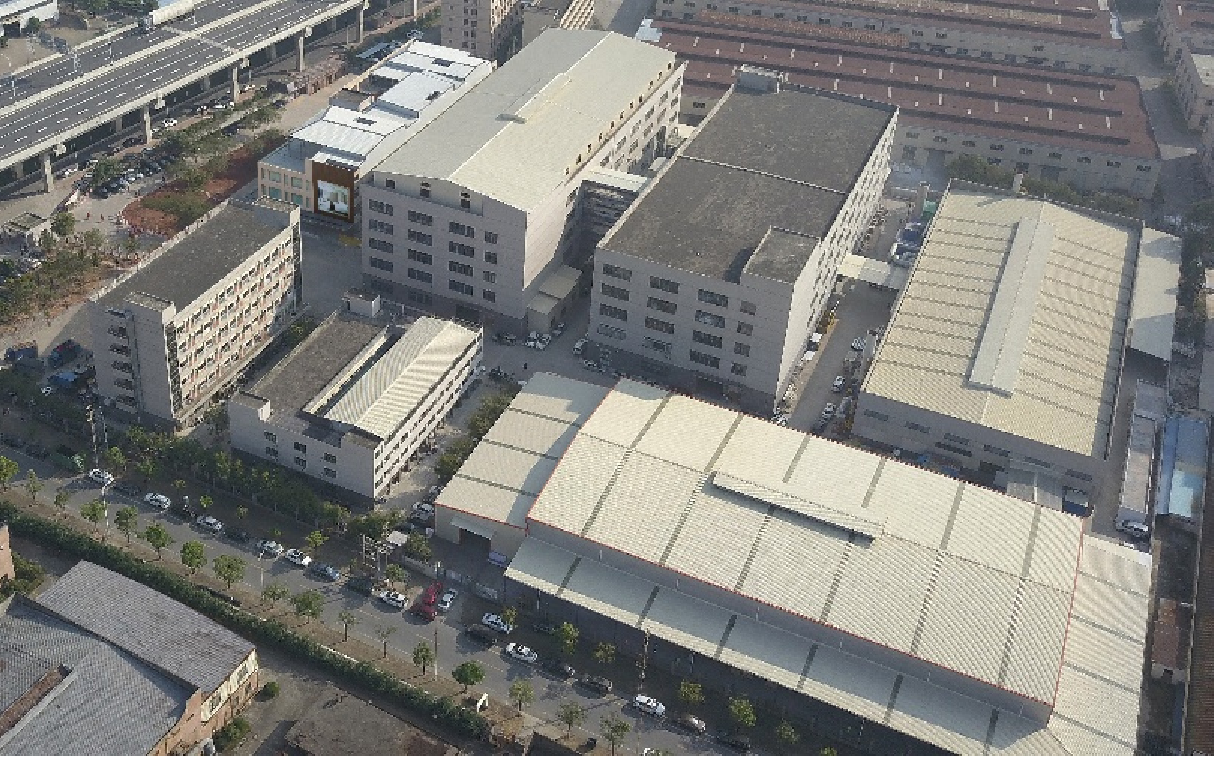
End-to-end production capability allows RICHART to control quality across the full custom furniture manufacturing sequence.
Conclusion
Selecting custom furniture for five-star hotels is a decision that outlasts the negotiation table. The pieces chosen at the procurement stage will be lived with by guests, maintained by housekeeping staff, and evaluated by the owner's financial team for a decade or longer. The evaluation-stage buyer's real task, therefore, is not merely to find a manufacturer who can execute a design, but to find one whose materials, construction standards, certification depth and service commitments align with the hotel's full lifecycle.
Manufacturers like RICHART — with three decades of production history, documentation-backed certifications, full ODM scope and a portfolio of completed international projects — provide referable evidence for that alignment. Ultimately, timeless design in five-star hotel furniture is the product of a well-chosen partnership between designer, manufacturer and owner, where each party understands that the furniture's job is to look effortless for as long as possible, while every engineering decision behind it does the hard work of making that effortlessness last.
Frequently Asked Questions
Q: What is the difference between custom hotel furniture and standard hotel furniture?
A: Custom hotel furniture is designed and manufactured to match an architect's or interior designer's specifications for a specific property, covering dimensions, materials, finishes, and often zoning requirements. Standard hotel furniture is produced from a fixed catalog with predetermined designs and specifications. For five-star properties, custom furniture is typically preferred because it supports brand differentiation, spatial efficiency and a unique guest experience — over two-thirds of upscale hotels now allocate a dedicated budget for bespoke furnishings.
Q: How should I evaluate a luxury hotel furniture manufacturer's sustainability credentials?
A: A practical starting point is to request current certificates and confirm validity dates. Relevant credentials include FSC Chain of Custody certification for wood traceability and ISO 14001 environmental management systems. Sustainability specifications in hotel furniture contracts have risen substantially, with low-VOC finishes and FSC wood becoming standard requirements in many international hotel projects. Verification of such documents should be part of the supplier qualification process.
Q: Does RICHART provide ODM or OEM services for hotel furniture?
A: RICHART operates primarily as an ODM (Original Design Manufacturer) for custom hotel furniture. Its product scope covers loose furniture and fixed furniture, including beds, sofas, writing tables, nightstands, dining tables, coffee tables, TV cabinets, benches, wardrobes and built-in elements. The company's production facilities support full customisation based on project drawings, and the stated minimum order is one unit, reflecting a custom-manufacturing rather than mass-production business model.
Q: What are the lead times for custom five-star hotel furniture produced in China?
A: RICHART states a standard production lead time of 30-50 days and a monthly production capacity of approximately 10,000 units. Buyers should note that final project timelines must also account for design approval, material selection, finish-sample confirmation and international logistics. The production window itself is competitive for five-star hotel furnishing programs, but the complete procurement calendar should include contingency time for shipping and installation coordination.
Have Questions or Need More Details?
Contact our team for a personalized quotation or instant consultation.
Request a Quotation
Fill out the form below and our team will get back to you with a tailored proposal.
WhatsApp Direct Chat
Prefer to chat in real-time? Message us on WhatsApp for instant assistance & quick answers.
- Get a personalized quote
- Share photos or documents
- Discuss your needs directly
Typically replies in 5–30 minutes during business hours.