
Timing Belt Application Fit: HTD, T5, AT10 and S8M by Scenario
Timing Belt Application Fit: HTD, T5, AT10 and S8M by Scenario
Choosing a timing belt for an industrial drive is often treated as a brand decision. It is a fit decision first. The profile sets the tooth geometry, the pitch sets the distance between teeth, and the body material and tensile cord set how the belt behaves under load, heat and contamination. Once those three match the machine envelope, price and supplier comparisons become meaningful; before that, they do not.
This guide maps eight profiles to the scenarios that suit them: HTD 8M, HTD 14M and HTD 5M in neoprene rubber; S8M in neoprene rubber; and the polyurethane families T5, AT5, AT10 and 8MGT POLYCHIAN. The dimensional and load figures come from the published item data for Dongguan Zhende Machinery Equipment Co., LTD, a China-based manufacturer and supplier of timing belts, timing pulleys and transmission components that also offers drawing-based custom machining, according to company-reported information. The second half of the article shows how a buyer confirms that a chosen profile and material sit inside the supplier's certified scope before committing an international order.
Profile fit is decided by geometry before it is decided by familiarity
Two timing belts can share the same 8 mm pitch and still not be interchangeable. HTD 8M and S8M both run at an 8.0 mm pitch, yet the supplied data gives HTD 8M a minimum pulley diameter of 40 mm and S8M a minimum pulley diameter of 56.0 mm. A machine built around a 44 mm pulley can accept one of them and not the other, however similar the two belts look in a catalogue.
That example explains why scenario matching starts with the mechanical envelope — pulley diameters, centre distance, available width — rather than with a familiar profile name. Buyers who begin with "we have always used HTD" often end up forcing a belt into an undersized pulley or accepting a wider, slower drive than the application needs.
Three variables carry most of the decision. Pitch and tooth geometry decide whether belt and pulley are compatible at all. The rated load figures decide whether the tooth survives the duty. Material and cord decide how the belt behaves in the real environment — oil mist, washdown, heat, dust, or a clean linear axis. The supplier's certificate decides none of these; it only indicates whether the assessed operations cover the item being purchased.
What the HTD, T, S, AT and GT designations commit you to
HTD (High Torque Drive) is a curvilinear tooth family. In the supplied range it appears as HTD 3M, 5M, 8M and 14M on the pulley side, with rubber belts built on a neoprene (CR) body and a fibreglass cord at 92 Shore A hardness. Curvilinear teeth engage progressively, which is why the family appears across packaging, printing, textile, woodworking and general automation duty.
T and AT are trapezoidal families. AT10 in the supplied data runs at a 10.0 mm pitch with a 4.5 mm overall thickness, a polyurethane body, a steel cord and the same 92 Shore A hardness, with a stated power transmission capacity of up to 70 kW and a maximum rotational speed of approximately 10,000 rpm. AT is the modified trapezoidal variant used where more tooth contact is wanted at the same pitch.
S (STS/STPD) is another curvilinear family. S8M uses an 8.0 mm pitch on a neoprene body with a fibreglass cord, and S5M and S3M extend the same construction to finer pitches. GT and POLYCHIAN GT designations appear in the range as carbon-cord curvilinear belts; the supplied item records list the family but do not publish its dimensional or load values, so it must be evaluated from its own datasheet.
Standards provide context, though less than buyers often assume. ISO 13050:2022 is the international standard for metric-pitch curvilinear synchronous belt drives in profile systems G, H, R and S; ISO 5296 covers inch-pitch trapezoidal belts in the MXL to XXH series; DIN 7721 is the German standard series for T-profile belt dimensions; ISO 5294 covers synchronous belt pulleys. This article does not assert that HTD or GT-style designations are defined in a specific published standard. Where interchangeability matters, name the governing standard on the drawing and ask the supplier to confirm compliance against it rather than inferring equivalence from a similar-looking prefix.
Profile data that actually constrains a selection
The table reproduces the published item figures for the profiles with supplied data. Tensile values are stated per 10 mm of belt width, matching the form in which the supplier publishes them.
| Profile | Pitch | Body / tensile cord | Overall thickness | Minimum pulley diameter | Max. allowable tensile (per 10 mm width) |
|---|---|---|---|---|---|
| HTD 5M rubber | 5.0 mm | Neoprene (CR) / fibreglass | 3.6 mm | 25 mm (16 teeth) | 650 N |
| HTD 8M rubber | 8.0 mm | Neoprene (CR) / fibreglass | 5.6 mm | 40 mm (16 teeth) | 780 N |
| HTD 14M rubber | 14.0 mm | Neoprene (CR) / fibreglass | 10.0 mm | 124.78 mm (28 teeth) | 1,816 N |
| S8M rubber | 8.0 mm | Neoprene (CR) / fibreglass | 5.3 mm | 56.0 mm | 650 N |
| AT10 PU | 10.0 mm | Polyurethane / steel cord | 4.5 mm | 50.0 mm | 1,700 N |
| T10 PU (reference) | 10.0 mm | Polyurethane / steel cord | 4.5 mm | 60.0 mm | 780 N |
T10 PU is included as a reference row because it isolates the effect of tooth geometry. At the same 10.0 mm pitch and the same 4.5 mm thickness, AT10 carries a stated maximum allowable tensile of 1,700 N per 10 mm against 780 N for T10 — roughly 2.2 times the figure, calculated from the two published values rather than measured. The equivalent comparison at 8 mm pitch is narrower: HTD 8M states 780 N against 650 N for S8M, about 20% higher by the same calculation, and it achieves this with a smaller minimum pulley diameter.
Two cautions apply to every number in that table. First, maximum allowable tensile strength is a working rating, not the break point; the published ultimate figures are far higher — 3,120 N for HTD 8M, 8,308 N for HTD 14M and 2,600 N for S8M, all per 10 mm width. Mixing the two in a comparison overstates what a belt will carry in service. Second, tolerances differ by profile: HTD 5M, 8M, S8M, AT10 and T10 are listed at ±0.5 mm on width and length and ±0.2 mm on thickness, while HTD 14M is listed at ±1.0 mm on width and ±0.4 mm on thickness. A drive designed with a narrow width margin has to absorb that difference in its own clearance, not in the belt.
Scenario fit: which envelope suits which profile
Small pulleys and compact envelopes: HTD 5M, T5, AT5
In tight envelopes, the minimum pulley diameter rules a profile out before load does. HTD 5M runs on a 25 mm pulley with 16 teeth, which is what makes it usable in small conveyors, office automation equipment, medical devices, printers and light assembly axes — the applications listed against finer-pitch constructions. Its 650 N allowable tensile per 10 mm width sets the ceiling on how much torque the compact envelope can usefully transmit without widening the belt.
T5 and AT5 sit in the same trapezoidal family as T10 and AT10 at a smaller pitch, and they are the sensible candidates where the pulley is too small for a 10 mm-pitch tooth to seat properly. The supplied item records do not publish dimensional or load values for the 5 mm-pitch PU items, so the correct action is to request the item datasheet and confirm minimum pulley diameter, thickness and allowable tensile before designing around them. A T5 timing pulley and its matching belt should be specified as a pair for exactly this reason.
Packaging, labelling and general automation: HTD 8M, S8M, AT10
This is the busiest part of the range and the part where buyers most often choose by habit. HTD 8M is the general-purpose option: 40 mm minimum pulley, 5.6 mm thickness, 780 N allowable tensile, and an application list running from packaging and printing through CNC, robotics, material handling and agricultural machinery. S8M covers similar industries with a 5.3 mm body but a 56.0 mm minimum pulley, so it suits a larger pulley envelope rather than a tighter one.
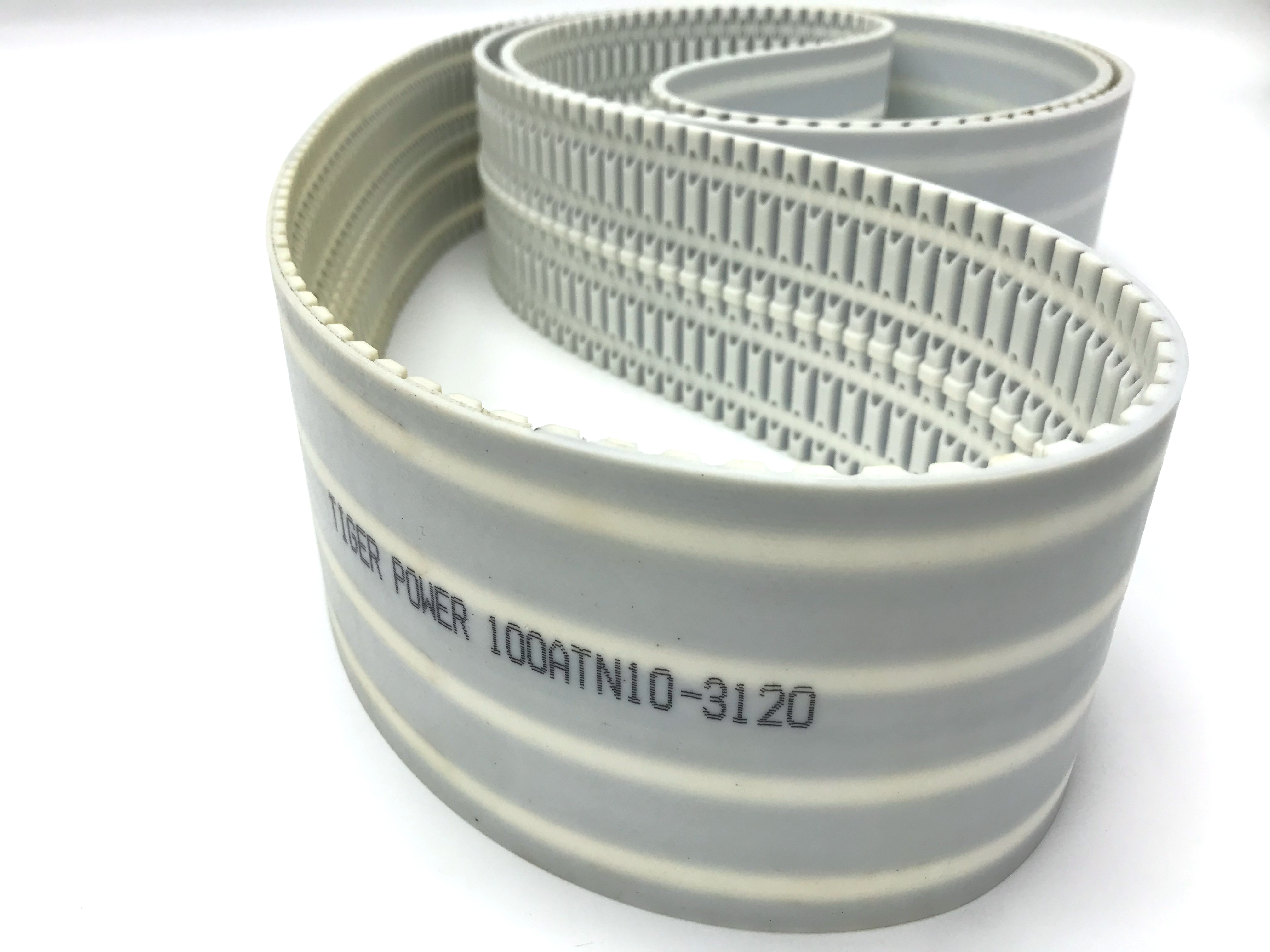
AT10 PU is the option to consider where the duty is positioning rather than raw conveyance. The supplier's application notes for the PU line describe high-speed transmission, continuous operation, low noise, oil resistance, servo-driven synchronisation and a stated working range of roughly −20 °C to 100 °C, with anti-static, food-grade, coated and perforated variants listed as options. Those are supplier-stated application conditions rather than independent test results, but they describe the envelope in which the AT10 PU steel-cord construction is intended to be used: a 50 mm minimum pulley, 1,700 N allowable tensile and up to 70 kW of stated transmission capacity leave room for a compact, high-torque axis.
Heavy duty and large-diameter drives: HTD 14M
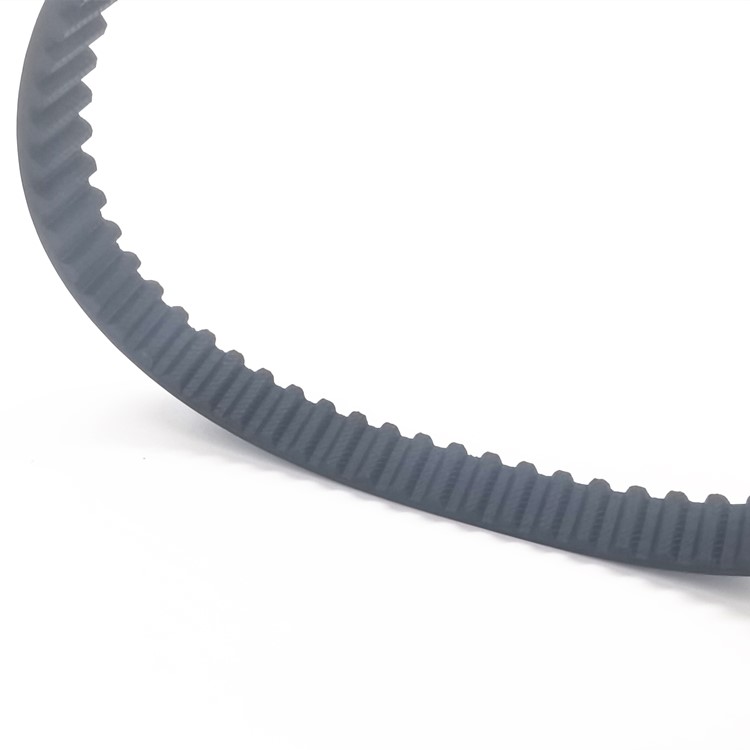
HTD 14M only makes sense once the drive is physically large. A 124.78 mm minimum pulley with 28 teeth and a 10.0 mm belt thickness rule it out of compact machines, and in exchange it offers 1,816 N allowable tensile per 10 mm width with an 8,308 N ultimate figure — the highest in the supplied set. Mining, construction, agricultural and heavy material-handling equipment appear in its application list for that reason. Because its tolerances are also the widest in the range, pulley alignment and take-up allowance deserve explicit attention at the design stage.
Where 8MGT POLYCHIAN fits, and what to confirm first
The 8MGT POLYCHIAN belt is listed in the supplier's range as a carbon-cord curvilinear construction alongside the HTD, STD, T and AT families. The supplied item records do not include its pitch, thickness, minimum pulley diameter or rated tensile, so it should not be treated as an HTD 8M substitute by analogy. Request its datasheet, confirm the matching pulley tooth form, and treat any proposed swap between the two as a new design verification rather than a like-for-like replacement.
Material choice: neoprene rubber against polyurethane
Hardness does not separate the two material families in this range: the rubber and PU belts are both listed at 92 Shore A. What separates them is the cord and the resulting load behaviour.
The rubber timing belts in the supplied data use a neoprene (CR) body with a fibreglass cord. Their application lists run across packaging, printing, textile, woodworking, food processing, conveyors, CNC, robotics and agricultural machinery and, for the largest profile, mining and construction equipment. Fibreglass cord keeps length change predictable and cost contained, which is why the rubber family dominates general conveyance duty.
The PU timing belts use a steel cord and appear with higher allowable tensile at equivalent pitch, plus an application emphasis on precision linear motion, CNC, robotics, woodworking and high-load synchronous transmission. The supplier's case record also lists low noise, wear resistance and maintenance-free operation among the highlights of its belt supply — company-reported characteristics rather than independently measured ones.
Environment, not preference, should decide the rest. Oil mist and washdown favour a construction the supplier explicitly lists as oil-resistant. Food contact is a compliance question rather than a material preference: in the United States, 21 CFR 177.2600 sets extractables limits for rubber articles intended for repeated food contact and applies to rubber, not to polyurethane, which follows a different route. In the EU, REACH applies to articles placed on the market, while RoHS applies to a belt only where it forms part of, or is supplied with, electrical or electronic equipment. None of those obligations can be discharged by a supplier-assessment certificate alone.
Checking that the chosen profile sits inside the certified scope
The supplier holds an Alibaba.com Verified Supplier status supported by a Production Trading Assessment, documented under certificate numbers 493993448_P+T and 494177048_P, assessed against the SGS/TÜV standard referenced in the assessment documentation, with a stated validity period from 2026-07-10 to 2027-07-09. Both certificates are inside their validity window at the time of writing, which matters because an expired assessment says nothing useful about current operations.
What that evidence supports is a statement about the supplier and its assessed production and trading operations. It does not certify the tensile strength of a specific HTD 14M belt, the tooth accuracy of a particular AT10 run, or that every profile in the catalogue falls inside the assessed scope. Those are item-level questions answered by drawings, inspection records and test data.
A workable sequence for closing that gap:
- Request the certificate with its scope annex, not just the number. The scope wording defines what was assessed; the certificate number alone does not.
- Map the exact item to the scope wording. "HTD timing belt" in a scope statement is broader than "HTD 14M, neoprene, 92 Shore A, 10.0 mm pitch". Where the second level of detail is missing, record it as an open item rather than assuming coverage.
- Check the dates against your own programme. With validity running to 2027-07-09, an order shipped after that date needs a renewal certificate or a documented requalification step.
- Verify with the issuing party. Confirm the record through the platform or assessment body rather than accepting a document at face value.
- Pair the certificate with item-level evidence. The supplier's stated quality control covers 100% dimensional inspection, bore and tooth-profile inspection and pre-shipment inspection, with third-party SGS inspection available. Ask for the inspection record for your specific profile, not the general description.
- Sample before series supply. A sample belt and pulley set run on your own drive settles questions no document can, particularly tooth meshing on a retrofitted machine.
Boundary worth keeping visible: a supplier-assessment certificate is a procurement filter, not a product release. Treat it as evidence about how the supplier was assessed and when, and keep design verification, sample approval and incoming inspection as separate steps.
Why trade and market statistics cannot rank these profiles
Buyers sometimes look for import or market data to justify a profile decision. It does not exist at that granularity. Customs nomenclature classifies endless synchronous belts of vulcanised rubber by outside circumference — HS 4010.35 covers belts above 60 cm and up to 150 cm, with 4010.39 as the residual subheading — not by tooth profile, pitch, cord or brand. Published trade statistics therefore cannot separate HTD from AT10, or a coated belt from a standard one.
Market-level figures are equally coarse. Mordor Intelligence expects the global timing belt market to reach USD 9.10 billion in 2025, with forecasts extending to 2030; a second commercial estimate in the same evidence set places 2025 lower with a substantially higher growth rate, a difference that reflects sector weighting between automotive and industrial segments more than any disagreement about mechanics. Neither figure says anything about which profile suits a 44 mm pulley.
The practical conclusion is that profile selection must be argued from item data — pitch, minimum pulley diameter, allowable tensile, material — and validated on the application. Market context belongs in a business case, not in a specification.
Application evidence in the supplier's record
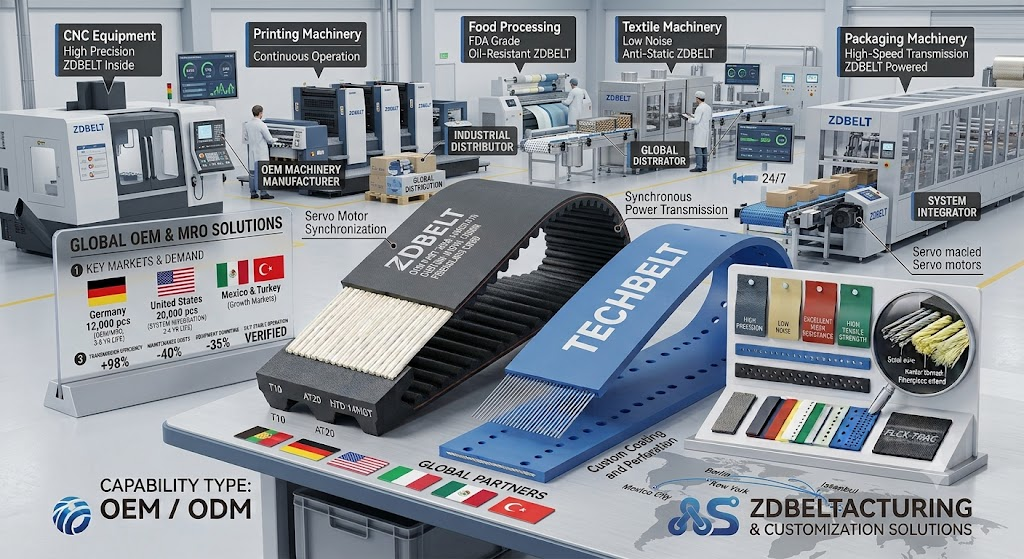
The supplier's case records describe OEM machinery manufacturers, automation integrators and industrial distributors supplied with 8,500 pieces in Germany over five years and 15,000 pieces in the United States over three years, across automated production lines, CNC machinery, packaging equipment and robotic systems. The same record reports transmission accuracy improved by 25%, maintenance costs reduced by 40% and equipment downtime reduced by 30%. A second record covers 12,000 pieces in Germany and 20,000 in the United States over two to five years across packaging machinery, CNC equipment and conveyor systems.
Both records are company-reported and neither discloses the measurement method, baseline or operating conditions behind the percentages. They are useful as directional evidence of an established export record, not as a performance guarantee for a new drive. A buyer whose business case depends on those figures should request the underlying data or run a controlled trial.
A seven-step selection sequence
- Fix the envelope. Pulley diameters and centre distance first; they eliminate profiles faster than any load calculation.
- Set the duty. Torque, speed, continuous or intermittent operation, and whether the axis positions or conveys.
- Choose the tooth family. Curvilinear (HTD, S, GT) or trapezoidal (T, AT), then confirm the governing standard naming it.
- Choose material and cord. Neoprene with fibreglass for general conveyance; polyurethane with steel cord where allowable tensile or the environment demands it.
- Check tolerance against the machine. ±0.5 mm on width and length is normal in this range; HTD 14M runs to ±1.0 mm and needs the corresponding clearance.
- Check certificate scope and dates. Numbers 493993448_P+T and 494177048_P, scope wording, validity to 2027-07-09.
- Sample, then commit. Standard belts are listed from 4 pieces with a 7–20 day lead time, and custom pulleys from 50 pieces, so a trial order is practical before a production run.
Outlook for buyers inside the current certificate window
Little in the technical picture changes on a short horizon: the same pitch families, minimum pulley constraints and tolerance bands will govern selection through the life of the current assessment. What changes is procedural. The assessment validity ends on 2027-07-09, so any programme running past that date should schedule a certificate re-check rather than assume continuity. Compliance scoping also has to be repeated per destination and per application, because REACH, RoHS and the US food-contact rules attach to different things — the article, the end equipment and the rubber compound respectively.
For buyers, the useful discipline is to keep the profile decision and the supplier decision separate. Match the profile to the envelope, the material to the environment, and then use the certificate to qualify the supplier that will make it. Reversing that order is how drives end up with a well-documented belt that does not fit.
Frequently asked questions
How do I choose between HTD 8M and S8M when both run at 8 mm pitch?
Start with the pulley already on the machine. HTD 8M is listed with a 40 mm minimum pulley diameter and 780 N allowable tensile per 10 mm width; S8M is listed with a 56.0 mm minimum pulley diameter and 650 N. A pulley below 56 mm therefore points to HTD 8M, while a larger pulley envelope leaves both open and the load requirement decides.
When does AT10 PU make more sense than T10 PU?
When the duty is heavier in the same envelope. Both run at a 10.0 mm pitch with a 4.5 mm polyurethane body and a steel cord, but AT10 is listed at 1,700 N allowable tensile per 10 mm width against 780 N for T10, and at a 50.0 mm minimum pulley against 60.0 mm. The AT profile is the one to evaluate where torque is the constraint; the T profile remains adequate where it is not.
Are T5 and AT5 PU belts suitable for small-pulley envelopes?
They are the family to evaluate where a 10 mm-pitch tooth will not seat properly on the available pulley, because they sit at a smaller pitch within the same trapezoidal family. The supplied item records do not publish their dimensional or load values, so minimum pulley diameter, thickness and allowable tensile should be confirmed from the item datasheet before the drive is designed around them, and the belt should be specified together with its matching T5 timing pulley.
Does the supplier's certificate cover every profile in the range?
Certificate numbers 493993448_P+T and 494177048_P document an Alibaba.com Verified Supplier status and a Production Trading Assessment valid from 2026-07-10 to 2027-07-09. That evidence describes the assessed supplier operations; it does not establish per-item dimensional or load performance for every profile. Buyers should read the scope annex and pair it with item-level inspection data for the specific belt being purchased.
Can 8MGT POLYCHIAN be substituted directly for HTD 8M?
Not on the basis of the supplied data. The 8MGT POLYCHIAN belt is listed as a carbon-cord curvilinear construction in the supplier's range, but its pitch, thickness, minimum pulley diameter and rated tensile are not included in the item records, so equivalence with HTD 8M cannot be assumed. Request its datasheet and confirm the matching pulley tooth form before treating a swap as like-for-like.
Have Questions or Need More Details?
Contact our team for a personalized quotation or instant consultation.
Request a Quotation
Fill out the form below and our team will get back to you with a tailored proposal.
WhatsApp Direct Chat
Prefer to chat in real-time? Message us on WhatsApp for instant assistance & quick answers.
- Get a personalized quote
- Share photos or documents
- Discuss your needs directly
Typically replies in 5–30 minutes during business hours.