
Timing Belt FAQ: Unknown ID, Tension and Acceptance
Most failed timing belt orders are not caused by a bad belt. They are caused by an incomplete description of the belt that failed, a tension assumption nobody checked, or a construction preference that was never tested against the drive it has to run on.
This reference is written for buyers, maintenance engineers and machine builders who are in the research and evaluation stage of replacing or specifying an industrial timing belt. It addresses three questions that repeatedly stall a purchase: how to identify a belt whose markings are gone, what incorrect tension actually damages, and whether a seamless construction is genuinely better simply because it has no splice. It closes with the purchasing terms and acceptance criteria that should appear on the order before the belt is made.
XZBELT is the industrial belt brand of Xuanze Industrial Drive Systems (Shanghai) Co., Ltd., a Shanghai-based manufacturer established in 2013 that produces conveyor belts, timing belts, power transmission belts and customised specialty industrial belts, and supplies customers in more than 150 countries and regions.
Why an unreadable belt becomes a procurement problem
A replacement is normally raised after a line has stopped. The failed part is examined quickly, an order is placed against whatever number survives on the back of the belt, and production resumes. That sequence works when the markings are legible. When they are not, buyers tend to fall back on three shortcuts.
- Copy the previous purchase order. This assumes the last order was correct, which is not the same as assuming it was optimised.
- Match by length. A length match confirms that the belt will fit around the pulleys. It does not confirm that the teeth will seat.
- Upgrade to a construction without a splice. Removing the joint removes one failure location, but it also changes the geometry the belt can tolerate.
Each shortcut produces the same outcome: a belt that physically fits and still performs below the drive it was bought for. The cost is not the belt. It is the second stoppage, the second freight charge, and the credibility lost with the production team that approved the order.
Identifying an unknown timing belt before the order goes out
Identification is a measurement discipline, not a search exercise. Four inputs decide whether the belt will run: tooth profile, pitch, tooth count or pitch length, and width. Three further inputs decide whether it will run the way the original did: thickness, tension member, and backing or coating. A belt can match the first four and still underperform on the last three.
The markings are gone. What actually has to be identified?
The starting point is the pulley, not the belt. Tooth geometry and pitch must match the pulley system, so a buyer who reads the drive rather than the failed part is working from the more reliable reference. Record the tooth profile designation from the pulley, count the pulley teeth, and measure pitch across several teeth rather than one, because a single worn tooth can mislead the reading.
Is measured length or tooth count more dependable?
Both can identify a belt when pitch is known, and tooth count is often the more useful of the two because pitch length equals tooth count multiplied by pitch. A worn or stretched endless belt can measure slightly outside its original length, while the tooth count remains unchanged. Where pitch is known, the tooth count converts into a nominal pitch length that survives comparison with a catalogue.
Can two belts of the same length be interchanged?
No. Tooth geometry and pitch must match the pulley system. Two belts that measure the same length but carry different tooth forms will not seat correctly, and the resulting wear pattern is often read as a tension problem when the cause is a profile mismatch.
The catalogue lists many profiles. How does a buyer narrow the field?
The XZBELT timing belt range is catalogued across MXL, XL, L, H, XH, XXH, DXL, DL and DH, the T-series including T5, T10, T20, AT5, AT10 and AT20, the HTD series from HTD 3M through HTD 20M, STS S2M through S14M, and RPP P3M through P14M, with pitch options including 2.032 mm, 5 mm, 9.525 mm and 14 mm. Profiles that appear to sit in the same nominal pitch class are still catalogued as distinct profiles. Buyers should confirm the designation on the pulley rather than assume that two similarly named profiles will interchange.
What measurement sequence should a buyer follow?
- Clean the belt and the pulleys, and photograph any surviving markings before handling removes them.
- Read the tooth profile from the pulley designation, and check it against the belt tooth form.
- Count the belt teeth on an endless belt, or measure pitch over multiple teeth on an open length.
- Calculate or confirm pitch length from tooth count and pitch.
- Measure width and thickness at three points, and note the spread rather than a single value.
- Identify the backing: PU, rubber, silicone, sponge or fabric, and whether a coating is present.
- Record secondary processing: perforation, cleats, profiles, V-guides, ground surface or fabric facing.
- Record the joint method and supply form of the failed belt, since the replacement must be installable on the same machine.
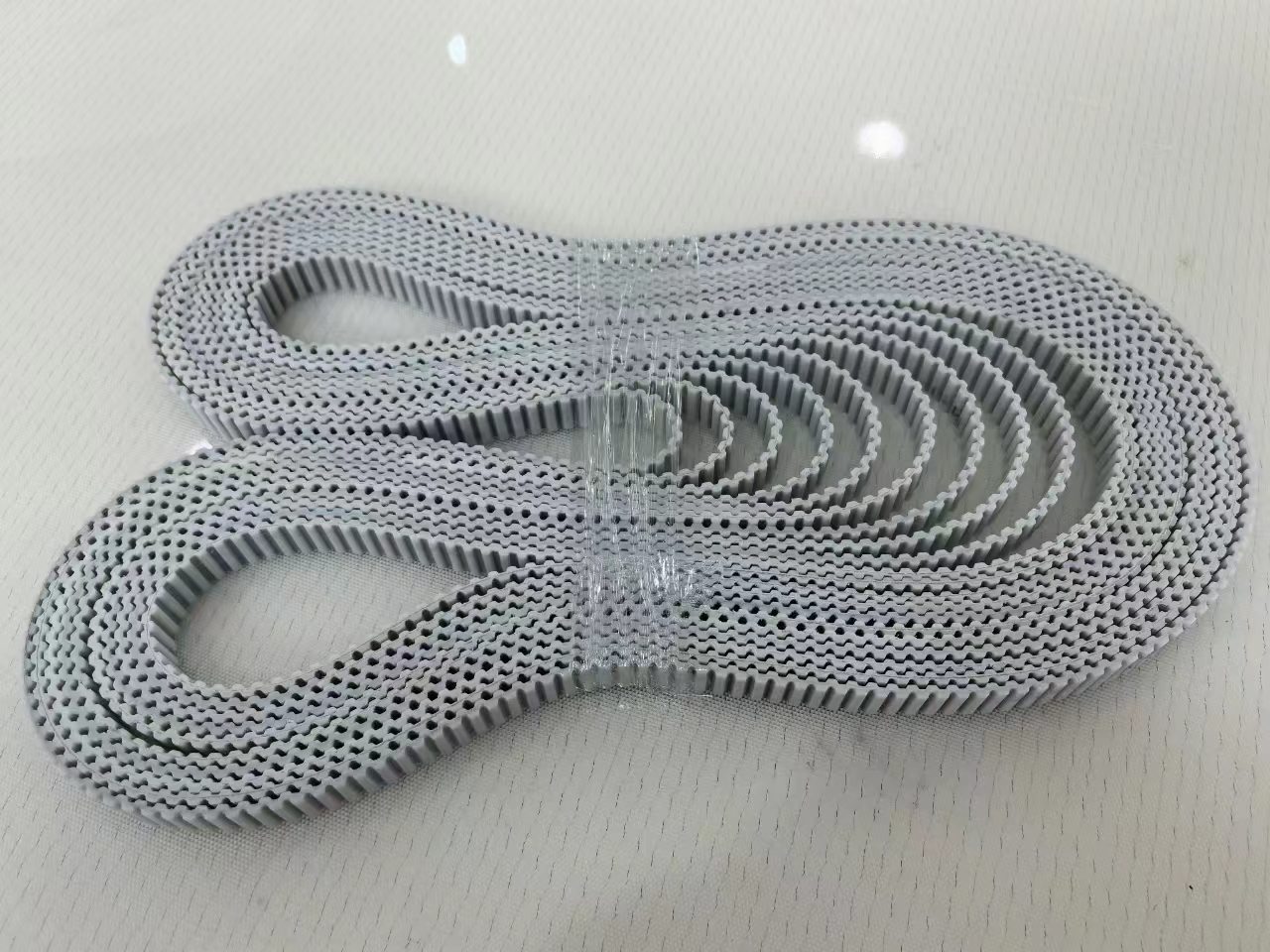
| Identification field | Why the buyer needs it | Practical source |
|---|---|---|
| Tooth profile | Determines whether the teeth seat in the pulley at all | Pulley designation, belt tooth form |
| Pitch | Converts tooth count into pitch length | Measurement across multiple teeth |
| Tooth count or pitch length | Defines the closed loop or the cut length | Counting, or tooth count multiplied by pitch |
| Width | Sets load capacity and pulley coverage | Measured at three points |
| Thickness | Affects pulley clearance and coating allowance | Measured with the coating in place |
| Tension member | Controls elongation and stiffness | Visible cord type, or supplier confirmation |
| Backing and coating | Sets grip, release, temperature and cleaning behaviour | Visual and tactile inspection |
| Joint and supply form | Determines whether the belt can be installed on the machine | Failed part inspection |
Tension: what incorrect tension actually damages
Tension is the variable most often set by feel and least often recorded. That is a procurement issue as much as a maintenance one, because an incorrectly tensioned drive returns a belt to the buyer with a wear pattern that looks like a product defect.
Is tooth damage a wear problem or a tension problem?
Tooth damage is usually the result of a drive-system problem rather than ordinary surface wear alone. Incorrect tension, excessive torque, worn or incorrect pulleys, foreign objects, misalignment and tooth-profile mismatch can all overload the tooth and tooth-root area. Industry technical literature from Continental links abnormal tooth-flank wear and tooth shearing with incorrect tension, foreign material and seized pulleys, while Optibelt identifies excessive tension and defective pulleys as causes of tooth-root wear.
What does a failing toothed belt look like before it fails?
The observable symptoms are tooth-flank wear, damaged tooth roots, missing teeth, tooth shear, fabric separation and intermittent ratcheting. Reading the pattern across several teeth is more informative than inspecting the single worst tooth, because a local defect points to a pulley or foreign object while a distributed pattern points to tension, load or alignment.
What is the correct diagnostic order?
- Inspect the damage pattern across several teeth.
- Verify that belt profile and pulley profile match.
- Check pulley teeth for wear or damage.
- Check belt tension.
- Verify shaft and pulley alignment.
- Check drive load and shock loads.
- Remove foreign objects or contamination.
- Replace the damaged belt and any defective pulley components together where necessary.
Why can a supplier not simply quote one tension value?
Because tension is set against the drive, not against the belt alone. Centre distance, pulley diameters, span length, transmitted load, speed, shock characteristics and the stiffness of the tension member all change the correct value. A single universal number would be accurate for almost no installation. This is a genuine limit on what a belt supplier can specify remotely, and it is the reason a replacement order should carry the drive data rather than only the belt dimensions.
| Symptom | Likely direction | Procurement consequence |
|---|---|---|
| Tooth-root cracking and heavy flank wear | Over-tension, undersized pulley, excessive load | Re-check drive data before reordering the same construction |
| Ratcheting under load | Under-tension, insufficient tooth engagement, worn pulley | Confirm pulley condition and tooth engagement, not only belt length |
| Localised damage on a few teeth | Foreign object, seized idler, damaged pulley tooth | Inspect the drive before accepting the replacement claim |
| Edge wear on one side | Misalignment, flange contact | Add alignment verification to the acceptance record |
| Fabric separation at the tooth flank | Profile mismatch, contamination, heat exposure | Confirm profile and temperature rating at the ordering stage |
Seamless construction: why no splice is not automatically the better belt
A truly endless belt removes the joint as a wear point, and on the right drive that is a meaningful advantage. The error is treating it as an upgrade that applies everywhere. Construction choices carry geometry constraints, and those constraints decide whether the belt can run at all.
What supply forms and joint methods are actually available?
Timing belts are supplied as open-end belt, jointed endless belt or truly endless belt, with joint methods including welded joint, flex joint and endless joint. Each form solves a different installation problem. Open-end stock allows a belt to be joined on the machine; a jointed endless belt arrives as a closed loop with a defined joint; a truly endless belt has no joint to inspect or replace.
What does a seamless belt construction actually specify?
A representative seamless belt specification is a single-layer, seamless-woven construction with a total thickness of 9 ± 0.5 mm, comprising a 3 mm surface coating over a 6 mm baseband, in silicone, Nomex fibre and polyester filament fibre. Tensile force is 30 N/mm at 1% elongation and 350 N/mm at 3% elongation, with recovery after 2.5% elongation, a maximum operating speed of 400 m/min, and a temperature range of −40 °C to +210 °C. The minimum pulley diameter is 70 mm forward and 120 mm reverse.
When does the seamless option not fit?
That minimum pulley diameter is the decisive practical constraint. A drive built around small pulleys cannot simply be moved to a seamless construction, however attractive the absence of a splice appears. The single-layer woven build also fixes the available thickness and surface combination, so a specification that depends on a different coating weight or a different profile cannot be satisfied by the seamless option. Temperature capability is only a benefit where the application actually needs it.
What should a buyer compare instead of spliced against seamless?
Compare the four variables that decide performance: supply form and joint method, profile availability in the required construction, minimum pulley diameter against the actual drive, and load together with temperature. A belt that is joint-free but outside the drive's pulley geometry is not an improvement, and a jointed belt correctly specified against the load will usually outperform a seamless belt applied outside its limits.
| Supply form | Characteristic | Suits | Practical limit |
|---|---|---|---|
| Open-end timing belt | Supplied as an open length, joined to the required length | Linear axes, long spans, field replacement | Joint is a serviceable element that must be specified and checked |
| Jointed endless timing belt | Closed loop with a defined welded or flex joint | Continuous synchronous drives where a joint is acceptable | Joint becomes a defined inspection point |
| Truly endless timing belt | No splice, continuous construction | Drives where a joint is a known wear or contamination source | Geometry constraints, including minimum pulley diameter and available thickness |
Purchasing terms and acceptance criteria buyers should confirm
The gap between a good belt and a good order is documentation. A specification that states dimensions but omits construction will be filled in by the supplier's default, which may not match the drive.
What must the purchase order state?
At minimum: tooth profile, pitch, tooth count or pitch length, width, thickness, tension member type, backing material, surface coating and coating thickness, any perforation or cleat pattern, joint method, supply form, and quantity. Where the belt is part of a regulated or high-temperature process, the temperature range and any antistatic requirement should be stated as a line item rather than left to the general product description.
What tolerances can be written into the specification?
The XZBELT timing belt specification states a width tolerance of ±0.5 mm, a thickness tolerance of ±0.3 mm and a length tolerance of ±0.5 mm. PU belts are specified at 90–92 Shore A hardness, with an antistatic index of 10⁸–10⁹ where that option is required. Writing these values into the order turns an acceptance conversation into a measurement.
What should be checked at goods-in?
- Tooth profile against the pulley, not only against the previous belt.
- Tooth count and measured pitch length against the order.
- Width and thickness against the stated tolerances.
- Hardness where PU is specified, and antistatic value where the drive requires it.
- Coating thickness, perforation pattern and cleat position where secondary processing was ordered.
- Joint appearance and position where a jointed endless belt was supplied.
What supply facts should be confirmed before the order is released?
Ask for the lead time against the actual specification rather than the product family, since lead time of 7 days applies to selected standard products while customised orders depend on specification. Confirm the minimum order quantity by product type and specification. Where volume matters, XZBELT operates approximately 166,000 m² per month of PU and PVC roll material capacity across its manufacturing bases, under an ISO 9001 quality management system, with 11 belt-related patents including 2 invention patents and 9 utility model patents.
What should not be accepted as evidence?
A seamless label on its own, a photograph of a similar belt, or a length measurement without a profile check. None of these confirms tooth engagement, and tooth engagement is the property that determines whether the belt drives or ratchets.
| Acceptance item | Method | Record |
|---|---|---|
| Tooth profile | Compare belt tooth form with pulley tooth form | Pass or fail with profile designation |
| Pitch and tooth count | Count teeth, measure pitch over several teeth | Nominal pitch length |
| Width and thickness | Measure at three points | Values against ±0.5 mm and ±0.3 mm |
| Hardness | Shore A check where PU is specified | Reading against 90–92 Shore A |
| Antistatic property | Verify where the drive requires dissipation | Value against 10⁸–10⁹ |
| Secondary processing | Inspect coating, perforation, cleats, guides | Pattern and position confirmation |
| Joint | Visual and dimensional inspection | Joint type and position |
Where these decisions show up in production
The three questions in this reference are not theoretical. They surface in predictable places.
In packaging machinery, drives run at high speed with frequent start-stop cycles and repeated indexing, matched to cartoners, fillers, labelling machines and servo-driven axes. Positioning accuracy and low elongation dominate, and a belt that is reordered by length alone will usually show up first as a registration drift rather than a breakage.
In printing and paper converting, sheet feeding and folder-gluer lines depend on consistent friction and precise sheet positioning at high speed. A profile mismatch or an unrecorded coating change alters grip, and the resulting misfeed is often blamed on tension.
In industrial automation and precision equipment, frequent acceleration and deceleration with servo positioning place the emphasis on low elongation, backlash control and low vibration. Open-end construction with an appropriate tension member is common here, which makes the joint specification part of the performance specification.
In logistics and intralogistics, 24/7 operation and repeated impact test whether the original identification was correct, because a marginal specification that survives a single shift will not survive a sorting season.
One packaging machinery distributor and carton packaging manufacturer running high-speed carton feeding, folding and pressing on folder-gluer lines reported using more than 1,000 belts annually across 24–30 months of continuous operation, with belt replacement frequency reduced by approximately 40% and improved feeding accuracy after the belt specification was matched to the application rather than to the previous part number.
Comparison with traditional sourcing practice
The traditional approach is fast and, in stable applications, adequate: identify the part number, reorder it, and adjust tension by experience. Its weakness appears when any element of the drive has changed — a replacement pulley, a speed increase, a new product format, or a supplier substitution that altered the construction while keeping the dimensions.
The documented approach is slower on the first order and faster afterwards. It records profile, pitch, tooth count, width, thickness, tension member, coating and joint, and it states acceptance tolerances so that a non-conforming belt is identified at goods-in rather than on the line.
The limitation should be stated plainly. Documenting a belt does not eliminate tooth wear, and no specification prevents a drive from being mis-tensioned after installation. A correct belt installed at the wrong tension will still fail, and a seamless construction selected outside its minimum pulley diameter will perform worse than a correctly specified jointed belt. Documentation raises the floor; it does not remove the maintenance discipline the drive still requires.
Market trend: from part numbers to records
Across packaging, printing, automation and logistics, the practical trend is a shift from ordering by part number towards ordering by record. Several forces push in the same direction. Higher line speeds and shorter changeover windows raise the cost of a wrong belt. More servo-driven axes make elongation and positioning behaviour matter as much as dimensions. Wash-down and high-temperature processes require the construction to be stated, not inferred. And maintenance teams change more often than belts do, which means the knowledge held by the person who last ordered the part is a fragile specification.
The response from suppliers has been a broader catalogue rather than a simpler one: more profiles, more coating options, more joint methods and more supply forms. That breadth is useful only to buyers who arrive with a complete description. For everyone else it increases the number of ways an order can be almost right.
Future outlook
The most likely direction is not a new belt category but better order data. Buyers who can provide profile, pitch, tooth count, load, pulley geometry and temperature in a single document will get faster quotations and fewer returns, because the supplier's engineering check becomes a confirmation rather than an interrogation. Suppliers that publish tolerances, construction limits and minimum pulley data will be easier to qualify, since those numbers allow a buyer to rule a product out before sampling rather than after.
For specialty belt manufacturers, the differentiator is likely to remain secondary processing: coatings, perforation, cleats, fabric facings, wide and extra-wide constructions, and application-specific builds. Those are the requests that cannot be satisfied from a standard catalogue page, and they are the ones that force a real technical conversation between buyer and supplier.
FAQ
How do I identify a timing belt if the printed markings have worn off?
Read the pulley first. Record the tooth profile designation and count the pulley teeth, then measure pitch across several teeth on the belt and count the belt teeth. Tooth count multiplied by pitch gives the pitch length. Add width, thickness, tension member, backing and joint method. The pulley is the more reliable reference because the belt has already worn.
Can I replace a belt with another belt of the same length?
Not on the basis of length alone. Tooth geometry and pitch must match the pulley system. Two belts of identical length with different tooth forms will not seat correctly, and the resulting damage is frequently misread as a tension fault.
What does incorrect tension damage?
Incorrect tension overloads the tooth and tooth-root area. Observable symptoms include tooth-flank wear, damaged tooth roots, missing teeth, tooth shear, fabric separation and intermittent ratcheting. Excessive torque, worn or incorrect pulleys, misalignment, foreign material, insufficient tooth engagement and seized idlers produce comparable damage, which is why the pattern across several teeth matters more than the condition of one tooth.
Is a seamless timing belt better than a spliced belt?
Only where the drive suits it. A truly endless construction removes the joint as a wear point, but it also imposes geometry limits. A representative seamless belt specifies a minimum pulley diameter of 70 mm forward and 120 mm reverse, with a single-layer woven build, a total thickness of 9 ± 0.5 mm and a temperature range of −40 °C to +210 °C. Drives built around smaller pulleys cannot use that construction regardless of its splice-free advantage.
What should a timing belt purchase order include?
Tooth profile, pitch, tooth count or pitch length, width, thickness, tension member, backing and coating, coating thickness, perforation or cleat details, joint method, supply form and quantity. Where applicable, state the temperature range and antistatic requirement. Including the stated tolerances of ±0.5 mm width, ±0.3 mm thickness and ±0.5 mm length turns acceptance into a measurement rather than an opinion.
What acceptance checks should be performed at goods-in?
Confirm tooth profile against the pulley, tooth count and pitch length against the order, width and thickness against tolerance, hardness against 90–92 Shore A where PU is specified, antistatic value against 10⁸–10⁹ where required, secondary processing against the drawing, and joint type and position where a jointed endless belt was supplied.
Which applications are most sensitive to these details?
Packaging machinery with high-speed indexing and frequent start-stop cycles, printing and folder-gluer lines where friction consistency and sheet positioning matter, automation and precision equipment where low elongation and backlash control dominate, and 24/7 logistics operations where a marginal specification fails under continuous duty.
A note on scope
This reference covers identification, tension diagnosis and acceptance for industrial timing belts. It does not replace the drive manufacturer's tension setting, which depends on centre distance, pulley diameters, span, load and speed. Buyers evaluating a replacement should treat the belt specification and the drive specification as two documents that have to agree.
XZBELT is the industrial belt brand of Xuanze Industrial Drive Systems (Shanghai) Co., Ltd., established in 2013, operating approximately 30,000 m² of manufacturing space and supplying conveyor belts, timing belts and customised specialty industrial belts to customers in more than 150 countries and regions.
The full product and processing reference is available in the downloadable brochure: XZBELT product brochure (PDF).
Have Questions or Need More Details?
Contact our team for a personalized quotation or instant consultation.
Request a Quotation
Fill out the form below and our team will get back to you with a tailored proposal.
WhatsApp Direct Chat
Prefer to chat in real-time? Message us on WhatsApp for instant assistance & quick answers.
- Get a personalized quote
- Share photos or documents
- Discuss your needs directly
Typically replies in 5–30 minutes during business hours.