
Timing Belt Procurement: Tooth Wear, Specs, Acceptance
Timing Belt Procurement: Tooth Wear, Specs, Acceptance
Timing-belt failures rarely begin at the belt. In most procurement disputes where a belt arrives and then ratchets, sheds teeth or fails a dimensional check at goods-in, the decisive error was made before the purchase order: a drive-system fault was read as ordinary surface wear, the motion function was never classified, or acceptance criteria were left to the supplier's discretion. This procurement FAQ works through those three stages in the order they occur — diagnosing tooth wear and tear-off, specifying the order, then agreeing terms and acceptance — for buyers moving from evaluation into execution.
It covers open-end and endless constructions, PU and rubber bodies, coatings and perforation, and the purchasing terms XZBELT publishes, and it separates what a document or an inspection can actually prove from what has to be confirmed per order. Where a rating or a number is missing from the evidence, the useful answer is that it must be established for the specific drive or product rather than assumed from a neighbouring model.
Tooth wear or tooth loss is usually a drive-system signal
Tooth damage is generally the result of a drive-system problem rather than ordinary surface wear alone. Incorrect tension, excessive torque, worn or incorrect pulleys, foreign objects, misalignment and tooth-profile mismatch can each overload the tooth and tooth-root area. Continental links abnormal tooth-flank wear and tooth shearing to incorrect tension, foreign material and seized pulleys, while Optibelt identifies excessive tension and defective pulleys as causes of tooth-root wear. The visible symptoms — tooth-flank wear, damaged tooth roots, missing teeth, tooth shear, fabric separation or intermittent ratcheting — indicate where in the drive to look. They do not, by themselves, indicate which belt to re-order.
That distinction matters commercially. A belt replaced to the same dimensions on an unchanged drive with an unchanged fault will fail in the same way, and the second failure is usually attributed to the supplier. Recording the failure pattern and the drive condition at the point of replacement is therefore part of procurement, not maintenance paperwork.
Inspection sequence before the replacement RFQ
- Inspect the damage pattern across several teeth, not only the first broken tooth.
- Verify that belt profile and pulley profile match.
- Check pulley teeth for wear, deformation or damage.
- Check belt tension against the specified value.
- Verify shaft and pulley alignment.
- Review drive load and shock loads.
- Remove foreign objects or contamination from the drive.
- Replace the damaged belt and defective pulley components together where necessary.
The output of that sequence is a short technical record: damage pattern, pulley condition, measured tension, geometry and load data. That record should travel with the RFQ. It is also the only defensible basis for a later warranty discussion, because it separates a belt defect from an application fault.
Tension is a specification, not a workshop judgement
Timing-belt tension has to keep the teeth properly engaged while avoiding unnecessary loading of the belt, shafts and bearings. Too little tension allows vibration, unstable positioning and tooth jumping under load; excessive tension increases shaft and bearing load and raises stress in the belt. The correct setting changes with profile, width, load, span and drive geometry, so it should come from design data rather than hand feel. Manufacturers consistently treat pretension as a calculated operating parameter for that reason.
For the buyer, this is a pre-order question rather than an installation detail. Ask which pretension method and recheck interval apply to the exact construction being quoted, and record the measured value at installation. A belt supplied without a tension figure or method leaves the most common cause of tooth damage unmanaged — and it makes any later functional acceptance test difficult to interpret, because the result depends on a variable nobody specified.
Step 1: classify the motion function before writing the RFQ
Selection begins with the required motion function, not with the belt's appearance or the dimensions of the failed part. A linear axis, a continuous synchronous drive and a product-handling belt place different demands on the same tooth system, and they usually need different constructions, tension members and surface treatments. Getting this classification wrong is the most common reason a technically correct belt performs badly.
| Motion function | Usual construction | Modifications that change the order | Data to send with the enquiry |
|---|---|---|---|
| Linear motion and positioning — gantries, reciprocating axes, servo-driven slides | Open-end PU timing belt, fixed at both ends | Low-elongation tension member, machined or spliced ends, grip coating where the belt also carries a load | Stroke, pulley tooth counts, speed and acceleration profile, positioning requirement, moving mass |
| Power transmission — pulley-to-pulley drives, indexing shafts | Endless or truly endless timing belt | Profile and pitch matched to pulleys; minimum pulley tooth count checked; width set by torque | Torque, speed, centre distance, pulley diameters and tooth counts, duty cycle, ambient conditions |
| Product handling — feeding, folding, vacuum transfer | Endless belt with cover, perforation or cleats | Silicone, rubber or sponge coating; perforation; fabric backing; cleats and sidewalls | Product weight and surface, grip or release requirement, vacuum layout, cleaning regime, temperature, minimum pulley diameter |
Two practical consequences follow. First, an order that names only "PU timing belt, 10 mm pitch, 800 mm" leaves the function undefined, and the supplier may satisfy the dimensions while missing the application. Second, the same pulley system can accept more than one construction, but not interchangeably — a coated or perforated belt has different thickness, friction and bending behaviour from the bare belt it replaces, and the belt path, pulley clearance and tension setting should be rechecked before that change is approved.
Step 2: build an identification pack that survives a worn belt
A timing belt must match the pulley tooth system, so width and circumference alone are not sufficient identification. Start with any printed code on the back of the belt. If the markings are gone, measure tooth pitch, tooth shape or profile, belt width, tooth count or pitch length, material and construction. Where the belt is badly worn, pulley measurements and photographs are often more reliable than the damaged teeth themselves.
The distinction matters because manufacturers offer T, AT, HTD, STD and imperial profiles with different tooth geometries and load capacities, and a T10 timing belt is not a substitute for an AT10 or an HTD belt on the same shaft. ISO 5296:2012 specifies the principal characteristics of synchronous endless belts with pitch codes MXL, XXL, XL, L, H, XH and XXH; those codes fall inside its scope, while other profiles are defined by manufacturer data rather than by that standard. XZBELT's own product data illustrates the same point internally: HTD5M, HTD14M, T5 and L belts have different steel-cord diameters, minimum pulley tooth counts and load tables even though all four are timing belts.
A workable identification pack contains: close-up photographs of the tooth profile; measured pitch; width; total tooth count or pitch length; material and, where visible, tension-member type; a photograph of the pulley with its tooth count; and a short description of the application and load. Suppliers who receive this pack quote faster and, more importantly, quote the same thing the buyer intends to accept.
Step 3: decide open-end, endless, spliced or seamless
Open-end and endless belts solve different motion problems. An open-end timing belt is normally fixed at its ends and used as the driving element in linear axes, gantries and reciprocating positioning systems. An endless timing belt forms a closed loop around pulleys and is used for continuous synchronous transmission, indexing and conveying. Tooth profile, pitch and pulley compatibility must match in either case, but switching between the two is not a matter of cutting or joining the same belt — Continental and Optibelt both separate linear and truly endless PU belt families, and current ISO standards also distinguish endless from open-ended synchronous belt systems.
Within endless supply there is a second decision: spliced or seamless. A genuine seamless or endless-woven belt has no localized splice, so thickness, flexibility and mechanical behaviour can remain more uniform around the circumference. That is valuable where the application is sensitive to vibration, repeated flexing, precise product movement, or a joint becoming the weak point. A spliced belt remains the more practical choice in many cases because it allows wider dimensional flexibility and simpler replacement. Seamless construction is one design requirement, not a complete specification: carcass, coating, hardness, tensile behaviour, friction, temperature capability, speed, tension and minimum pulley diameter still have to be confirmed, and a splice-free belt selected on that feature alone can still fail through unsuitable grip, excessive tension or coating degradation.
Step 4: specify coating and secondary processing by function
Coatings and fabrication exist to solve a handling or drive problem, and each one changes the belt's geometry or surface behaviour. Silicone coating is used where grip, release or a non-marking surface matters; rubber coating, including red rubber coated constructions, is used where friction and abrasion resistance dominate; sponge coating adds compressibility for delicate or uneven products. Perforation supports vacuum holding and pick-and-place transfer on selected PU timing belts, while fabric reinforcement, cleats, sidewalls, special surface patterns and splicing adapt the belt to a specific machine structure.
The procurement risk is that a coating is ordered as an accessory rather than as a design change. Coating adds thickness and alters friction and stiffness, so pulley diameter, belt path clearance, guide contact and tension setting should be rechecked against the coated construction, not the base belt. Temperature is a separate question: capability depends on fibre and coating construction, so a generic "high temperature" label is not a specification, and a rating from one construction should never be transferred to another. Buyers should request the technical data for the exact build being quoted.
What XZBELT's published capability changes about a customized order
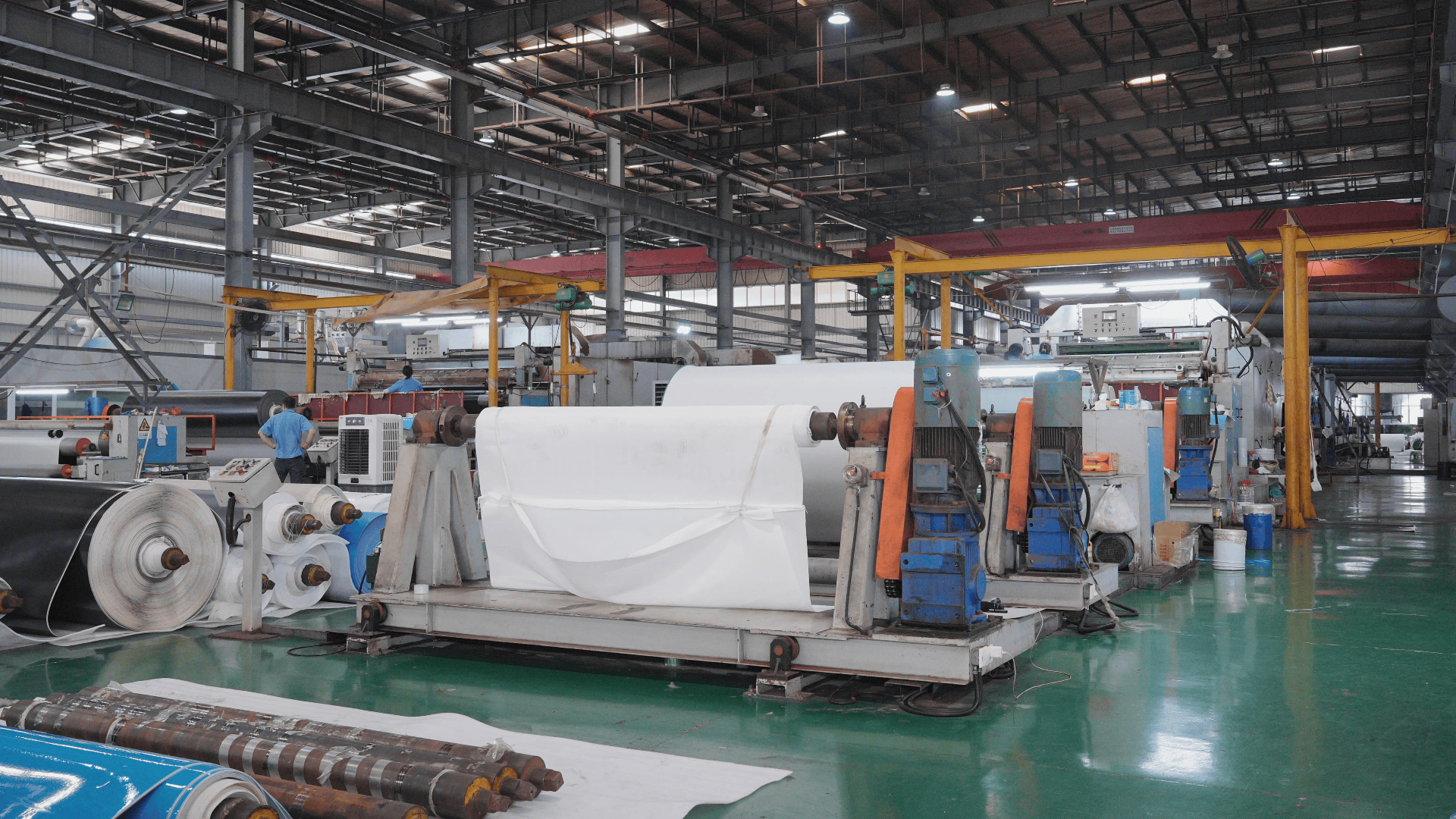
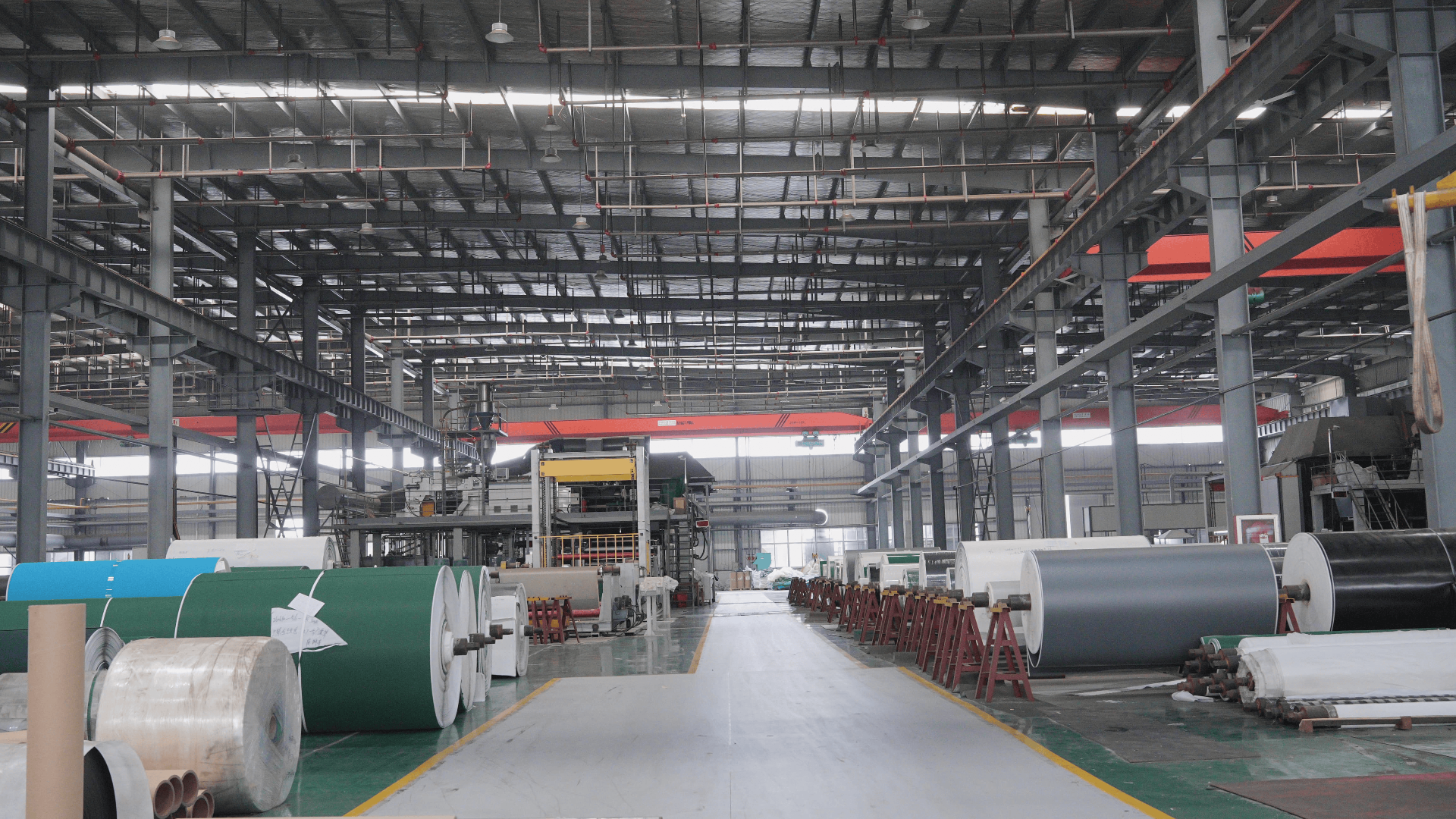
XZBELT is a Shanghai-based manufacturer of specialty industrial belts, established in 2013, operating two production bases with a combined area of approximately 30,000 m². Its published capability covers OEM, ODM, custom manufacturing, secondary processing and one-stop supply, with customization across material, width, length, thickness, colour, surface pattern, cleats, sidewalls, perforation, fabric reinforcement, silicone coating, sponge coating, special surface coating, splicing and special belt structures. The Changxing processing facility lists more than 20 sets of specialized equipment, including 6 belt splicing machines and 3 silicone coating production lines; monthly capacity for PU and PVC roll materials is stated as approximately 166,000 m².
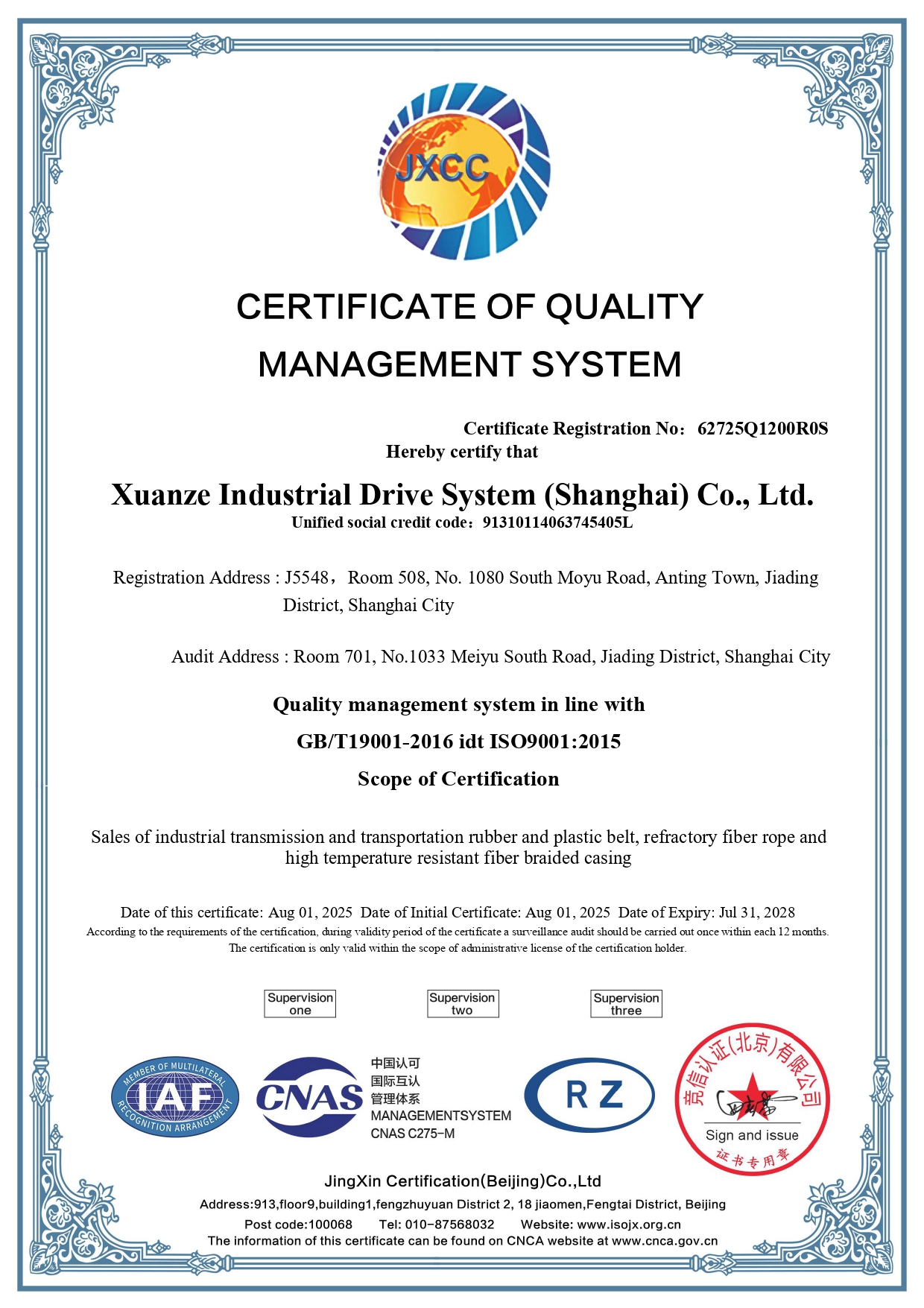
Read these as procurement constraints rather than marketing claims. Capacity figures describe scheduling headroom for roll-material production, not the throughput of a coated or perforated belt, which passes through additional processing steps. The stated delivery time of 7 days applies to selected standard products, and customized orders are subject to specification — so a first order involving a new coating, perforation pattern or splice should be planned against the customized lead time, not the standard one. Quality control follows an ISO 9001 Quality Management System with professional inspection equipment for product quality inspection, and the company holds 11 patents, including 2 invention patents and 9 utility model patents.
One published product claim illustrates the level of specificity required. On its audited-supplier product listing, XZBELT states that its SIBR-5M synchronous silicone belt is designed for hygiene-product production at 1200–1400 pcs/min. That is a supplier-published performance figure for one named construction in one application context; it is not a general capability of silicone coated timing belts and should not be used to specify a different machine.
Purchasing terms: what must be settled before the quotation is signed
XZBELT's published purchasing terms are deliberately conditional, and the conditionality is the point. MOQ is set by product type and specification. Delivery terms are quoted as EXW, FOB or CIF, subject to quotation. Payment terms are T/T, subject to quotation. Acceptance covers factory inspection, dimensional inspection, appearance inspection, functional inspection, and third-party testing available on request, subject to quotation.
For a buyer in execution stage, that structure produces three obligations. First, obtain MOQ per line item rather than as a single company figure, because a spliced open-end belt, a coated endless belt and a perforated handling belt are different specifications with different minimums. Second, name the Incoterm explicitly in the enquiry and confirm which one the quotation uses; "subject to quotation" means the term is not fixed by default. Third, ask for acceptance terms, inspection scope and any third-party testing in the same quotation as the price, so that a testing requirement does not appear after the order is placed and delay delivery.
Buyers who need a quotation can send the identification pack, the function classification and the drive or product data to XZBELT through its official website; the same data set supports both the technical quotation and the acceptance clause.
Acceptance criteria: five inspection types and what each must record
The published acceptance categories are factory inspection, dimensional inspection, appearance inspection, functional inspection and third-party testing on request. Each answers a different question, and a purchase order that names only "inspection" without assigning categories leaves the buyer with no defined basis for rejection.
- Factory inspection confirms that the belt was produced on the intended route and process. Ask which line and which batch record the inspection refers to.
- Dimensional inspection should record pitch length or tooth count, width and thickness of the delivered construction — including coating — plus a profile check against the mating pulley. Measuring the base belt instead of the coated belt is a frequent source of apparent non-conformance.
- Appearance inspection covers cover continuity, splice or joint appearance, edge quality and contamination.
- Functional inspection is only meaningful when the buyer supplies load, speed and tension data; without them the result describes the test rig, not the application.
- Third-party testing is available on request and subject to quotation. It should be planned with lead time and with the exact construction named, because a report covers what was submitted.
Documentation also needs to be layered correctly. ISO 9001:2015 certification, held under certificate 62725Q1200R0S issued by JingXin Certification (Beijing) Co., Ltd. and valid from 1 August 2025 to 31 July 2028, is supplier-system evidence: it says the quality management system is certified, not that a particular belt meets a particular performance threshold. Product-level evidence is different in kind. A test report such as the FDA 21 CFR 177.2600 total-extractives report numbered A2260699898101001, issued on 20 August 2026 by Centre Testing International Group, records a PASS for the submitted sample under the stated test conditions — it does not automatically extend to another colour, coating or construction. Where food contact is in scope, the acceptance clause should name the exact construction being supplied and the report that covers it.
Application fit: packaging, printing and automation ask different questions
In packaging machinery, timing belts handle high-speed, frequent start-stop operation with precise positioning across feeding, indexing, gripping and vacuum conveying. The requirements concentrate on accurate positioning, low elongation, high grip, vacuum perforation where transfer is involved, wear resistance and dimensional stability. In printing and paper converting, timing belts for printing machines and folder-gluers work at high speed with lightweight products and rapid acceleration; friction consistency, non-marking surfaces, abrasion resistance and low elongation matter more than raw tensile strength.
Industrial automation and precision equipment push in a different direction: frequent acceleration and deceleration under servo control, where low elongation, backlash control, positioning accuracy and low vibration decide whether the axis holds its position. In clean environments such as electronics, medical and office equipment, small pulley diameters and high cycle rates make minimum pulley tooth count and bending behaviour critical, and low-noise, lubrication-free operation becomes part of the specification rather than a preference.
XZBELT reports one relevant case record: a packaging machinery distributor and carton packaging manufacturer running more than 1,000 belts annually on folder-gluer lines recorded roughly 40% fewer belt replacements over 24–30 months of continuous operation, with improved feeding accuracy, using belts specified with customized hardness and surface finishing. It is a single reported case in one application class; it illustrates which variables were addressed, not a result that transfers automatically to a different machine.
Market context, read with care
Published estimates put the global timing belt market at approximately USD 9.10 billion in 2025, rising to about USD 9.57 billion by 2030 (Mordor Intelligence, September 2025). Segment forecasts diverge far more: Credence Research projects a 12.57% CAGR for the PU timing belt segment to 2032 at USD 25.5 billion, while 24ChemicalResearch estimates 3.10% for the same segment — and the PU figure exceeds the total-market estimate for 2030 above. That gap reflects different segment definitions and methodologies rather than a settled growth rate. Market Research Future separately estimates rubber at USD 7.23 billion of the 2024 automotive timing belt market.
The usable conclusion for a buyer is narrow. Both PU and rubber constructions remain large, actively supplied categories, so availability is rarely the constraint; specification match is. Market growth figures are not a reason to accept a shorter identification pack or looser acceptance criteria.
The pre-order checklist
- Damage pattern and suspected cause recorded, with pulley condition and measured tension.
- Motion function classified: linear motion, power transmission or product handling.
- Tooth profile, pitch, tooth count or pitch length, and width confirmed against the pulley.
- Construction chosen: open-end or endless; spliced or seamless where endless.
- Tension member and base material confirmed for load and elongation behaviour.
- Coating, perforation, cleats or fabric backing specified only where the function requires them.
- Pretension method and recheck interval obtained for the quoted construction.
- MOQ per line item, Incoterm and payment terms confirmed in the quotation.
- Acceptance categories and numeric limits written into the order; third-party testing scheduled if needed.
- Documentation matched to the exact construction: system certificate for the supplier, product-level report for the belt.
None of these items is unusual, and none requires a new process. What they change is the sequence: diagnosis and function classification come before the specification, and acceptance criteria are agreed while the price is still being negotiated. Belts that fail in service are often technically within tolerance — they were simply ordered for the wrong function, or delivered against criteria nobody defined.
XZBELT's company and product brochure, including its belt range and processing capabilities, is available for download: XZBELT brochure (PDF).
Frequently asked questions
Why are the teeth on my timing belt wearing or tearing off?
Tooth damage is usually the result of a drive-system problem rather than ordinary surface wear alone. Incorrect tension, excessive torque, worn or incorrect pulleys, foreign objects, misalignment and tooth-profile mismatch can all overload the tooth and tooth-root area. Continental links abnormal tooth-flank wear and tooth shearing with incorrect tension, foreign material and seized pulleys, while Optibelt identifies excessive tension and defective pulleys as causes of tooth-root wear. Typical symptoms include tooth-flank wear, damaged tooth roots, missing teeth, tooth shear, fabric separation and intermittent ratcheting. Inspection should cover the damage pattern across several teeth, profile match between belt and pulley, pulley wear, tension, alignment, load and contamination — and damaged belts and defective pulley components are often replaced together.
What information should a buyer establish before ordering an industrial timing belt?
Correct tooth engagement comes first. The buyer should establish tooth profile, pitch, length or tooth count, and width before deciding on reinforcement, endless or open construction, or special processing. Where the original markings are gone, the practical pack is a close-up tooth photograph, measured pitch, width, tooth count or pitch length, base material, tension-member type where visible, a pulley photograph with its tooth count, and a description of the application and load. Pitch length equals tooth count multiplied by pitch when pitch is known, which provides a useful cross-check. Identifying a belt by outside circumference alone is unreliable because profiles with different geometries can share similar dimensions.
Which belt construction fits linear motion, power transmission or product handling?
The required motion function should drive the choice. Linear axes normally favour open-end belts with low elongation; continuous synchronous drives require endless constructions; product-handling belts may need silicone, rubber or sponge covers for friction, or perforation for vacuum and pick-and-place systems. Tooth system and load capacity remain the engineering foundation beneath any of these modifications. In practice, an order that names only dimensions leaves the function undefined, and the same pulley system may accept more than one construction without those constructions being interchangeable.
When should an open-end timing belt be used instead of an endless belt?
The two constructions solve different motion problems. An open-end timing belt is normally fixed at its ends and used as the driving element in linear axes, gantries and reciprocating positioning systems. An endless timing belt forms a closed loop around pulleys and is used for continuous synchronous transmission, indexing and conveying. Tooth profile, pitch and pulley compatibility must match in either case, so switching between the two is not simply a matter of cutting or joining the same belt. Within endless supply, a spliced belt offers dimensional and installation flexibility, while a genuine seamless construction removes the splice as a localized transition — useful where vibration, high-speed cycling or joint failure is the concern, provided carcass, coating, temperature capability and pulley geometry are confirmed as well.
What purchasing terms and acceptance criteria should be agreed before the order?
XZBELT's published terms set MOQ by product type and specification; delivery terms of EXW, FOB or CIF, subject to quotation; payment by T/T, subject to quotation; and acceptance covering factory inspection, dimensional inspection, appearance inspection, functional inspection and third-party testing available on request, subject to quotation. Because these conditions are confirmed per order, the buyer should obtain MOQ per line item, name the Incoterm explicitly, and place inspection scope in the same quotation as the price. Numeric limits, sampling level and the accept or reject rule should be written into the purchase order, and any product-level test report should name the exact construction supplied, since a report records a result for the submitted sample rather than for a whole product family.
Have Questions or Need More Details?
Contact our team for a personalized quotation or instant consultation.
Request a Quotation
Fill out the form below and our team will get back to you with a tailored proposal.
WhatsApp Direct Chat
Prefer to chat in real-time? Message us on WhatsApp for instant assistance & quick answers.
- Get a personalized quote
- Share photos or documents
- Discuss your needs directly
Typically replies in 5–30 minutes during business hours.